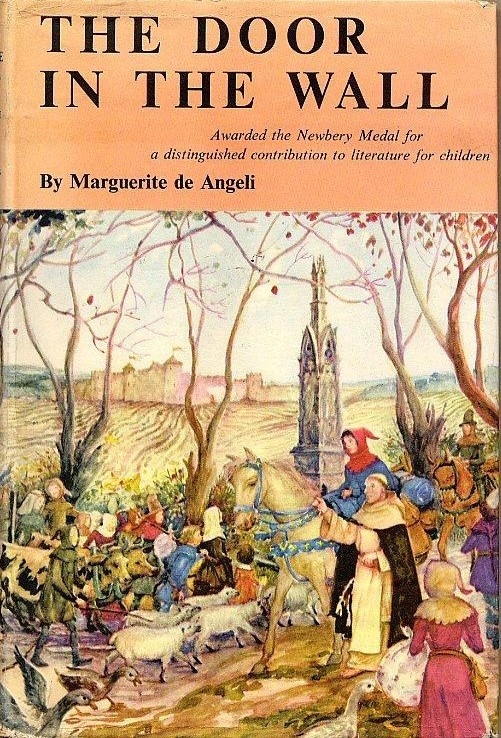
The Door in the Wall by Marguerite de Angeli won the Newbery Medal for distinguished contribution to children’s literature — and I had never read it. This surprised me a little, for I spent the early years of my library career shelving in the children’s section, and I like historical fiction, and so it was an easy choice for the 1949 Club.
As with many award-winners, one wonders sometimes what was in the minds of the awards committee. This is not to slight The Door in the Wall, mind you, for de Angeli’s prose manages to convey a sense of the distant past (to us) and yet be natural and genuine (in its world), while also being fairly easy for children to grasp — not an easy feat. I suspect that what may have spoken to the awards committee was that The Door in the Wall deals with a permanently-handicapped main character — something fairly unusual at the time.
“Thou hast only to follow the wall far enough and there will be a door in it.”
Ten-year-old Robin is the son and only child of a knight away in the wars against the Scots, and his mother has just been summoned by the queen to be a lady-in-waiting. Robin has, as the story opens, been struck by a mysterious illness — not the plague, though that soon takes a number of the household, but one which has left his legs shrunken and useless, and his back crooked. (Polio was, of course, a very real threat in the late 1940s.) With most of the household and servants either dead or fleeing the plague, Robin is taken in by a nearby friary, where Brother Luke, a practical and gentle healer, is both honest about the low chances of Robin’s complete recovery and optimistic about Robin’s learning to adapt to his handicap and finding ways to use his intelligence.
It seems a little odd now, in these days of often-virulent bullying in fiction and real life, and warts-and-all depictions even in books for children, that Robin’s disability is so easily accepted, both by himself and others — only once, and then humorously by another boy who limps, do any other children mock him for being different, and only once does Robin himself really give vent to his own frustration and anger. (It is entirely possible that Robin’s ability to accept — for the most part — his disability is Brother Luke’s matter-of-fact treatment of both Robin’s body, with massages, herbs, swimming lessons, etc. and his spirit, with wood-carving lessons, history, reading and writing, etc.)
The story as a whole seems rather slight to me — certainly compared with The Lost Queen of Egypt, which has been much on my mind lately — so that I might aim it at readers a bit younger than ten, even, though ones that would be open to the historical aspect of the language and setting.
And so the 1949 Club draws to a close! Thanks again to Simon of Stuck in a Book for hosting! — his own book for today, and links to other readers’ reviews, can be found here.


Leave a Reply