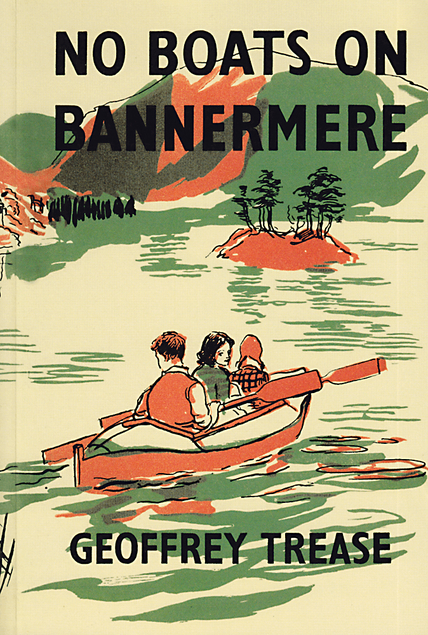
Anyone — like me — who loves the “Swallows and Amazons” series by Arthur Ransome might indeed look at a summary of Geoffrey Trease’s No Boats on Bannermere with some trepidation. Children and boats in the Lake District? And the lake has a tiny island at one end, furnished with tall pines and eminently suitable for camping? and one of the children is named Susan, and the house on the shore is called Beckfoot? Oh, no!
But not to worry. Trease, already by 1949 an accomplished writer of children’s fiction, was well aware of his predecessor, for nearly the first thing that happens once his main characters, siblings Bill and Sue, reach Bannermere itself, is that they find out that the parvenu squire has forbidden boats on “his” lake — hence the title. Trease also seems fairly determined to go in quite different directions from Ransome — the children’s father, unlike Lt. Walker, is not merely away, but has in fact done a bunk, leaving his wife to fend for herself and the two children — luckily, she inherits a cottage in the Lake District from an elderly cousin, and although it is not a little bit dilapidated, and the lack of income makes the idea of offering teas to hikers and other visitors fairly appealing. Trease has also chosen to write the story as told by Bill, whose authorial style — Bill is already determined to be a writer — is nothing like any of the Walker children, and he sounds quite “modern” even just twenty years later than them.
Bill and Sue, with new friends Tim and Penny, are thwarted in their interest in camping on the little island, which “belongs” to Sir Alfred.
It was rather a disappointment after the plans we’d been making. We could still save up and buy a tent, and it would be fun to go camping, but it wouldn’t be the same as having an island all to ourselves.
But while casting about for things to do instead, the children begin to suspect Sir Alfred, with his mysterious comings-and-goings in the woods near the manor, of more than just being a pompous killjoy. Complications obviously ensue!
I’m glad that I gave this book a chance, and I’m very glad that I didn’t have to pay the exorbitant amount that book dealers are charging for it — into three figures in most cases — as a copy is available to borrow from the Internet Archive for free, as long as one doesn’t mind not having the “real” paper version.
Links to other readers’ reviews for today’s edition of the 1949 Club can be found here.


Leave a Reply