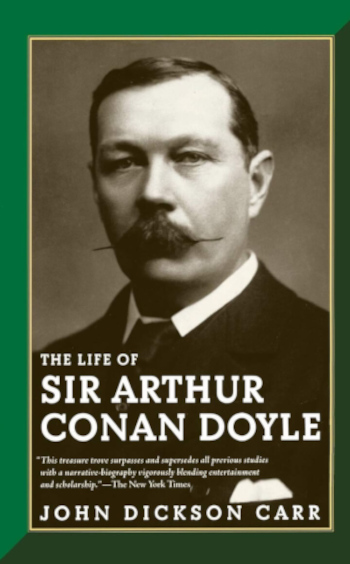
I confess that I rather expected a sort of dry, “he did this, he did that” kind of thing from John Dickson Carr‘s The Life of Sir Arthur Conan Doyle, but I was quite disappointed in the best possible way, for I found Carr’s writing intelligent yet easy to read, and Doyle himself, apart from that lamentable episode with the fairies, to be quite an interesting and engaging person.
Doyle began his adult life by studying medicine, gaining knowledge and experience by hiring himself out as a naval surgeon before going, not particularly successfully (though mostly due to bad luck), into private practice, and he began to write, as many writers do, to earn money. Unlike many writers who simply want to earn money, however, he proved to be quite good at it, publishing short stories throughout his twenties, and his first Sherlock Holmes novel, A Study in Scarlet, at the comparatively tender age of 28. (I admit that I haven’t read the Holmes stories for decades, but I devoured them all I think well before I was in high school, which is to Doyle’s credit that while certainly complex in plotting, they were not difficult to read, even though written a century earlier!)
Doyle famously had a deep and abiding interest in spiritualism, not prompted by but certainly deepened by the deaths of many family members, including one of his sons and a brother, in the Great War, and although a number of the spiritualists that he supported (some in print) later proved to be frauds, and Doyle himself was at times quite skeptical about particular psychic readings, séances, and so on, he clearly wanted to believe in the paranormal — which seems curiously at odds with Sherlock Holmes’s utter rationality, but to me it only makes Doyle more sympathetic as a person, that he could carry these contradictions within him, and perhaps it is also Carr’s even-handed presentation of this side of Doyle, that makes it easier to accept those contradictions.
Doyle also had a strong sense of moral honor — he had married a pretty and likeable young woman when both in their mid-twenties, then a little over ten years later fell completely in love with another woman, but due to loyalty to his wife, the relationship remained platonic until after his wife’s death — and also of justice, to the extent of being instrumental in reversing the decisions in two separate criminal cases, exonerating the two men, one of whom certainly and possibly the other as well, had been the victims of racial stereotyping.
It is also fascinating to realize that, although we associate Sherlock Holmes (the original one, anyway!) and thus Doyle himself, with the Victorian era, he lived well into the 20th century, even appearing in filmed interviews such as this one —


Leave a Reply