I enjoyed my first participation in one of the “clubs” at Stuck in a Book, which clubs focus on books published in a particular year, but have not yet had the wherewithal to do another until now — and so here, in no particular order except that in which they arrived on my bedside table, are my Adventures in the 1949 Club.
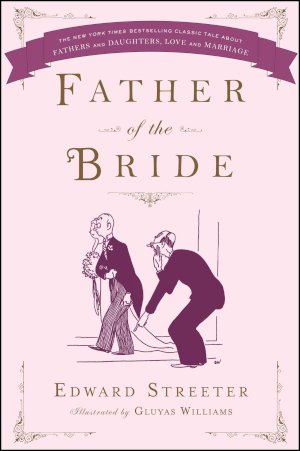
First is Edward Streeter’s Father of the Bride, which, yes, is the novel on which was based the 1950 movie with Spencer Tracy as the father and Elizabeth Taylor as the daughter, and the 1991 remake with Steve Martin, as well as numerous other remakes and sequels, which shows how universal a trope marrying off one’s daughter really is. And the novel will certainly be familiar to every parent who has married off a child, to most of those children, and probably to anyone who has ever organized a major event or listened to anyone even talk about organizing a major event.
Basically, it should have been so simple. Boy and girl meet, fall in love, marry, have babies — who eventually grow up, meet other babies, fall in love, marry. Looked at from this angle, it was not only simple, it was positively monotonous. Why then must Kay’s weeding assume the organizational complexity of a major political campaign?
Streeter’s comic style is fluid and witty, and I enjoyed his descriptions like this one —
Each day there were several frantic messages from Buckley [the fiancé]’s family about V.I.P.s who had been overlooked and must be invited immediately. It was Mr. Banks’ job to get these belated invitations into the mailbox on the corner before going to bed. As he remembered it in after years, it seemed to him that, like a figure from a Brontë novel, he was always struggling through violent rain and sleet storms on these profitless errands.
And aside from the funny bits — of which there are a great many — there is also a great deal of truth in it. I certainly have of my own wedding a similar sort of dream-like memory — I remember being there (!), I remember enjoying it — because everything went smoothly, it was a beautiful day, and people we loved were there — and yet it is still a kind of blur.
A wedding was like the experimental explosion of the atom bomb, thought Mr. Banks as he walked out behind his wife, smirking to right and left. You made the most careful preparations for months, them someone like Mr. Tringle [the sexton] pressed a button — and it was all over. There was scarcely any present tense in connection with weddings. They existed either in the future or in the past.


Leave a Reply