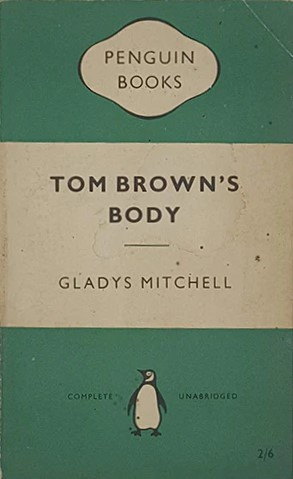
My second book for the 1949 Club is Tom Brown’s Body by Gladys Mitchell. I had heard of Mitchell, having handled a great number of her titles in my shelving days at the library — she had a long career, spanning some sixty years — though I had never read a single one, but I quite enjoyed this, which appears perhaps a third or so of the way into Mitchell’s writing days.
Gerald Conway is a junior master at a smallish public school (old-style, I mean, it is 1949 after all), but although he is well-thought of by the headmaster as a teacher and as a games coach, the other members of the staff find him rude and insufferable — so that there is no shortage of suspects, even at times among the boys, when he turns up dead. Mitchell herself, I find, was a teacher — like Conway, in fact, of both history and games — which clearly is the source of her facility with schoolboy dialogue, as here where Merrys is trying to talk his friend Skene into an illegal late-night outing —
“… We could take turns at riding the bike and standing on the step. We could get to the place by nine, see two or three dog-races, nip back again on the bike, and so home by about eleven.”
“And suppose we get nabbed? We’d be sacked at once.”
“You can’t be sacked unless you’re out after midnight. I know that for a cast-iron fact. Besides, we shan’t be nabbed. How can we be? Who’s to nab us?”
“Things might go wrong. Besides, the bike! Think of the frightful row there’d be if Albert-Edward knew we’d pinched his bike! He may be an ass, but he is a Housemaster.”
“Oh, rot! He never even looks at the bike. He only had the thing for the war when he was in the Home Guard. It’s just shoved inside that little place by Jack the Ripper’s toolshed. I expect Albert-Edward’s forgotten he’s got it by now. Beaks are always absent-minded about property.”
“The tyres’ll be flat.”
“Oh, well, it’s sure to have a pump on it. Tell you what! Let’s get Jack the Ripper to pump it up, and tell him to see that the lamps are O.K. He’ll do it for a bob, and once he’s taken the bob he’ll have to keep his mouth shut for his own sake. What do you say?”
“We’ll have to go out past Spivvy’s cottage, remember.”
“What odds. Ten to one, hell be up in the masters’ Common Room when we go, and asleep by the time we get back. Now you said you’d come –“
“On condition that you get the bike, then.”
“All right, then, although I think –“
“And that the lamps and the tyres are all right. I’m not going to break my neck.”
“All right, then, but they will be all right. And who cares, anyway, about your bally neck?”
“And,” said Skene, with sudden cunning, “that if we win anything on the Dogs, we split it fifty-fifty. You’re always much luckier than I am.”
“Win anything on the — Gosh! I’d never thought of that!” said Merrys, startled. “I say, though, that would make a stink if it came out! Do you think –?”
“It’s my last condition,” said Skene, who now saw a ray of hope that the expedition, of which he was thoroughly nervous, might, after all, be abandoned.
There is much like this from a number of the boys, but Mitchell’s facility in giving each boy a characteristic way of speaking makes it easy to read and at times very amusing. (I am quite fond, myself, of little Ingpen, who is too young to know that school is not something he should enjoy.)
The school-masters and their wives — in one case, his sister — are equally well-drawn, although I must say there do seem to be quite a lot of them, quite a lot, I mean, who feature significantly in the story. Mr. Loveday and his sister, for one, are rather mind-bogglingly eccentric in that wonderfully English way: Mr. Loveday has indulged himself, being a housemaster, in building a replica of a Roman baths (“The Romans did not use coke, of course,” he mourns), and his sister enjoys airing her numerous opinions and sparring (gently? icily? this is not quite clear!) with the equally strong-minded psychoanalyst and amateur detective Mrs. Bradley.
“You are still with us, then?” Miss Loveday remarked, when next she encountered Mrs. Bradley. “I thought you have left for good just before the Christmas holiday.”
“I have been asked to treat Mr. Poundbury, who seems to be indulging in a nervous breakdown,” replied Mrs. Bradley, “and I am still partly in attendance on Mrs. Poundbury, whose recovery seems to be slow. I think she has had a bad shock.”
This leading gambit was pointedly ignored. “She suffers from self-pity,” said Miss Loveday. “And that is a bad sort of medicine. What she needs is an airing.”
“What kind of an airing?” Mrs. Bradley enquired.
“Why, she needs to tell somebody how she came to be struck on the head. She knows very well who did it, and why,” said Miss Loveday positively. “She should be made to unburden herself. Not for nothing was the Confessional invented. Leo the Isaurian knew that.”
“Did he?” said Mrs. Bradley, somewhat puzzled by this last reference. “We have tried to get from Mrs. Poundbury how she came to meet with her accident, but she declares she does not know.”
“Shielding him, I suppose,” said Miss Loveday, with a virtuous, spinsterly snort. “That heaven, there is only one man I’m foolish about, and that is my brother. Brothers, I find, are the only satisfactory members of their sex. They can drive the car, and climb step-ladders, and do not require one to waste time and strength in procreation.”
“The Poundburys have no children, though,” Mrs. Bradley felt compelled to point out.
“Ah, but they cohabit,” proclaimed Miss Loveday. “You can see it in their faces.”
I admit that I can’t quite vouch for the mystery plotting, as I rarely even try to guess whodunit — indeed, am usually disappointed if I guess before the end, feeling that in that case the author has not been particularly clever! — but this was for the most part an enjoyable, intelligent if quirky read.
But there are, it must be said, some quite repellent attitudes towards Jews and blacks, some of which might be ascribed to public-school ragging (and possibly in the case of Prince Takhobali, “the scion of a West African royal house,” attempting in awkward English to imitate the dialect of his schoolmates), but mostly not. Considering that this book was written some time after the Holocaust, it is especially discomfiting to find such casual racism still in evidence. Reader beware.


Leave a Reply