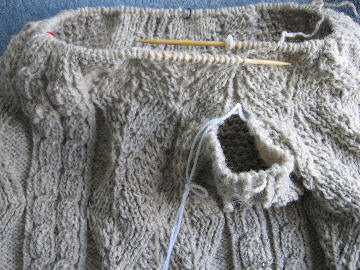
• Show and Tell this week  is of something we’ve made "or would like to" — not being a particularly crafty person, at least not like some of the amazingly productive bloggers out there, I had to think a lot about this.  The things that I make are usually either knitted, which have already been shown here, or eaten, like dinner, which can be creative but isn’t what you’d call "crafty."  And then I realized that the qualification would save me —

    Img_2637_small

    I have for umpteen years had a fascination for dollhouses, possibly inspired by Mary Norton’s The Borrowers series, and certainly by Queen Mary’s Doll House and Colleen Moore’s "Fairy Castle".  The dream to have one of my own has always been that, mostly a dream, until, after having two daughters, I thought about making a dollhouse for each of them.  A year or so ago, I bought a mousepad that looks like a Persian carpet, and looking at it every day made me remember my dream and start planning to make it a reality. 

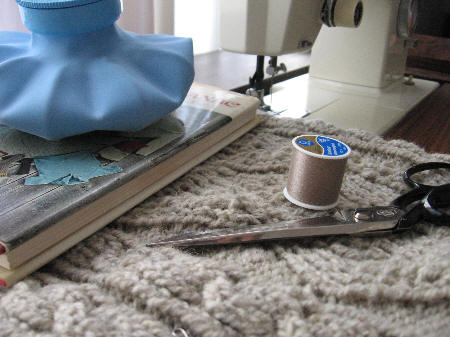
    This year, Laura will be seven, a good age I think for a dollhouse of her own.  The book is The New Dolls’ House Do-It-Yourself Book by the picturesqely-named Venus Dodge, and it is open to the picture of the house we’ll build for Laura, David doing the shell and some furniture and I the painting and details of decoration.  My idea is to give her a fairly simple setting for each room — kitchen, living room, and bedroom — with plenty of space for adding things that she herself chooses.  And while the Queen Mary and Colleen Moore houses are wonderful, they are not the kind of thing that a child would really be allowed to play with, and so I want to make a house more like Tasha Tudor’s dollhouse, perhaps, or like something out of Beatrix Potter, that is more fantastical, not dependent on a particularly rigid scale or literalness.  Animals may end up living alongside people, who knows?

    Well, now that I’ve announced it, I’d better get started, hadn’t I!

  • What You Will

    Because today is Twelfth Night, here is a photo from one of my favorite Shakespeare plays, from the The Royal Shakespeare Company archives —

    12thnight_1983_rsc_small

    "Twelfth Night, 1983, directed by John Caird, designed by Robin Don. The photograph shows Sir Toby (John Thaw, left), Fabian (Stanley Page, background left) and Maria (Gemma Jones, right) mocking the deluded Malvolio (Emrys James, centre), Act 3 Scene 4."

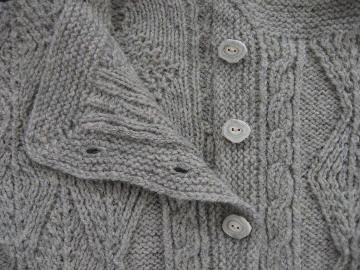
  • Well, interest in a Pearl Buck Swing Jacket knitalong has been positively underwhelming!  I’ve noticed a rather wide gap between those who love the design and those who don’t.  One of the more disdainful comments seemed, though, to be directed as much at IK‘s choice of an Asian model for a Good Earth-inspired design, which in IK’s defense seems to be a no-win situation — either they are derided for having a white model wearing an Asian design, or they are accused of racism by "stereotyping" an Asian model.  That said, I think that the design itself — which is, after all, the important thing here — is lovely.  It’s one of those things that looks simple and difficult at the same time — perhaps that puts people off.  It’s certainly very restrained, despite the pleat in the back, not the in-your-face kind of thing that seems to be so popular these days.  Maybe that’s why it appeals to me so much. 

    Img_2641_small

    Subtle, yet chock-full of interesting details.  The box pleat with its interesting diamond detail, the half-diamonds edging the front opening, the back yoke worked side-to-side — well!  Not to mention the scrumptious Jaeger merino.

    I know that I won’t be able to start on this until after the Aran is finished, so it would be a month at least, maybe two.  But I’ve posted a link to here on the 2006 Knitalongs page at keeping me in stitches (a very handy list, by the way, for those in search of knitalongs) — if anyone does want to work on this project, post a comment here, and we’ll see how things go!

  • I worked a bit more on the hat-sized swatch, then blocked it.  (I have far too many times ended up with partial balls of yarn, or run out before a project is finished, to want to cut at the end of a swatch any more, as you can see.  Haven’t gotten into the habit of saving my swatches yet.)  The swatch stretched almost an inch when wet — two inches that would be, if flat instead of round! — but after a bit of prodding it went back to almost the same measurements as before, and the fabric firmed up nicely, so I’ll go with the larger needles.  This is an only slightly larger gauge than Elizabeth’s, and I do want to make a slightly larger cardigan, so it should be all right.

    Aran_swatch

    Here the swatch is folded off-center to show the cables.  (I forgot to cable on Row 2, so mine look a bit splatty at the beginning.)  I sat down for a bit of quality time with a pen and paper, and have worked out a pleasing arrangement of fishtraps and cables, and am ready to cast on.

    It’s a lovely bright day today, after the rainy weekend!

  • The Knitter’s Almanac project for January is an Aran sweater, an appealing idea for these chilly days.  Elizabeth gives us a brief background of Arans, then leads us gently into the designing and knitting of those textured marvels from the Aran Islands

    Let me say from the beginning that while I’ve of course known of Elizabeth Zimmermann for many years, I’ve not actually taken the opportunity before this to study her, as it were, to knit her designs in depth.  But I loved her voice from the very first — it’s probably also why I like Nigella Lawson so much, that she writes in such a way as to bring her warm, engaging personality into one’s living room (or kitchen).  They both make it sound so fun to knit, or cook, that sometimes I can’t even finish reading before I’m reaching for a saucepan or a pair of needles.  I found the Knitter’s Almanac one day many years ago on the donation shelf at the library where I worked, and was intrigued, so I put my 25¢ in the box and brought it home — a very good use for a quarter, I must say!  One of the most wonderful things about Elizabeth is that she is so calming, so reassuring, the perfect voice for a teacher.  She talks at one point in this first chapter about how she always knits cardigans in the round, then cuts them, and this idea has always filled me with panic and revulsion.  But in three words, "Then — horrors — cut," she not only identifies and sympathizes with my anxiety, but reassures me that it will all come out right.

    Jan_aran

    I’m glad I started a few days early, actually, as I’m having a bit of trouble getting a gauge I like with the Sheepswool and the size needles I have.  (Michael’s, I think the only source for me of knitting needles within a ten-mile radius, has nothing smaller than US7 circulars, and no dpns, not a one!)  But time has not been wasted, because in the swatching process, I am getting to practice with the main pattern, a wide one that Elizabeth calls "Fishtrap," because it reminds her of one.  A new technique I’ve learned already is the travelling stitch, that interesting phenomenon of a single cable effected by simply working the second stitch before the first one.  The travelling stitch leans to the right or to the left by virtue of starting the twist either from the back or the front, respectively.  This would in a larger cable be performed with a cable needle, but here, as Elizabeth says, "After the first few times of taking a single stitch on a spare needle, holding it in front or at the back while you knit the next stitch, and it trying to slide off all the time, the craythur, you will smartly come to the decision not to fool around with spare needles, but simply to knit the second stitch first and the first one second, and slide them both off the lefthand needle together."  While technically not a purl stitch, the back stitch functions as one here because it recedes, rib-like, bringing the travelling stitch into focus.  (I was a bit confused by her directions for the Right Twist, which essentially are K2 tog but do not slip from needle, K first st again, and slip both from the needle.  It never did look right to me, so I had to Google the procedure, and found different (and contradictory) versions in which the second step knits either the first or the second st again.  This seems to be a mistake, as I can’t get the twist to work knitting the first stitch again, only with the second.)

    (And I did find two errors in the chart, two missing purl stitches.  The "Fishtrap" pattern has a simple double-symmetry that makes the chart omissions jump out at the moment you reach them.  Perhaps this was corrected in the later editions?)

    Fishtrap

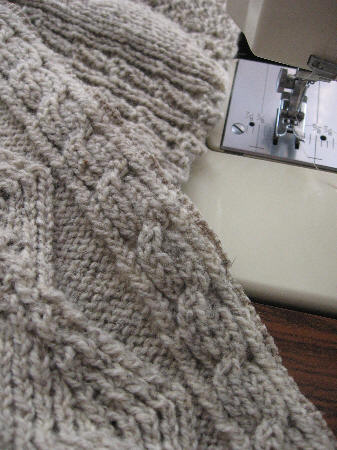
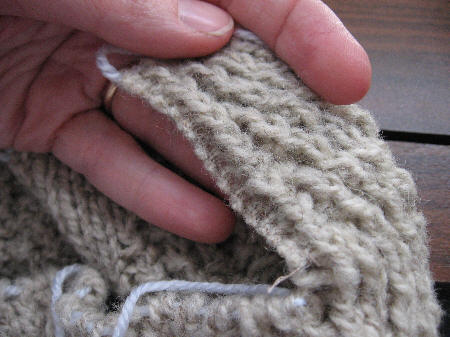
    I confess that I took a shortcut and first "swatched" on the sleeve.  A bit of a gamble, which may or may not have paid off, I haven’t decided yet.  The sleeve/swatch on US5 (!) is a bit stiff, while the larger swatch ("make a hat," Elizabeth suggests) on US6 seems a bit loose.

    Some favorite quotes from this chapter: "Take some of your wool and the size needle your intelligence tells you might be right, and make a swatch."  "Experiment, for goodness’ sake."  Sound advice in the matter of gauge, and well-said.  (Maybe I should make swatch and wash it….)  And, you know, if Elizabeth was responsible for nothing else but the suggestion to pattern-writers and editors to knit the swatch for a pattern stitch over stockinette, I would still sing her praises.  How many times is it impractical or impossible to work a swatch in pattern?!  "You can take note of what I do, and do likewise; or improve on me."  "Once you have tried complicated patterns, or even simple ones, from … charts, you will look only with pity on written-out directions."  (It’s strange to think that back in the mists of 1974, charts were still a new thing.  I learned from written-out instructions, in fact, and remember doing a Shetland baby blanket from pages of K2 tog, yo, sl 1, K1, psso, &c &c &c.)

    "After all this I hope you will feel inspired to design, calculate, and execute your very own personal Aran, like unto nobody else’s."

  • Snowflakes

    In the spirit of the season — although this is probably the only snow I’ll come in contact with this winter! — here are a few of the fascinating snowflake photomicrographs of Wilson A Bentley.

    Bentley_fsr107

    Bentley, a farmer in rural Vermont, became in 1885 the first person to photograph a snowflake, using a microscope fitted to a bellows camera.

    Bentley_fsr108

    Bentley_fsr105

    Images from Wilson "Snowflake" Bentley at snowflakebentley.com .  (Knitters, have a look at the snowflake zipper pulls in the virtual gift shop — would be lovely on a winter cardigan!)

  • Look what I got for Christmas! —

    Knittedrug_amazon

    The Knitted Rug by Donna Druchunas, a fascinating and inspiring collected of rugs in a wide variety of styles and shapes.  Round, rectangular, stripes, spirals, blocks, Log Cabin, even some unexpected Fair Isle and Aran-ish rugs.  I love the one on the cover.  The book got my head so buzzing with ideas that I picked up some Lion Suede at Michael’s to work up a sample —

    Test

    The colors, I think, don’t look as pleasant knitted up together as they do side by side, but that’s what samples are for, eh?  I don’t usually like acrylics, but the knitted sample in the store showed a lot less wear than the others, Lion’s wool/acrylic blends and such — less pilling, most obviously — a plus in a rug, so I thought I’d try it.  It feels really nice worked up, too, soft and squishy, and three strands together in garter stitch (on US10 needles, very tight) are almost half an inch thick, also good in a rug.  The color palette is a bit limited, but I might try the greens together, or the browns, something with less contrast….

  • Here is Backyard Leaves, all finished and sewn up, ready to send off to its recipient and only a few days after Christmas!

    Backyardleaves1

    This scarf is not exactly hard, but it certainly is complex.  It took me almost two hours to do the first repeat, and I thought I’d really gotten myself into a project that would take forever, but as so often happens with lacy patterns, once I could see what was happening, it all started to make sense.  I never did memorize it, and had the pattern next to me all of the time, but often that was just to reassure myself that it was going well. 

    My gauge was quite different than it would have been with the merino of the original, and I did extra repeats in an attempt to compensate for the finer gauge — the scarf ended up being about 4 1/2 inches wide and a rather gasp-inducing 100 inches long, but it is so fine and soft that wrapping it three or four times around my neck was in fact a pleasure, and it’s warm without being stifling.  I’m not entirely pleased with the join in the middle, and I can’t help thinking that it wasn’t the best way of going about it, design-wise, but merely the least complicated — luckily, with all of the wrapping that will be necessary to wear it, one little seam will never be noticed!

    The Cashmere/Seta is perhaps a touch too fine to show off the leaf pattern to its best advantage, but it is certainly wonderfully soft.  I like the fact that the modified I-cord edging smooths out the edges, too, as so often garter stitch and the wrong side of stockinette make a yarn feel a bit rougher than it did in the ball.  This yarn is so soft that the leaves don’t stand out as much as with the original merino, but … did I mention how soft it is?!

    Backyardleaves4

    Merry Christmas, Helen!

  • And here is my January-project-to-be, the Aran cardy from Knitter’s Almanac — nine skeins of Sheepswool from Schoolhouse Press, in pale gray —

    Sheepswool

    with naturally-shed deerhorn buttons.  The color is actually a rather sandy gray, tending more towards the brown than the gray, I mean, which gives me pause, but as I seem to naturally gravitate towards darker grays, I chose the lighter shade, and this will be something different in my wardrobe.  The yarn is actually from Bartlettyarns, though I don’t see the exact thing at their website, so perhaps it is unique to Schoolhouse.  It is thick and rather rough, but according to reviews at WiseNeedle it softens up nicely after washing — it does have a strangely interesting and not at all unpleasant smell, that reminds me vaguely of the auto mechanic — it must be the lanolin, as I could actually feel it on my hands after I spent a few minutes fondling and pondering its texture.

    I think I will start this a bit earlier than January proper, as I am very familiar with my own dawdling tendencies, and am not convinced that a full-sized Aran cardigan will take a mere four weeks! and so after the last few repeats left to finish the Backyard Leaves scarf, I will wind up the Sheepswool and get started!

  • Merry Christmas

    Xms2_1

    Xms5

    Xms3

    Xms6

    Xms1_1

    Xms7

    Xms4