• Booking Through Thursday writes, "We’re just wrapping up the third week of January. Wow. Already. Time to check in with your reading report" —

    1. Have you finished any books yet? Aaugh, progress reports already??  Why, yes … yes I have!
    2. If you have, how many, what were they, how did you like them?  Dozens!  Here’s a few — Alice the Fairy and A Bad Case of Stripes, both by David Shannon (as usual, mixed feelings about David Shannon, Stripes is mildly amusing, I don’t like Alice, girls love them both); Marjorie Priceman’s How to Make an Apple Pie and See the World, Mary Jane and Herm Auch’s The Princess and the Pizza, Lynley Dodd’s Hairy Maclary from Donaldson’s Dairy, Edward Ardizzone’s Ship’s Cook Ginger, all old favorites; Uncle Jed’s Barber Shop, which Julia chose at the library (an unusual choice, I thought, for a 3 1/2-year-old, but certainly there is always time for lessons in tolerance, generosity, and persistence, and this is a good one); and the girls’ current obsession, Fancy Nancy by Jane O’Connor and Robin Preiss Glasser.
    3. If not, why not? Are you currently reading anything that you just haven’t finished yet? Er, don’t look at my sidebar….
  • Temptation

    Cth_spanishmoss

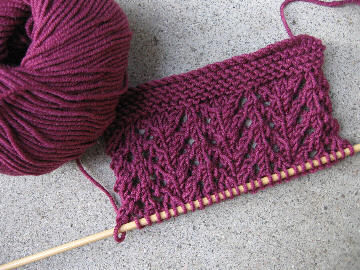
    "You came, I was alone, I should have known, / You were temptation! / Your smile luring me on, my heart was gone, / You were temptation!"

    (With apologies to Arthur Freed and Nacio Herb Brown, who in all probability were not thinking of Cherry Tree Hill’s Supersock merino in Spanish Moss when they wrote this song….)

  • 2765_small

    "Still Life With Aran Sleeve and French Horn"
    The Bluestocking (fl. late 20th-c.-early 21st-c.)
    mixed-media (wool, bamboo, brass, etc.), temporary installation (since demolished)

    (We went to the local children’s museum this afternoon.  "Museum" is a rather loose description here, but still it makes me come over all arty-farty sometimes.)

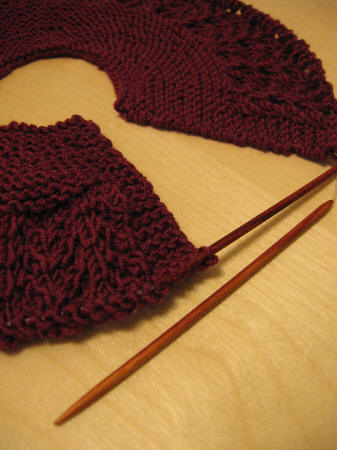
  • Am finishing up the body of the Aran cardy, and starting on the first sleeve.  I wondered whether I should block the pieces before basting and cutting them, but can find no advice for or against this in the Almanac — I’m guessing that it’s not terribly important, or Elizabeth would have mentioned it.  It seems to me that the stitches would lie flatter if I block it first, which might make a difference in where the machine-basting ends up, but on the other hand, the garter stitch edging is to be picked up afterwards, and it might be awkward to work a new bit onto a blocked bit.  I’m leaning towards not blocking, simply because the gauge didn’t change all that much with it, so it shouldn’t matter terribly.  If anyone thinks I’m making a dreadful mistake, please let me know!

    I think this is what Elizabeth means by the "kangaroo-pouch neck-shaping" — the instructions seem a bit casual.  "About 3" shy of desired body-length," she writes, "put the center 1/3 of the front stitches on a piece of wool, cast on 2 stitches [I put one on each side of the departed stitches], and continue working.  When the body is finished … machine-stitch and cut the front center 3", which will fall apart to reveal a nicely scooped-out neck."

    Kanganeck

    Frankly, this looks more like a codpiece to me, but I suppose that a) I’ve been watching too much of "The Black Adder," and b) "kangaroo pouch" is more tactful.

    I’m also doing short-rows and a three-needle bind-off at the shoulders, instead of a stepped slant on the back half and sewn shoulder seams.  I think the three-needle bind-off is wonderfully tidy, and more flexible than my sewing.

    Aransleeve1

    David and I went out for lunch and a movie yesterday, while Grandma was here to look after the girls.  We tried a new Indian restaurant, and then went to see "The Lion, the Witch and the Wardrobe".

    Pevensiesenternarnia_narniaweb_small

    I wasn’t really sure what to expect, having heard different reactions from friends and in print.  I was very disappointed in the first few seconds, in which we see the Blitz from the viewpoint of the German bombers — distracting and unnecessary — but the non-Lewis addition of the evacuation scenes were so moving that I was in tears.  (What an awful position to find oneself in, sending one’s children away in order to keep them safe, or being sent away to live with strangers, in an already-disorienting time.)  I thought it interesting that Edmund was the one who ran back from the Anderson to get the photograph of their father, not one of the others, who we could expect to be more sentimental.

    I did not think that Tilda Swinton was particularly miscast (as I’ve heard from a certain person who may disagree at length here, if she likes!).  Swinton always gives me the creeps anyway.  I thought that her plastered dreadlocks were odd, but not out of character, as it were, although I found myself more distracted by her dress and its strange way of seeming that it contained her, rather than that she wore it.  I could find, in my dash through the book last night, no mention that the White Witch is supposed to be dark-haired — the only physical characteristic mentioned other than a general ominousness is her crimson lips — and that mental image seems to be from the Baynes illustrations that so many of us grew up with (reinforced by Jadis’ "later" appearance in The Magician’s Nephew, published after LWW but set earlier in Narnia’s history).  I never found the Baynes illustrations of the White Witch to be particularly frightening, anyway, so it doesn’t bother me.

    A lot of the dialogue has been changed from the book, for reasons that on first viewing don’t seem particularly obvious to me, other than to inject more humor into things (Mr. Beaver’s first line, for instance).  Lewis’ dialogue always seemed to me very easy, very readable and speakable and natural, so it seems strange that it’s been rewritten, but I can’t really quibble much, never having written a movie.  (Mr. Beaver’s first line was pretty funny, after all.)  I do think it unfortunate that it was felt necessary to "update" some of the wartime speech, especially when it was so painstakingly established to be that particular time and place.  (It certainly doesn’t hurt to use a different vocabulary now and then, or "dude" will soon be the only word people know.)

    The effects in this movie are amazing — the animals are so incredible that after a few moments I stopped being intrigued by the effect and just accepted that beavers and lions could talk.  There were a few rear-projection inconsistencies that were jarring — the backdrop when the children cross the frozen river, for one — but otherwise it’s just incredible.  The expressions on Aslan’s face are so subtle, so nuanced — I would say "so human" if that weren’t more than a little insulting!  I liked that the filmmakers didn’t make the animals more Beatrix-Potterish, like putting an apron on Mrs. Beaver or such (Tumnus’ scarf was all right, as I worried that he was cold!), and I appreciated the way that the Beavers played off each other (an inspired bit of voice casting, there).  I liked the little touches, too, such as the giants — which in Lewis are rather stupid — pushing each other and arguing on the way to the battle, and the way that the lamppost actually appears to be growing from the ground, with a treelike lumpiness of surface roots at the base, which we later, in The Magician’s Nephew, find to be the case.

    In fact, one of the few distractions I had during the movie — aside from the cell phone ringing somewhere in the theatre during the Stone Table scene, for heaven’s sake — was thinking suddenly, "Is Susan’s cloak … knitted?"

    Susanatthebattle_narniaweb_cropped

    This is not the best image of the cloak — the first time she’s wearing it, it looks like a fairly fine-gauge stockinette.  Curious — an interesting choice, if it is.  A knitted cloak would not be particularly comfortable in the rain, but it would be warm otherwise and it certainly moves very nicely.

    A lot has been said, in a number of places, about Susan, and quite rightly a lot of feminists are disappointed that it’s the girl who grows away from Narnia when she gets interested in boys and make-up.  Susan always struck me as being a bit wet, so it didn’t surprise me that, in The Last Battle, she as "the pretty one" and the oldest girl of the family is the one who falls prey to the desire to fit in with what is obviously meant to appear to us as superficial.  I’m not saying that in any given set of people, one of them has to lose the childlike innocence that lets one believe in magic wardrobes, but it does happen in real life.  This is, after all, a story, and Susan’s function in the story is as an example of what might happen to those who want only to "grow up" and fit in with everyone else.  (Paul R. Ford makes an interesting point about Lewis’ own character, which was in fact much more like Susan’s than Lucy’s, something Lewis himself realized and acknowledged.)  While my sympathies were usually with Lucy, I could almost always identify with Susan’s practicality (the coats, the meals) and often with her fears.  Lucy is, of course, the one who is afraid but follows Aslan anyway, the point that Lewis wants to make.  Lewis wasn’t the only writer, by any means, to succumb like Susan to the stereotypes of his time and place — it can’t be argued that men didn’t have the upper hand in pre-war England — and while I don’t think that women have to be satisfied that "at least" he gave the most important role to a female character, Lucy, it seems that in at least this he was willing to be fairly open-minded.

    For some reason that I don’t understand, I hesitate to say that this movie is "brilliant" — my head is still swimming with the stunning images and the cultural implications, its problems and joys, the deep feelings I’ve had for these books ever since I first read them at age eleven or twelve.  All in all, I found myself much more viscerally involved in this movie than in any of the three "Lord of the Rings" movies.  (I knew what was going to happen, but that didn’t stop me from gasping aloud when Edmund was wounded at the battle, and finding this inexpressibly moving.)  I don’t know if this is due to the movies themselves or to the stories — I think of myself as being more than a little hobbitlike, but perhaps it is that I could never find myself in Middle Earth, but as Professor Kirke might point out it is not impossible that I too might, like Lucy, one day find a door into Narnia.

  • Claire tagged me for the Meme of Four a while back.  It seems to have morphed a little in the meantime, or maybe that was just me —

    Four Jobs You’ve Had in Your Life:  Library page, library clerk, library assistant, library cataloger.  (And get this, all at the same place!)

    Four Movies You Could Watch Again and Again But For Some Reason Haven’t Pulled Off the Shelf in Ages:  "Truly, Madly, Deeply", the 1987 Lord Peter Wimsey/Harriet Vane series, "The Music Man", "Our Mutual Friend".

    Four Places You’ve Lived in Another Life (Or Wish You’d Lived if You Can’t Really Believe in Past Lives):  England at pretty much any point in history, somewhere on the Oregon Trail, ancient Egypt, Renaissance Italy.

    Four Relatively Obscure Actors Who Make You Cheer When You See Their Name Scrolling By After the Title:  Sophie Thompson, Roshan Seth, Cherie Lunghi, Jean-Pierre Cassel.

    Four Voices You’ll Listen To Even if All They Are Reading Is Your Grocery List:  David McCullough, Alan Rickman, Michael Wood, Cecilia Bartoli (especially because my grocery list would sound fantastico in Italian).

    Four Websites On Your Blogroll:  Blogroll?

    Four Food Indulgences:  Sticky toffee pudding, a Ruby’s Super Burger with a cherry Coke (the only time I ever drink Coke, and it has to be with Grenadine, not that fake stuff), scones with clotted cream, See’s chocolates (especially the chocolate buttercreams).

    Four Things to Knit if You Ever Get Around to Joining the Behind the Times Knitalong:  A Picovoli, Eris, a Sophie bag, another Clapotis.

    Four Albums You Can’t Live Without:  The Christopher Hogwood recording of Handel’s "Messiah", Vivaldi cello concertos, a "Best of Split Enz" that has a lot more tracks than this, and a Beatles to be named later (because I can’t decide).

    Four Simple Pleasures:  Coming in to the house from outside and smelling something good, and realizing, "That’s my dinner!"  Writing a letter with pen and paper.  Glass doorknobs.  Watching my children sleep.

  • Show and Tell Friday this week wonders about our favorite room….

    Our house was built in 1929.  It is not particularly fancy, nor a remarkable example of bungalow architecture, but it is cozy and welcoming, and we loved it instantly.  I love older houses — there is a lot to be said for newness, but not only do I prefer the older architecture, but I feel an enormous satisfaction from knowing that generations of families have grown up in a house, in the connection to history and time that come with an older house.

    Our house was a rental for a long time before we bought it, and we got it for a song from the bank who had repossessed it, just before the real estate market soared.  I have a kind of superstitious feeling about repossessed things, cars especially, but with houses it’s exactly the opposite.  It was unloved, unlooked-after, abandoned really, and now somebody loves it.  Each of the rooms has its own character and charm, but the sunroom holds a special place in my affection, as it is so far the first one we have "remodelled".

    This room used to be a porch at the side of the house, a common feature in bungalows.  At some point in the past — after the switch to drywall, is all we know — the porch was enclosed and the french doors moved to the new exterior wall.

    Sunroom1

    At first, we used this room as a sunroom — which is what we still call it — with white-painted wicker furniture and a table covered with plants, since the western exposure makes it very bright on summer afternoons.  (I had a lovely dream of looking out the windows onto roses planted along the edge of the driveway, but I’m afraid the tree-planting frenzy of the 1960s owner has made it far too shady for roses, and for the moment the only thing that lives there is trash cans.  It’s on the list of Things to Change.)  After our first baby started crawling, we put up a temporary gate from the dining room, as we worried that she would fall off the step onto the hard concrete floor and break her nose, and then because the gate was so hard to step over, we rarely used it.  After Julia was born, we decided to make it into a playroom for the girls.  We were getting a new roof and fixing serious termite and water damage at the same time, so this room was gutted and fitted out with new drywall, new double-paned windows and wiring, and I painted it, the stucco and trim a plain clear white and the drywall a lovely buttery yellow, Laura Ashley Pale Cowslip I.

    Sunroom3

    David’s parents still had his desk knocking about in their basement, so we were happy to pass that along to our girls, with an inexpensive but fairly sturdy IKEA chair.  A piece of blue plush carpet with a non-slip liner underneath makes the hard floor comfortable, and a pile of IKEA pillows can be tossed into the corner to clear the floor, or piled up to make a cozy reading spot.  A small but fairly handsome laundry basket makes a handy spot for toys.  It is intentionally rather spartan, both because the room itself is just too small for much furniture, and so that it is adaptable to whatever the girls want to do at a given moment.  The window into the breakfast room makes a great puppet theater.

    Sunroom2

    The transition from the formerly-exterior stucco and the drywall had always been an awkward one, and so when I saw this molding carved with climbing roses at a building-supply company, I knew it would do the job perfectly.

    Sunroom4

    We dawdled rather a long time with curtains, but eventually the foot traffic from the apartment building next door proved too much, and we put these up.  I sketched out a fairly simple bracket, and David cut and installed them, with one long rod that runs the length of what is essentially a wall of windows.  I wanted curtains that would be easy to remove for washing, so the rod only rests on the bracket, and the rings are simple plastic ones from the crafts store, that are sewn onto panels of bleached muslin, and I just toss them in the laundry.  The rings make it easy for the girls to open and close the curtains themselves.

    Sunroom5

    It makes me happy.

  • Booking Through Thursday this week wonders about the compulsions of famous people to write books, both how and why….

    1. What do you think of celebrities who write biographies when they’re only twenty-something?  If they’ve got something to say, and the determination to see it through the writing and publishing, then I salute them.  I wish I’d done something worth writing about in my twenties!
    2. Have you read any?  I read Kenneth Branagh’s Beginning, which I found fairly interesting.  If I have read any others, I’m afraid they weren’t terribly memorable.  (Please note the "worth writing about" in #1.)
    3. What about novels by people such as politicians? Are they just cashing in on their fame? Ah.  Difficult question.  Politics can be such a self-serving field, although I would like to think that there are still some noble-spirited people around who get into politics so that they really can help people.  I also understand the need to write.  Why should politicians be immune from this simply because they are politicians?  That said, I don’t have to read it just because it’s been written (or just because the author is famous), either.
    4. Should ghost-writing be allowed or should the true writer get the credit?  This seems uncomfortably close to plagiarism to me, although bizarrely with the actual author’s cooperation.  Why would someone want to take credit for someone else’s work, and why would someone be willing to let someone else take all of that credit?  I don’t really understand the kind of ego that can’t accept even an "as told to" line, or acknowledge the contributions of a really good editor.
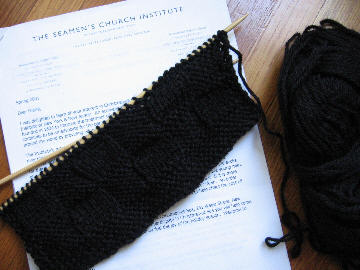
  • I’ve gotten almost to the end of the third fishtrap repeat on the Aran — just about where the armholes will be.  I like the pattern, the way the lines move in and out, like a stately dance — it’s simple enough to be more-or-less memorized, but I find this lets me daydream perhaps a little too much.

    Aran_magnoliablossom

    I was rather surprised to hear that A Bluestocking Knits had been nominated for "Best New Knitting Blog" at the 2005 Knitting Blog Awards organized by QueerJoe.  I couldn’t think why my visitor stats had skyrocketed this past week!  Obviously, I should get out more.  Anyway, I just want to say thanks to whoever nominated this blog, and congratulations to the winners.  It really is an honor just to be nominated!

    But before I’d even had much of a chance to fantasize about red carpets and Badgley-Mischka gowns, life broke in as usual this morning — Julia wanted to take her new ballerina Barbie for show-and-tell at preschool, and Laura cried because Julia had taken the same Barbie only last week and now Laura thought that she should have a turn to play with it, in the two hours this morning before her late-start day, and Julia dug in and insisted (rightly enough) that it is her Barbie, and I turned around to find that Julia had taken off the socks I’d just put on her, throwing them who knows where, as I still haven’t found the other one, and tempers were getting short all around, I had to pack Julia’s lunch and get the laundry started and we should have left five minutes ago — and somehow a little miracle occurred, and Julia suddenly said, "Laura can play with my Barbie.  I want to take her new Little Pony for sharing," and Laura saw the wisdom of this, the Little Pony which she had refused to let Julia take for show-and-tell last week.  Peace was restored.  Isn’t it amazing how one minute they can be at each other’s throats, and the next generous and kind?!

    And I got to spend the first part of the afternoon in a house filled with utter silence, except for the wind outside and the occasional murmured "whoops, that’s not right" when I found that I’d twisted right instead of left.

  • Moth Heaven Julia asked about the "Golden Hands" books that I mentioned in a comment on her post of January 2nd, when she wrote about the Time-Life Art of Sewing books she was given for Christmas.  I don’t think I could do this series justice without at least a few pictures, so I thought I’d write a post about it.

    Goldenhands_1_1

    "Golden Hands" was a serial published by Marshall Cavendish in the early 1970s, not technically a book but a series of magazines, essentially, that you would buy as they came out.  (My mom got hers at the grocery store.  You could send away for binders to keep the issues in order — "$1.75 plus 25¢ shipping and handling" — and the index.)  It was kind of like a home-study thing, a little "chapter" of two to four pages per issue on knitting, crochet, embroidery, needlepoint, dressmaking, beading, patchwork, tatting, and so on, and finishing and care techniques for the resulting projects.  If you were a complete beginner, you could start at the "Knitting Know-How 1" chapter, for instance, which gives basics on yarn types, gauge, and abbreviations, then goes on to casting on and off, the knit stitch and the purl, with increasingly advanced techniques throughout the 74 chapters.  I more-or-less taught myself to knit from here, studying the pictures and going for help to my mom when things didn’t go right.  If you already knew the basics, you could start at a later chapter for new techniques, or jump straight into a more difficult project.  Rae Compton was the knitting consultant for the series, and while I don’t recognize any of the names in other areas, I expect they were all equally competent and qualified, judging by the thoroughness of the instructions.

    Goldenhands_3

    Many of the projects are more than a bit dated now, of course — macramé vests, ponchos the first time around — but the lace doilies, Shetland shawls, floral needlepoint handbags (with a chapter on mounting the needlepoint piece on a metal bag frame), ganseys, and such, are as timeless as they were in the 1970s.  Some of the knitting techniques are a bit dated, too — psso instead of the now more usual ssk, for instance — but nothing that would really hold you back.

    After the series was completed, they did one that went into more unusual crafts, like candle-making, millinery, costume-making, batik, some really interesting stuff, and then a monthly that as far as I know only went to two issues.  They also did a few paperback pattern collections, with new patterns, "All You Can Knit and Crochet For Women/Babies and Children/the Home," and so on. 

    Goldenhands_4

    I started with the garter stitch scarf, and not much later (in my early teens, perhaps) made a lovely doll dress and coat, and eventually at least three different baby blankets.  There was also a stunning bridal coat that I considered years later, and would have been high on my list if I’d been married in cooler weather than a California June.  In fact, I’m seeing quite a lot of things here that intrigue me now!….

    Goldenhands_2

  • Booking Through Thursday (a day late) wants to know if there are any reading resolutions out there for the New Year —

    1. Do you have a reading plan for the new year? Why or why not? I plan to read.  That’s about as specific as I can get!  I have a list of things that have intrigued me lately, from one source or another, but no "plan."  One of the reasons that I haven’t (yet) gotten into a reading club is that I’m more a spur-of-the-moment reader these days, both in schedule and subject.  I would like to develop a bit more self-discipline, though, so maybe a reading club, or some kind of plan at least, wouldn’t be a bad idea.
    2. If you do, what is it? In hand is The Annotated Anne of Green Gables — and other things I’m thinking about are Republic of Shade, by Thomas J. Campanella, John Kelly’s The Great Mortality, a history of the 14th-century Black Plague, Audrey Niffenegger’s The Time Traveler’s Wife, and Happiness: A History by Darrin M. McMahon.