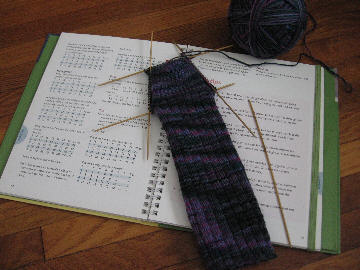
• The Knitter’s Almanac projects for February are snuggly babies’ things, a simple blanket, a mat or sleeping bag, a jacket and matching hat, and footed leggings.  I made a throw/shawl to Elizabeth’s baby blanket pattern here a few years ago, for my sister, in one of those fortunate coincidences where I had a lot of yarn and Christmas was coming up and I saw the photo and put one and one and one together.  I used a plain black wool I’d had stashed in a box under the bed for far too long, and I tried the Gull Stitch Elizabeth recommends, which is very pretty indeed.  It made a very handsome throw, if I may say so myself.  And another shawl that I made (ostensibly for Laura when she was born, but to be honest, I kept it for myself) was inspired by this, too, although using the Old Shale charted out by Martha Waterman.

    Oldshale_shawl

    I definitely approve of Elizabeth’s views on colors for babies.  Soft heather-grey — "especially if you incorporate some white around the edge of the bonnet" — navy blue, greenish-blue Shetland.  "And what’s wrong with scarlet?"!  (I seem to recall making one of these double-knit mats in a dashing peacock blue.  This was, as it happens, my first introduction to double knitting.)  The traditional pastel pinks and blues are all right in their way, but I’m always impressed by the less-traditional things that folks come up with for babies.

    Striped_sweater

    "Our favorite longies are those on which we used up odd remnants of wool.  A green pair has a cute grey color-pattern at the calf, and then becomes steel-grey for the feet.  A navy pair has a white pattern at the knees and scarlet calves and feet.  They must actually be seen on young legs for their true charm to become apparent." ("Thrift and conservation are in the wind: how delightful to find that using up wool-remains improves the appearance of our finished product"!)

    Feb_babystuff

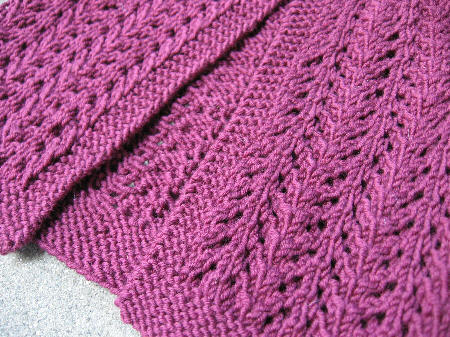
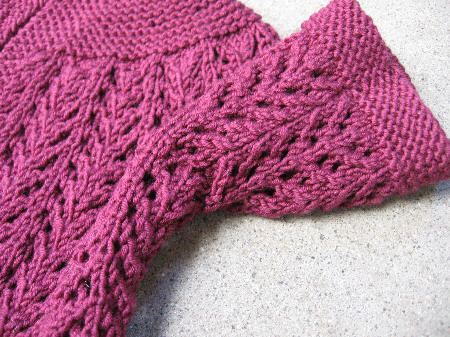
    New technique for this month: knitting from the top down.  Frankly, I’m a bit surprised that I’ve never done this; there must be dozens of patterns in my collection alone.  But I’ve always been a bit leery — like with cutting — that it just looks upside-down.  Well … I will let Elizabeth take me by my lily-white hand and lead me over the water.  The Gull pattern does look nice upside-down, too, I’ll say that.  And personally, I am always grateful to those designers who, like Elizabeth, arrange things so that the fiddly bits of a pattern stitch are on one round and the other round is the "mindless and relaxing one" of knitting all the way!

    Gull_pattern

    This is the merino left over from Ene’s Scarf.  I also appreciate what Elizabeth has to say about wool.  While I understand that some people really do have an allergy to certain fibers, others object to wool simple because they’ve succumbed to the notion that wool is hard to wash, and so I find very amusing Elizabeth’s underhanded methods for dealing with those stubbornly ignorant of the "warmth and comfort of wool": "If I were stuck with a child allergic to wool I would become very sneaky: I would make it a sweater of orlon or whatever, into which I would knit one color-pattern of wool. If this were received and worn without carping comment, I would increase the dose — next sweater, two patterns, next one, three.  After twenty sweaters — in theory, at least — I would have a nice normal wool-wearing child.  At least I would have tried.  If caught at my fell deed, I could always say that the particular color I wanted was only available in wool."  "Pass by the synthetic yarn department, then, with your nose in the air."  Synthetics have come a long way since 1974, it must be admitted, and I am not so much a snob that I refuse to work with synthetics on principle, but I do love natural fibers the best, by far.

    And this just makes me laugh: "My special technique for car-cat-naps is to sit bolt upright, and let the chin drop down as far as it can on the chest, relaxing all neck-muscles.  My reflexes are now so conditioned that this pose sends me to sleep almost immediately; the head doesn’t loll, the mouth doesn’t open degradingly, and I like to think that there is no snoring, although the family is in a conspiracy to tell me that I always snore, which is plain nonsense."

  • Good Things

    I’m starting a new category, "Good Things," for charity knitting.  It’s always been important to me to help others, although I admit that I have not been as consistent about it as I should be.  But helping Laura recently with service projects for her Brownie troop has made me feel that I should dedicate more of my time to this, and set a better example for my daughters in the process.  This category, then, will be a collection of opportunities for knitters such as myself to help others, through multi-, inter-, and non-denominational service organizations.

    Mariners_scarf

    I didn’t find out about the Orphan Foundation of America’s Red Scarf Project until too late to make this year’s deadline, and then only a few days later, I came across in my pattern stash the reply to my query about the Christmas-at-Sea program run by the Seamen’s Church Institute.

    Christmas-at-Sea provides holiday packages to sea and river mariners working on Christmas Day.  Included in each package is a handknitted vest, socks, or watch cap and scarf set for sea mariners, and a scarf for river mariners.  Unlike, say, the Red Scarf Project, whose only firm requirement is that the scarves be red, the SCI requests that one use specific patterns in superwash or acrylic, and in dark, manly colors.  (This is my phrasing of their request.  I had a very amusing mental image of the sailors arguing over who would get the purple scarf, but I suspect that this is not the reason.)

    I’m happy to borrow the name for this category so that perhaps it may come to mean not only clever solutions to everyday living but also good things in the greater sense.

  • Blackbird requests our computer for "Show and Tell Friday" this week.

    I am something of a computer ignoramus, so I leave the hardware decisions to Bluestocking Tech Support (i.e., David).  For our relocation to Hong Kong last year, he bought this reconditioned IBM ThinkPad, mostly because he knew that we were going to have a very small flat to live in, and a laptop certainly doesn’t take up much room!  He also rationalized that I would be able to take the laptop on genealogy research trips once we came home, although that hasn’t materialized yet, since after a virus scare we’re not using the big desk computer atal.

    Thinkpad

    I miss my ergonomic keyboard, but the laptop is nice, I must say.  It amazes me that it is more powerful than the big desk one.  (Someone commented to Blackbird that she looked forward to using a laptop on the couch or in bed, but I must warn you that this thing is hot, and I don’t mean style-wise this time.  I always had to put a throw pillow underneath it, to keep the heat from the fan from scorching my legs!)

  • Wove in the ends and sewed on the buttons yesterday morning for the January Aran.  I like this cardy — it has a comfortable Wisconsin-ness to it, good for a fine winter afternoon puttering in the garden, or a rainy day curled up with a good book.

    Aran1

    For some reason, my right slants are much tidier than my left slants (I’ve noticed this with decreases, too — note to self, fix this!).  But it smooths out pretty well with blocking.  I really like the three-dimensional effect that comes with Aran patterns.

    Fishtrap_detail

    Here are some suggestions for future January Aran knitters —

    Allow some extra "seam allowance" stitches where you want the cuts to be, maybe one or two.  This is not mentioned specifically but sort of implied, when Elizabeth says to sew down the turning, but it is much further along after the section about designing one’s own fishtrap/cable layout, so I had quite forgotten that I had read it a week earlier.  Worth remembering, if only for those nervous about cutting their knitting.  It would also have helped me avoid that section of the armholes where the cable seems to completely disappear along the outside edge, where it blends into the reverse-stockinette of the sleeve; I should have added an extra line of that lovely single-twist to make it stand out, as I did at the edge of the button band.  I would also suggest, especially if you want to use Sheepswool, that you consider putting 2 stitches between cables; I used 1, and although it can be blocked hard enough to show both clearly, 2 might be better.

    Aran_flat_1

    When you are sewing the reinforcing lines before cutting, make sure that the top stitch on either side of the cut-to-be is securely sewn down.  The cutting makes this particular stitch especially vulnerable, and even more so if you’ve left the top row live for picking up a collar.  If you’ve made a line of "seam allowance" stitches, then you can sew between this last stitch and the others, back and forth for a few machine-stitches to hold it down.

    I had a really hard time with the formula Elizabeth gives for figuring the buttonhole spacing.  She says, "Count the stitches of one front, subtract 6, divide the remainder by 6, and subtract 3 from the result.  The number left will be the number of stitches between each of the seven 3-stitch buttonholes, with 3 extra stitches at the bottom."  This never worked for me — she seems to be saying that a buttonhole will take up 3 stitches, whereas as given it covers 5 (it makes a hole 3 stitches wide).  Possibly instead of "*knit the number of stitches you have calculated, make another buttonhole, and repeat from *," she meant that you should end up with x stitches between the buttonholes, counting the last K2tog of the buttonhole’s edge — I don’t know.  My own formula ended up being more like (tnb) / s = x, where t is the total number of stitches in the buttonhole band, n is the number of buttonholes needed, b is the number of stitches needed to work the buttonhole (5, in this case), and s is the number of spaces between the buttonholes, including the half-spaces at the bottom and top.  Considering that I was never very good at algebra, this was pretty brave of me, I thought.  I still ended up doing this, though —

    Buttonholeband

    to fit in that pesky remainder, using the pins to mark the buttonholes-to-be.

    The Sheepswool has a pleasant roughness to it, and it softens considerably with wet-blocking.  Dry, it has an appealing lanolin smell, although in the water it smelled distinctly daggy.  I had not a single knot, and only a few thin spots here and there — I barely broke in to the seventh skein (needed it only for the last cast-off), so six might do someone else, but seven should be enough to make this size cardigan with a bottom band.  I rather like the jackety look of it without that bottom band, so I’ve left it off.  I was rather intrigued by the deerhorn buttons on the website, and Meg herself (!) advised me to ask that the wool and buttons be matched in color, so maybe my batch of wool is a bit browner than might be expected from "pale gray".

    Button_detail_1_1

    Aran2

    "Arans are now your oyster; enjoy them"!  "The rest of the designs in this book will now seem childishly simple, and will, I hope, have the appeal of a child — a nice child; not too pretty, not too prissy, but with good genes and reasonable upbringing"….

  • Booking Through Thursday wants to know what we think about multi-volume novels — "I’m thinking here of any story that is split into more than one volume, stories such as Tolkien’s Lord of the Rings, Rowling’s Harry Potter volumes, Eddings’ Belgariad, to name just a few. Christie’s Hercule Poirot stories do not count, nor do Doyle’s Sherlock Holmes stories, as the reader can consume them in any order."

    1. Do you enjoy reading multi-volume stories? I’ve read a number of these series, sagas some of them, including all that BTT mentions above.  I’m not sure that Harry Potter belongs in this category, as each book is fairly self-contained — perhaps that series can be regarded as a crossover.  The same goes for Diana Gabaldon’s "Outlander" series, and Patrick O’Brian’s Aubrey/Maturin novels.  It’s certainly easier to follow what’s going on if you’ve read the earlier books, but it isn’t completely necessary, as I think it is with Tolkien, Jordan, et al.
    2. Do you prefer the shorter stories that are done in two or three volumes, or do you willingly go for longer tales? It certainly does depend on the author and story — I got bored with Stephen R. Donaldson’s "Thomas Covenant" series pretty early on, and stopped reading Robert Jordan’s "Wheel of Time" series around book 8 or 9, from sheer exhaustion, I suspect.  I enjoyed most of the Eddings books, although I think he’s been losing steam lately.  I really enjoyed Robin Hobb’s "Liveship" trilogy, although I’ve not read any other of her books.  And I’ve just found out that the long-awaited fourth installment of George R.R. Martin’s "Song of Ice and Fire" is finally out, but it’s been so long since book 3 (five years!) that I might just wait until the series is complete, then reread from the beginning….
    3. What do you like/dislike about these long tales?  It seems that the time and emotional/intellectual investment required creates a kind of bond with a series, like with a personal relationship, although on a different scale, of course.  You feel let down by a series that disappoints, but rewarded by one that involves you deeply.  It can be hard to let go of characters that you’ve come to love, when the series ends.
  • Here is Cinxia, which I finished and wore to the theatre in early December, when we took the girls to a Christmas matinee.

    Cinxia_1

    I should perhaps have made it with a bit more ease, as it tends to slip back off my shoulders, and possibly a bit longer, but I like it anyways (I was aiming at a size M, 42 inches for my 39 bust, so would recommend a little more ease than one might think for a bit of embonpoint, and now upon subsequent wearings I suspect I might rework it slightly larger).  For my first determined resizing attempt, though, this was wildly successful — everything is in proportion, and it looks pretty much exactly like the picture!  As I said earlier, I used this formula in the resizing.  I think that the bias of the fabric (from the twisting of the knit stitches) makes it pull in a different direction from what one would expect — this is what makes the bottom front slant downwards so attractively.  The neck shaping does tend to make it contract a bit across the back of the shoulders, I suspect, which is why mine slips — I might rework it a bit, which is why I’ve neglected writing about it for almost two months, but I am too tempted by other things at the moment.

    Cinxia_detail

    This is an interesting design — I like the sort of hint-of-the-Fifties about it, and love the wide collar/scoop neck combination.  The shaping is different from what I’ve done before, so it was fun to try something new, too. 

    The Shetland Aran seems to have a bit more drape than the Classic Elite Renaissance of the original, but it is very nice to knit with and to wear (it softens up remarkably with washing), and I love the color —

    Cinxia

    I was hoping to get better pictures with the self-timer, but it is so windy outside that they were all blurry!  I feel a little negligent about not writing this up, though, so here it is.  Maybe I can get a better one in a few days….

  • Bunny_sweater

    Grandma made this for Laura a few years ago, and Julia is wearing it now.  I had one just like it when I was little, and it was a big favorite.

  • I finished the second sleeve of the Aran cardigan last night, so there was no more putting it off — time to cut.

    Cardy1   

    It’s really very simple — run a line of basting down the center of the place to be cut, then run two lines of very short stitches along each side of the basting, then cut along the basting itself.  If the line to be cut stops in the middle of the knitted piece, as for an armhole, run a horizontal line of reinforcement stitches just below.  (This ends up looking similar to a zipper’s stitching.)

    Cardy2

    Here are the basting and stitching lines of the neck front, ready to cut.  It was a lot easier to sew and cut on the reverse side, since in my particular Aran that was where the knit stitches (the wrong side of the purl stitches) made lovely guide lines for me.

    Neck

    The "kangaroo pouch" does fall into place quite nicely, just as Elizabeth says.  I didn’t think of it until it was too late, but the technique would also make perfect armhole gussets, thereby reducing some of the bulk at the underarm — six or eight stitches would probably do, but you’d have to take it into account when laying out the Aran patterns beforehand (e.g. if you want the cables to run up the sides of the armholes).  Elizabeth didn’t suggest it, but I added a few extra purl stitches for a kind of seam allowance — sacrificial purls, really.  I estimated about where I thought the armholes would start, and an inch or so below that I added another stitch for this purpose, although as it turned out I underestimated and had to cut considerably further than I’d expected.

    Cardy3

    Sewing down the body was tricky, as the flexibility of the knitting and the fact that it was still a tube made it hard to hang on to, kind of like giving a ten-month-old toddler a bath.  Each line gets easier, though, as the one before holds things in place.

    Cardy4

    If the thought of this makes you queasy, look away now.  It’s kind of horrible and fascinating at the same time.

    Cardy5

    Cardy6

    Neck2

    It is nice and tidy, and I can see where it would make a great deal of difference in Norwegian sweaters and such, where working multicolored patterns flat can be a real chore (especially with more than two colors), but I must say that I’m not entirely convinced that this is the solution for me, or for every project.  (Haven’t tried knitted steeks yet, of course.)  I’m not wild about the stiffness of the machine-stitching compared to the knitting — it is similar to the feel of a ribbon sewn onto the back of the front band of a cardigan.  But I’m glad I’ve tried it, after all — now, on to the button band!

  • Blackbird‘s Middle Child requests "a good hat" for Show and Tell Friday.  I do not have a hat head, much as I desire this mysterious thing.  I do have lots of old photos, though….

    Audrey_hat

    This is a cousin from a few generations back, obviously very close to her uncle, who was my great-grandfather, as Audrey sent him many photos at various stages of her life.  She and Arthur were married around 1912, and so this may be a wedding or honeymoon photo, but she always seems well-turned-out, so I can’t really say.  He’s no slouch in the dapperness department, either, although I might wish that his own hat was just a little bit bigger.

    (And here, Middle, you get two hats for the price of one!)