• April’s Knitter’s Almanac project is a "mystery blanket," the mystery being in the fact that it has no apparent beginning.  Elizabeth pondered the idea of weaving together squares that had been knitted in the round, thereby "[producing] the mysterious effect of the blanket having been knitted in all directions at once," and this pattern was the result.  The technique may have been quite inscrutable at the time, but these days with our sometimes-emphasis on the eye-catching and marvellous (sometimes merely for the effect of being startling), it’s not so unusual, I think.  It was used quite gracefully by Selma Miriam in her Kousa Dogwood Shawl in Melanie Falick’s Knitting in America (reprinted in paperback as America Knits), which I remember knitting a number of years ago.  Still, Elizabeth’s blanket is very handsome, and the technique is not to be scorned simply because it is not so unusual as it once was!

    Ezapril

    Elizabeth used her 4-Ply Sheepswool, which is apparently now 3-Ply, working up originally at 12 sts per 4 in./10cm.  This pattern looks extremely adaptable to different weights of wool, and so since I’m on a b*dg*t, I’m using Patons Classic Wool with those handy weekly 40%-off coupons from Michaels.  The Classic Wool works up to about 20 sts per 4 in./10 cm, so you can either knit the squares to the given stitch count, and simply make more squares, or work to the given measurements, and weave more per square.  (Let’s see, 96 sts divided by 4 is 24, so 24 sts at 3 sts per inch in the Sheepswool would make 8-inch squares.  And 96-stitch squares at 5 sts per inch in the Classic Wool would make 4.8-inch squares.  Or 8-inch squares at 5 sts per inch means 40 sts per side, 160 altogether.)

    And, oh yes, there will be a lot of weaving!  "If you are one who hates and fears weaving (or grafting, or — why — Kitchener-stitch), and tries to con others into doing it for you, now is the time to take yourself in hand"!

  • Suse writes happily, "I have chosen my wool!  Da-dah!!!  8ply DK in cranberry.  Am ordering it tomorrow so hopefully this time next week I will have cast on, or at least swatched …"

    Theresa has in fact finished!

    I had put off the back piece, a bit dismayed at the prospect of working that wide piece on regular-sized straights (one US2 and one US3, not being in a situation at the moment to use Philippa’s brilliant suggestion of interchangeable circulars), but it proved not such a bother as I had thought.  The pleat lines showed up almost immediately, to my amusement.

    Img_3779_small

    The markers are not absolutely necessary, as long as you pay attention towards the middle of the rows.  I never moved my markers from the first row, except once, when I knitted instead of purled one and didn’t feel like tinking back through the cable section, so I moved the pin up to keep myself from missing it again, and simply reset that stitch as I worked the next row.

    Img_3782_small

    The points of the diamond gave me some pause, until I realized that the crossing lines do not actually line up, giving a sort of "twisty" effect, instead of the expected Xs.

    Some people have voiced a bit of nervousness about the pleat on the back piece.  It’s one of those things that looks a bit daunting and wordy when written out, but when you actually do it, it goes together almost effortlessly.  Here is mine after folding at the pleat lines for the first half, on the right side (the sections will make a kind of S shape) —

    Pleat1

    Just be sure to hang on to the working needle!  I was so busy folding the pleat that that needle kept sliding out.  Working the K3tog section is but the work of a moment, being only 6 sts long — it’s fiddly, rather than difficult.

    And here is the other half of the pleat, which will make a vaguely Z-shaped arrangement —

    Pleat2

    The last K3tog —

    Pleat3

    and a finished pleat!  Mine tended to make a bit of an hourglass shape, due I suppose to the loose binding-off, but this came out in the blocking.

    Pleat4

    Pleat5

    Pleat6

    Voilà!

  • Here are two Interweave Knits projects — in this month’s "Project Spectrum" colors — that I’ve been happily pondering for a while —

    Saltpeanuts_ik

    Sunrisecircle_ik

    — Véronik Avery’s Salt Peanuts and Kate Gilbert’s Sunrise Circle Jacket.  Neither of which, I confess, I am interested in knitting in orange, but would look equally fantastic in a color more suited to my complexion!

  • Redscarf

    I had a suspicion that I would probably not get around to knitting in the current Project Spectrum colors each month, with so many other things in the knitting queue (let alone life, etc.), but here is a red scarf on the needles.  It’s a perfect car-knitting project, eminently rollable, for those I’m-five-minutes-early-to-pick-up-the-girls-at-school days.

    I heard about the Red Scarf Project too late this past year to send something in, so I wrote and found out that it will be an annual project.  The Orphan Foundation of America makes "care packages" for foster children who are going off to college, and the packages around Valentine’s Day contain among other things a red knitted scarf.  As the OFA website points out, "[The college-bound kids] are success stories merely by showing up: Studies show that less than 50 percent of foster youth graduate from high school, and less than 10 percent go on to post-secondary or vocational training," and most of them don’t have families to support them. 

    This particular scarf is in Bernat Soft Boucle in a rather vivid scarlet.  I’m working it on the bias — I like the way that the fabric feels this way, a little bit more intriguing than straight rows, especially with the bouclé disguising the angles.

  • Img_3801_small

    I was casually reading the new issue of Country Living, as one does of a morning, and was looking over the photographs with this article on entertaining and thinking, "Ah, Project Spectrum pinks!" when I gasped aloud.

    Knitting needles as drink mixers.  Let’s look at that again, shall we?  Knitting needles to stir your drinks.  Not just any knitting needles, either, not the cheap Clover ones, but those tall ones are nice Brittany Birches.

    Curtain ring clips for placecard holders, I can see.  A linen scarf for a table runner, that could be pretty.  But I am not going to stir my Rosé Spritzer with a wooden knitting needle.  Admittedly, I come from the no-liquids-of-any-kind-on-the-wooden-furniture kind of family, but this takes the whole "repurposing" thing a little too far.

    Now, putting a few pairs of exceptionally beautiful wooden knitting needles in a pale pink glass for a centerpiece, that I might do!

  • Booking Through Thursday wants us to pick one of our favorite authors.

    1. What are some of your favorite books by this author? Wait, I'm still trying to choose just one author….  Right, I'll say D.E. Stevenson (although I am tempted just for a lark to say Antonia Fraser, who I admire not only for her fascinating histories, but because she can write mystery novels as well!).  I've talked about Stevenson before, but she's rather old-fashioned and so her books tend to get weeded off the public library shelves by those rather less-discerning librarians (ahem!), and I think she deserves to be more widely-known.
    2. Why do you like this author? Stevenson (1892-1973) has a deceptively effortless style, the kind that looks quite easy to do until one tries it oneself.  She has three main types of novels, mainly divided by tone — some serious (Smouldering Fire, if I remember correctly, deadly serious at times), some quite funny (the Miss Buncle books, for instance), and most somewhere in the middle.  Her plots tend towards romance, the standard girl-meets-boy, girl-gets-thwarted-through-shyness-or-circumstance, girl-gets-boy-after-all kind, and quite often you can see the outcome quite early on, which man the heroine is going to end up with, but the way that Stevenson gets us there is what makes it so enjoyable.  Many of her characters appear in multiple books, some as a series and some coming in as supporting players; she also frequently returns to the same location.  The "Mrs. Tim" series is I think the only recurring character whose story is told in the first person, here in diary form — the adventures of an army wife — so laugh-out-loud funny at times that my husband was intrigued enough to read them (more than one!).  (Mrs. Tim reminds me of E.M. Delafield's Diary of a Provincial Lady but not so cynical.)  I think that one of the things I like most about Stevenson is that she's just nice — she seems like a nice, sensible, intelligent, polite lady, and to be honest this is in rather short supply these days.  She is possibly most similar to Miss Read, although of course this is open to debate; the earlier Rosamund Pilcher novels seemed to me a modern heir to the rather more serious Stevensons. There are three Stevenson fan sites that I know of — one by Susan Monahan, which includes a pleasant little virtual tour of Stevenson's home and the prototype for many of her novels, Moffat in Dumfriesshire, Scotland; a brief appreciation by A. Bunting; and a rather extensive one by Dalyght with a light but discerning tone (including a pair of 1/12 miniature scenes from Stevenson's novels!).
    3. Have you read everything by this author? Why or why not? I own about a dozen of her novels, out of about forty that she wrote.  I think I've read almost all of them, but there are one or two on the list that I can't place.  For a long time — pre-Amazon — almost all of her novels were either out-of-print or available only in large type, and it was pretty hard to get books from the U.K. without actually going there, so I had to content myself with what I could find at the public library.  (I did read a lot of them in large print, which oddly gives them a completely different air in my memory.)

    Postscript (1 April 2006): I need to add that while one of the things that I love about D.E. Stevenson is that she is "old-fashioned" — even, I suspect a bit old-fashioned to her contemporaries in her writing heyday, the 1940s-1960s — she does have a regrettable tendency to reflect common opinions of that time about race.  Perhaps, as an American I am more sensitive to this than other Westerners of my generation.  I hasten to add that I have seen this in Stevenson's books less than half-a-dozen times, usually as casual remarks by certain characters, and not as a deeply-held philosophy of Stevenson herself.  I suspect from having read so much of her and therefore feeling that I now have something of an insight into her own character, that if this had been pointed out to her, she would have regretted it.  (It reminds me of the "Bad Tuesday" chapter of Mary Poppins, that has since been rewritten.)  I don't want to make a lot out of this, but it is there, and it needs to be said now.  There is far more about Stevenson to love than there is not.

  • Chocolate

    I’m pretty easy-going when it comes to chocolate.  I do like the milk and not-too-dark varieties best, but other than that I think they’re all pretty good.  Like books or friends or wines, in different situations depending on one’s mood or whatnot, they each have their strengths.

    I discovered Green & Black’s this past summer, in the exotic otherness of ParkNShop, and while I haven’t yet tried many of G&B’s varieties (with orange and spices, Blackbird?!), their creamy vanilla white is high on my list of favorites.  Hershey’s is what I grew up on as to bar chocolate, so I cook with it and find that it makes an excellent cup of hot chocolate — comfort food, indeed!

    This chocolate moment comes via Show and Tell

  • Pskroyer_interiorwithmariekroyer_small_2   

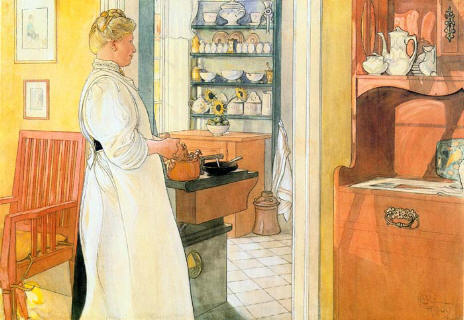
    Peder Severin Krøyer, "Interior with Marie Krøyer" (1889), Hirschsprung, Copenhagen.  I find the Skagen painters fascinating — such light, such color.  The outdoor scenes seem to be more well-known, generally, so here is an interior for a change.

    Anguissola_doubleportraitofaladyandherdo

    Sophonisba Anguissola, "Double Portrait of a Woman with her Dog" (undated), National Museum of Women in the Arts, Washington, DC.

    Reynolds_misssusannagale_176364_ngv

    Sir Joshua Reynolds, "Miss Susanna Gale" (1763-64), National Gallery of Victoria.  "On loan" to the Red and Pink Gallery from my dear friend Helen.

    Nshake28

    Unknown, "Portrait of a Man, aged 24" (1588), John Rylands University Library, Manchester.  This painting, commonly known as "the Grafton Portrait" after a previous owner, is argued by some to be a portrait of Shakespeare.  I am prepared to accept that it is not (some say it is in fact of Christopher Marlowe), but I would like to think that it is.  (The argument that Shakespeare at 24 would not have been able to afford such a rich silk doublet doesn’t make sense, in my opinion, as he would certainly have had access to theatre clothing.)

    Carllarsson_ruth_1

    Carl Larsson, "Ruth" (1906).  Some critics think less of Larsson for his so-called sentimentality — it’s true that one can hardly look at this picture and not smile, but it’s a lovely work.  I like the way that the bookshelves make such strong horizontals and verticals against the softness of her dress, the way she is slightly off-center, and the utterly characteristic tossing of her own arm across the arm of the seat, childlike against the maturity of the books.

    Whistler_pinkandgray_small_1

    James McNeill Whistler, "Nocturne in Rose and Gray (Portrait of Lady Meux)," (1881-82) The Frick, Pittsburgh.  Such a bravura piece — so characteristic of Whistler!  The wonderful pink satins flowing, the dark haughty eyes — I could look at it for hours.

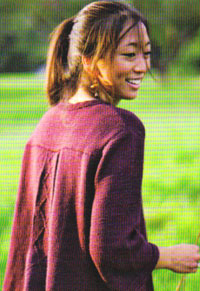
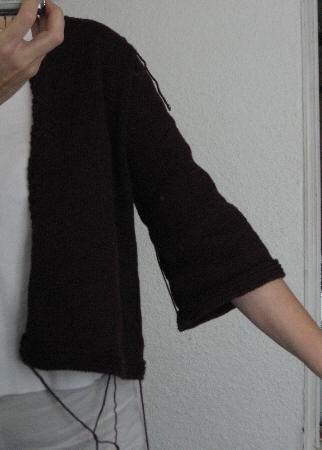
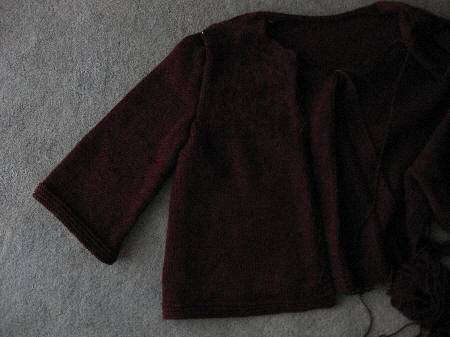
  • Another week gone by, another Swing Jacket update!  I’ve been bit slow thanks ("thanks") to a hayfever attack over the weekend — but Theresa writes, "I just seamed up the sleeves and attached them to the body today and wove in most of the ends.  She’s doing a little bit more blocking so that I can see if I can get that pleat to hang right before I take any pictures.  The shaping is nice, although I think that "bracelet" length is an optimistic name for the sleeve length.  Mine came just below the elbows and I don’t have unusually long arms."

    I ran into a little difficulty when I compared the left front on the needles to the right front that I’d blocked earlier, and found that the length is remarkably different, so my next job is to count the rows and see if I can figure out what happened — it could be a blocking quirk, after all.  In the meantime, I cast on for the back, on straight needles as I couldn’t bear the idea of having to use two circulars to get my eccentric gauge, with all of those needle-ends flapping about.  It’s a bit, well, squished, but the widest part is at the beginning, so I’m trusting that it will sort itself out!

    Pbsj_startback

    Fern and Suse would like some suggestions on yarn substitutions.  I am using the wool specified in the pattern, Jaeger Extra Fine Merino DK, at 22 sts and 30/32 rows per 10cm/4 in. (according to the ball band) and 11 wpi (according to Woodland Woolworks).  A good substitute is the yarn that Kat used, Jaeger’s Matchmaker Merino DK, 22 sts and 30 rows per 10cm/4 in. and 11 wpi (and about US$2 less).  This is a very good yarn that I’ve used to happy results — nice to knit with, easy to wash, and doesn’t show wear quickly.  There are a couple of other Jaeger and Rowan yarns described at English Yarns that look suitable, although I have never used any of these so can’t say for certain.

    Jo Sharp Classic might be nice (22 sts per 10cm/4 in. and 12 wpi)….

    Rowan’s Calmer, a cotton/microfiber blend, has a very similar gauge (21 sts and 30 rows per 10cm/4 in. and 10 wpi), and has a nice drape that would make an elegant jacket (though possibly rather heavy).  I’m using Calmer for that Ostrich Plume throw, and it does have a lovely feel to it, much like the Extrafine Merino, very "swingy".  Linen Drape might also work — anyone have any experience of it?

    Ola used Rowanspun DK, which she is generally pleased with (except that its tweediness obscured the cabling) — this wool is discontinued so color choices might be limited, but on the other hand prices would be good.  (Rowan recommends Yorkshire Tweed DK as a substitute for the Rowanspun DK.)  Theresa is using Elsebeth Lavold Silky Wool, to good effect; Anne has chosen this too, I think.

    Does anyone — knitalonger or not — have other recommendations?  Please feel free to chime in!

  • Booking Through Thursday‘s questions for this week were suggested by Christine.

    1. How do you decide to read a book by an author you haven’t read before? Reviews, either from the newspaper, Amazon (especially those reprinted from Booklist (ooh, it’s online now!) or other library journals, or word-of-mouth from friends and bloggers. 
    2. What sort of recommendations count most highly in making that decision? I do pay attention to the reviews from readers posted at Amazon, but I confess that I give more weight to the reviews from Booklist, which rarely lets me down.  I’m always a little wary of buying picture books sight-unseen, so it’s good to have a recommendation from them.  I much prefer to see a book first, though, whether it is a children’s or adult book.