• Booking Through Thursday‘s question for today was suggested by Mary — "Connect any six books in your library to each other by any way you want. One book will remind you of another because the author’s name is similar, a fictional character shows up in someone else’s book, another author is talked about by characters in a book, maybe the same friend recommended both books, or whatever. Books from a series count as one entry in your list."

    This question is a bit of a trip down Memory Lane — I find that it ranges from some of my earliest reading to the present, and the books likewise range in tone from light-hearted to deeply serious, and in setting from ancient history in exotic lands to 1940s America (not my own generation, but close enough to be familiar to me through my parents).  The bookshelf in my bedroom holds a selection of my most beloved favorites, and in order to keep the "six degrees" to a manageable post, I sat in front of this shelf to find my selections.
    Btt

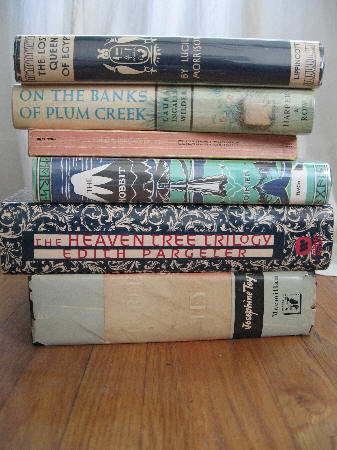
    I started with The Lost Queen of Egypt by Lucile Morrison.  This is the first book that I bought with money that I earned myself.  I was twelve and had a job at a very small academic library, pasting pockets and bookplates.  I loved this book, which I had checked out from the public library innumerable times, and it was the start of a lifelong fascination with Ancient Egypt.  It has a very dated feel to it, at times, and the archaeological/historical theories have shifted considerably (for instance, Tutankhamun is now fairly widely accepted to have been a son of Akhenaten by a minor wife, and so Ankhesenamun, the heroine of this novel, would have been his half-sister), but the writing is very atmospheric, and I find that even though I haven’t read it in years, I can recall passages from it almost word for word — I can still almost feel the heat of the sun on my skin, the rocks of the Valley of Kings beneath fine leather sandals, the cool plash of water on my fingers.

    Next, On the Banks of Plum Creek by Laura Ingalls Wilder.  This series was I think the first books that I bought myself, with pocket money — this is how my mind made the first connection between The Lost Queen and Plum Creek, but I also spent long weeks absorbed in these stories, and lost myself quite thoroughly in their time and place.  I don’t know if my old-fashionedness was a result of reading these books so thoroughly, or if I was drawn to them because I am naturally a little old-fashioned, but there it is.

    Then There Were Five by Elizabeth Enright is like the Wilder books, in that I have read the Melendy Family series so often that I can still almost instantly recall passages and their place in the series.  Wonderful characters, adventure, wit and charm, family and a deep understanding of children ("and probably she was going to have a scar!"), satisfying conclusions — this series struck a rich chord with me, and still does.

    The Hobbit by J.R.R. Tolkien comes next.  I can’t quite put my finger on why my subconscious made this connection.  Perhaps it was the sheer eventfulness of its place in my life, that inner pantheon of one’s Great Books, those read over and over so often that they almost become a part of one.  The Hobbit of course leads to The Lord of the Rings series, the same world and a continuation of the main story, but loftier in themes and language.  I appreciated the effort put into the movies, but I must say that I was disappointed that so little of the poetry and music remained.  This is one of the few poems (any poetry, not just Tolkien’s) that I can recite from memory —

    "Gil-galad was an Elven king,
    Of him the harpers sadly sing,
    The last whose realm was fair and free,
    Between the mountains and the sea.
    His sword was long, his lance was keen,
    His shining helm afar was seen,
    The countless stars of heaven’s field
    Were mirrored in his silver shield.
    But long ago he rode away,
    And where he dwelleth, none can say.
    For into darkness fell his star,
    In Mordor, where the shadows are."

    Tolkien’s "high" language sparked the connection to The Heaven Tree Trilogy by Edith Pargeter.  I have read so far only the first novel in this trilogy, The Heaven Tree, but was fascinated by the wonderful writing and the mediaeval setting.  Pargeter also wrote as Ellis Peters, the creator of the Brother Cadfael series of mysteries, also a long-time favorite of mine (the books, not the television series), and a series of modern mysteries.

    And "modern mysteries" leads me to Three by Tey by Josephine Tey, an omnibus volume of three of Tey’s mysteries from the 1930s and 40s.  Daughter of Time was the first one I read (which is in the other volume, Four, Five and Six by Tey) — in which a convalescent detective ferrets out the mystery of whether or not Richard III killed the princes in the Tower.  I wasn’t sure if I agreed with Tey’s conclusion in that particular story, but I was delighted with her style, full of intelligence and wit, in all of her novels.
  • ,

    Thrills and Chills

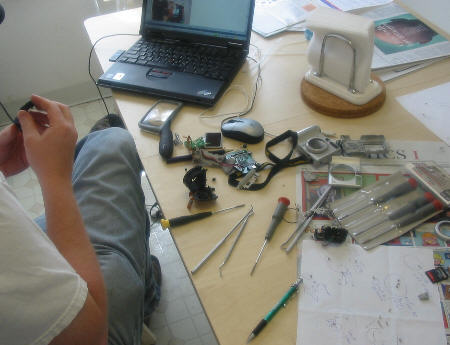
    My heart nearly stopped when I came in from the backyard yesterday to see this on the kitchen table —

    Camera2

    David had decided that since the US$125 camera repair bill was only a few dollars less than a new camera would cost, he would just see if he could fix it himself.

    So he found a few websites — one in Russian, but apparently it was still helpful — and started in.  Perhaps a closer view will convey some of the full horror —

    Camera1

    The two sheets of white paper hold the various screws with notations as to their placement.  He was fairly methodical about it, although got a bit enthusiastic the further in he went and stopped writing everything down, but when it was down to the bare bones — circuit boards flapping pitifully — he said, "A-ha!" and the lens retracted smoothly once again.  He did get it all back together and then found the lens gasket left behind on the table, so he had to disassemble it again and redo it with the gasket — but in fact he finished before dinner time.

    "You could blog this," he said modestly.

    Does it work?  Well —

    Hedera1_1 

  • Yellow_knitting

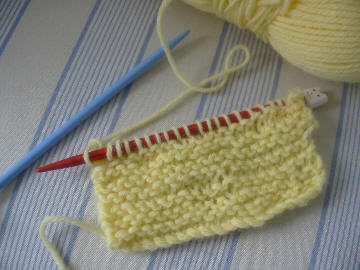
    This is Laura’s knitting — she chose the color herself.  She still goes in spurts of interest, leaving it alone for months and then doing a whole row at once, but still, this is not bad for a barely-six-year-old, I think!  She is learning right-handed, too, because that’s the way I knit, and I was impressed at how easily she managed it "the wrong way around" (although of course I didn’t phrase it that way to her!).

  • Beth writes, "I’ve finally bought my yarn!  It’s Dalegarn Hauk in a pretty shade of olive.  I really wanted to buy some gorgeous Jo Sharp DK in a color called glade, but it was twice the price, couldn’t justify it.  I’m swatching right now and pretty pleased with the yarn – I hope to post a picture (at least of my yarn and swatch) soon."

    Suse writes, "I’ve finished the yoke, and am working my way steadily through the first sleeve.  No pics this week; I’ll try and do better next week."

    Bigsleeve

    As for me, I cast on for the first sleeve a while back, and after only a few rows wondered if I should make the sleeves narrower than written.  I am, I’m afraid, one of those people whose sleeves drag in whatever happens to be around to have sleeves dragged in.  (Is this a mommy thing? am I just more susceptible now that I have small children in the household who leave messes around for me to drag my sleeves in?)  The sleeves are much wider than they appear in the IK photographs, due to the way that the model is holding her arms.  The easiest way to do it is, of course, simply eliminate the sleeve shaping, by casting on the same number of stitches needed at the point where the sleeve cap shaping begins.  But would this alter too dramatically the lovely swinginess of the garment?  I’m still pondering ….

  • Good morning, all, and here we are with another Swing Jacket update!

    Anne says, "I am such a bad knit-a-longer. I have a swatch just about done :)" — I must add here (partly in my own defense, as well as Anne’s) that there is no such thing as "good" or "bad" here, just "focused" or "distracted"!

    Suse writes, "Hooray, my yarn arrived!  I chose 8ply pure wool, from Bendigo Woollen Mills, in Cranberry.  The colour is just delicious and I’m looking forward to getting properly started" —

    Swatch_small

    "I’ve swatched, not something I normally do (shock horror) and have decided to go up one needle size.  I’ll start with the yoke I think, for a gentle introduction."

    I myself have been distracted with current and upcoming birthday parties, and the whirl of gaiety that is a kindergartner’s social life.  I cast on for the first sleeve last Sunday, and there it sits yet —

    Newsleeve

    But perhaps I will find some mommy-time somewhere this week, and add another row or two!

  • New_novel_homer

    Winslow Homer, "The New Novel" (1877), Springfield Museum of Fine Arts, Massachusetts.  Well, it should be obvious why this is a favorite of mine!

    Carllarsson_thebridge

    Carl Larsson, "The Bridge" (1912), private collection, Finland.

    Leighton_flamingjune

    Frederic, Lord Leighton, "Flaming June" (ca. 1895), Museo de Arte de Ponce, Puerto Rico.

    Vangogh_stilllifevasewith12sunflowers_au

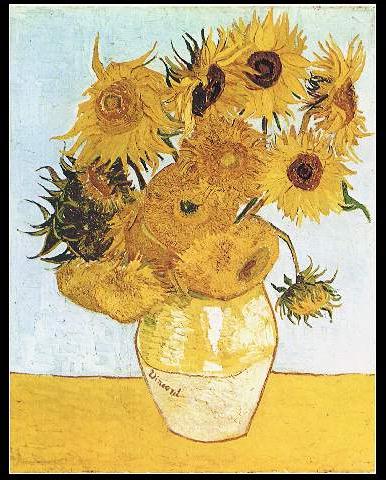
    Vincent van Gogh, "Still Life: Vase with Twelve Sunflowers" (August, 1888), Neue Pinakothek, Munich.  What would a collection of yellows and oranges be without van Gogh sunflowers?

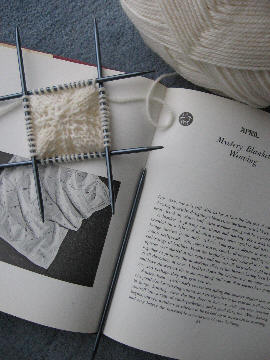
  • April’s Knitter’s Almanac project is a "mystery blanket," the mystery being in the fact that it has no apparent beginning.  Elizabeth pondered the idea of weaving together squares that had been knitted in the round, thereby "[producing] the mysterious effect of the blanket having been knitted in all directions at once," and this pattern was the result.  The technique may have been quite inscrutable at the time, but these days with our sometimes-emphasis on the eye-catching and marvellous (sometimes merely for the effect of being startling), it’s not so unusual, I think.  It was used quite gracefully by Selma Miriam in her Kousa Dogwood Shawl in Melanie Falick’s Knitting in America (reprinted in paperback as America Knits), which I remember knitting a number of years ago.  Still, Elizabeth’s blanket is very handsome, and the technique is not to be scorned simply because it is not so unusual as it once was!

    Ezapril

    Elizabeth used her 4-Ply Sheepswool, which is apparently now 3-Ply, working up originally at 12 sts per 4 in./10cm.  This pattern looks extremely adaptable to different weights of wool, and so since I’m on a b*dg*t, I’m using Patons Classic Wool with those handy weekly 40%-off coupons from Michaels.  The Classic Wool works up to about 20 sts per 4 in./10 cm, so you can either knit the squares to the given stitch count, and simply make more squares, or work to the given measurements, and weave more per square.  (Let’s see, 96 sts divided by 4 is 24, so 24 sts at 3 sts per inch in the Sheepswool would make 8-inch squares.  And 96-stitch squares at 5 sts per inch in the Classic Wool would make 4.8-inch squares.  Or 8-inch squares at 5 sts per inch means 40 sts per side, 160 altogether.)

    And, oh yes, there will be a lot of weaving!  "If you are one who hates and fears weaving (or grafting, or — why — Kitchener-stitch), and tries to con others into doing it for you, now is the time to take yourself in hand"!

  • Suse writes happily, "I have chosen my wool!  Da-dah!!!  8ply DK in cranberry.  Am ordering it tomorrow so hopefully this time next week I will have cast on, or at least swatched …"

    Theresa has in fact finished!

    I had put off the back piece, a bit dismayed at the prospect of working that wide piece on regular-sized straights (one US2 and one US3, not being in a situation at the moment to use Philippa’s brilliant suggestion of interchangeable circulars), but it proved not such a bother as I had thought.  The pleat lines showed up almost immediately, to my amusement.

    Img_3779_small

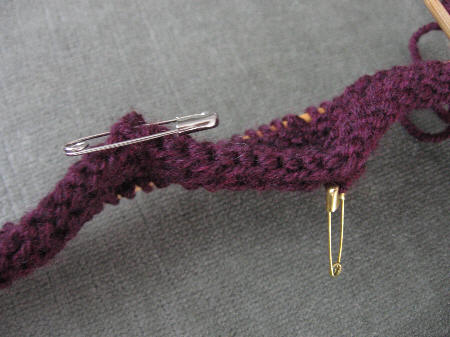
    The markers are not absolutely necessary, as long as you pay attention towards the middle of the rows.  I never moved my markers from the first row, except once, when I knitted instead of purled one and didn’t feel like tinking back through the cable section, so I moved the pin up to keep myself from missing it again, and simply reset that stitch as I worked the next row.

    Img_3782_small

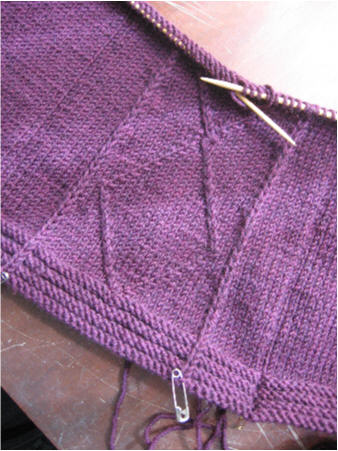
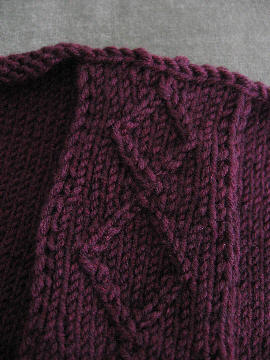
    The points of the diamond gave me some pause, until I realized that the crossing lines do not actually line up, giving a sort of "twisty" effect, instead of the expected Xs.

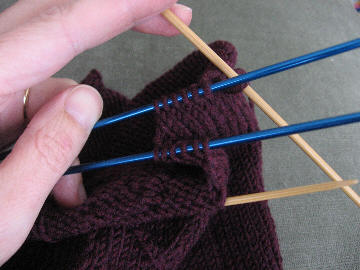
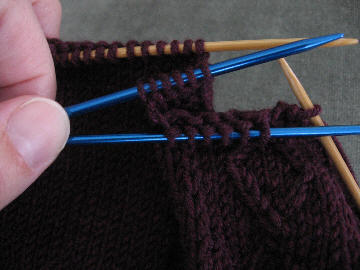
    Some people have voiced a bit of nervousness about the pleat on the back piece.  It’s one of those things that looks a bit daunting and wordy when written out, but when you actually do it, it goes together almost effortlessly.  Here is mine after folding at the pleat lines for the first half, on the right side (the sections will make a kind of S shape) —

    Pleat1

    Just be sure to hang on to the working needle!  I was so busy folding the pleat that that needle kept sliding out.  Working the K3tog section is but the work of a moment, being only 6 sts long — it’s fiddly, rather than difficult.

    And here is the other half of the pleat, which will make a vaguely Z-shaped arrangement —

    Pleat2

    The last K3tog —

    Pleat3

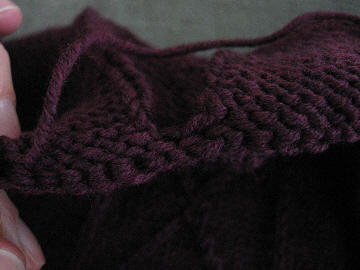
    and a finished pleat!  Mine tended to make a bit of an hourglass shape, due I suppose to the loose binding-off, but this came out in the blocking.

    Pleat4

    Pleat5

    Pleat6

    Voilà!

  • Here are two Interweave Knits projects — in this month’s "Project Spectrum" colors — that I’ve been happily pondering for a while —

    Saltpeanuts_ik

    Sunrisecircle_ik

    — Véronik Avery’s Salt Peanuts and Kate Gilbert’s Sunrise Circle Jacket.  Neither of which, I confess, I am interested in knitting in orange, but would look equally fantastic in a color more suited to my complexion!

  • Redscarf

    I had a suspicion that I would probably not get around to knitting in the current Project Spectrum colors each month, with so many other things in the knitting queue (let alone life, etc.), but here is a red scarf on the needles.  It’s a perfect car-knitting project, eminently rollable, for those I’m-five-minutes-early-to-pick-up-the-girls-at-school days.

    I heard about the Red Scarf Project too late this past year to send something in, so I wrote and found out that it will be an annual project.  The Orphan Foundation of America makes "care packages" for foster children who are going off to college, and the packages around Valentine’s Day contain among other things a red knitted scarf.  As the OFA website points out, "[The college-bound kids] are success stories merely by showing up: Studies show that less than 50 percent of foster youth graduate from high school, and less than 10 percent go on to post-secondary or vocational training," and most of them don’t have families to support them. 

    This particular scarf is in Bernat Soft Boucle in a rather vivid scarlet.  I’m working it on the bias — I like the way that the fabric feels this way, a little bit more intriguing than straight rows, especially with the bouclé disguising the angles.