-
-
I’ve added an album to my sidebar about knitting caps for chemo patients, with yarn suggestions and links to free patterns online. (The beautiful pink ribbon image is from the BBC’s Breast Cancer Awareness Month page.)
Please feel free to write with further suggestions!
-
Here are two chemo hats for my friend. Odessa is a fast knit, simple and elegant, easily memorized (even the crown shaping), and it uses only one ball of Cashsoft with quite a bit left over, so you don’t have to skimp. I left off the beads, obviously, not sure how that would feel as a chemo hat.

The hint of cashmere makes it wonderfully soft. And it looked so cute on Laura that I suspect I’ll be making more soon!
Shedir was rather more difficult. I expected this, of course, from looking at all of that knotwork! but I didn’t expect to run out of yarn a full two inches before the end of the hat. I had to pull out a good portion of it, removing one of the braid repeats, which gave me enough to finish. (I also found not one but two knots in the ball, which with the iffy yardage leads me to wonder about Rowan’s quality control. My gauge was spot-on.)
The pattern itself is complicated, with a lot of fiddly cable work, although the chart may be a little more off-putting than it needs to be — the reason for the numerous cable symbols being that in some places you cable over two knit stitches, and on others you work this maneuver over a knit and a purl, which is called a twist (not technically a cable, apparently), and these require different symbols. After the first repeat, though, it all starts to make sense.
(I think there is an error on the chart, though, at round 63, which should include one of the stitch marker shifts.)
A bonus is that inside is a lovely smooth field of mostly knit stitches, very nice for sensitive heads, and a very thoughtful touch on the designer’s part.
I am actually happier with the shorter version. I’ve heard that longer caps are better for chemo patients, to keep the head covered and I suspect to disguise the lack of hair, but I think that the cap is more flattering with it not quite so low on the forehead. (It’s more trendy in the original length, to be sure, but for myself I prefer flattering over trendy any day, and I think that my friend does too!) At this shorter length, it can still be worn back on the head so that it reaches the nape of the neck, but it frames the face a bit better.

-
I’m catching up this week — three posts in one.
Booking Through Thursday this week is brought to you by Deb.
- What is the most pristine, perfect book in your collection? The one that looks like it’s never been opened (and in fact may never have been)? Whose binding is uncracked, the corners still perfect? I don’t think I’ve ever bought a book without opening it, and I rarely bring one home without at least perusing it that day, if not reading it fairly soon (although it may take a while for me to get started on it, to be sure). I take good care of my books, even paperbacks, and so barring some unfortunate accident, they are generally in good condition.
- Why is that book so perfect? Was it a gift? Is it a coffee table book too beautiful to use? Something you simply have no interest in and haven’t bothered to open? If a book is beautiful, then it deserves to be read, and I love looking at beautiful books; I also don’t keep books I’ve no interest in. The one in my collection in most pristine condition at the moment is probably the very newest, The Week-end Book edited by Francis Meynell. It’s a lovely little volume of chapters designed to fill one’s week-ends in the country, something to stick in a pocket before a long walk, or leave on the nightstand and skim before bed. There are identifcation guides for flowers and animal tracks and architecture and birdsongs — including musical bars written-out — recipes and poems and games and rounds to sing in the evenings, all written with exceedingly proper British prose and wit. (I am very amused at the publisher’s note on Amazon, "with various editions and altercations," though I suppose this was not on purpose.) I’ve in fact gotten lost for the past ten minutes in the article on penmanship — "PPS. W.R. Lethaby once wrote: ‘A common interest in the improvement of ordinary handwriting would be an immense disciplinary force; we might reform the world if we began with our own handwriting but we certainly shall not unless we begin somewhere’"!
The questions for the week of July 6 were suggested by Christine.
- Do you read non-fiction books for pleasure, not counting books required for courses or for work? Absolutely. I used to read a lot more fiction, but for some reason, in the last five years or so if not more, I’ve gravitated more towards non-fiction.
- If so, what areas of non-fiction interest you the most? If not, why not? History (social history, more often than not) and biography, literary criticism. I’m currently reading a paperback copy of John Guy’s Queen of Scots, which I found in a box of stuff that my aunt was giving away. The last biography of Mary that I read was Antonia Fraser’s, some years ago, and although I tend to lean towards Elizabeth I’s side of the story (if I have to choose sides atal), I still find myself fascinated by the goings-on in 16th-century Britain. (The copy that I read was a library book that had been extensively annotated — in pen — by a rabid supporter of Mary, who made such vicious and copious notes in the margins that it quite colored my reading of the book and stands very clearly in my memory of it. Funny, how such things can affect the reading of a book. I felt quite defensive of Elizabeth.)
The questions for the week of June 29 were suggested by Marie.
- Do you ever reread your books? Oh, yes — some more than others, of course. But one of my criteria for buying a book is whether or not I intend/hope to read it more than once — otherwise, it’s a library read. I found Anne Fadiman’s Rereadings to be a fascinating look at this very topic, the rereading of long-ago favorites.
- If so, which ones? If not, why not? Novelists that I love — D.E. Stevenson, Tolkien, Jane Austen, Eva Ibbotson — nonfiction and biographies that inspire me (through the subject or the author’s writing).
- Do you read the books the whole way through or pick through for favorite scenes? I don’t often go straight to favorite scenes unless it’s just to verify a quote or passage, in which case I don’t consider that really rereading.
- What qualifies a book for the reread pile? Something that captures my imagination, whether through brilliant writing, locales I love, "kindred spirit" characters, it could be any number of things!
-
I have a dear friend who will be starting chemotherapy for breast cancer in a couple of weeks, and so naturally my thoughts quickly turned to knitted comforts. Fortunately, in a way, my experience with chemo is limited to one person in my family — also breast cancer, like my friend — but since it was high summer in Southern California during her worst weeks, she felt most comfortable without anything atal on her head, and so doesn’t have much advice about patterns or yarns. If anyone has suggestions, I would be most grateful!
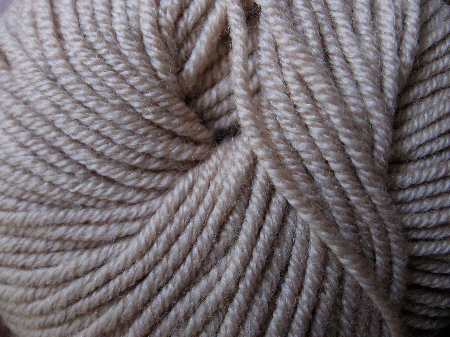
I’ve been admiring Grumperina’s lovely Odessa for some time, in and of itself, and so that was the first thing that came to my mind. Grumperina used RYC Cashsoft DK, and I even happen to have some on hand, in a beautiful thundery grey, very "Scottish autumn," as per the request. But I’ve read in a couple of places that wool is not recommended for chemo caps, and so I hesitate — Cashsoft being a merino/microfiber/cashmere blend. There is also Shedir in Knitty’s Breast Cancer Awareness issue from a few years back, and I think that Rowan’s Calmer would be a wonderful cloud-soft choice. My friend thinks that perhaps something close-fitting, as these both are, would be uncomfortable, but I wonder if something loose wouldn’t stay on very well, once the hair isn’t there to help hold it on.
There is definitely a consensus on the internet about seamlessness — understandable in the circumstances. But what about the wool? and washability? Does the luxuriousness of Calmer and Cashsoft outweigh the dreariness of handwashing things when one is not up to it?
There are, by the way, lots of free knit and crochet patterns for chemo caps at Head Huggers (which also accepts donated caps for distributing to patients of all ages), and links to patterns here from Dallas/Fort Worth Fiber Fest — I’ve also found a fancier hat at KnitPicks (which might work in Calmer…) and a rather fetching toque here, too.
-
July is not, I’m afraid, Travel-Month for us — but I can see, as Elizabeth makes a point of telling us in this month’s Knitter’s Almanac chapter, that shawls make good travel knitting. "First of all, fine wool takes up little space, but affords plenty of actual knitting. Secondly, a circular needle can hardly get lost unless you pull it out by main force and cast if from you." You can even store the current ball of yarn in the little "bag" made by the growing shawl on a circular needle!
The Pi Shawl is possibly Elizabeth Zimmermann’s most well-known design — a quick internet search yields 47,500 hits, from projects on individual knitting blogs to knitalongs to kits from dozens of vendors. Based, of course, on the geometric relationship of the circumference of a circle to its radius, the Pi Shawl is one of those things that seems so obvious that you wonder why no-one had ever done it before. The circumference of a circle doubles as its radius doubles — thus, doubling both the number of stitches and the number of rows between increase rounds will get you a shawl that shapes itself neatly and efficiently into an ever-larger circle. Brilliant, and brilliantly simple.
"Need it be said that the first and most important step is to choose the best material available?"
Mine is Koigu KPPPM in shade P305, a rather sedate (for Koigu) blend of lavendars, purples, and greys. It was a coincidence that it matches this month’s Project Spectrum palette, but a happy one, to be sure! I ordered it late last summer, when I first thought of doing the Almanac — it’s the month I’ve most looked forward to, in fact. I like both of Elizabeth’s versions, but although the one in the top picture is pretty (for those, like me, to whom it would matter, there is a slightly different version in Knitter’s Magazine Shawls and Scarves, in which the diamond and petal patterns are straightened out to align symmetrically), I thought that the concentric-circles would be more interesting with this Koigu colorway.
One of the nice things about working from the center outwards is that in gratifyingly short order, you’ve really gotten somewhere!
-
Since I didn’t do much more for Laura’s first year of Brownies other than drive her to and from meetings — and work on a few Try-Its, the Brownie equivalent of merit badges — I thought I’d jump in at the deep end and volunteer for Girl Scout Day Camp this summer. We start tomorrow — the theme this year is Hawaii, hence the lei — and the girls are beside themselves with excitement. (Julia gets to go too, as the Scouts have cleverly come up with "Pixies" to accommodate those moms with younger children who would otherwise be unable to volunteer.) As it is all day, every day this week, I’m going to take a break from blogging during the event!
Nice that some of our stuff is Project Spectrum blue, too!
-
Because there seem to be so many blues in Scandiavian art, I thought I’d devote a "room" in my imaginary museum to Scandinavian blues —
Carl Larsson, "Suzanne and Another" (1901), private collection. This really speaks to me for some reason, perhaps the blue of Suzanne’s dress and her long braid, and her standing on a chair to decorate her new bedroom, the fact that she’s probably getting paint on her dress but she’s concentrating so much that she doesn’t notice. Apparently the frieze is still there in the Larsson home in Sundborn. ("Another" refers to the worker on the ladder outside, Carl Oscar Persson, a Sundborn local and the Larssons’ house-painter, who appears in a number of Larsson’s paintings.)
Peder Severin Krøyer, "Summer Afternoon on the South Beach of Skagen" (1893), Skagen Museum, Denmark. This painting is so iconic that it is almost too much so, and becomes perhaps more than a bit of a stereotype and like much of Larsson’s work quite sentimental. But it is lovely, so filled with light and blue, that I can’t help admiring it.
Christen Købke, "The Landscape Painter Frederik Sødring" (1832), Den Hirschsprungske Samling, Copenhagen. I adore this fellow, adore everything about this portrait, from the rather weedy little ivy plant and the pink and white striped cushion cover, the jumble of stuff on the table and wall, to his casual pose and the twinkle in his eye.
Peder Severin Krøyer, "Ettermiddagssol og Havblik (Late-Afternoon Sun and Calm Sea)" (1899), Johannes Larsen Museum, Kerteminde, Denmark. I can hardly get enough of Krøyer’s beach scenes, the light shining on the waves in this one, and the even more intense blues than usual.
Peder Severin Krøyer, "Stenbjerg med Marie Malende (Stenbjerg with Marie Painting)" (1889). It’s easy to see why Skagen captivated so many artists, with its marvellous light and the spare beauty of the sand and the waves. I can hardly wait to go there myself.
-
In honor of what would have been Billy Wilder‘s hundredth birthday today, I watched one of my favorite of his movies tonight, "Sabrina" with the ever-lovely Audrey Hepburn.
Apparently, Cary Grant was the original choice for Linus Larrabee, played in the movie by Humphrey Bogart — I can’t help wishing that this had come off, as I personally would feel more likely to be torn between the two brothers, the dashing William Holden and the straight-laced (as if!) Cary Grant. Still, it’s a charming movie, full of wit and romance, and Audrey is exquisite!
-
Blackbird, in honor of her eagerly-awaited holiday, would like to see our luggage. This, I must admit, is not my travel luggage, a random collection which is since our last jaunt packed away in the far reaches of the garage. I bought this case in London, years ago when I was young and carefree. I cannot now remember which shop — there were so many! — and it has no maker’s mark, other than a discreet "Made in Italy" tucked inside.
I loved its boxy lines, its way of standing open at attention, the fact that even though it is rather awkward to carry (being so wide, with the handle in the middle, causing it to bump inelegantly against my leg), it is perfect for strapping onto the back of the roadster.
It in fact holds a part of my wool stash, and I’d gotten it down from a shelf in the closet recently to weed out the stuff that no longer speaks to me. I’m tempted to make the case a project bag now, but it would have to be something special …