• Peacock

    Cth_supersock_peacock_1

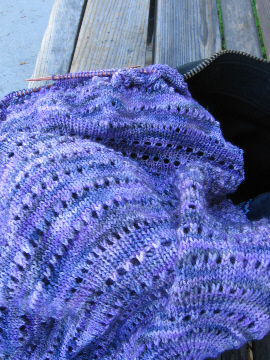
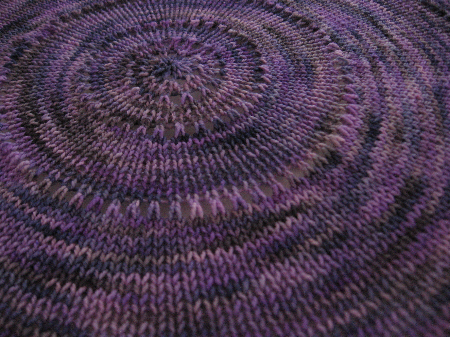
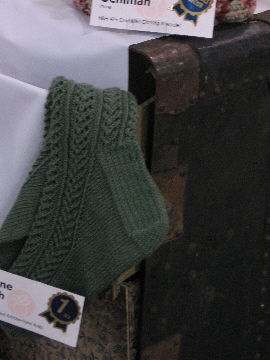
    Supersock from Cherry Tree Hill, in "Peacock", to be a pair of socks for a gift.  Nothing fancy, just a 3×1 rib to enjoy the colors, which are fabulous —

    Peacockstart

  • Welcome to new members of the knitalong, Sarah of Lieblingsgarn, and Little Jenny Wren!

    Bec writes, "I’m going to try to finish my left front later today – thanks to Suse helping me with the ‘wrap’ instruction!  That’s all I’ve done so far but it went together faster than I thought.  I will send in updates as I go too.  I’ll say thanks again for the toothpick tip as I would never have got the back pleat right without it!  Cheers –"  (I had mentioned to Bec that I use a toothpick as a cable needle, as it does the job perfectly well, stays stuck in one’s knitting, and can be lost on the bus without much financial damage.)

  • Booking Through Thursday‘s questions this week were suggested by Mary.

    Which book character(s) would you…

    1. Like to have dinner with? Captain and Mrs. Wentworth (as they would be after the end of Persuasion).
    2. Believe would be the best to help you out in a crisis? Well, an obvious choice for a good person to be stuck on a desert island with would be Robinson Crusoe!  I remember being fascinated with this book when I first read it years ago, how resourceful he was.
    3. Like to ask for an autograph?  Lucy Pevensie, perhaps?
    4. Most identify with personally? This one is difficult — there are so many!
  • Pealerembrandt_rubenspealewithageranium

    This — which is Rembrandt Peale’s "Rubens Peale with a Geranium" (1801), from National Gallery of Art, Washington, DC — was supposed to be my Show and Tell a houseplant last week, since I had been so busy watering my family during the brief but blistering heatwave a few weeks ago that I forgot to water my houseplants, and they are both looking more than a little peaky at the moment.  The Peale boys’ father hoped that they would all be great artists, hence the names like Rembrandt, Raphael, Titian, and Rubens — from what I’ve seen of dad, I suspect they hardly dared not to.  I like Rubens — he has a sweet Hugh-Grant-ish look to him, and I warm to the fact that he needs two pairs of glasses.

    But hats, something we wear in the summer, that’s what we’re supposed to be doing — I have a rather disreputable straw thing which I wear in the garden when necessary, but to be honest, I rarely go out in the sun.  I can’t find my hat at the moment — hence the photo for last week’s — a few days ago it was being used as a kind of boat/hot-air balloon basket to carry Little People from one side of the living room to another, and I haven’t seen it since….

  • My father-in-law is a wonderful person, and I don’t mind the whole world knowing that I think so.  When my mother-in-law asked me if I could mend his favorite cardigan as a surprise birthday present, I jumped at the chance.  He bought this sweater some thirty-five years ago on a trip to his ancestral home in Scandinavia.  Unfortunately for the sweater, he loved and wore it so much that the cuffs gave out, causing it to be packed away in the closet for years.

    Nesjar

    Cardigan

    Frayedcuff

    Holes

    I also found a number of moth holes, so this turned out to be quite instructive for me, as well.  I’ve always shuddered when faced with the possibility of something needing mending, but I will say now, it isn’t as bad as you might think.

    I took the sweater to my favorite yarn shop, and asked one of the owners for some advice on wools.  "Oh, well," he said dubiously, shaking his head, "you’ll just have to look through the store, until you find something that matches," and he handed me a skein of black Sandesgarn Smart superwash, and left me to it.  I looked through the whole place after that, but it turned out that the Smart was indeed the best choice.  The sandy-brown of the body has a hint of slightly darker sand in it, but the rich coffee-brown wool at the edges has an almost silvery hair running through the brown that gives it a lovely depth, and the skein of Smart has this same hint in it.

    The shop owner also suggested tapestry wool, which as soon as he did stirred something in my memory to the same effect.  There is not only a very wide variety of colors available, but you also don’t have to buy very much at a time, either.  I ended up getting a pretty close match for the main color with a dollar’s worth of tapestry wool,

    Wool

    and took the black Smart for the cuffs.  I didn’t notice until afterwards that there was also a small hole in the burnt orange inside the neck hem, so I had to go back for another bit of tapestry wool — "oh, no," I said aloud, to no one in particular, "I have to go back to the yarn shop."

    Many moth holes are, of course, obvious, but I found a number of not-quite-holes by holding up the sweater to the sunlight, which showed them quite clearly.  I didn’t see the third one here until I did this —

    Findingholes

    There is surprisingly little in knitting reference books about mending.  Luckily for this particular repair, which usually involved only one stitch per hole, duplicate stitch (also called Swiss darning) is an excellent solution.  Most reference books have full diagrams and instructions on this for stockinette, and Theresa Stenersen’s article is very helpful as well.

    The brioche stitch of this cardigan involves a more complicated maneuver with the needle than plain stockinette, and for the first five or six holes, I had to turn the piece for each stitch, working first the front loop, then the back loop separately.  (I dreaded the sleeves, which this way would have meant doing the front loop, turning the sleeve inside-out, doing the back loop, turning the sleeve right-side-out, doing the front loop….)  But after a while, something clicked in my mind, and the maneuver became much less complicated.  Stick with it — it gets easier with practice.  Don’t be tempted to skimp on the anchoring stitches on either side of the hole, as an inch to an inch-and-a-half of anchoring stitches will not only keep the loose ends from ravelling, but it will also give you a bit of practice, a running start if you will.

    Since I am right-handed, I found it easier to work from right to left at first.  Bring the needle up through the bottom of the first stitch (the V-shape), and around the first loop at the top,

    1

    then down back through the bottom of the first stitch and without going all of the way through the fabric aim the tip of the needle out toward the left.  Push the fabric out a little from the back, if you can, so that it is easier to see the direction of the original wool.  It’s a bit like following someone through a tight maze; just stick close.  The brioche doesn’t go straight across to the next V from here as the stockinette would, but up again and slightly to the right, almost underneath the first stitch, then across in a purl bump,

    2

    then down again slightly to the left, and under the lower purl bump, to come out at the bottom of the next V.

    4

    Or, work the first knit stitch from the front — up from the bottom of the V, around at the top, and down again at the bottom of the same V, and do go straight through to the back.  Turn the work over, and work another knit stitch where the wool is placed — this V will be smaller than the front V —

    3

    and straight back through at the point of that V, to the front.  I’m fairly sure that this doesn’t quite capture the form of the brioche, but it is nearly invisible, and that is, after all, what counts in mending.

    One of the cuffs was frayed completely, which involved picking up the loose stitches — which thanks to the lovely hairy wool had dropped only one row — replacing the dropped row, and grafting the two sides back together.  (The lump in the middle is the seam of the sleeve, which was worked flat and sewn together.  Being at the underside of the wrist, it was the first thing to go.)  The Smart is a 4-ply, and so I pulled out one of the plies to make it a more similar weight to the original wool, but I didn’t want to do more than that and compromise the strength of the wool.

    Cuffonneedles

    In a way, it was nice that there was actually an open section, as I could put my finger inside the hem and see clearly where to put the darning needle.

    Graftingcuff

    I stopped for a moment, literally to smell the roses, as the "Gertrude Jekyll" bush just outside the sunroom window is covered with gorgeous blooms, and so I brought some inside to enjoy close-up.  Thorny things, but a heavenly scent, not to mention the color.

    Gertrudejekyllrose

    The section of cuff that was the most frayed looked a bit wonky when I was finished, but on the whole it went back together pretty well, I thought.  The whole fold line was looking a bit thin, so I darned that row all of the way around.

    Mendedcuff

    The other cuff was just held together —

    Worncuff

    but with a good strong light and a large, flat surface to work on, the duplicate stitch went very smoothly.  The black is rather obvious against the coffee-brown original, but this is less apparent when folded in its usual position.  I still like the depth that the little silvery fibers give the wool, both the original and the Smart, and I think that a flat brown mend would have actually stood out a bit more against the original.

    Mendedcuff2

    Pewterclasp

    The hole on the inside of the collar was a cakewalk after the brioche and the cuffs,

    Collarhole

    duplicate stitch up to and around the hole, pulling the ends inside the turned-over hem.

    Mendedcollar

    Tapestry wool does have a different texture than this wool, but after washing and a few judicious tugs, this will settle in.  I don’t usually iron knitted things, but early on I decided that this one actually requires a good pressing, since the uniformity and flatness of the machine-knitting make the hand-mending stand out a bit.

    Mendedholesoutside

    Twenty holes in the body and sleeves, one inside the collar, and two frayed cuffs repaired!

    I had not actually seen this article on repairing knits when I started, but it’s worth keeping on hand —

  • Well, this is a fast project — I was finished with it before the ink was even dry on the last post!

    Hat3

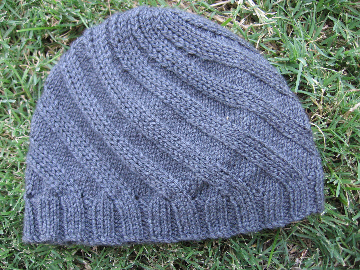
    Interestingly, it took more wool to do the bottom half than it did on the top, despite the rather large opening for one’s head.  I added the second ball in the middle of the turning, and had a fair bit left over.  It was also curious how the spacing of the decreases affected their shape — on every other row, the SSK and K2tog pairing lies smoothly, but working them every row (about halfway along the top) makes them stand up a bit, even tending to fold away from each other.

    I did make a rather embarrassing gaffe at first, reading "Gauge: 5 1/2" and realizing after a few inches that the hat coming off the needles would barely have fit a baby doll — the gauge is "5 1/2 sts to 2 in.," which I can only murmur weakly is an unusual way of writing it.  I did have to adjust the pattern then to fit the gauge of the Cleckheaton, which was in fact 5 1/2 sts per inch, so I merely doubled the cast-on.  The "pithy directions" are especially pithy here, and I found the longer explanation in the text of the chapter much easier to follow, especially as Elizabeth gives measurements here instead of row counts, and I could use those for my readjustments.

    Hat1

    Hat2

    I was happy to take Elizabeth’s advice — "Do not feel that you are in any way obliged to possess perfect sets of four needles.  Emergency and experiment have taught me that a very motley quartet will finish off a hat quite adequately"! — since I have at the moment only a US6 small circular and 3.75mm (US5) double-pointeds.  I used the circulars for the majority of the hat, and finished it off with the smaller dpns when it got towards the end.

    It has a rather beret-like languor — which would be lessened with a firmer gauge, of course — and the corners make it not a little jaunty.

    Hat5

    "Wear it down or up, with the point to the front or the back, or with all points tucked in — it has as many lives as a cat"!

  • Ez_june

    This month in the Knitter’s Almanac, Elizabeth talks about hats and borders.  "I will come out flat-footed and personally disapprove of crocheted borders on knitted cardigans, but without in anyway trying to convert those who crochet borders expertly and with pleasure.  May their paths run smooth."  Ahem!  Garter stitch — it should come as no surprise to anyone who has read even a few chapters of any of her books — is her favorite, worked sideways or straight, to create a simple, flat border for sweaters and cardigans, shawls and blankets.

    (She does say, touching on the subject of borders at the neck of a cardigan, "Don’t forget to increase at the front neck-corners, and to decrease at the inside corners of a square neck," which I fear that she neglected to point out in the January chapter, regarding the Aran.)

    Like Elizabeth, I’m not much of a fan of grosgrain borders, either, which always seems to end up slightly smaller than the knitted part, however sturdy it makes the buttonband.

    As for hats this month, she says, "A good summer project is a bevy of hats.  They don’t take much wool, and are an excellent means of using up leftovers and oddments in the form of stripes or color-patterns."  I do have about four balls’ worth of the teal-green Cleckheaton left from last month’s mittens, and so I will use that.

    The mitered or "ganomy" hat — gnome, to us, with that pronunciation like "gaze-bo" or "sword" with the "w" firmly pronounced, which has stuck with us since childhood — looks very practical indeed, with the miters coming down over one’s ears most warmingly, and the Maltese Fisherman’s Hat even more so (with its "ridiculous tassel of a couple of dozen ends … make still more antic by cutting them at different lengths and putting a knot at the end of each"!) — but since I am going to make a set with the mittens from last month, which look rather less casual than the Ganomy, I will do the Three-Cornered Hat for this month’s Almanac project.

  • Constable_cloudstudy_1822_cortauldinst

    John Constable, "Cloud Study" (1822), Cortauld Institute of Art Galleries, London.  My first introduction to Constable was, I confess, through a Monty Python sketch in which one of the key phrases was — I think in one of Graham Chapman’s pepperpot voices — "Oh, look, it’s the man from ‘The Haywain’!"  Python notwithstanding, I’ve grown quite fond of Constable, and this cloud study is perfectly lovely.

    Canalett0_grandcanalfromsmariadellacarit 

    Canaletto, "The Grand Canal, Venice, from Santa Maria della Carità to the Bacino di San Marco" (1730-33), The Royal Collection, Windsor.  I think that I get almost as much fun from just saying the title of this painting as I do imagining myself in it.

    Carllarsson_insundbornchurch

    Carl Larsson, "In Sundborn Church" (1905).  This is rather unexpected from the stereotypical Larsson watercolors of jolly young children outdoors — subdued, moody, with the architecture taking the focus and the people half-hidden and obscured, with the tight, almost claustrophobic perspective and the infinitely beautiful blues.  I like the rather finished look of Karin in the sunlight and the less-polished brushwork of the townspeople in the shadows inside.

    Mauricequentindelatour_selfportrait_1764

    Maurice Quentin de la Tour, "Self-Portrait" (1764), Norton Simon Museum, Pasadena, California.  Another of my favorites at the Norton Simon (apparently another version is in Amiens), this self-portrait is remarkable not only for the brilliance of its colors and detail and its charm, but also for the fact that it is quite small, just 18 x 15 in. (45 x 38 cm).  He looks very French, does he not?  I find it very poignant, too, that on first appearance, even second, this portrait delights with the casual turn of his head and the pleasant smile, and yet his eyes are rather sad.  One hesitates to read too much from an artist’s life into his works, but de la Tour suffered from mental illness in the second half of his long life, and it seems to me that he senses it already.

    Boticelli_madonnaandchildwithadoringange

    Botticelli, "Madonna and Child with Adoring Angel" (ca. 1468), Norton Simon Museum, Pasadena, California.  A gem among gems at the Norton Simon.  The rather shimmery lines in this image are actually golden in the original, which has a luminous, ethereal beauty surrounding its impeccable draftsmanship.

  • Beth writes, "I’ve started on the back, seems to be going smoothly so far – I just find Kate’s design with that back pleat to be ingenious.  However, I think I need to make mine a little longer than the pattern calls for – and feel rather intimidated to figure out how without goofing up that pretty pleat as well as matching up the front pieces!"

    I think that lengthening the body would involve a bit more than just working it longer than instructed, because of the back pleat.  I’ve never modified such a tailored garment before, so if anyone has some advice, please shout out!

    My guess would be that in order to keep the armhole shaping intact, the length needs to be added to the body pieces below the point where the armhole shaping begins.  On the front pieces, this isn’t much of a problem, as you can either add some rows in at the "continue even in patt until piece measures ___" part, or add two rows in between the decreases (as I did for the sleeves), to keep the line of the side seam straight.

    For the back, you might be able to add a bit of length by widening the yoke piece, and then repositioning the armhole shaping on the back, but you either have to know ahead of time that you will adjust the length, or be prepared to reknit the yoke.  This would be considerably fiddly, as well as setting the top of the pleat further down on your back, rather awkwardly.  The diamond section on the pleat is the same on all sizes (112 rows), and so obviously the least-complicated way is how Kate set the stitch count for the differing sizes, by adding stitches to the plain sections on either side of the pleat, and then at the "cont without further side decs" section (just before the armhole shaping begins), do decrease until the correct number of stitches for your size is reached.  The pattern doesn’t give you much space to perform this trick, but I think it could be done, as long as you don’t want a lot of extra length!  It might be simpler to put the side decrease rows closer together, spacing them out evenly through the stockinette section.

    Whew!

  • Mary Tess sent me some photos of her very handsome Norwegian Mitten, the other mitten pattern in the May chapter of Knitter’s Almanac, which she finished at about the same time I did my mitered mittens.  Elizabeth would be proud, don’t you think?!

    Marytess_2_1 Marytess_palm_2

    Mary Tess writes,
    "Specs: Norwegian Mittens from Elizabeth Zimmermann’s Knitter’s Almanac
    Yarn: Dalegarn Falk 100% superwash wool 50 g. 116 yds/106 m. 
    Colors: grass green (a much brighter green than appears on the monitor) and cream
    Needles: Rosewood 2.5 mm (U.S. 1 1/2) dpns
    Gauge: 15 1/2 stitches & 15 rows per 2 inches in stranded pattern
    Completed size: 10 1/8 inches long, 7 inches around hand
    Completed width at cuff: 4 inches
    One mitten used less than 50 g. of yarn
    This size would fit a child."