• Booking Through Thursday asks a rather provocative question this week —

    1. Do you tend to read more books written by one gender over the other? I haven’t ever considered this!  Upon reflection, the last three books I’ve gotten from the library — assuming that cookbooks don’t count, although in the strictest sense of the issue, I suppose they should — A Year in the Life of William Shakespeare by William Shapiro, The Short Life and Long Times of Mrs. Beeton by Kathryn Hughes, and Anne Boleyn: A New Life of England’s Tragic Queen by Joanna Denny makes it two to one for the women. 
    2. If so, which one? Men? Or women? Is this a deliberate choice? Or just something that kind of happened?  I am glad to say that I do not choose books on the basis of their author’s gender, but instead on the interest said books may hold for me, the recommendation of another reader I trust (as a personal friend or as a professional reviewer), or on other writings by the author.  The only situation I can imagine where this might happen is that of encouraging certain categories of author, such as regional, cultural, maybe even occupational.  It doesn’t seem to me, thank heavens, that women authors need that kind of promotion much these days.  That said, one of my favorite subjects is women’s issues, but I don’t consider the author’s gender in the choosing, but whether he or she writes well, knows the subject, teaches me something that I didn’t know before, and so on.
    3. And (without wanting to get too personal), is this your gender?  I am in fact female.

    As a postscript to this question, looking at my short list above, I did notice that of the three books I checked out from the library a few weeks ago, I bought the one written by a man after reading merely the first two chapters, finished reading one of the two written by a woman (the biography of Mrs. Beeton), and am seriously considering dropping the second of the two written by a woman (the Anne Boleyn biography) due to clumsy writing and egregious scholarship.

  • Supersock_lakeview_panorama

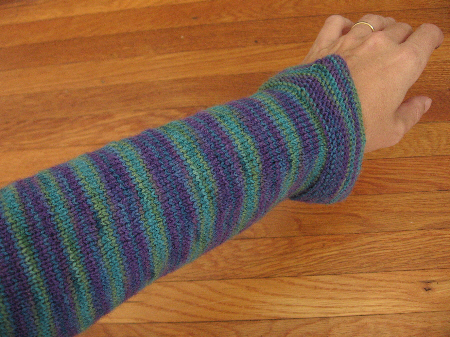
    Marie was curious about how the Lakeview Shepherd Sock looks when knitted up.  The colors have shifted now that I’m doing the increases, but this is probably how it would look on a sock leg.  Pretty, isn’t it?

    Lakeview_1

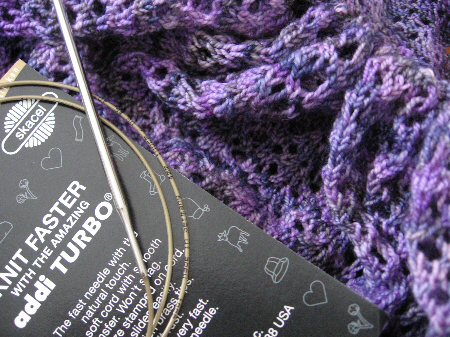
  • Well, I don’t know if it was the effect of the Addi Turbos,

    Npb

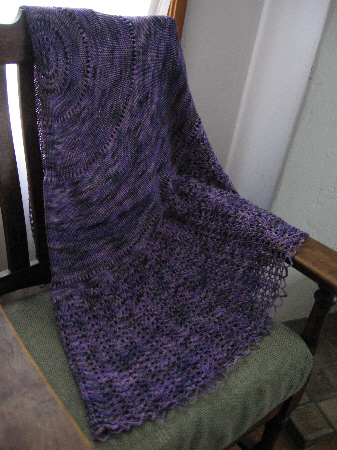
    but I have taken to calling them the Nickel-Plated Beauties.  I finished the shawl on Tuesday, and worked the border Wednesday morning.

    Pishawl1_2

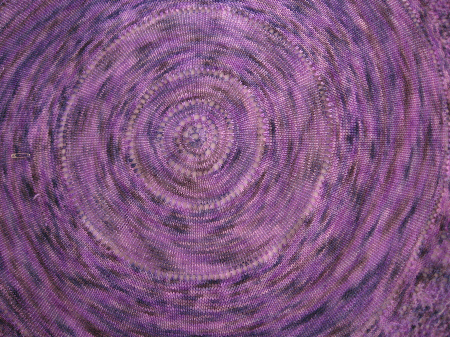
    It’s about 62 in./1.5 m. across, which around my shoulders is just slightly small, so if anyone wants to make this with Koigu and US6 needles, I would recommend 10 skeins just to be safe.  I did want a rather warm everyday shawl, and so of course a looser gauge would take less wool.  (Another option might be to increase the needle size at the increase rows, thereby making a shawl that is actually more than a circle, sort of crescent-shaped when folded in half, which would make it sit on the shoulders better.)

    Pishawl4

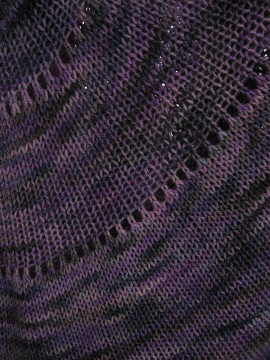
    David came upon it stretched out to dry on the floor, and stared at it for a few minutes, mesmerized by the rather psychedelic sensation of falling into the center, both from the increasing/decreasing eyelet rows and the color smudges.  (The curious funnel shapes in some of the larger plain circles are actually a result of resizing the photos, one of the downsides of my camera’s phobia about straight lines, and are not in the actual shawl.)

    Pishawl3

    Pishawl2

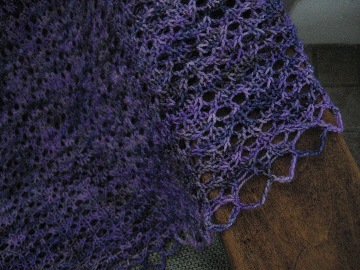
    I really enjoy the Gull Stitch, as it’s both very simple to work and very pretty.  I can see, though, why Elizabeth didn’t care much for the crocheted-loop finish — she starts off by saying that it’s "good," and goes on to describe the method, but then adds, "I no longer finish shawls in this fashion, so have not much of an opinion to offer" — it seems a bit anti-climactic here, although in other situations I think it is quite effective.  I didn’t want to do the sideways knitted-in border though, as it made the Koigu’s color smudges go in a different direction all of a sudden, which I found rather jarring.

    Laura is quite taken with this shawl — purple is her favorite color!

  • All You Need is Love

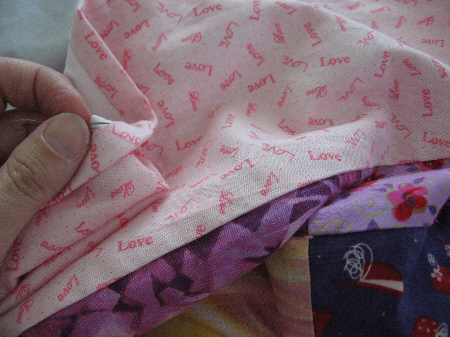
    I couldn’t think why this song was in my head all of the time lately.  "All you need is love — rum, da da-da da — All you need is love!"  I’ve been blind-stitching the binding around the edges of Laura’s quilt — have been at it one whole evening, and boy, is it slow going.

    Img_6060small

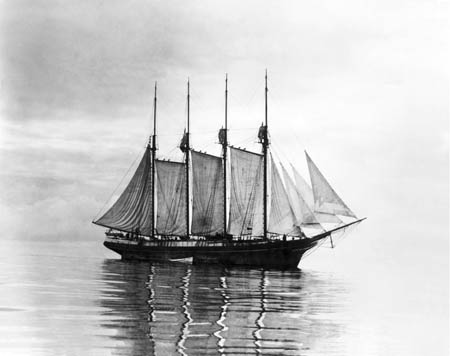
    But now I know where the song came from.

  • Becalmedintheberingsea_anon_c1935_lc

    To be honest, I’ve had the knitting doldrums for a while.  I like the Pi Shawl, am fairly happy with the Koigu (not as nice to knit with as Supersock, though not unpleasant, by any means), but — well, I’ve been busy with the start of school and all the little things that need to be done, with reading, sometimes with just sitting.  The join on the circular needles that I was using is a bit tetchy, and I got increasingly frustrated with having to stop and pull the stitches up to the needle-end, to the point where I put the whole thing right away for a while, convinced that there was only one thing that would make it go faster —

    Img_6035small

  • I found it difficult to whip up any enthusiasm for this month’s Knitter’s Almanac project, what Elizabeth rather Englishly calls "nether garments," wondering what on earth I would do with full-length woollen stockings in what we naively call "winter" here in Southern California.  I thought that things would go the way of the Difficult Sweater (Not Really).  Until, that is, one day a few months ago, when I was reading Anne’s post about her socks, it suddenly came to me in a kind of whisper … Shepherd Sock.

    Supersock_lakeview

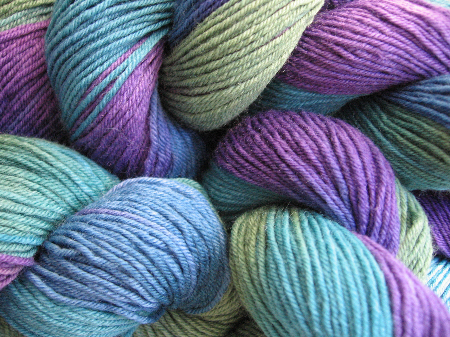
    This is the "Lakeview" colorway — I was somewhat limited in the choice of colors, to those that had at least eight skeins on hand, and so I got this one, a rather serene and pretty blend of blue, teal, and purple.

    This month’s project came about from Elizabeth’s frustration at not being able to find a pattern for "truly organically designed" tights, not the ones that are knitted flat and sewn together.  "Wouldn’t you think that such a very circular piece of work would bring the term ‘circular needle" to the designer’s minds?" she asks rhetorically.  "Let us be the first on the block, then, yea, the first in the town, the county, the State, to make these useful garments the way I’m sure Providence intended them to be made, on circular needles"!  I don’t know quite when I will be able to actually wear them, but I’m interested in the process, and certain in the possibilities, as well as the opportunity to try Lorna’s Laces for the first time.  Let’s look at it this way — (stands on head) — if I ever make it to Scotland for that ancestor-hunting, hill-walking, probably-in-the-off-season-because-that’s-the-only-way-we’ll-be-able-to-afford-it holiday, I will want Nether Garments!

    "I have been known to pull them on under a housedress, add boots, my warm coat, and woolly cap and mittens, and trot comfortably to the A&P, looking (almost) like everybody else."

    Much of this chapter is taken up in calculations for the Nether Garments, which require a good amount of shaping — but fear not, Elizabeth includes a kind of template into which you plug your measurements and multiply by your gauge.

    Some excellent advice about first projects for children — "M and F" — learning to knit: garter-stitch pot-holders, in variegated wool.  "Then hang the pot-holder up behind the stove, and use it, and use it, and use it.  It won’t be your most efficient pot-holder — it will give you many a burned hand — but use it.  It won’t even be necessary to comment on its excellence or beauty every time you use it; you will be noticed, and the fact that it will soon become shabby, worn, and beat-up will be the best thanks and encouragement you can give.  Soon its successor will be cast on."

    Kniton10035purple

    I’m also collecting Elizabeth Zimmermann appreciations — here is a lovely one from Grumperina (the button is hers), and here is one from Knitting Universe.

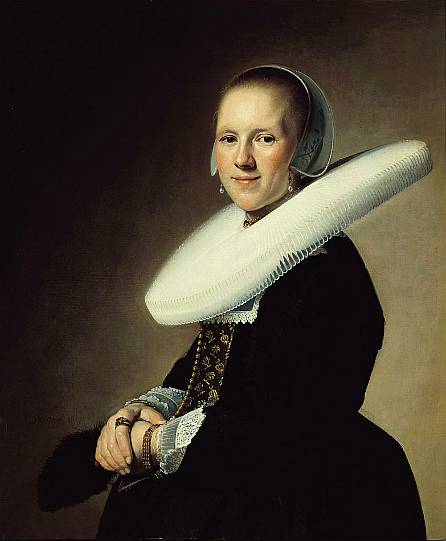
  • Verspronck_portraitofalady_1641_nortonsi

    Jan Cornelisz. Verspronck, "Portrait of a Lady" (1641), Norton Simon Museum, Pasadena.  One of my favorite portraits ever, not just at the Norton Simon.  I’m rather drawn to the Dutch, their comfortable, maybe even stolid outlook on life, and this portrait speaks to me on many levels.  It’s not only technically brilliant, but captures character wonderfully.  I like how her dress manages to be plain and extravagant at the same time, and the way that her bum roll tips up at the back because she’s resting her hands on it in the front, and most of all her smile.

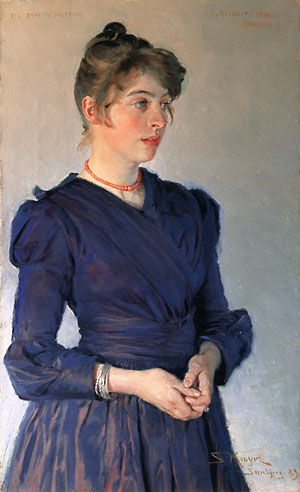
    Kroyer_mariekroyer_1889_skagens

    Peder Severin Krøyer, "Marie Krøyer" (1889), Skagens Museum.

    Sargent_mrsjohnjchapman_1892_nmaa

    John Singer Sargent, "Mrs. John Jay Chapman" (1893), Smithsonian American Art Museum, Washington, DC.  Another wonderful portrait from a master.  The Smithsonian has a brief background of the painting here (slight quibble, though — these are not leg-of-mutton sleeves).

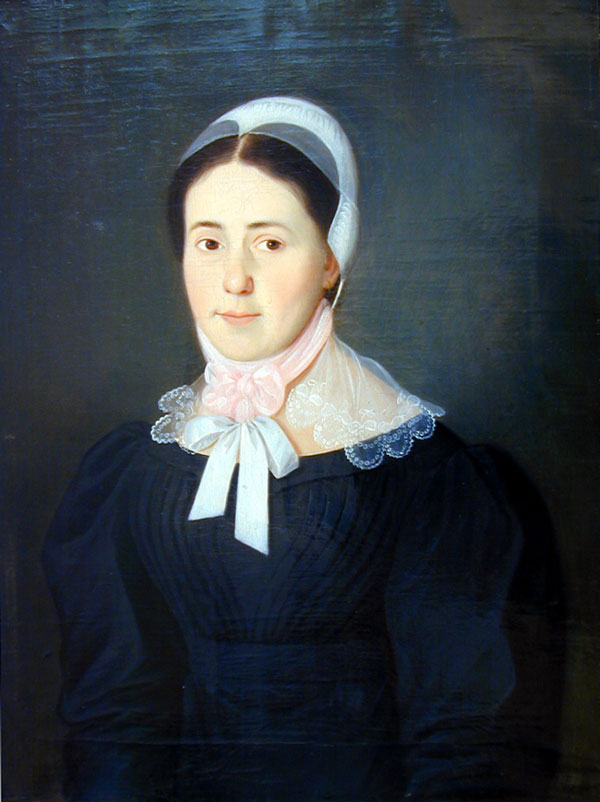
    Anon_moraviansinglesister_c18101820_mhsn

    Unknown artist, "A Moravian Single Sister" (ca. 1810-1820), Moravian Historical Society, Nazareth, Pennsylvania.  The first of my family that I know of to come to America were part of the earliest Moravian migration to Pennsylvania, in 1742.  This came as a surprise to me, having always assumed that the various mid-19th century immigrations were pretty much the whole story.  The early Moravians, like the early Quakers and some of the Brethren today, were "plain" people, wearing simple clothing and living with a strong emphasis on community, although they did take a fairly active part in society in general, unlike the Amish.  At the time of this portrait, the single women wore plain dresses with a pink ribbon on their bonnets, and the married women wore blue ones.  I find it rather poignant that the name of this sister is not known, nor that of the artist — though she is not particularly pretty, her face is drawn with a gentle affection and respect.

    Kroyer_arkitektenfmendahl_1882

    Peder Severin Krøyer, "The Architect F. Mendahl" (1882).  The way that the light plays off of various surfaces — the gleaming brass, Mendahl’s shoes, the tile chimneypiece, the dull woollen suit — is wonderful.

    Anguissola_infantaisabellaclaraeugenia_1

    Sophonisba Anguissola, "The Infanta Isabella Clara Eugenia" (1573), Galleria Sabauda, Turin.  Oh, the Spaniards!

    Rembrandtpeale_rubenspeale_1807

    Rembrandt Peale, "Portrait of Rubens Peale" (1807), National Portrait Gallery, Smithsonian, Washington DC.  This is of course the same fellow with the geranium, six years on.  It’s hard not to sympathize with someone about whom the Grove Dictionary of Art via Artnet writes, "Poor eyesight dictated a career in museum management."  I find it interesting that in both portraits his spectacles obscure his eyes, instead of being the means of clearer sight.

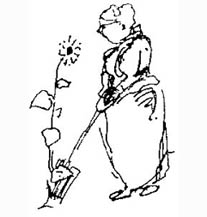
    Jekyllsketchedbylutyens_ca1896

    Sir Edward Lutyens, "Jekyll Sketched by Lutyens" (ca. 1896).  Such a concise, economical, yet gentle sketch of the famous gardener, by her friend.

  • Millais_princesinthetower_1

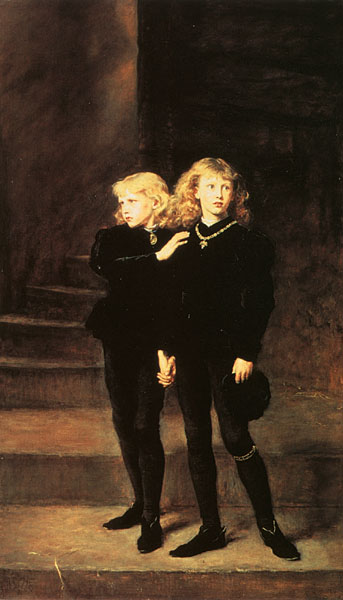
    John Everett Millais, "The Princes in the Tower" (1878), Royal Holloway Picture Gallery, University of London.  When I was small, I had a set of books, about a dozen in all, bound in red and containing according to the volume, all types of stories from fairy tales to "modern" stories to historical tidbits.  My favorite was the third volume, the fairy tales, and I read that one over and over again — I can still picture the look of the books, and it is now one of my greatest bookish regrets that I didn’t keep them (I don’t know what I was thinking).  Anyway, one of the volumes had a color plate of this painting and a rather melodramatic version of the story.  I remember being fascinated by it — an early factor, I guess, in not only my burgeoning Anglophilia, but in my later interest in murder mysteries!

    Bernini_francescodeste_1650_1 

    Gianlorenzo Bernini, "Francesco d’Este, Duke of Modena" (1650-51), Galleria Estense, Modena.  A bravura piece by a master sculptor.  I am constantly amazed at the apparent ease with which he made marble look like silk, lace, ringlets, leaves, lace, like flesh and blood.

    Whistler_nocturneinblackandgoldfallingro

    James McNeill Whistler, "Nocturne in Black and Gold (The Falling Rocket)" (1875), Detroit Institute of Arts.  It’s hard to imagine the stir that this painting created in the 1870s — the critic John Ruskin said that it was like flinging a pot of paint in the public’s face.  (Whistler promptly sued him for libel and won, but it wasn’t much of a victory, as he was awarded a mere farthing in damages.)  It’s certainly not a "realistic" painting in the usual sense of the word, but if you’ve ever seen the remnants of fireworks falling from the sky, you’ll have to agree that this is very much like it, the smoke grey against the black, the bits of colored fire falling like snow.  I think it’s wonderful.

    Blomster

    Anna Ancher, "Ung Pike som Ordner Blomster (Young Girl Arranging Flowers)" (1885), Aarhus Kunstmuseum, Copenhagen.

  • Reynolds_mrssiddonsasthetragicmuse_1784_

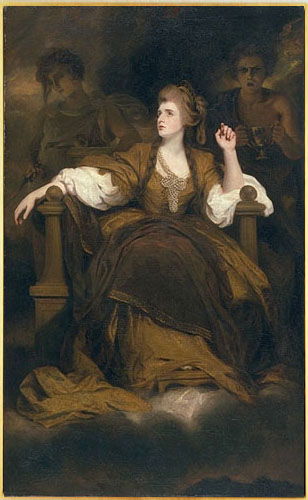
    Sir Joshua Reynolds, "Mrs. Siddons as the Tragic Muse" (1784), The Huntington Library and Art Gallery, San Marino, California.  I must confess that my favorite story about the actress Mrs. Siddons — and possibly about Reynolds as well, apocryphal or not — is his exasperated comment to her while painting this portrait, "Good heavens, madam, your nose! is there no end to it?"

    Rembrandt_selfportrait_c163638_nortonsim

    Rembrandt, "Self-Portrait" (ca. 1636-38), The Norton Simon Museum, Pasadena, California.  Rembrandt is, I think, one of the most interesting people in history, certainly one of the most interesting portraitists.  His "official" pictures can be masterpieces, certainly, but I find myself more drawn to the private ones, the ones he made for himself, like this one from his lifelong series of self-portraits, and the one below of his mistress Hendrickje.  Like Shakespeare, he had a way of looking at people that is infinitely fascinating, in which one can find something new with every viewing.

    Turner_rainsteamandspeed_1844

    J.M.W. Turner, "Rain, Steam, and Speed (The Great Western Railway)" (1844), National Gallery, London.  Coming from a train-mad family, I could hardly not like this picture.  It does not, I think, capture train-ness so much as a sort of train dream, the "rain, steam, and speed" of a moment.

    Carllarsson_thelinencupboard

    Carl Larsson, "Karin by the Linen Cupboard (Karin vid Linneskapet)", 1906.  I like this because everything isn’t all tidy!  Larsson managed to produce an incredible number of paintings, watercolors, and sketches, and yet really took the time to look at a scene — how Karin’s body is tilted towards and away from the window at the same time, here, for instance, to make the light fall on her work.

    Durer_selfportrait_1498_prado

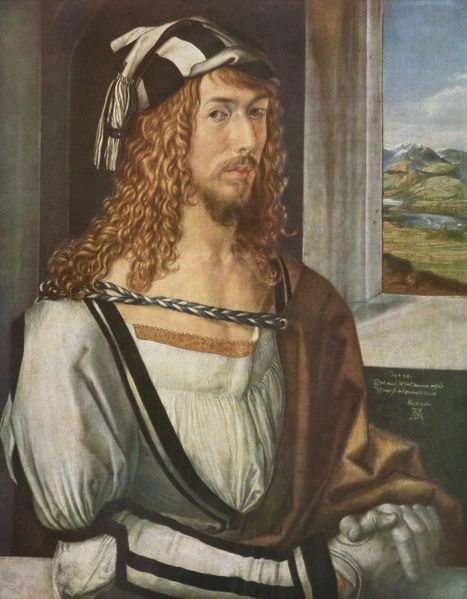
    Dürer, "Self-Portrait" (1498), Prado, Madrid.  What a piece of work! and so modest, too!

    1659_rembrandt_hendrickje_stoffels

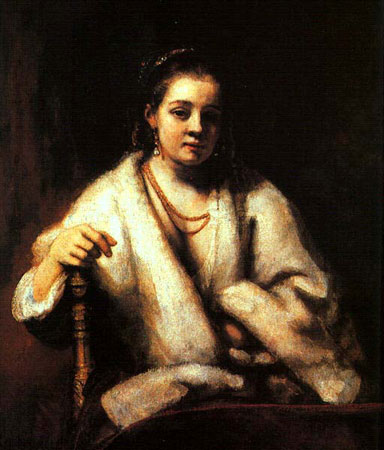
    Rembrandt, "Hendrickje Stoffels" (1659), National Gallery, London.  Melancholy, and achingly beautiful.  The coral necklace and furs against her bare skin, and the sad, rather tired look in her eyes — wonderful.

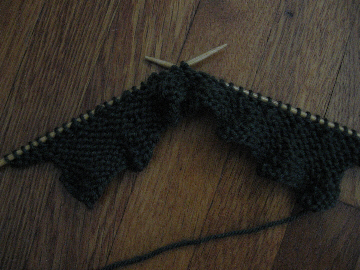
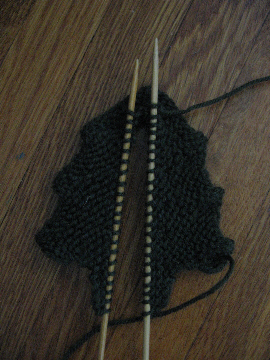
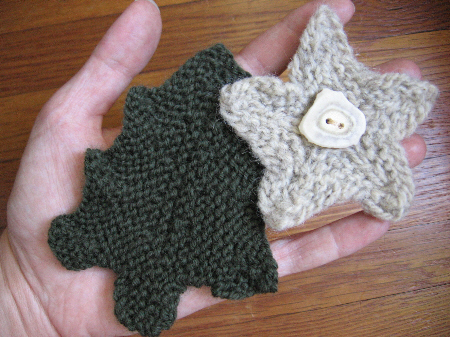
  • These little things are pretty clever.  You take a bit of knitting, fold it in half,

    Tree1

    Tree2

    and you’ve got a knitted Christmas ornament — or decoration, gift tag, whatever!

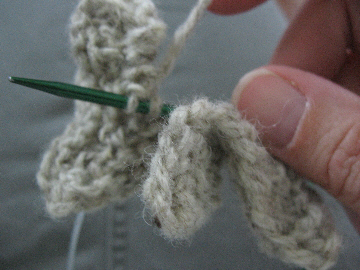
    I’m not much of a person for fiddle-faddle, to be honest (yes, I’m passing on the angel), but even as these little things were coming together — in well under an hour apiece, less if I hadn’t stopped to take photos — I found myself thinking of variations, the endless possibilities.  Colors! textures! variegated wools, or stripes! bigger, even … a dishcloth!

    Star1

    Star2

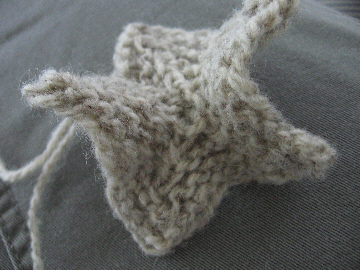
    The star obviously requires some firm blocking, but it is definitely a star — and can be made with pretty much as many points as you like.  I did this one on 65 stitches, instead of the 55 in the basic version.  (I think that the Old Norwegian cast-on was the best choice for these, being almost-reversible and blending in well with the garter stitch.)

    She’s not kidding about the "knitted firmly" part — even though it can get a bit tough towards the end, especially on the star, you need the body for the piece to hold its shape after blocking.  Finer wools could of course be doubled.

    I see no reason why beads couldn’t be added, either.  This would be a great project for those Christmas fund-raisers, as a dozen or so could be turned out in a weekend, for next to nothing (now, so it doesn’t take up valuable December time) — and use up scraps in the process.  How about all of those golf-ball-sized bits left over from socks?

    Img_5956small