• Verspronck_portraitofalady_1641_nortonsi

    Jan Cornelisz. Verspronck, "Portrait of a Lady" (1641), Norton Simon Museum, Pasadena.  One of my favorite portraits ever, not just at the Norton Simon.  I’m rather drawn to the Dutch, their comfortable, maybe even stolid outlook on life, and this portrait speaks to me on many levels.  It’s not only technically brilliant, but captures character wonderfully.  I like how her dress manages to be plain and extravagant at the same time, and the way that her bum roll tips up at the back because she’s resting her hands on it in the front, and most of all her smile.

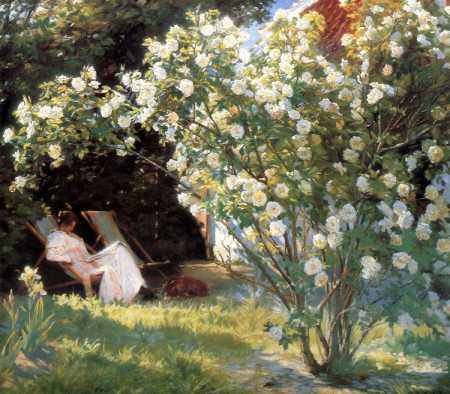
    Kroyer_mariekroyer_1889_skagens

    Peder Severin Krøyer, "Marie Krøyer" (1889), Skagens Museum.

    Sargent_mrsjohnjchapman_1892_nmaa

    John Singer Sargent, "Mrs. John Jay Chapman" (1893), Smithsonian American Art Museum, Washington, DC.  Another wonderful portrait from a master.  The Smithsonian has a brief background of the painting here (slight quibble, though — these are not leg-of-mutton sleeves).

    Anon_moraviansinglesister_c18101820_mhsn

    Unknown artist, "A Moravian Single Sister" (ca. 1810-1820), Moravian Historical Society, Nazareth, Pennsylvania.  The first of my family that I know of to come to America were part of the earliest Moravian migration to Pennsylvania, in 1742.  This came as a surprise to me, having always assumed that the various mid-19th century immigrations were pretty much the whole story.  The early Moravians, like the early Quakers and some of the Brethren today, were "plain" people, wearing simple clothing and living with a strong emphasis on community, although they did take a fairly active part in society in general, unlike the Amish.  At the time of this portrait, the single women wore plain dresses with a pink ribbon on their bonnets, and the married women wore blue ones.  I find it rather poignant that the name of this sister is not known, nor that of the artist — though she is not particularly pretty, her face is drawn with a gentle affection and respect.

    Kroyer_arkitektenfmendahl_1882

    Peder Severin Krøyer, "The Architect F. Mendahl" (1882).  The way that the light plays off of various surfaces — the gleaming brass, Mendahl’s shoes, the tile chimneypiece, the dull woollen suit — is wonderful.

    Anguissola_infantaisabellaclaraeugenia_1

    Sophonisba Anguissola, "The Infanta Isabella Clara Eugenia" (1573), Galleria Sabauda, Turin.  Oh, the Spaniards!

    Rembrandtpeale_rubenspeale_1807

    Rembrandt Peale, "Portrait of Rubens Peale" (1807), National Portrait Gallery, Smithsonian, Washington DC.  This is of course the same fellow with the geranium, six years on.  It’s hard not to sympathize with someone about whom the Grove Dictionary of Art via Artnet writes, "Poor eyesight dictated a career in museum management."  I find it interesting that in both portraits his spectacles obscure his eyes, instead of being the means of clearer sight.

    Jekyllsketchedbylutyens_ca1896

    Sir Edward Lutyens, "Jekyll Sketched by Lutyens" (ca. 1896).  Such a concise, economical, yet gentle sketch of the famous gardener, by her friend.

  • Millais_princesinthetower_1

    John Everett Millais, "The Princes in the Tower" (1878), Royal Holloway Picture Gallery, University of London.  When I was small, I had a set of books, about a dozen in all, bound in red and containing according to the volume, all types of stories from fairy tales to "modern" stories to historical tidbits.  My favorite was the third volume, the fairy tales, and I read that one over and over again — I can still picture the look of the books, and it is now one of my greatest bookish regrets that I didn’t keep them (I don’t know what I was thinking).  Anyway, one of the volumes had a color plate of this painting and a rather melodramatic version of the story.  I remember being fascinated by it — an early factor, I guess, in not only my burgeoning Anglophilia, but in my later interest in murder mysteries!

    Bernini_francescodeste_1650_1 

    Gianlorenzo Bernini, "Francesco d’Este, Duke of Modena" (1650-51), Galleria Estense, Modena.  A bravura piece by a master sculptor.  I am constantly amazed at the apparent ease with which he made marble look like silk, lace, ringlets, leaves, lace, like flesh and blood.

    Whistler_nocturneinblackandgoldfallingro

    James McNeill Whistler, "Nocturne in Black and Gold (The Falling Rocket)" (1875), Detroit Institute of Arts.  It’s hard to imagine the stir that this painting created in the 1870s — the critic John Ruskin said that it was like flinging a pot of paint in the public’s face.  (Whistler promptly sued him for libel and won, but it wasn’t much of a victory, as he was awarded a mere farthing in damages.)  It’s certainly not a "realistic" painting in the usual sense of the word, but if you’ve ever seen the remnants of fireworks falling from the sky, you’ll have to agree that this is very much like it, the smoke grey against the black, the bits of colored fire falling like snow.  I think it’s wonderful.

    Blomster

    Anna Ancher, "Ung Pike som Ordner Blomster (Young Girl Arranging Flowers)" (1885), Aarhus Kunstmuseum, Copenhagen.

  • Reynolds_mrssiddonsasthetragicmuse_1784_

    Sir Joshua Reynolds, "Mrs. Siddons as the Tragic Muse" (1784), The Huntington Library and Art Gallery, San Marino, California.  I must confess that my favorite story about the actress Mrs. Siddons — and possibly about Reynolds as well, apocryphal or not — is his exasperated comment to her while painting this portrait, "Good heavens, madam, your nose! is there no end to it?"

    Rembrandt_selfportrait_c163638_nortonsim

    Rembrandt, "Self-Portrait" (ca. 1636-38), The Norton Simon Museum, Pasadena, California.  Rembrandt is, I think, one of the most interesting people in history, certainly one of the most interesting portraitists.  His "official" pictures can be masterpieces, certainly, but I find myself more drawn to the private ones, the ones he made for himself, like this one from his lifelong series of self-portraits, and the one below of his mistress Hendrickje.  Like Shakespeare, he had a way of looking at people that is infinitely fascinating, in which one can find something new with every viewing.

    Turner_rainsteamandspeed_1844

    J.M.W. Turner, "Rain, Steam, and Speed (The Great Western Railway)" (1844), National Gallery, London.  Coming from a train-mad family, I could hardly not like this picture.  It does not, I think, capture train-ness so much as a sort of train dream, the "rain, steam, and speed" of a moment.

    Carllarsson_thelinencupboard

    Carl Larsson, "Karin by the Linen Cupboard (Karin vid Linneskapet)", 1906.  I like this because everything isn’t all tidy!  Larsson managed to produce an incredible number of paintings, watercolors, and sketches, and yet really took the time to look at a scene — how Karin’s body is tilted towards and away from the window at the same time, here, for instance, to make the light fall on her work.

    Durer_selfportrait_1498_prado

    Dürer, "Self-Portrait" (1498), Prado, Madrid.  What a piece of work! and so modest, too!

    1659_rembrandt_hendrickje_stoffels

    Rembrandt, "Hendrickje Stoffels" (1659), National Gallery, London.  Melancholy, and achingly beautiful.  The coral necklace and furs against her bare skin, and the sad, rather tired look in her eyes — wonderful.

  • These little things are pretty clever.  You take a bit of knitting, fold it in half,

    Tree1

    Tree2

    and you’ve got a knitted Christmas ornament — or decoration, gift tag, whatever!

    I’m not much of a person for fiddle-faddle, to be honest (yes, I’m passing on the angel), but even as these little things were coming together — in well under an hour apiece, less if I hadn’t stopped to take photos — I found myself thinking of variations, the endless possibilities.  Colors! textures! variegated wools, or stripes! bigger, even … a dishcloth!

    Star1

    Star2

    The star obviously requires some firm blocking, but it is definitely a star — and can be made with pretty much as many points as you like.  I did this one on 65 stitches, instead of the 55 in the basic version.  (I think that the Old Norwegian cast-on was the best choice for these, being almost-reversible and blending in well with the garter stitch.)

    She’s not kidding about the "knitted firmly" part — even though it can get a bit tough towards the end, especially on the star, you need the body for the piece to hold its shape after blocking.  Finer wools could of course be doubled.

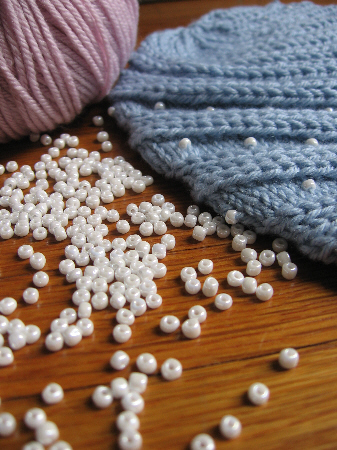
    I see no reason why beads couldn’t be added, either.  This would be a great project for those Christmas fund-raisers, as a dozen or so could be turned out in a weekend, for next to nothing (now, so it doesn’t take up valuable December time) — and use up scraps in the process.  How about all of those golf-ball-sized bits left over from socks?

    Img_5956small

  • The August chapter of the Knitter’s Almanac describes some "fiddle-faddle" that Elizabeth came up with while camping, Christmas ornaments "based on the principle that knitting will hump itself up when it is consistently decreased at the same spot."

    Img_5930small

    This will, in fact, be a knitted Christmas tree!  All of this chapter’s projects — a tree, a star, and an angel — are indeed small and portable enough to take on an outing, whether camping or merely picnicking.  Very economical, too — bits and bobs of wool left over from another project, just about anything, really, because who says that your Christmas tree has to be green?!

    "The more you do a thing, the more ways you find of doing it — if you keep an open mind, that is.  Quite often the new ways are improvements."  Elizabeth found that the usual slip-knot at the beginning of a cast-on was just niggly enough for her to look for a different way of doing it: "Simply lay the wool over the righthand needle where it will form the first stitch.  Grasp the wool-ends with the left hand, spread thumb and forefinger between them, and proceed as usual.  The knot is done away with and the join much neater."  A while ago, not long after I started using the long-tail cast-on instead of the cable cast-on I’d used for years, I modified this to something that was a bit easier for me to work with: make a U-shape at the point where the tail end is long enough, hold this in your left hand, stick the needle down through the loop, and twist the end of the needle upwards.  This will cross the yarn around the needle, holding it firmly enough to start the cast-on stitches.

    1_1 2_1

    And a nice little bit of August, for these last few days of summer before school starts next week: "Last night, the moon — three-quarters full — reflected herself in the water behind the triple twisted cedar as in a Japanese print.  This morning, the print has changed; all the further shores have disappeared, the sun is seen only as a pale radiance, and sky and water have merged and mingled.  Tall rushes next to the fireplace mirror themselves unwaveringly in the glassy lake, making one perfect circle, some pointed eggs, and some funny triangles.  Slowly, to the scent of coffee, the radiance turns to a silver sun doubled by its own reflection, and the opposite shore appears through the haze.  Clearly, another perfect day is coming up."

  • The Booking Through Thursday questions for today are about the settings of books we read.

    1. Have you ever wanted to travel to a place described in a book? If the author is good — and there are so many who are — every time.
    2. Have you ever ACTUALLY travelled to a place because of the way it was described in a book? Where do I get the tickets for Middle Earth? or Victorian England?
    3. And if so, did it live up to the expectations, feelings, emotions you expected from the book? Did you feel like Anne was going to come romping around the corner of Green Gables? Was it as if Jo was upstairs at Orchard House, scribbling on a story? Or was it just a museum, or just a city street? Like Abbey Road without the Beatles? The only actual "pilgrimage" I’ve made so far was to Hyde Park Gate in Kensington, to see the house where Virginia Woolf and her sister Vanessa Bell grew up, and to Charleston Farmhouse in Sussex, where Vanessa lived for most of her life — these were on my first trip to London.  Number 22 was rather different than I’d pictured it, since I’d never seen the rest of the street, and I’d imagined it with the noise of four young children, hackney cabs outside, and so on, but despite the unmistakeable aura of the late 20th century, I was not disappointed.  Charleston was pretty much everything I expected, although rather lonely without its residents and the smell of linseed and turpentine and tea.  And these are both, of course, settings more in the biographical sense, not fictional like Green Gables.  A place I would like to visit someday because of a particular author’s novels is Moffat, in Dumfriesshire; D.E. Stevenson lived there for many years.

    View_over_alton_area_of_moffat

    Photo from Visit Moffat, who although there is no mention of Stevenson, do include a lovely series of walks around the countryside, something very dear to her heart.

  • Knitting Hands

    Hands1

    Hands2

    Hands3

    Laura walked into the living room this morning and saw Grandma and me knitting, and said, "I’m going to knit, too!" and so we had an unexpected moment of three generations.  Luckily, the camera was nearby, and so for Shelagh, here are three pairs of knitting hands, Grandma’s (with Julia cuddling), mine, and Laura’s.  We’re all three "throwers," not surprisingly, but Laura is actually left-handed.

  • Cashseta

    Filatura di Amigo Cashmere/Seta, in color 68, a sort of camelly beige —

    Chinch

    Berroco Chinchilla, in color 5517 "cola" —

    Cth

    and Cherry Tree Hill Supersock in "Java", a lovely merino that appears a coffee-like brown from a distance, but upon inspection proves to be a mixture of browns, taupes, near-reds, and even a bit of navy blue..

  • Americanmemory_8c27629r_daughtersknittin

    "Fort Kent, Maine. (vicinity). Albert Gagnon’s daughters knitting.  August 1942  Farm Security Administration – Office of War Information Photograph Collection (Library of Congress)"

    Another photograph from the American Memory Collection at the Library of Congress, and a nice bit of summer nostalgia.

  • Booking Through Thursday wants to know if and how we plan ahead….

    1. Do you plan ahead for your reading? Work off of a to-be-read pile? A reading list? Or do you wing it, choose whatever you’re in the mood for?  A little of both, really.  I have a mental list of things that have piqued my interest, although since it is only in my head, I frequently forget what is on it, sometimes completely. 
    2. If you do plan ahead, how far ahead? Do you have two or three books waiting in queue? Or are you backed up by dozens of volumes waiting their turn?  Well, I mean to plan ahead, but the road to, er, well, good intentions and all.  If I buy it, it goes into the queue, of course, and eventually gets read; sometimes I do have to browse around the shelves at home for something I’ve forgotten about, though.
    3. If you do not plan ahead . . . well, never? What about if you’re reading a series? Or someone gives you a book for a present?  I did actually plan ahead for Audrey Niffenegger’s The Time Traveler’s Wife, which I just finished — I’d checked the library catalog regularly, and was just on the verge of paying my 75 cents for a reserve, when I found it on the shelf.  (I enjoyed the book, time-travel being something that intrigues me.  One of the first time-travel things I ever read was a short story by Jack Finney, I can’t remember the title now, but it involved old postage stamps being used to send letters to the past — not the usual time travel, but fascinating nonetheless.  I thought that Wife was intriguingly written, and had some interesting differences from other time travel stories, such as here that Henry cannot take anything with him, not even his clothes — he even mentions glasses and fillings in his teeth at one point — while in say, Diana Gabaldon’s "Outlander" series the time traveler does not have this problem — of course with her time travel is an external force, and with Henry it is internal.  And it was different especially in that usually traveling in time is something that people want to do, whereas here it is something Henry has no control over, and makes the story as much about people dealing with a chronic condition, like cancer or a stroke, as it is about the physics and mechanics of time travel.)