• Klaralund5

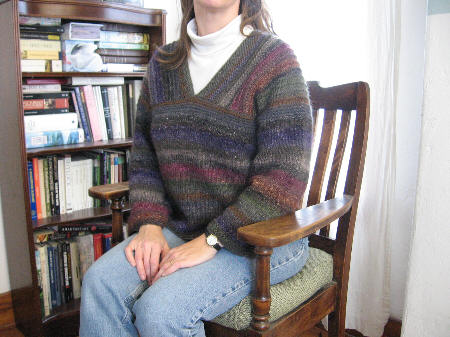
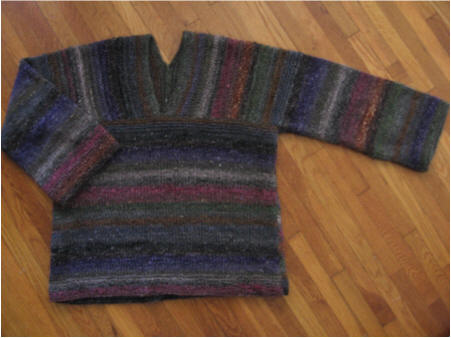
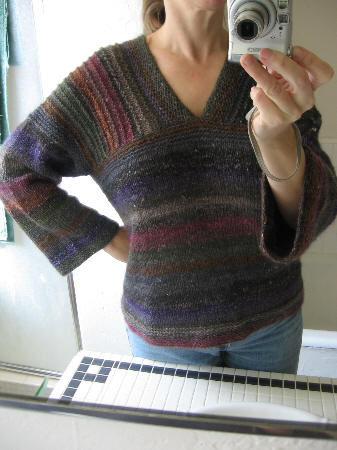
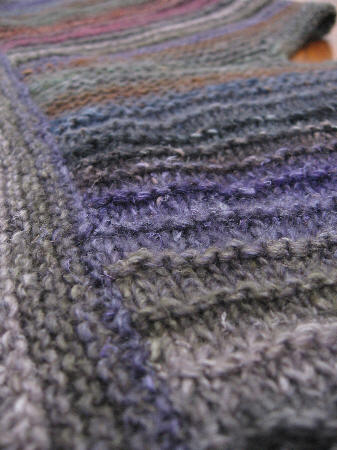
    "K" is of course for Klaralund.  This sweater, from the Cornelia Tuttle Hamilton Book Two, was one of those patterns that I mulled over for some time, not sure at all that it would work on me, but impressed with its classic simplicity.  I have to say, that despite my not being a wispy little thing like the model in the book (nor the photos turning out the way I imagine that I look), it’s actually a rather flattering design, and I’m very pleased with the results.
    Silkgarden_82

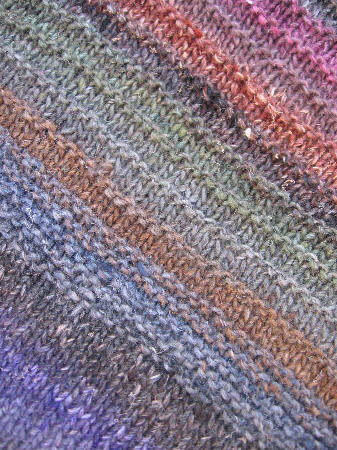
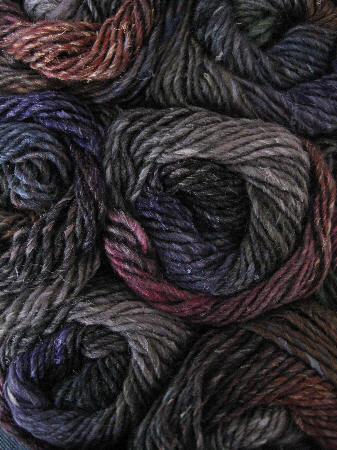
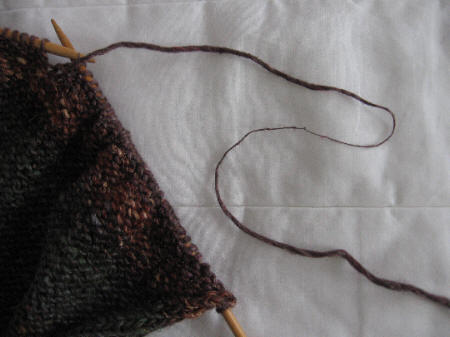
    I’m still not quite sure what I think of Silk Garden.  It has a curious now-soft-now-scratchy texture, and there is of course the infamous vegetable matter to be dealt with.  I was lucky this time in that all of the colors were present in each ball, but in the past I’ve been frustrated to find that the knots seem to jump quite a distance in the color sequences, usually skipping my favorite one.  In this batch, though, the problem was of thick/thinness, in that the wool far too often wasted away to almost nothing.
    Erk

    I usually broke these sections and spit-spliced them — in Silk Garden’s favor, it splices wonderfully.  I just don’t think that that should excuse the poor quality of the yarn itself.
    Klaralund5_1

    On the other hand, Noro’s famous colors were much in evidence.  I’ve marvelled before that just watching the colors change is fascinating — I loved the surprise, too, of knitting in the evenings in artificial light and finding out the next day what the colors had done.  I meant to not fiddle with the sequences and changes too much, although I did towards the end when the colors almost lined up — I don’t seem to mind the asymmetry, but the just-slightly-skewedness was hard to bear!
    Klaralund2 

    But Klaralund, that’s what I was talking about.  Very long, very wide sleeves do not often work for me, and so I decided to shorten and narrow those famously long and wide sleeves a bit.  The sleeve measurements as given in the book are somewhat deceptive, though — I was sure that 26 1/2 inches would be too long and 16 inches far too wide, assuming also that the weight of the Silk Garden would pull them even farther.  I initially worked the sleeves to 11 inches long to the underarm and starting at 13 1/2 inches wide at the cuff, but this proved to be in fact too short, and so with only a twinge of regret — for one of the sleeves had taken a day of only slightly obssessive knitting to work — I ripped out both and worked them again, taking off only about 3 inches from the original length, about 25 inches total, and 1 1/2 inches or so (6 sts) from the width at the cuff.
    Klaralund1

    (Check the errata page here for corrections for a number of the patterns in this book, and additional sizes for Klaralund.)
    Kristinlavransdatter

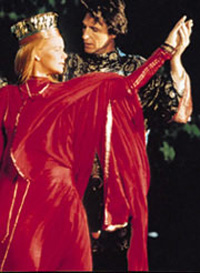
    "K" also stood for "Kristin Lavransdatter", which I watched while knitting much of Klaralund.  (It’s three hours long! good for almost a whole sleeve!)  The book is one of those that I should like, having so many of my favorite elements — the Middle Ages, high language, Norwegians — but I just can’t seem to get the hang of it.  The movie hasn’t helped much, I confess.  The story is, briefly, that Kristin, the rather willful daughter of a farmer/landowner in 14th-century Norway, falls in love with a knight and has a passionate affair with him despite her father’s wishes that she marry a neighbor’s son.  I was rather surprised that the movie lets us know at the very beginning that not only do Kristin and Erlend eventually marry, but that by then their affair has already been consummated, although this does give the story an air of inevitability, if not "happy ending".  It might be that now that I am a parent myself I felt much more sympathy for Lavrans, Kristin’s father, whose goodness shone through this film for me.  The characters I should have liked (I assume, not having read the books) I often didn’t — Kristin’s so-called childhood sweetheart pulls one of those "if you loved me, you would" manipulations that irked me no end — I wanted to smack him.  Simon Darre’s only fault seems to be that he is not Erlend Nikolaussøn, but then I cannot for the life of me see what is so attractive about Erlend himself.  He is dull and stoic and dumps his mistress (who left her husband for him) and takes up with someone else’s bethrothed.  Not the best catch, frankly.  I found the two main characters so flat and uninteresting that I was easily more interested in the parents’ relationship, impressed with the subtlety and depth that the actors brought to their roles, and in the crippled sister, wanting to know more of their stories.
    Babettesgaestebud_2   

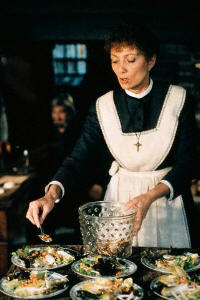
    So, well, I was so unsatisfied that I had a sudden craving to see "Babettes Gaestebud (Babette’s Feast)" afterwards.  Alas, not starting with "K," but a wonderful movie nevertheless, filled not only with affection and gentle humor but with much deeper layers of meaning than I ever got from "Kristin Lavransdatter".  The story here is that two elderly sisters, the daughters and heirs of the pastor of a stoic religious sect in a remote part of 19th-century Denmark, find themselves taking in as housekeeper a political refugee from Paris, the Babette of the title.  After some fourteen years with the sisters, Babette, whose only tie with her former life is a lottery ticket, wins 10,000 francs and decides to spend the money on a celebratory feast the sisters plan to hold in honor of the hundredth anniversary of their father’s birth.  The film has many delightful moments — the look on Babette’s face when one of her new employers shows her how to make ale-bread is alone worth the price of the movie — and when you know Babette’s backstory, it makes the moment that much better.  But it also has some very philosophical things to say, and the characters evolve, unlike Kristin and Erlend, who seem miserable throughout.  Martine’s erstwhile suitor — not to give too much away, I hope — says early on, "I am going away forever, and I shall never, never see you again. For I have learned here that life is hard and cruel, and that in this world there are things that are impossible," but by the end of the film this has become, "I have been with you every day of my life. You must also know that I shall be with you every day that is granted to me from now on. Every evening I shall sit down to dine with you: not with my body, which is of no importance, but with my soul. Because this evening I have learned, my dear, that in this beautiful world of ours, all things are possible."
  • Princesses1

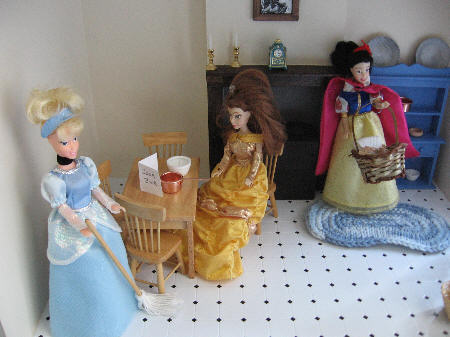
    Hard at work, I see.  But where is Sleeping Beauty?

    Princesses2

    Ah.

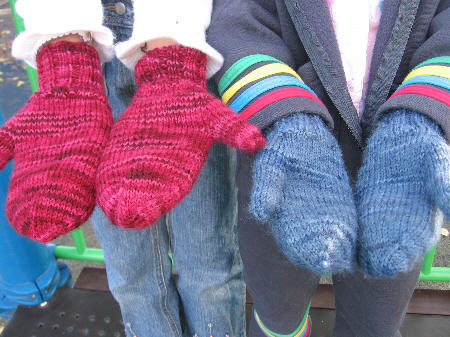
  • We’ve been talking about going up to the mountains to play in the snow — the girls have never seen snow — and so we’ve been getting ready clothing-wise.  I had to search high and low for a suitable jacket for Laura, since here in southern California, the summer wear comes out after the Christmas sales, and there was not a jacket to be found in her size, not even for ready money.  I had to buy one that is bigger than even I usually buy for a fast-growing first-grader, but my consolation is that it was on sale, and she’ll grow into it.  But no-one who calls herself a knitter would let her children go out into the snow for the first time in their lives in store-bought mittens! and so I dug around in my stash of Araucania Nature Wool and borrowed Ann Budd’s Handy Book of Knitting Patterns from the library again, and now they each have a pair of custom-fitted, made-with-love mittens of their very own.

    Mittens1

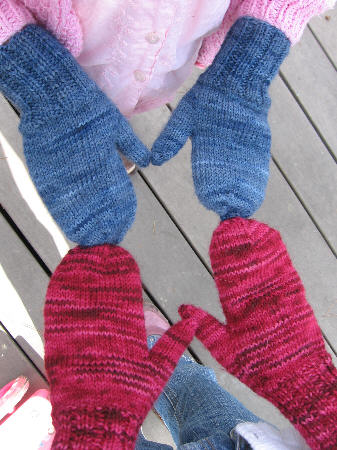
    My gauge on the US2 needles is a smidge under 6 sts per 1 inch — firm but still pliable and comfy.  It’s a very simple pattern — I extended the rib at the wrists about a half-inch each, and wasn’t very happy with the little "point" at the ends of the fingers on Julia’s (where all of the decreases come together at once), and so on the second pair, I chose the "8 sts rem" option instead of 4, and might even do 12 next time — but this is a minor quibble compared to the ease of knitting (two days! felt like I was flying), and the girls’ delight in wearing them, even on fairly warm days.

    2araucania

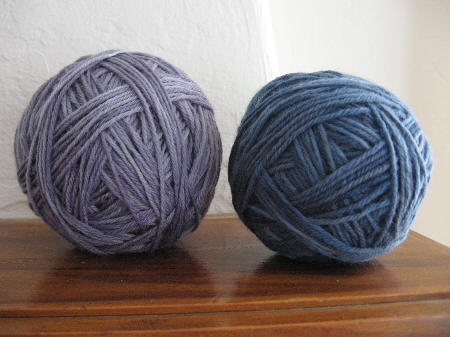
    This gives you an idea of how much wool it took for the child’s medium-sized mittens — the ball on the left is a full skein, and the one on the right is after making the pair for Julia.  (I was going to make Laura’s pair in the purple, which has been her favorite color for some time now, but after seeing the red, she chose that!  Admittedly, it is not a very purple purple, and the red is beautifully intense.)

    Mittens2

  • Booking Through Thursday wants to know what kind of care do we take of our books?

    1. Are you careful with the spines? Or do you crack your books open to make them lay flat? From years of working in a public library — shelving, processing, cataloging — I’ve developed a little routine, although it’s really just more a habit, for opening new hardcover books, that I find myself doing automatically, even at bookstores with books that I don’t intend to buy.  I open the front cover, gently but firmly, as far back as it will go, then repeat this with the back cover, which loosens the stiffness that comes with the gluing of the spine.  I usally riffle the pages too, although this is difficult with books from those publishers (like Knopf) who don’t trim the edges.
    2. Do you use bookmarks? Or do you dog-ear the corners? If you do use bookmarks, do you use those fashionable metal ones? Or paper? I use paper or thin cardstock to mark my place, although they are usually not official "bookmarks" as such, but handy scraps of paper or index cards if I’m taking notes — those subscription cards from magazines that we perpetually find under the chairs are very handy, for instance!  I don’t like the bookmarks that clip over a section of pages, as like paper clips I think these will either crinkle the pages or discolor them eventually.  I really dislike the magnet kinds, as clever as they are, because I don’t want to put anything thick inside a book, being too hard on the spine.  I knew a librarian once who had a collection of things that she’d found in books, things that people had been using to mark their places — leaves, dollar bills, old letters, a boxed deck of cards, bits of string, and such (I didn’t really believe her about the strip of bacon, though).
    3. Do you write in your books? Ever? If you do, do you make small marks, or write in as much blank space as you can find? Pen or pencil? Highlighter? Your name on the front page? I found it extremely difficult to get into the habit in college of writing in my textbooks.  I think it took the gradual dawning on me that either my notes would be helpful to me in the future (!), or that my used textbooks would to be honest not get used again by anyone else, to get me to put pencil — not pen! — to paper.  I sometimes, although rarely, make light Xs in the margins at passages I especially want to remember and find again, but on the whole I don’t write in books.  This is somewhat ironic, as I love to find old inscriptions on the flyleaf of a good book (I always laugh at the part in 84, Charing Cross Road when Helene chides FPD for not writing an inscription in a book he sent her from the shop staff, how she would have enjoyed and valued it but their booksellers’ aversion to "damaging" the book has prevented them.)  The only time I use pen is to write my name or a gift inscription.
    4. Do you toss your books on the floor? Into book bags? Or do you treat them tenderly, with respect? Er, define "toss"!  That slip from bed to floor (for I as yet have no nightstand)?  Does that count?
    5. Do you ever lay your book face-down, to save your place?  Only paperback cookbooks — otherwise, never!  Certainly not hardcovers.  (I had to laugh when a few months ago I heard Laura, then aged six, say sternly to her little sister, "Not that way, you’ll break the spine!")
    6. Um–water? Do you bathe with your books? Hold them with wet hands? Read out in the rain? Anything of that sort? There is a certain category in my mind that I call "bathtub books" — generally romances or light mysteries in paperback that would be no great loss if they were to be dropped into the tub and ruined (which I have done, I confess!).  Many of Barbara Michaels’ books are this kind.  I generally don’t read the Harlequin/Mills & Boon kind of stuff, but those would also qualify.  I’m careful not to read with wet or dirty hands, not even magazines.
    7. Are your books lined up on a bookshelf? Or crammed in any which way? Stacked on the floor? Well, frankly, some of each, although this is more from lack of space than from any disregard or thoughtlessness!  Most of my P.G. Wodehouse collection (I adore P.G. Wodehouse) is stacked up next to the bookcase in the hallway, having been crowded out by the DVDs — the reasoning being that the DVD boxes are slippery and the stacks fall over far too easily, whereas the books make a fairly sturdy pile which hasn’t fallen over yet, despite being whacked now and then with the broom when I sweep.  (Pathetic, isn’t it.)
    8. Do you make a distinction–as regards book care–between hardcovers and paperbacks? Not usually, no.  It’s more the book itself that qualifies it or not — but even with books I don’t like much, I am not careless.  It’s either "careful" or "more careful"!  If I don’t want it, it goes to the library booksale.
    9. And, to recap? Naturally, you love all of your books, but how, exactly? Are your books loved in the battered way of a well-loved teddy bear, or like a cherished photo album or item of clothing that’s used, appreciated, but carefully cared for? This question is making me think — it’s not the same as a comfort object, the way that Julia, for instance, carries her Lambie around by the tail, thoughtlessly but with a certain basic need — it’s not the same as clothing, in the way that some people have rooms dedicated to their wardrobe, climate-controlled and organized by color or purpose — it’s more like close friends, that you enjoy having them around, you are considerate of their "comfort" (having a good chair for them to sit on, and tea, or a sturdy shelf), you enjoy their company when they are around and think about them when they are not, you even introduce them to others because you think they’ll get along well together.  You think all of a sudden one afternoon, "I haven’t seen X in a while, I must call her!" or "Eva Ibbotson! I need to read her again!"  My books are in some ways extensions of myself, too, not just like friends who are the world coming to and interacting with me, in that the books that have spoken deeply to me at different parts of my life are in a way like my diaries, except with experiences that I didn’t actually have myself.
  • I Spy

    I spy with my little eye —

    Silkgarden82

    — something beginning with K.

  • Booking Through Thursday today wants to know not what we read, but when —

    What are your reading habits? Do you tend to read at specific times during the day, or does it vary from day to day, hour to hour, minute to minute?

    I don’t think that I could be so organized as to have a scheduled reading time!  My reading is pretty much as the mood strikes me, although I do tend to have phases, either from having a really good book in hand or just feeling read-ish, when I do more reading than at other times.  Some days or weeks, I feel knit-ish instead, or genealogy-ish, although I must admit that none of these is ever completely exclusive!

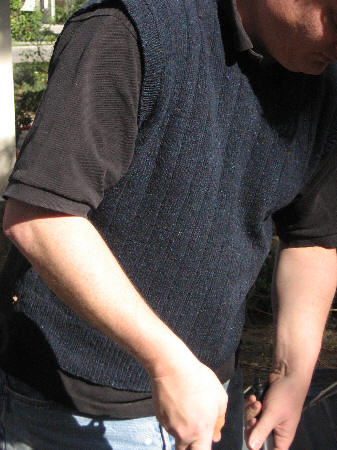
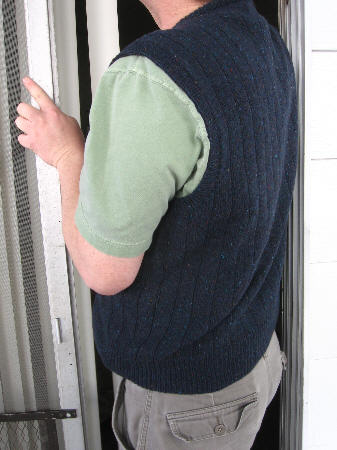
  • My dear husband, who has an internal thermostat roughly equivalent to the Sahara Desert, was puttering out in the garage one late night last winter when he came in slapping his arms and saying, "Honey, I need a sweater!"  This took me so much by surprise that it was some time before I could actually pick up some needles, but here it is at last.  It was meant to be a Christmas gift, although the bronchitis that we all came down with after Thanksgiving delayed the finishing by a couple of weeks — it wasn’t so much that I didn’t feel like knitting (although there was that at times), it was that David was sick too, and therefore home and underfoot, and it was meant to be something of a surprise.

    He wanted something warm, but not as warm as a full sweater; his only requests last winter were that it be "plain" and "blue".  Regretfully, I had to set aside my dreams of cables or even relatively sober Fair Isles, but these I hope to carefully insinuate into his wardrobe in time, and I was still happy to spend some hours poring over vintage British patterns, delighted by their equally vintage captions.

    Dfslipover

    "Trim and smart because of its extreme simplicity."

    Dfslipover2

    "For golfing, gardening or just ‘pottering around.’"

    Yorkshiretweed_281knight

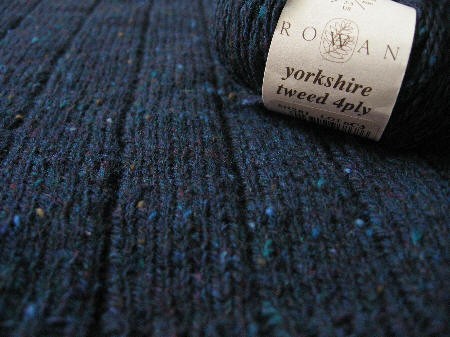
    As Yorkshire Tweed is, alas, discontinued, Rowan recommends Rowanspun 4-Ply or Scottish/Harris Tweed 4-Ply as substitutions.  Rowanspun 4-Ply, Yorkshire Tweed’s previous incarnation, can still be found in some quantities.

    Dfs_2

    "Every man needs a slipover!"

    The shaping of this slipover is based on the vest chart given in Ann Budd’s extraordinarily useful Knitter’s Handy Book of Patterns and on a number of vintage patterns.  Dad’s Favorite Slipover, which will shortly be available in the Original Patterns album in the sidebar, is a men’s V-neck sleeveless slipover with traditional shaping, sized to fit a 37 (42, 46, 51) in. / 94 (106.5, 117, 129.5) cm chest.

  • Swf_3

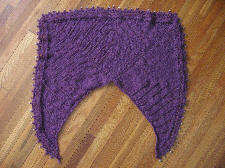
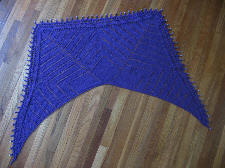
    In our post-Christmas gift card shopping spree, I bought myself Jane Sowerby’s Victorian Lace Today (click on the "thumb-through" for sample pages, or go and browse Grumperina’s paean to the book here for even more photos).  It’s a lovely book, perfectly suited to the knitter’s coffee table, filled as it is with gorgeous photos of lace shawls and stoles, and a nice dash of history.  My eye was caught by a number of things — not even including the Cambridge locations — but a few days later I started on the Spider’s-web Fichu, mostly because I conveniently had the yarn waiting in a drawer, namely,

    Jaeger_alpaca4ply

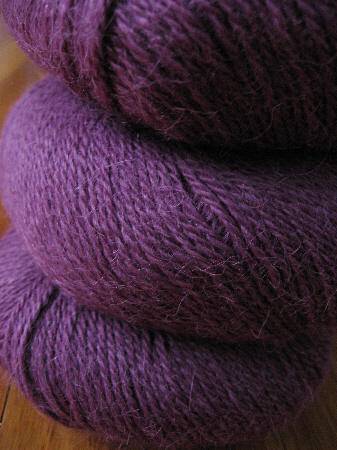
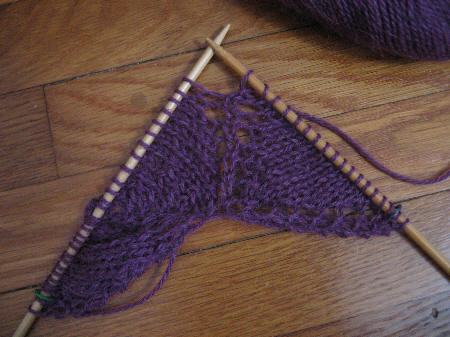
    Jaeger Alpaca 4-Ply in shade 393 Damson.  (Not 395 as in the book, apparently a misprint, but perhaps it will not be much of a problem as it seems that Jaeger has discontinued this line entirely).  The fichu is a fairly easy knit, although it took me a few rows to settle in with the chart.  The triangle is in fact one repeat, worked x times depending on whether you are making the half-hexagon (3 repeats) or the full version (6 times), the pink squares being the single line of st st that runs upwards between the triangles.  Thus, here —

    Fichu_start

    is one full repeat of the chart on the right needle, with the garter st edge border, which is not included in the chart.  Once you see how it grows, very organically from the previous rows, it is quite simple.

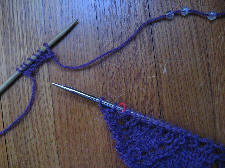
    The crochet cast-on for the border as given in the instructions leaves the working yarn at the left side, without mentioning a set-up row to bring it back into place for starting Chart D, and so I used a regular lace cast-on instead, attaching it to the edge of the shawl on the next (WS) row.

    1_2 2_2

    You do have to start the border at the opposite corner to where you finished (wh. is not mentioned in the pattern), otherwise the RS will be facing the back.  This may not matter terribly much on a garter-based border, really, but somehow I just couldn’t bring myself to work it that way.  (Be sure to visit the corrections page at XRX for errata and clarifications.)

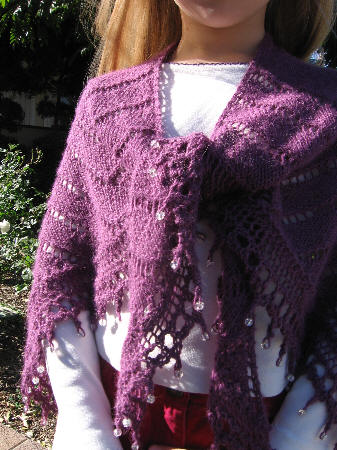
    It seems to make a rather larger shape than a half-hexagon, coming off of the needles in what is actually three-quarters of a square, each repeat of Chart A being an equilateral triangle.  I couldn’t get it to block as an actual half-hexagon without making it much larger than the specified measurements — either the garter stitch edge was straight and the triangles waved a bit, or the triangles were smooth but the border curved.  This is nice, though, as the finished piece sits on the shoulders much more easily.

    Swf_b_1 Swf_a

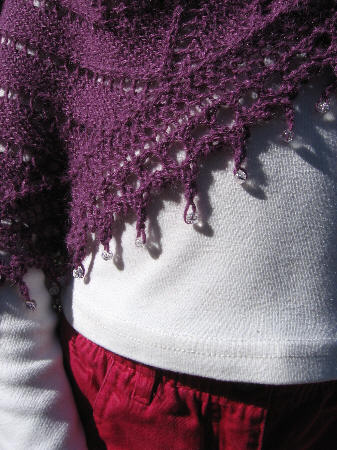
    And some details of the finished fichu —

    Swf_1

    Swf_2

    A satisfying knit, with very pretty results.  Laura is utterly charmed with it, too!

  • Booking Through Thursday writes, "Let’s keep it simple today":

    1. What are you reading right now?  I went to the library yesterday morning, and found on the new book shelf Scott of the Antarctic: A Life of Courage and Tragedy by David Crane.  I first learned about the story from watching "The Last Place on Earth", based on the book by Roland Huntford, and then from reading pretty voraciously almost everything I could find on the subject, I learned that the truth, as so often happens, was probably somewhere in between Huntford’s inept bungler and the glorious hero of popular mythology.  (One of the best books that I read this past year was Sara Wheeler’s Cherry: A Life of Apsley Cherry-Garrard, a fairly minor member of the Terra Nova expedition who afterwards produced one of the most lyrical works on polar exploration, The Worst Journey in the World.)  Crane is obviously, from the subtitle of his book, in the Scott camp, but he does have some interesting and perceptive things to say, in the first chapter alone, about the English character and its need for heroes in the early days of the twentieth century, with its inexorable slide towards the hell of the First World War.

      I’m also well into Reading Like a Writer, by Francine Prose, a literate and elegant guide to the appreciation of great literature.