• Javawalker

    I woke up at about 1:30 one morning last week — can’t call it "morning," really, at that point — and found myself reading knitting blogs, as one does, and that sign-ups for Sockapalooza 4 had just opened.  And, well, yes, I signed up!

    Sockapalooza4_button

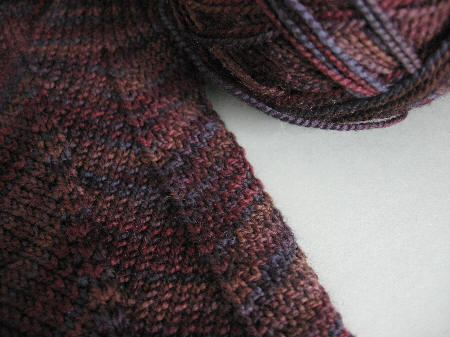
    So, local sock news seems appropriate at this point.  I couldn’t seem to get enough of Jaywalkers after the "Lakeview" pair, and so I cast on in some Supersock in "Java," a gorgeous rich brown.

    Java1

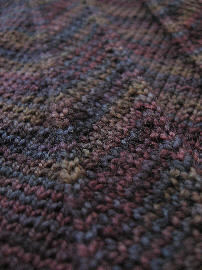
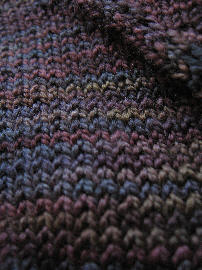
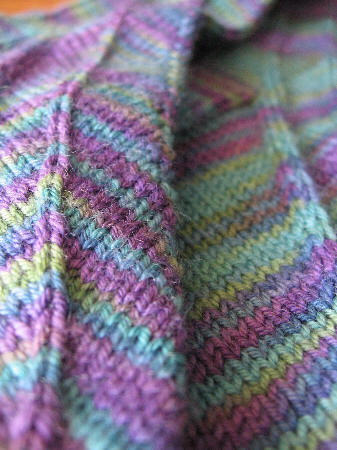
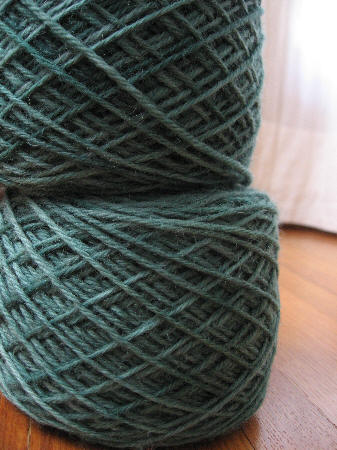
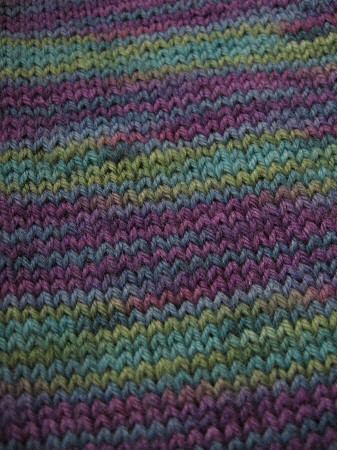
    This is one of the few colorways I’ve tried in which ball and knitted fabric look remarkably similar.  Most of the time, of course, the striping (or, horrors, pooling and flashing) make it look quite unlike the skein.  "Java" does have a mild striping effect, but the colors are so similar and tone and so well-blended that the effect is not of stripes but of gentle ripples of color, as it were. 

    J1 J2

    I have never been much of a brown person, but this is far from being your average brown.  With a second look, you can see near-blues and almost-reds — it reminded me of a passage in the book I’m reading about Beatrix Potter, and her advice in Peter Rabbit’s Painting Book on mixing Antwerp blue with burnt sienna to make dark brown.  It’s rather hard to capture in a photograph, I find — the general effect in most lights is a bit darker than these pictures, although in bright sunlight, the tan tones are more prominent.

    (I have found, in my limited experience, that contrary to Sockamaniac’s review on the Cherry Tree Hill site, some Supersock colorways may pool and flash and some may not.  Even within the same skein, results may vary widely.  You never know.)

  • Jaywalker1

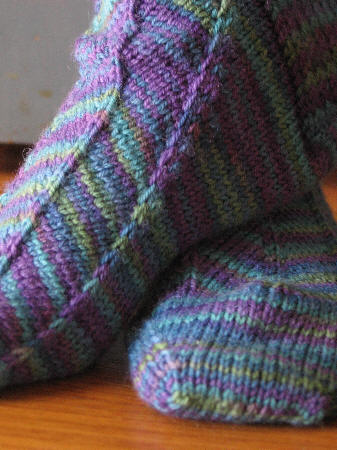
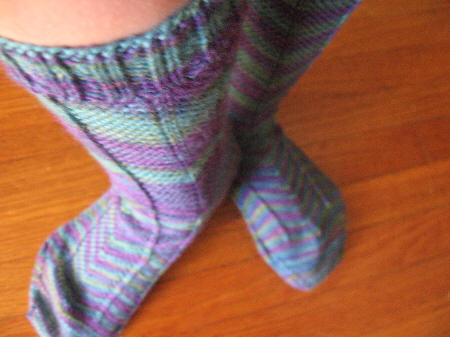
    I started out making these for Laura, and they fit rather snugly, so they went on to Julia instead, as she didn’t have a knitted pair of her own yet — these are still on the big side, but I can almost see her growing as I watch, so I think they’ll be fine after only a few months!

    I used 68 sts — one st less per each side of the bias — a simple matter.  The bias pattern seems pretty forgiving, and can be sized down quite a bit.  (Grumperina offers some suggestions about resizing up here.)

    The Shepherd Sock is lovely yarn to work with — it feels wonderful in my hands, makes a beautiful fabric, and the colors are rich and intense.

    Jaywalker2

    Jaywalker4

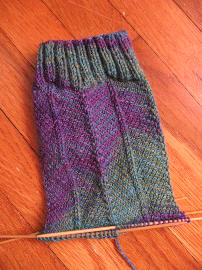
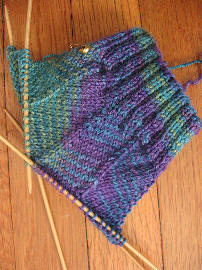
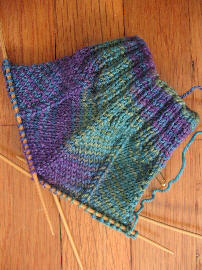
    But here is proof positive that when it somes to space-dyed yarn, I have no idea what I’m talking about — I remarked earlier with great confidence after the first sock that since I was making the pattern in a smaller size, the stripes were coming out slightly thicker than they would have done.  You will notice that the second sock I worked, on Julia’s left foot in the photos, has the stripes in a fairly narrow pattern.  So much for predictability!  And the socks in a yet smaller size — casting on 60 — did not stripe at all, merely blobbed, and so unattractively that I tried again two more times before I gave up in despair.  (Another reason that I gave the socks to Julia instead of Laura.)

    1 2

    3 4

    The second pair started out very promisingly, but then started to go up straight — at the center shaping line in the photo on the left, the purple is on one side and the green/blue on the other — very disconcerting.  So I’ve ripped them out and hidden the yarn away for another day, and decided to enjoy the ones I do like, the ones that Julia is so pleased with that she wanted to take a photo herself!

    Jaywalker3

  • Booking Through Thursday for today wants to know where we read —

    Where do you do most of your reading? Your favorite spot?

    I usually read on the sofa in our living room, a comfy two-seater in sagey-green velveteen bought at a huge discount when our local Laura Ashley shop closed some years back.  (Our loss was our gain, as it were, as we could not have afforded it otherwise.)  My second choice is the IKEA sofa in what we call the front bedroom, although it is in fact our TV room.  I try not to read in bed much, as I have occasional bouts of insomnia.   I don’t think I have a favorite spot for reading, as such — every spot for reading is a favorite spot! — just a usual one.

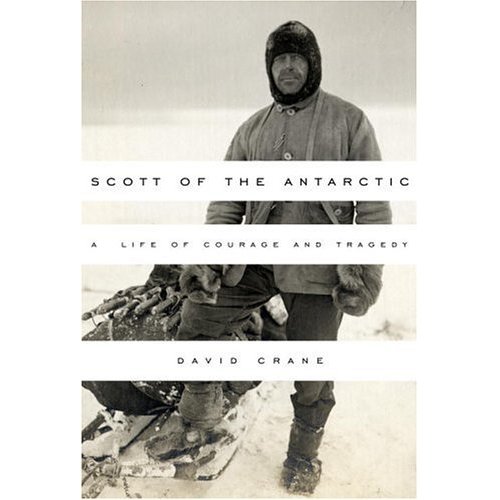
    I finished reading David Crane’s Scott of the Antarctic a while back, and had to rush it back to the library some days late.  It is an interesting book, one that impressed me in a number of ways, and made me think, and want to linger over it.  I was delighted first of all by Crane’s writing, with complex yet fluid sentences that made me realize how comma-starved I’ve become in these days of text messages and emails.  Here is one of my favorites, regarding Scott’s meeting with his future wife, Kathleen: "Bernacchi [as an early biographer of Scott] reckoned that Scott had ‘only a slender knowledge of women,’ but it is fair to say that all the knowledge in the world would probably not have prepared him for the wonderfully tanned, determinedly virginal, twenty-eight-year-old sculptress with a passion for ‘male babies’ and a critical eye for a prospective father, just back from five months’ vagabonding around Greece" (p.312).  How often does one actually laugh out loud at a book on Polar exploration? I ask you!  Subtle, humorous, and telling.
    Scottoftheantarctic_davidcrane_amazon

    I was very impressed at Crane’s ability to not only write interestingly and thoughtfully, but to balance the admirable and not-so-admirable aspects of Scott’s character.  It did seem to be rather difficult at times, though, for him to tell enough of the story to keep the Antarctic-novice reader going.  I can imagine that it’s hard when the writer knows the cast of characters so well to say, for example, "Crean" or "Lashly," and not realize that the reader has no idea who Crean or Lashly is.  (Even I wished for a little list at the back of the book.)  Crane at one point remarks on Scott’s stomach troubles in a way that implies this was chronic, but it had not been mentioned to us before then.  On the other hand, Crane’s ability to make the rather gorgonlike Kathleen Scott into a relatively sympathetic character can only increase my admiration for his abilities as a writer.  (In Kathleen’s defense, I can only admit that most of my impressions of her come from the men’s diaries, as biased and anti-feminist as most Edwardian men.) 

    My first experience of the Capt. Scott story, as I’ve said before, was from the Roland Huntford book and television series — definitely unflattering towards Scott — and so my opinion of Scott was quite low for a long time, but after reading Crane’s book, I think that Huntford is too hard on Scott, or at least unwilling to show the good side.  I wonder if our taste for gossipy, warts-and-all biographies (did the gallant Captain Oates really father a child at the age of twenty, with an eleven-year-old girl?) these days make us underappreciate the loyalty Scott inspired — sadly lacking in so many of our public figures now, to our great cost.  Talking of the great Memorial Service at St. Paul’s, Crane writes, "There are few things that more poignantly signal the remoteness of Dean Inge’s age from our own, because while nothing is more inevitable or healthier than historical revisionism, what has happened to Scott’s reputation requires some other label.  It might seem odd from this distance that neo-Georgian England should find in a Darwin-carrying agnostic of Scott’s cast the type of Christian sacrifice, but the historical process that has shrunk the rich, complex and deeply human set of associations that once clustered round his story into an allegory of arrogance, selfishness and moral stupidity is every bit as extraordinary" (p.11).

    While we can’t forget that, as Huntford reminds us repeatedly, ponies and manhauling in the Antarctic lacks a great deal of common sense (to put it mildly), and that by association this lack is transferred to Scott himself with tragic results, we also must remember, as Crane points out not only elegantly but tellingly, that "In such a climate of doubt and self-questioning [as that of post-Industrial Revolution and pre-WWI England], the outpouring of national pride over Scott was no demonstration of imperialist triumphalism but its reverse, its militancy the militancy of weakness, its stridency the stridency of a country desperate for assurance that the moral qualities that once made it great were still intact" (p.9).  Huntford sees the mistakes — huge mistakes, certainly — while Crane sees the mistakes in context, which, while it doesn’t excuse them, does go some way towards explaining them.  "The most tempting answer is suggested by the cultural and political overtones implicit in Trevor Griffiths’ use [in "The Last Place on Earth" series] of the word ‘Englishness,’ because if Scott was once celebrated as the incarnation of everything an Englishman should be, he is now damned as the sad embodiment of everything he actually was" (p.12), in other words, an Englishman.  We do tend to lash out at the characteristics in other people that we most despise in ourselves, don’t we.  The qualities that "made England great" — duty, self-sacrifice, discipline, patriotism, hierarchy, as Crane lists them — are now seen as less than admirable.  It’s an interesting thought.

  • Garterknee3

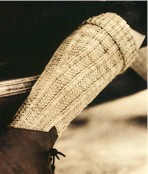
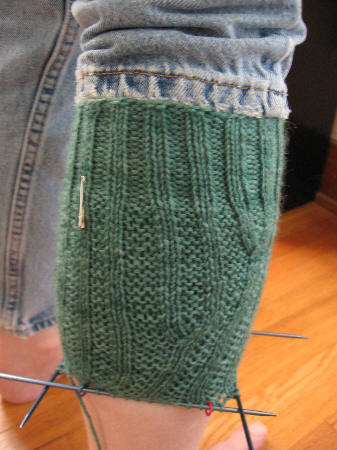
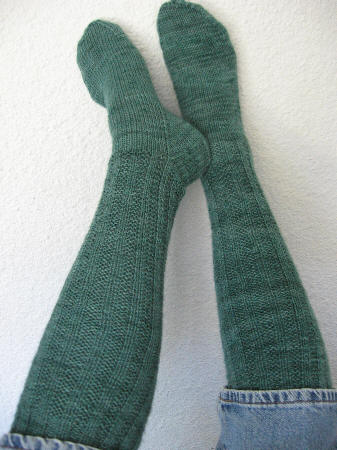
    Inspiration, as so often happens, comes from many sources, the Araucania mittens being the first.  Looking at the stocking stitch, I realized that the wool would make a lovely, thick sock.  I had also been pondering the garter rib in Charlene Schurch’s Sensational Knitted Socks for some time, and Googling "araucania nature wool socks" led me to the discovery that since the Nature Wool felts so readily, socks made from it would felt and conform to the wearer’s feet — a fascinating idea.  I’m glad I didn’t see these,

    Taltuttensocks

    Cornelia Tuttle Hamilton’s Taltutten socks from her "Transitions" Nature Wool Collection, until after I’d finished writing up my own pattern.  I’m not the only one thinking about knee socks these days — see Gabriella Chiarenza’s gorgeous Clessidra knee socks in the Spring ’07 Knitty, too!

    Naturewool2

    The Nature Wool is lovely to work with, thick and wooly but still soft with a pleasant rusticness.  I love the way that the kettle-dyed colors shift here and there, sometimes markedly but very subtly here, in this dyelot.

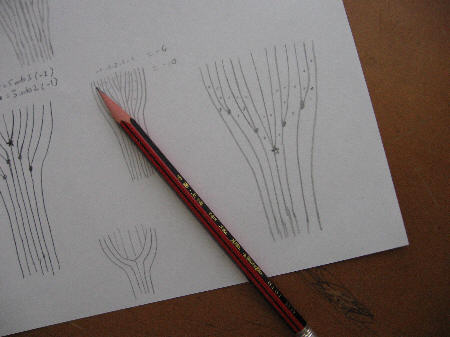
    There are a fairly endless number of ways for incorporating leg shaping into a pattern.  They don’t always turn out they way they look on paper, though — this, for example,

    Img_7908small

    turned out like this,

    Garterknee1

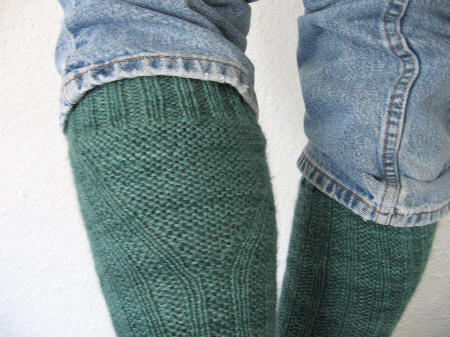
    which is okay, but not what I had in mind.  In the end, I opted for a simple V-shaped gusset,

    Garterknee4

    which is easily adaptable to different calf sizes.  You don’t really realize how long your legs are until you knit yourself a pair of knee socks — I ended up adding two full inches more because of the horizontal stretch of the fabric once it was on my leg!

    Garterknee2

    And it’s a bonus that they look really good with my new shoes!

    Garterknee5

  • Redscarf

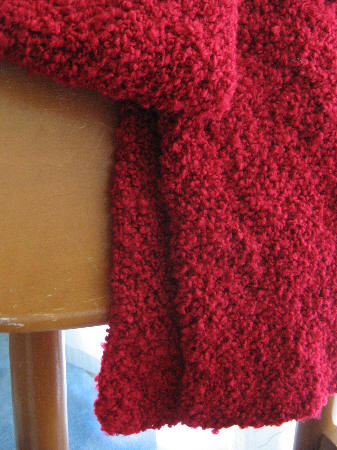
    Well, it took me an incredibly long time, but I have at last finished a scarf for the Red Scarf Project.  (There is a Red Scarf Project 2007 blog, too, although I believe that the Project itself is on-going.)  This is the organization that sponsors "care" packages for kids leaving foster care and heading off for college, the packages arriving around Valentine’s Day and including a handmade red scarf in each.

    It’s a bit embarrassing to call this a pattern, it’s so simple.  I’m not a big fan of either acrylics or heavily-textured yarns, but I like this — the bouclé is even nicer on the bias, I think.  And machine-washable!  The yarn is very splitty, but frankly I just ignored that most of the time, and it was fine — a little extra texture here and there, eh?  The pattern requires almost no concentration at all, although I did find it much easier to remember where I was by putting a large safety pin at the upper edge on the front, moving it up as the scarf grew!

    You will need 1 ball of Bernat Soft Bouclé in "Richest Red" and a pair of US7 or 8 needles.  This pattern will make a scarf about 7 x 59 inches (18 x 150 cm), is machine-washable, and is designed to use the entire ball of Soft Bouclé, with a bit left over as a margin of error.  If you want to make it go as far as you possibly can, I highly recommend putting in a lifeline before beginning the last decrease section, as the bouclé is very tricky to pick up once ripped out!

    A Red Scarf

    Kfb = K into front of st, then into back of the same st.

    Cast on 2 sts.

    Row 1: Kfb twice.
    Row 2: K.
    Row 3: Kfb, K to last st, Kfb.
    Row 4: K.

    Rep rows 3 and 4 until there are 34 sts.

    Work straight thus:

    Next row: Kfb, K to last 2 sts, K2tog.
    Next row: K.

    Rep these 2 rows until scarf measures about 59 inches.

    Next row: K2tog, K to last 2 sts, K2tog.
    Next row: K.

    Rep these 2 rows until 2 sts rem.  K2tog, and draw end of yarn through the last st to fasten off.  Weave in ends.

  • And the Winner Is …

    Winner

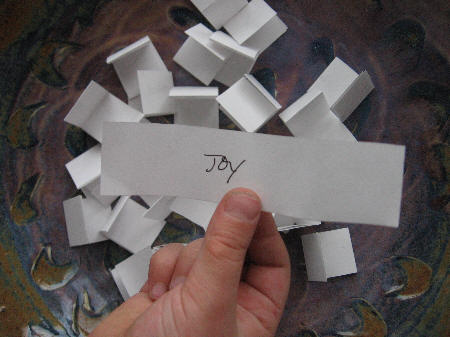
    Joy, of joyousknits!  Huzzah!

    Honorable mention goes to Kelli Ann of avoir une famille n’est pas comme un téléroman, just because she used the word déguste.  (Actually, Meriel, I was already thinking of it!)

    Thank you, everybody, for taking part in A Bluestocking Knits’ first-ever giveaway!

  • Cardimg

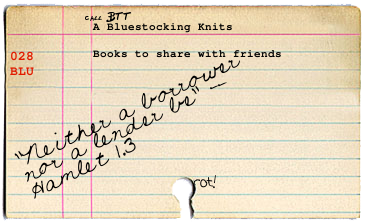
    1. Do you lend your books to other people? If so, any restrictions?  How could a librarian not loan books to other people?!  I usually just put a sticky note inside, so that it is obvious it’s borrowed.
    2. Do you borrow books from other people? (Friends or family–I’m not talking about the public library)  Yes, I’m certainly an equal-opportunity borrower/lender.  I must admit, though, that in my circle of friends and family, I have the lion’s share of books.  (David, just be quiet.)
    3. And, most importantly–do the books you lend/borrow get returned to their rightful owners?? Assuming that I see the other person regularly, yes!  The overdue fines might stack up a bit, though.

    Catalog Card Generator from Blyberg.net, via Kay — thanks to both!

  • ,

    Jaywalking

    Kids’ socks! you gotta love ’em!  This is how far you can get with just one sleepless night and an early morning!

    Img_7706small

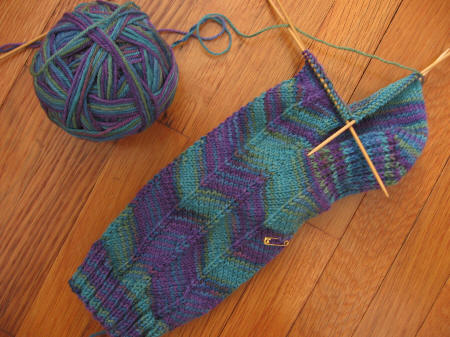
    Of course, it doesn’t hurt that the pattern is the fabulously simple yet brilliant Jaywalker socks by Grumperina.  I’m late to the party — again! — I know, but I’m hooked now.

    And yes, this is more Shepherd Sock "Lakeview" knitted up.  Since I’m resizing the pattern to a child’s size, the color bands are wider than they might ordinarily be.  If you want to be entered in the drawing for two skeins, please post a comment below!

  • Snow Day

    Snowday4 Snowday2

    Snowday6 Snowday5

    Snowday3 Snowday1

    Snowday7 Snowday8

  • Blogiversary

    I think it’s time for a little celebration of sorts, don’t you?

    Lakeview_2

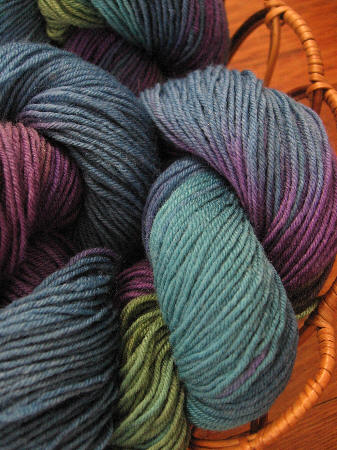
    I’ve always loved the idea of giving gifts on one’s own birthday, and so now it’s time to put that into practice.  In honor of my two-year "blogiversary" on March 19, I will hold a drawing for two skeins of lovely Lorna’s Laces Shepherd Sock in "Lakeview," enough for a pair of Jaywalkers or whatever your imagination comes up with.  Just leave a comment on this post, and on the 19th one or other of my darling daughters will choose a number at random for the winner.  Please, of course, be sure to include a valid email address if you want to be included in the drawing!

    DLF, your entry would include the knitting!

    Lakeview_1_1

    Thanks for stopping by!