• Elizabethan stockings 5
    This is the first part of my planned Renaissance Faire clothing.  I say "Elizabethan" as there is apparently no evidence that hand-knitted stockings were worn quite so early as that in England, although I'm still waffling about their period authenticity.  Up to the Elizabethan era at least, stockings and hose were commonly sewn from bias-cut fabric, a long and elaborately-shaped piece with a separate sole — one can only imagine the suprise when putting on a knitted one for the first time! like wearing leggings after years of wearing jeans.

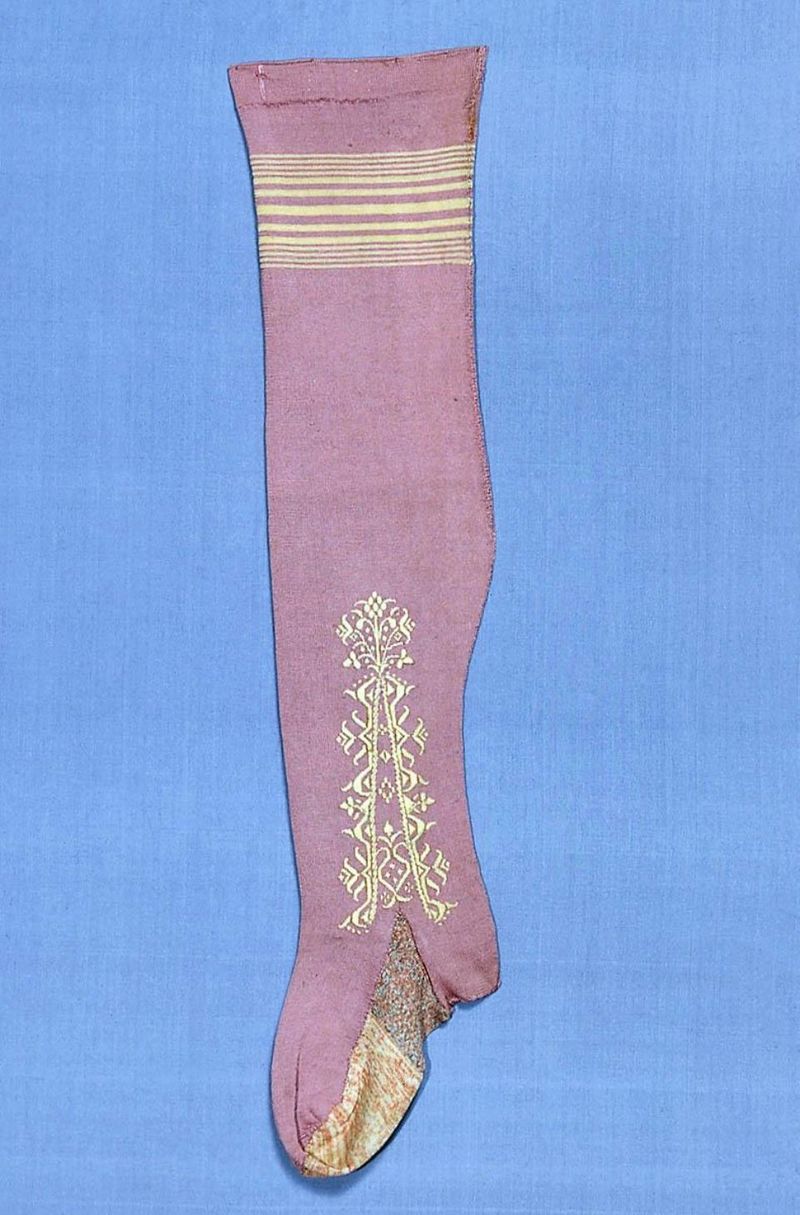
    One of the earliest known pairs of knitted stockings in Europe are part of Eleanora of Toledo's burial garments from 1562 (here is someone's pattern for them):

    Image002

    I have not done any serious research on Eleanora's stockings, so cannot be taken as an expert by any means, but I have to wonder if they were either simply not taking advantage of the stretchability of knitting at this point, or were so taken by the possibilities of patterned stitches that these were made rather larger than modern stockings would be.  There is no record, of course, as to the size of Eleanora's calves, but the proportions look a little off to me.

    Knitted stockings 1

    The earliest known pattern for knitted stockings is from a book called Natura Exenterata — "Nature unbowelled", that is, with all of her secrets spilled, as it were — from 1655.

    Natura exenterata

    (This copy is from the Folger Library)  It is a book mostly of physicking, with shorter sections on household practices from horse-breeding to distilling, making perfumes, and so on, including how "To Dye divers kinds of Colours" which I found rather interesting — things like "To dye Popingay Greene.  Take penny-hew and put it to Chamberlye or good Boockley, and seeth it and put it in the yeallow Yarne, and let it seeth, the longer it seetheth the deeper the colour will be."  "Popinjay" is the old word for parrot, so I can only assume some sort of parrot-y green — chamberlye is, yes, urine from the chamber-pots, which apparently acts as a cleansing agent on the wool, removing oils and dirt, and it also apparently works in combination with the other dyestuff as both a pigment and a fixative. 

    Anyway —

    The "knitting" bits in Exenterata can be found online at this University of Arizona page, under "Monographs" — I say "knitting" because there are only twenty pages included there and then only three actually related to "the order how to knit a hose", the rest being the dye recipes and a long section of netting patterns and another of lacework.  (I get a kick out of one of the patterns, as the author says after every step that you should have x number of stitches "provided alwayes, if your work go true", that is, if you've done it right.  I can't tell if that inspires confidence or not.)

    There are quite a variety of opinions around as to whether or not knitted stockings, despite the difference between dates of Eleanora's obviously expertly-knitted stockings and the Exenterata pattern, are really "period" when talking about Elizabethan costuming.  The Exenterata pattern gives instruction on shaping the calf and turning the heel, but stops at the toe, making me think that this must have been common knowledge by 1655, enough that it wasn't thought necessary to include that part, and the novelty, if any, is in the heel and foot.  Actually, I think you could find opinions these days for either date, even among the really dedicated SCA folks, but I am willing to be corrected, my philosophy being, as someone once said, "To stonde alwaies stiff and obstinate in one opinion is rather Vice than Vertue".

    For mine, I was really just making it up as I went along, according to my brief and limited research.  Ribbing was not known until quite some time later, so the top of a stocking was a simple one of garter stitch, or perhaps a fancier cuff like Eleanor's, to be folded over or not as the case may be.  The stockings were held up with separate garters, either a knitted strip of garter stitch (hence the name), a piece of fabric, or a woven strip such as from tablet-weaving.  Knitted stockings were made to imitate the sewn ones by including a "seam" down the back — I used a simple one-stitch purled line, but apparently a wider version can be found. 

    Shepherd sock natural

    Stitch detail 1

    The yarn is two lovely skeins of Shepherd Sock in Natural, a delight to work with, and the pattern is custom-fitted with help from the Arachne Sock Calculator

    Shaping detail

    I think that the only thing I would do differently is to move the center of the clock towards the back by 2 stitches, so that it lines up with the edge of the heel flap.  If I'd thought about it more thoroughly, I probably would have realized that the center of the side is two stitches towards the instep, and not in line with the gusset decreases.  (Smacks forehead.)

    Clock detail

    The heel is the "common shaped heel" from Nancy Bush's Folk Socks book, which is I think essentially the same as the Exenterata one.  The only modification I made from Bush's version was to not cut the yarn but simply use a three-needle bind-off instead of grafting the bottom-of-the-heel stitches.  Yes, I know, I thought "a bind-off on the bottom of the foot!" too, but I was going more for historical accuracy, as grafting apparently wasn't known for quite some years more, and as it happens, at this gauge and for so short a length as this, I can't feel it at all.

    Shaped common heel 2

    This is how the heel looks in progress from the inside — the line of knit stitches is the "seam", then the three-needle bind-off goes on up to where the needles meet —

    Shaped common heel - inside

    I used the round toe — it seems that a wedge toe was more commonly used in early hand-knitted stockings, with a three-needle bind-off, but that seam, I think, you would feel more easily than one at the bottom of your heel, and so the second-earliest option won out.

    Round toe

    And so — as far as a Faire gown is concerned anyway, I've had my fling with knitting — on to sewing!

  • This is another mish-mash post, all of the little bits and bobs that separately don't make up much of a post!

    I finished knitting the Hug-Me-Tight a month and a half or so ago, and sewed it all together — unfortunately the result is a resounding "meh".  Am not really sure if I simply made it too big (this is the larger size) or if the drape of the Cashsoft is too lazy to show it off much, or if blocking would help — but it resides on the top of the end table still.

    0942 small

    0943 small

    0944 small

    It looks even worse on me than it does on Laura.  Not sure yet whether or not I'm going to rip it out or block it and hope for the best — I'm inclining towards the former, as I suspect that the Cashsoft won't block much.  The larger border is curling I think because it is basically a circle, so that the outer edge is simply stretched too far.  It may just be a matter of the wrong yarn for the project.  Sigh.

    Also on the needles are an Elizabethan-of-sorts stocking, and a generic sock in Paton's Kroy "Camo Colors" — huge gauge, it seems! so it's working up gratifyingly quickly as I pass the time during various dentist appointments and piano lessons.

    Kroy camo colors

    Last week I went to Michael's for a piece of embroidery fabric, and started a blackwork sampler.  I was so amazed that my local public library actually had two books on blackwork (three, really, although apparently one is missing, as my request for it is still hanging in the ether somewhere), that, really, I could hardly not.

    I first worked a simple all-over pattern from Rosemary Drysdale's The Art of Blackwork Embroidery (Scribner, 1975), and then jumped in to the two patterns from Jane Pemberton's smock, charted here by Kirrily Robert, aka "Lady Katherine Rowberd" of the SCA.  Here is the original Holbein miniature again — this picture isn't as detailed as the one I posted before, but I love the little pearls (or water sapphires?) on the frame, which isn't included in most of the images of the miniature:

    Holbein_Jane_Pemberton_c1540

    Wikipedia reports that her name was Jane Pemberton, later Jane Small, daughter of a Northamptonshire gentleman and later wife of a London cloth merchant, and dates the miniature to around 1540.

    And just because I get such a kick out of it, here is the back of the miniature:

    Holbein - jane small aka jane pemberton - reverse - v&a

    These two blackwork patterns are worked mostly in Holbein (or "double running") stitch.

    I made a slight modification to the collar pattern as given by Rowberd in that I eliminated the little bar across the end of the Celtic-like ribbonwork between the diamonds — I thought this made the ribbonwork a little more obvious.  It made the set-up more difficult, in that I couldn't simply work the main diagonals straight across but had to count out where to leave off those stitches.  This picture is how the diagonals look before working the fiddly bits:

    Collar patt setup

    I still haven't figured out the "right" way to do blackwork — if there is only one — I found another photo of this pattern in progress by someone who worked each section separately.  There is much to be said for that method, as it isn't nearly so nerve-wracking wondering if you've left enough room or counted correctly.  (In fact, you can see in the above photo where I assumed that the diagonal I was working would "bounce"off of the top margin, and I had to pick it out.)  If you get the set-up right, though, it is usually progressively easier to work each element, because you can see where each one sits, as well as how it fits in with the previous elements.

    This, by the way, is worked on 28-count Monaco cotton with one strand of black floss, over two threads per square of the chart.  Ragnvaeig's scarlet piece is obviously worked with at least two strands, and is therefore much denser, but I think that color on white linen is just gorgeous.

    Here is mine with some of the ribbonwork completed and one on the third of its four passes:

    Pemberton in progress

    I'm not sure yet if the wobbliness of the lines is due to my amateurishness, or just the nature of the thing, that sometimes the thread gets crowded in the hole of the fabric and sits differently. Luckily, from a distance, you can hardly tell….

    And here are the finished collar and cuff patterns:

    Pemberton done

    I actually don't like the cuff pattern much (it looks a bit choppy, I guess), and upon reflection would probably work a line of the ribbonwork on its own for the cuff.  Rowberd details her re-creation of Mistress Pemberton's smock here — alas, though, without a photo of the finished garment.

    And for those who are tired of blackwork, a paper crane that Julia folded one afternoon, to my astonishment and delight —

    Mini origami

  • Classic 3

    This is the Classic Sock from Melissa Morgan-Oakes' 2-at-a-time Socks, in Trekking XXL.  Started it ages ago, I'm afraid, fully a year at least, probably more — was going to do a toe-up, thinking pessimistically that I didn't know how far one ball would go for David's manly feet, but when I discovered that the reason he wasn't wearing the first pair of socks I'd knitted for him was because he was afraid of wearing them out, I thought "poor man!" and resolved to finish this pair immediately.

    Classic trekking greens

    I've misplaced the ball band but this is probably 327 Dark Greens and Blues, a handsome combination — not David's usual colors, but I figured that if he didn't like it, I certainly would.  The camera doesn't seem to like this color combination as much as I do — it looks a bit dusty in this photo.

    Classic 1

    The pattern is a fairly straightforward sock with a K1, P1 rib at the cuff and K3, P1 on the leg and foot, with a slip-stitch heel flap and a standard toe.  I didn't work it two-at-a-time, mainly because I really have no problem with "second-sock syndrome" and felt somehow, I suppose, that the method is more goal-oriented, as it were, than process-oriented, and while I do like having a pair of finished socks, I also simply like the time spent knitting them, so that this is a method that I don't really have an incentive as yet to try.

    I have heard, of course, of the problems with the book itself, and experienced a bit of that myself with the Coquette socks a while back.  With this pair, I cast on for the men's large size at 96 sts and found after a few inches that it was absolutely enormous.  I ripped it out and whacked off a chunk of the stitch count — still too big — ended up using 68, and even that is still on the roomy side.  The gauge given in the book is 9 1/2 sts per inch with XXL, whereas mine is seven to 7 1/2.  Knitter beware.

    The first sock weighed 52 g, so because I was still a bit concerned about not having enough yarn to finish, I did not cut the yarn at the end of the first sock, but put all of the sts on a holder before grafting the toe, and made the second sock from the other end of the yarn.  The XXL did not like being a center-pull ball, by the way.  I did have enough to spare, though, so that worked out all right.

    Two new sock projects on the needles already — a pair for my mother-in-law, and an "Elizabethan stocking" as part one of my Renaissance Faire costume-to-be ….

  • Famous Knitters

    Audrey knitting

    Audrey Hepburn, date unknown.

  • From Real Simple’s “Summertime New Uses for Old Things” list — mitten-as-sunglasses-case:

    Solution-mitten-glasses_300

    Hands up, those of you who thought “nice mitten — I could make a pair of those!” before you thought of sunglasses holders ….

  • The D.E. Stevenson community has been abuzz for the past few months with the debut of two lost novels, Emily Dennistoun and The Fair Miss Fortune, both published this month by Greyladies of Edinburgh.

    Emily dennistoun

    Emily Dennistoun was originally titled "Truth is the Strong Thing". There is no date attached to it, but it seems to have been written in the late 1920s, then put away and never published. I have to admit that if I had written this, and then, say, Mrs. Tim of the Regiment, I would have stuck this in a drawer and tried to forget about it as well. It is surprisingly overwrought for a Stevenson, even a serious one — which she does now and then — although, to rather curious effect, the dialogue at least often has her usual light touch. The plot is a "typical" Stevenson one in which a quiet, reserved heroine, under the thumb of a tyrannical parent, falls in love unexpectedly and must suffer several changes of fortune and twists of plot until we find out how exactly — for the outcome is never in doubt — she is rewarded with happiness in the end. With Stevenson, like Vivaldi, it is the journey, not the arrival, that is what makes things interesting and often compelling. Emily Dennistoun is not, though, I regret to say, Stevenson at her best. There are a number of editorial inconsistencies that I expect would have been fixed if she'd meant to publish it, and the prose is very Mills-and-Boon.

    "Emily's soul was in tune with the storm, she suffered with it, suffered as only those can whose art lives upon their nerves like a hungry animal.  Suffered all the more because she was gentle and sweet in every-day life.  She was like the quiet pastoral English country that smiled in the sun.  The storm came to her heart and roused its slumbering rage, changing the familiar scene to a nightmare of madness.  What did it all mean — where did it come from? Whither was it going?"

    I have to say, though, that I did really appreciate that the heroine is not young — in her early thirties for the main part of the drama — and that the hero is not some dark and brooding Rochester-type, but tall and ugly with bright red hair. I think that it takes a bit of courage to buck the trends when one is starting out as a novelist, so I give Stevenson credit for that.

    The fair miss fortune

    The Fair Miss Fortune, however, is classic early Stevenson. It was written around 1937 — and was rejected by Stevenson's then-publisher as "too old-fashioned". (Stevenson replied bemusedly, "I am old-fashioned.")  Charming heroines — two of them, identical twins, which was the publisher's kick against the story ("it's been done") — likeable heroes, characters of both supportive and hindering stripes, misunderstandings, sparkling and easy dialogue, all of Stevenson's hallmarks.  One doesn't like to bandy the word "delightful" about too often, but this one probably deserves it!

    And here are two knitting patterns to go with them — for Emily Dennistoun,

    1920s jumper

    a sensible 1920s jumper, don't remember now where I found this. Plain garter rib, yet with hidden depths in the differently-colored trim….

    Moorland Tweeds Redingote ruffled dress c1935

    and for The Fair Miss Fortune, from around 1935, a flirtatious ruffled dress of Moorland Tweeds wool — with "that English flair" so essential, we think, for a D.E. Stevenson knit-along.

  • Rosalina 59

    I am very late in posting this, which was a Halloween costume for Laura, but since I want to keep a record of my sewing — such as it is — for an Elizabethan costume for myself, I will recap it here.

    Some of the boys in Laura's class decided that they wanted to do a mass Super-Mario dress-up for Halloween, and they asked Laura if she could dress as Rosalina (good heavens, there's a whole Super-Mario wiki!).  Laura, still with touching faith in my sewing abilities after the Pilgrim costumes I ran up for her and a classmate in first grade (all straight seams with an elastic casing at the neck, to be covered with already-made white collars), said, "Oh, my mom can do that!" and so after thinking to myself that it would be good practice for the Elizabethan one, I said I would.  Two weeks' notice, mind you!

    Princess-Rosalina-super-mario-galaxy

    We went to the fabric store and I chose this pattern to adapt, as the neckline was the closest I could find, and the sleeves would be fairly easy to make a little more bell-like —

    Simplicity 9891

    I bought swathes of white costume satin for the underskirt and trim, and they happened to have some lovely acqua satin with sparkles — I was aiming for more costume satin, but as it turned out, this was a lucky find, as the sparkly stuff had much more body to it, and was easier for me to sew, being much less slippery than the costume satin.

    Rosalina 44

    I made a full underskirt, not sure why now.  Partly the petticoat effect, certainly, and since I intended all along to make the bodice and skirt with that Empire-effect as in the Rosalina illustration, I figured that it would hang better to have the underskirt go all of the way around.  This would probably have been much easier if I'd had more experience altering patterns, but as it's all a blur to me now, it apparently worked fairly well.  And, well, yes, partly because if the dress had been for me, I would have wanted a full underskirt — the feel of it is wonderful as you walk!

    I did make a muslin before cutting the satin.  I still always get that "oh, I don't need to take all of that time" feeling in addition to "what a waste of fabric!", but it's really worth it, especially with such extensive alterations of a pattern.  I did the muslin hip-length, though, with no fastenings at the back other than pins and marks to myself where the zipper would go.

    All of the seams are French.  This took more time, but I think was worth it as the satin would have frayed quite a lot otherwise, especially the plain one.  I didn't finish the edges at the zipper and they look dreadful on the inside already!  (In fact, you can see a little poof of it in the photo of the back below.)

    Rosalina 49

    Rosalina 46

    The collar is a complete invention, done mostly free-hand, with the neck edge following the bodice pattern.  It is doubled for more body.

    Rosalina 51

    The cuffs were comparatively simple, done free-hand following the pattern for the sleeve edge after adjusting for a fairly emphatic bell shape.  I doubled the satin like the collar for more body, and also so that the hem wouldn't show as much; if I'd been a better seamstress, I would have turned the side seam to the inside, but that would have involved a) planning further ahead, b) more time, and c) hand-finishing, so I didn't.

    Rosalina 50

    The bodice was very difficult to get to lie flat, and I had to take it out and re-sew it more than once.  I'm still not entirely pleased with it, but time was running out.

    Rosalina 53

    The trim around the bottom was theoretically fairly simple, but proved to be quite a hassle.  The satin was very slippery, and despite careful measuring I still managed to cut it wrong, so that some of the turnings were hair's-breadth close.  I sewed the upper edge to the skirt with the machine, turned it under at the bottom hem, and finished it by hand.  The inverted-V at the front never did lie flat, even with heavy pressing.

    After that, the accessories were easy.  The bodice pin is sparkly stiff white felt from Michael's, with a big jewel on the front and a safety pin glued to the back.  The sceptre is yellow craft foam glued to a piece of dowel painted white, with more jewels.  The crown is the same sparkly white felt — double thickness both for stability and to have a place for the seams to be glued to — with large gems all around.

    I have to say that Laura looked a picture of loveliness.  The color suits her very well, and she is tall and slender, so that the line of the skirt was very regal on her.  Plus of course it twirls!

    Rosalina 55

    Now —

    The_tudor_tailor

  • ,

    Girl Scout quilt

    Gs quilt 1

    Here is my first batted quilt — I finished (eventually) two "Turning Twenty" quilts for the girls (to be blogged shortly) without batting so that they could be used year-round here in sunny Southern California.

    These fabrics are from the Girl Scout collection by Robert Kaufman — last year's assortment from Hancock's, or possibly the year before (oof).  I was going to make another "Turning Twenty" but the fat quarters shrunk so much that it wasn't possible with the bundle I had to get the right size blocks out of them, so I just cut everything into 4×4 squares.  I was a little intimidated by the batting, but it actually went together very easily, and I machine-quilted along the seam lines so that the fabric shows off better.

    I don't know why now that I got it into my head that I could save time and fabric by making the back and binding in one piece, but I did — I cut the back a few inches wider all around than the top, folded the hem edge under, then wrapped the "binding" around and top-stitched it down (finishing the mitered corners by hand).  It did go fairly easily, but since I didn't have a very big quilt in the end, I was being a bit miserly and folded the "binding" a little too skimpily, and the top has been popping out in places, necessitating hand-mending.

    But it has seen a week of day-camping and an overnight weekend and sailed through without a scratch, so I'm quite pleased!

    Gs quilt 2

  • Gymkhana Bag

    Gymkhana bag 1

    I’ve made I think four of these tote bags already, very simple and handy.  This is one of matching bags (one has black webbing handles and the other brown) for the girls, who are horse-crazy, in two fabrics from Makower UK, Gymkhana Showground on the outside and Gymkhana Rosettes for the lining.  Big enough to take for a a sleepover at Grandma’s.

    Gymkhana bag 2

    Gymkhana bag 3

  • I finished my blackwork sampler from the class at the Renaissance Faire. 

    Finished blackwork

    I have worked needlepoint and cross-stitch before, so the fact that you work blackwork motifs in segments was not entirely unfamiliar to me.  You want to do this because if you work each motif, say the little "wishbones" in my sampler, on its own, the thread will lie in different directions.  (For knitters, this is the same principle behind not only the obvious K2tog vs. SSK, but also in the more subtle variations on how to work the SSK, the loops lying differently depending on the way that it is worked.)  So with blackwork, basically, you work all of the little dashes along one edge of your pattern, turn the work around, do the next line of dashes, perhaps the angled ones this time, turn the work, do the next segment, and so on.  Medallion motifs and so on are on the same principle, although with more pieces of the pattern worked before you go on to the next step.

    The class was pretty good, especially because I was the only one signed up that day and thus got the instructor's undivided attention.  For your thousand pence (because, marry, it's the Ren Faire), you get a square of 11-count Aida cloth to work practice stitches, needle and thread, the sampler backing in 18-count Aida (a bookmark kit by Charles Craft from Jo-Ann's), and a hand-out, plus of course the instructor for an hour to get you started.

    There are actually two different kinds of blackwork: one is the counted kind, worked in short, straight segments which result in a geometric angularity to the design, and free-stitched black work, with a more curvilinear look, and which is really simply embroidery in a single color, usually black.

    The first picture is my sampler as it was when I came home:

    First blackwork started

    There are two separate strands of thread because the instructor had me stop working the second angled leg, and start adding in the last straight leg, so that I could see how the pattern would look.

    I worked the second border and then picked a center pattern that would fit between the two.

    I had a very difficult time figuring out how to read the chart.  It has numbers all over it, obviously some sort of sequence, but with numbers missing.  I had had a little introduction to these charts from the instructor at the Renaissance Faire, but in my case a little education was probably worse than none at all.  Although there is plenty of information on how to do blackwork on the internet, these numbered charts don't seem to be standard, and there is apparently nothing on how to read them.  After no little time of trying to understand what went where and how, and not getting it at all, I gave up in frustration and went off to do something else.  Some time later, I thought of my old "Golden Hands" set, and looked up blackwork.  There was a single two-page spread, which was actually not much help as the project was "easy to work from the photograph" and had no chart at all, but the diagrams somehow sort of began to make sense, and so I picked up the numbered chart again.

    Apparently — and someone please correct me if I'm wrong! — you simply assume some of the numbers, that some are, as it were, "innies" and some "outies" and you only get the "outies" numbers.  Believe it or not, this way of looking at it actually helped, and while I may not have been working it "correctly", I got into the swing of it fairly quickly after that.  It certainly looks like the illustration! so I can't be too far off.

    Blackwork 2

    Here I have worked the first half of the center motif — again, you work part of it to the end, then turn around and work your way back, sometimes three or four times.  The "wishbone" border took five passes, although (amusingly) the more complicated lozenge pattern only two, but with back-stitches.  Here I accidentally left off the extra lines on the first star and didn't notice until two or three along, so I left it in as a "design element", planning to make the last one to match.

    Blackwork 4

    But then when I got to the end of the first pass, I found that I had badly estimated the spacing, and it was unbalanced enough to disappoint me greatly, so I picked it all out and did it again, also fixing the first star.  "If it's worth doing", and all.  I got this far the second time when I saw the mistake which positively leaps out at me now.  First person to spot it gets a prize — oh, I know, two virtual weeks at the Royal School of Needlework!

    So I finished the thing, and carefully snipped the black thread in the middle of the mistake and picked out four or five stitches on either side of it, and reworked them with new thread.  You'd never know.

    Finished blackwork back

    Here is the back, in all its sorry glory.  The border at the bottom is the one I worked at the Faire — you can see that for one thing, once I got home I didn't remember in what order I'd done the parts of the "wishbones", and for another, it was much better the second time regardless, and I got into a good rhythm.  (The wobbly lines in the top border are the woven-in ends, and at the right is when I careened off the reverse for a moment until I got my balance again.)  I found that it was a lot like knitting lace, that I was kind of humming to myself "over two, under three — over two, under three — over two, under three" on down the row.  The lozenge motif started off very awkwardly and the back was all over the place, but it actually didn't take me very long to see how it was fitting together — I'm still not at all sure I understand the numbered chart, but after a while I didn't really need it — all that knitted colorwork stood me in good stead, I guess.  The back of the blackwork here is the second try, of course, so it looks much tidier.

    The instructor recommended Donna Kooler's Encyclopedia of Needlework for an introduction to blackwork as well as dozens of other different kinds of embroidery, and Mary Gostelow's Blackwork and Rosemary Drysdale's The Art of Blackwork Embroidery for more in-depth stitches and patterns.  Online, the Blackwork Embroidery Archives has many lovely patterns for free, but little how-to information for the utter novice.

    And because I can't resist, here are some contemporary examples of blackwork:

    1537_jane_seymour_by_holbein

    Jane Seymour, by Holbein, ca.1537.  Rather restrained blackwork at the cuff edges of her smock.  I wonder if the little black dashes around the neck are some kind of blackwork edging?

    Jane_Seymour__Workshop_of_Hans_Holbein_the_Younger

    Jane Seymour again, by the workshop of Holbein (apparently a copy of the first portrait but with a different smock and undersleeves).  Even more restrained blackwork than the other, but look at that pleating on the undersleeves!

    Besshardwick

    Bess of Hardwick by a follower of Hans Eworth, ca.1550s, and no, I don't know why it says "Maria Regina" as this certainly isn't the pinch-faced Mary.  Red blackwork, and lots of it — even on the ruffles!

    Holbein - mrs pemberton - 1535

    The only commoner here, Mrs. Pemberton, whoever she is, by Holbein, ca.1535-40.  A pretty blackwork collar and cuffs on her smock.  Someone has worked out a chart for this smock and made a lovely copy.

    Mary_I_by_Master_John

    Mary Tudor, by someone called "Master John".  The blackwork is not especially clear in this image, but it is apparently the freehand kind, not counted like all of the above examples.