• Clocked stockings - 1650-1750 - mfa boston 43 1944a-b

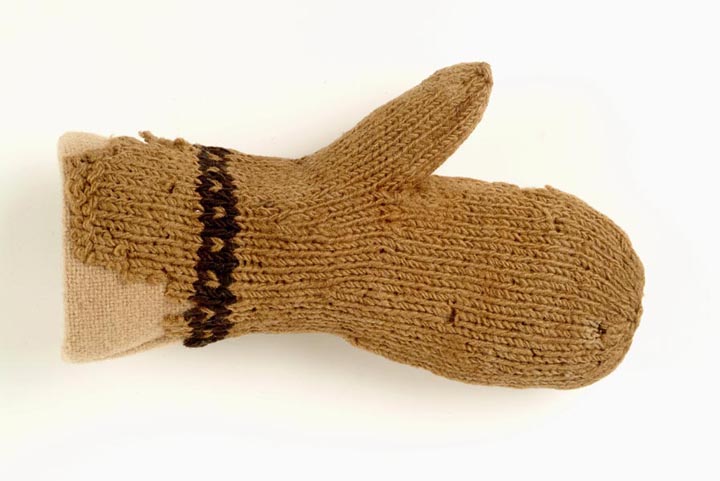
    Pair of clocked stockings
    1650–1750, European; 19 x 52 cm (7 1/2 x 20 1/2 in.)
    Knitted silk, embroidered with silk yarns. Embroidered clocks of straw-colored silk yarns in decorative motif. Knitted rose silk ground, thirteen yellow stripes at top, polychrome sole.
    The Elizabeth Day McCormick Collection, Museum of Fine Arts, Boston.

  • I am currently reading The Paper Garden : an Artist Begins Her Life's Work at 72 by Molly Peacock, a biography of the woman who invented the art of paper collage — rather accidentally, it seems, by noticing the similarity of a piece of colored paper and the petal of a geranium.  Interesting to think that of such trivial coincidences are art forms born.

    Mary delaney horse chestnut

    I don't remember ever having heard of Mary Delany (1700-1788), so this was all new to me, and thus perhaps all the more amazing, to look at a collage like the one above and try to comprehend that it is all little bits of colored paper meticulously cut and pasted onto a black background, with startlingly life-like accuracy.

    Delany had an interesting life, a marriage arranged by her family when she was seventeen to a much-older landowner who turned out to be an alcoholic and a gambler, which hardly surprisingly with hindsight turned out to have been such a disaster that Mary could not help being more than a little relieved when he dropped dead quite unexpectedly after seven years.  Now only 24, Mary could perhaps have hoped to live the rest of her life in peace, but unfortunately her husband had not altered his will, and so she did not inherit even what little remained of his estate, and spent the next twenty years living with various friends and family, trying to secure a court appointment, setting up a small household and yet still finding time to produce reams of intelligent, witty, and sensible letters

    In her forties, Mary received a proposal of marriage from Patrick Delany, an Irish clergyman of her acquaintance (later Dean of Down), who it seems had long held her in the utmost regard.  Now both widowed, the two enjoyed a very happy marriage until the Dean's death in 1768.  A few years later, Mary made the connection between the bits of colored paper and the flower petal, and made nearly a thousand of these flower portraits, what she called collectively her "Flora Delanica", until her eyesight failed in her late eighties.

    Rosa gallica

    I found the book at the public library, opened it at random and read the first pages of the chapter on the passion flower, and was enchanted.

    Magnolia grandiflora

    Mary_Delany_(née_Granville)_by_John_Opie

    A portrait of Mary Delany, by John Opie, 1782.

    Peacock, being a poet, has a way with words, so that her prose too is often very poetic.  I did, though, I must confess, get a little tired of the amount of autobiography Peacock stuck into Mary's story.  I can understand objectively why she felt it works, I guess, but subjectively, as it went along, I really wanted more Mary.  The book itself is beautifully made, which I thought a lovely dollop of extra poeticism — lovely creamy thick pages, a handsome dark font and wide margins.  I was not sure in the end, though, that I wouldn't rather have simply a catalogue of Delany's "mosaicks", and spend a great many hours enjoying a vicarious friendship through her letters.

  • Found Object

    IMG_1472 small

  • “Forever Plaid”

    The cast of "Forever Plaid" on the "Tonight Show" in 1992.  Gosh, the memories this brings back! I don't want to say how many times I saw the show at the Canon in Beverly Hills, but it was a lot more than once.

    The album is still a treasure, too —

  • Drysdale 20

    This pattern is number 20 from Rosemary Drysdale's The Art of Blackwork Embroidery, adapted a little in that I shifted each line of medallions so that they nested together a little and left less white space.

    Drysdale 14

    Drysdale's pattern 14.  This one seemed to take forever; I don't know if that is why I don't like it as much as I thought I would, or if it just doesn't speak to me as much as some of the others, but there it is.  Perhaps it's too modern -looking?!

    Neue modelbuch 1 in progress

    This one is lifted from Alina Silverthorne's "Chalice stockings", in turn being a pattern from Ein New Modelbuch [sic] of 1526.  Unlike the very-fiddly pattern #14 above, for example, this one is completely in Holbein stitch, and if I'd taken a little care would be completely reversible.  It says Catherine-of-Aragon to me — I'm not sure why, perhaps the rather severe Catholic look to it?  Those Spaniards!

    This was fun to work in a daring sort of way, in that the first pass — every other stitch showing, as it were — requires understanding how the pattern will look when finished without actually seeing the whole thing as you work it.  The first pass thus looks like a set of bird tracks in the snow.  The second pass was only a matter of connecting the dots, though!

    Neue modelbuch 1

    (All of these samples are worked in one strand of black embroidery floss on 28-count Monaco cotton.)

    And here are two contemporary examples of blackwork on garments —

    Simon_George,_by_Hans_Holbein_the_Younger

    Simon George of Cornwall, by Holbein ca.1533, a lovely little work now in the Städelsches Kunstinstitut in Frankfurt.  His considerable technical mastery aside, Holbein's people always look so utterly real to me that I find it impossible not to be fascinated by them.

    Mary nevil lady dacre

    "Mary Nevill, Lady Dacre?" ca.1545–1549, by an unknown artist; also known as "The Wrest Park Portrait" from its former location, and also identified as Lady Jane Grey.  J. Stephan Edwards at Some Grey Matter writes convincingly and at length on his re-identification of this portrait as Lady Dacre.

  • Poring over my copy of Nancy Bush's Folk Socks of an evening — as one does — I thought that I would do some "school socks", fairly simple socks that use these different heels and toes.

    Crocuses 1

    Camo 3

    First, a pair in Loops & Threads Luxury Sock in the "Crocuses" color, with a Dutch heel and star toe.

    Loops and threads luxury sock crocuses 1
     
    The first pair is in the new Luxury Sock yarn from Michael's.  It is very soft, rather limp with the bit of cashmere, but pleasant to knit with.  There was a partial splice in the first ball, insignificant enough that I could winkle the ends back into the twist.  The second ball, though, had an actual knot in it, towards the bottom of the leg, and then this —

    IMG_1314_small

    I was going along swimmingly, very pleased with myself that I'd matched the color changes perfectly, when near the end of the heel flap I realized that I'd been knitting with white for nearly an arm's-length of yarn.  Not only was the blue-and-white section incomplete color-wise, it was shortened by nearly half.  The photo is slightly misleading, as I didn't notice that Laura had pulled the second sock higher, but you can see quite clearly that the blue-and-white band is only half the depth it should be.  (The colors are a bit brown in this photo: what looks like brick is more of a dusty rose in real life.)

    So I ripped back the heel and whacked off an entire color repeat to get back to the right spot, and carried on.  When I got to the end of the second toe, I looked at the finished sock, and lo and behold the repeats were off again.  Now this may have been my fault, as in comparing the two socks I notice that the second is noticeably narrower, and even slightly shorter!  (This is an instance of where knitting two socks at the same time would be a good idea, as apparently my gauge on the second sock was considerably tighter.)

    IMG_1355_small

    So I ripped out half of the foot,  back to the start of the next-to-last blue-and-white band, and worked it again v-e-r-y l-o-o-s-e-l-y, counting the rows in each band to make sure that the second sock was exactly the same row count and color match as the first one.

    This is how much was left over from the middle of the second ball:

    IMG_6014_small

    The top bit is due to pulling off a length in order to start at the same spot in the color sequence; the bottom (5 grams!) is due to the defect.  Perhaps this is why there is a good 15g more in each ball than you need for a generously-sized pair of socks?

     Loops and threads luxury sock crocuses 2

    As I said, it's a pleasant yarn, although while inexpensive, at $5.99 it isn't what I'd call cheap, and so I would expect a little more than knots and color flaws in it.

    Crocuses 2

    The Dutch heel is quite simple, and Bush's instructions worked like a charm.  I did the heel flap in a sl 1, K1 fabric, and kept this through the heel turn, which was quite easily done and I'm told will make the heel that much sturdier.  (In the photo just above, the sl-st section continues along through the purple section downwards from the flap, and into the first part of the blue-and-white section.)  The cashmere content seems to make the yarn feel a little fragile, so I'm hoping that the extra thickness here will counteract that.  The heel itself is a bit more square than the heel I usually use — which is in fact called a round heel — but this isn't really obvious once it is on my foot.

    The star toe is also quite simple, and fits my squared-off toes nicely.  (I don't know why there is a little jog in the decreases line in the purple section there…?)  This toe is especially easy if you use 5 dpns, as the decreases are spaced a quarter of the way along each round, and will thus come at the end of each needle without having to resort to markers or counting in the first round.

    Crocuses 3

    Laura modelled both of these socks for me this afternoon.  She pulled on the Kroy pair first, and said, "Mom, there's something wrong with the heel."  The Luxury ones, she is still wearing an hour later, despite the heat wave.  (This is saying something, even more than you'd think, as she has declined politely to wear knitted socks at all for at least a year.)

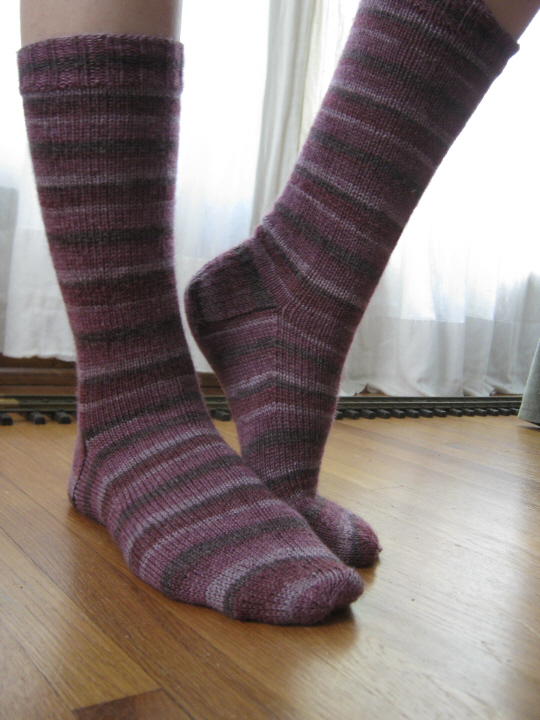
    The second pair are in Paton's Kroy FX in "Camo Colors", with a German heel and wedge toe.

    Kroy fx camo

    I don't like this wool much at all, as it is very scratchy even after washing, although I don't notice it quite so much when wearing as I did while knitting with it.  (I shall be generous and call it "bargain wool", as it is about half the price of the Luxury Sock.)  It is, however, thick and quite warm. I might have better used 2.5mm needles, as the fabric is a bit stiff.

    Camo 1

    The German heel is also fairly simple, and went together easily with Bush's instructions — so far my Becher's Brook is the Welsh one, it seems.  I did a plain flap with no reinforcement — I think this wool will wear like iron anyway (she said grimly).

    Camo 2

    Both the Dutch and the German heels are essentially a square and a small rectangle, the sides of which rectangle (the turn) are joined to one side of the square (the flap).  This is noticeably different from the round heel, which is a square (the flap) with a triangle (the turn).  This construction makes both of these heels more squared-off than the round heel, and a good choice, I would think, especially for those wearers whose heel sits low to the ground.

    Heel geometry

    The German heel doesn't allow for much of a gusset, though, at least not at this gauge — there were only 2 extra stitches after picking up! — and so I did not work the decreases as P2tog as in Bush's versions, since it looked more like a mistake than a line of purl decreases.  To get a teeny bit of length, though, I did work 2 plain rounds before the decrease round, and another 2 plain between the second (last) dec round.

    The heel itself, though, is exactly as written by Bush.  It is very square in shape, and the angle of heel to foot is much sharper than with the round heel.  This is quite noticeable in the feel of the sock, especially compared with the much more subtle round heel.  (You can see in the picture of the socks laid flat, how much more square it is.)  I was looking for a difference when I put it on, of course, but even Laura noticed it right away.  It isn't bad, mind, only not quite as fitted as some; this could be adapted a little by making the turn a few stitches narrower, perhaps, or working it in a softer wool that molds more readily to the foot inside, or at a finer gauge altogether.

    This toe is a wedge toe.  I did one of Bush's variations, which proved to be too pointed for my substantial feet, and so I pulled it out and used my standard wedge, lifted from Grumperina's "Jaywalkers".

    Camo 4

    And there are still four more heels in Bush's book!

  • Harding chester - Mrs. Abbott Lawrence (Katherine Bigelow) - ca1855

    "Mrs. Abbott Lawrence, née Katherine Bigelow", around 1855, by Chester Harding (Museum of Fine Arts, Boston), found via Katherine at One More Stitch.

    The face you would not be surprised to see on some small-town parson, and so it is a little disconcerting to see it surrounded by delicate ringlets and fine lawn.  Is the look in those black eyes gentle or stern?  What is she knitting that is so red against her severe black dress?  Her face is rather hard and her back unforgivingly straight, and yet her feet sticking out like that give her a curious casualness.  The Gothic chair and the homely little dog-like workbasket only add to the ambiguity.

  • Testing, Testing —

    Loops & threads crocuses

    "Luxury Sock" in the Crocuses colorway, from the new Loops & Threads line of yarns from Michaels.  Has anyone tried it?  It's either so new that it isn't on the website yet, or they are being really quiet about it.  The URL on the ballband leads to a page that is spectacularly uninformative.

    This sock yarn is a 60% merino superwash, 30% nylon, 10% cashmere blend — very fine, very soft.  I was rather dismayed to read the fine print when I got it home, that says "hand wash only", as I am really not into handwashing socks — I had assumed from the superwash and nylon content that it would be machine-washable.

    The ballband gauge is 32 sts on 2.75mm/US2 — I am getting that but on 2mm needles (I generally have to go down one size needles, though).

    This was the most sedate colorway, by the way!  And no solids…

  • So we lived in Hong Kong for a while a few years ago, right?  We passed the cemetery in Happy Valley any number of times on the way into town.

    So I have family from Pike County, Illinois, some generations back.

    Who would have thought that these two would ever coincide?

    42754053_125481859658

    Thanks to another wonderful researcher at Findagrave.

  • IMG_1242_small

    Last night I sewed some pillowcases for the girls with fabric I'd originally bought for carry-all totes but realized was not really enough for a good-sized bag.  There wasn't enough of the print to make full pillow-cases, so I used the solids (which I'd bought for lining the bags) and pieced them onto the ends of the cases.  The proportions are not really what I'd do on purpose, as it were, but needs must and all.  I was rather pleased with myself that there is not a raw edge visible anywhere, as the edging is folded over inside and out to meet the patterned fabric, and the seams are all French.  Finished size 20×30 inches (51×76 cm).

    David came in from a bike ride this morning and said, "I really shouldn't tell you this, but there's a garage sale around the corner with lots of yarn."  "Lots" didn't really describe it, either.  Boxes and boxes and boxes, plus ribbons (cloth and gift), laces and other notions, dozens of hats.  The lady said that her mother had just moved into an assisted-living place, and she's been cleaning out the condominium.  "The craft stuff will be out tomorrow morning."  It was a little sad to think about, really, what we leave behind.

    I bought a half-dozen balls of kitchen cotton for new dishcloths, and this length of woven ribbon, which I don't really have a plan for, but I liked the colors and that it was pretty from both sides —

    IMG_1236_small

    Last week I read The Wilder Life by Wendy McClure, a memoir about seriously geeking out on Laura Ingalls Wilder and the "Little House" books.  I say that with about 30% gentle revulsion — you know, the way you draw your skirts in a little — and 70% secret envy that I haven't done all of the things McClure has.  Having grown up, like so many of us did, feeling somehow a part of Laura Ingalls's life through her books, McClure succumbed to the temptation to try some of the things that Laura experienced — wearing a sunbonnet, making candy by pouring maple syrup in the snow, twisting hay into sticks, churning butter — and to visit all of the places where Laura lived.  The book is actually more serious in places than I thought it would be, and McClure has some interesting things to say about Rose and the contentions that it was actually she who did most of the writing, as well as about why we continue to find the books so compelling.  But she is also at times laugh-out-loud funny — you can tell that she, too, has that mixture of revulsion and fascination when she comes across some real "Little House" um, aficionados — although, in an appealing way, much more often her humor is about her own self-admitted dorkiness.

    I also learned something I hadn't known before, that Almanzo is not pronounced, as I have for years assumed, all-MON-zo.  There is in fact a recording of Laura herself in later life — she sounds, I thought rather wistfully, like someone's Midwest grandma (like my Midwest grandma) — and she says the name almost as though it were two words, the first rhyming with "pal", Al MAN-zo.  (This is so obviously where Royal's nickname for his brother, "Manny", and Laura's own nickname for him, "Manly", came from that I wonder it didn't occur to me before, but it is still going to take some serious mental adjustment.)

    And just because I like the idea of seeing the faces behind the stories, here are some photos of the Ingallses —

    Charles and caroline ingalls

    Pa and Ma, Charles and Caroline Ingalls.  I don't know the date — perhaps someone else does — but Ma looks fairly young.  Pa's beard always surprises me, as it is completely out of my own experiences of beards, as well as nothing like the Garth Williams illustrations.  I might like the second photo a bit better, perhaps because it is more "like" Pa, somehow, with his hair not staying slicked down, and his eyes looking as though the twinkle is not far away —

    Charles_caroline

    Carrie_Ingalls_-_Mary_Ingalls_-_Laura_Ingalls

    Carrie, Mary, and Laura.  Carrie hasn't quite grown into the hand-me-down dress yet, I think.  Laura's hand has been pointed out, I think by Zochert, as pent-up energy, but you know, I think it's just resting on the back of Mary's chair.

    Liw

    Laura as a teenager in DeSmet.  Remember her cutting the bangs and curling them with her slate pencil?

    IngallsFamily2

    Ma, Carrie, Laura, Pa, Grace, and Mary.  (Does anyone look good sitting in a bustle?  My own great-great-grandmother's photograph looks the same, as though she's about to slide out of her chair — and curiously enough, with a similarly-misshapen bust, as though the stays aren't the right size any more.)

    Laura_Ingalls_Wilder 

    This is the iconic portrait of Laura Ingalls Wilder, the Author — it's on the bookplates I sent away to Mansfield for all those years ago, that still grace the endpapers of my copies of her books — but I think I prefer the other lesser-known one, which I'd never seen before now, though it is obviously from the same photographic sitting:

    Wilder8

    "But Laura lay awake a little while, listening to Pa's fiddle softly playing and to the lonely sound of the wind in the Big Woods.  She looked at Pa sitting on the bench by the hearth, the firelight gleaming on his brown hair and beard and glistening on the honey-brown fiddle.  She looked at Ma, gently rocking and knitting.

    "She thought to herself, 'This is now.'

    "She was glad that the cosy house, and Pa and Ma and the firelight and the music, were now.  They could not be forgotten, she thought, because now is now.  It can never be a long time ago."