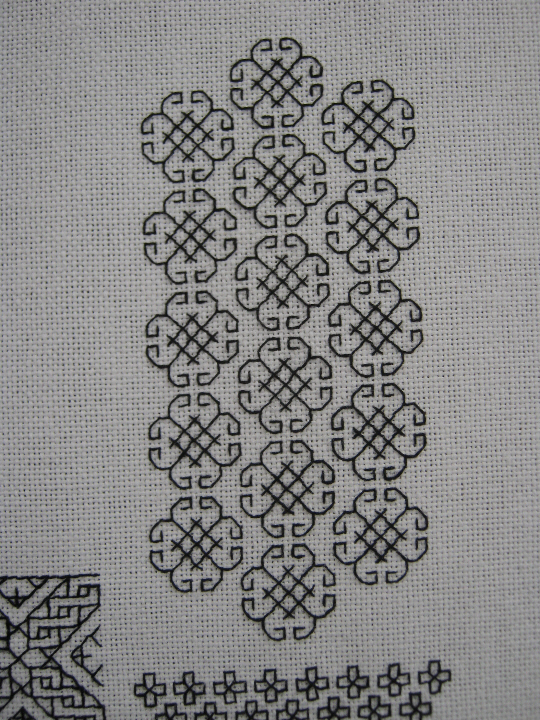
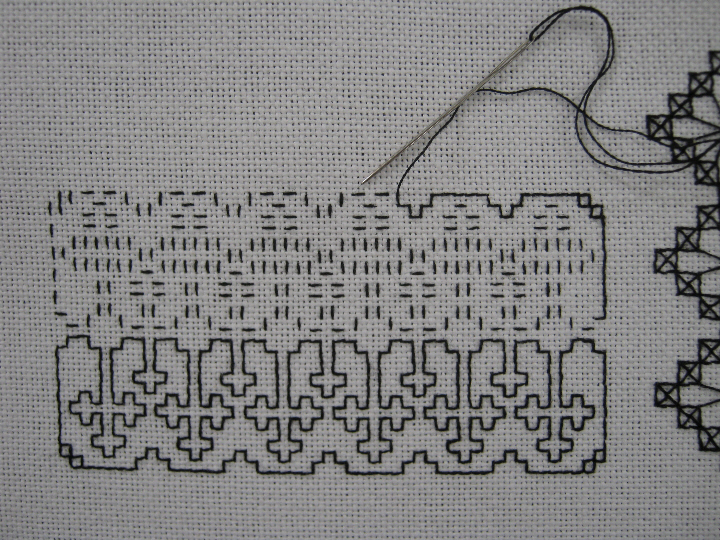
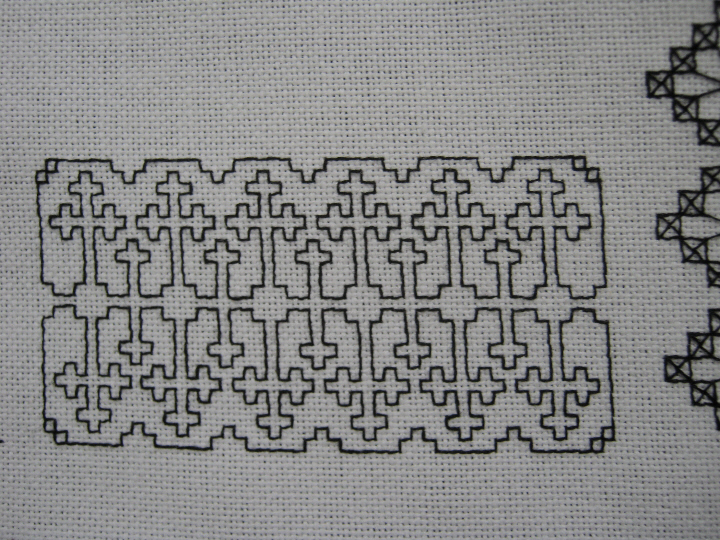
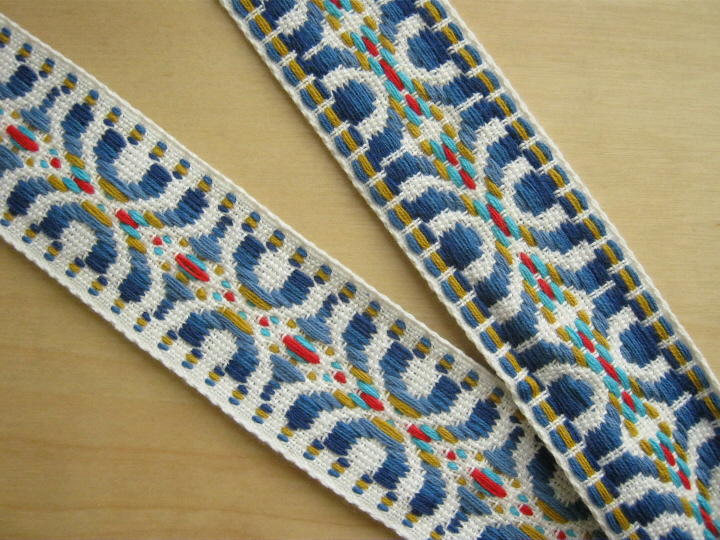
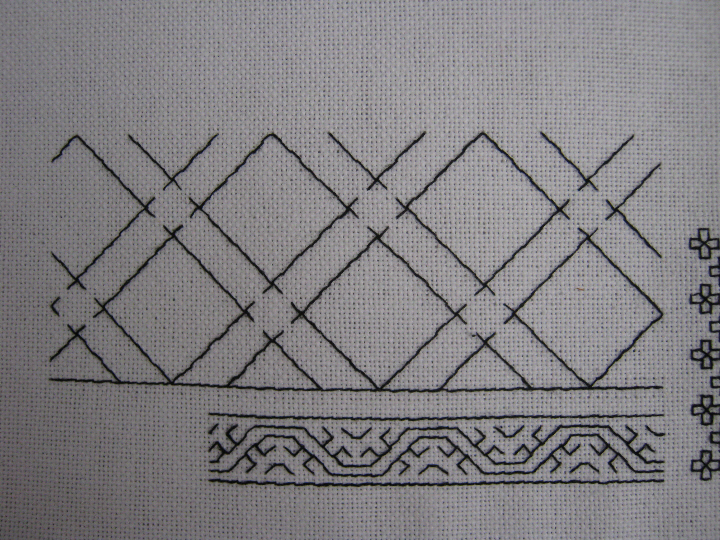
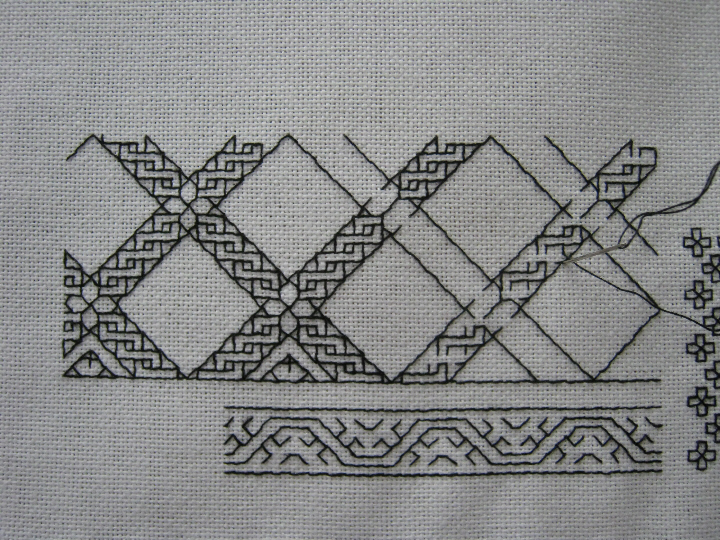
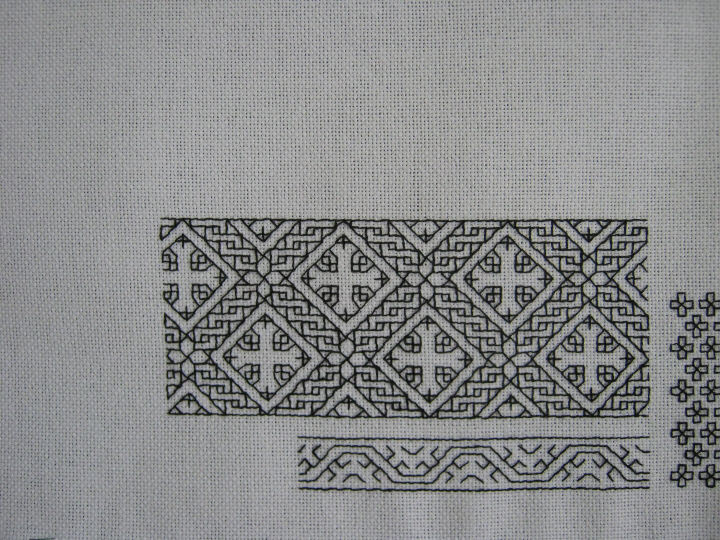
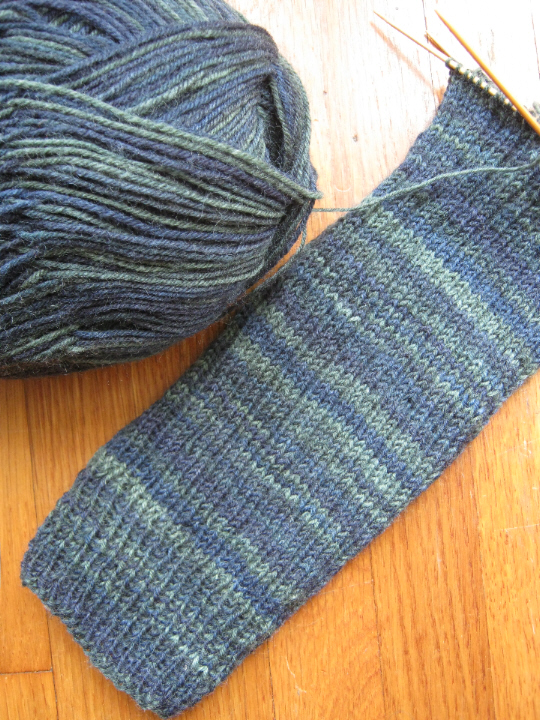
• We went to the Renaissance Pleasure Faire yesterday– not exactly for Mother's Day, but as it was certainly my idea of a good time, it was fine with me!  I took a little "class" in blackwork embroidery this year, while Julia was doing a mask-painting one.  I didn't have the camera with me the whole time, as David and Laura went off on their own while Julia and I were at the "Queen's College", so some of these photos are from last year.

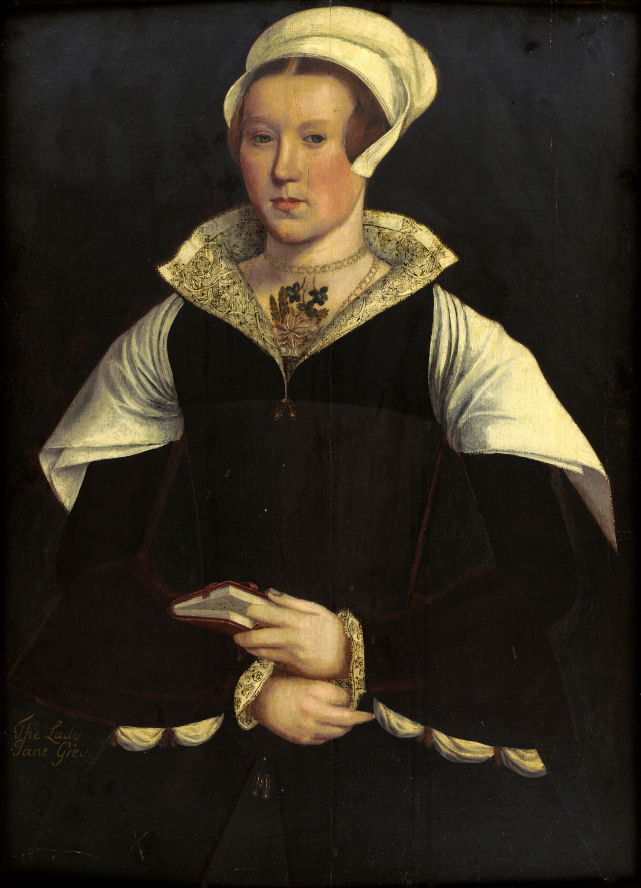
    I meant to sew myself a costume for this year — had even bought a copy of The Tudor Tailor in preparation — but alas, that was not to be.  But my ambitions, although modest, are inspired yet again by the lovely costumes, from commoner to nobility, that you see every few yards.

    Ren faire 1

    Ren faire 2

    Ren faire 3

    Ren faire 8

    Ren faire 4

    Ren faire 5

    Ren faire 7

    Ren faire 9

    Ren faire 6

  • Curses!

    Foiled again

    Foiled again!

  • Easter Mysteries

    It is a tradition in Norway at Eastertime, I learned recently, to read mystery and crime novels over the long holiday from Holy Thursday to Easter Sunday.  Now, I like Norway, and I like reading, so this just seems too good a tradition not to adopt!

    Paskekrim2

    (A little too blurry to read most of the titles, worse luck, here in an Oslo bookshop called Ark, from an article in an Oslo news-site.)

    This tradition is of fairly long standing, dating from 1923 when writers Nordahl Grieg and Nils Lie decided to write a crime novel — but instead of the publisher releasing their book in the autumn as usual at the time, the story ran in an advertisement in a Bergen newspaper just before Palm Sunday, under the headline-looking title "Bergen train looted in the night".  This caused great excitement and even consternation — shades of Orson Welles — in those who didn't notice the "advert" in fine print at the bottom, and the whole thing proved to be so popular that a number of crime and mystery novels began to be published in the spring.  As well as books, radio mysteries were broadcast, and later television shows — often the great British shows such as the Lord Peter Wimsey series in the 1970s, "Miss Marple" and "Poirot", the Adam Dalgliesh series, and more latterly, "Foyle's War".

    Apparently, Påskekrim — the å is pronounced like the RP "aw" in "law" and "jaw", but "POHS-keh-krihm" is pretty close — remains to this day a puzzle to the "outside world".  The Norwegian Wikipedia writes a little bemusedly, "Not even the Swedes have been infected with the Norwegians' penchant for murder mysteries and suspense."  I can't think why, really — a long holiday, inclement weather, a juicy murder mystery, it sounds like a perfect combination to me!

    These are the most popular Norwegian crime writers available in English:

    Karin Fossum
    Jo Nesbø
    Kjersti Scheen
    Gunnar Staalesen
    Anne Holt
    Kjell Ola Dahl

    some of whom are discussed at Elusive Moose and in more detail at Scandinavian Books.  I have, I confess, only one book by one of these authors — Karin Fossum's Inspector Sejer novel Black Seconds — mostly because when I went back to the bookstore the other two titles were already gone!

  • Cashsoft mist

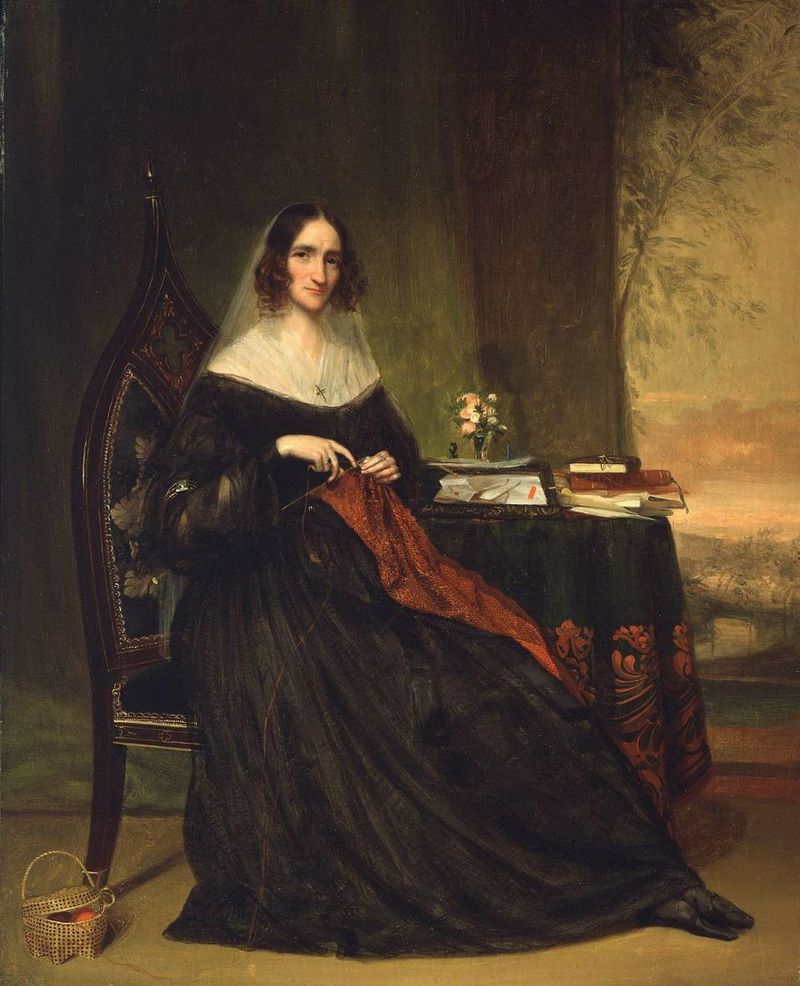
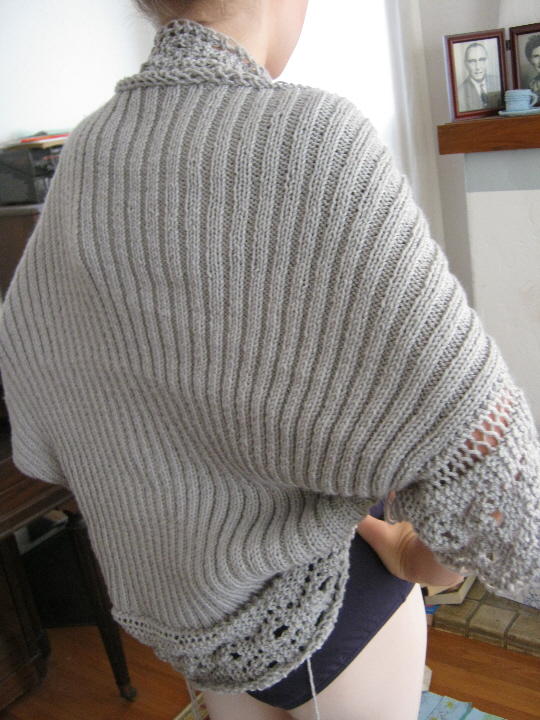
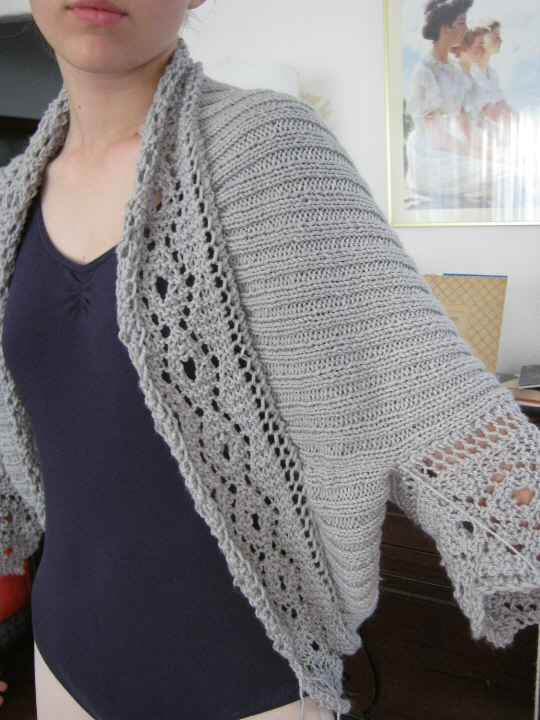
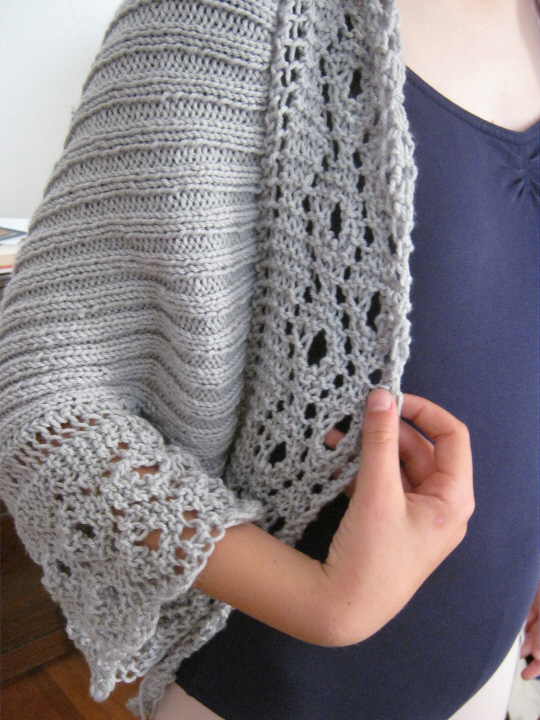
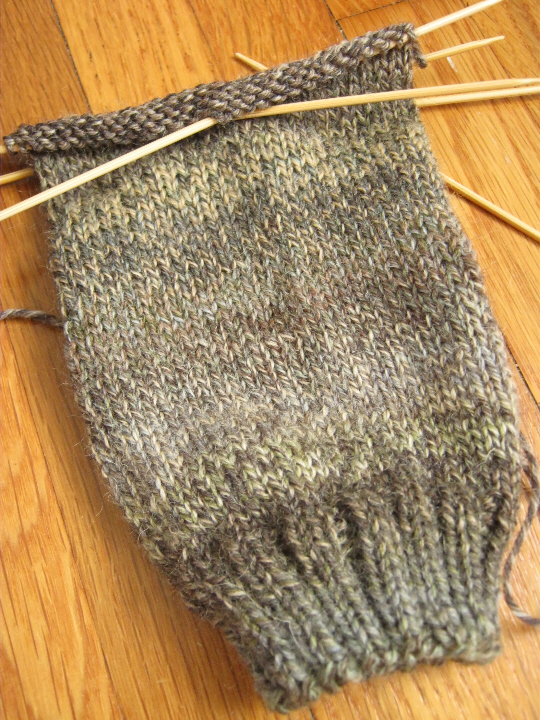
    I am currently in the middle of the Lacy Hug-Me-Tight from Tracey Ullmann's and Mel Clark's Knit Two Together.  I have at last got past the Rib of Eternity, and into the fussy bit — ah me, ordinarily I like lace, and I like knitting lace, but I'm very tired lately, dragged down with an ear/sinus infection, so that it took me 45 minutes last night to do one 12-row repeat, as I kept knitting a row in a kind of stupor and coming out with the wrong number of stitches at the end and having to shake myself and unpick and recount, and in the end I just set it down thinking I might do some colorful fingerless mitts instead, or a sock.

    Well, at least I have the liberty of knitting or not, of saying to myself, "oh, I'll just do something quick and pretty!" —

    Meek's cutoff

    This is Michelle Williams and Shirley Henderson in a scene from "Meek's Cutoff", just out this month.  I've long been fascinated by the Oregon Trail, and this movie looks interesting because of that, because it gives more of a woman's perspective on the journey — not just the adventure, the Indians, but the long hard slog, the difficulty of preparing meals for your family, of keeping them clean, keeping them safe.  The image has stayed with me for years of a rocking chair left behind at the side of the trail because the wagon is too heavy.

  • Thoughts on the 1810 Socks

    1810 3

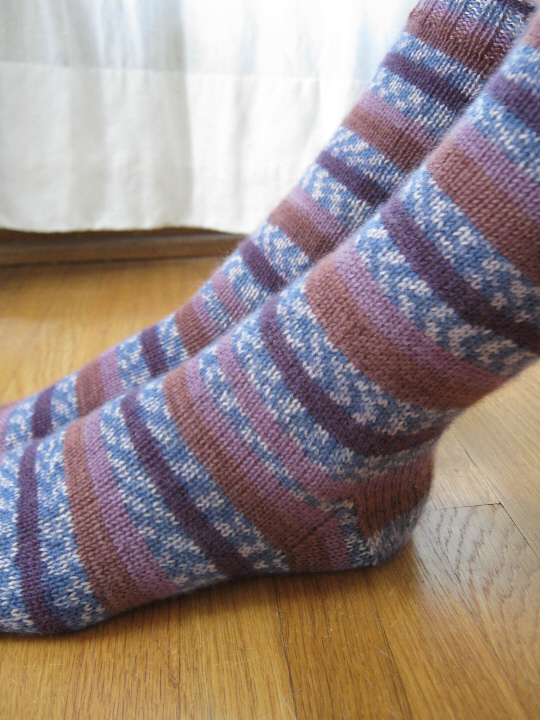
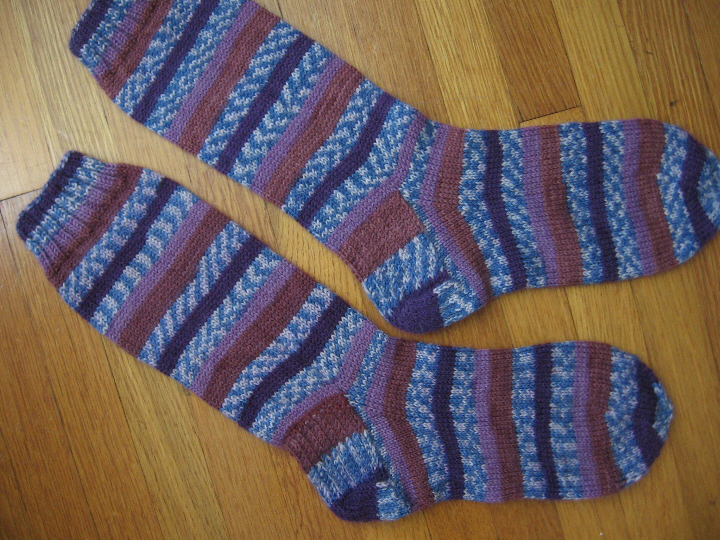
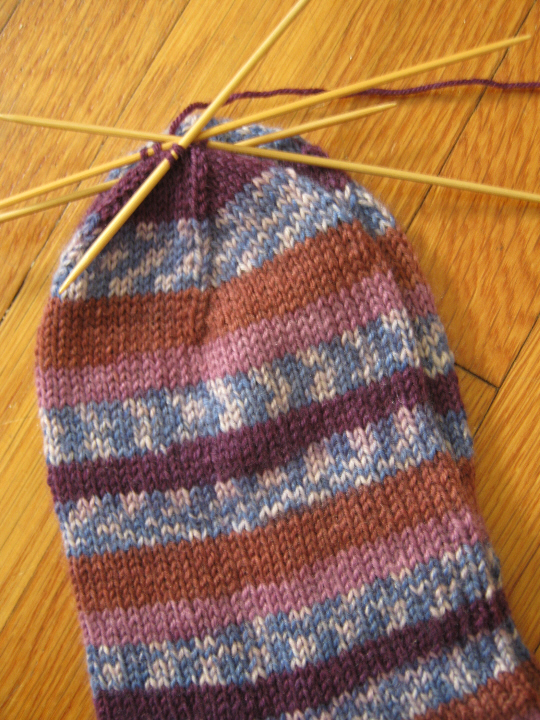
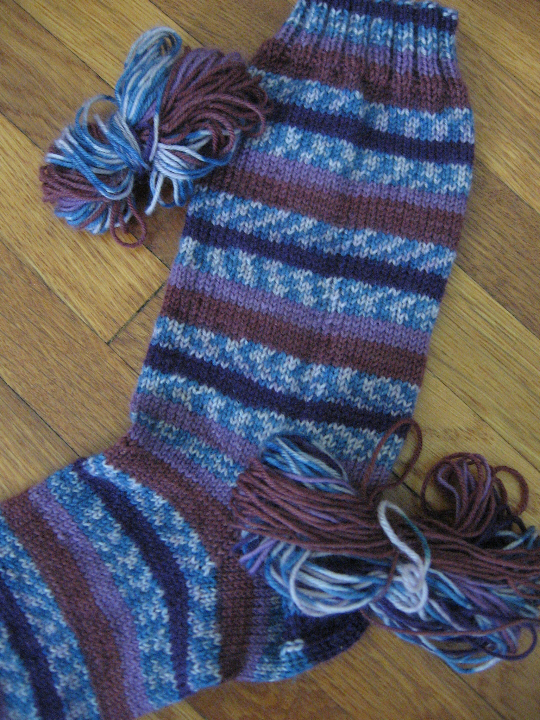
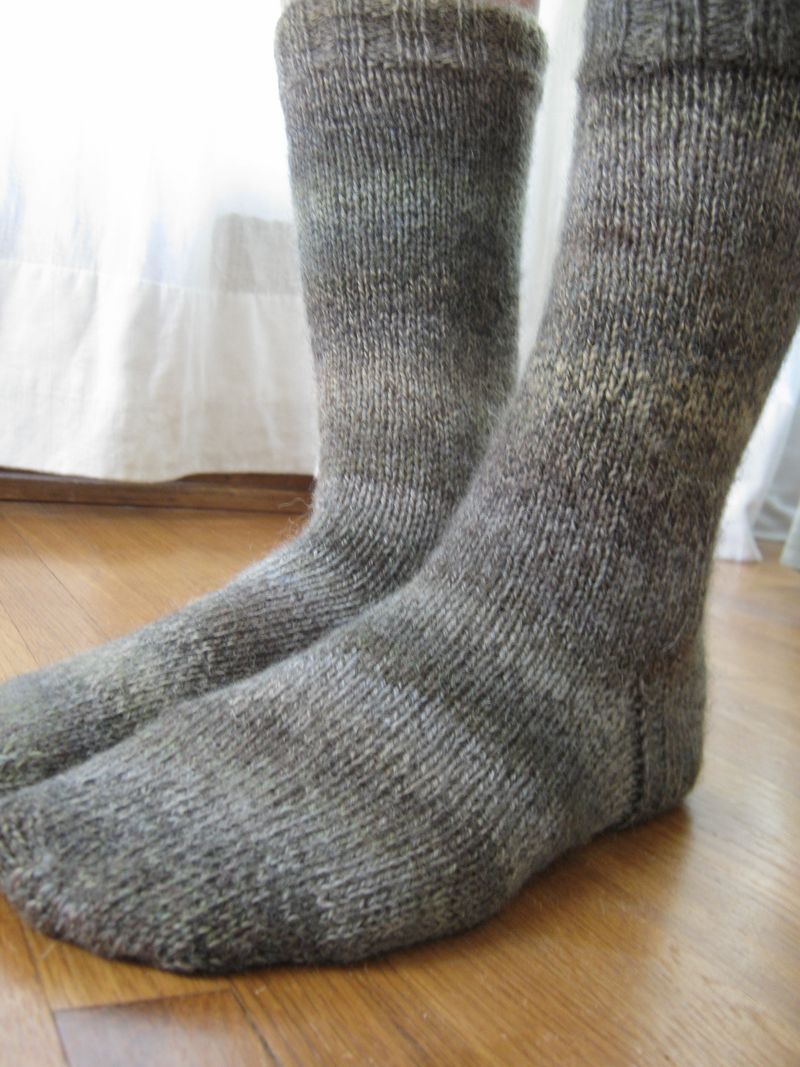
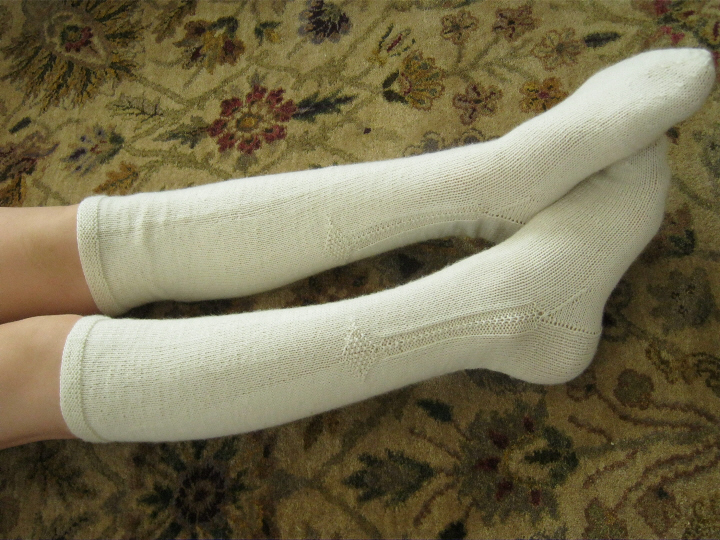
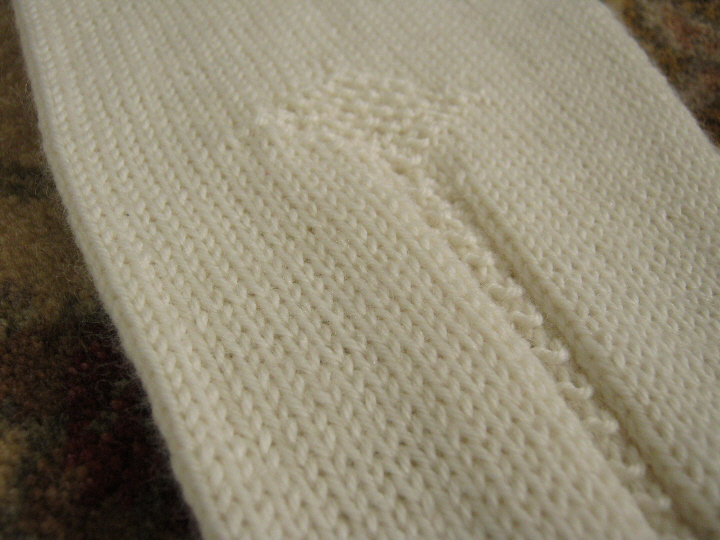
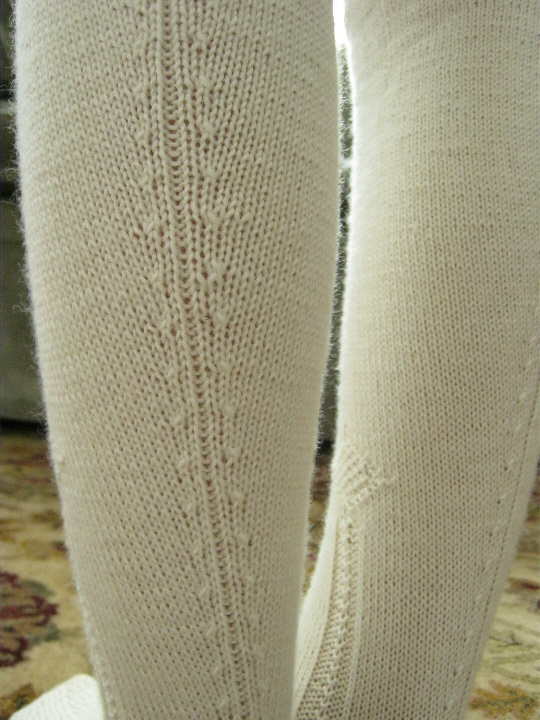
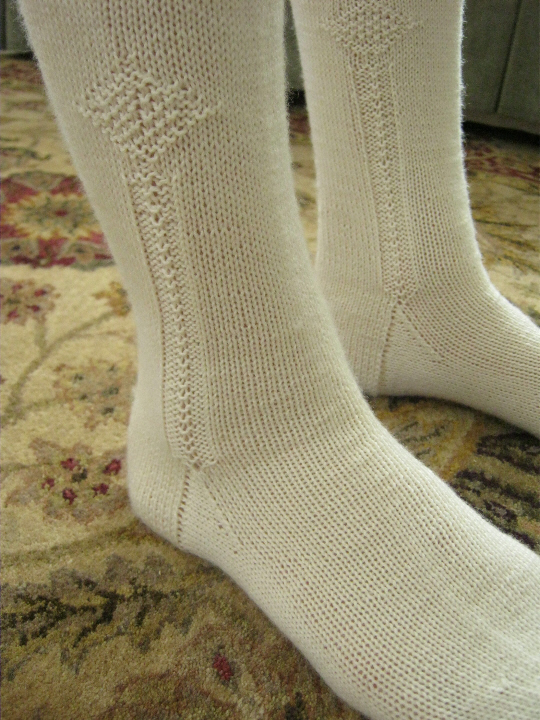
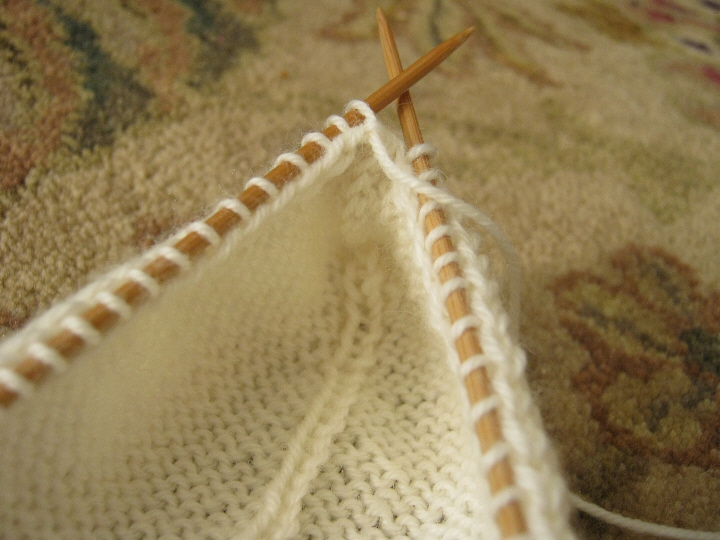
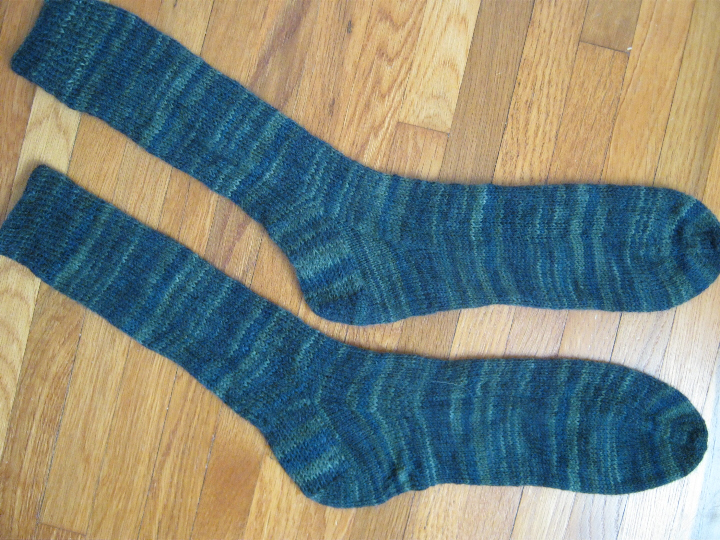
    These are the Lichen Socks from Nancy Bush's Knitting Vintage Socks, modified a bit because my gauge was apparently huge compared to the original wool — I blithely cast on 60 sts as per the instructions, and could have fit both of my feet in it.  I ended up starting with 48!

    1810 1

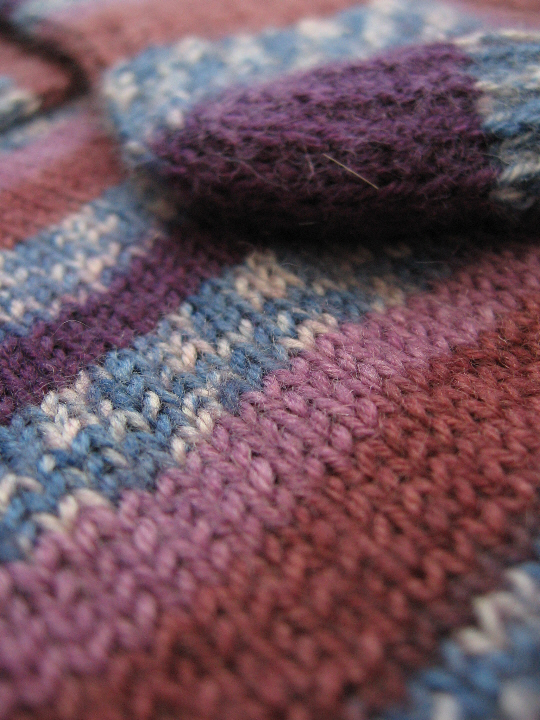
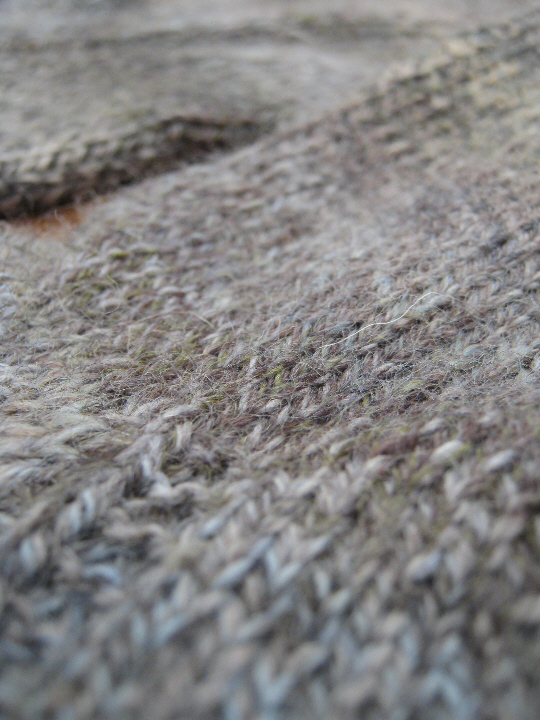
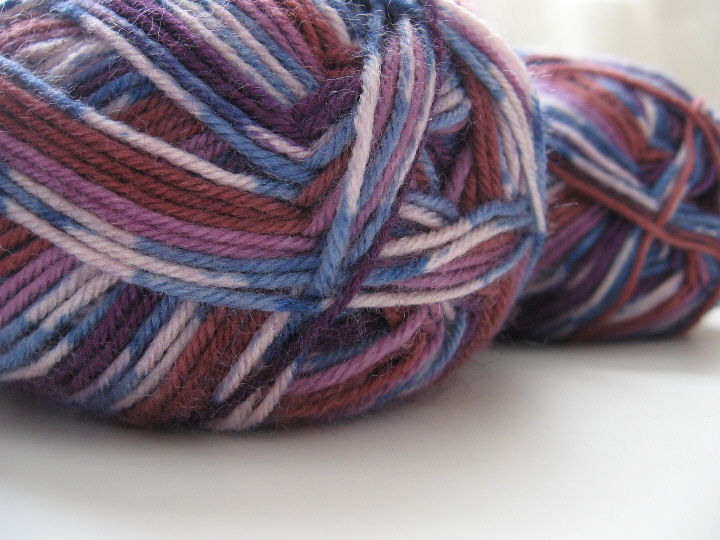
    The yarn is Trekking 6-fach in color 1810, mostly purples with hints of blue and grey.  I still can't seem to get the color right in the close-ups with my camera — this is the photo from Skacel —

    6 fach 1810 skacel

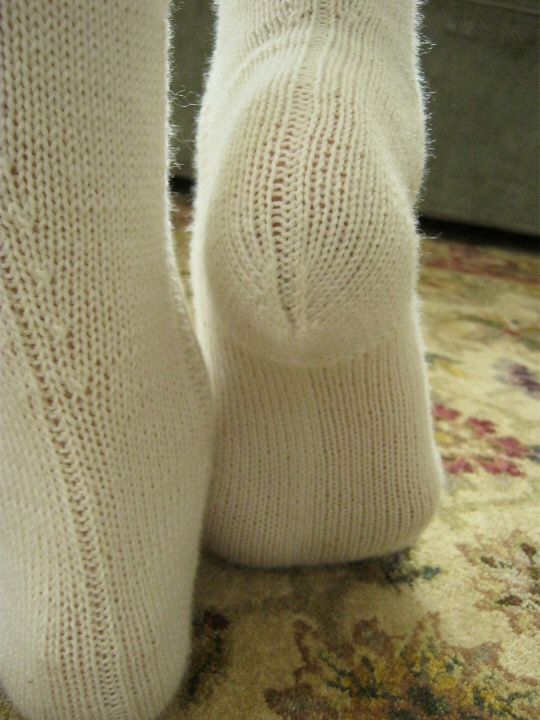
    Luckily the rib was really simple, and went at a terrific clip at this gauge, as the Welsh heel is still, I find, very fiddly, and the Star Toe of Three Points also, although that was most likely because I had to adjust them to my drastically-smaller stitch count.

    1810 2

    1810 4

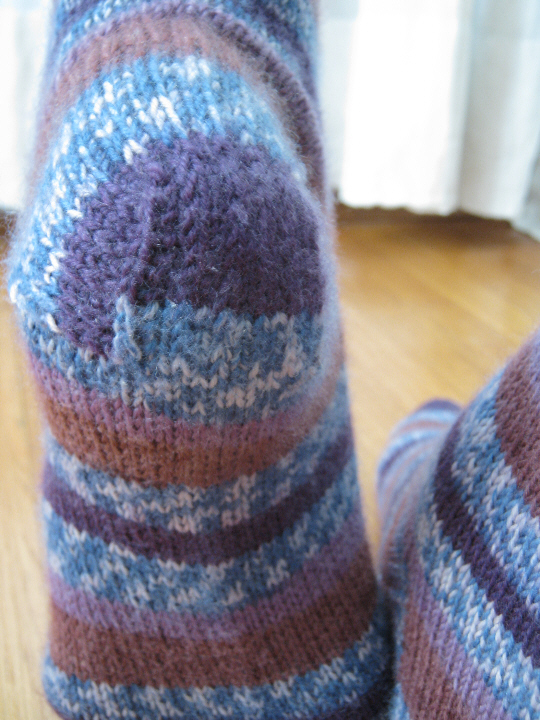
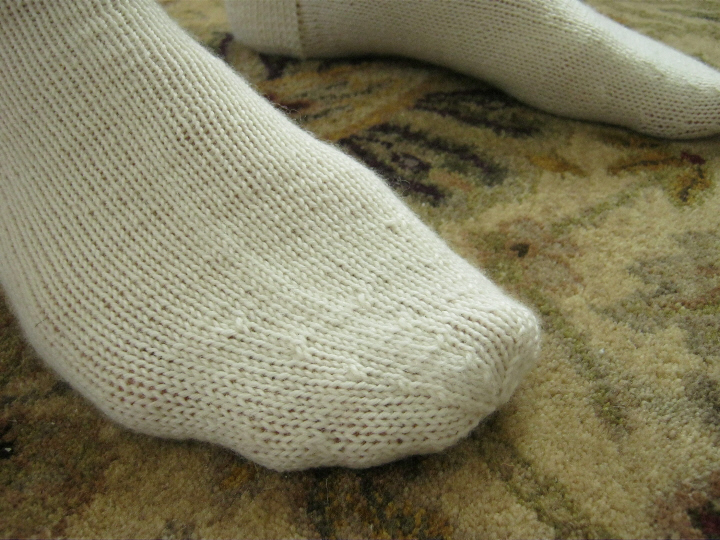
    The toe is not particularly comfortable, I find, as it is quite easy to feel the purl bumps at the decreases, like a lump under one's toes — although, I must say, the lumpiness of the Welsh heel all but disappeared with the first wash, so maybe the toe bumps will too.

    1810 5

    I still didn't get the Welsh heel quite right, I think (I've used it once before, on my Conwy socks).  The first one went along nicely, but the second one for some reason gave me much grief, and after six or eight attempts I just said "the heck with it," and left it the way it was.  Can't tell now, though!

    The socks are very warm.  They also softened up quite a lot in the first (machine) wash — almost alarmingly so when they were damp, but they firmed up a bit as they dried.  And there was over 50g left, so I forsee a pair of fingerless mitts before next winter.

    1810 6

    The model is, in fact, Laura, who at age eleven has feet the same size as mine!

  • 80394

    I started reading Charlotte Fairlie this morning, for the D.E. Stevenson list's current discussion.  I knew for certain that I didn't own it, and ordered it a month or so ago from a bookseller in New Zealand, of all places ($10! $11 shipping! still a bargain, especially for a Stevenson first UK edition), and I had vague suspicions that I had actually never read it before, wh. were confirmed before I was five pages in.  It seems already a classic Stevenson — witty, generous, perceptive.

    I am so pleased to have a "new" Stevenson that I thought I'd commemorate it with a "Knitting with D.E. Stevenson" category, along the lines of the apparently-defunct Knit the Classics.  This is only a virtual knitalong, mind — although sometimes it might be a real one — posting a knitting pattern or project that goes with the Stevenson book I'm reading at the moment.  Charlotte Fairlie was first published in 1954, and I know already, from the blurb and the kilted chappie on the dust-jacket, that the heroine travels to Scotland, so something like this —

    Bestway fair isle jumper 1950s

    It isn't "real" Fair Isle, obviously, but it has a Fifties flair to it, with its fitted silhouette and its vividness. This particular jumper is from Skiff Vintage Knitting Patterns' 1950s page.  It's sold out, but the pattern would I think be fairly simple to re-create.  I'm seeing it in Rowan tweeds, actually …

  • Grant Duncan - Despair

    Duncan Grant, "Despair" (ca.1909)

    This is a painting of Grant's cousin Marjorie Strachey having just finished reading Crime and Punishment.  It might be a bit melodramatic, but I've always empathized with this feeling that a book can be so real to a reader that, for a while at least, it seems to color everything around you.

  • Molly Clavering

    One of the side benefits of being on the D.E. Stevenson list is that when someone offers a book that she or he no longer needs — not, mind you, that she no longer wants, because most of the books that go up-for-grabs are duplicates in someone's collection — you can come across something that you might never have known about otherwise.

    Clavering molly mrs lorimer's family

    Someone found a copy of this at a book sale and bought it for 25 cents, and offered it up on the list because she not only had enjoyed reading it herself but because the author, Molly Clavering, was a contemporary of D.E. Stevenson's as well as a fellow resident of Moffat and a novelist.  This particular novel, Mrs. Lorimer's Family (1953), is rumored to have been based on Stevenson herself.  Well, all of this was intriguing enough for me to put my name in, and as I happened to be the only one on the list who did so, I received it in the mail less than a week later.

    This is of course the only one of Clavering's novels that I have read, but I can certainly see the similarities to Stevenson's, from the very first pages.  It is character-centered, a blend of humor and seriousness, quiet and gentle, and with comfortable predictability all comes right in the end.  I could find only a very few bits of information about Clavering on the internet, one being this summary of Mrs. Lorimer's Family, almost certainly the publisher's blurb: "With the straightforward warmth of a friendly handclasp, this appealing novel draws you into the very heart of a delight­ful family circle. Here you will share with a wise, gentle mother the conflicts and dis­coveries, the decisions and triumphs of her engaging but constantly surprising brood. For this is a novel, as perceptive as it is tender, of the parental concerns, the young-married difficulties, the romantic entanglements that are so fundamental a part of day-to-day living everywhere. With all but one of the children married and living away from home, Mrs. Lorimer and the Colonel look forward to gathering them together for a summer reunion at their comfortable country place. But as the children arrive, Mrs. Lorimer begins to see beneath the gaiety of homecoming the urgent personal problems each has been un­able to leave behind. Phillis's marriage is being threatened by a critical misunderstanding; Tom and his gifted wife Mary are anxiously trying to work out a tricky compromise; quiet Alice, who appears to be the most content and safe, brings about an unexpected crisis. And Guy, the unmarried one, whose laughter bravely conceals a broken heart, seems bent on risking the perils of falling in love again — and with, of all people, a spirited newcomer who has some curious ideas of her own about romance!"

    I can see why Stevenson's children were apparently somewhat dismayed by the novel — the children don't come off especially well at times, especially Phillis — who often acts like a spoiled little girl — and Colonel Lorimer walks a fine line between being endearingly eccentric and exasperating.  Still, I found the wit quietly witty, the wisdom gentle enough not to be sententious, and the characters deftly drawn — certainly worth picking up for pennies if you happen to come across a copy at a book sale.

    Most of the things I did manage to find about Clavering were bibliographic — she looks from the dates of other works to have been a fairly close contemporary of Stevenson's (who was 1892-1973), but I could not even find dates for Clavering online.  Here is a list of some at least of her works, culled from the ever-useful WorldCat:

    Georgina and the stairs, 1927
    The leech of life, 1928
    Wantonwalls, 1929
    Mrs Lorimer’s quiet summer, 1953
    Mrs Lorimer’s family, 1953 [possibly a retitle of Mrs Lorimer’s quiet summer?]
    From the Border hills, 1953
    Because of Sam, 1954
    Dear Hugo, 1955
    Near neighbours, 1956
    Result of the finals, 1957
    Dr Glasgow’s family, 1960
    Spring adventure, 1962

    (The dust-jacket is, I think, yet another example of how different one's own mental picture of a person in a book can be from someone else's.  The lady here is I'm sure a very nice person, but she does not look at all like I picture Mrs. Lorimer — far too jolly.  Too American, in fact.  Too brisk and efficient, perhaps.  This lady does not write "quiet workmanlike novels, redeemed from any suggestion of the commonplace by their agreeably astringent humor and lack of sentimentality," and she certainly does not go off on flights of fancy which she frequently finds herself continuing out loud!)

    I made some origami bookmarks to send to the lady who gave me the book, as a thank-you.  Here's how you do it:

    Origami bookmark 1

    Lay a piece of origami paper colored-side down, with the points making a diamond.

    Origami bookmark 2

    Fold the south point up to the north, and crease firmly.

    Origami bookmark 3

    Fold the east point up to the north and crease firmly, then unfold.  Repeat with the west point.

    Origami bookmark 4

    Fold one of the two north points down to the middle of the long crease at the bottom edge.

    Origami bookmark 5

    Fold the east point over to meet the folded-down point along the bottom edge; crease lightly and unfold.  Repeat with the west point.  (This is only to help with the next step, which you will crease more firmly when it is in position.)

    Origami bookmark 6

    Tuck the east point into the "pocket".  Repeat with the west point.

    Origami bookmark 7

    Crease all folds very firmly to make the bookmark as thin as possible.  (You can fold the remaining north  point into the pocket as well, but this will make the bookmark thicker.)

    Origami bookmark 8

  • ,

    “Olympia”

    Multidirectional olympia

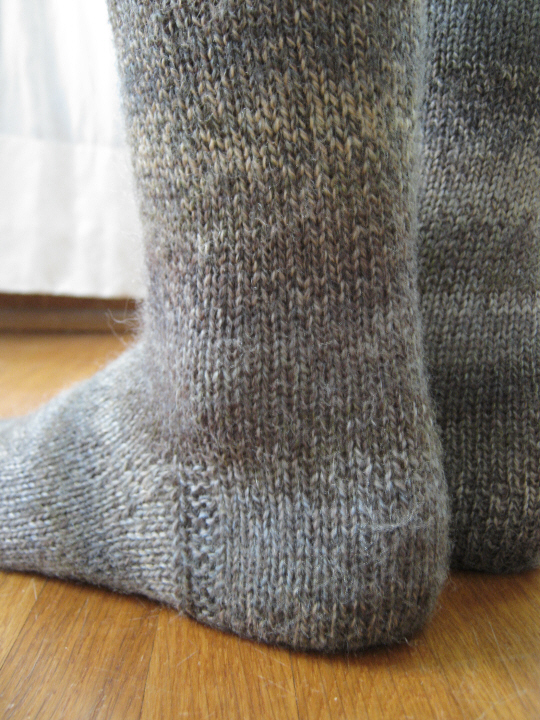
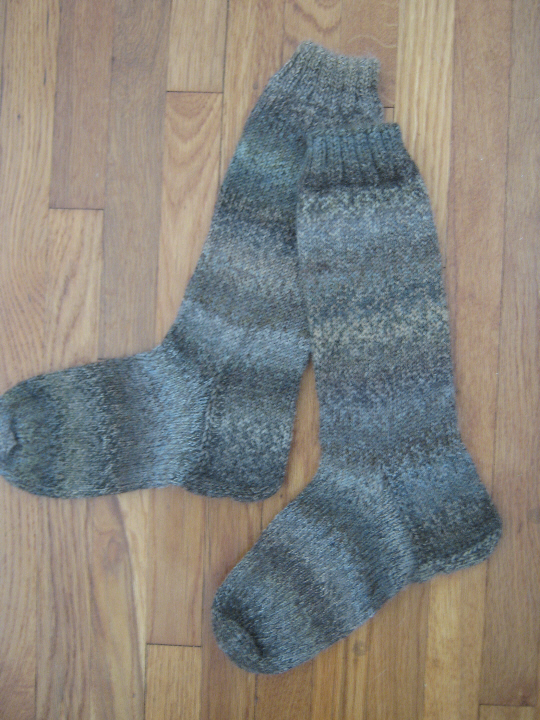
    I found this new-ish Lion Brand yarn at Michael's not long ago — wasn't sure I liked the feel of it much, being a bit rough, but frankly the dreariness of this colorway appealed to me in its subtlety, sort of greys with a bit of grey-blue here and there like a stormy sky, a bit of grey-green, a bit of grey-brown. I thought almost at once of the Multidirectional Diagonal Scarf, and found that they suited each other very well.  I had to go around to a number of different stores looking for another ball when I realized that two was not enough — the Pasadena store had two as well, so I finished the scarf with one and now have one left over.

    I have not really captured the color to my satisfaction, even outdoors in natural light, but it does seem very elusive even to the eye, so I can't really blame the camera. 

    My first thought upon seeing the name of the colorway was this,

    Manet_olympia

    which I have to admit seems unlikely.  Possibly this,

    Olympia temple of zeus

    although upon reflection it is probably this,

    Olympia washington

  • Today was the Girl Scout Birthday Event at the Nixon Library in Yorba Linda, celebrating the anniversary of the founding of Girl Scouts of America on March 12, 1912.

    Gs bd 1

    It was a beautiful afternoon, warm and sunny.

    We did some different things this year, in that the little farmhouse where the Nixon family lived was open.  I saw this crocheted blanket on a rocking chair in the living room, and thought I'd post it here.

    Gs bd 2

    Here is a detail of the part over the back of the chair — the color is better in this photo.  You can see a little bit of the picot edging at the lower left.

    Gs bd 3