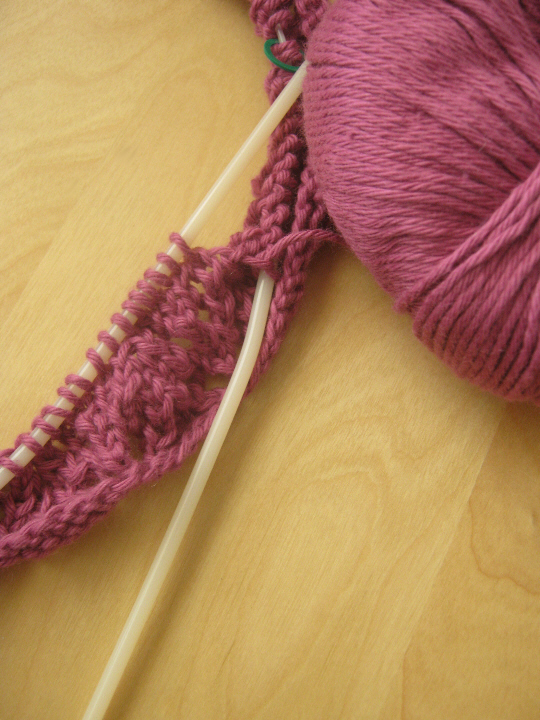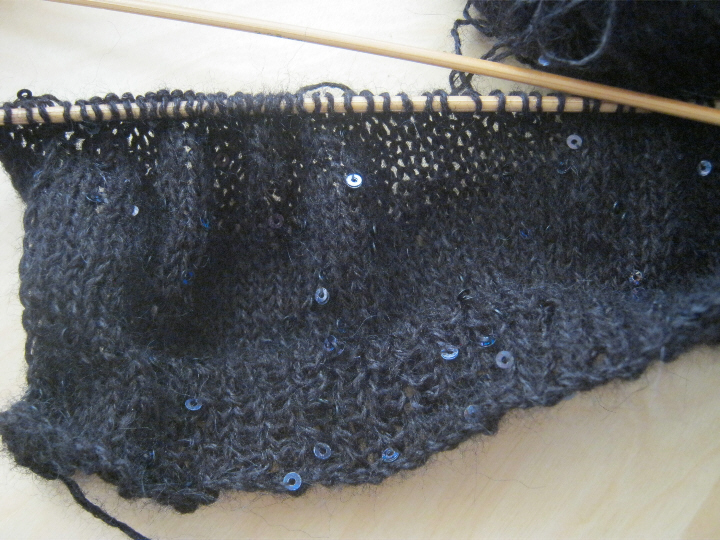
I'm not knitting much, I'm afraid, though this project has been great for these first few weeks of summer — a cowl/neck scarf in Noro Sekku — as it is small, portable, and completely memorized. I stuck it in a Ziploc bag and took it with me to Girl Scout day camp, and at lunch time actually managed to knit a round or two every day before our girls wandered back and said, "What are we doing this afternoon, Miss Jeanne? Ooh, what's that? Is that knitting? I wish I could knit!" The colors are much more vivid in real life — I'll try to get a better picture when it's finished.
(Yeah, it's Noro. When I came home with it a few months ago, David said, "I thought you were never ever going to buy Noro again!" Well, what can I say? The colors are fascinating. I still don't like knitting with it.)
I've been reading much more than knitting. Yes, that's a Kindle — I finally succumbed. I looked at all of the yellowing classics on our shelves one day, and thought, "I suppose I could get a Kindle and have all of these in less than an inch of shelf space." I've been downloading freebies like a wild thing since then — P.G. Wodehouse, Mrs. Gaskell, Jane Austen. I confess that a few purchased ones have made their way across the ether to me as well — this one is Edith Pargeter's The Brothers of Gwynedd, after I found that you still can't get the Brother Cadfael series in e-books. I'm a little vexed with some of the features of the Kindle — don't like the font and that you can't change it, don't like that you can't flip pages fast when you're looking for a particular spot (mine at least often gets stuck in a circle of three pages, and just goes round and round those three) — but it's still amazing enough to me that you could have hundreds of books in one little place that I'm still happy.
I came across this set at Flickr this morning, part of the Swedish National Heritage Board's collection, and was struck by the generous and wonderful beards on every one of the men. These particular photos were all taken by Einar Erici in the 1930s — he was obviously a talented and sensitive photographer, to judge by the character studies that each of these photographs becomes.
The coachman C. P. Lundström, born in 1851, and his wife, who lived in Södra Trädgårdsgatan street in Gävle, Gävleborg province.
The postman Anders Wedin in Enånger, Hälsingland. Born in 1866.
The master painter (målarmästaren) Olof Nilsson, Kulladal, Skåne. Aged seventy; born in 1865.
A man on the doorsteps to a house, place unknown.
Churchwarden Anders Andersson, born in 1866, and his wife, of Brunn, Gästrikland.
The verger (kyrkvaktmästaren) Andersson, born in 1858, and his wife, of Skederid, Uppland.
The farmer J. Johansson, seventy years old, with a cat, in Åslunda, Uppland.
The crofter G. V. Gustafsson, born in 1872, of Margretelund, Uppland.
Oskar Almgren in Stockholm, born in 1852, smith at the Maritime Pilots Administration.
The parish constable (fjärdingsmannen) August Ländin in Åkeshov, Uppland playing the guitar. Born in 1863.
The yeoman farmer (hemmansägaren) Carl Anders Samuelsson, born in 1857, and his wife Anna Lena, of Stigåsa, Småland, in 1932.
This is a gift for a friend, a sort of knitted hug-from-afar. It's the Burberry-Inspired Cowl from Julianne Smith at The Garter Girl, a simple, quick knit — yeah, if you don't cut the yarn too short for weaving. It's cables but isn't cable-y, more just sort of ripples, or in this particular color, kind of like sand dunes —
This is the Filatura di Amigo Cashmere/Seta yarn I got from Joy in Hong Kong umpteen years ago, and made a Backyard Leaves scarf out of not long after. Still have tons left over. I remembered how much this yarn stretched, so I worked it a little tighter this time than I might have done, and hoped it would stretch enough to soften and show the cashmere to its best advantage.
And of course the recycled Kidsilk Haze, this time into nona's "Tie One On" Wrap from Knitty —
I do not like knitting with Kidsilk Haze. Scratchy and hairy, and with an unpleasant feel almost like very thin wire, not to mention unkind when you make a mistake. This color is wonderful, though — "Ghost" — a very soft purply-grey neutral.
But the pattern is, like the cowl, a quick and satisfying knit, and I think will be pleasant to wear on a cool spring afternoon. Just be warned that you will not be able to make the ribs line up.
Not sure I will knit much for a while, as summer is rapidly approaching here in Southern California, and although I was wearing wool socks and a slipover just last week, this morning I am in sandals and short sleeves! But a sewing project is on the cutting board —
Well, this wanted to be a pretty lace wrap, but — alas.
It is the Kid Mohair Wrap from Susan Cropper's Pretty Knits: 30 Designs from Loop in London of 2007, reprinted in Canadian Living a year or so ago (there's no date!). I was a little surprised to find almost no mention of this around the blogosphere, thinking that surely I could not be the only one seduced by the photograph. I wonder now if knitters just gave up.
As I mentioned before, there are a few errors in the border pattern, not earth-shattering ones, but enough to be worth fixing.
This is a fairly-standard lace edging, found in Martha Waterman's Traditional Knitted Lace Shawls, among others I'm sure, and there called "Ocean Waves". Here it is written worked in opposite directions on the right and left edges, so that they are mirror images. The right-side edge has a three-stitch "wave" that swirls upwards towards the left, while as written here in the Kid Mohair Wrap the left-side edge has a two-stitch swirl. It is not entirely noticeable at this lacy gauge, which is one of the reasons (the other being Kidsilk Haze's resistance to being picked out and re-knitted) that I simply left it there and went on. The decrease used in the pattern is a left-slanting sl1-K1-psso, but it should be a right-slanting K2tog. I worked the second repeat this way, and to my eye it looks much better, certainly a mirror image of the right-side border. After working the second repeat, I realized that the one triple-decrease on the left-side border should be changed as well, from a sl1-K2tog-psso to a K3tog — you can see the second repeat's sl1-K2tog-psso at the top of the first "swirl", just to the left of the last yarn-over hole, where the triple decrease is leaning the wrong way. I worked a K3tog instead on the third repeat, along with the line of K2togs, and it looks much tidier.
So my recommendations: In Row 3, change the second sl1-K2tog-psso to K3tog, AND in Rows 5, 7, 9, and 11, change the second "skpo" (i.e. sl1-K1-psso) to a K2tog. This will also need to be changed in the crossed-eyelet section, thus: In Row 31, change the second sl1-K2tog-psso to K3tog, AND in Rows 33, 35, 37, and 39, change the second "skpo" (i.e. sl1-K1-psso) to a K2tog. There is another typo in Row 35: after the second "slip marker", K2 should be K3.
There also should be an asterisk in Row 39, after the first "slip marker", but this is only a slight hiccup.
The scarf version apparently simply continues a narrower version of the knot-stitch section all the way up, omitting the crossed-eyelet section — but a commenter on the Canadian Living version of the pattern notes that Row 28 in the scarf version says to repeat Row 14, ie. Row 4 of the knot-stich pattern, but that this should be Row 2, not Row 4.
But the biggest problem for me is that two balls of Kidsilk Haze is not enough by some way to complete a 30×60-inch wrap. I pin-blocked what I had worked so far to a 30-inch/76cm width, which to me looked far too stretched, so I repinned it to what looked good, which was 28 inches (71 cm) wide — although certainly this was not proper blocking, and the results may have been different, but I suspect not much. The result was a 28×22-inch piece, which of course with only one more ball of Kidsilk Haze would not have made a wrap that measured 60 inches by any means.
So, well — it's pretty, but the yarn is now well on its way to becoming nona's Tie One On after all …
It has been quite a long time since I finished the first part of our Elizabethan garb, and I have let myself get distracted from even starting the rest of it, but here are the shirt and the smock — David's and mine respectively.
These are both fairly simple to scale up from the graphs, as almost every piece is either a square or a rectangle. I made the shirt with a plain collar and cuffs, and the smock with a ruffled collar and cuffs; both have tie fastenings.
I used the IL019 linen — 5.3 oz per yard — from Fabrics-Store.com, and washed and dried it in the machine three or four times before cutting to soften and pre-shrink it. It is the mid-weight linen, with a bit of that lovely linen slubbiness and heft but is not too heavy.
I decided to flat-fell all of the seams, which with french seams are the two most common period seams. I like the look of them, and the flatness. They turned out well on the whole, although working the underarm gussets was a bit awkward, and so I did them a little differently from the book's. I attached this square gusset as instructed, but instead of sewing the side seam first and then inserting the sleeves, I started working the flat-fell at the bottom of the underarm gusset, sewed up the front of the armhole to the shoulder and down the other side, and then straight into the side seam, all in one go. Trimming this for the second pass of the flat-fell was a little awkward, but it turned surprisingly neatly, towards the back on the side seams and towards the sleeve on the armholes.
I'm in two minds about the ruffle — it is obviously too short to iron, so that it has a kind of solidity to it which is not especially handsome, but under a waistcoat will perhaps not be so obvious.
David was looking at my blackwork sampler one evening and said, "You know, I really like this one. And this one. I like all of them. Can you do some on my Ren Faire shirt?" Well, this was like saying, "Honey, could you knit me some socks?" — of course I said yes, although I didn't really know at the time if it would be as simple a matter as it seemed. The biggest problem was that all of the borderlike patterns I knew of were a bit girly, so I thought of Celtic knotwork and wondered if I could find a chart.
This was actually quite fun once I realized the trick of it. I couldn't find any suitable chart online, so I had to "unvent" a couple. I liked a twist-straight-twist-straight sequence I saw somewhere, so adapted that, a narrow one for the cuffs and a wider one for the collar.
You can see my thought processes in the page of sketches below. The top one (which has a height of 10 stitches) is finished at the left edge and increasingly draft-like as you go towards the right. Basically, all you have to do is draw the squares, then fill in the edges slanting to the right or left depending on whether the ribbon should cross "over" or "under". This seemed quite miraculous to me when I saw how it worked!
In theory, this is infinitely expandable, although the ends of the border would have a greater and greater number of "unconnected" ribbons depending on how many you use. The 4-stitch border (which is the one I used for the shirt cuffs) has only one ribbon, the 8-stitch border (which I used on the collar) has two, and the 12-stitch one has three. (Whoops, I see a mistake on that one now!)
I actually did the blackwork without my contact lenses. The only benefit I have ever found to being extremely near-sighted is that of having Super Microscopic Up-Close vision. If I look at something at a normal hand-working distance without my glasses, it would look like this —
but if I hold it within, say, two inches of my unaided eye, it looks like this —
which as you can imagine is perfect for counting those very fine threads of linen! (And for removing splinters, but that's another story.)
I worked this particular piece in two strands of regular embroidery floss, each stitch over four threads of the linen. I'm not entirely pleased with this result, but for a first effort it's not bad. The pictures above are my sample — when I worked the shirt, I basted the "safety box" one stitch out from the design, as stitching into it sometimes incorporated red fibers into the black floss which remained behind when I pulled it out. I highly recommend the basted outline, by the way — enough said, I think.
I added a "turning" in the knotwork at the center back of the collar as I was working it, in order to lengthen the design enough to fill the ends of the collar, but I think unless you actually count the turns you'd never know.
I did do all of the blackwork before cutting the pieces to size, for ease of handling, having heard this advice from a number of sources, luckily for me well before-hand!
The man's shirt differs from the woman's smock mostly in that it has neck and side gussets. I'm not sure why women don't need the neck gusset, but the side ones, because of the shirt's much shorter length, need a little extra room and reinforcement at that point to keep from tearing. Also different, at least in the Tudor Tailor versions, is that the shirt is gathered a little between the collar and the straight top of the shirt, whereas the smock has a curved neckline and fits smoothly where it joins the collar.
I haven't decided yet what kind of ties to put on the shirt — for my smock, I simply braided three strands of crochet thread, but I was thinking for David's I might try a lucet braid.
Mistakes: I wasn't very careful when I cut the shirt pieces, and so the front and back are slightly on the bias and don't sit quite straight. I had no idea how to set in the side gussets — maybe this was after I decided to flat-fell all of the seams, which then meant that the "flaps" at the bottom of the shirt had turnings that sometimes had to go first one way (for the flat-fell seam) and then the other (for the turned edge) — I sewed in one of the side gussets and hand-sewed the other one simply on top of the seam and turnings, but wasn't especially happy with either method. I assumed that the generous-seeming size of the shirt would mean that it would fit the 5'11" David easily, but the collar is barely long enough, and the length of the shirt itself is a bit on the short side. I haven't seen anywhere what a "typical" length is for an Elizabethan man's shirt, but the book's illustration is just above knee-height (the idea being that the side slits allow you to wrap the tails between your legs, fore and aft as it were, and this is what serves as underwear).
I cut the neck slits the length in the pattern, which is far too long. Since at the time I was sewing it was approaching winter, I also ran up a version of the smock in flannel just to use as a nightgown, and made the neck slit half as deep, which is much more comfortable and a lot less drafty.
This is the sand-dune-y landscape of a Burberry-Inspired Cowl, which unfortunately got stalled when I cut the ends of wool just too short to graft together, so that I am now resigning myself to ripping out the last balls' worth in order not to have to splice in yet another length. The good news is that the whole thing took only a few hours to knit, so once I get up the nerve to pull the needles out, it shouldn't take long to actually finish.
Another work-in-progress is the Brahms German Requiem, which we started rehearsing the week before last. How very lucky I was to be able to sing this in high school — how lucky I still am, to be a part of it again.
This is a lovely version, a yummy Romantic tempo, and the parts are beautifully balanced. It's interesting, the different perspectives you get, from the chorus or from the audience; I have to not look at the video at times, as it can be distracting, although educational. That is some serious stink-eye Nikolaus Harnoncourt gives even before he lifts up his hands! Rather consoling, in a way, to see that even the Vienna State Opera Choir has trouble with getting their eyes off of their music.
I'm currently reading a "medieval noir" that I found on the new-book shelf at the library the other day. I think I've got spoiled by Ellis Peters, as I find this one more than a little anachronistic in vocabulary — "décolletage" for example, a late-Victorian word at the earliest, or even more jarring, "gifted" (in the sense of having presented something as a gift), at the same time that the characters say things like "'How fares your good wife?'" and "'Is that the weapon that committed this most foul deed?'". There certainly can be a good argument for writing a historical novel in the modern vernacular, since at the time period of said historical novel, the way that people commonly talked was in fact "modern" — compare, for example, the 1920s Charles Archer translation of Kristin Lavransdatter with the 1990s one by Tiina Nunnally. And there can be an argument that people in the Middle Ages talked more like the Wife of Bath than like Brother Cadfael, too, I suppose. Still, there it is.
I went to the library, in fact, for the omnibus Mapp and Lucia volume, thinking that I wanted something terribly, terribly English and 1930s. Have not read any of them before.
I'm also reading one of D.E. Stevenson's "lost" novels again, Emily Dennistoun, the current book of the Stevenson discussion list at Yahoo. The more I think about it, the more I think this was not only an early work of Stevenson's, but a very early work, and one that she may have not bothered to dig out of the drawer because the things she wrote later were so very much better. Anyway, here is my choice of something late-1920s for my virtual Stevenson "knitalong" —
I think that Emily Dennistoun would be rather shocked to think that her underwear might be discussed in public, but it is not at all unlikely that she would have actually knitted such things herself. I was surprised at first to see the number of patterns for "vests and shorts" out there — this is one of dozens from The Vintage Knitting Lady. I had not in fact given much thought to knitted underthings, but upon reflection suspect that in Scotland at least, where this novel is set, one might want such things more often than not.
As for "real" knitting, I did start the Kid Mohair Wrap the other day. Found a number of mistakes in the pattern right off, but once that settled down it has gone very quickly, so quickly that I am rapidly nearing the end of the first ball of Kidsilk Haze and at the same time am becoming increasingly alarmed that I will not finish nine repeats of the crossed-eyelet section, as the pattern assures me I can do, before I get there.
Finished The Shakespeare Thefts by Eric Rasmussen, a blithely quick read, but interesting. The title is somewhat misleading, as there is not really much theft involved — it is about a project to trace all known copies of Shakespeare's First Folio, the famous 1623 first "collected works" of Shakespeare. There were 750 copies in the run, of which only 232 are known to still exist, so Rasmussen has made it something of a life's work of his to not only find them all but to examine them minutely, even to the marginalia scribbled by innumerable hands down the centuries, partly just for the fun of it, but partly also so that in the very-real possibility of theft not only the books themselves but the individual pages are identifiable. He has a light, breezy style that sits somewhat oddly, to my mind, with such a scholarly obsession, but it certainly makes for a good popular introduction to the subject.
I am now working through the four "historical" novels of Joanna Trollope that my public library has — I say historical in quotes to distinquish them from her "modern" ones, called somewhat disparagingly "Aga sagas" by some. I pay that no mind, as I've always found her to be an interesting writer, serious yet not at all without humor, and some of her novels I count among those I have reread a number of times. I did not, I regret to say, much like the first of these historicals I read, Eliza Stanhope, which I thought more than a little formulaic and with little to distinguish it from any other Regency romance writer except perhaps a good ear for dialogue. I was a little relieved to find out that it was her very first novel. The Taverners' Place was an engrossing multi-generational family saga, stretching from the 1870s to the 1930s, which I quite enjoyed, although I was rather depressed to realize towards the end that very few of the many marriages were happy. The third one I read — because I had (characteristically, I suppose) arranged them in chronological order by historical period — was the Boer War drama The Steps of the Sun, about which I had very mixed feelings, thinking it well-written but finding it surprisingly difficult to tell the main characters apart — although in Trollope's defense, this may have been only because I seemed to have the time this past week to read only in three- or four-page bursts, and therefore could never really get involved in the story. I am now in the middle of The Brass Dolphin, set in World-War-II-era Malta, and am much involved in it, interested in the characters and appreciating Trollope's easy hand at describing the Mediterranean beauty of the island.
Knitting? Well, yeah, I'm thinking about it, actually. Got two balls of Kidsilk Haze yearning to cover my shoulders this spring. Only two.
Plain-but-pretty, probably a quick knit. Useful too — and I mean that in the best way, in that the trapezoid shape will actually stay on your shoulders.
Perhaps a little impractical? can you actually do anything with this fallng off of your shoulders all the time? But rather spectacular, certainly, and a lot of wow for only two balls of Kidsilk Haze.
We had a booth sale the other day, and I managed to get a good way down the leg of a Welsh Country Stocking — this is is Paton's Kroy, a bit heavier than the original wool, so I've had to adjust the stitch counts considerably.
But other than this I haven't done much knitting, still absorbed in Swedish church-books. Found this the other day, which amused me greatly —
Imagine the ruckus when papa found out that little Stina had been looking for a piece of paper and decided to make do with one of those old books in the vestry….
And in bookish news, I haven't seen "War Horse" yet, but came across this charming little video in which three of the actors talk about the book and their childhood reading — that Tom Hiddleston was rather precocious, it seems!
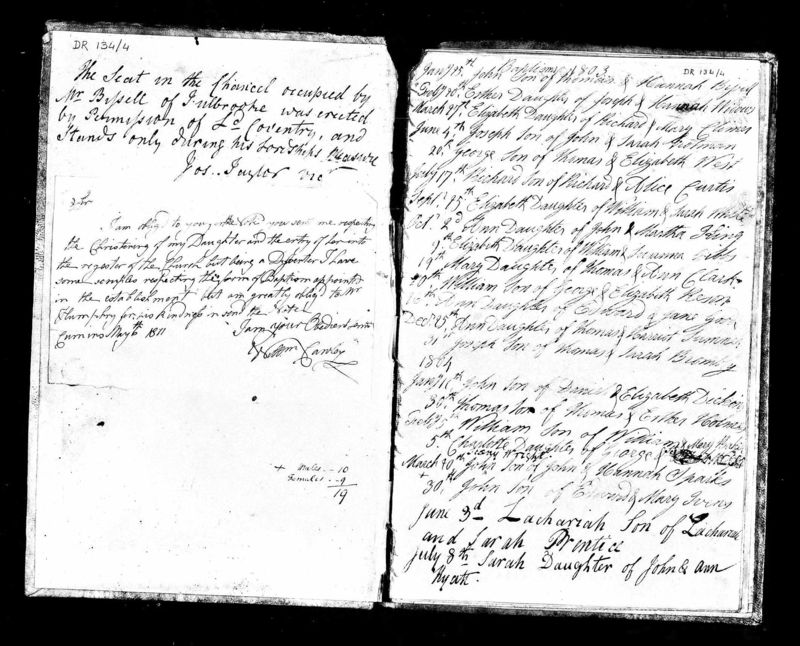
I haven't been knitting much lately, because I admit I've been distracted by my recent discovery of the Danish church-books to be found online at Statens Arkiver. Even if you are not much interested genealogy, you can probably understand the fascination of something like the page above — which is a beautiful thing in itself, and all the more when it is one's own ancestors (even if only by marriage). The Danes, bless their record-keeping hearts, required local ministers to keep track of births, marriages, and deaths from quite early on, the late 1600s in some parishes, and later they also recorded movements to and from the parish and of smallpox vaccinations (which were in fact not only sensible, but a requirement for getting married). This is of course a genealogical treasure-trove. A birth record such as the one above gives not only the date and name, but the parents' names and residence, the age of the mother, and the names and residence of the baptismal sponsors, who were often relatives as well — so that it is often only a matter of following the trail back to the previous generation, and on. Quite satisfying.
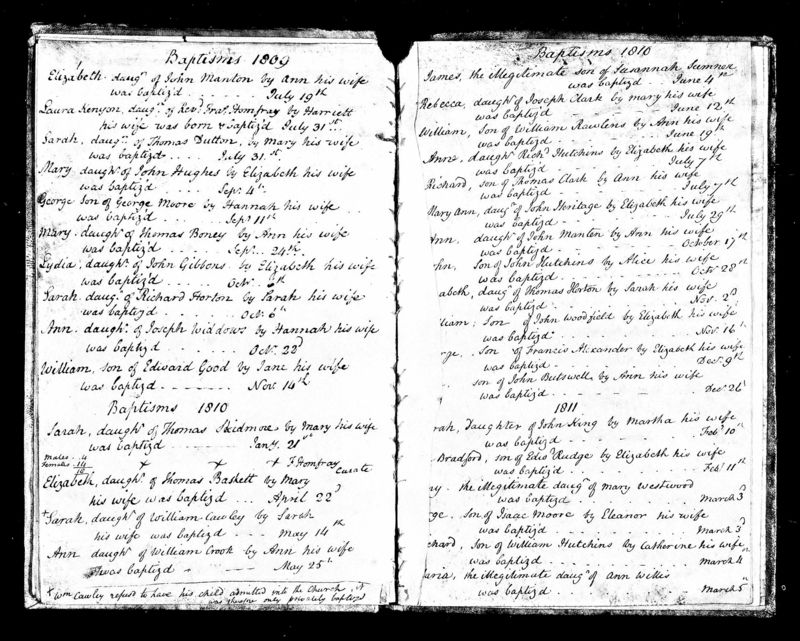
Of course, it isn't always as simple as that. After 1814, they had printed books to fill out, so that things are arranged quite tidily, but before that it was up to the individual priest, and instead of something as clear as the above record, readable even if you know little Danish, you get ones like this, from the early 1800s —
— which takes a little more work. It's funny, though, that since starting this post a week or so ago and thinking of how much time it took me to decipher the above page, it looks a walk in the park to me now, compared to this one from 1777 —
So, well, no, I haven't been knitting much. But I did manage to finish these socks, plain ones with a Dutch heel and round toe, in the Deborah Norville Serenity Sock yarn in the Violas color. I won't say how long ago I started them, but it's been a while. This yarn feels a little different from the Acquamarine pair from a year or so ago, a bit sturdier, soft but less squishy. I do like this color, too.
And here is something I found in a church-book that amused me, one of those little non-genealogical gems that you get every so often —