
"British Blue" Bluefaced Leicester wool by Erika Knight, three 25g balls of "Steve" (sky-blue), two balls each of "Milk" (cream) and "Fawn", and one of "Mouse" (grey), at Tuesday Morning yesterday for half-price. Not bad. What should I make with it?
"British Blue" Bluefaced Leicester wool by Erika Knight, three 25g balls of "Steve" (sky-blue), two balls each of "Milk" (cream) and "Fawn", and one of "Mouse" (grey), at Tuesday Morning yesterday for half-price. Not bad. What should I make with it?
I am suffering at the moment from a recurrent bout of DKS — Distracted Knitter Syndrome. As with malaria, the knitter with DKS can be distraction-free for months, even years at a time, and then without warning, and with other projects already on the needles, she casts on for a new project.

This is the Hidden Gusset mitt by Mone Dräger, from the latest issue of Knitty. I recently recycled a skein of Collinette's Jitterbug in "Velvet Plum", a truly gorgeous color that for some time has been a pair of Jaywalker socks just too big to wear comfortably. I let them sit in the back of my sock yarn drawer, then not long ago put my hand on them while searching for something else, and thought, "gosh, that yarn is pretty!" and that because they felted noticeably in just the two or three times I wore the socks, mitts would be a better idea than my original plan of a smaller pair of Jaywalkers.
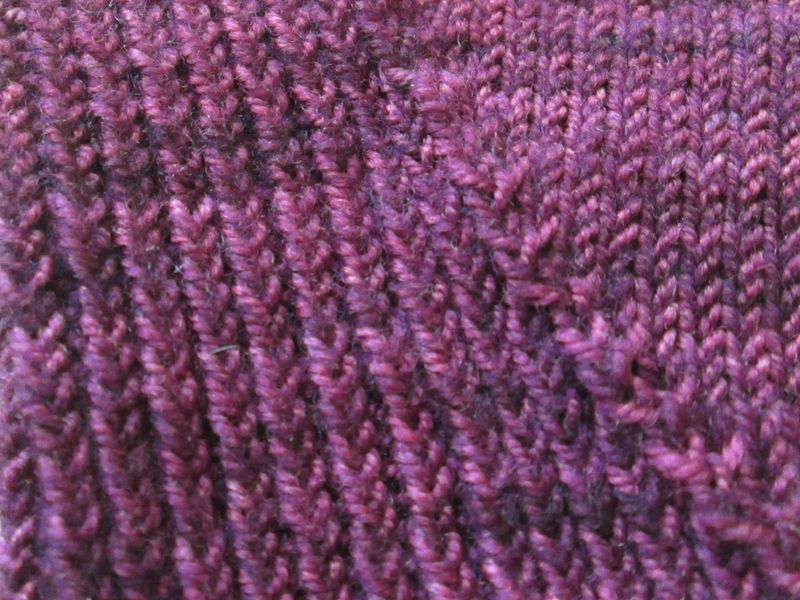
I confess I've had some trouble with this pattern, but maybe it's just me. It's been unpleasantly hot for most of the summer, and added to that things have been a little chaotic what with the girls both being in new-to-them schools this year, and the new schedules for both — so, yeah, I haven't been the sharpest knife in the box lately. I couldn't quite understand the three-markers bit, so I've just moved the offending stitch over to the fourth needle and start my rounds on the first one as usual. I also thought that the increases looked a little muddy, so I redid mine with a simple M1L and M1R — this didn't work quite as well as I had hoped, but there it is. The color is still gorgeous!
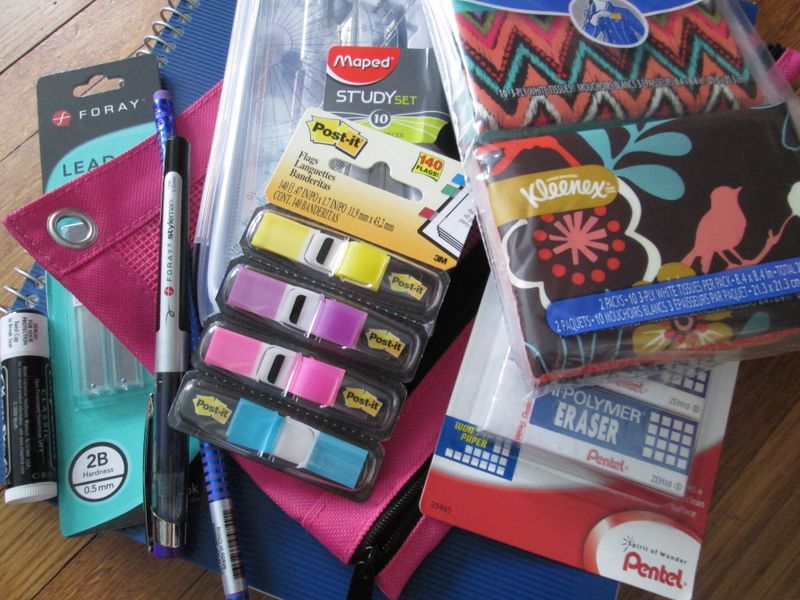
Hurray! School starts next week! Maybe I'll actually manage find the time to post on my blog!
Well, I can't blame it all on being busy, though that's a big part of it. The weather has been so awful and hot and humid that when we're not running around to tennis camp and Girl Scout service projects and clarinet lessons and whatnot, we collapse in sodden little heaps on the floor in front of the nearest fan.
So what have I done this summer?
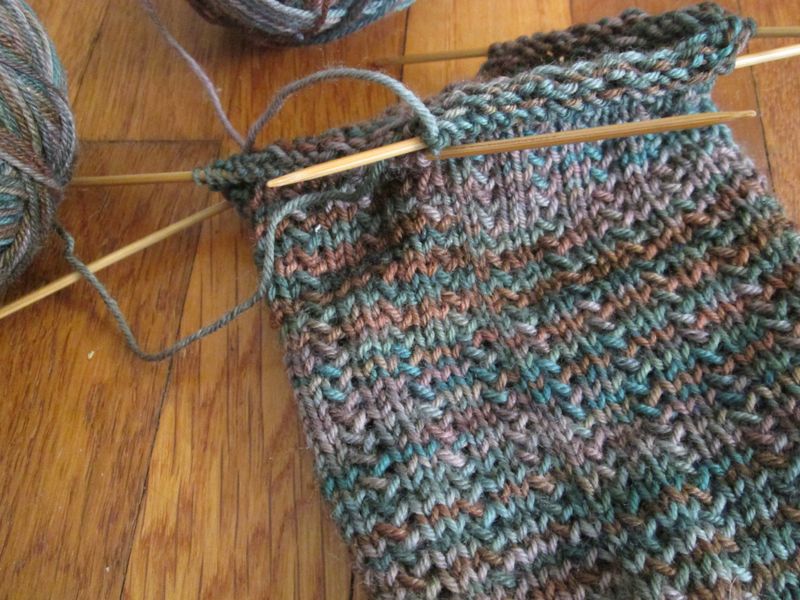
I picked up a long-neglected pair of socks, and thought I was doing really well, but set it down one day and promptly forgot all about it. Love the yarn, though — Shepherd Sock in "Baltic Sea," alternating strands on every other row so that it absolutely will not flash or pool.
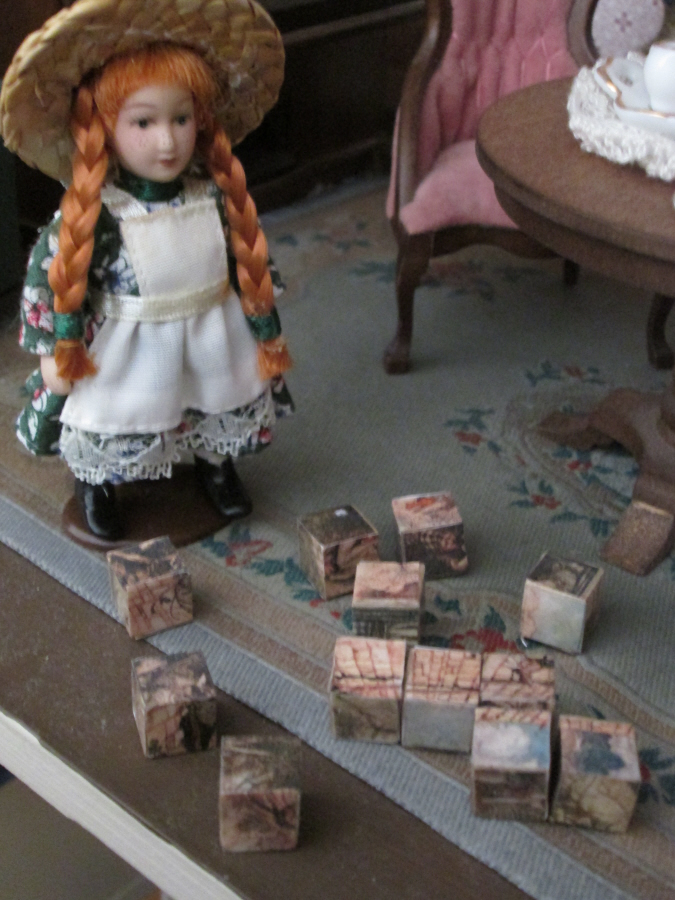
I made a set of puzzle blocks for No.16, to instructions in Christiane Berridge's Victorian Dolls' House Projects. Mine aren't quite as successful as they might have been, because although I love the Rackham illustrations, the detail in them at this scale tends to get lost. I tried to pick simpler ones I thought would reduce well, but there it is. Anne Shirley is just getting started with Rapunzel, it looks like, but she's got a block wrong at the top.
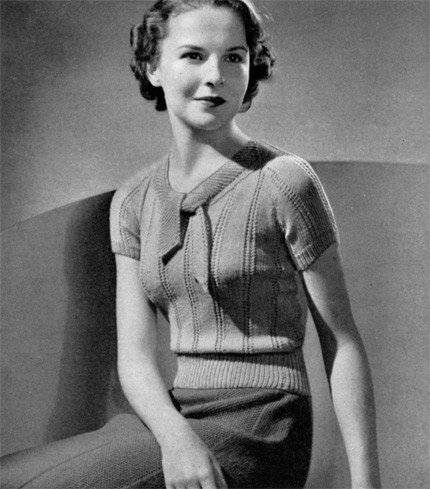
I read Miss Buncle's Book, and chose for my "Knitting with D.E. Stevenson" virtual knitalong, this pretty 1930s jumper from Dee's etsy shop nostalgiarules — it's perhaps a little more Elizabeth Wade than Barbara Buncle, with the frivolous ties! but I can see her wearing this while lunching with Mr. Abbott.
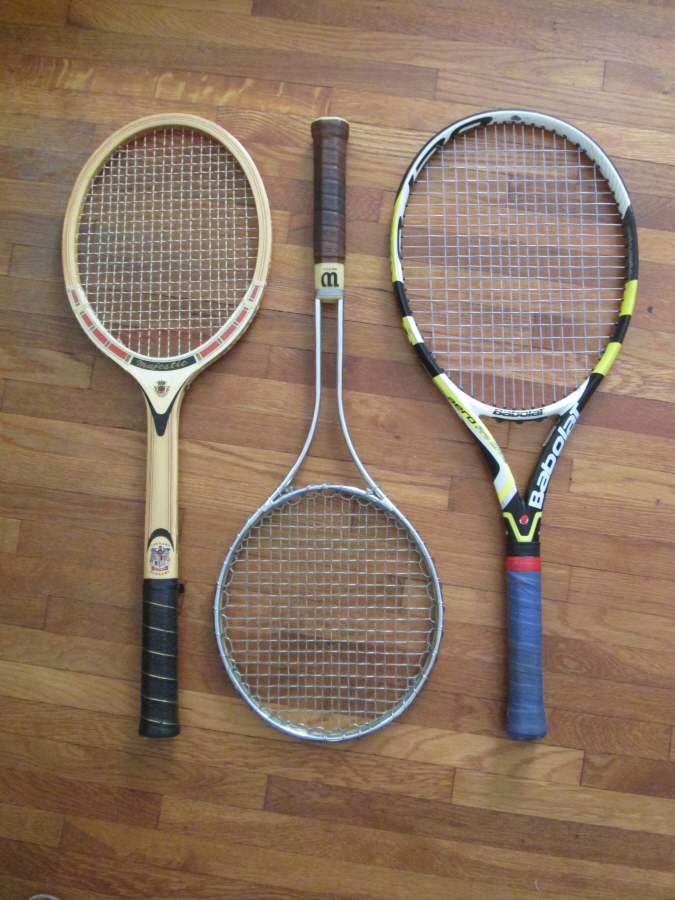
Laura decided that she wanted to go out for tennis in her upcoming freshman year in high school, so she's been taking lessons at the local tennis center. She's had really only a month to prepare — after never having played tennis at all bar lobbing a few balls around with a friend — so she was a bit dismayed when the high school's tennis camp started and she began to realize how much farther ahead most of the other kids are, but good for her, she's sticking with it. We had borrowed a racket until she decided whether or not she was really interested, but bought a fairly-new used one on consignment at the tennis center, just at the same time that Grandpa dug out his old rackets from the basement. Grandpa's basement is tidier than most people's houses, certainly ours, so the rackets are in great shape for being thirty or forty years old, but isn't it interesting to see how much they've changed over the years?!
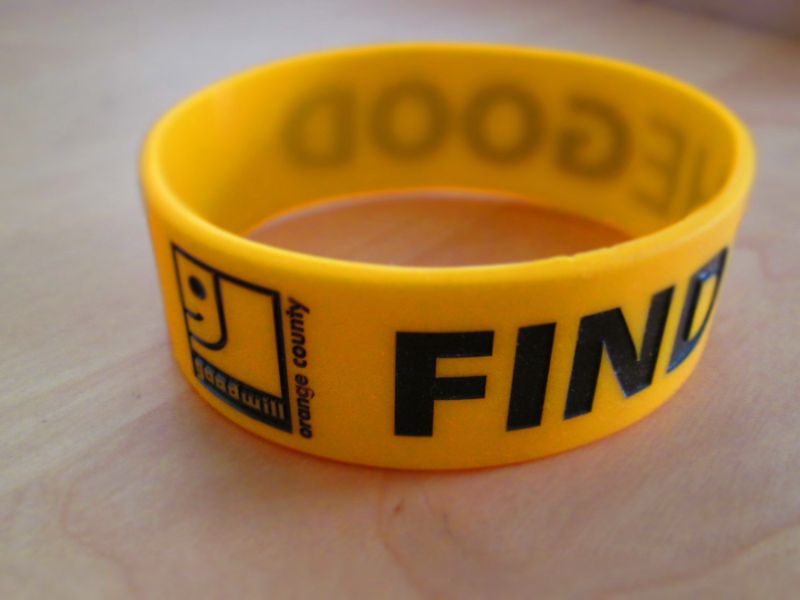
I took the girls on a tour of the big Goodwill facility in Santa Ana, as part of the Good Turn for Goodwill service project that is new here in Orange County. It was really amazing — I had no idea of the sheer scale of it. What a great opportunity for the girls to see what a service project really can do for their community — not only how their donations get resold or recycled, but that the people working there, the ones that smiled at us and said hello every time we passed, are some of the ones that Goodwill is actually helping, right there, right now.

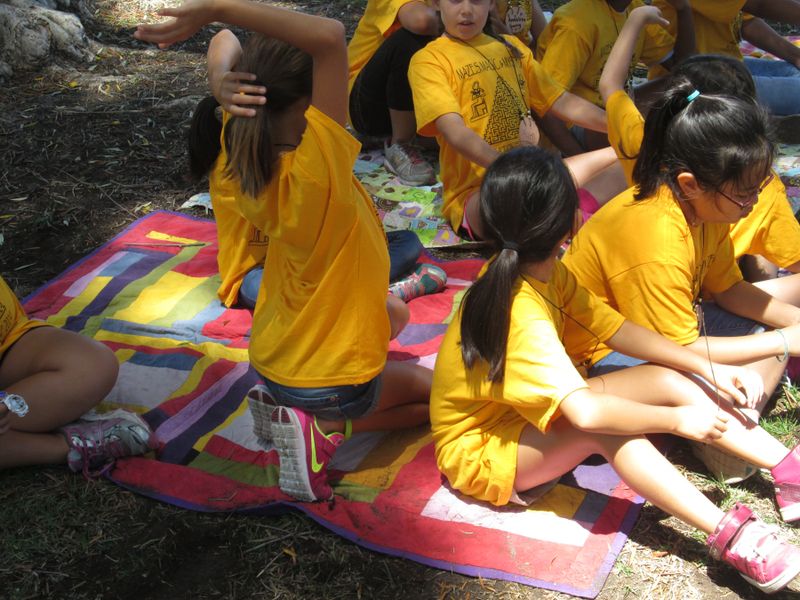
The theme of our Girl Scout day camp this year is Ancient Egypt, which has got Julia and me especially interested. I've been thinking for a long time about making a senet board, but when I saw this mehen game somewhere recently, I thought, "Oh, we could make one for day camp!" Those girls who were tired of playing Dollar, Dollar — and thankfully, there were some — really enjoyed playing mehen instead.
"Mehen" means "coiled one" and refers to the snake deity who coils protectively around the sun-god Ra on his journey through the night, and the name is also given to this game, for obvious reasons. Like senet, many boards but not the rules have survived, and so there are many different theories about how it was played.
We made our game out of Sculpey polymer clay one afternoon last week. This version is loosely based on the instructions in Philip Steele's book Ancient Egypt. We used 2 1-lb blocks of terracotta-colored clay, and a 2-oz package each of gold, yellow, blue, and silver. We rolled the clay into a ball and flattened it out using a large dowel for a rolling pin, until it made a large circle about 3/8-in/1cm thick, then scored the "snake" outline. (I decided not to make the little handle-like projection that some boards have, since that would be vulnerable to breakage.) The tokens are made with 2g each of two colors, gold and yellow for one set, and silver and blue for the other, and 4g each of the two colors for the larger "lion" token. After the Sculpey was baked, we were supposed to rub diluted green paint on the board, so that the lines would stand out, but haven't done that yet.
You will also need a die or counting sticks to play.
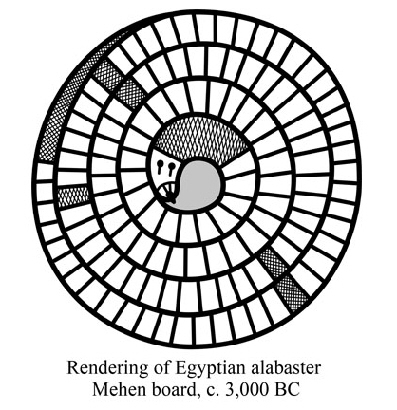
This is how you play:
Start all of your counters on the board before advancing any of the other pieces. A throw of 2 ends your turn (it was 1 in the rules I based our game on, but we couldn't resist the snake eyes, of course!). When you approach the center, you must throw the exact number needed to land there. Once at the center, turn your token over for its return journey. When your first token gets back to the start, your lion (the single larger piece) can begin. The lion moves the same way as the other tokens, but on its return journey, it can "devour" any of your opponent's players in its way. The winner is the player whose lion has devoured the most tokens.
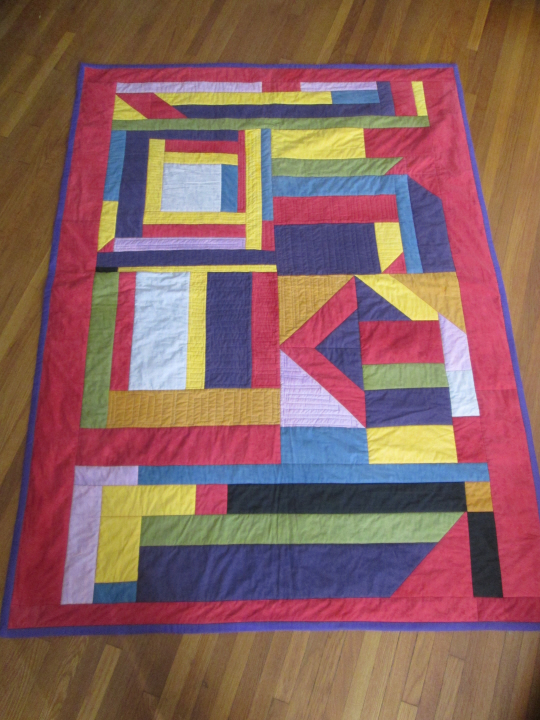
I have finally finished (sort of) this quilt, which is the “Medallion Variation” by Louisana Pettway Bendolph, from one of the Gee’s Bend series of kits from Windham Fabrics. I had a lot of trouble with the fabrics in this kit, from when I started it in July 2012 and picked it up again in June 2013. I also had trouble with pretty much everything else except the piecing, which was great fun — but I am coming to the conclusion that I am not much of a quilter, because the only thing I really like is putting the pieces together.
The backing is a dark purple Kona Cotton, of which I apparently did not buy enough, because when I picked it up again after a year or so, backed and partly-quilted but not bound, there was no fabric to do any edging at all, and I didn’t have enough time before my personally-set deadline to order another piece of the Kona Cotton, so I bought something as similar as possible from Jo-Ann’s, slightly lighter in both weight and color. Luckily, you wouldn’t know from the front, since a Kona Cotton binding wouldn’t have matched the Windham fabrics either.
I say “sort of finished” because I started to machine-quilt it, in a geometric meander along each of the pieces, with no experience other than a previous stitch-in-the-ditch quilt. This was not particularly successful, unfortunately, more due to my lack of skill and chronic tension problems with my machine, than to the idea of a geometric meander itself — which when it worked, worked very well. I think the first few times I made the lines too close together, as the later ones just feel better to the hand; I also couldn’t seem to get the machine’s tension the same from one block to the next, so that some looked fine from both sides, more looked wonky, and some looked absolutely awful. I got so frustrated that David said, “Honey, just do it like you did the Girl Scout quilt,” whereupon I glared at him, and realized that he was probably right. I stitched all of the pieces along their seams, picked out the worst of the first attempts at the meander, and left the others for perhaps a future day, either picking-out or re-doing.
The only change I made to the design was to rearrange the center blocks a bit, as I thought the original was a little busy towards the top —
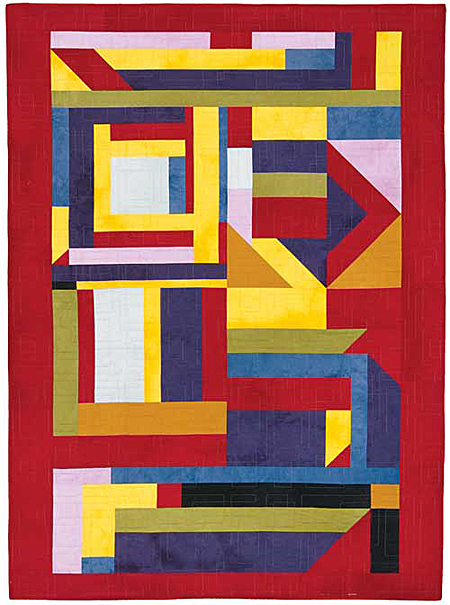
though I can’t think now why I didn’t switch the two on the left as well.
I don’t think I will ever buy fabrics from Windham again, even though I generally like the hand-dyed look — the fading in some cases was I thought far too much, despite their assurance that the colors would not bleed after a few washings, and are more “bright and appealing” afterwards. Sometimes I wonder if “slight imperfections” isn’t often a euphemism for “flawed” or at the least “carelessness”.
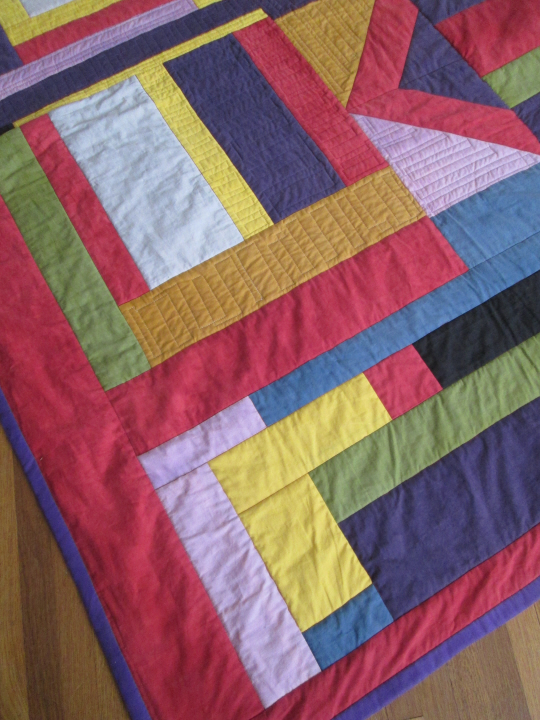
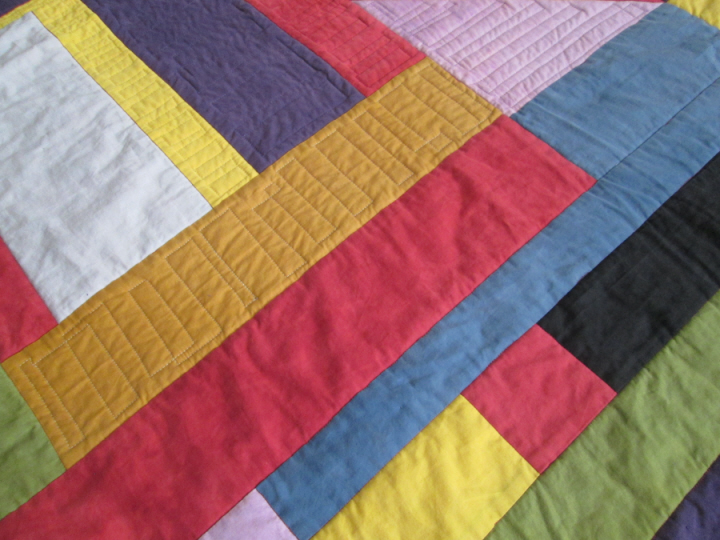
But despite all of the grief this quilt gave me, I actually like it a lot now that it’s done. I like the cheerful colors — even though they aren’t as bright as they started out — and the bold, dynamic shapes. And here it is in action at last! at Girl Scout day camp this week —
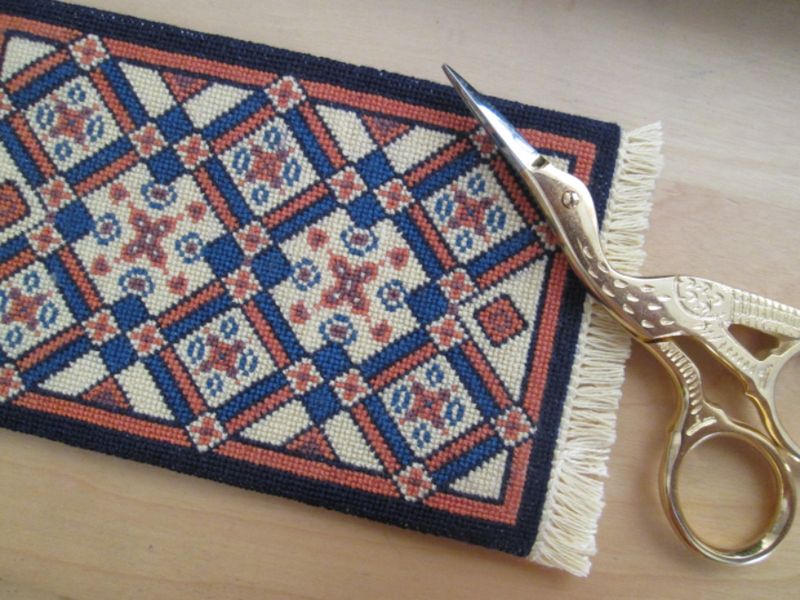
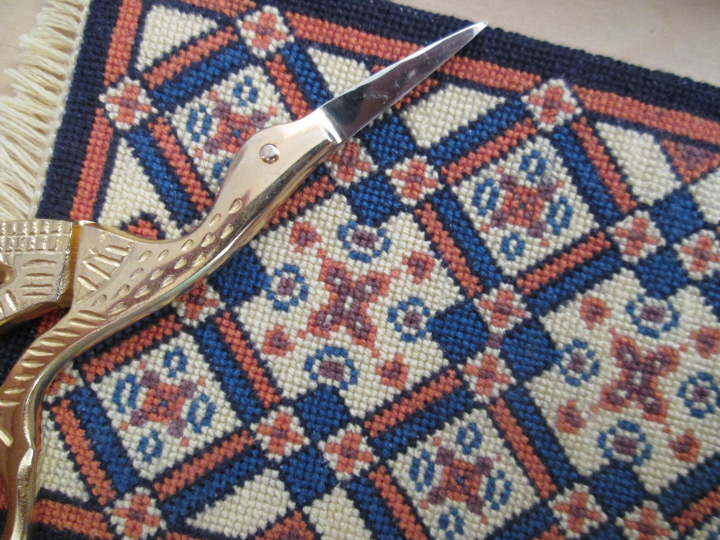
Here is another miniature carpet, called "Elizabethan Squares"; like the Long Flowers Panel, it is from Sandra Whitehead's book Celtic, Medieval and Tudor Wall Hangings in 1/12 Scale Needlepoint, but with three major modifications, one Whitehead's suggestion and the others mine. I wanted a carpet instead of a wall hanging, since it isn't for my Tudor-house-to-be (because they didn't have carpets on the floors at that period), so I added in another pattern repeat at one end to make it longer, and I used Whitehead's alternative color scheme instead of the original pinks and creams. The other modification was to work it in cross stitch instead of tent, as I generally feel that single-stitch diagonal lines in tent stitch always look a bit off to me, unsymmetrical, whereas in cross stitch they look the same whether they are heading upwards or downwards — the strong black diagonal lines in this seemed to want more symmetry to my eye.
I made only one permanent mistake on the chart, on some of the 0 shapes inside the squares, but by the time I noticed it, it became a design element (!).
The fringe is a side-by-side Turkish knot one — I used the chart in Meik and Ian McNaughton's Making Miniature Oriental Rugs & Carpets, which is essentially the same as the side-by-side knots here.
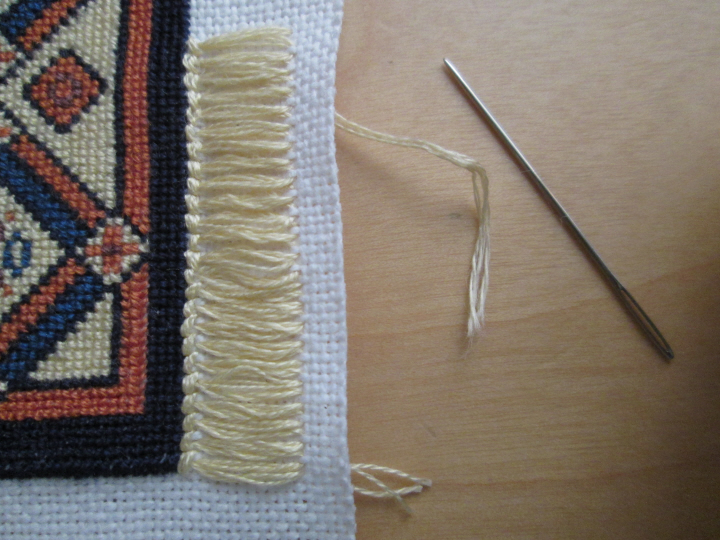
On 28-count Monaco, this carpet as modified works up to a finished size of 4 3/8 x 3 inches (11 x 7.5 cm), not counting the fringe.

I wasn't quite as successful with the long-legged cross-stitch edging this time — I don't know why. Maybe just because the white canvas stands out more between the navy threads?

I also tried something different with the hem, using mitered corners instead of folded ones. Not sure if this is the best way of going about it, but I really love mitered corners, so I just get a kick out of it. They didn't fold quite as well as I would have liked, but the Turkish knot edging needed a little bit of cheating on the turn to lie flat, and I suppose that canvas isn't as helpful as something lighter would be.

I enjoyed working this carpet very much — the original colorway is very pretty, but the stronger blue-and-ginger really speaks to me.
Marking the thirtieth anniversary of Torvill and Dean's gold-medal performance of their "Bolero" routine in the Sarajevo Olympics in 1984, the citizens of Nottingham honor their own. It's a wonderful, heart-warming tribute —
The original Nottingham Playhouse article about the Mass "Bolero" is here.
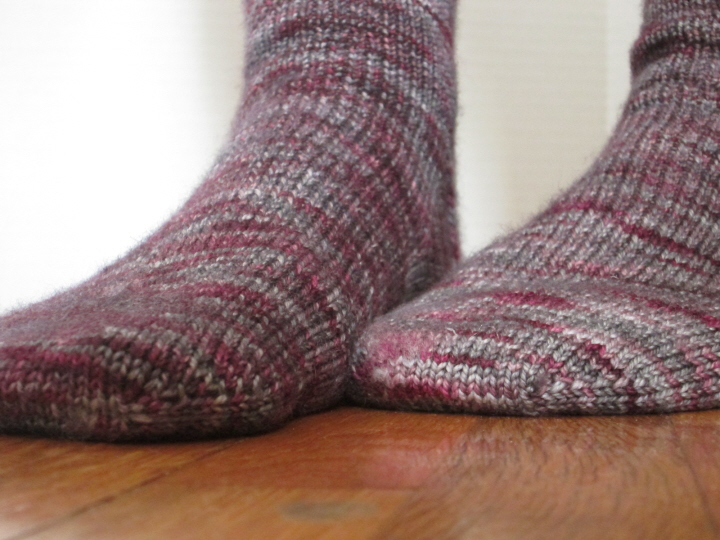
These toe-up school socks have taken me a while to knit, but I've enjoyed the knitting thereof, so I don't mind at all. While only the heel was actually a new-to-me technique, I used a number of unfamiliar ones, so it was also definitely a learning experience.
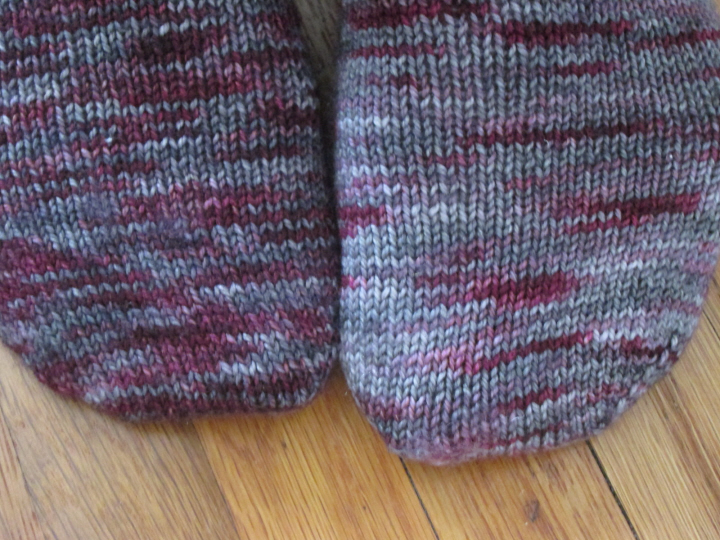
I started with a toe-up toe adapted from Charlene Schurch's Sensational Knitted Socks, which turns out looking very much like a top-down grafted toe and goes together fairly easily. It is also adaptable to a wide variety of sizes. I worked the first one according to the instructions, then thought that the 2 sts between the increases looked a little narrow, so I worked the second sock with 4 sts between the increases. I've done this toe a number of times, but rarely actually finished the socks, so now I can give full marks to the "school" part!
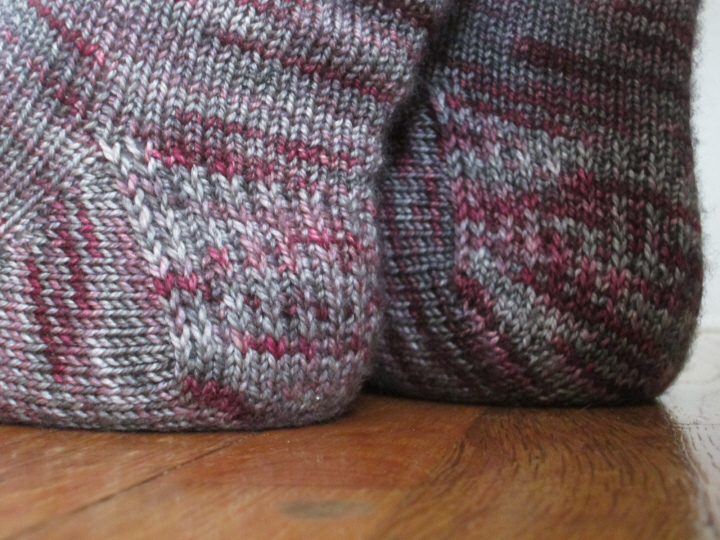
Here you can see the difference between the toe with 2 sts between the increases, and the one with 4 —
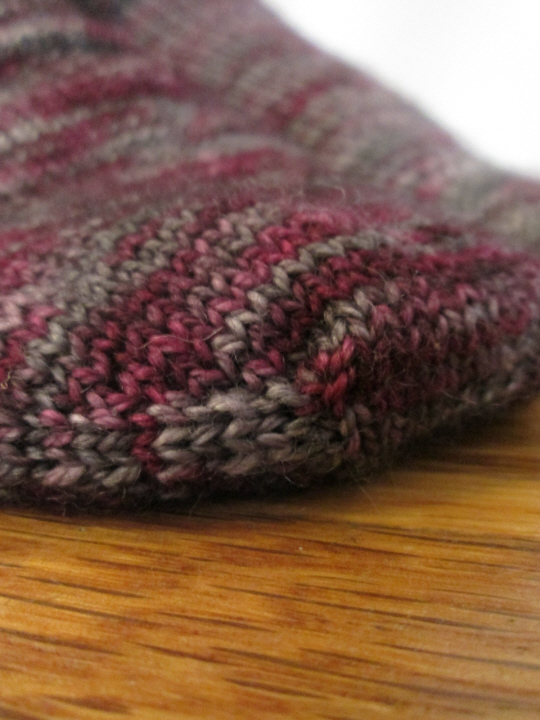
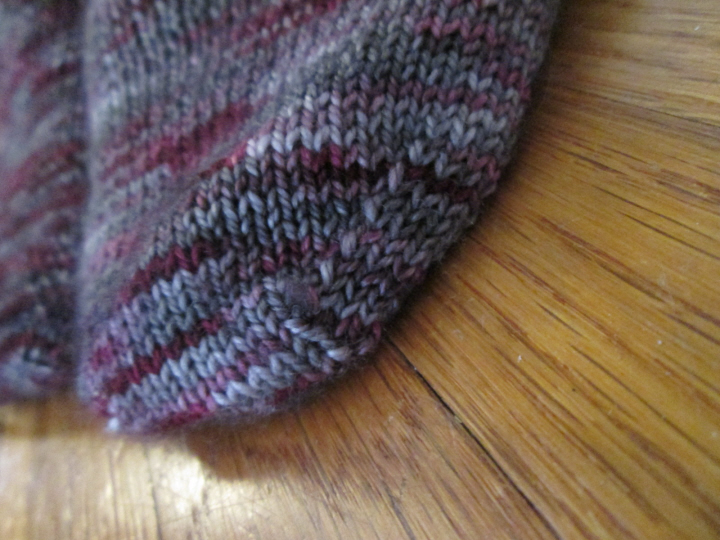
To be honest, I couldn't really feel a difference in the wearing, but I like the look of the wider toe, so that is what is in the pattern below.
I also used the justly-famous Widdershins heel, which worked perfectly and looks very nice. My heel is actually an adaptation of an adaptation, since for some reason I was a little anxious about the whole toe-up thing, and I'd heard around the knitting blogosphere that the original Widdershins was only for a certain number of stitches, so I ended up using a formula that allowed the knitter to calculate for more or fewer stitches. Despite this being a rather convoluted path, it all went very smoothly.
The heel turn of the Widdershins makes a very generous curve, wider than the standard top-down turning, but this is not necessarily a bad thing, and I expect it could be adapted for those who want a narrower turning at the bottom of the heel.
The third new-ish technique was the Russian lace bind-off, said to be excellent for toe-up socks that need to have a stretchy bind-off.
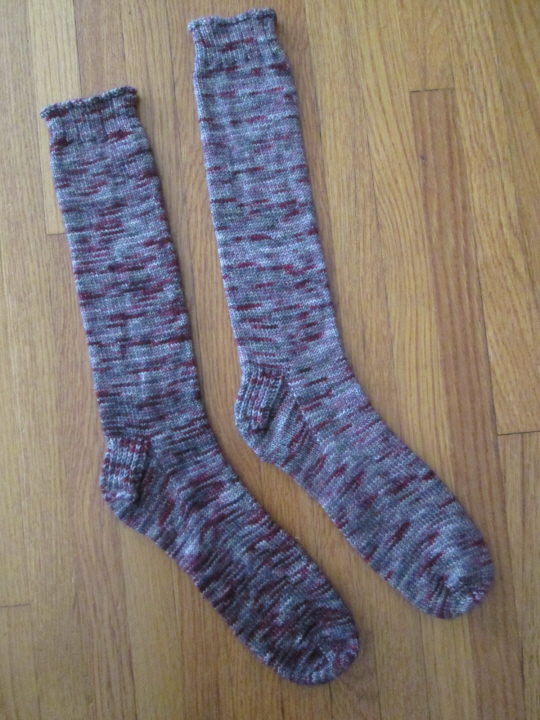
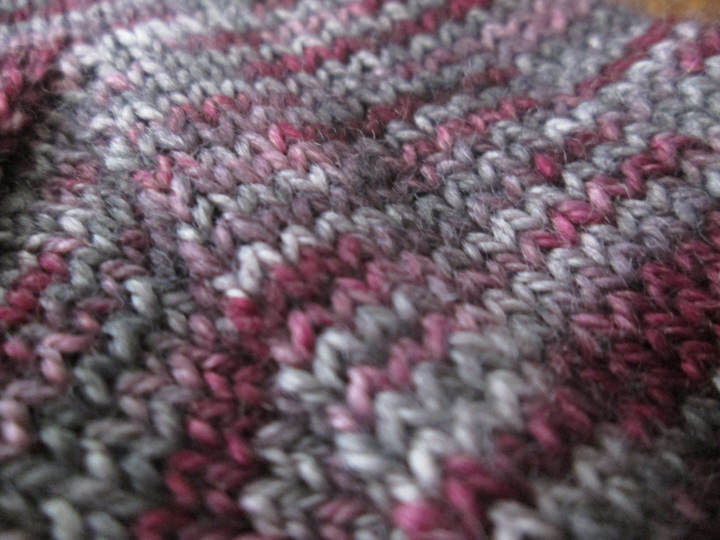
The Tosh Sock is really lovely to knit with, soft and silky, and the color is fabulous. The skein is very generous, and I made the legs quite long with still a golf-ball-sized length left over. On the down side, the yarn bled quite a lot when I blocked them (the red), and the socks are already starting to fuzz at the toes, after only one wearing.
On the whole, I like the socks very much, and I've finished and worn a pair of very nice toe-ups, but generally I think I prefer the top-down construction. Even though the bind-off is fairly stretchy, it just doesn't appeal to me as much as a good Old Norwegian cast-on. I also like the ability to make the length of the gusset longer without having to recalculate the distance between toe and the beginning of a toe-up gusset. The biggest plus that I can see in working a toe-up sock is still having the stitches in a pattern "right-side up"!
Here is my pattern in full:
"Black Velvet" School Socks
This sock uses a toe-up wedge-type toe adapted from the Easy Toe in Charlene Schurch’s Sensational Knitted Socks (Martingale, c2005), and a version of the "generic Widdershins heel" by Mel of Cabezalana, in turn adapted from Brooke Chenoweth Creel’s innovation of the classic round-heel, Sl1-K1 heel-flap heel worked toe-up. My version realigns Mel’s generic Widdershins to accommodate the round starting at the bottom center of the heel.
This sock is knitted in Madelinetosh Tosh Sock yarn (100% superwash merino wool, 395 yards/361 meters per 100+g skein) in the "Black Velvet" colorway, worked on 2mm needles at a gauge of about 32 sts per 4 in./10cm, and measures about 3 1/2 in. (18 cm) across the foot laid flat.
Toe
With waste yarn and provisional CO, cast on 12 sts. Change to sock yarn and P 1 row.
Work back and forth in st st for 6 rows. Remove provisional CO and place sts on a second needle. (12 sts on each of 2 needles.)
Beg working in the round.
Set-up rnd (RS): K 4; this needle will in a moment be needle 4. With another needle (needle 1), K 6 then pick up and K 2 sts from side edge. With needle 2, pick up and K 2 sts from side edge, then K 6 from CO edge. With needle 3, K remaining 6 from CO edge, then pick up and K 2 from side edge. With needle 4, pick up and K 2 sts from side edge, then K to end. Rnd now begins at center sole. (8 sts on each of 4 needles.)
K 1 rnd.
Rnd 1: K to last 2 sts of needle 1, M1R, K2; K2, M1L, K to end of needle 2; K to last 2 sts of needle 3, M1R, K2; on needle 4, K2, M1L, K to end.
Rnd 2: K.
Rep Rnds 1 and 2 until there are 56 sts total.
Continue until foot measures 3" (7.6 cm) less than desired length.
Gusset
Rnd 1: K to last st of needle 1, M1R, K1; K across needles 2 and 3; on needle 4, K1, M1L, K to end.
Rnd 2: K.
Rep these 2 rnds 9 times more. (10 sts inc on both needles 1 and 4).
Turn Heel
On needle 1, K8, M1L, K1, w&t.
P10 on needle 1, P8 on needle 4, M1P, P1, w&t.
K10 on needle 4, K6 on needle 1, M1L, K1, w&t.
P8 on needle 1, P6 on needle 4, M1P, P1, w&t.
K8 on needle 4, K4 on needle 1, M1L, K1, w&t.
P6 on needle 1, P4 on needle 4, M1P, P1, w&t.
K6 on needle 4, K2 on needle 1, M1L, K1, w&t.
P4 on needle 1, P2 on needle 4, M1P, P1, w&t.
K4 (to end of needle 4).
K one round across all needles, picking up wraps and knitting them with the wrapped sts as you come to them.
Heel flap
K 13 sts on needle 1, SSK, turn work without wrapping.
Sl1, P to end of needle 1, P 13 sts on needle 4, P2tog, turn work without wrapping.
(Sl1, K1) to end of needle 4 and on across needle 1 until there are 13 sts on needle 1, SSK, turn without wrapping.
Sl first st, P across needle 1 and needle 4 to 1 st before the previous SSK, P this st tog with the next st, bridging the "gap" formed by the decrease.
Rep these last 2 rows until all of the gusset and heel sts have been worked except for 1 remaining gusset st on each of needles 1 and 4. (Sl1, K1) to the gap, then SSK across the gap as before, but do not turn. K across needles 2 and 3; on needle 4, P2tog across the gap, P to end. (14 sts on each needle, 56 total).
Leg
Work in st st until leg is desired length. Work 15 rnds in K3, P1 rib. BO using Russian lace bind-off as follows:
*Purl 2 sts tog. Loosen up st on right needle, and return it to left needle. Rep from * until all sts have been bound off. Cut yarn and draw through last st. Weave in ends.
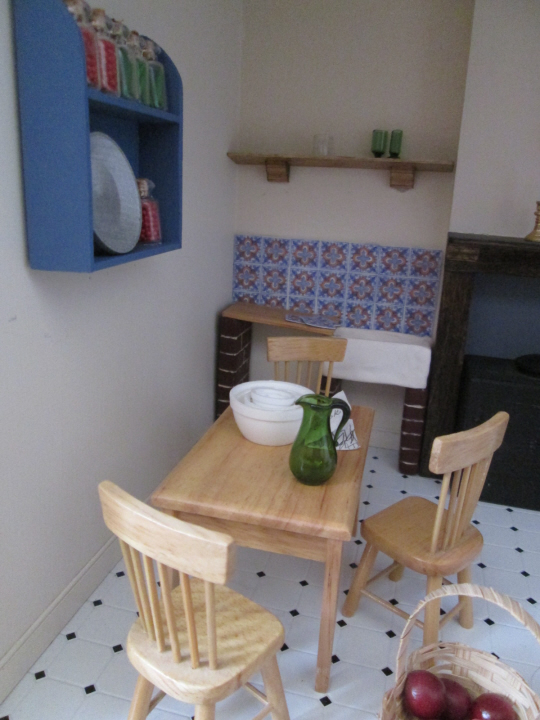
I thought this corner of the kitchen in No.16 looked very bare even with the new sink, so the other day I made a tile backsplash using a wonderfully simple tutorial from Eliza at Wasting Gold Paper. You print out on watercolor paper the appropriately resized pictures of the tiles you want, cut them out, apply artists' gloss medium, then install where you want them. The hardest part was just getting my printer to feed the watercolor paper through!
I was thinking Delft, of course, then saw this Mexican Talavera tile somewhere and kept coming back to it. I did lighten the color about ten percent, to keep it from jarring too much, but one of the reasons I like it is that I think it cuts the sweetness of the rest of the house a bit. It's easy to get too cute with all of that Victorian pink.
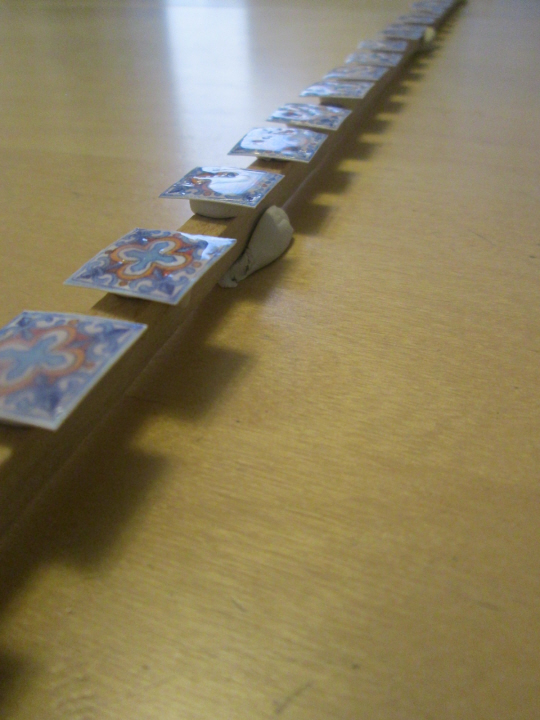
I didn't make a dedicated gluing board like Eliza did, but used a long 5/16×5/16 inch piece of scrap wood which I stuck to the kitchen table with reusable putty, then stuck the tiles-to-be onto the stick with a small ball of putty each. This worked perfectly, holding everything firmly then went back into the jar/scrap bin for another time.
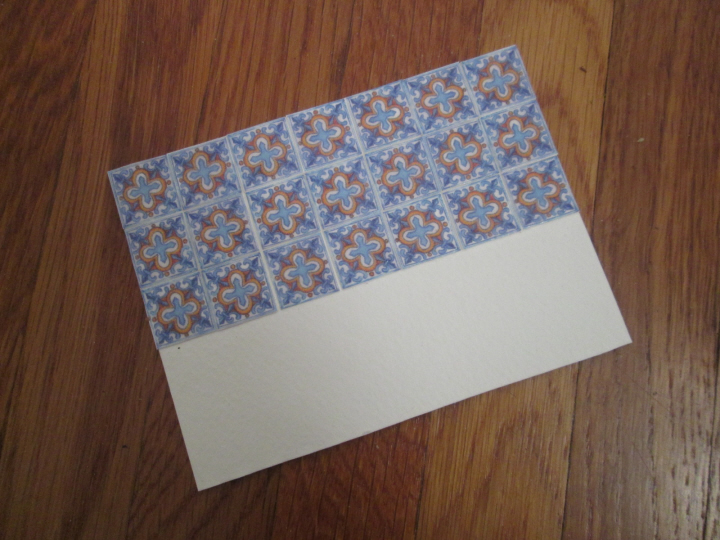
At 0.67 inch, these tiles are slightly larger than true 1/12 scale, but this way they fit the space perfectly. I cut a piece of watercolor paper to size — made sure that it fit — then glued the tiles to the paper, before "installing" it above the sink.
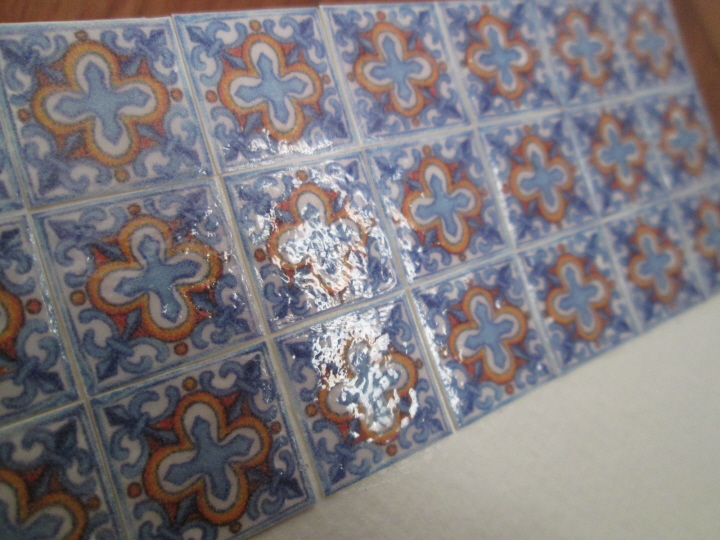
You can see how the watercolor paper adds a bit of texture to the tiles. I was a little worried at first that they would be perfectly smooth, since when I brushed it on, the medium self-levelled after a few moments — you can see this starting to happen in the photo of the tiles on the stick — but as it dried, the medium took on some of the texture of the watercolor paper.

This was so fun and worked so perfectly that I want to make hundreds — thousands! — of tiles now.
The shelves are from instructions in Venus and Martin Dodge's The New Dolls' House Do-It-Yourself book, where the house itself is from. The one above the sink is obviously very simple, a piece of wood the right size and two pieces of the cornice moulding left over from building the house. (A lot of things in the dollhouse fell over in the earthquake we had a few weeks ago, and now I'm a little heavy-handed with the museum putty, I see!)
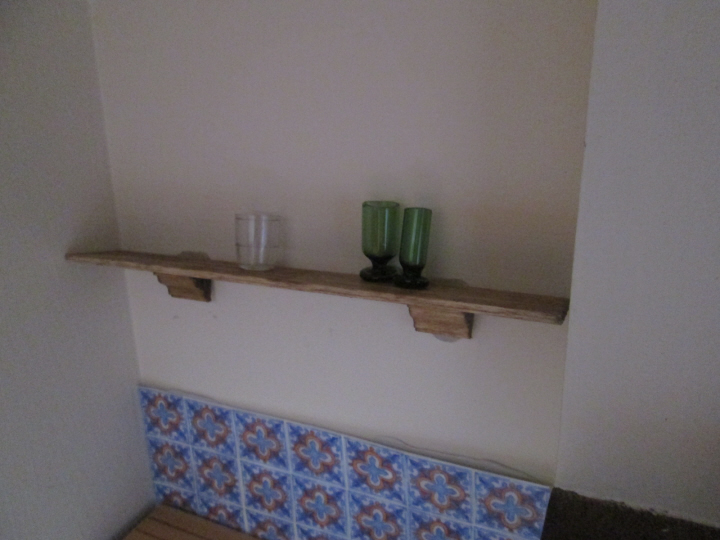
The second is a little hanging shelf, which I'm pleased to say that I cut all myself, except for the curve which David did on the bandsaw, free hand. I stained the plank shelf with some very ancient Minwax I found in a corner of the garage, and painted the hanging shelf with FolkArt acrylic paint in Sterling Blue.
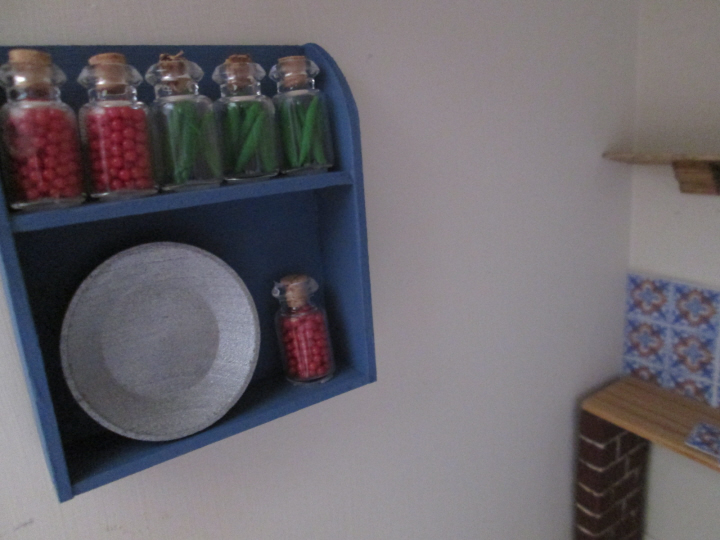
The preserves are from Timeless Minis, which I got through KitKraft a few years ago.
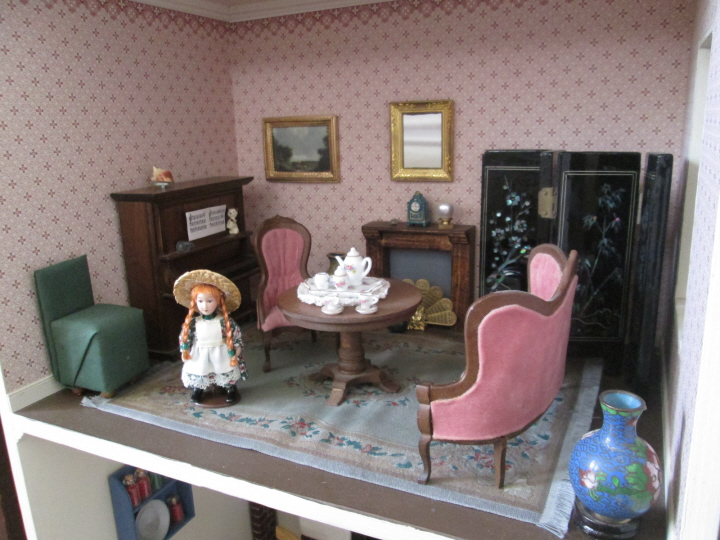
Here is the sitting room, now with some things I got in Hong Kong — two large jars and a folding screen — and a few more pieces of furniture, with the Anne Shirley doll from Avonlea Traditions —
Will would have enjoyed this, I think. Always good to see the Beatles larking about, too!
(I'm pretty sure that Peter Quince doing the prologue is Trevor Peacock.)
Knitting, reading, other stuff.

