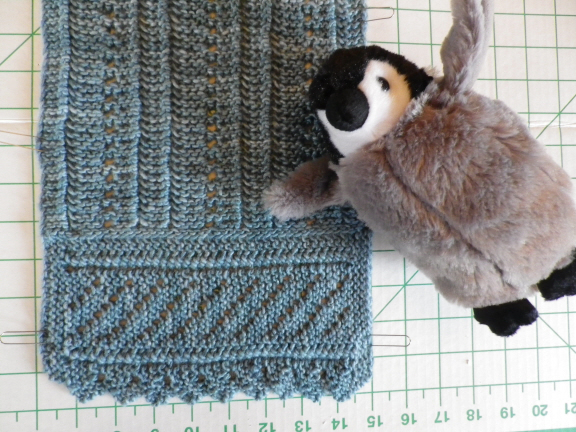
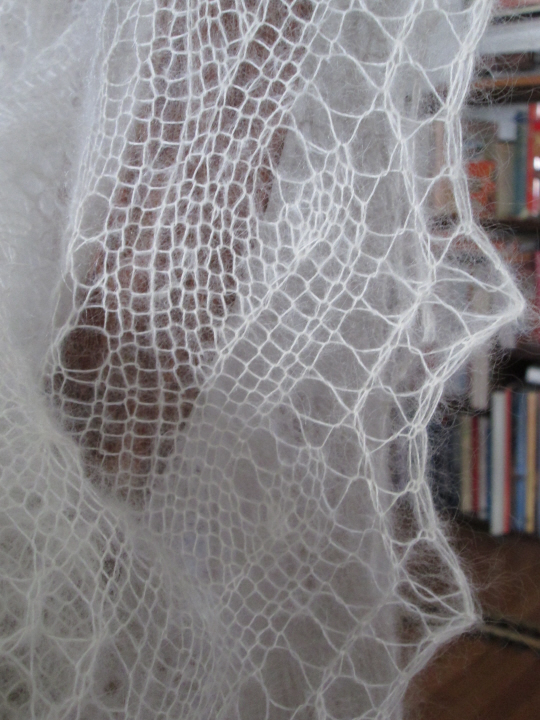
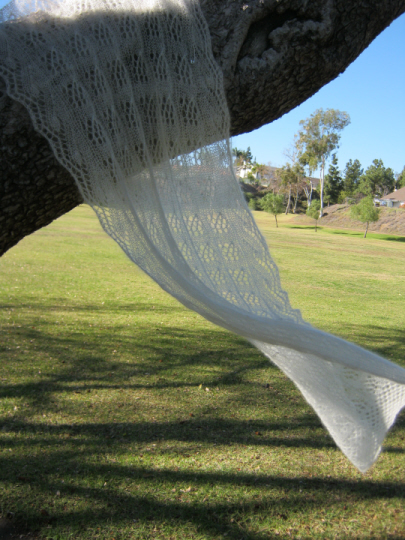
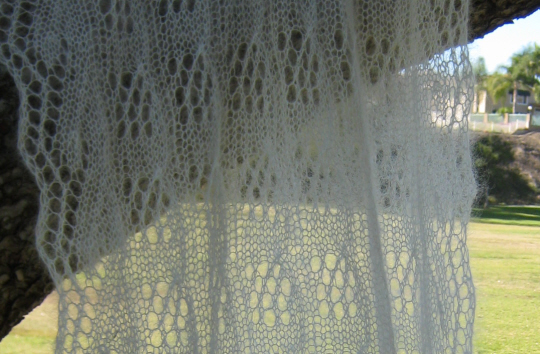
Elizabeth H. send me a photo of her "Sophie" scarf, which she worked in Malabrigo Silky Merino. It looks lovely! Thanks, Elizabeth!
She found an omission in the pattern, which is now corrected and can be found here.
Elizabeth H. send me a photo of her "Sophie" scarf, which she worked in Malabrigo Silky Merino. It looks lovely! Thanks, Elizabeth!
She found an omission in the pattern, which is now corrected and can be found here.
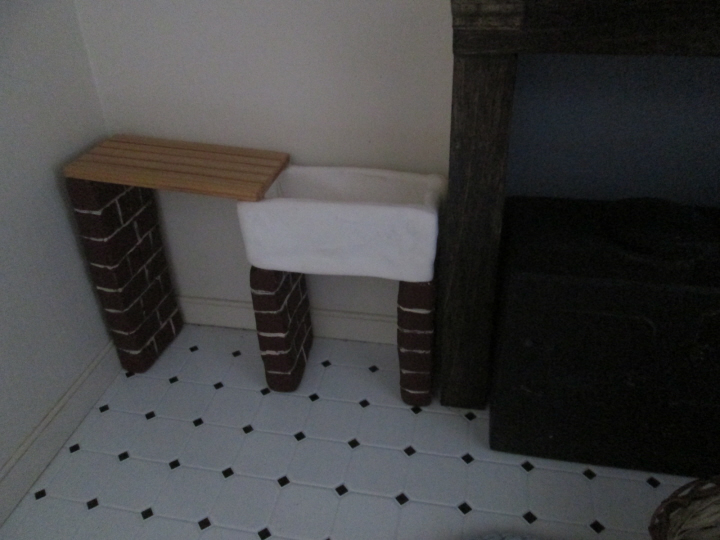
This is my first-ever polymer clay project, a sink for Laura's dollhouse. I started it probably in 2007 (!) when we were building the house, according to the photograph in the book — which is Venus Dodge's The New Dolls' House Do-It-Yourself Book. I wasn't at all happy with it at the time, with my inability to get a truly smooth surface on either the brick pillars or the sink, and so after I baked the Sculpey, I put it away and left it until just the other day, when deep in the delightful throes of planning a Tudor house, I poked through the box of leftover bits and bobs, and found the sink.
Obviously the kitchen needs a sink, so the choice was to start again from the beginning, or to put together the pieces I had and see how it turned out. I did consider starting over again, but luckily talked myself out of that within a day. I glued together two pieces of thin wood from David's scrap box, cut it to roughly the size I thought the drainboard should be, and sanded it — he showed me how to score the lines in it with an awl, and helped me to glue it all together with epoxy, using a temporary jig measured to the size of the opening beside the kitchen fireplace.
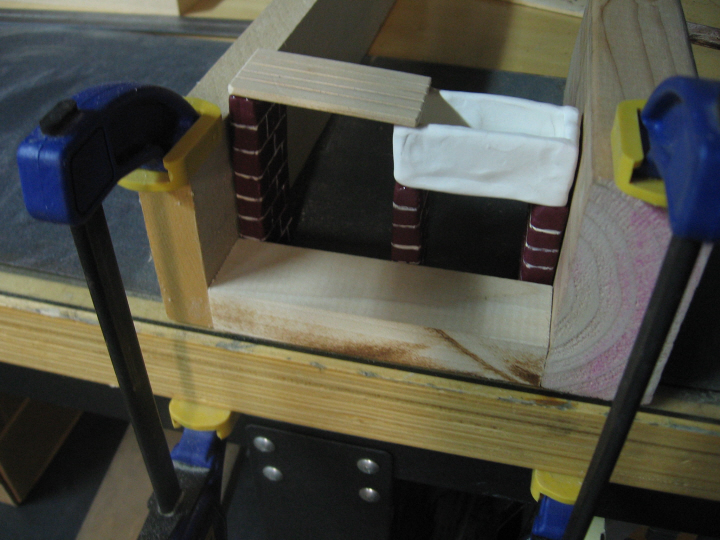
I've never actually seen a real sink like this, only in Victorian-cottage dollhouses, so I wasn't sure of the proportions, and still think the sink part is a bit too small, probably in both directions. I'm also a little embarrassed at my lousy paint job on the brick pointing, but I'll blame that on the brush for now, as it was a cheap and ill-used watercolor one from the girls' art bin. On the other hand, I'm delighted with the drain board, which turned out exactly the way I'd pictured it in my mind, especially after I brushed a little wood oil on it this morning.
It's very wonky, I know, but I'm telling myself that this house isn't meant to be especially realistic, but dolly-friendly. Of course this doesn't preclude making a better one some time in the future, but for now, wonkiness is part of the charm! And it isn't so obvious once the other furniture is back in place.
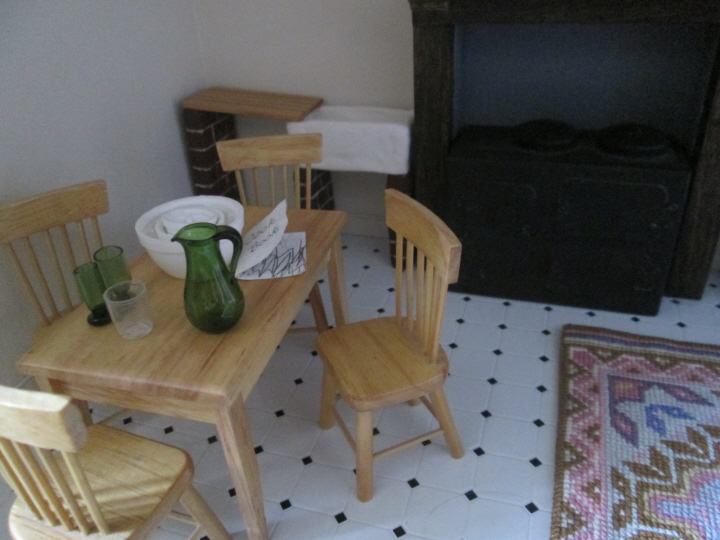
I still have a piece of fine brass rod, apparently meant for "plumbing", so perhaps I'll put that in eventually, along with a tile splashback, as it still looks quite bare in the corner!
I had forgotten that the book has instructions for a kitchen dresser, so perhaps I might do that next.
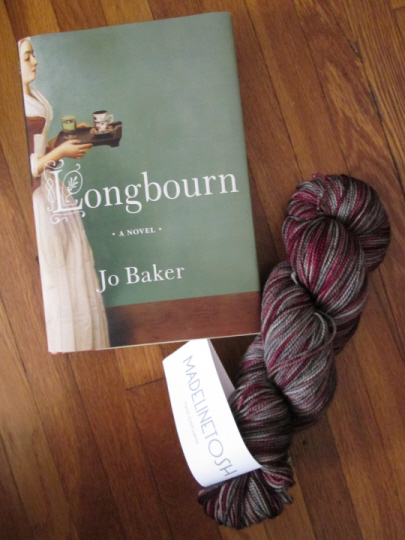
As for the "sock" part in the title of this post, I've been slowly but steadily working on a toe-up school sock in MadeleineTosh Tosh Sock in the lovely "Black Velvet" colorway, greys and purply-reds. I was dragging my feet for nothing, as the Widdershins heel worked like a charm. I am almost halfway through the skein, so in a day or two I'll be starting the second sock…

A text-message conversation this morning:
Is it snowing yet?
Yes and im freezing i didnt wear enough socks
— (Dad) I hope she has the boots and jacket on
Are the mitts warm?
Yes but my fingers are still freezing
Are you wearing the snow jacket?
It wont fit over my other jackets [sweatshirts]
— (Dad) Arrrgggh
Instead, instead!
But but but….merp
You funny. And cold huh?
Were inside now but soon out again so yah
K mom says instead next time. You wont have fun with bronchitis trust me. Love
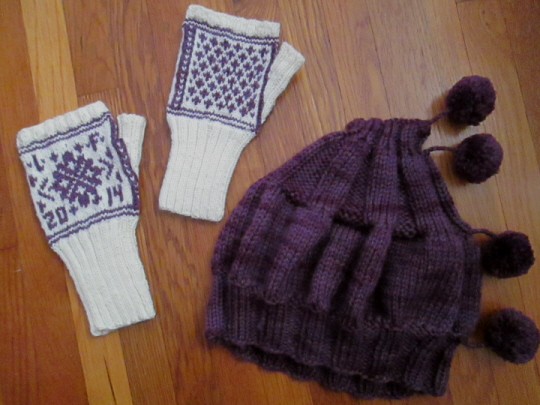
Laura was off on her trip this morning at four a.m. The weather forecast is a bit more optimistic than it has been for a while, but still with a drop of twenty degrees (twenty!) after the mild weekend. I made her a Three-Rib Beret at Christmas, in Lorna's Laces Shepherd Worsted in "Blackberry", modifying the pattern to make the child-sized hat a bit larger. She has worn the hat quite a lot already, even when I would have thought our sorry-excuse-for-winter didn't warrant it, so that's nice — I think it's an incredibly cute hat.
The purple isn't quite true in the photo, but Laura has taken the good camera with her so I can't try again. Jimmy Beans' photo seems to me more accurate, though on the other hand it doesn't show those subtle gradations of color that make it so luscious —
And of course I've been working on the Norwegianish mitts for a while now — cough! — and was still not entirely happy with them, but things were getting down to the wire. I discovered a mistake late in the pattern just the other day, long after blocking it and weaving in the ends, where I'd worked a purple stitch instead of a white one — David couldn't find it, and when I pointed it out said, "Just leave it", but it was actually a simple matter to work a darning stitch over it to at least disguise it. (That was I think mitt #5!)

I was stubbornly determined to work the thumb in ribbing, since unlike a mitten — which would be worked in more stockinette — the mitt thumb would be open at the top, and therefore curl unless it was in ribbing. I wasn't entirely satisfied with my method of catching down the long floats across the thumb of my first stranded mitts, so I thought I'd try the corrugated rib, which worked pretty well in itself, but the contrasting colors just seemed really loud to me, so I ripped it out and did it again with the thumb all-white, and simply tacked down the (very) long floats with the end of the yarn left nearby when I finished off the thumb. This method was mostly successful, though I was better at making the catching-down less visible the second time around, when instead of simply laddering through the backs of the purl stitches, I made a sort of spiral along one of the knit colums (on the inside), in the same manner that I usually weave in the ends on a ribbed sock. I'm still not sure if there is a really good way of going about this, but I'm happy to keep experimenting, and of course there is — admire my cunning plan! — enough yarn left for at least one more pair of mitts, this time to be mainly purple with a white pattern.
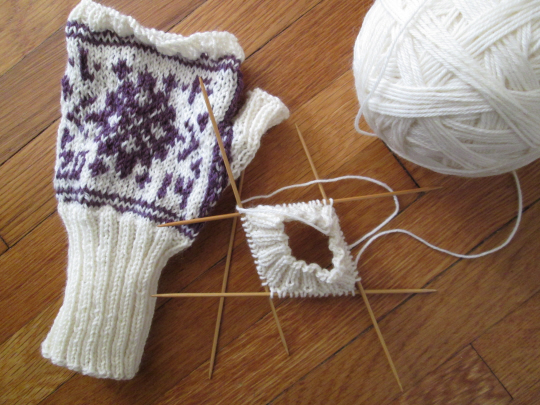
I still get a kick out of how alarmingly wobbly two-color knitting looks until it's blocked. The yarn is Shepherd Sock in "Blackberry" and "Natural", really lovely separately and together. Laura, I regret to say, received the mitts with rather wilting indifference, but they are wonderfully soft, and I'm sure will be pleasantly warm in cold weather.

I also made a luggage-identification thingy, in one of the most vivid colors to be had at Michael's, Red Heart Super Saver's "Bright Yellow" worsted. I've used big homemade pompoms for luggage tags in the past, which are all right for a journey or two but tend to moult after a while. This is spool knitting, on a six-peg spool so the strand came out about as thick as my finger. I decided that a loop of about seven inches was a decent size, and just worked the strand until it was about twelve or thirteen times that, then folded the strand one loop at a time and sewed each loop down, to itself and the previous one, making this flower shape. I left the two ends unlooped for tying it to the duffle bag. It's pretty sturdy, so as long as it doesn't actually come untied (I might sew the knot later), it should last a long time!
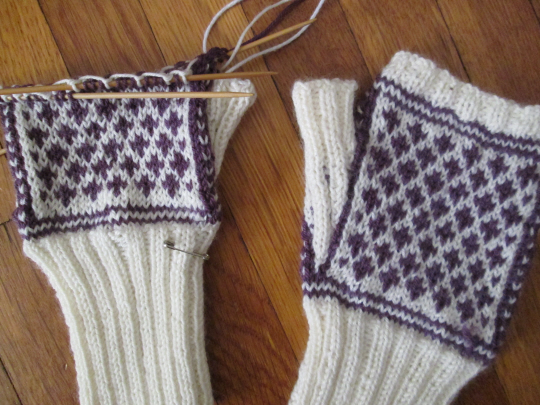
Yeah, the plain column of purple should be on the inside of the thumb, and the dotted column on the outside.
What's that sound? Ripping?
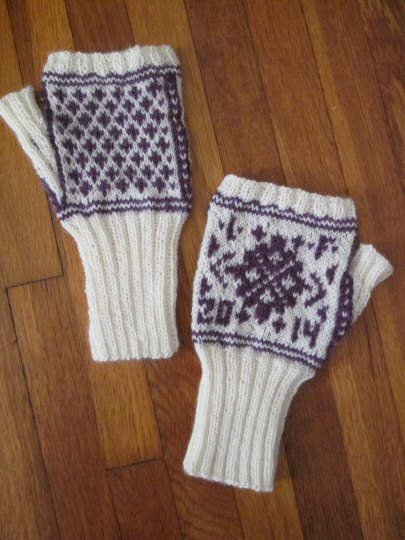
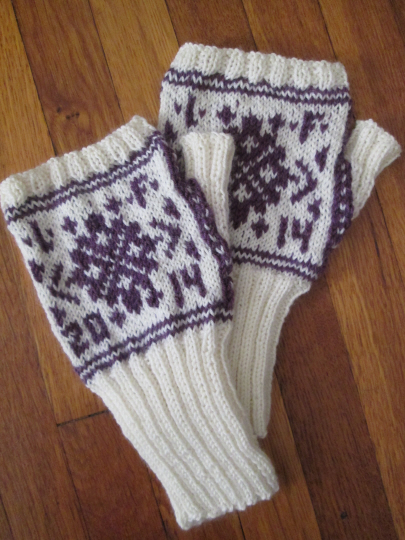
Laura has been saving and fund-raising for the past two years for the 8th-grade school trip to Washington DC, which is at last upon the horizon, at the end of this month. Washington DC in March! Brr! Luckily, there has been a lot of time to prepare. I knitted her a hat in her favorite color, and decided to make some Norwegian-style mitts to nearly-match — because at fourteen, we are not about matchy-matchy — with the same lovely Lorna's Laces "Blackberry".
I am not entirely happy with my design, having found it a little awkard to fit in the date and initials so that they stand out yet do not leave great stretches of background color where the contrast floats must be caught down. But the yarn is wonderfully soft, and I like the two colors together, and I think they'll be pleasantly warm and useful too.
Well, if only I had paid a little more attention —
I think I may have to go and console myself with a little something this morning — not drink, I suppose, as my tendencies do not lie in that direction, but perhaps …
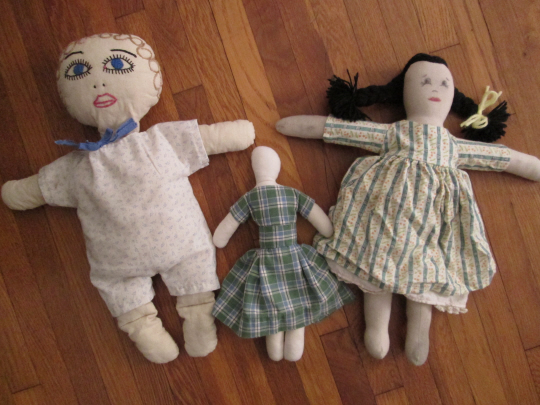
On the props list that was sent home recently for the 6th-grade production of "Annie" going up in a couple of weeks was "Tattered Rag Dolls 2 or 3". I thought to myself, "I bet I could make rag dolls that look like they belong to orphans!" so I poked around on eBay for "1930s rag dolls" and came up with a number of ideas, and searching generally for free patterns brought a few more. I chose a range of models and patterns because I wanted the dolls to look like they'd been made by different people, and possibly at quite different times.
I even managed to use all materials from my stash — even the stuffing, which is from an old pillow that I had thrown out literally the day before and then rescued from the bin! (and washed, of course!)

The first one was based on a couple of eBay vintage dolls, and used the rag doll pattern from Allcraftsblogs.com. I couldn't open the PDF file, so I just cut-and-pasted the pattern, and sized the body up to about 7 inches, and the arms and legs proportionately. This one has the most shaping of the three, and with the limbs being separate was a bit more fiddly, as it turned out, but not at all difficult.
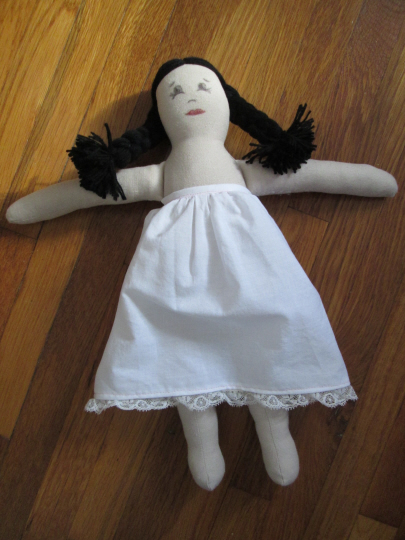
Her hair is fine black wool (from Super Yarn Mart, so that might tell you how long it has been in my stash!). I wound a long length of the wool around a book, to what looked like "enough", then carefully spread the mass across a strip of fabric, then machine-sewed along the strip with black thread to make the "part", then hand-sewed the hair to the doll's head. This took a bit of fiddling, and I had to trim the base strip and color it with black laundry marker to keep it from showing through, but it worked pretty well. I trimmed the ends of the yarn after I did the two braids — it seemed safer that way.
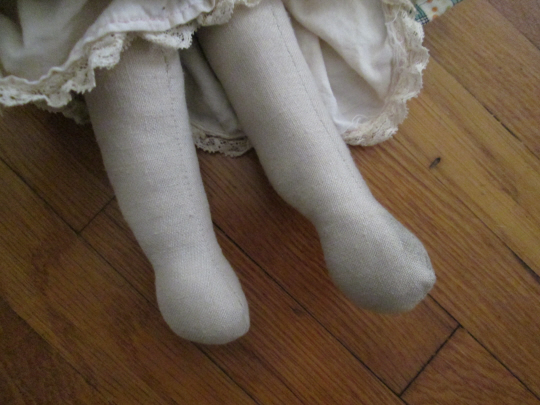
She has very shapely calves, and the feet are, for a rag doll, quite elegant I think.
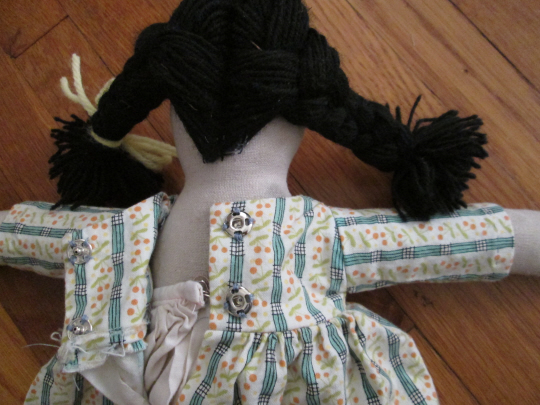
I ended up making her bodice fully lined, because facings at this scale were far too fiddly.
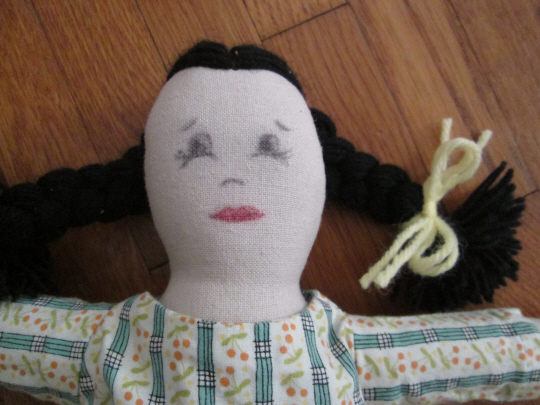
Her face is drawn on with ballpoint pen, which has a faux-faded look already. I am not very good drawing faces.
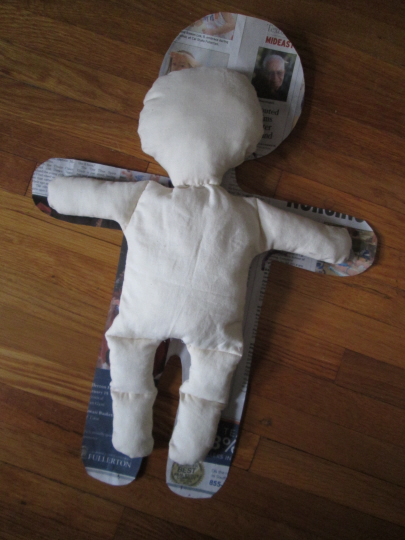
The second doll was based quite thoroughly on a vintage original, with the pattern half-improvised and half the Simple Doll Pattern from Doll Chamber. I thought it was interesting how much size was "lost" with stuffing, even this one which I wanted to be much softer than the first one.
I made the neck too long — it flopped very disconcertingly — and because I was lazy I didn't bother making a new body, but just tucked in the original one until it was as short as I could get it. It's still floppy, but at least more of a "baby" floppy than otherwise. These joints are simply machine-sewn across after stuffing.
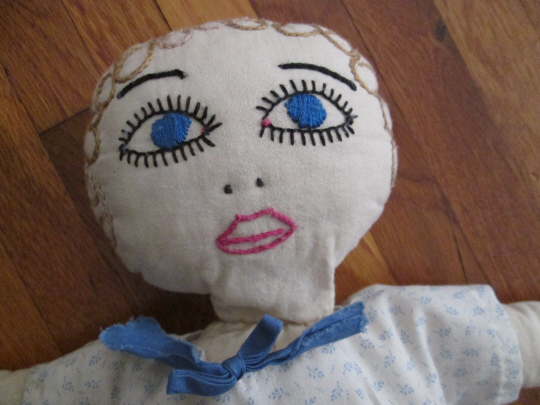
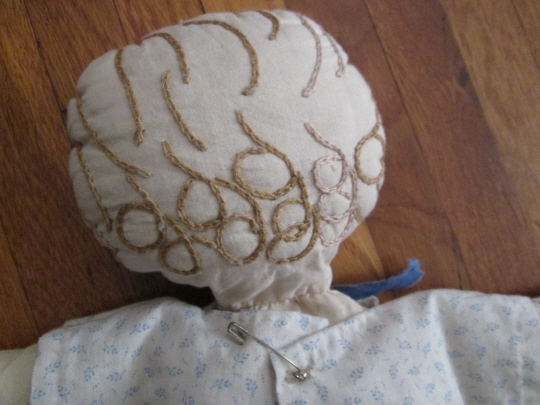
The face and hair are embroidered with three strands of floss, based fairly closely on the original folk-art doll. I couldn't decide from the seller's photographs if the original doll's hair was chain stitch or outline stitch, or maybe a combination of the two, so I just used chain stitch. I used two slightly different shades of blond floss so that it would look "faded". The eyelashes are blanket stitch, the pupils satin stitch and the rest outline stitch. I was impressed by the artists' trick of the dab of pink in the corners of the eyes on the original doll!
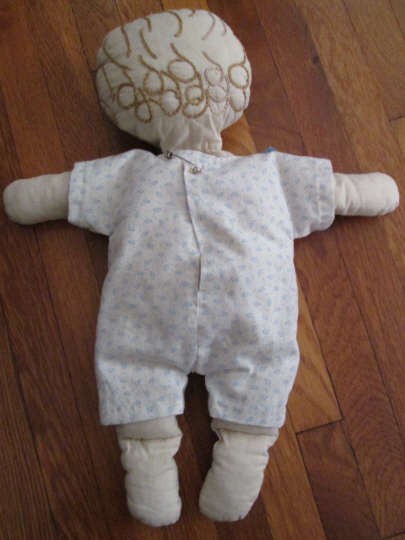
The original doll has a safety pin at the back of its romper, too —
The third doll was an utter failure on three attempts, and ended up back in the rag bag (do not make the arms too narrow, trust me!), but the fourth one, from a pattern at Nadene's Practical Pages, went together quite easily. I did modify the pattern by adding a quarter-inch seam allowance all around, and omitting the armature — as a result, the body was much simpler, and finished in about an hour.
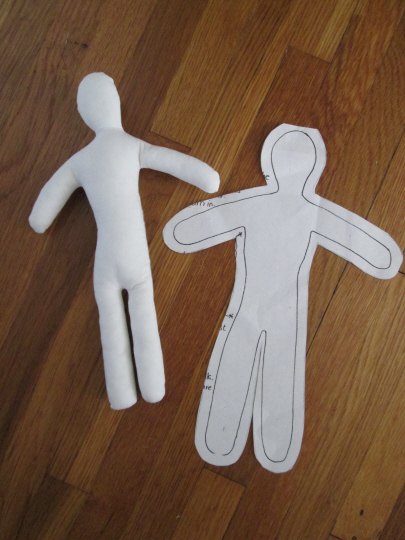
This one is also based fairly exactly on a vintage original, but didn't turn out quite as appealing as the original for some reason. It went together relatively easily, though, as I sewed the pieces of the dress straight onto the body, first the bodice, then the skirt, then the waistband.
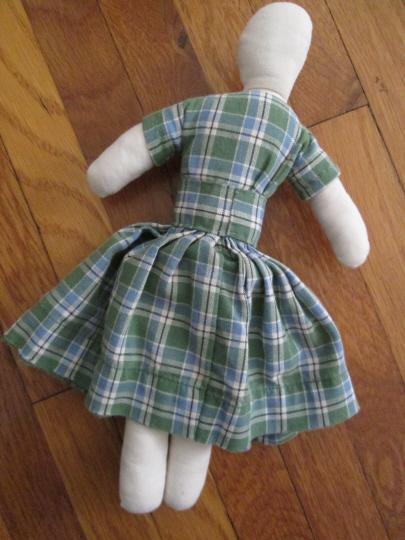
This is the back, although really you can only tell because of the seam in the waistband, since I left her face blank like the original doll's. The dress is made from an old shirt of David's that was frayed at the hems and collar, but I liked the fabric so much that I saved it. The skirt is one of the shirt sleeves, partly because it was already hemmed but mostly because the hem was already worn through in places. Except for this hem, the dress is completely hand-sewn! I made two basic T-shapes for the bodice and sleeves, and gathered it a little at the waist — sewing it directly onto the doll — then "pleated" the skirt and sewed it down, then folded a strip for the waistband and sewed that on top of the join between skirt and bodice.
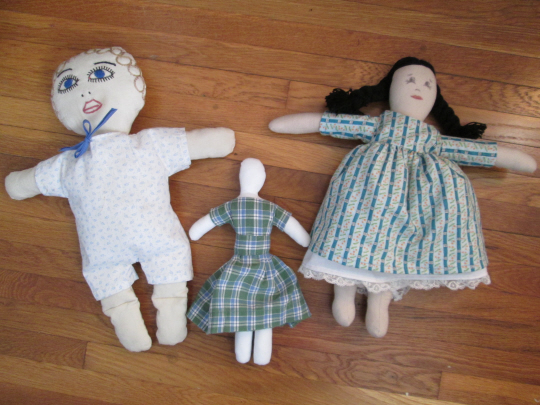
So these are the dollies before "aging". The girls kind of laughed when I said I wanted them to get the dolls dirty — like "is she serious? get stuff dirty on purpose?" — and I had to actually throw the baby doll on the ground as Laura and I were walking across the school field the other day, and tell her to kick it as we walked. (I heard other kids saying to each other in disbelief, "She's kicking that doll!") That didn't get it really dirty, to my surprise, so yesterday I filled a dishpan full of coffee and soaked the baby doll and the plaid-dress one, and the clothes of the pigtailed one in that for about half an hour. (The pigtailed doll is stuffed fairly hard, and I was afraid she wouldn't dry fully before Tuesday. Her hair wouldn't survive the washing-machine or dryer either, I suspect.) I had also bleached the striped dress to fade it.
(I also, I confess, stomped heartlessly on the pigtailed doll after I threw her down onto the deck in the back yard. That got it dirty.)
It was interesting how differently the fabrics were affected by the coffee. The pigtailed doll's petticoat looks quite ancient now, but the plaid-dress doll — who was bleached-white muslin to start — is only a pale ecru.
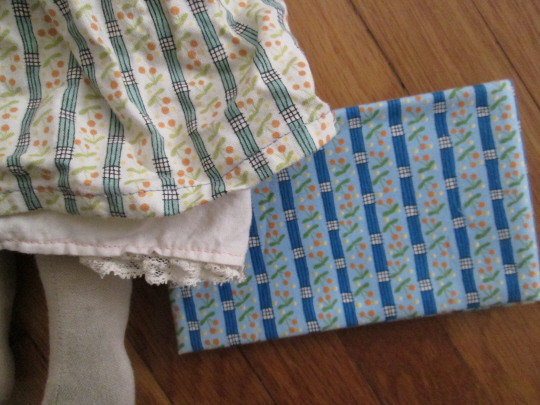
It's a hard-knock life ….
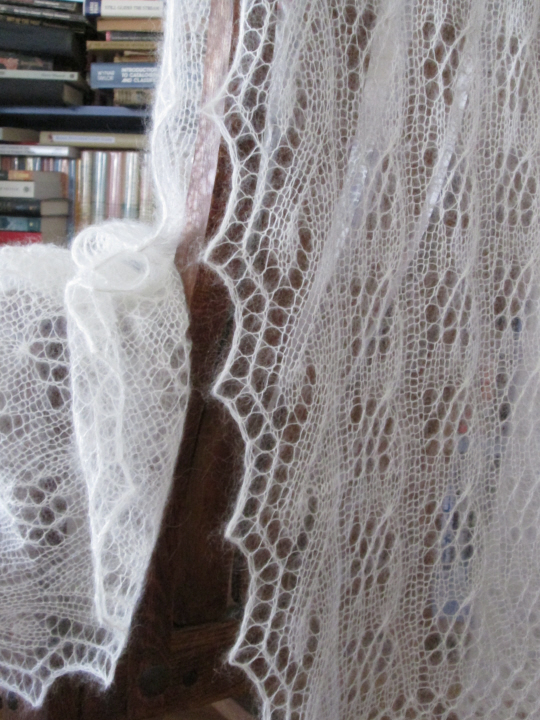
I'm having a kind of love/hate relationship with this wrap.
I don't much like Kidsilk Haze. I can see the appeal of the finished product, but knitting with it is rather unpleasant. I found not one but two knots in the first ball, and at $15 apiece (for just 25g!) the stuff is far too expensive to have to contend with knots, let alone multiple ones.
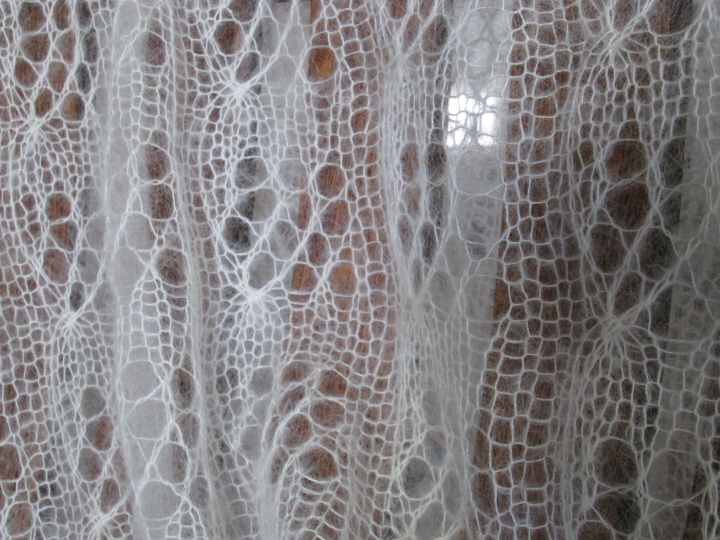
The pattern is the Kid Mohair Wrap from Susan Cropper's Pretty Knits: 30 Designs from Loop in London of 2007, reprinted in "Canadian Living". As I've said before, in my previous attempt at knitting this, there are a few errors, though perhaps only of judgement, in the pattern as printed in "Canadian Living", and one howler, which was in the amount of yarn needed to complete the wrap. Two balls is not nearly enough for a full-sized wrap.
One ball would have got to about 25 in. long, which was 6 1/2 repeats of the crossed-eyelet stitch — the pattern assumes that you will get 18 repeats total plus the two knot-stitch borders, so that one ball would be 9 repeats of the crossed-eyelet, a serious underestimate in my opinion.
There is as far as I can tell no errata page for this book at Potter Craft. I can sort of understand why a publisher might not want to admit that a book has mistakes, but frankly I don't think it serves them well in the long run. It certainly only makes me frustrated and annoyed that I cannot find an errata page on their website.
The dimensions given in the pattern are 30×60 in. (76×142 cm) blocked, with 2 balls of Kidsilk Haze. I found that 3 balls blocked assertively but not aggressively to 27×75 in., which was 21 repeats of the crossed-eyelet stitch. I have never tried blocking wires, but would recommend that anyone working this wrap consider them. Even getting the piece to this size was a trial, and after an hour of pinning and stretching, I was beginning to long for some nails and pieces of lumber.
After relaxing a bit, when I laid it out for the photo and did a quick measurement, it is about 24×72 inches.
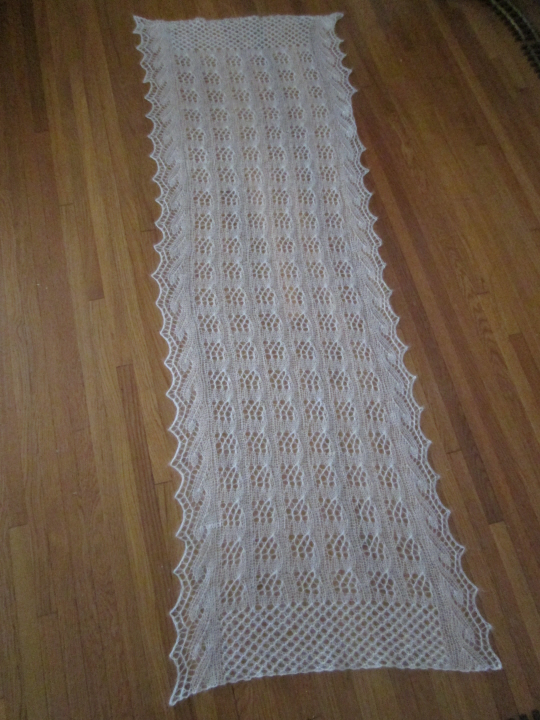
That said, it's a very pretty wrap. The lace patterns go together very nicely — I like that the knot section is garter-based, while the border and middle sections are stockinette-based. Much of the apparent cumbersomeness of the written pattern is because the border pattern is "attached" to the center pattern in the instructions, so that this way the knitter does not have to contend with juggling two separate charts, and trying to remember "am I on Row 4 of the border and Row 10 of the middle, or Row 4 of the middle and Row 10 of the border??"
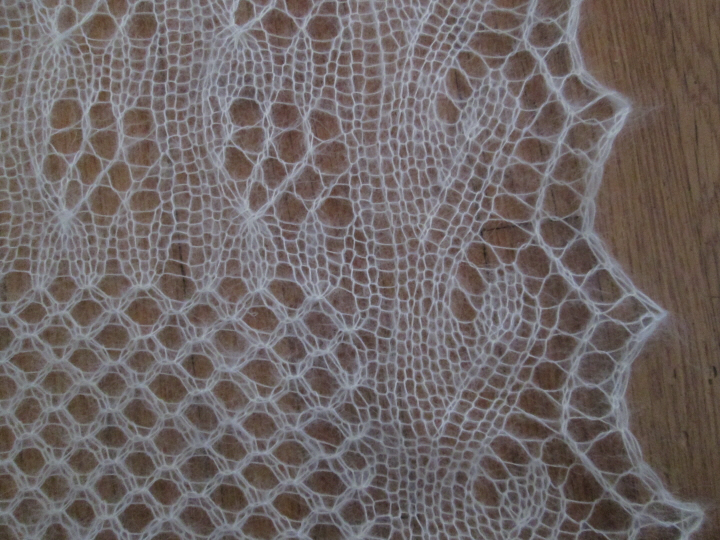
I really liked the mirror-image of the wave border, but was perplexed that the pattern as written didn't take advantage of the "waviness" with the decreases going in the right directions. So here are my corrections and amendments:
SSSK (my own un-vention): An SSK with three stitches instead of two.
Row 3: Sl 1 purl-wise, [K2tog, yo] twice, K2, SSSK, K5, slip marker, knit to marker, slip marker, K5, K3tog, K2, [yo, K2tog] twice, K1. (86 sts)
Row 5: Sl 1 purl-wise, [K2tog, yo] twice, K2, SSK, K4, slip marker, knit to marker, slip marker, k4, K2tog, K2, [yo, K2tog] twice, K1. (84 sts)
Row 7: Sl 1 purl-wise, [K2tog, yo] twice, K2, SSK, K3, slip marker, knit to marker, slip marker, K3, K2tog, K2, [yo, K2tog] twice, K1. (82 sts)
Row 9: Sl 1 purl-wise, [K2tog, yo] twice, K2, SSK, K2, slip marker, knit to marker, slip marker, K2, K2tog, K2, [yo, K2tog] twice, K1. (80 sts)
Row 11: Sl 1 purl-wise, K1, yo, K2tog, yo, K1, yo, K2, SSK, K1, slip marker, knit to marker, slip marker, K1, K2tog, K2, yo, K1, yo, K2tog, yo, K2. (82 sts)
Row 31: Sl 1 purl-wise, [K2tog, yo] twice, K2, SSSK, K5, slip marker, *P1, K1, [skpo, yo] 3 times, K1, P1, repeat from * 5 times, slip marker, K5, K3tog, K2, [yo, K2tog] twice, K1. (86 sts)
Row 33: Sl 1 purl-wise, [K2tog, yo] twice, K2, SSK, K4, slip marker, *P1, K1, [skpo, yo] 3 times, K1, P1, repeat from * 5 times, slip marker, K4, K2tog, K2, [yo, K2tog] twice, K1. (84 sts)
Row 35: Sl 1 purl-wise, [K2tog, yo] twice, K2, SSK, K3, slip marker, *P1, [skpo, yo] 3 times, K2, P1, repeat from * 5 times, slip marker, K3, K2tog, K2, [yo, K2tog] twice, K1. (82 sts)
Row 37: Sl 1 purl-wise, [K2tog, yo] twice, K2, SSK, K2, slip marker, *P1, K1, [skpo, yo] twice, K3, P1, repeat from * 5 times, slip marker, K2, K2tog, K2, [yo, K2tog] twice, K1. (80 sts)
Row 39: Sl 1 purl-wise, K1, yo, K2tog, yo, K1, yo, K2, SSK, K1, slip marker, *P1, C4B, K4, P1, repeat from * 5 times, slip marker, K1, K2tog, K2, yo, K1, yo, K2tog, yo, K2. (82 sts)
[Edited, thanks to the eagle eyes of Emily, who spotted a typo! — 19 February 2016]
I would have found it more helpful to give the number of stitches in the wave borders outside of the markers than the total number of stitches in a given row, but I haven't changed that here.
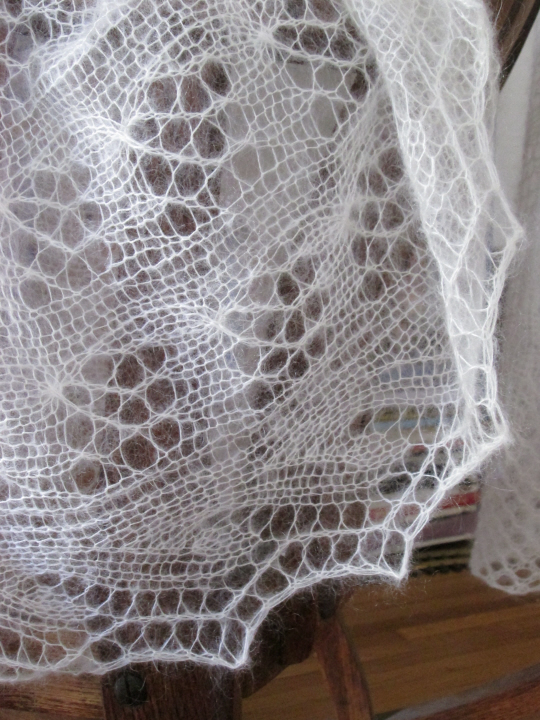
And for more personal recommendations:
I omitted Row 308 (the last row), as I thought it better matched the beginning of the wrap to not have an extra "plain" row there.
The bind-off given in the pattern was far too tight, even worked very loosely, so I used the suspended bind-off instead:
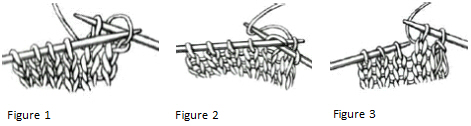
Slip one stitch, knit one stitch, *insert left needle tip into first stitch on right needle and lift the first st over the second (Figure 1), leaving the first stitch on the left needle, knit the next stitch (Figure 2), then slip both stitches off the left needle-two stitches remain on right needle and one stitch has been bound off (Figure 3). Repeat from * until no stitches remain on left needle, then pass first st on right needle over the second. (The image has been lifted from Knitting Daily's helpful glossary.)
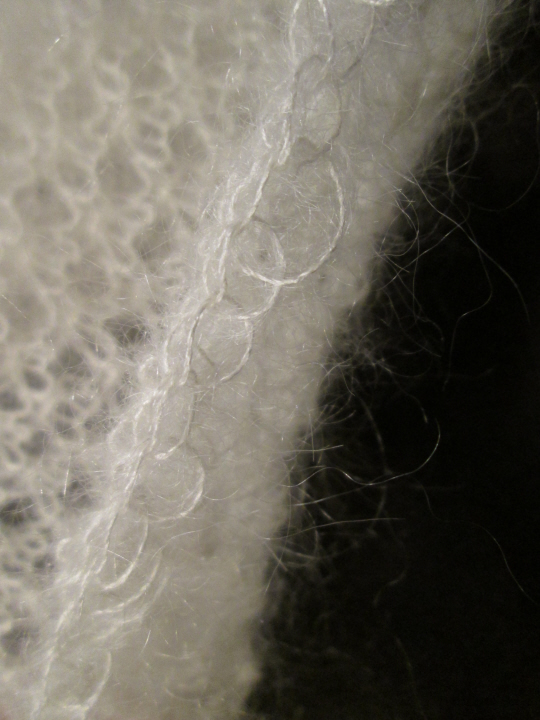
I was going for length over width in my blocking, as I was concerned that it wouldn't be long enough to be comfortable for the wearer — but I found that hard blocking rather spoiled the "fluffiness" of the knot stitch, so if it is not an issue, 4 balls and a much less assertive blocking might be preferable.
This is, by the way, forty hours of knitting!

Red fitted t-shirts from Michael's, with iron-on Chinese dragons from Dritz-Prym (no. 2909).
Gung hei fat choy!
Well, after twenty-five hours of knitting, I decided to block the Kid Mohair Wrap — still on the needles — and see what I've got.
This is eighteen repeats of the "crossed eyelet" stitch, which the pattern says is what is in the accompanying photo. If I added the knot-stitch border at the end now, my finished wrap would be only 53 inches long, so I can only assume that the "2 balls" in the pattern is a mistake for "3", as going by this test-blocking three balls of Kidsilk Haze will make it almost exactly 60 inches, the target length in the pattern.
Note that I could not reasonably get a 30-inch wide piece, so this is about 27 inches. Pulling it harder would of course make the length even less. It is obviously pretty fiercely blocked in the pattern's photo —
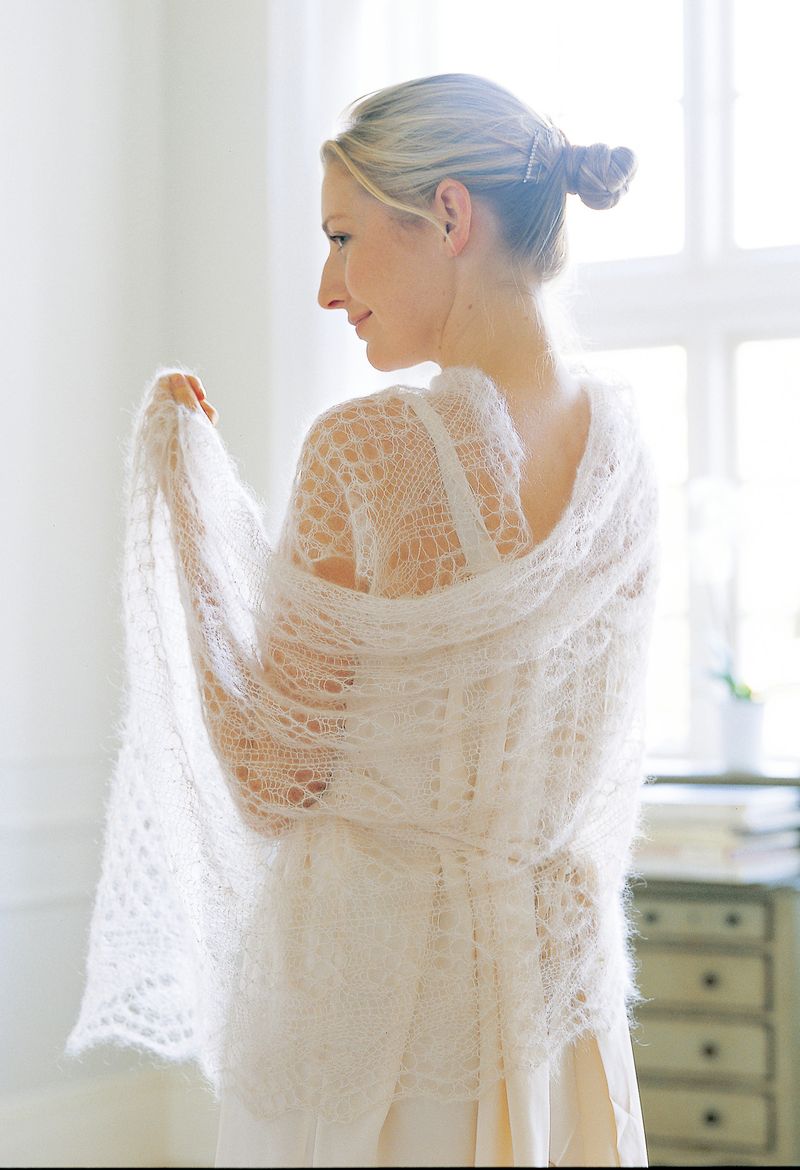
But now 60 inches seems a bit stingy for a wrap to me. If I use the fourth ball, it would be around 80 inches, which is probably too much. Is 70-75 inches a good length for a wrap? I've been going through the dresser drawers, pulling out scarves and stoles and even bath towels, and draping them around my shoulders, and still can't decide. Any advice?
Knitting, reading, other stuff.

