• Wm morris 1

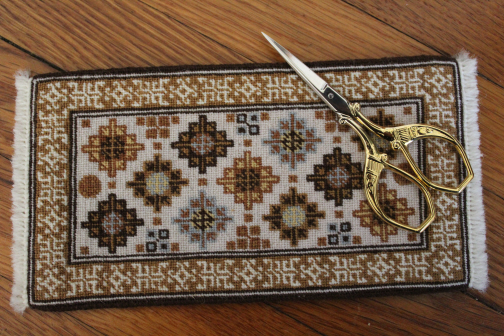
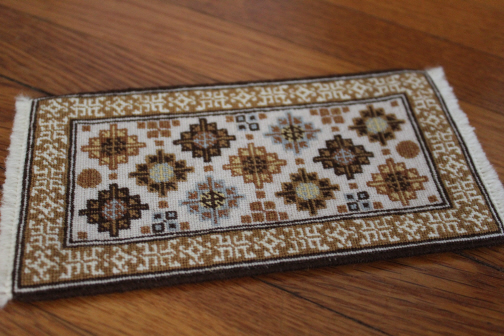
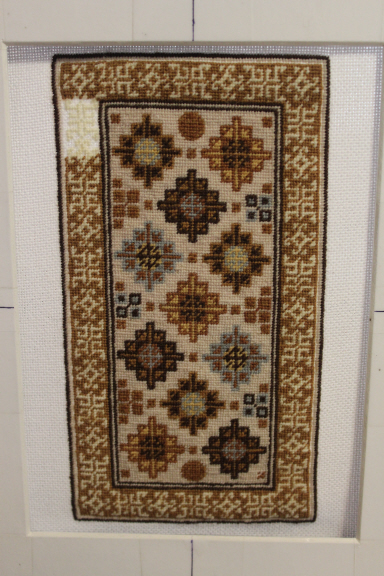
    I was holding out on you yesterday, actually — I had only a few stitches left on this carpet before it was finished!  This project is from Dollhouse Decor by Nick and Esther Forder, and is designed by Sue Bakker, based — pretty successfully, I suspect — on a William Morris design.  I can't find an image of an original anywhere, but Bakker's certainly looks very Morris-like, so I'm sure it's accurate in spirit.

    Wm morris 3

    As a project, this wasn't quite first-rate — there are quite a lot of … well, not mistakes but inconsistencies in the chart, though luckily I noticed most of these before they were past.  The photos in the book clearly show different colors of floss on some of the swirls in the outer border, as well as some revisions in the stems in the main border, and the general effect of the colors in the photo is quite different from the chart, which is more like the actual colors.  I also found that the recommended thread coverage (2 strands on 18-, 22-, or 30-count canvas) was quite skimpy for the 22-count I was using, so I would advise either experimenting with more threads, or using cross-stitch as I did, for better coverage.

    There is also very little finishing instruction given in the book — you have to look hard to find it, as it's a few pages past the carpet section in the "finishing workshop" at the back of the book — and the photo of the carpet in a room setting clearly shows that it has no edge stitching, so presumably the Forders mean you to simply turn the edges of the canvas under and sew a lining to the wrong side.

    Wm morris 2

    But as a finished piece, I'm very pleased with this carpet — I really like the strong colors, and the design itself is very pretty.  Interestingly, Janet Granger's "Carole" carpet is obviously based on the same Morris design of peonies and stylized tulips, to interestingly different effect with her own interpretation of the design and her (two!) different colorways.  (Here is another interpretation in miniature presumably of the same carpet, wh. dates it to ca.1865.)

    I suppose quite a lot of Morris carpets do have this formal symmetry — the Forders' chart is only one-quarter of the design, so that you repeat it in mirror image for the other quarters — but I felt that the center section at least wanted a little less formality, so I worked the green stems and leaves and the peonies slightly differently each time.  The border being much more stylized, I worked it with the chart's strict symmetry.

    Wm morris 4

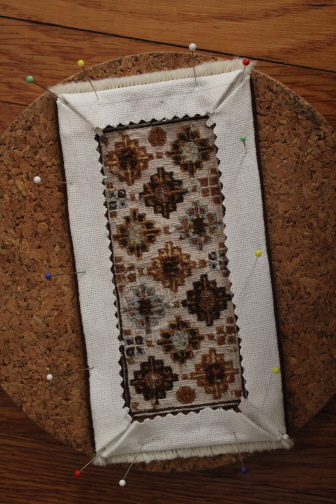
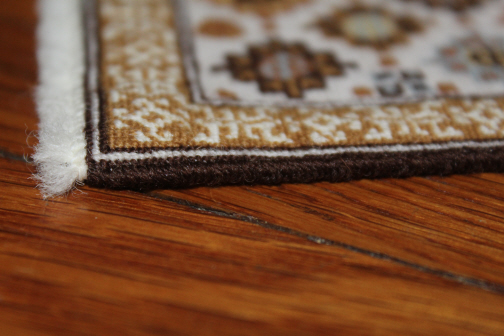
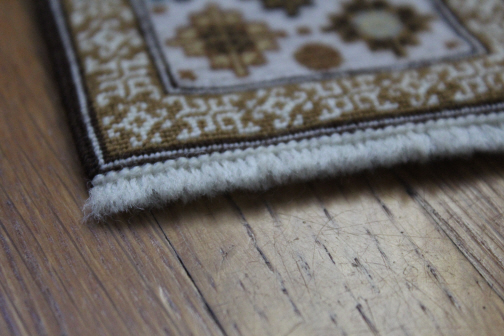
    I edged my carpet using Janet Granger's overcast edging technique, but I mitered the corners instead of just folding them squarely as she does.  I also tried something different with this carpet — I'd heard somewhere that you can leave the third row of stitching for last, then stitch it together with the hem of canvas, thereby catching down the hem quite neatly.  (I did the fourth row, actually, since the third row was white, and you are supposed to work the lighter colors before the darker ones, to prevent stray fibers muddying the colors.)  I found it pretty tedious, but then I was determined to match up the two sets of holes one-by-one as I went, and so I had to flip the piece over for every single stitch.  I don't find that the finished hem is that much better than simply tacking down a turned one, so I don't think I'll do it again very often.  It would be excellent if you are not using an edging stitch, though, because it does make a very tidy and firm hem in itself. 

    I did try pinking the raw edges of the canvas this time, to help avoid that cut edge showing from the front — this is on the same principle as grading a seam in sewing.

    Wm morris 6

    My overcast edging wasn't terribly successful, as it happened, which rather shook me since it's Janet Granger, after all!  But I suspect now that this stitch would work better in wool, which is what Granger generally uses, whereas the long-legged cross-stitch may be better for floss.  By the way, at one skein of each required color, there was just not enough of the two reds (which are blended in the needle) to work an edging stitch, so stitcher beware.

  • Mishmash

    New-book-flow-chart

    Well — I totally get that.

    So I was tidying up my pictures folder on my computer, and saw all this stuff that I've been saving, and it's really a bunch of odds and ends, but here it is.

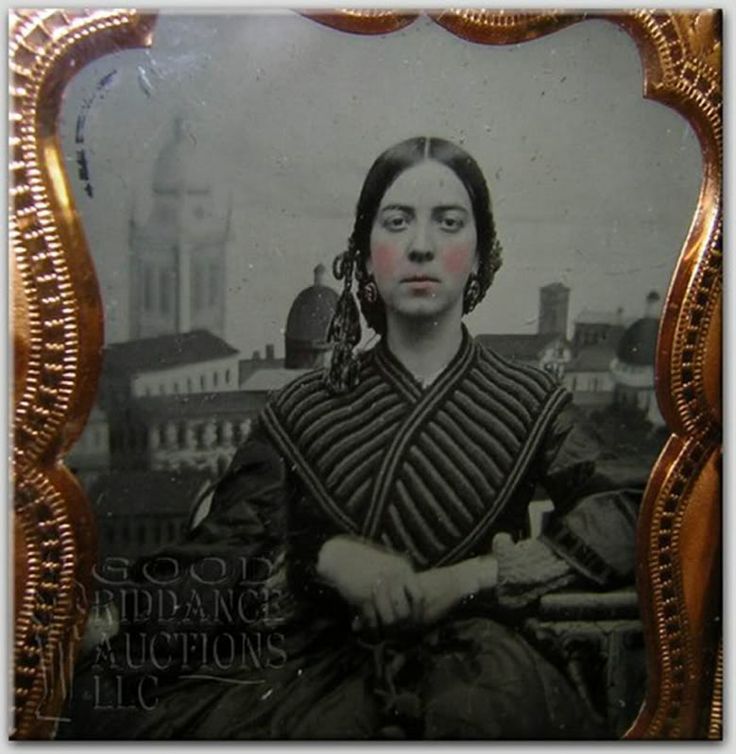
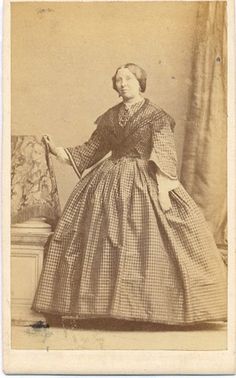
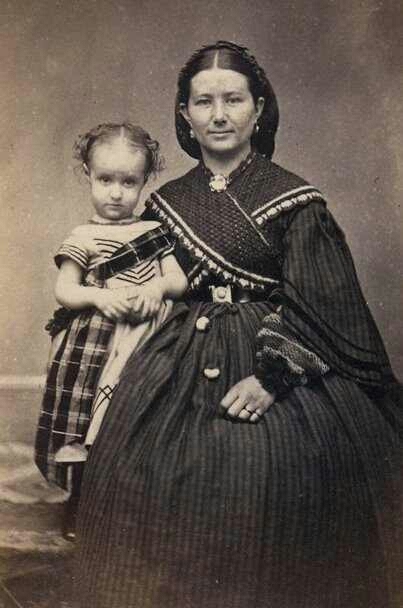
    My new Daguerrotype Boyfriend

    0_cartes_de_visite_dickson_john_man_chair_top_hat

    Okay, two —

    NP012403

    who happens to be Fritjof Nansen, actually….

    Speaking of polar explorers, here's a blog button, just for fun —

    Polar geek button

    Persuasion 1995 1

    One of my favorite scenes in one of my favorite films, the 1995 "Persuasion" with Amanda Root and Ciaran Hinds.  This scene is just after Fredrick has written that heart-stoppingly romantic letter, and Anne's brother-in-law asks him "Which way are you going?" and he replies, looking at Anne, "I hardly know."  Oh!  Plus I crave a spencer like hers.

    Just because we're all so used to seeing her as quite old in her dust-jacket photo, here is Edith Pargeter, also known as Ellis Peters of the "Cadfael" books, young and with a drolly quizzical smile —

    SA-IMG46884 edith pargeter

    Why I love the British (I):

    Tea

    Why I love the British (II):


    Well, I don't think I'm going to get my last two projects done for my self-imposed WIPapalooza — I admit I got distracted by FutureLearn courses, then David said he needed something to keep his hands warm on his Shanghai trip, and could I make fingerless gloves instead of just mitts? and then there was this pretty little thing,

    1900

    which is a miniature William Morris carpet in cross-stitch.  I can probably finish the Norwegian mittens this winter, but the scarf is still a really long-term, a-few-more-rows-a-week kind of project.  Such is life.

  • Happy Violin Day!

  • Catherine zeta jones

    I noticed the other day that I have quite a stash of "famous knitter" photos, so here they all are in that wonderful odd-coupling you sometimes get with an otherwise random bunch of people connected only by one thing.  First is Catherine Zeta-Jones, with some super chunky needles.

    Barbara Bel Geddes knitting on set of Five Branded Women 1959

    Barbara Bel Geddes, on the set of "Five Branded Women" in 1959.

    Carole lombard

    Carole Lombard.

    Gina-Lollobrigida-is-knitting

    Gina Lollobrigida.  I can't decide if the grimace is because of her knitting or from trying to balance that thing on her head.

    Grace_Coolidge_knitting

    Grace Coolidge.

    Ingrid bergman

    Ingrid-Bergman-knitting-on-the-beach

    Ingrid Bergman, twice.

    Kirsten flagstad museum

    Corbis-HU058876 kirsten flagstad knits in dressing room 1936

    Kirsten Flagstad again, in her dressing room, 1936.  (Why are the two Scandinavians here twice?  I don't know!)

    Linda ronstadt knitting

    Linda Ronstadt.

    Queen-Victoria-crochet-1890

    Queen Victoria, crocheting.

    Sarah-Jessica-Parker-knitting-2

    Sarah Jessica Parker.

    Grace-Kelly-knitting

    Grace Kelly.

    Sophia-Loren

    Sophia Loren — the only actress here not knitting on set.  (Wonder if she knitted those tights?!)

  • Picture3

    I finished the last random-stripe place-mat yesterday!  I've been working on these for at least two years — put them aside when it was pretty clear that I would run out of some of the colors much sooner than others, and I got a little discouraged.  It seemed silly, though, not to carry on and finish, especially when I had only four mats, and I wanted at least five, and six would be better, when I certainly had enough wool by weight.

    These are Araucania Nature Wool, in blue, lilac, red, and green, worked in garter stitch on US7 needles, then fulled in the washing machine.  They shrank rather more than I had anticipated, so they look a bit stingy even under the smaller plates that we use for regular meals, but they are wonderfully thick, and the colors are so beautiful that I must accept that — and I do have six, there is that!

    These were about 21 x 16 inches (136g) before fulling, and about 14 x 9 inches afterwards — a whopping 35% loss in height!

    1885

    1893

    I ran out of blue wool first, long before any of the other colors looked dangerously low, so I ripped out the mittens I made for Julia many moons ago, which she wore once or twice then left in the corner of her closet floor until they were ratty and moth-eaten.  (Long-ago-grown-out-of, anyway — I'm using Laura's as pockets for my reading glasses.)  But the extra wool got me quite a few more blue stripes — you can see how wretched the wool looks in the "before" photos of the mats, but after fulling they're quite indistinguishable from the others.

    1440

    It's really a shame that the Nature Wool is discontinued — it's really gorgeous stuff, a pleasure to knit with, and the colors are just sumptuous, the red and green especially.

    1886

    1894

    As it turned out, I ended up with at least two skeins of green left after the last mat, so I thought I'd whip up a pair of Fuzzyfeet for what I hope will be winter this year.  I made a pair years ago that ended up too small, so I thought I'd err on the side of generosity, and estimated a stitch count based on the shrinkage of the place-mats.

    1884

    Another reason to make them über-gigantic is that my Easy House Slippers, which I wore for a couple of years, kept shrinking with every wash, and eventually my big toe poked a hole at the end of each sock.

    1888

    These are worked on US7 needles with one US8 because the set was only four needles, so the gauge is rather smaller than you usually do for fulling, but I already had a reference point from the mats, which after a couple of washes are tight and thick.  David and Julia both mocked me for making them so big, but I erred on the side of caution, in fact.  They are just comfy now, so I will have to wash them by hand, I guess.

    (I'm using "Henry V" for scale as I am doing the FutureLearn "Shakespeare and His World" online course again, and it's this week's play …)

  • Jay2

    This is of course the famous Jaywalker socks pattern from Grumperina, the next on my WIPapalooza 2015 list.  Some time ago, I offered a pair of knitted socks as a Christmas present for my cousin — who, though not a knitter herself, is in fact the one who started me reading knitting blogs, way back when — and her only requests were for knee socks and that they be pink (her emphasis).

    1426

    I did get the pink part, in Shepherd Socks' "Pink Blossom", wh. is vivid indeed.  The knee socks part rather defeated me, I'm afraid, as I have found, even in my one or two adventures in knitting knee socks, that unless you're willing to wear garters, knee socks really have to be custom-made-snug.  M. has very shapely calves, and lives far enough away that we don't see each other regularly, both of which made it difficult to get the sock shaping right, and I felt so bad about the years intervening between promise and product that I eventually capitulated on the knee sock part.

    I'm afraid, too, that this isn't quite my finest hour, sock-wise, as it's been so hot this whole summer that my heart just hasn't been in knitting at all, and it seems to me to show a bit in these — that funny little valley you get along the bottom of the foot if you don't tug the yarn a bit between needles in the round, a slackness at the heel flap/gusset join which I managed to disguise by winkling the extra wool a stitch at a time into the instep, a general air of ennui.

    But they are Jaywalkers after all, and I am not the only one by any means to be charmed by their zigzaggy joie de vivre.  I've not made any before in a solid color, so this was quite fun.

    1424

    So now I still have the unfinished felted random-stripe place mats, the red and white Selbu mittens, and the Setesdal scarf.  Shall I ignore the pretty-but-workhorse mittens I found in a drawer last month?

    1423

    This is Brown Sheep's Lamb's Pride in fuchsia and Handpaint in English Garden, which play quite nicely together.  Well, the wool is kind of scratchy, and the thumbs really are too tight — so, out they go!

    David took this photo of the eclipse Sunday night —

    1417

    a triple event combining a full moon, a supermoon, when the moon's elliptical orbit makes it seem bigger in the sky than usual, and a lunar eclipse, which because the sun's rays have to pass through the Earth's atmosphere, makes the moon look reddish-orange.  Apparently this combination has happened only five times since 1900.  We could add some more rarities, actually — that it was at a civilized hour (just past supper), and that the night was unusually clear for us here in smog-land!

  • 0983

    It's hot again today, in the 90s (30s C) with far more humidity than we really like — we want our California summers nice and dry, you know.  Not a good day for knitting, anyway.  I tried a few rounds of this Jaywalker, and not just the yarn but the needles were sticking to my hands.  It's a nasty irony that there is so much moisture in the air and yet we're in a drought with no end in sight.  ("The only way in which we know that summer is coming is by the more chilling winds, the increased dust, the tawny color of the hills, and the general dying look of things," wrote Caroline C. Leighton in June 1876. Heck yeah.)

    Strangely enough, it isn't too hot to do needlepoint.  I'm not sure why this is, but I suppose it's that the needle and wool don't need to slide through one's fingers.

    0981

    This is another miniature carpet from the McNaughtons' book — the Khotan No. 25.  I've changed the background color from the lightest gold shade in the medallions to the putty-ish white left over from the Holbein carpet.  The pale gold was quite all right, but this really speaks to me.

    91DvqHsyK7L

    Am also reading The Shepherd's Life by James Rebanks.  I'm torn, actually — sometimes he writes whole paragraphs in sentence fragments, which are generally like fingernails on a chalkboard to me, but sometimes he's quite lyrical, and sometimes I feel, with his viewpoint, that the world would be a better place if more people were able to simply do what they love, regardless of whether others think they are "wasting their lives," and that tourists are a nuisance (or worse), and from my own viewpoint that those who are blessed enough to live in the Lake District, to have lived there for centuries, regard people like me as a nuisance (or worse).  A conundrum, to be sure.

  • 0962

    I haven't been knitting much, I confess, but that is because I've been so charmed by this little beauty, from the wonderful Making Miniature Oriental Rugs & Carpets by Meik and Ian McNaughton.  The style of carpet, which dates from the 15th century, is named after Holbein not because he had anything to do with them particularly, but apparently just because they feature quite a lot in his portraits, such as this one —

    Holbein,_Hans_-_Georg_Gisze,_a_German_merchant_in_London

    which is "Georg Giese" of 1532.

    I decided not to fringe my own carpet once I'd seen this 15th-century original, at the MFA website

    SC283207

    which if it isn't the inspiration for the McNaughtons' version, then certainly must be a typical example of the small-patterned type.

    0967

    I tried the edging stitch that the McNaughtons use, but wasn't very happy with the result, so I worked the long-legged cross-stitch I've used on previous miniature carpets — but since I know already that in my room setting-to-be, the carpet will be laid over a table, which is how they were used in the Tudor and Elizabethan periods, it needed to be not only as flexible as possible, but to have no canvas showing at the back.  The McNaughtons' plaited edging is worked on the cut edge of the canvas, thus has no extra layer of folded hem, so would have been ideal if I had managed to figure out how to work it, but alas, in lieu of that I had to deal with the hem left by the long-legged cross-stitch, which I did by whipping over and thus covering the narrow but turned-under hem.  This was, I thought, only partly successful, but much of that I suspect is due to my having to fake it, instead of getting the original plaited edging to work perfectly the first time.  Other than that, I'm actually quite pleased with the back, which for a first effort in wool looks nicely tidy to my eye!

    0965

    (You can see that I was working the red background in the center any-old-way for a while — on the right here — then settled into a rhythm, and things got tidier!)

    This carpet is worked in Appleton's crewel wool on 28-count Monaco canvas, which is a bit finer than the 26-count canvas in the original instructions.  It is fairly flexible, as needlepoint on canvas goes, but it will need a bit of help to drape realistically over a table, I suspect.

    0969

    I did not have enough blue wool by quite a ways, and barely enough red, so for future reference, two skeins would be safer of each color than one, especially if working it in the original scale; one skein was plenty of the other three colors.  I used about half of a second blue skein, in fact.  But I'm really pleased with the results — it's a handsome, well-balanced design in soberly harmonious colors.

    There is an interesting article here about the Giese portrait and Holbein and Oriental carpets, filled with interesting tidbits about their history, about which I knew next-to-nothing before this!

    0964

  • 0425

    We decided this year to take another summer road trip, this time a shortish one up to Northern California along Pacific Coast Highway, the main destinations being Hearst Castle and the Monterey Bay Aquarium.

    We left not too early on Sunday morning, and stopped in Solvang for lunch, having a very good meal at the Solvang Restaurant on Copenhagen Dr. (where else?!), including the obligatory and delicious æbleskiver.  After lunch we impulsively rented a four-person bicycle surrey, and rode around town to find ourselves at the Elverhøj museum on the edge of town, which was small but very charming — the textiles were a bonus!

    0432

    0439

    The red sleeves, by the way, are a hand-knitted nattrøje, the bodice that forms part of the traditional Danish folk costume.  This one appears to have a fabric waistcoat over it, or possibly the knitted sleeves are sewn to the fabric bodice, as was sometimes the case.

    0451

    On the drive up to San Simeon, we stopped in Morro Bay, really just to visit the Shell Shop, which David thought that Julia would enjoy.  She was in sea-shell heaven, actually — it is truly amazing, all of the shells they have, some in displays like this one, but most just in orderly bins so that you can pick and choose, and a real bargain, too.

    On Monday morning, we went to Hearst Castle.  Even if you know all about it and have seen the photos, or what you think of Hearst himself, it's still jaw-droppingly splendiferous.  It was a beautiful day, warm and breezy but not too much of either — we did two of the three available tours that day, the Grand Rooms and the Upstairs Suites, partly because to be honest it's a bit pricy but also because it's just a lot to take in, all of that sumptuousness.

    0520

    0540

    Ceremonial flags in the Refectory.

    0550

    Ketchup and mustard bottles and paper napkins amidst the centuries-old furnishings and china.  Apparently I am not the only one amused by this irony of the "common touch" amidst the opulence.

    0587

    A still life in a corner of one of the dozens of guest rooms.  Each room that is visible on the tour has a dressing case or clothes laid out, as though a house party was going on.

    0625

    0652

    One of the three "guest houses" surrounding the main house — these have at least four bedrooms each.

    On the way up PCH, we stopped to see the elephant seal rookery.  The males come ashore at this time of year to molt, and just lie there on the beach like a bunch of boneless chicken breasts, occasionally rearing up to make a strange grating bark.

    0669

    0715

    The coastline is lovely, and we stopped a number of times just to take photos, even though the air was a bit grubby.

    0722

    On Tuesday, we went to the Monterey Bay Aquarium.  It was very crowded, but the jellyfish exhibit was strange and lovely.

    0746

    0751

    Someone had brilliantly arranged the tanks so that the light coming through the water, and the color of the backgrounds, made the jellies beautifully surreal.

    0788

    This was a brilliant touch, a crowd of ceiling lamps covered with fiber optic cable, so that you felt as though you were swimming with the jellyfish, or perhaps were one yourself.

    0827

    After the aquarium, we were, surprisingly, not too tired for another bicycle surrey ride, and went along the waterfront to Lovers Point, to admire the views.

    0853

    On Wednesday, we stopped at Point Pinos to look around in the tide-pools and admire the lighthouse, though only from a distance, as it wasn't open that day.  This is the oldest operating lighthouse on the west coast.

    0837

    And then home!  It was a good trip, not too long, with a pleasing variety of sights along the way, and it was good to see some more of our beautiful state!

  • ,

    Covington Bag

    0059

    For our road trip this summer, we decided to go and see Hearst Castle, and from there up to Monterey to visit the Aquarium.  I'm usually much more comfortable while museum-going with a cross-body bag, instead of my usual short-handled shoulder purse — not only for toting around the camera and guide-book, but also for hands-free walking.  So I decided to sew one.  I had two choices, the Covington Bag pattern by Amy Butler, which I've had in my drawer for years — so long that it is now out-of-print — or the much simpler shoulder bag from Melissa Wastney of Tiny Happy.  I've made the Tiny Happy bag before, for some Girl Scout outings (to carry water and snacks on nature hikes!) and it's a fine bag and tutorial, but I wanted something with a bit more structure this time, and so I decided to go with the Covington.

    You can cinch it up closely, as in the top photo, or leave it open, as below, which gives it a little more tailored look, though obviously a little less security.  The opening isn't huge, so you could also just cinch it a little, and still be fairly safe.

    0046

    0047

    The pattern is a fairly straightforward one, though it does get a bit fiddly in places.

    0048

    I decided rather on the spur of the moment not to buy anything to make the bag, so this cost me nothing at all — not even the pattern, since if it's been in your stash for more than five years, it doesn't count, right?  (I bought the pattern around 2006, at the much-lamented Tall Mouse in Yorba Linda, which never survived the move to a much-smaller location in I think 2011, and closed for good a year or two later.)  I used a Moda remnant for the outer fabric, some medium-weight bleached muslin (left over from my curtain adventure a few years ago) and two pairs of worn-out Dockers of David's that I'd been saving for just this sort of thing.  (I'd been thinking Elizabethan stays, but this works too.)  If I had remembered in time that I wanted to lengthen the straps, I might have been able to get all of the "canvas" interfacing from one pair of Dockers, so it was actually a pair and a half.  I didn't have any Timtex for the bottom of the bag, as called for in the pattern, so I used rather a lot of Pellon fusible interfacing, and two pieces of the twill instead.  My bag probably doesn't hold its shape as much as the original, but I'm very pleased with being frugal instead.

    0053

    The straps are now the full 44" width of my fabric, so that the bag when worn across is just about at my waist — it's a little high, but such is life.  I didn't want to piece the outer fabric — I did have to piece the twill, which I did just by laying one end over the other, and sewing it down with zig-zag stitch, so as not to add bulk. 

    0057

    The only other change I made was on the lining, since unlike the outer bag it doesn't have side pieces, so is just two isosceles trapezoids sewn together.  This resulted in a strange little pyramid pooch of fabric once I'd turned the lining to the inside — so I pulled it back out and sewed across the corners.  It's not quite the same size as the outer bag now, but I think it's a worthwhile trade-off, not just not having a pooch of fabric there, but also not having the annoyance of losing coins or other small things down in a narrow corner of your bag!

    0052

    The sides have a little pleat at the middle of the top, which gives just a little more room at the bottom, and add a subtle bit of glamour, I think. 

    The bag is a little smaller than I'd pictured it in my mind, but I think it would be a fairly simple matter to enlarge it when making it again.  I didn't want a big bag, anyway — "Mom, will you carry my [insert here anything the girls don't want to carry themselves]".  I would probably also put a pocket or two on the lining.

    These photos, by the way, are taken with my shiny new Canon EOS Rebel T5, which I think is doing a bang-up job so far!

    0058