• 3883

    3895

    3896

    I suppose that someone has already done a time-lapse series of a needlepoint piece being worked — anyway, I obviously didn't take a daily photo, but it amused me to imagine the piece just sort of filling itself in, as though it were being worked in the middle of the night by elves or something.

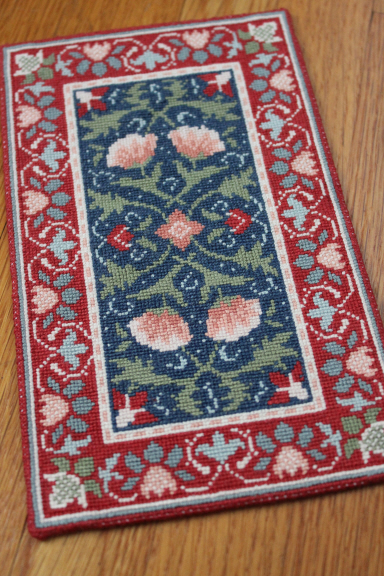
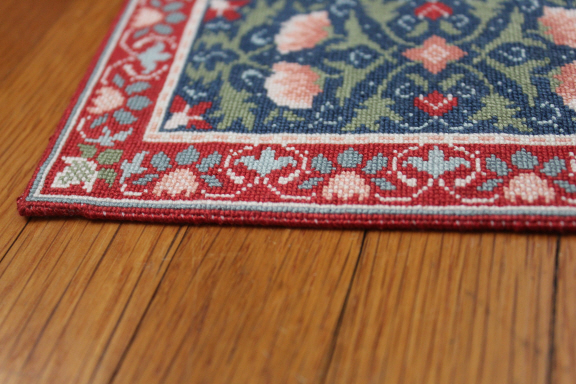
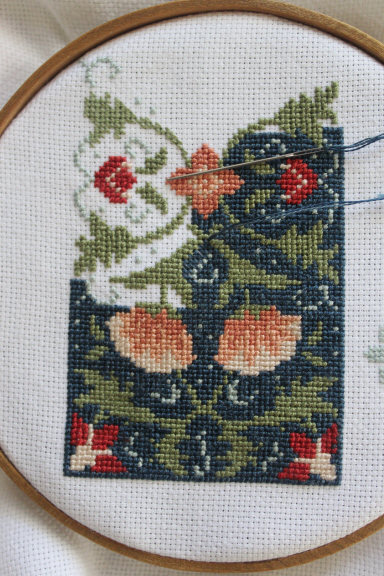
    I picked up my "Small-patterned Holbein" carpet after some months of neglect (plus somehow losing the ball of red wool and having to wait for a replacement), and took it with me to a Fourth of July do at a friend's house, and worked on it while keeping an eye on the kids in the pool.  The top photo is the results of that day, which was a pleasing improvement on where it had been since I'd picked it up last, but then I got into the rhythm of it and didn't have to keep looking at the chart, and got quite far.  I've just now finished the first "border" around the center section — that solid line in a sort of brownish-purple.  There are two patterned borders to come.

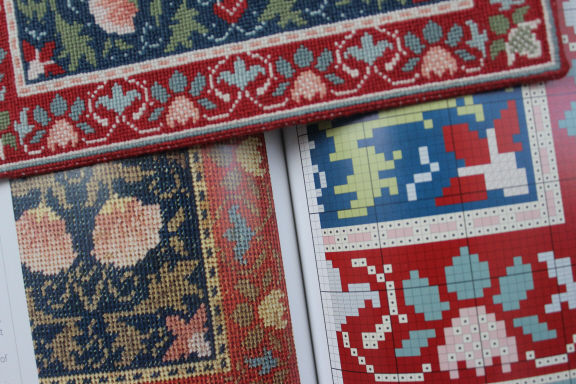
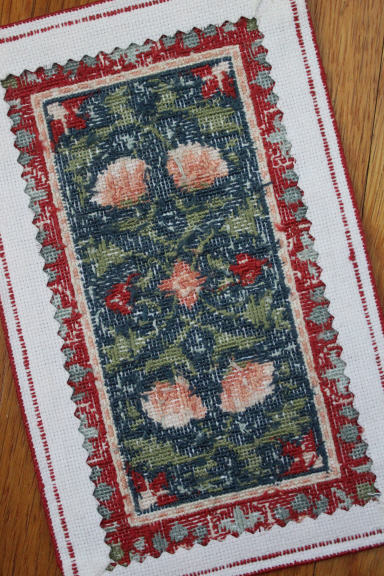
    The canvas is just a little too small for this wool, as I have to tug rather firmly sometimes to pull it through, and my stitches do not lie as smoothly as I'd like, though that may just be me.  I hope that a good blocking will take care of at least some of that — I'm afraid the canvas is stretching dreadfully.  On the other hand, much as I'd like to, I can't take all of the responsibility for uneven coverage, when Appleton's provides this:

    3893

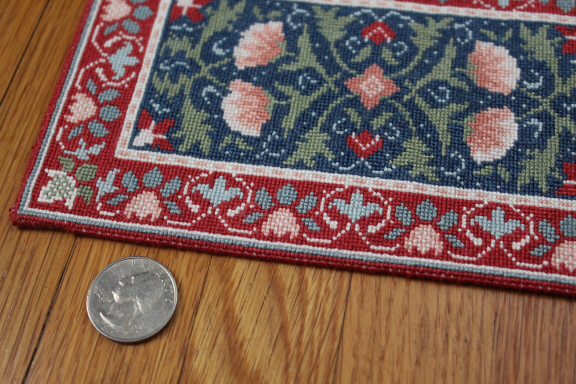
    Oh well.  The colors are a bit deeper in real life — it is already quite lovely, and will make a somberly beautiful little carpet.

  • Picture2

    A few episodes — well, quite a few — of "Poirot" and I have a Muriwai Bath Mat, a pattern by Mel Clark, in her book (with Tracey Ullmann) Knit 2 Together.  I started this around the middle of 2008, I'm sorry to say — my advice to anyone who wants to knit it is to have lots of circular needles on hand!

    This is my usual Sugar 'n Cream dishcloth cotton from Michael's, here in Icing Sugar (white) and Strawberry (pinks and white), knitted together.  I had one of the mega-balls (400g/14 oz) in white, of which I had a good deal left, and numerous regular (2 oz) balls of the pinks, so I calculate this as most of 6 balls of the latter — the whole thing weighs 630g.

    3860

    It's an easy pattern, but a bit tedious, and obviously I had a bit of a problem with this, as one of the corners is quite wonky — an attention error, I suspect.  Since I didn't have the same gauge as in the pattern, I worked the center section roughly as indicated, then just kept knitting until I thought it was about the right size (with a little extra to allow for shrinkage, wh. I'm sure it will do), so the center section on mine is a little "smaller" scale-wise than the original — oh well.

    It seemed more and more obvious as I went that this pattern would scale down to dolls-house size very easily, and indeed it did! —

    3861

    The Mini-Muriwai is in crochet thread from Michael's — Aunt Lydia's, I suppose, but I don't know which blue, though it is very pretty.  I worked this mat on US000 needles (1.5mm) in a couple of hours, just dividing the full-sized dimensions by 12, and estimating the gauge.  The increases are, curiously, a little awkward on the miniature version as well — I thought I was doing the increases the same on either side of the corner sts, but I guess that one being enclosed, as it were, by the corner st on the right needle, and the other exposed at the beginning of the left needle, made a difference somehow, either in how I laid them on the needle or how I worked them on the next round.  Oh well!

    I was aiming for about 2 1/3 x 3 in., and got 2 3/4 x 3 1/4, so a little off, but not too bad.

    3866

    The picot edging is worked here by binding off 5 sts in every repeat, instead of 6 as on the full-sized mat, which reduction I thought would be better for scale, though I suppose looking at the final mat, it wouldn't really matter one way or the other.

    3857

  • 3848

    Quite a lot of our dishcloths are looking a bit ratty, so I got out a bunch of the little odds and ends of kitchen cotton left over from other cloths, and whipped up some new ones.  The two on the right are just Grandmother's Favorite, while the one on the left is a Quaker Ridging cloth.

    3851

    I also got out the Muriwai Bath Mat to have a go at that, for my next WIPapalooza project — the receipt is dated "4/30/08" so that tells you how long it's been.  I couldn't tell at all how big it actually is, since it's been scrunched up on a single circular needle for five+ years, so I ran a piece of plastic trimmer string — straight off the spool — through the live stitches, so that I could actually spread it out and see how much more I need to do.  (It was much easier getting it back on the needle from the trimmer string than it would have been from a strand of yarn!)  I figure the mat will shrink more than a bit with washing, so say ten more rounds, and it will be done.  Of course, ten rounds is a lot by now ….

  • Summer Jammies

    3762

    With the completion of yet-another-long-unfinished-project in the Blueberry Waffle socks, I allowed myself a little flirt with the sewing machine, and made a pair of summer pyjamas for Julia, who is still wearing fleece and flannel in June because that is all she has that still fits.  (Five-four and growing! at just a few months over thirteen!)  I've had this piece of bright batik in my stash for quite a while — about a yard and a third — with the intention of actually making pyjamas for one or the other of the girls, so it's good to have that feeling of accomplishment as well!

    This is actually two different patterns, and both free.  The bottoms are Simplicity's Easy PJ Pants 0501, available in a wide range of unisex sizes.  Since I wanted to make a top as well, and it's summer, I made them into shorts.  These pants are even simpler than the original, since I omitted the drawstring ties at the waist.

    The top is Colette's Sorbetto tank top pattern.  This pattern seems to be quite popular on the web, partly I'm sure because it comes in sizes 0-18! quite a range.  I omitted the front pleat simply by laying the pattern piece with the pleat stitching line on the fold of the fabric.  I was a bit surprised that the cutting layout has you put each piece on the center fold of the fabric, thereby leaving great swathes of fabric unused at the selvedge edges, and so I arranged my piece of fabric with two folds, with the selvedges meeting in the middle and a fold each to the near and far edges (like a stapled staple, as it were), and got the two pattern pieces cut from 2/3 yard of fabric, instead of the 1 1/2 yards given on the pattern (!), and I still had plenty left over for the bias edging.  I suppose that with the larger sizes you wouldn't be able to do this, but certainly for the smaller ones you can — this one is a size 0.

    And I only made one stupid mistake! which was cutting the bias edging less the seam allowance instead of more, at the last prospective join, so that I had to add a measly inch or so of fabric to get it long enough.  Only one stupid mistake is pretty good for me, so I'm quite pleased with myself, all things considered!

    3760

  • 1 small

    Another one done!  These are the Blueberry Waffle socks by Sandy Turner, for my mother-in-law, who chose this yummy color of Shepherd Sock, which is "Purple Club".  I decided on this pattern for a number of reasons — that it was said to be nice and stretchy, and that it is a good pattern for avoiding the dreaded pooling-and-flashing, and because, well, how could I not when the colors actually look like smooshed blueberries and cream?!

    3693

    3757

    I used the eye-of-partridge heel flap instead of the usual Sl1, K1 — it seemed more in keeping with the waffle pattern somehow.

    As I was knitting blithely along on the second sock, I looked down at the finished heel turning and realized that because I was actually reading the instructions, I'd done a sort of band heel.  Since I'd turned the first heel months ago, I'd forgotten that I'd done a round heel on the first one.  I will offer as an excuse that I was not following the pattern especially closely since Turner had written it for 4 dpns, including specific instructions as to how many sts per needle, etc. and I was knitting with 5.  It's too bad that I wasn't paying attention the first time around, as I appreciate the use of different heels, and of course it's good to have various types in one's bag of knitting tricks.

    That said, this particular sock can be adapted to any kind of heel and toe the knitter likes, using the basic "waffle" pattern, which is simply,

    Rounds 1 and 2: K to end.
    Rounds 3 and 4: K2, P2 to end,

    over a total number of stitches divisible by 4.

    The stitch pattern doesn't really avoid pooling and flashing so much as disguise it, as you can still see the effects, but they are certainly muted a bit.

    3755

    In addition to the inherent stretchiness, I added a little calf shaping, which wasn't especially difficult to do with this pattern, thank goodness, as I foolishly didn't keep track of what I did on the first sock, and had to re-create it for the second — which on the second attempt proved to be much less complicated than I was making it!

    The moral of the project is, of course, it's just not a good idea to leave things half-finished for years!

    3756

  • Dsc06122 (2)

    (Welsh Quilts)

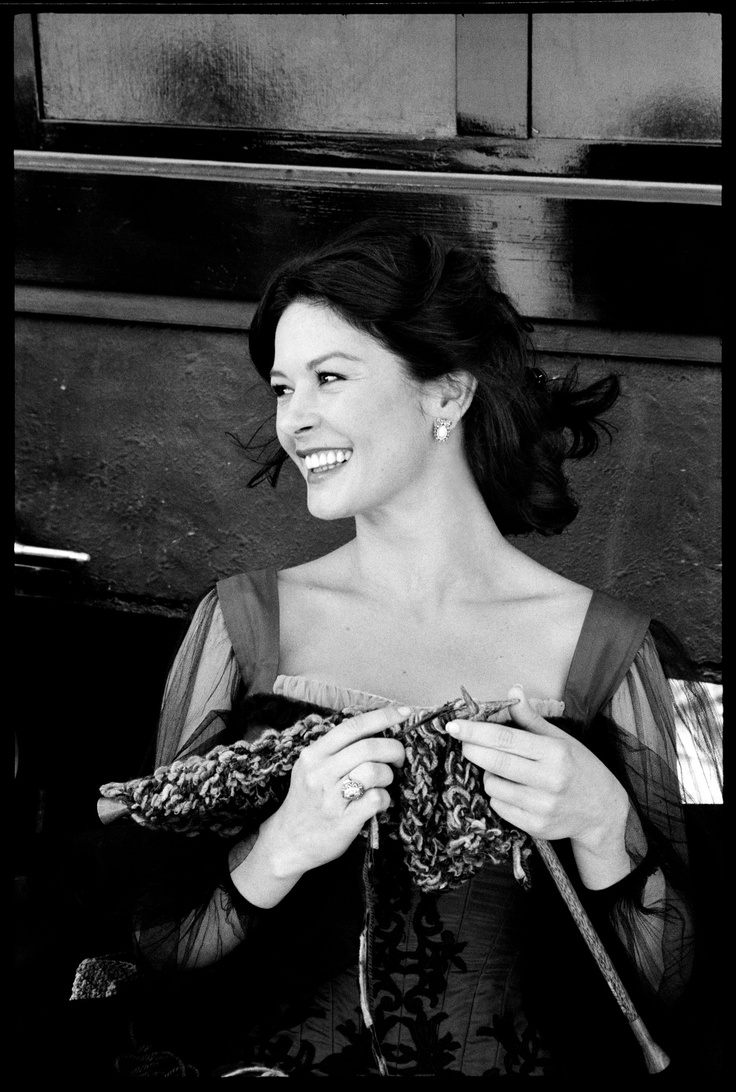
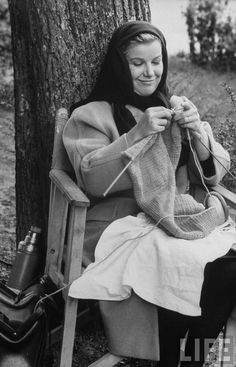
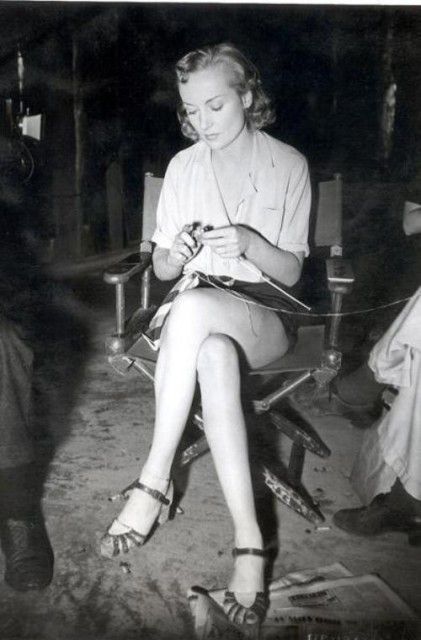
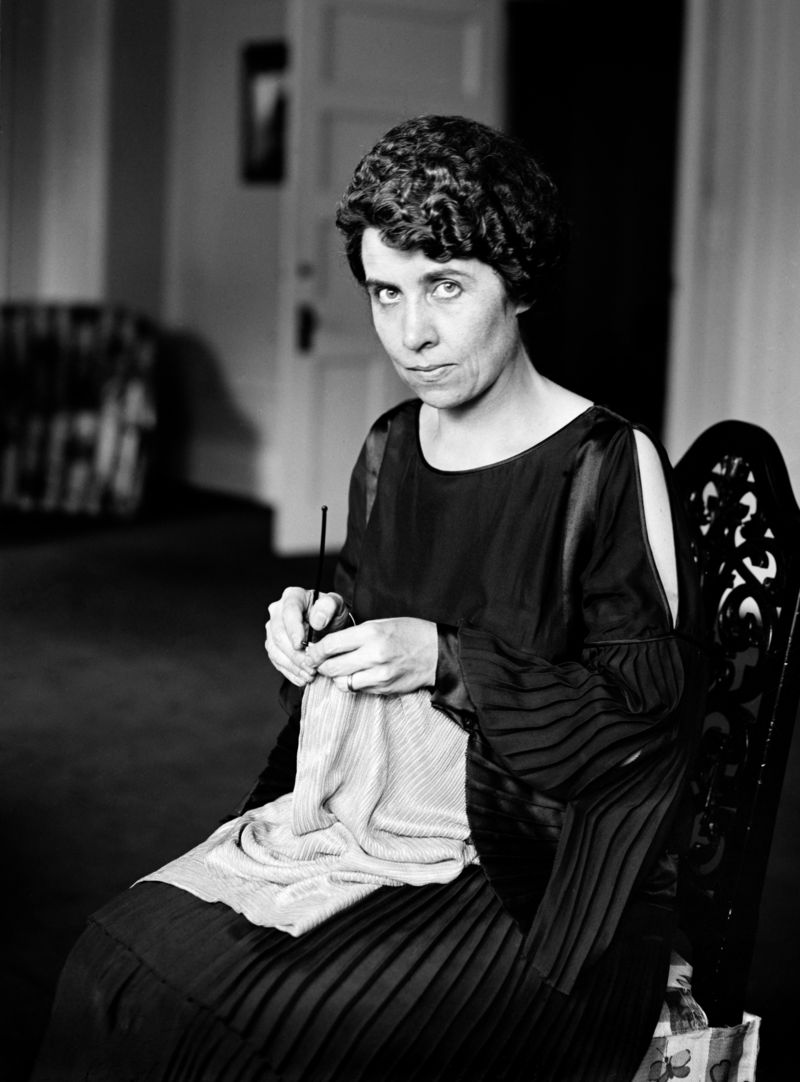
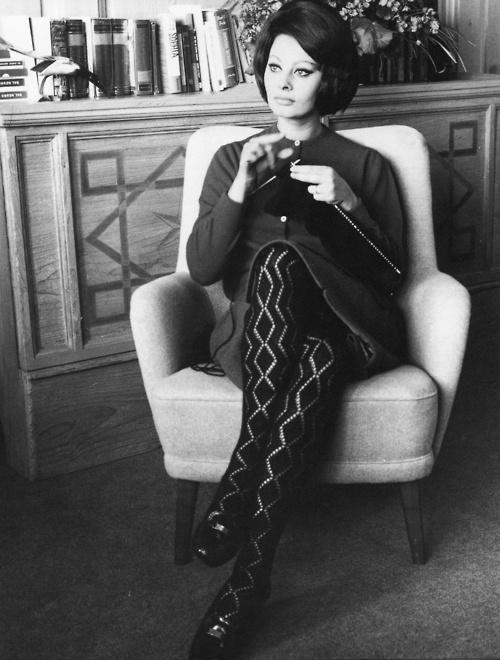
    Photographs of Welsh women in national dress were wildly popular in the late 19th century, partly as tourist souvenirs, and partly I think as a record of rapidly-disappearing country life.  One of the three most common occupations for the subject — the other two being going to market and having tea — was knitting.  I happened across one of these images this morning as I was searching for my ancestors in Breconshire, and quickly found myself utterly absorbed in the genre.

    43641_2

    "Mrs Edwards knitting in Welsh national dress, c. 1875" (Gathering the Jewels/Casglu'r Tlysau).  Mrs. Edwards, bless her, appears to have cataracts.

    Tumblr_llgnacidWJ1qzt5uoo1_400

    (feitoamao)

    It was not unusual for Welsh countrywomen to have bare forearms, so as not to get their sleeves dirty as they went about their daily work.  They would then wear separate half-sleeves for Sunday and best.

    Woman

    Photographed by John Thomas. (WalesOnline)  This woman, and some others I've seen, has attached the ball of yarn to her apron with a spare needle.  I can't quite tell if she has ringlets or if her goffered bonnet is dyed black for mourning.

    Tumblr_lp5v9nuXGJ1qlts9lo1_500

    (Victoria's Rusty Knickers [sic])  The source identifies this as a "Welsh Lady knitting a Scarf," but I think it's more likely a sock.  Curiously, I've seen a number of sources say that Welsh countrywomen knitted "socks and scarves" for sale, but all of the images I've seen are pretty obviously socks or stockings.
     
    Welsh knitter #2

     
    These last three photographs also appear in a Flickr group entitled "Welsh Fashions" consisting almost entirely of late 19th-century photographs of Welsh women, a very great many of whom are knitting. Notice how many of them are wearing exactly the same betgwn, petticoat, and apron?!  Yes, apparently the clothes were provided by the photographer.  There is some debate about how widespread, even how "traditional" the so-called traditional Welsh dress really was, though most people now seem to agree that it was usually worn for Sundays and best, not everyday.

    There was a resurgence of interest all over Europe, it seems, in the 19th century, in national dress, and in some places (Norway, for one) the lack of local interest in it — because the country women would rather wear more fashionable clothing like their city cousins' — led to varying degrees of outright invention.  That said, some of the photographs here don't look staged, and even though I know it is at least in part, I really love this one —

    43420_2
     
    "A woman knitting in Welsh national dress, c. 1875," photographed by John Thomas (Gathering the Jewels/Casglu'r Tlysau).
  • 3650

    Since finishing the yoga socks, I've been plugging away at the Blueberry Waffles and am now a ways into the foot on the first sock, but paused a few hours to whip out a house-warming gift, a set of bright dishcloths.

    3661

    The pattern is the Reversible Pips Dishcloth by Hannah Maier, available free from KnitPicks, part of their "52 Weeks of Dishcloth Patterns" series. I found this new (to me?) color of Sugar 'n Cream at Michael's the other day — "Psychedelic"!  You can always use a bit of cheerfulness when washing dishes.  Two balls of the yarn made three full-sized cloths quite easily, with a small ball left over.

    The pattern works up very quickly — the only quibble I have is that the finished cloth doesn't lie quite flat.  I actually had to block it for the photos.  I liked the designer's note that the pips give the cloth "plenty of scrubbing power" — the psychedelic part was a bonus.

    3660

    I washed them thoroughly before sending them off, since the yarn did this to my needles and fingers! — the first time I've ever experienced this with Sugar 'n Cream.

    3670

  • Picture5

    I finished these yoga socks at the beginning of the month, but to tell you the truth, I'm so tired of them that I couldn't be bothered posting about them until now.  I played around with the "toy camera" setting when I was taking the picture, just to make it a little less boring.

    One skein of Berocco Comfort Sock, in color 1810 "Invercargill", on I think 2.5 mm needles.  I can't remember which pattern I used — probably this one, just with a continuous 3×1 rib.

    3644

    3499

    On the bright side, the yarn in 3×1 rib is very stretchy, so I could make knee socks without any shaping at all.

    I actually meant these as more of a sock dickey than for yoga — because I'd heard that acrylic yarns make your feet sweatier than cotton or wool does, I thought, "oh, yoga socks over cotton ones!".  This is I think a good idea, but these have rather large heel openings, which means that the white sock underneath shows above the top of my shoes — if I do this again, I'll make the opening a little smaller.

    3648

    Sorry for the crummy lighting, indoors and out — it's actually raining at the moment!  "Ten percent chance," the weather man said!  In the middle of a drought!  It looks like it won't do much more than get the pavement damp, but gosh, you take what you can get!

    3640

    And just because I'm pleased with these, here are some gratuitous roses shots, an oldish one and a new one —

    3463

    3464

    These are "Duchesse de Brabant" — in January! — and the one below is "Sharifa Asma".

    3517

  • 13768022134_6c6080922e_b

    I found out only yesterday that there is a new movie of Vera Brittain's Testament of Youth, her memoir of her experiences as a VAD in the Great War, and the devastating repercussions of that war on women's lives.  I was one of those who was deeply moved by the 1979 television serial with Cheryl Campbell as Brittain, so that I was interested to learn more about the new film. 

    It was a pleasant surprise, and rather a relief after writing so recently about the "Outlander" knitwear, to see immediately — since the above still was the very first thing I saw when I Googled the film — that there are a number of historically-accurate knitted garments worn by Brittain (played by Alicia Vikander) in the film.  Perhaps the designer's task was made a bit easier, since there is much more available in the way of fashion plates, photographs, and actual patterns, but there it is.  Brittain herself was very interested in clothing, despite her bluestocking air, so it is good to see that the costumes for the film reflect this — in fact, the blue outfit below is apparently intentionally rather like her description of what she wore when arriving at Oxford, “a flimsy lace frock under a pale blue and grey reversible satin cloak, and an unsubstantial little pair of high-heeled white suede shoes.”

    Oxford-pastel-blue

    A lovely ensemble, with the high-waisted skirt and the Edwardian-but-not-too-much-so details.  This cardigan would hardly be out-of-place in any period in the subsequent century.

    Buxton-jumper

    I think that Vera should perhaps be wearing some, er, undergarments here, but this silky jumper is lovely.  (Curious, that Roland's trousers have buttons for his braces, and yet he has none … but he is apparently going for the louche Rupert-Brooke effect.)

    Two more images of the garter-stitch beret, though rather less of that fancifully-embroidered slipover:

    Testament of youth 1

    Vera-Brittain

    Harper's Bazaar has an interesting article about the film's costumes, including many photos.  I must admit that I rather lust after that black velvet hat …

  • Outlander 8

    There is a thread currently running in the Historic-Knitting Yahoo group, prompted when someone asked, "So, the 'Outlander' series — is the knitting accurate?" and the numerous replies came back with a resounding "No!" 

    The first photo (above) is a lovely look, with all of the soft greys, and the gown is pretty accurate, historically speaking, except that it probably should have a separate stomacher (instead of what is apparently all one piece), as well as at least a lace or linen "tuck" peeking out from the neckline. But knitted shawls didn't appear until the early 1800s (Shetland shawls in the 1830s) — even though it seems not a far leap to us now, knitted garments remained pretty firmly in the region of caps, stockings, undershirts, and gloves until some decades into the 19th century.

    Part of the problem here seems to be that the designer of the "Outlander" costumes, Terry Dresbach, quickly became self-defensive (and sarcastic) when others started questioning the historical accuracy of the knitted garments, and seemed to want to have it both ways when she said that her work is extensively researched and plausible if not authentic (e.g. the gowns are not hand-sewn, certain French fashions are apparently not documented in Scotland at the time but could have been there because of the close Franco-Scottish relationship, etc.), and that leeway was taken due to budget and time constrictions.  Those who are sticklers for historical accuracy — which admittedly isn't always possible with costumes for either theatre or movies, for different reasons — feel that Dresbach can't have it both ways.  It seems to me that with the sewn garments Dresbach has done a wonderful job in synthesizing the requirements of film and the historical record, but, surprisingly, then dropped the ball as to the knitwear.

    The gist of the rebuttals on the Historic-Knitting list seems to be that the knitted garments are in styles that are not appropriate to the period, and far too coarse, when most knitting of the period was done on fine needles with fine wool, or by machine, except for a few items such as sailors' caps and seaboot stockings.

    Outlander 2

    This garment, for example, is a fairly logical jump from "worn-out cloak cut down to a shoulder-warmer" to "knitted version of that", but I don't think there is any documentation that anything like this was ever knitted, in Scotland or anywhere, in the 18th century.  Claire is, however, obviously wearing appropriate stays, so kudos for that.

    Outlander 3

    This looks very good on the face of it, especially because she is wearing a kerchief over her neck and bosom, and there is a lot of evidence for fingerless mitts of this kind — just none of them knitted.  Again, it seems a short jump to us, especially when you know that knitted stockings were common, but at this period fingerless gloves were sewn out of fabric.

    Outlander 4

    No, no, no.  The gown is very good, and is an excellent choice of colors, fabrics, and patterns (though I think the stomacher is too long), but the chunky knitted cowl practically shouts "late 20th-century!"

    Outlander 5

    This cowl puzzles me, as I suspect that it is knitted, since fur wouldn't drape quite so beautifully (but then, I don't wear much fur, perhaps someone else could offer an opinion?).  This simplest kind of tubular knitted wrist-warmer did not make its first appearance until the beginning of the 19th century, and then was knitted with fine wool on small needles, not chunky stuff like this.  (We tend to think that Aran knitting, for example, has been around for centuries, but Aran jumpers were in fact invented around 1900.)  Again, the gown is very good — and closes with pins, or perhaps hooks-and-eyes — but not the knitting.

    Outlander 15

    This is so obviously a modern shrug that I don't need to say anything.  Again, this gown is good, but she needs a kerchief over her bosom.

    Outlander 9

    I'm a little perplexed by the fichu — which to my eye looks exactly like a worn-out high-necked smock cut off and used as a fichu, an excellent and frugal use of worn-out garments.  Did it happen?  Maybe — probably.  Is it accurate?  I don't know.  But the muffatees — no.  The earliest known reference to knitted muffatees that I can find is 1813, when an officer in Wellington's Foot Guard wrote home asking for some; they were obviously being home-knitted by then, but again, that's at least fifty years after the "Outlander" series is set, and they would have been worked with finer wool on smaller needles than these, comfy and warm though these doubtless are.

    Outlander 13

    Too chunky, and it's apparently not a flat piece of knitting, but shaped?

    Outlander 14

    Outlander 17

    Outlander 18

    This looks so much like the shawl worn by Mrs. Forrester in "Cranford" that it's hard to believe it isn't the same one reused, but either way, "Cranford" was set in the 1840s when knitted shawls were starting to become more widely made at home.  The mitts almost work for this period.

    Outlander 20

    Now if I were a cook wearing thick knitted wristwarmers, I would certainly do what Mrs. Fitz has done here, and turn them up out of the way, or they would look like the dog's breakfast after only a few minutes' of work, but if I really was a cook in the 1740s I would far more likely be wearing sewn woollen wristwarmers.

    Outlander 19

    This is the only knitted garment I've seen that works in its historical period — Claire in the 1940s wears a knitted slipover.  Lots of documentation for this, and any number of patterns still available.

    I think, actually, that the problem resides not in Dresbach's choices as a costume designer, but in her insistence that the costumes — that is, the costumes as a whole — are historically accurate.  If she had said, which as far as I can tell she has not, that the "leeway" is specifically with the knitwear, then it would not be so jarring to those who never saw a Moebius cowl before Elizabeth Zimmermann's in 1983.