• 3301

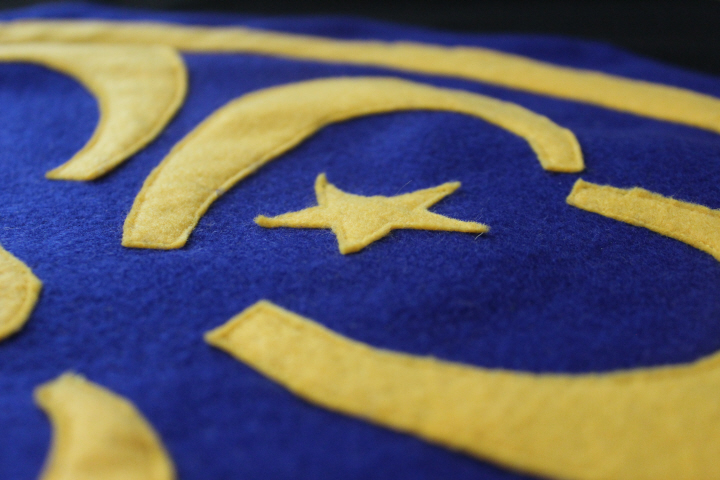
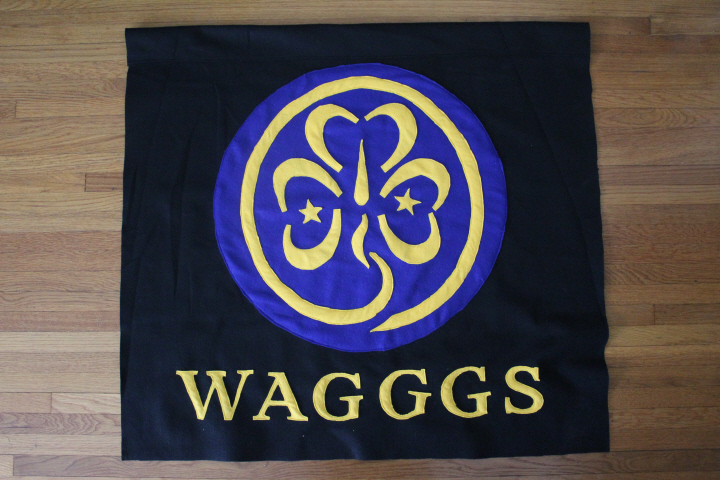
    I took the time from David's Faire stocking this morning to sew up a banner for our Girl Scout International Day (a.k.a. Thinking Day) this weekend.  Our girls are putting it all on this year, from planning to clean-up, and as the hosts they are representing not a country but the World Association of Girl Guides and Girl Scouts, or WAGGGS for short.  I was astonished to find that there is apparently no such thing as a WAGGGS banner for sale, not even for ready money, so homemade felt banner it is.  After ten years (ten years!) of summer day camp, I've had a bit of experience with glued-felt banners and, while they're great for a week, they can get a bit ratty-looking after a while, and you can't really store them easily as the glued areas are difficult to fold, and so I offered to sew it, so that the banner can be re-used year after year.

    3296

    I got an outline image of the logo, and made a "poster" in Publisher, with "WAGGGS" underneath, and printed it out for the pattern, then the girls cut out all of the felt pieces and pinned them into place.  I used felt from a bolt for the blue background and the trefoil symbol, as I wanted them to be all one piece.  I sewed the inner trefoil pieces to the blue circle, then the large yellow outline to both the blue circle and the black banner, since it was so much easier to sew the fiddly pieces to a comparatively small piece than to the big banner.  It took most of the morning to sew, and that's without mistakes (!), but to be honest, this was much quicker than I expected it to be!

    (The wobbly bits are the girls' pinning, and the ripples are mine.  I certainly have more respect now for people who can appliqué circles!  Even with felt, the pieces tended to wander under the presser foot.)

    3299

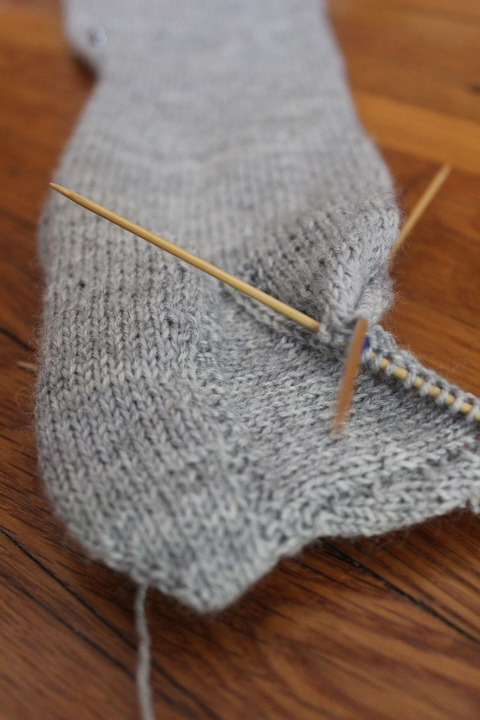
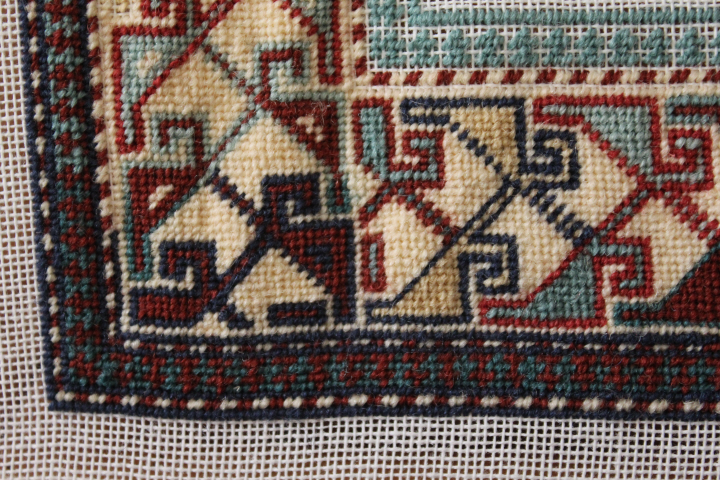
    As for knitting, I'm afraid that I could have been a lot further along with this stocking if I hadn't been so charmed by that miniature Shirvan carpet!  Since David is away again to Shanghai in a few days, I turned the needlepoint face-down and resolved to knit like billy-o this past weekend — as a result, I turned the heel yesterday afternoon, and am now about two inches into the foot gusset.  I decided on the so-called Barnim foot, as I like the pair I made for myself, and this type of stocking foot was known in Scandinavia in the early 1600s, so that if David wants a Faire persona, he can stick with the Swedish soldier.  I can get more knitting in while I wait for Julia at the orthodontist's this afternoon …

  • Rg4

    The other day I was delighted to see in our local bookstore a stack of Ruth Goodman's new book, How to Be a Tudor.  I enjoyed very much her How to Be a Victorian, a sensible and very readable description of the daily life of the average Victorian, and although I am fascinated by the Victorian period, I admit that — like Ruth herself — I can hardly get enough of the Tudors/Elizabethans.

    Like her Victorian book, Ruth has organized this new one according to the daily routine of the average person of the period, "from dawn to dusk" — that is, getting up from bed and saying one's prayers, getting dressed, having breakfast, and so on.  I have noticed, in my own explorations of the Tudor period, quite a lot of sources insisting that the people as a rule smelled bad, so I was interested to find that one of the first things Ruth does is refute this, not only with her historical research, but with the personal experience she has had in living, for months at a time, as the Tudors would have done, in her series, "Tales from the Green Valley" and "Tudor Monastery Farm".

    Rg3

    It is generally known now to be correct that the Tudors didn't bathe, but what is misunderstood is that just because they didn't actually get into a tub of hot water doesn't mean that they didn't keep themselves clean.  Since it was commonly thought in the period that disease entered the body not only by breathing noxious vapors but also through the pores of the skin, the importance of maintaining personal cleanliness was widely accepted, and one of the surest ways to do this was to keep the filth of the outside world and of one's own body from contact with the skin through clean clothing, most especially the layer closest to the skin.  Since the outer garments were usually of wool, and sometimes silk, and therefore difficult to launder, the clothing that was next to the skin was generally made of linen, and changed and washed as regularly as possible.  You would have a linen smock or shirt, under-breeches, hose, cuffs, coifs and caps (to wear under a hat), and so on, which meant that essentially everything in contact with your skin or hair could be fairly easily cleaned.  In addition, many authorities of the time also recommended that one's daily routine should include a vigorous rub-down with a linen cloth, since linen's absorbent properties were well-known, with the added benefit of the light roughness of the weave gathering up the sweat and dirt from the skin.

    Rg2

    Rg8

    What about the less well-off people?  Wills and probate inventories, even of non-nobles, seems to indicate that most people had two or three sets of undergarments — presumably one to wear, one in the laundry, and a "best" for Sundays — though of course nobles sometimes had several dozen shirts or smocks, and changed at least once a day.  Was two or three changes enough?  Allow me to quote Ruth at length —

    Did people in the Tudor era stink to high heaven? …

    I have twice followed the regime [of linen undergarments and a daily scrub of the skin with a linen cloth].  The first time was for a period of just over three months, while living in modern society.  No one noticed!  It helps, of course, if you wear natural-fibre clothes over the top of your linen underwear.  I used a fine linen smock, over which I could wear a modern skirt and top without looking odd, and I wore a pair of fine linen hose beneath a nice thick pair of woollen opaque tights (these, of course, did contain a little elastane).  I changed the smock and hose daily and rubbed myself down with a linen cloth in the evening before bed, and I took neither shower nor bath for the entire period.  I remained remarkably smell-free — even my feet.  My skin also stayed in good condition — better than usual, in fact.  This, then, was the level of hygiene that a wealthy person could achieve if they wished: one that could pass unnoticed in modern society.  While we know that some people did follow the full regime outlined above, we have no way of knowing how many.  Several advice books that include some form of early-morning hygiene regime don't mention the rubbing cloth at all, stopping short after telling young men to wash their hands and face and comb their hair.

    I have also followed the regime in a more Tudor context while filming a TV series, during which I wore all the correct period layers and head coverings.  I was working on a farm, so this entailed a much heavier coarse linen smock, woollen hose and far fewer changes of underwear.  Although I was working mostly outdoors, often engaged in heavy labour and also lurking around an open fire, I found that just changing my linen smock once a week proved acceptable both to me and to my colleagues — including those behind the camera, who had more conventional modern sensibilities.  The woollen hose I changed just three times over the six months; the linen parts of the head-dress I changed weekly along with the smock.  There was a slight smell, but it was mostly masked by the much stronger smell of woodsmoke.  Once again my skin remained in good condition.  This, of course, was much more representative of the majority of the population's experience in Tudor times, in the frequency of changes, the lifestyle and the types of material that the underwear was made from.

    A friend and colleague has also tried it the other way around, washing his body but not the underwear.  The difference between the two was stark and revealing.  He continued with a full modern hygiene routine, showering at least once a day and using a range of modern products, but wore the same linen shirt (and outer clothes) for several months without washing them at all.  The smell was overpowering, impossible to ignore.  He looked filthy, too.

    Many modern writers have presumed that without hot soapy water being regularly applied to bodies, Tudor England must have been a place inhabited by people who smelt like the long-term homeless.  Much play has been made about the difference between beautiful clothes on the surface and an imagined filth and stench on the inside.  I would refute that reading of the situation.  The sixteenth-century belief in the cleansing power of linen turns out in practice to have some truth in it.  The laundry makes a vast difference.  The smell of the past undoubtedly was not the same as the smell of the present, but we need to be aware that cleanliness and being neat and sweet-smelling were important issues for Tudor people.  Charitable institutions were eager to ensure that their inmates conformed to the social norm, and masters wanted their servants to be so attired.  There must of course have been the occasional "stinking beast" among those having a particularly hard time, but it appears to be the absence of laundry, rather than the absence of washing the body in water, that has the biggest impact upon personal hygiene.

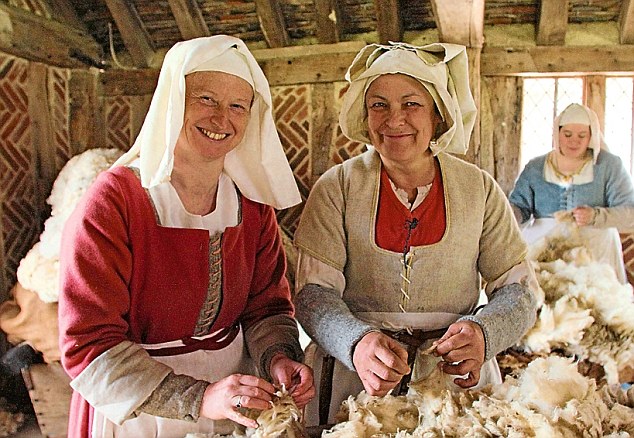
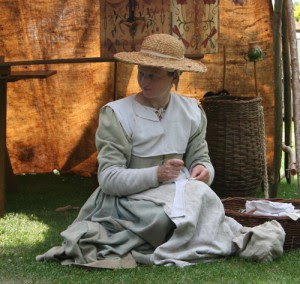
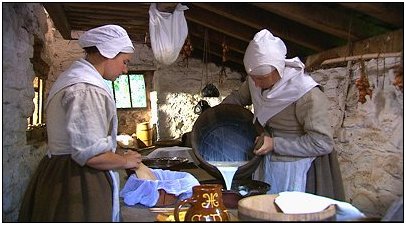
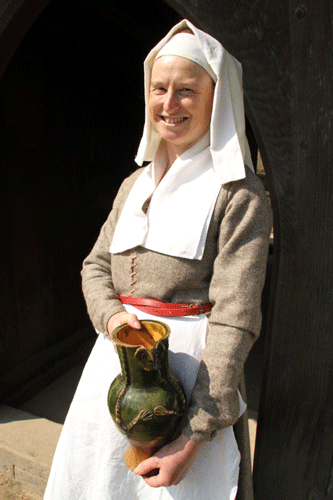
    [From chapter 2, "To Wash or Not to Wash". Photos from "Tales from the Green Valley" and "Tudor Monastery Farm".]

    Rg7

  • Dobbins o n probate 1852 - andrew mo - 02 of 14

    Sometimes the things you find in your family story just tear at your heart.  My ggg-grandmother is one of those mysteries you sometimes have — the family today remembered nothing about her, but I later found her as "E.E. Mallory" born around 1824 in Virginia, though she lived most of her life, as far as I can tell, in Missouri.  Her name was in fact Elizabeth, I discovered on the marriage record to my ggg-grandfather Jesse Mallory in December 1855.  She was listed as "Miss Elizebeth E. Dobbins" but upon further research I found that this was the surname of her first husband, who was a Dr. O.N. Dobbins of Andrew Co., Missouri.  Elizabeth had married Dr. Dobbins around 1840, and had four children by the time of the 1850 census — Ada, Oscar G., Cornelia E., and Delasco Benjamin.  Now, with names like these, you'd think I could find them later on, but I have traced only Cornelia with any certainty — she married a man called George F. Martin and lived to the age of ninety in Kansas City.

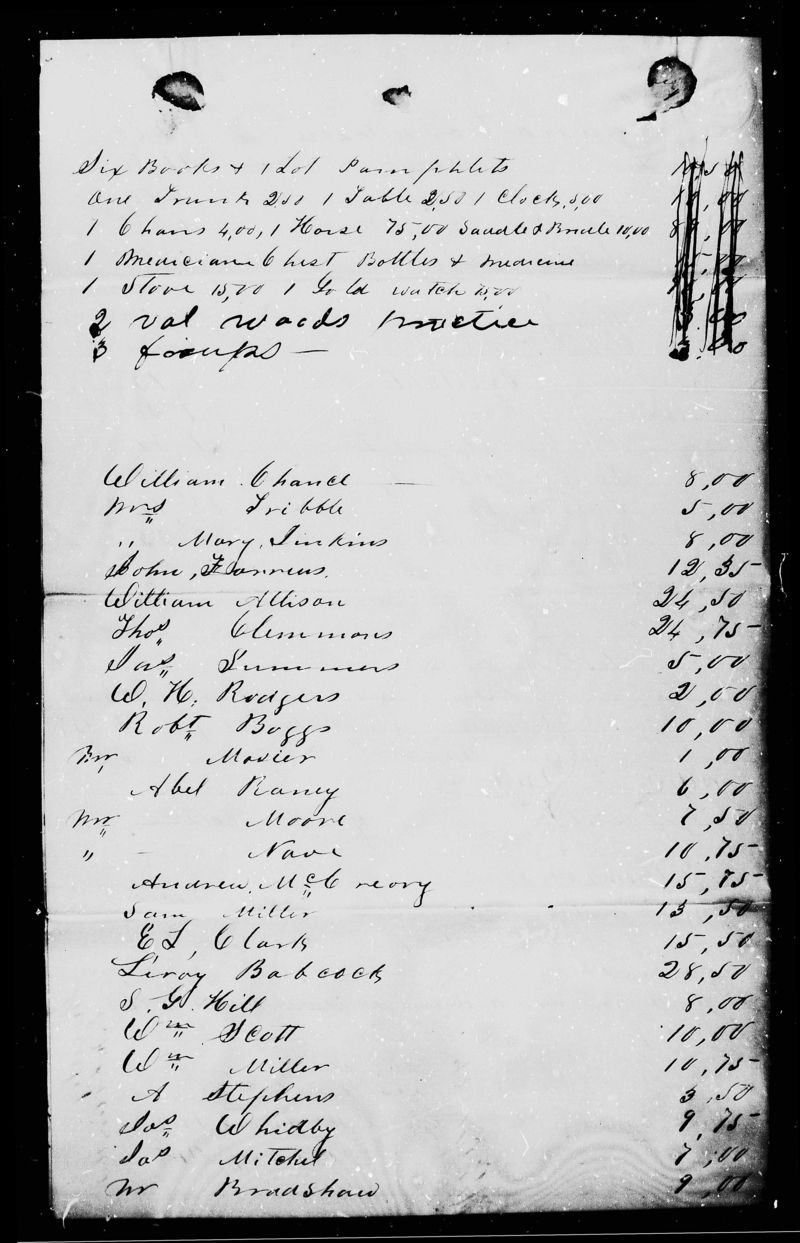
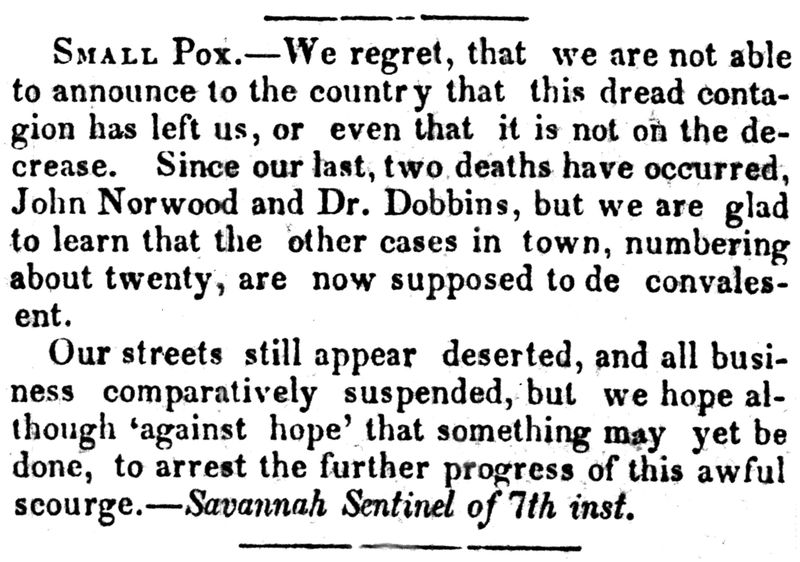
    Dr. Dobbins' first name is not given anywhere that I can find — something embarrassing, perhaps, like Ozymandias, or just Oscar, like his son.  I can't find him in 1840, either, when a thirty-year-old man of some learning at least should be in the records somewhere.  He was said on the 1850 census to have been born in Ohio.  He died intestate in 1852, during a smallpox epidemic in Missouri, leaving his wife with four children under ten years old.  The image at the top is the second page in his probate file in Andrew Co., which file is almost exclusively a list of outstanding debts — presumably to him, the writing is very poor — and a sad little inventory of his belongings —

    • six Books & 1 Lot Pamphlets [10.50]
    • one Trunk, 2.00, 1 Table 2.50, 1 Clock 5.00
    • 7 Chairs 4.00, 1 Horse 75.00, Saddle & Bridle 10.00
    • 1 Medicine Chest Bottles & Medicine [15.00]
    • 1 Stove, 15.00, 1 Gold watch 75.00
    • 2 vol. Woods Practice [3.00]
    • 3 forceps [3.00]

    The "Woods Practice" I think is a set like this —

    Woods2

    A Treatise on the Practice of Medicine by George B. Wood (this image is from Civil War Medical Books, which has an article about Wood and his manual, the 1858 edition having been issued by the US Army Hospital Dept. to army medical personnel).

    There is no mention of Dr. Dobbins's clothing in the inventory — I don't know if this was standard practice in the US and it was just given to the widow, or if in this case everything had been burned because of the smallpox.

    Apparently the estate representative managed to collect a number of the outstanding accounts in the year following Dobbins's death, but a second list at the end of the file shows those "not collectible", with notes such as "dead" or "claims paid", or (quite a number of times) "gone to Calaforna".  ("William Hale, not known, 5.00 … Levi Macey, worthless, 17.25")  The total outstanding is over $400, which in 1852 was astronomical — at least $12,000 today, perhaps as much as $86,000.  I find myself wanting to think that Dr. Dobbins treated so many of these people on account because he was a generous soul ("Mrs. Tribble, 5.00 … Mrs. Woodcock, 31.25"), but it is also quite possible that he simply didn't keep very good accounts ("Thomas Clemons, proved paid, 24.00 … Thomas Roberts, shows receipt, 0.50"), which is almost as sad.

    There is nothing — nothing — in the file about the children.  The unnamed "widow as dower" got $200 cash, and I hope at least the gold watch, as there is no mention of that nor the horse anywhere else in the file, even on the list of who bought the rest of the things.  (Seventy-five dollars! that's a fine watch.)

    I must admit that it was a bit of a shock to read, as I was trying to decipher the handwriting, a standard we-do-solemnly-swear that the evaluators were not related or connected to anyone concerned with the estate, etc. etc. etc., "and that we will, to the best of our abilities, view and appraise the slaves and other personal estate to us produced".  But of course, Missouri was a slave state, and although I was relieved to find that Dr. Dobbins owned no slaves, I can't help but remember that Elizabeth's second husband, although he also owned no slaves, was a Confederate sympathizer, and would be killed with a neighbor in 1864, by a group of US militia men who accused the two, probably correctly, but certainly without due process, of aiding Confederate bushwhackers.

    Dobbins notice liberty mo weekly tribune 13 feb 1852

  • 3270

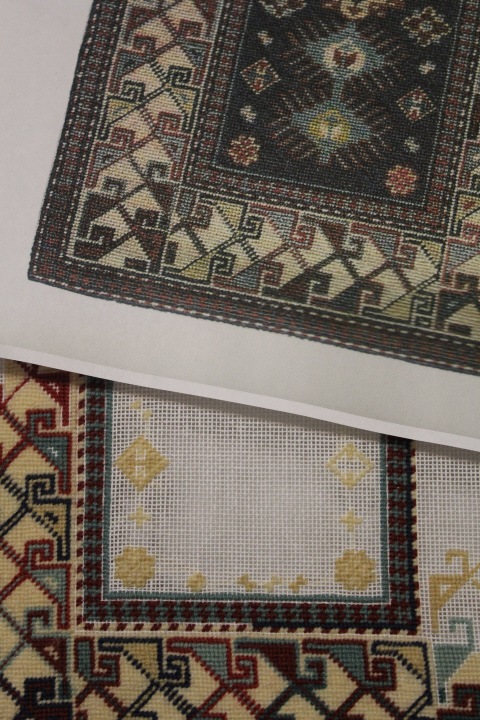
    The miniature carpet and the Elizabethan stocking are running neck-and-neck, as it were, although I confess that the carpet is a little more interesting to me at present — I could have been a lot further down the stocking, I suspect, if I'd given my mind to it.  Oh, well.  I am finding a lot more inconsistencies in the carpet chart, which is annoying, and working from a photocopy of the finished carpet is like a game of Needlepoint Telephone, in that sometimes I work what I think I see, which may not always be what Cooper actually did (wh. wasn't like the chart anyway!).  But, as it happens, now that a good portion of it has been worked completely and I can see the patterns and colors, I remember why I fell in love with it in the first place, so despite all of the irritations regarding the chart, I'm still delighted with the carpet itself.  I have just realized that I miscounted on the little white triangle at upper left, so after I post this, I am going to have to go and pick it out.

    I'm really tempted to take my steam iron to the thing — it's a poor workman who blames his tools, but the canvas is warping a lot, and I'm tending to blame the thick/thin irregularities of the Paternayan, as sometimes the coverage is a bit thin and other times it is so thick that it squooshes out that section of the canvas.  Or it may just be me, that I chose a canvas gauge that is just slightly too small for the wool — there is always that to be considered.

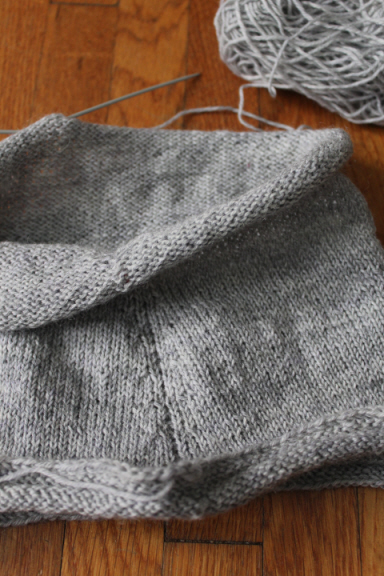
    As for the stocking I've moved it off of the circular needle and onto dpns.  Am amused to find that the irregularities in the stitches have smoothed out noticeably in the two inches or so since I did, as common knowledge has it that your knitting is smoother on dpns!  Some of the irregularities are due, I suspect, to my catching a few hairs of the easily-splitted yarn in previous stitch, which makes them pull out of shape — hope this will not be too obvious once worn.

    3272

  • 3065

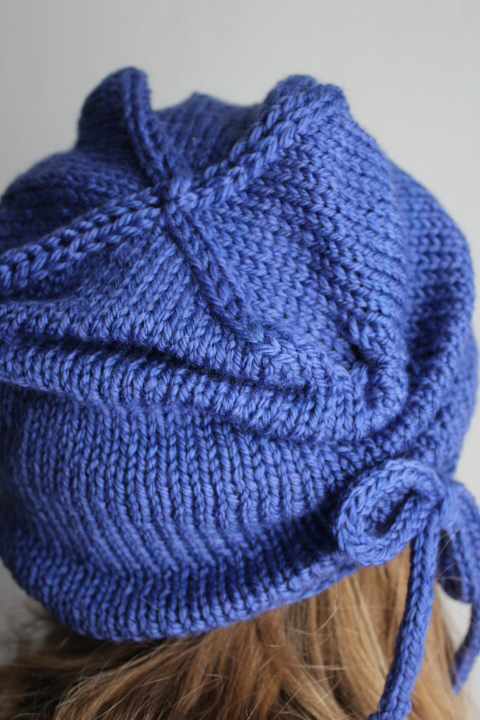
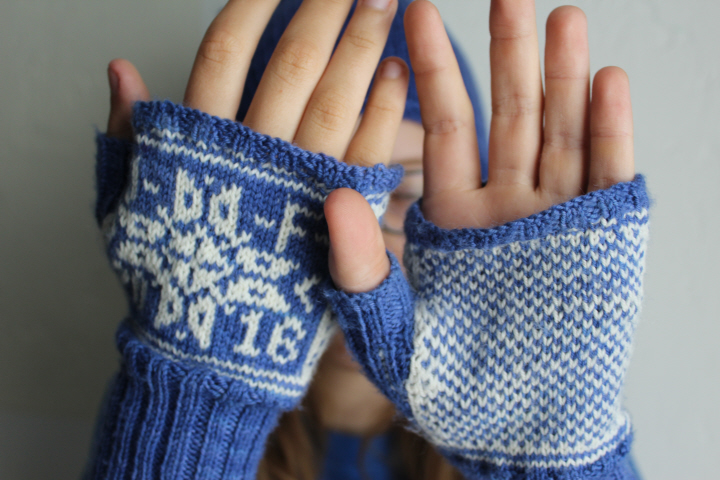
    Here is Julia's hat-and-mitts set for her Washington DC 8th-grade trip, which is coming up quickly at the end of the month.  I made a set for Laura two years ago, and used the same yarns again — Lorna's Laces Shepherd Worsted and Shepherd Sock — in Julia's choice of blue.

    The hat is Minty by Erica Jackofsky from Knitty a few years back, which works up very quickly and satisfyingly — this is the striped version without the stripes (the solid version has a different crown shaping).  Julia wanted something that wasn't close-shaped, so I chose this one because the shaping gives it a little squareness at the top of the head.  The scrunch at the side is accomplished with a column of double eyelets with the i-cord laced through — simple but effective.  The yarn is (of course!) very pleasant in itself, and suits this hat well, too.

    3076

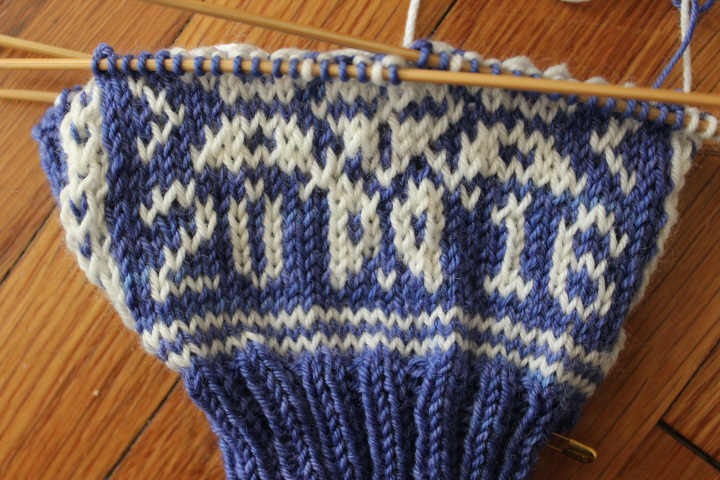
    The mitts are my own standard Norwegiany mitts, with a ribbed thumb.  As I mentioned previously, I tried something new with this pair, working them "inside out" so as to keep the floats from pulling too tightly.  It turns out that they are quite loose, not quite too loose, but nearly — but I think this will be all right in the long run, as Laura's have pulled in a little bit with wear and washing, so I expect this pair will be no different.  The places where it is a little too loose are along the edges of the thumb gusset, where I think there would have been problems anyway, with the long floats across the gusset, so I'm still pleased with the method and will certainly avail myself of it in future.

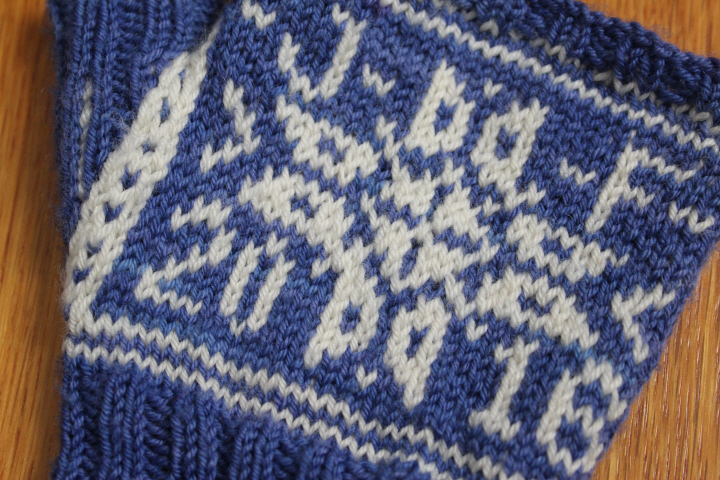
    The star is a sort of impromptu one, not from any pattern — I simply graphed out the initials and date in a block about the right size, and filled in a star pattern.  These initials are a bit larger than Laura's, so I had less space to work with for the star, wh. ended up looking as much Navajo as Norwegian, but I don't think that's a problem per se!

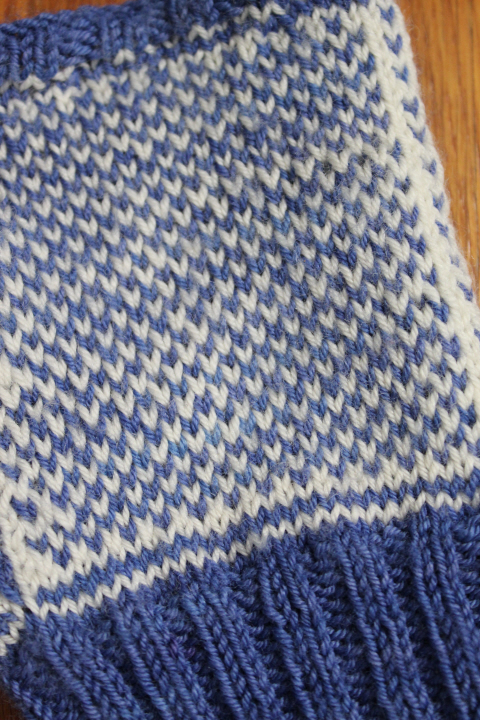
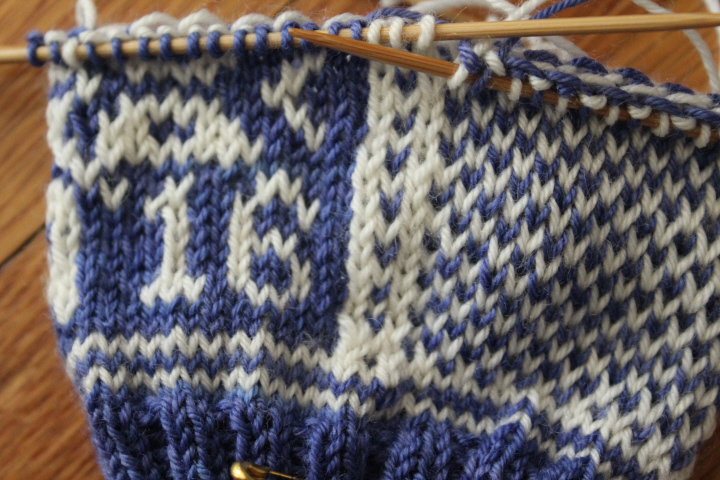
    I still haven't worked out to my satisfaction a method of securing the floats behind 2×2 ribbing, but the flashes of white underneath the china blue here are not unpleasing, as it happens —

    3077

    3078

    3079

    I think that Julia is actually beginning to come round to the idea that not all wool is scratchy, but I'm not going to tell her I've noticed that she likes wearing these!  We had a cold snap yesterday — with hail — after a few weeks of mid-springlike weather, so hurriedly got out the sweaters and scarves we'd discarded, and Julia wore the mitts to school yesterday and today both!

  • ,

    Grrr…

    2986

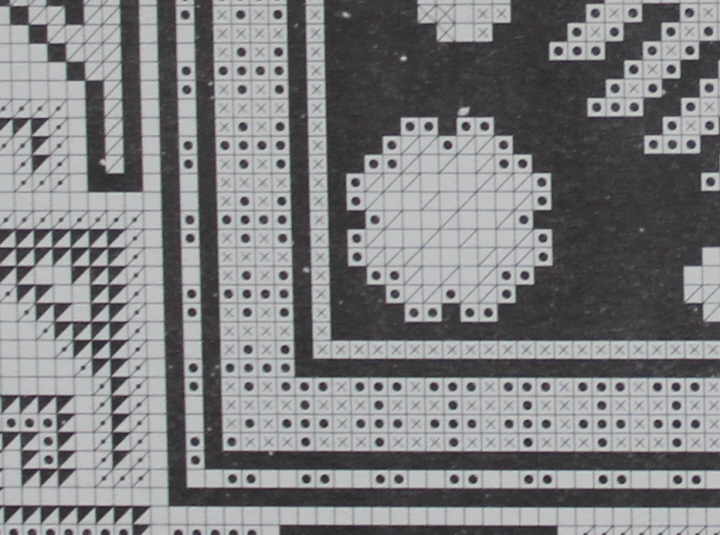
    I've been stitching along, happily if intermittently, on the Shirvan miniature carpet — happily although more than a little daunted by the small size of the chart and the mid-1990s photocopy-generation printing quality in the book.  Mystifyingly, Cooper also used two very similar symbols for two very similar shades of red and for two similar shades of green — a serious error of judgment, in my opinion, since of course it is therefore very easy to confuse not only the two reds, but the two greens.

    Well, I was quite pleased to feel myself ready to start the center section the other day, and carefully counted out the white stitches — since of course if you make a mistake setting it up, everything from there after is thrown off! — and was rather puzzled to find that the next-lightest shade, an off-white, was combined with the white in the round medallions in the corners, and then in the diamonds a little further up.  Two whites together — well, he knows what he's doing, right?

    Then after I'd worked a substantial amount of the second white, I looked at the color photo, and it isn't two whites at all in the finished carpet, it's white and medium-red!  And not even in the same places as on the chart!  See the little tuning-fork shapes in the chart? those, the blank squares, are white, the slash "background" is off-white, and the dot is dark red — but in the finished carpet, the tuning-fork is definitely red, the background maybe off-white, and the outline white?

    Cooper's symbol for medium-red is the dot with a slash through it — I thought maybe he'd confused the slashed dot with the plain slash, medium-red for off-white — but no, it's actually the reverse of that in the finished carpet.  And that's just the round medallion — the diamond above is also completely different.

    Let's not even get started on what happened to those little plusses across the bottom, under the spidery figure, which have almost completely disappeared in the finished carpet!  They are all fairly bright colors in the chart — including white and off-white! — and should stand out clearly.

    What a shame — these are all wonderfully detailed charts of some really beautiful little carpets, and while I'm still excited about making many of them in future, I'm feeling really frustrated not only at the difficulty of deciphering similar symbols on a small and not-very-high quality print of a chart, but now I can't trust that the chart will produce something that looks like the photo of the finished carpet.  Hence the "grrr."  I think this carpet will be really lovely when it's done, but … grrr.

    (I have, by the way, found only a single instance of this miniature carpet on the internet, by a stitcher on the American Needlepoint Guild website, but she obviously changed her colors along the way to look more like Cooper's finished one.  I'm guessing she just said to herself, "the heck with it," and did what she wanted for the center section, as those diamonds at the sides, the ones I'd just started, are like neither Cooper's chart nor his finished carpet!)

    2881

    No, I didn't really like the white/off-white combination anyway, so — heavy sigh — I am going to pick it all out now.

    Perhaps needless to say, I have also just now enlarged my high-resolution photograph of the two center-section charts, enlarged those, and made myself some copies of half of each — so four gigantic charts, each one quarter of the center section, which I am now going to cross-check and re-color.  But first, a nice cup of tea, I should think.

  • 2972

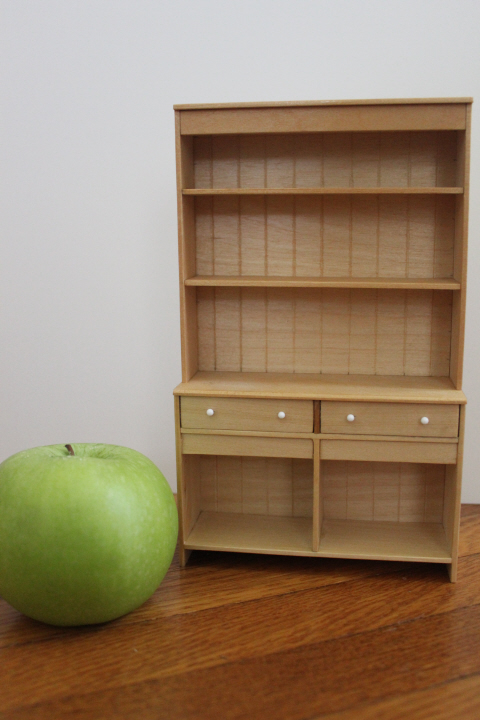
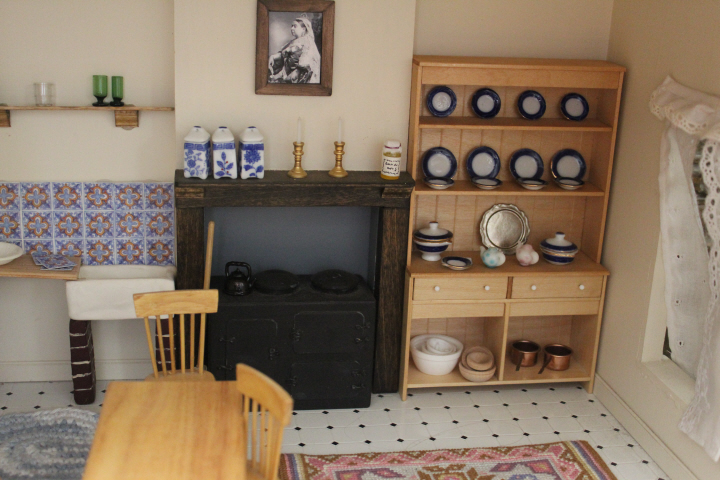
    At last! here is the new kitchen dresser for No.16.

    2982

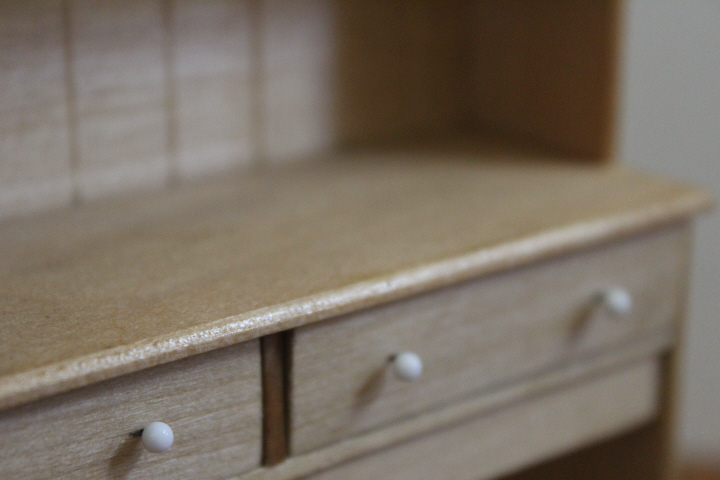
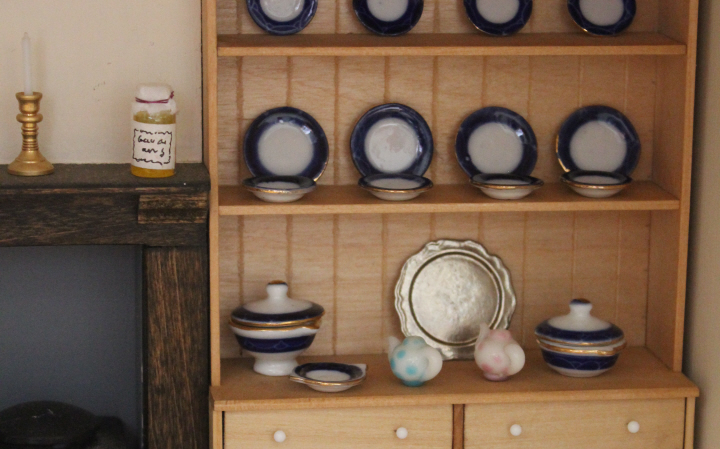
    This is made to a 1/12 plan from the Victorian Town House chapter in Venus and Martin Dodge's New Doll's House Do-It-Yourself Book.  (There are in fact two different kitchen dressers in the book, of which this is the simpler.)  Mine is made of bass wood with thin plywood for a back, finished with wood conditioner only (instead of stain) and two coats of Krylon spray lacquer.  The drawer handles are glass-headed sewing pins.

    2974

    2977

    2979

    This took an extraordinarily long time to put together, I must admit, though pretty much all of that was due to my clumsiness, and apparently an innate inability to glue at right angles.  That said, the Dodges' plan is excellent, though fiddly, and I would recommend it either for beginners who are very patient or have an expert close at hand, otherwise for those with some modeling experience.  I've learned a lot about the process, wh. is good.

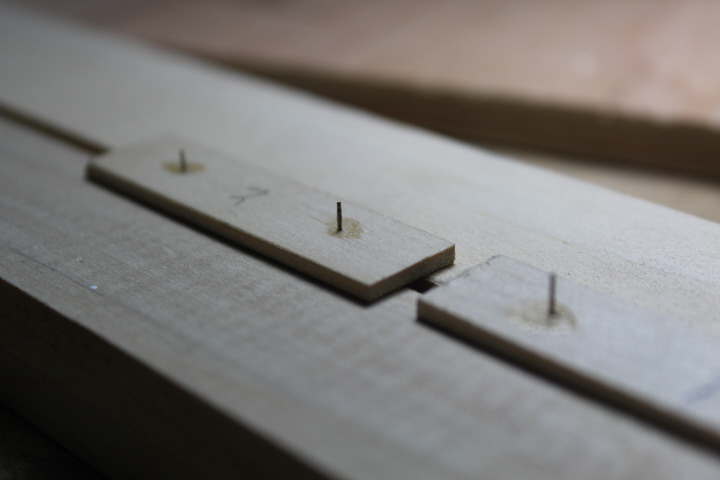
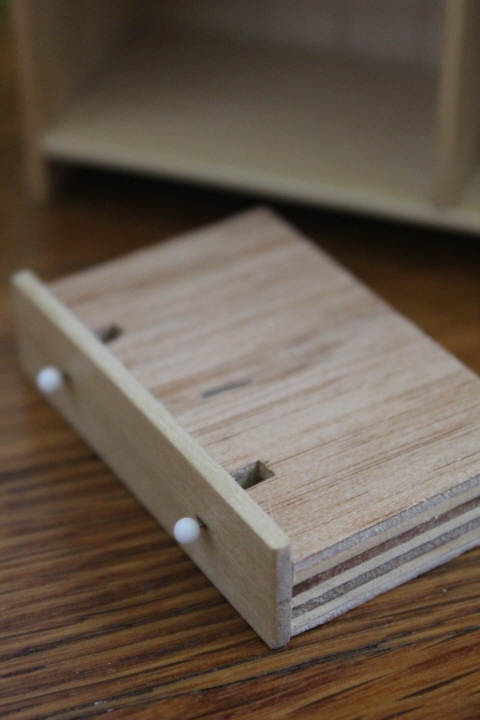
    I said before that I was tempted to just glue the drawer fronts into place, instead of making drawer boxes as the plan gives, but I realized that I would need something at the back to keep the fronts-only from being crooked, so was on the verge of cutting some lengths from a squareish scrap of plywood, one for each side of the two drawer holes, when David came home from Shanghai and said, "I'll just cut a block.  But I have to rout out a space for the pins," so that I could secure them with super-glue (since of course I pictured a pin coming right out the moment anyone tried to pull out the drawer).  So it turned out to be a little more trouble than my original idea, but not as much effort or time as a full drawer box.  I'm glad we did it this way, as it happens, as the drawers look much more realistic if one is slightly less pushed-in than the other!

    2953

    2976

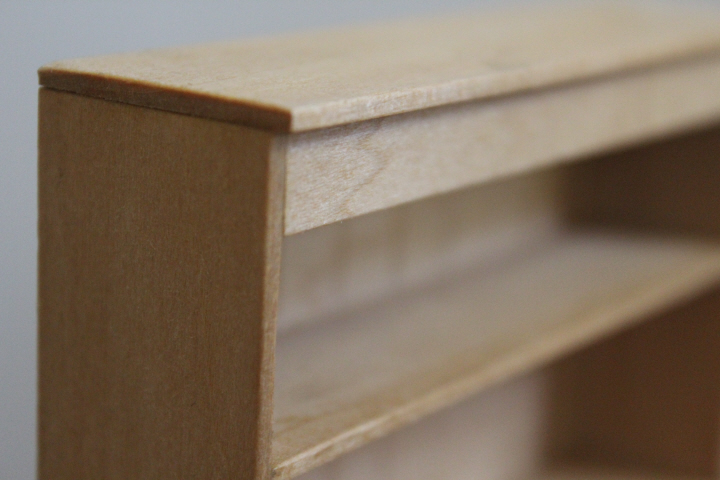
    I will most likely either not use Gorilla Glue again, since it expands as it dries and therefore needs much more care in application than other glues, or let David do it!  I can still see some lumps, especially in these close-up photos, that I couldn't sand off — but really, in the room you don't really notice it.

    The center divider between the two drawers is the only piece of wood with its end visible from the front, and unfortunately it didn't occur to me that the end-grain would take the wood conditioner differently from the straight-grain, wh. is why it is noticeably darker than any other bit of the dresser, but there it is.

    Other than that, I'm quite charmed by it, and delighted to have the kitchen looking noticeably more kitchen-y than it has been — and the dishes look perfect!

    2983

  • 2895

    I had to move my Shirvan-in-progress from a mat frame to my big wooden one, as the opening in the mat was really too big — I admitted to myself with great reluctance — and the canvas was distorting dreadfully.  The frame is much heavier and rather awkward for working in my lap, wh. I really have to do because most of the time I work it without my glasses, so have to hold it two or three inches from my face in order to get the benefit of my Super Microscopic Up-Close VisionTM.  I worked the smaller carpets on a smaller mat, which was perfect for holding up close, and fit into a regular 8 1/2×11 page protector or a zip bag when I wasn't working on it.  Oh, well.  The Shirvan is definitely happier in the frame, I could see at once, though it still has a bit of a list to port.

    I am pretty sure that the wobbliness of the stitches is going to come out in the blocking, so I'm not alarmed at present.

    2896

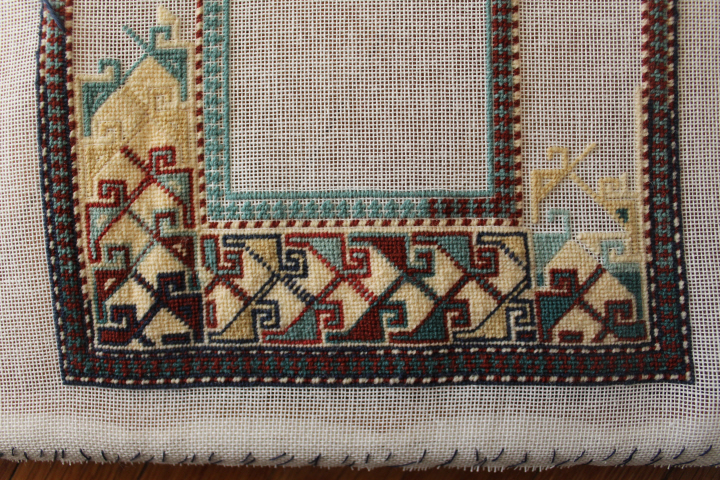
    You can see the built-in abrash, the color variations often found in Oriental carpets due to time and different dye lots, in the border greens, where there is a darker one along the bottom and a little bit up the side, then a mid-range green continuing.  I learned this word from Cooper, in fact, who remarked on it in the description of another of his charts, that he'd run out of wool and had to match it somewhat imperfectly.  This carpet actually has the color variation charted in a couple of places, so presumably the abrash is in the antique original.

    But you can also see the differences in tension, either where I was working up-and-down or side-to-side, or where the wool varied in thickness.  The cream is especially prone to the thick/thin issue — it's especially obvious to me in the little dashed lines along the bottom edge here, where the outer one is super-thick and the inner one is teeny-tiny.  I'm tempted to work over the teeny-tiny one with another thin strand.

    I am really enjoying this carpet, though! the colors are lovely.

    2897

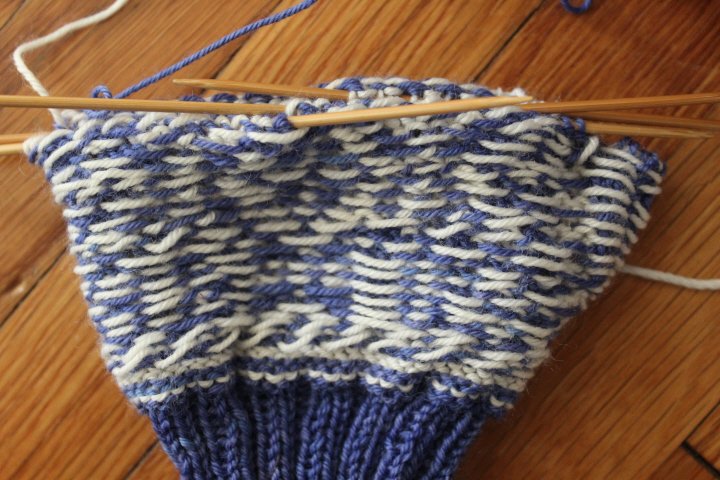
    Here is another tension issue, though with a much happier initial outcome.  This is the first of Julia's mitts for her DC trip next month.  I got halfway up the stranded part, and wasn't very happy with my tension, so thought I'd try the inside-out trick.  You simply turn the piece inside out and knit it looking at the center — down the inside of the "tube" — and the floats are just a little more generous from traveling on the outside of the tube instead of the inside as usual.  I was really amazed at the difference between the two methods, which was obvious after just a few inches.

    2898

    This still needs a bit of blocking, to be sure, but is noticeably smoother already than the right-side-out method, especially at the needle joins —

    2900

    The spotted three-stitch stripe up the middle here would have been much wobblier than it is if I'd worked it right-side out.  The white is still a bit looser than it should be, but I'm hoping that a good blocking will fix that right up; I've noticed that Laura's pair, two years old now and much-worn, has tightened up noticeably (to me), so a little looseness at first shouldn't be a problem.  Bit of a mental adjustment, working inside-out, but worth a try!

  • Zhī zhēn

    2889

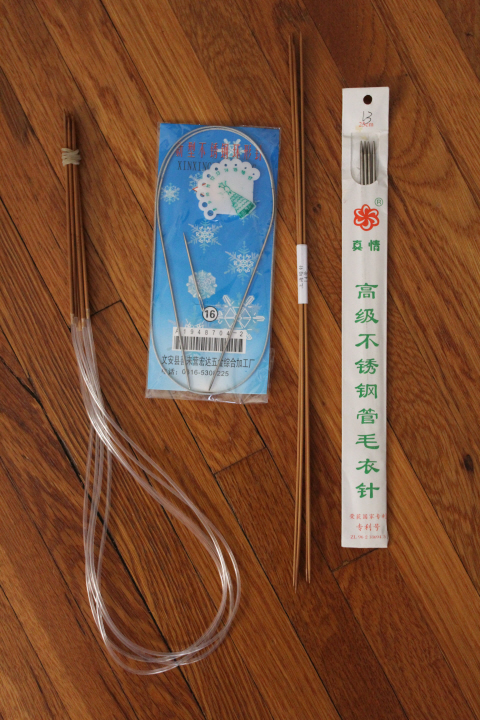
    David brought me these from Shanghai — I don't know how he managed to find a knitting shop, but he did!  The double-pointed sets are tiny, and long! so presumably they are for lace rather than socks, which is what he was thinking of.

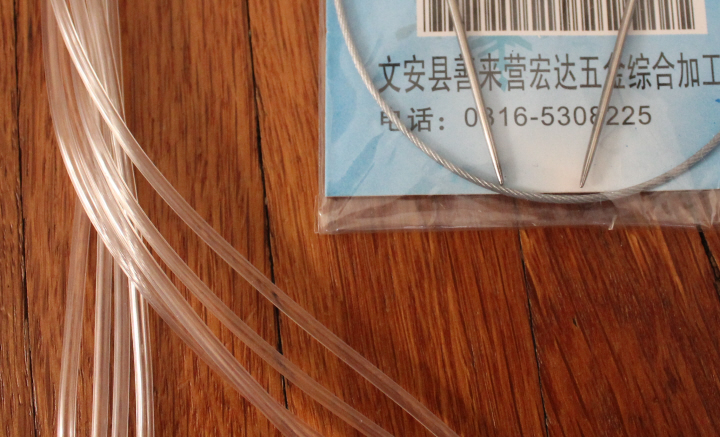
    The Mandarin for "knitting needle" is zhī zhēn, or 织针, I'm told — the zhēn (needles) part of this character appears at the bottom of the paper packet that looks like a sleeve for chopsticks.  I guess the Chinese are still knitting with the UK needle sizing, as that is what these are all marked except for the bamboo circulars, which are stamped with metric sizes, and they still come in sets of four, not five.  I'm delighted to see that one of the circulars comes with a gauge for the fine sizes, as I don't have one!

    The circulars are interesting, as the one in the snowflakes packet is a steel cable encased in plastic, which is not only both strong and flexible but doesn't have that "flip" that plastic circs get in the middle of the cable after being in a packet for a long time.  I'm very intrigued by the bamboo sets, as they have what appears to be IV tubing, light and hollow and very flexible.  Not like I need to start a new project just now, but ….

    2894

  • 2879

    Progress on the Faire stockings.  I started these over when after a few inches I admitted to myself that my attempt to use dpns for their "historical accuracy" was more trouble than it was worth — because although at eight inches apiece my steel 2mm set is long enough for all of these stitches, it is also long enough to poke my hands at regular intervals, get caught in my sleeves, require frequent juggling of stitches to avoid a wobbly line between needles, and just be generally cumbersome — so I gave in and got out my 20th-century circulars. 
    Histknit2016 button 1

    I consoled myself by making this button for my historical-knitting projects this year, since apparently I have a weakness for blog buttons and Girl Scout patches.  On the bright side, the circulars increased my knitting speed by as much as 75%!
    2870

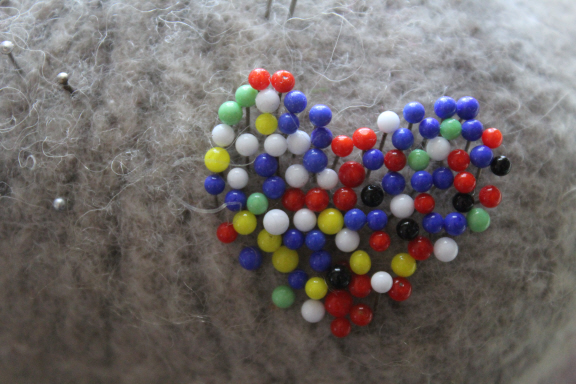
    I found this on my pincushion the other day — Julia, I suspect.  A cynical child, but with much more sensitivity than she lets on.
    958

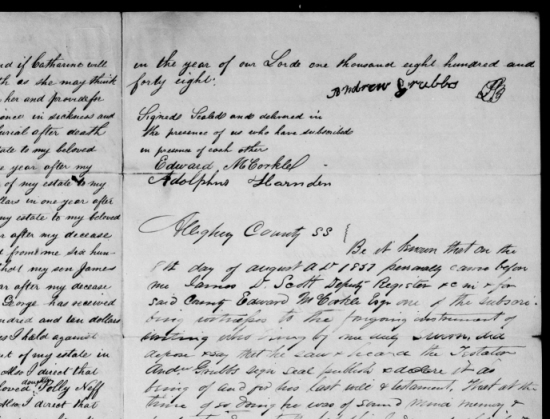
    I had a bit of a lost weekend, when I discovered last Friday afternoon that FamilySearch has the Pennsylvania probate records microfilm available online.  It took me a bit of time to figure out the indexing system, and I'm still baffled by the page numbers that run not in a single sequence but a series of them with no apparent reason or — more importantly — no note at the beginning of the book to tell the searcher where each sequence starts and stops.  ("So is that the first page 1501, or the fourth??")  But, yeah, I looked up and it was Sunday.  I did not, alas, break down a single brick wall, of which I have a number in Pennsylvania, but I found some interesting things.

    2876

    Here is a dry-fitting of the kitchen dresser for No.16.  The top section is not glued to the bottom yet, as I haven't done the drawers.  To be honest, I think I'm just going to glue the drawer fronts in place, and not fiddle with working drawers — I can certainly understand the appeal of working drawers, and I'm not ruling them out in future, it's just that I found myself vexingly klutzy gluing the rest of this thing together, and I would rather just have a pleasing finished piece, and I only want to put stuff on the shelves anyway!  David has been in Shanghai for three weeks, so instruction has perforce been by e-mail, which isn't terribly convenient.

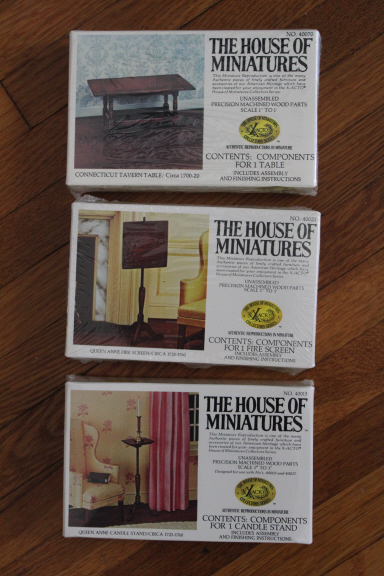
    I got a very generous gift card from my in-laws for Christmas, and still had enough on it last week to buy these on Ebay —
    2873

    The candle-stand and fire-screen came in a single lot, minimum bid $3.99.  I was the only bidder, as it happened, but I still hate Ebay auctions.  I can understand the thrill some people get from it, but it's just not for me: my heart started pounding anxiously even as I was only logging in.  (The first auction I lost, I discovered that they send you an e-mail afterwards with the subject line "Got Away!" and the pictures of what you didn't get, like "what a loser you are!")  The Connecticut table was a "buy it now" and although at $13.99 wasn't as triumphal a bargain, it was a much less stressful purchase!

    (How can the 1980s be "vintage"?  This is not possible.)

    2673

    I made a pair of "portraits" — not for anything, really, just to figure out how it works.  I found images of a husband-and-wife pair from some online auction house, reduced them to about the right size and layered a cutting circle on top to save myself some fiddling, printed, and stuck them on to these purchased charms.  Perhaps I didn't wait long enough for the glue to dry after this photo — they seemed stuck to the metal fairly well, but although Mister's "glass" went on perfectly, the one for Mrs. slipped a little and of course the picture stuck to the adhesive on the underside, so that now there is a noticeable sliver of silver showing near her hands.  If I can find another set of the charms, I might take the trouble to do them again, as I've got rather fond of the faces — unknown sitters, unfortunately.
    Screenshot-2015-06-10-18-15-09

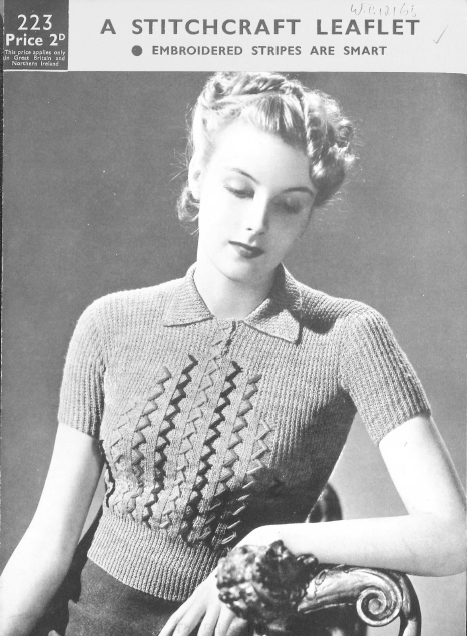
    The D.E. Stevenson list is reading Listening Valley, a story that begins in the early 1930s and follows Tonia, a shy girl with a sparkling older sister and indifferent parents, through the next fifteen years or so of her life.  It is not really a major part of the story, but Tonia has some undiagnosed problem with her hands, making her "butter-fingered", by which her parents are uninterestedly mystified but her sister and Nannie make generous allowance for her clumsiness.  A number of Stevenson characters in other books are seen knitting, but I suppose that this problem with her hands would mean that Tonia doesn't knit herself, but surely Nannie would make this jumper for her, because the quiet and withdrawn Tonia wouldn't have chosen zigzags down the front for herself but Nannie would think they add a little sparkle to her cheeks.  This late-thirties tuppenny Stitchcraft pattern leaflet is a scan from the British Library collection, generously available free from The Sunny Stitcher.
    2882

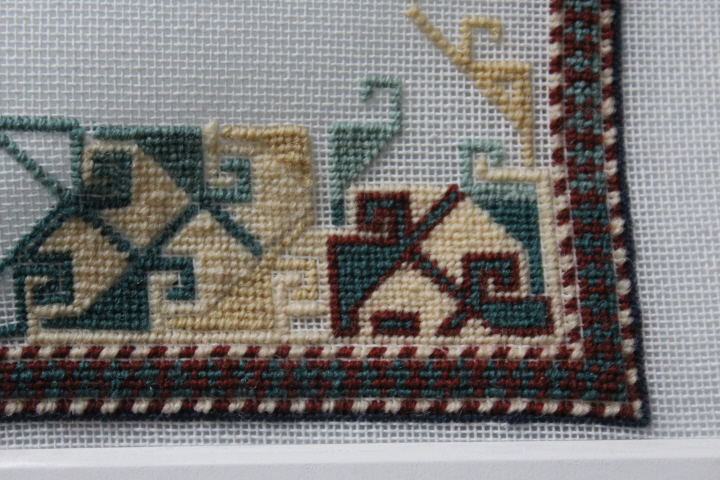
    Talking of Yahoo lists, I joined the Petitpointers list the other day, which as you might tell from the name, is for needlepointers in smaller gauges.  The carpet above is my first from Frank Cooper's book Oriental Carpets in Miniature, which I got for a song from a used-book seller.  This is the Shirvan 1 — even though I am reducing it a bit from Cooper's 18-gauge canvas to 22, it's still going to be easily twice the size of any miniature carpet I've done before, but the picture is really lovely, so I'm looking forward to it.  These are Paternayan wools, wh. I haven't used in an age.
    Dickerson sidney edward - 1936

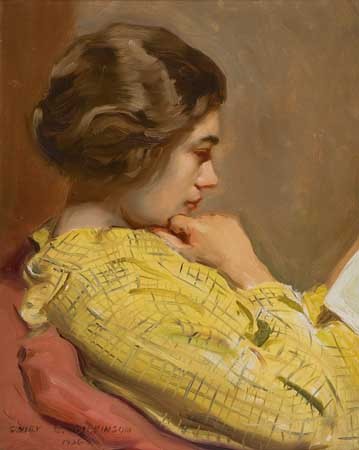
    I'm also taking another FutureLearn course, entitled "Literature and Mental Health".  Jonathan Bate and Paula Byrne are teaming up to explore "how poems, plays and novels can help us understand and cope with deep emotional strain".  I enjoyed immensely Bate's "Shakespeare and His World" course — he's an engaging and level-headed instructor — and there are already lots of interesting discussions going on in the comments, plus with this first-run course the instructors are commenting and responding to comments as well, which makes it even more appealing.  There was a sort of attempt at the beginning to maintain an air of academic neutrality about the subject, but of course anyone who reads a lot will already feel, fairly strongly I suspect, that literature is a balm in times of stress or depression, so the outcome is already a foregone conclusion.  I didn't know beforehand that the professors would be talking to such luminaries as Ian McKellen and Stephen Fry, among numerous others, so that's a bonus!  I had to rush through another course, finishing six weeks' worth in less than three, in order to clear my slate for the Mental Health one, but I'm glad I did, as it is rather intense and deeply thoughtful at times, even in the first week.


    Adlestrop

    Yes. I remember Adlestrop —
    The name, because one afternoon
    Of heat the express-train drew up there
    Unwontedly. It was late June.

    The steam hissed. Someone cleared his throat.
    No one left and no one came
    On the bare platform. What I saw
    Was Adlestrop — only the name

    And willows, willow-herb, and grass,
    And meadowsweet, and haycocks dry,
    No whit less still and lonely fair
    Than the high cloudlets in the sky.

    And for that minute a blackbird sang
    Close by, and round him, mistier,
    Farther and farther, all the birds
    Of Oxfordshire and Gloucestershire.

    — Edward Thomas, 1917