• 2972

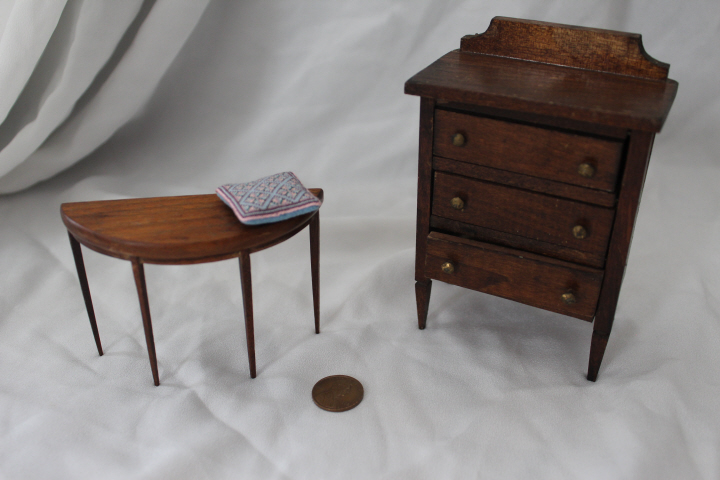
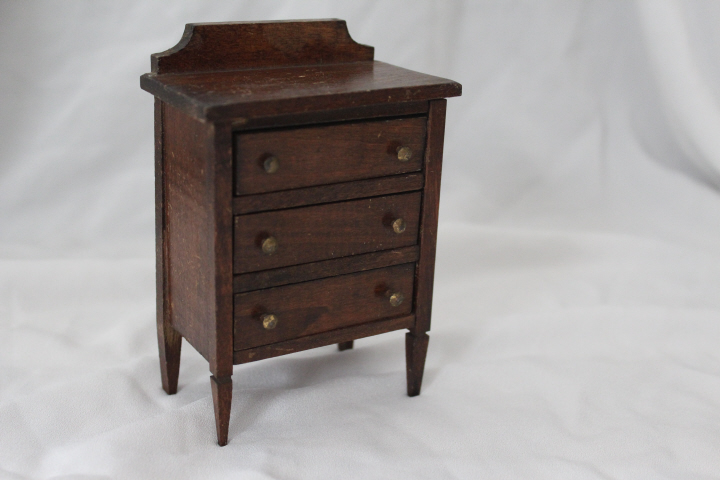
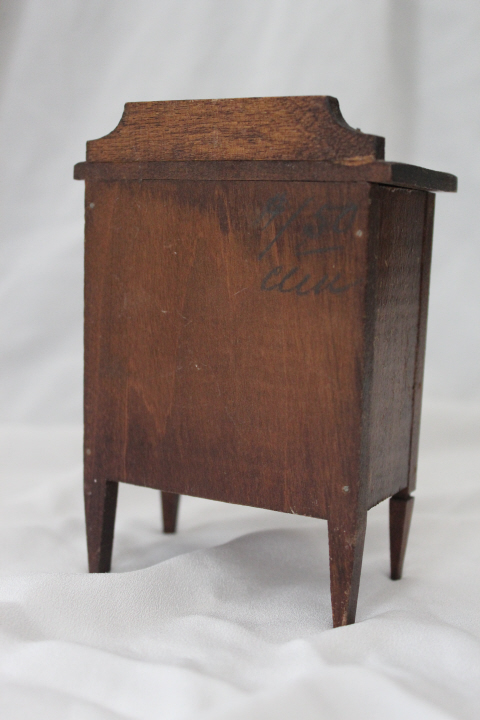
    At last! here is the new kitchen dresser for No.16.

    2982

    This is made to a 1/12 plan from the Victorian Town House chapter in Venus and Martin Dodge's New Doll's House Do-It-Yourself Book.  (There are in fact two different kitchen dressers in the book, of which this is the simpler.)  Mine is made of bass wood with thin plywood for a back, finished with wood conditioner only (instead of stain) and two coats of Krylon spray lacquer.  The drawer handles are glass-headed sewing pins.

    2974

    2977

    2979

    This took an extraordinarily long time to put together, I must admit, though pretty much all of that was due to my clumsiness, and apparently an innate inability to glue at right angles.  That said, the Dodges' plan is excellent, though fiddly, and I would recommend it either for beginners who are very patient or have an expert close at hand, otherwise for those with some modeling experience.  I've learned a lot about the process, wh. is good.

    I said before that I was tempted to just glue the drawer fronts into place, instead of making drawer boxes as the plan gives, but I realized that I would need something at the back to keep the fronts-only from being crooked, so was on the verge of cutting some lengths from a squareish scrap of plywood, one for each side of the two drawer holes, when David came home from Shanghai and said, "I'll just cut a block.  But I have to rout out a space for the pins," so that I could secure them with super-glue (since of course I pictured a pin coming right out the moment anyone tried to pull out the drawer).  So it turned out to be a little more trouble than my original idea, but not as much effort or time as a full drawer box.  I'm glad we did it this way, as it happens, as the drawers look much more realistic if one is slightly less pushed-in than the other!

    2953

    2976

    I will most likely either not use Gorilla Glue again, since it expands as it dries and therefore needs much more care in application than other glues, or let David do it!  I can still see some lumps, especially in these close-up photos, that I couldn't sand off — but really, in the room you don't really notice it.

    The center divider between the two drawers is the only piece of wood with its end visible from the front, and unfortunately it didn't occur to me that the end-grain would take the wood conditioner differently from the straight-grain, wh. is why it is noticeably darker than any other bit of the dresser, but there it is.

    Other than that, I'm quite charmed by it, and delighted to have the kitchen looking noticeably more kitchen-y than it has been — and the dishes look perfect!

    2983

  • 2895

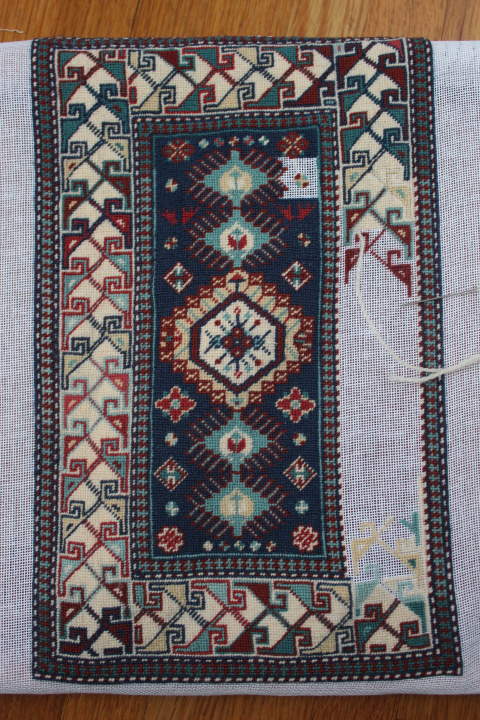
    I had to move my Shirvan-in-progress from a mat frame to my big wooden one, as the opening in the mat was really too big — I admitted to myself with great reluctance — and the canvas was distorting dreadfully.  The frame is much heavier and rather awkward for working in my lap, wh. I really have to do because most of the time I work it without my glasses, so have to hold it two or three inches from my face in order to get the benefit of my Super Microscopic Up-Close VisionTM.  I worked the smaller carpets on a smaller mat, which was perfect for holding up close, and fit into a regular 8 1/2×11 page protector or a zip bag when I wasn't working on it.  Oh, well.  The Shirvan is definitely happier in the frame, I could see at once, though it still has a bit of a list to port.

    I am pretty sure that the wobbliness of the stitches is going to come out in the blocking, so I'm not alarmed at present.

    2896

    You can see the built-in abrash, the color variations often found in Oriental carpets due to time and different dye lots, in the border greens, where there is a darker one along the bottom and a little bit up the side, then a mid-range green continuing.  I learned this word from Cooper, in fact, who remarked on it in the description of another of his charts, that he'd run out of wool and had to match it somewhat imperfectly.  This carpet actually has the color variation charted in a couple of places, so presumably the abrash is in the antique original.

    But you can also see the differences in tension, either where I was working up-and-down or side-to-side, or where the wool varied in thickness.  The cream is especially prone to the thick/thin issue — it's especially obvious to me in the little dashed lines along the bottom edge here, where the outer one is super-thick and the inner one is teeny-tiny.  I'm tempted to work over the teeny-tiny one with another thin strand.

    I am really enjoying this carpet, though! the colors are lovely.

    2897

    Here is another tension issue, though with a much happier initial outcome.  This is the first of Julia's mitts for her DC trip next month.  I got halfway up the stranded part, and wasn't very happy with my tension, so thought I'd try the inside-out trick.  You simply turn the piece inside out and knit it looking at the center — down the inside of the "tube" — and the floats are just a little more generous from traveling on the outside of the tube instead of the inside as usual.  I was really amazed at the difference between the two methods, which was obvious after just a few inches.

    2898

    This still needs a bit of blocking, to be sure, but is noticeably smoother already than the right-side-out method, especially at the needle joins —

    2900

    The spotted three-stitch stripe up the middle here would have been much wobblier than it is if I'd worked it right-side out.  The white is still a bit looser than it should be, but I'm hoping that a good blocking will fix that right up; I've noticed that Laura's pair, two years old now and much-worn, has tightened up noticeably (to me), so a little looseness at first shouldn't be a problem.  Bit of a mental adjustment, working inside-out, but worth a try!

  • Zhī zhēn

    2889

    David brought me these from Shanghai — I don't know how he managed to find a knitting shop, but he did!  The double-pointed sets are tiny, and long! so presumably they are for lace rather than socks, which is what he was thinking of.

    The Mandarin for "knitting needle" is zhī zhēn, or 织针, I'm told — the zhēn (needles) part of this character appears at the bottom of the paper packet that looks like a sleeve for chopsticks.  I guess the Chinese are still knitting with the UK needle sizing, as that is what these are all marked except for the bamboo circulars, which are stamped with metric sizes, and they still come in sets of four, not five.  I'm delighted to see that one of the circulars comes with a gauge for the fine sizes, as I don't have one!

    The circulars are interesting, as the one in the snowflakes packet is a steel cable encased in plastic, which is not only both strong and flexible but doesn't have that "flip" that plastic circs get in the middle of the cable after being in a packet for a long time.  I'm very intrigued by the bamboo sets, as they have what appears to be IV tubing, light and hollow and very flexible.  Not like I need to start a new project just now, but ….

    2894

  • 2879

    Progress on the Faire stockings.  I started these over when after a few inches I admitted to myself that my attempt to use dpns for their "historical accuracy" was more trouble than it was worth — because although at eight inches apiece my steel 2mm set is long enough for all of these stitches, it is also long enough to poke my hands at regular intervals, get caught in my sleeves, require frequent juggling of stitches to avoid a wobbly line between needles, and just be generally cumbersome — so I gave in and got out my 20th-century circulars. 

    Histknit2016 button 1

    I consoled myself by making this button for my historical-knitting projects this year, since apparently I have a weakness for blog buttons and Girl Scout patches.  On the bright side, the circulars increased my knitting speed by as much as 75%!

    2870

    I found this on my pincushion the other day — Julia, I suspect.  A cynical child, but with much more sensitivity than she lets on.

    958

    I had a bit of a lost weekend, when I discovered last Friday afternoon that FamilySearch has the Pennsylvania probate records microfilm available online.  It took me a bit of time to figure out the indexing system, and I'm still baffled by the page numbers that run not in a single sequence but a series of them with no apparent reason or — more importantly — no note at the beginning of the book to tell the searcher where each sequence starts and stops.  ("So is that the first page 1501, or the fourth??")  But, yeah, I looked up and it was Sunday.  I did not, alas, break down a single brick wall, of which I have a number in Pennsylvania, but I found some interesting things.

    2876

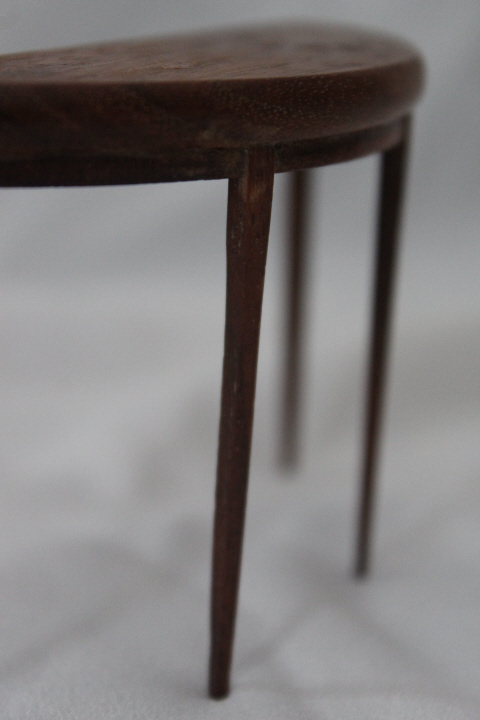
    Here is a dry-fitting of the kitchen dresser for No.16.  The top section is not glued to the bottom yet, as I haven't done the drawers.  To be honest, I think I'm just going to glue the drawer fronts in place, and not fiddle with working drawers — I can certainly understand the appeal of working drawers, and I'm not ruling them out in future, it's just that I found myself vexingly klutzy gluing the rest of this thing together, and I would rather just have a pleasing finished piece, and I only want to put stuff on the shelves anyway!  David has been in Shanghai for three weeks, so instruction has perforce been by e-mail, which isn't terribly convenient.

    I got a very generous gift card from my in-laws for Christmas, and still had enough on it last week to buy these on Ebay —

    2873

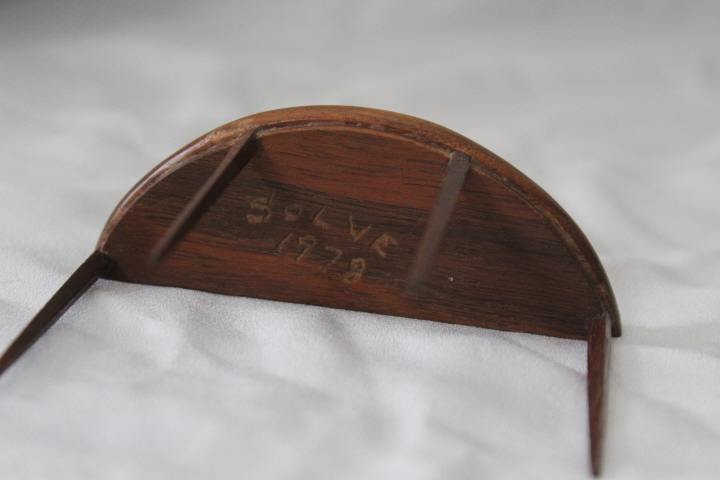
    The candle-stand and fire-screen came in a single lot, minimum bid $3.99.  I was the only bidder, as it happened, but I still hate Ebay auctions.  I can understand the thrill some people get from it, but it's just not for me: my heart started pounding anxiously even as I was only logging in.  (The first auction I lost, I discovered that they send you an e-mail afterwards with the subject line "Got Away!" and the pictures of what you didn't get, like "what a loser you are!")  The Connecticut table was a "buy it now" and although at $13.99 wasn't as triumphal a bargain, it was a much less stressful purchase!

    (How can the 1980s be "vintage"?  This is not possible.)

    2673

    I made a pair of "portraits" — not for anything, really, just to figure out how it works.  I found images of a husband-and-wife pair from some online auction house, reduced them to about the right size and layered a cutting circle on top to save myself some fiddling, printed, and stuck them on to these purchased charms.  Perhaps I didn't wait long enough for the glue to dry after this photo — they seemed stuck to the metal fairly well, but although Mister's "glass" went on perfectly, the one for Mrs. slipped a little and of course the picture stuck to the adhesive on the underside, so that now there is a noticeable sliver of silver showing near her hands.  If I can find another set of the charms, I might take the trouble to do them again, as I've got rather fond of the faces — unknown sitters, unfortunately.

    Screenshot-2015-06-10-18-15-09

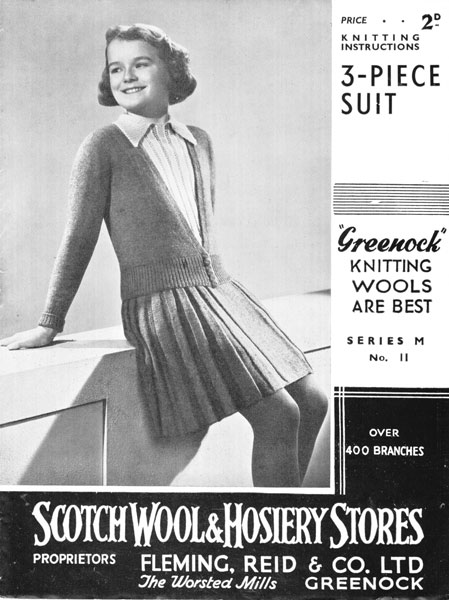
    The D.E. Stevenson list is reading Listening Valley, a story that begins in the early 1930s and follows Tonia, a shy girl with a sparkling older sister and indifferent parents, through the next fifteen years or so of her life.  It is not really a major part of the story, but Tonia has some undiagnosed problem with her hands, making her "butter-fingered", by which her parents are uninterestedly mystified but her sister and Nannie make generous allowance for her clumsiness.  A number of Stevenson characters in other books are seen knitting, but I suppose that this problem with her hands would mean that Tonia doesn't knit herself, but surely Nannie would make this jumper for her, because the quiet and withdrawn Tonia wouldn't have chosen zigzags down the front for herself but Nannie would think they add a little sparkle to her cheeks.  This late-thirties tuppenny Stitchcraft pattern leaflet is a scan from the British Library collection, generously available free from The Sunny Stitcher.

    2882

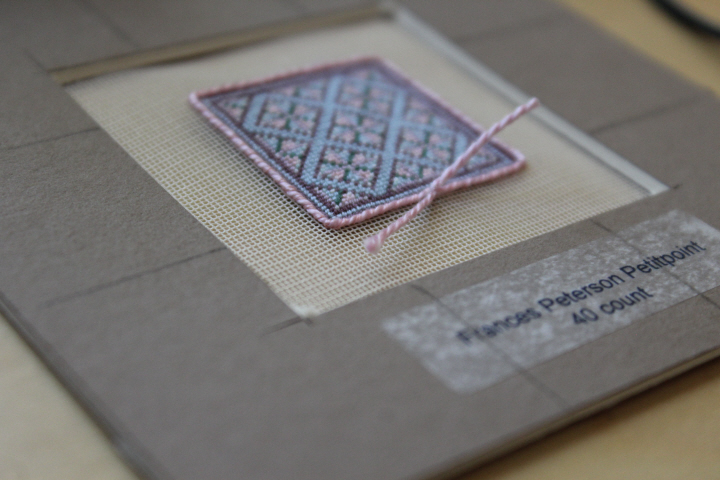
    Talking of Yahoo lists, I joined the Petitpointers list the other day, which as you might tell from the name, is for needlepointers in smaller gauges.  The carpet above is my first from Frank Cooper's book Oriental Carpets in Miniature, which I got for a song from a used-book seller.  This is the Shirvan 1 — even though I am reducing it a bit from Cooper's 18-gauge canvas to 22, it's still going to be easily twice the size of any miniature carpet I've done before, but the picture is really lovely, so I'm looking forward to it.  These are Paternayan wools, wh. I haven't used in an age.

    Dickerson sidney edward - 1936

    I'm also taking another FutureLearn course, entitled "Literature and Mental Health".  Jonathan Bate and Paula Byrne are teaming up to explore "how poems, plays and novels can help us understand and cope with deep emotional strain".  I enjoyed immensely Bate's "Shakespeare and His World" course — he's an engaging and level-headed instructor — and there are already lots of interesting discussions going on in the comments, plus with this first-run course the instructors are commenting and responding to comments as well, which makes it even more appealing.  There was a sort of attempt at the beginning to maintain an air of academic neutrality about the subject, but of course anyone who reads a lot will already feel, fairly strongly I suspect, that literature is a balm in times of stress or depression, so the outcome is already a foregone conclusion.  I didn't know beforehand that the professors would be talking to such luminaries as Ian McKellen and Stephen Fry, among numerous others, so that's a bonus!  I had to rush through another course, finishing six weeks' worth in less than three, in order to clear my slate for the Mental Health one, but I'm glad I did, as it is rather intense and deeply thoughtful at times, even in the first week.


    Adlestrop

    Yes. I remember Adlestrop —
    The name, because one afternoon
    Of heat the express-train drew up there
    Unwontedly. It was late June.

    The steam hissed. Someone cleared his throat.
    No one left and no one came
    On the bare platform. What I saw
    Was Adlestrop — only the name

    And willows, willow-herb, and grass,
    And meadowsweet, and haycocks dry,
    No whit less still and lonely fair
    Than the high cloudlets in the sky.

    And for that minute a blackbird sang
    Close by, and round him, mistier,
    Farther and farther, all the birds
    Of Oxfordshire and Gloucestershire.

    — Edward Thomas, 1917

  • 2663

    Julia and I went to our first miniatures show today, since it was quite close to home.  I don't know whether it was big or small compared to the average show, but there were nearly fifty vendors over sixty-some tables, so that it took us a good hour of exploring to look at everything before deciding what to spend our wodge of cash on.  (I had an envelope with me, on the strict admonition that that was all of the budget!)  I bought this charming basket and filled it with mushrooms from Twin Heart, and the Provence-style plate from Hemy & Laura's Miniatures.  The blue-and-white plate was from a "grab bag" bin at a vendor who didn't put a name on her receipts.  Hemy & Laura unfortunately do not have a website, but they have a range of really lovely decorated porcelain plates.

    2664 2

    Two copper pans — inadvertently similar shapes, but the one on the left was from the dollar bins! (“it’s only a dollar! get it, it’s only a dollar!” I kept hearing Julia murmur to herself as she poked through the bins) — and a mismatched pair of copper tankards, also from the dollar bin.  The pan on the right is from Lilliput Land.

    2666

    A mash-up from the dollar bin, a tall brass pedestal with the original white plastic bowl discarded and replaced with a clear-blue glass globe also from the dollar bin.  It's about as long as my little finger, so rather tall for a mantel tchotchke but amusing, and a lovely color.

    2667

    A set of glass jars from Vegas Airs, to be filled with preserves or some such later, and two tiny crocheted dishcloths from an Italian lady at Vilia Miniature (who also has an Etsy shop).  These are only about the size of my thumbnail! they must be made from sewing thread!

    2669 2

    The big blue jug in the back is from Rhea Strange, and the two brown ones from Itty Bitty Builder/Betty and Larry Herman.  There was surprisingly little at the show that was not the usual general-Victorian-era, but these I think will work well for my Elizabethan house-to-be.

    2671

    A charming hand-woven "rag" rug from Jane Graber, and a pair of (non-working) embroidery scissors from the dollar bin, with Julia's pair of full-sized ones for scale.  The rugs were lovely, lots of different colors available, and I could have happily bought more — this was the smallest one.  Graber also does really lovely hand-thrown stoneware and redware, but apparently sells directly only at shows and by post — so I will start saving up for next year!
  • 2404

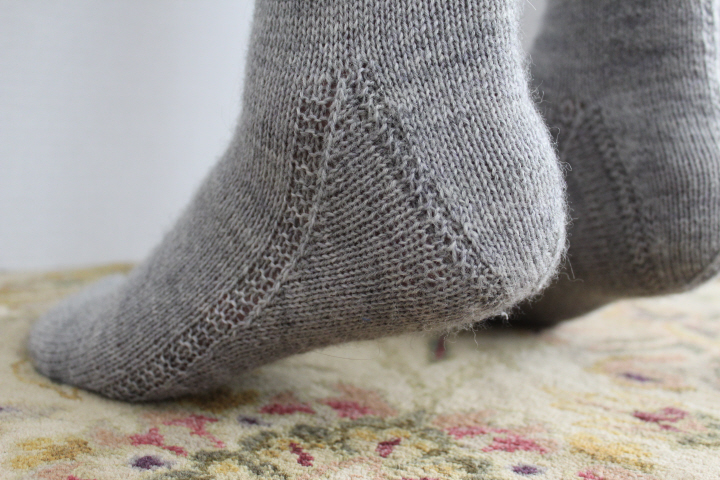
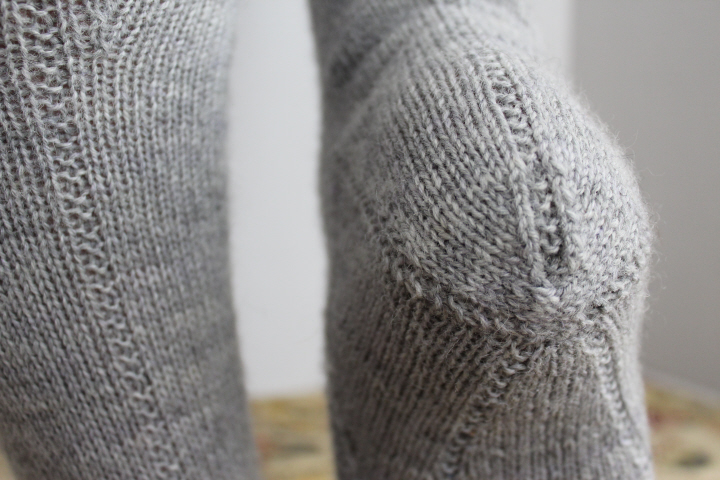
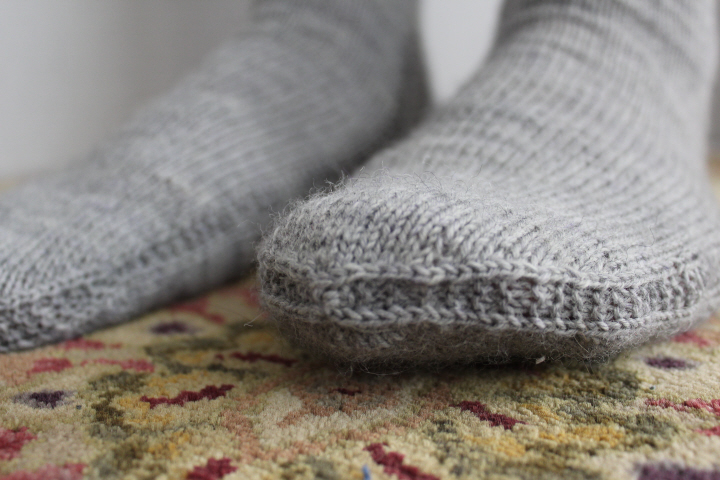
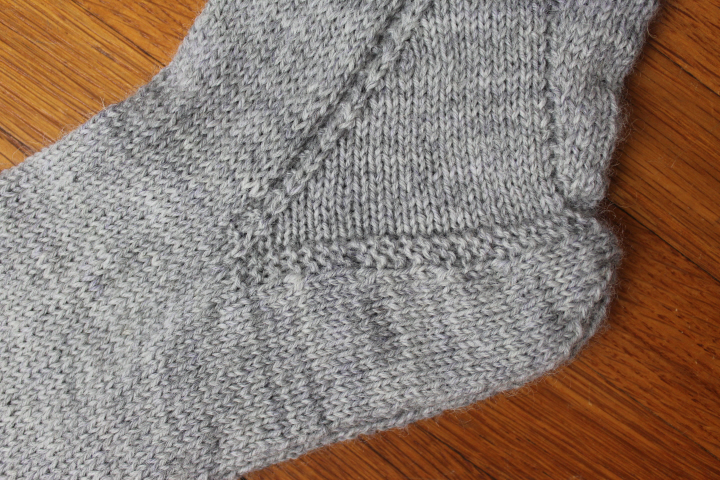
    The Renaissance Faire is coming up in April and May, which sounds a long way off unless you need to make some more garb, in which case it’s uncomfortably close.  I am the only one who has a complete outfit that still fits — Julia grew out of hers and into Laura’s, and is now edging her way out of that one, and David never has had period nether garments (no, he just wore some old Dockers!), so since knitting I think will take me the most time, I am going to start on a pair of knitted stockings for him, to go under a new pair of Venetians.
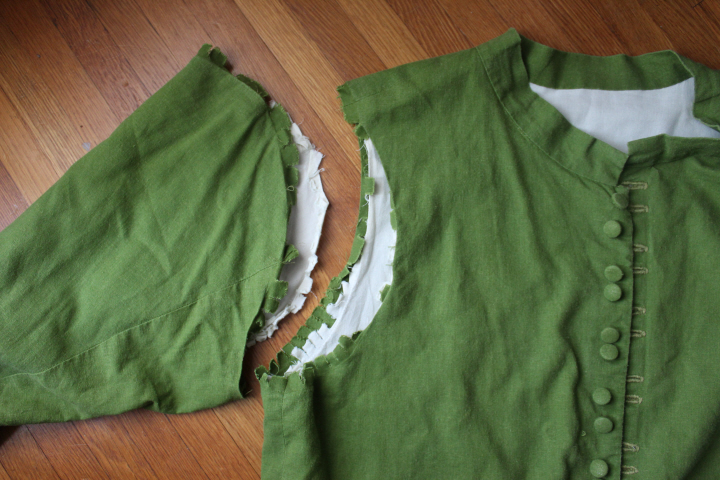
    David doesn’t really have a “persona” since we aren’t deeply enough into Faire-going for that, though I did originally start his garb thinking “Swedish soldier” (since he wants a sword!), but as his green jerkin is a little snug in the arms, I am thinking of re-fashioning it — so I don’t have a definite style in mind for the ensemble, but luckily for me there are only minor regional variations in stockings, if indeed there are many at all.

    There are in fact a number of good and excellent reconstructions of 16th-century stockings available, and one could either recreate a known stocking or cobble together bits from different ones.  This, I suspect, would be the best route since of course a stocking knitted for a particular person would have to be adjusted anyway.
    Being not only of natural fibers, generally wool (and therefore vulnerable to time and the elements), but everyday (and thus not “worth” saving), extant 16th century common stockings are fairly rare, but here are two from the Museum of London —
    Stocking 1 of a pair - 16th century - Museum of London A26851

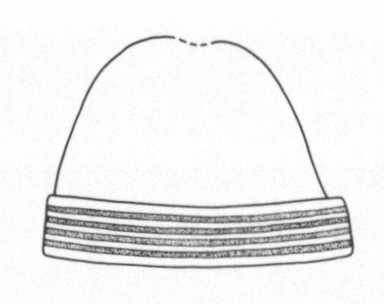
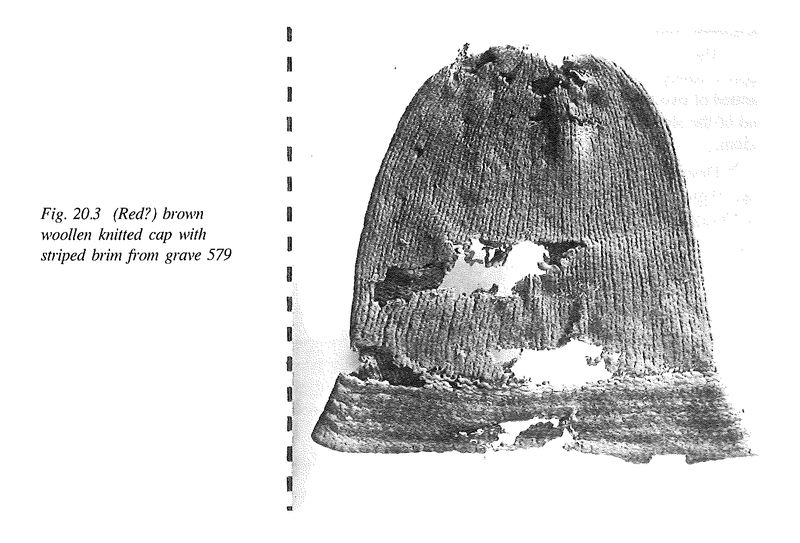
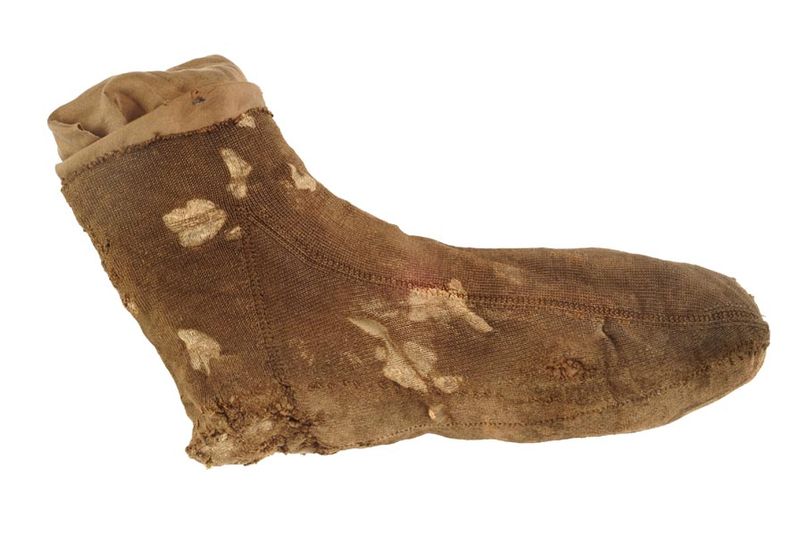
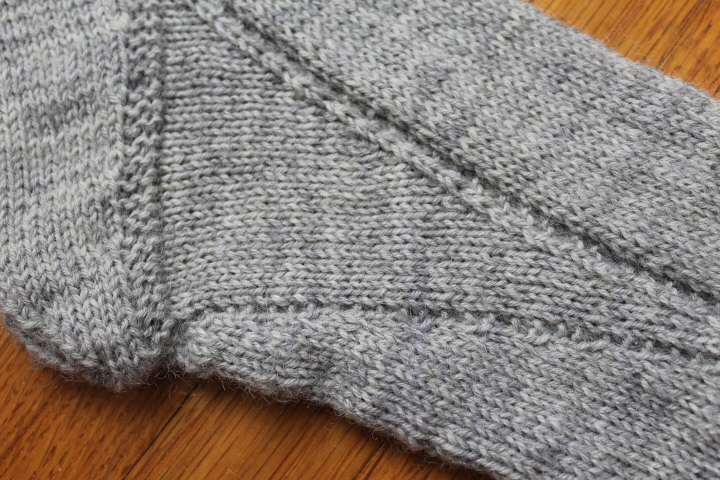
    One of a pair of stockings (nos. A26851 and 2), found at an archaeological site in Worship Street, Finsbury, EC2.  The stockings are described by the Museum as “knee-length wool” with a vague date of “1501-1599”.  This is obviously a very basic stocking, with little or perhaps even no shaping until about halfway down the foot, where there are a couple of decreases, presumably preparatory to narrowing the toe.  It isn’t clear in the photograph, and perhaps the stocking is too damaged now, to tell whether there is a round toe or a wedge, but apparently both were known at this time.  I suspect that the strange angle of stitches at the heel is a darn, not shaping, but it would be interesting to see the other of the pair to be sure; unfortunately an image is not posted on the Museum website.

    Stocking foot - mid 16th century - Museum of London A13833
    Stocking foot (no.A13833).  The Museum writes, “This skilfully knitted silk stocking-foot is the only example of its kind in England. A highly fashionable garment, it was probably imported from Italy or Spain. It may have been sold in one of the luxury drapery shops in Cheapside,” and gives the gauge as a very fine 18 sts and 30 rows per inch.  They date this “mid-16th century” but allow that stockings began to appear in England during the reign of Henry VIII, though they were rare and expensive at that time.

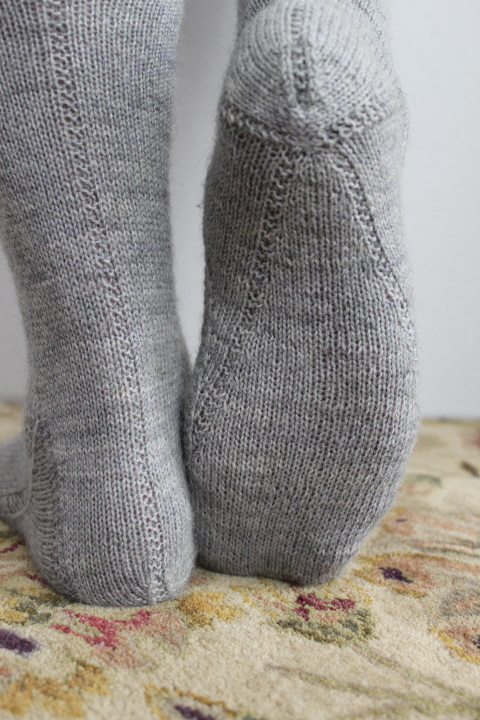
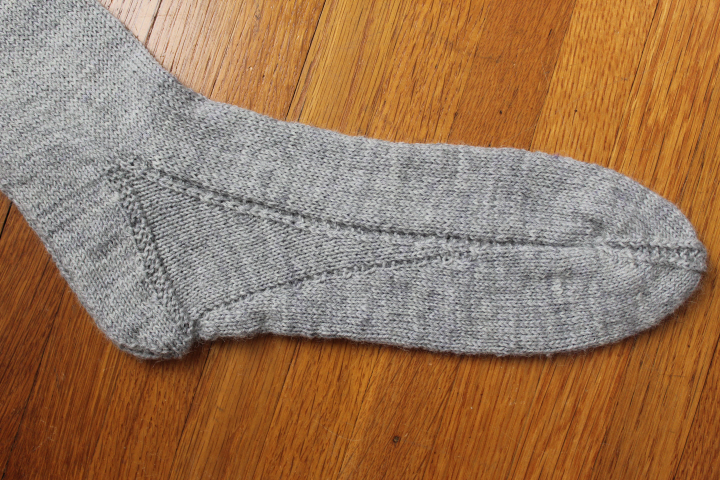
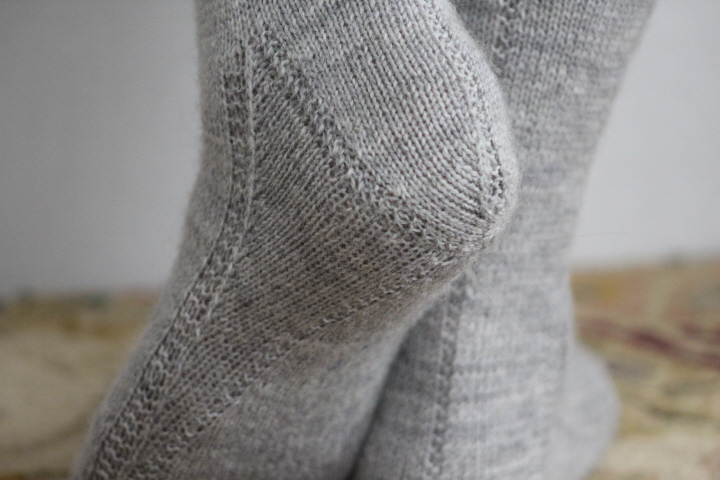
    This particular stocking foot is clearly related to the “Barnim foot” with its inverted gusset opening from the center bottom of the heel outwards to the toe along the bottom of the foot.  This knitter has neatly edged both the instep gusset and the foot gusset with garter stitches, making a very elegant foot indeed.  The heel appears to be a common heel, possibly even unshaped, much like the Exenterata stocking of 1655.  Interestingly, there appear to be decreases narrowing the heel flap towards the bottom —- would these be meant to pull the heel flap more snugly against the wearer’s foot?  I’m puzzled by the other line of what appear to be holes, running just about parallel to the bottom edge of the foot in this photo — they seem unusually tidy for damage, but I can’t explain them otherwise.

    So I have thought and thought and changed my mind any number of times — CarnamoyleGunnisterJohan IIIBarnim?  English?  Swedish?  Anglo-Scandinavian? Scottish-Anglo-Irish-Scandinavian?? — but David is off on another long trip at the end of the week, and I’d like to have a good bit of the first stocking knitted before he leaves, to make sure I’m on the right track shaping-wise, so I’m going to cast on right now ….

  • Sontag 1

    I’ve gathered here numerous period photos of sontags and maybe-sontags, and some not-quite-sontags, as part of my research as I knit one for myself.  I remember some historical costumers sighing over the fact that all of the sontags they saw at re-enactments were knitted to the same pattern, again and again, but it’s pretty obvious from these photographs that there must have been as many different versions as there were knitters, so that unless the modern knitter is actually re-creating a period pattern, there is no reason why you need to stick to the basketweave one from Godey’s.

    The version worn by the lady above might be knitted in a honeycomb stitch, to which she has added a two-color crochet edging.  She also appears to be wearing fluffy netted sleeves.

    Here are three original patterns —

    1860sontag

    the earliest one from the 1860 Godey’s,

    1861 godeys sontag

     another one from the next year’s Godey’s (1861),  (A “habit-shirt” was a sort of dickey, or as Chambers’ dictionary has it, “a thin muslin or lace under-garment worn by women on the neck and shoulders, under the dress“, which sort of makes sense but not quite here, as of course the sontag is worn over one’s dress.)

    1862 petersons sontag

    and a third by Mrs. Weaver, in Peterson’s Magazine of 1862.  The two Godey’s patterns are very similar in effect, especially with the faux ermine trim (!), but the first one will result in a definite U-shaped piece, while the second will give you a V-shaped piece, since you not only start with only five sts but you also don’t cast off any sts at the back neck.  There is no mention at all in the second one of closures, whether ties or button.

    Mrs. Weaver’s is different yet again, as while she does use the U-shape (which would certainly sit better on the wearer’s neck), her front points appear to be a little squared off, and at least in the illustration don’t wrap around the wearer’s body.  She is unfortunately rather non-committal about how one secures it, which might explain the solution of these two ladies —

    Sontag 4

    Sontag 11

    which appears to be to simply to tie it together with a cord over the wings at one’s waist.

    Sontag 10

    The photographer has with his highlighting unfortunately obscured the details of this lady’s sontag, but it has a very similar crocheted border to that of the lady in the top photograph, though here the shell stitch is in a single color.

    Sontag 12

    This one appears to be entirely crocheted, but is not perhaps strictly a sontag either, since the ends don’t seem to go all of the way around the wearer’s waist and attach to the back of the garment.

    Sontag 13

    This lady’s sontag has a deeper and frillier border than most, which make it come further down the upper arm than the previous ones.  Her ties are also longer than the others, but also end in pom-poms.

     Sontag 14

    This lady has chosen a very striking three-toned stripe for her sontag.  It’s too bad that her arms are in the way, as it looks like the points of the sontag end in the front, presumably with ties that wrap all of the way around and back to the front.

    Sontag 2

    This is I think the most “famous” example of a sontag now, as it’s the one you see most often if you Google “sontag bosom friend”.  It appears to be entirely crocheted, and unlike the 1860 Godey’s pattern, has ties that wrap all of the way around and back to the front.

    Sontag 3

    This lady’s is quite vivid with its checked two-color pattern!

    Sontag 5

    This is the only one I have seen that does not have a contrasting border.  It’s too bad the image isn’t bigger, as it looks like she might have used a ripple or feather-and-fan edging.

    Sontag 6

    This lady shows up in a collection of sontag photographs, but I don’t think it really can be called that, as while it is clearly related, it doesn’t wrap around the wearer, who has instead attached it at the neck, perhaps with a chain, and left the points to hang free like a short tippet.

    Sontag 7

    Sontag 8

    I am not sure that this can really be called a sontag, either, as it doesn’t wrap around in the same manner.  This looks to me like she heard about a sontag and thought it was a good idea, but hadn’t seen the illustration.  (Or perhaps made it according to the pattern in the book and found out, like so many of us do, that it was too small, and just made do.)  I do like the lacy border, though!

    Sontag 9

    Oh, I wish this image was bigger!  It looks very like the Godey’s basketweave.  The “wings” on this one are rather short, perhaps not even making it to the wearer’s side — which is just what the 1861 Godey’s one does, where “the ends cross over the bosom”.

    In summary, the definition of a sontag or “bosom friend” seems to be a U- or V-shaped piece which lays over the wearer’s shoulders, with the wings being long enough to either just meet at the waist (with straight ends) or, far more usually, to wrap around the waist, sometimes to the extent of meeting at the center back.  Strings or cord of some sort are usually used to secure the wings, with those that are long enough being secured also with a button where the points meet at the back.  There is always some sort of edging, often crocheted but sometimes knitted (perhaps also with a narrow crochet edging); the edging is usually in a contrasting color.  The crucial element of a sontag, if you want to be a stickler (and don’t we?!) seems to be its U- or V-shape, otherwise it is a variant of a hap or similar shawl (triangular or square folded cross-wise) that wraps around the waist and ties at the back.

    (I doubt, by the way, that it was ever called a “bosom buddy”, which I have seen lately.  The word “buddy” first appears in print, according to Merriam-Webster, in 1850, just a little earlier than the sontag shows up, but I suspect that it would have been thought too slangy for ladylike use.  The phrase “bosom buddy” first appears, according to Dictionary.com, in the 1920s, much too late for the sontag.)

  • 2223

    This is the Khotan No.25 miniature carpet from Meik and Ian McNaughton's wonderful book Making Miniature Oriental Rugs and Carpets.  I started this all the way back in August, as it happens.  It has been almost finished for quite a long time, but I ran out of one of the colors and had to wait for another skein, and I didn't block it very well the first time and had to do it again, just at the last before I sewed down the hem.

    2206

    I still didn't get it quite true, so I need to be sure to block a piece really severely before working the edging next time.

    This was actually a very tricky chart, and it took me some time to stop confusing the colors in those stepped medallions!  The wools themselves had a little more difference between them, luckily.

    I noticed not very far into working it that the colors in the photograph of the finished carpet were noticeably different from what was in my hands, and so I decided after some internal debate to change the background of the center section from the lightest wheat-colored shade to a cream in my stash.  Unfortunately what looked like cream in the ball turned out to be putty (Appleton's 988, left over from the Holbein carpet), so the finished carpet looks neither like the original colors should nor the slightly-off illustration in the book, though it is not unpleasant, to be sure.  I just think the putty doesn't play quite as well with the wheat of the border as I had hoped.

    2220

    I also switched out the "dark" wheat-ish shade (903) for the medium one (766) on the border — the 903 is quite auburn, and I liked the more-brown one better.  By the way, this is how far you can get with one skein of each color —

    1382

    so I would recommend two skeins of the 766, certainly if you are going to use it for the border instead of 903.  (This photo shows that I was going to use the "hemming row" trick, but after working the Wm. Morris one, I realized that the finer gauge on this carpet would make it considerably trickier, and as I'd already decided that the hemming row isn't really necessary with an edging stitch, I went ahead and worked it without hemming.)

    2227

    I managed the McNaughtons' edging stitch much better this time, though I think it doesn't have quite the same handsome braided look that the long-legged cross-stitch does, as the "braid" is nearly on the underside.

    I did work the fringe a smidge too short — it's like cutting your hair, that when you smooth it down you think "there!" and after you cut it, it bounces back a little, so I need to be sure and keep this in mind with a wool fringe!  This is two strands of wool, without "fluffing" the strands with a pin afterwards.

    The finished measurements on 28-count Monaco canvas are 6 1/4 in. x 3 1/2 in. (16cm x 8.75cm), not counting the fringe.

    The McNaughtons write of this 20th-century design, "The carpets of East Turkestan, now part of the Chinese province of Sinkiang, show some Chinese influence in their decoration, including the use of muted colours, as in this example. The details of the design, however, show a clear relationship with both the Caucasus and Anatolia in the geometric stars and the decorative Kufic border."  I can read neither Kufic nor Chinese, but the border pattern has a strongly Chinese look to me! so it's fascinating how it manages to convey both at the same time.

    2237

  • The old favorite "Ding Dong! Merrily On High" arranged by Charles Wood, performed by London Contemporary Voices.  Hope you've had a merry Christmas!

  • The German carol "Joseph Lieber, Joseph Mein" sung by Anonymous 4 (the women) and New York Polyphony (the men).  A gorgeous performance, like angels.  Want to try it at home?