• 4742

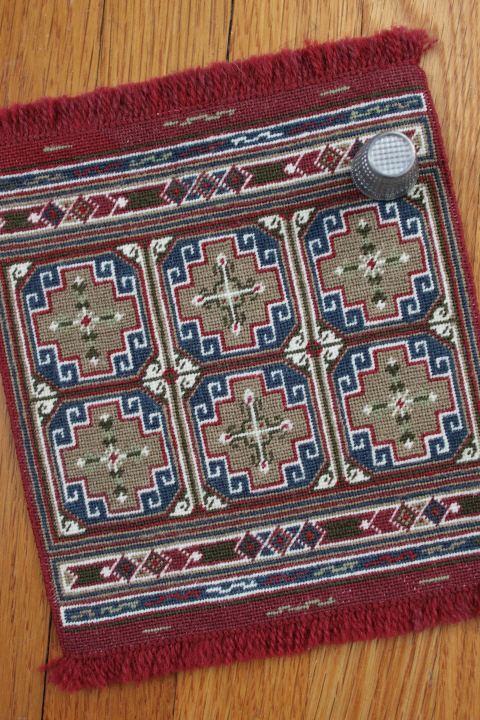
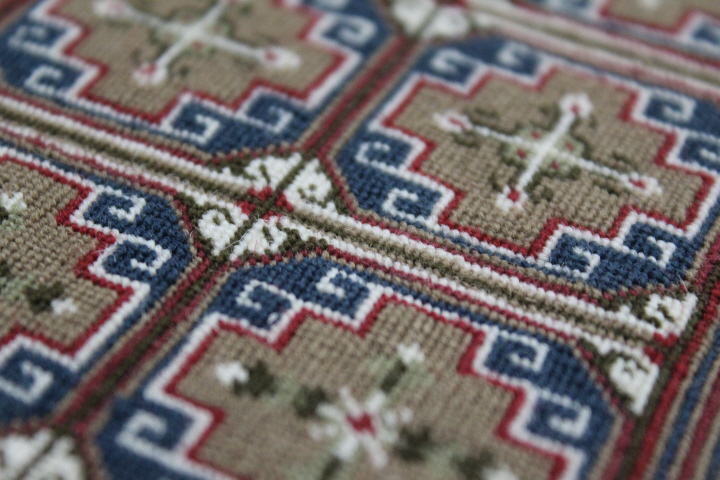
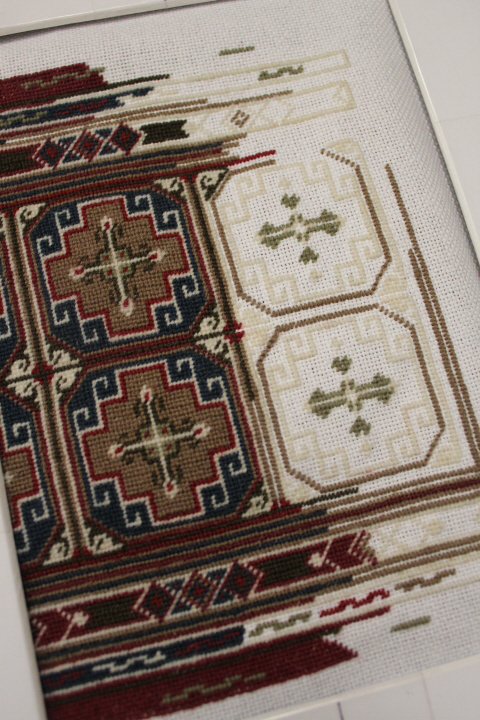
    This is the Karagashli carpet, number ten in Meik and Ian McNaughton's Making Miniature Oriental Rugs and Carpets

    4743

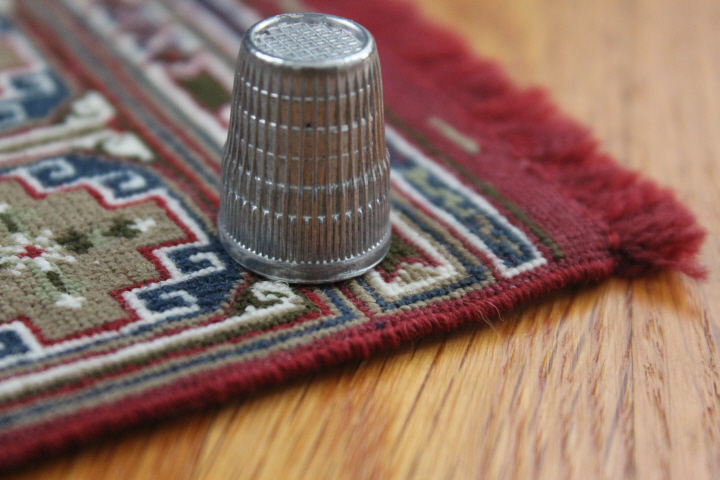
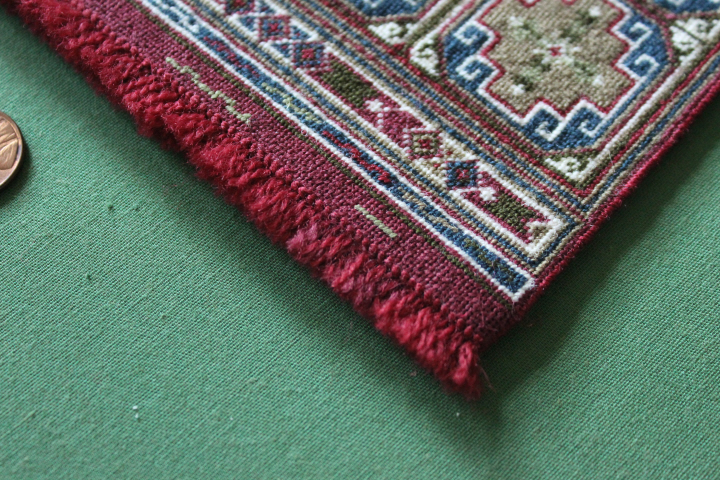
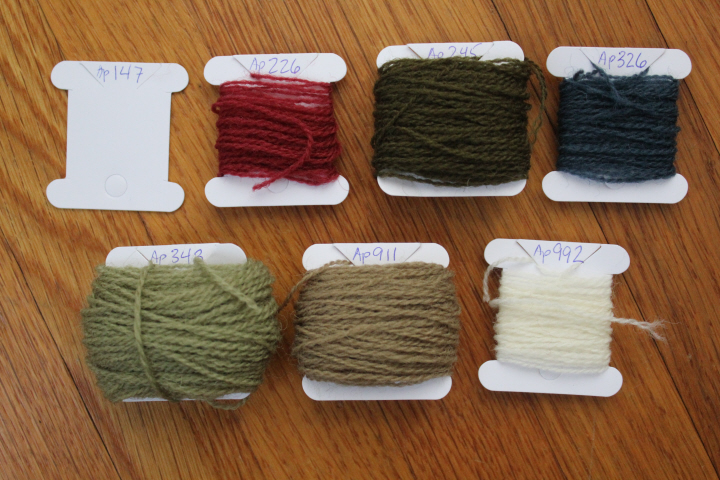
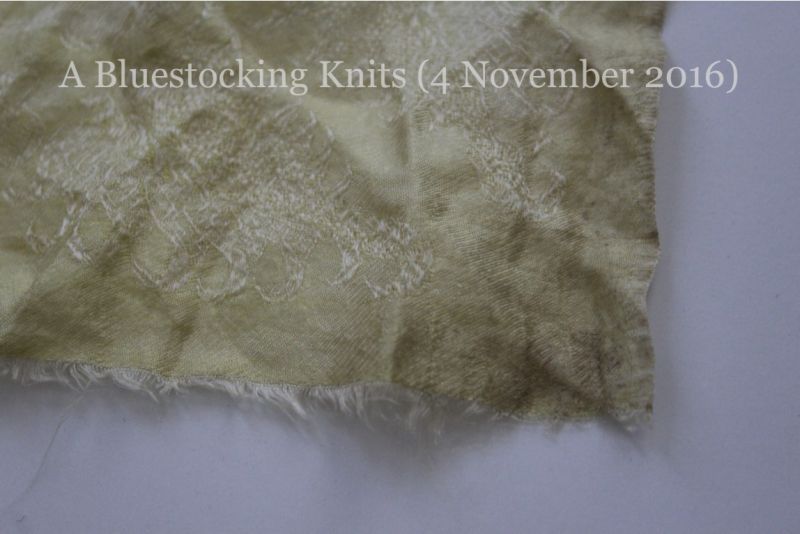
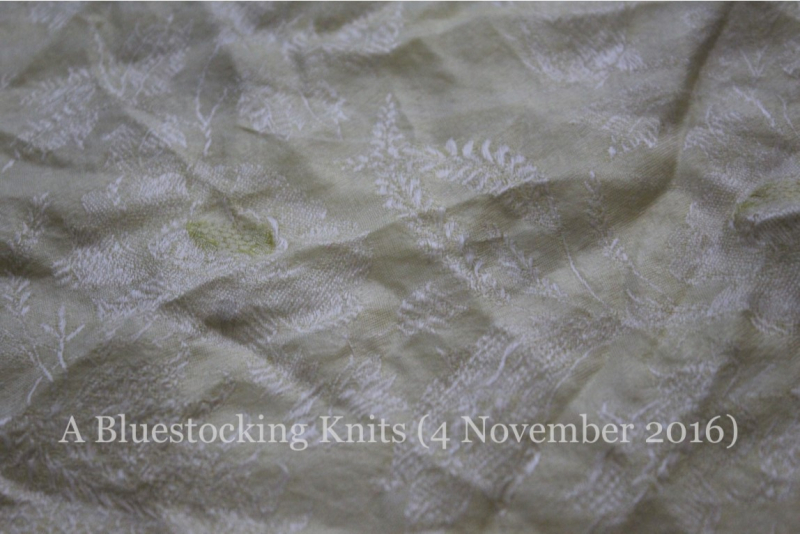
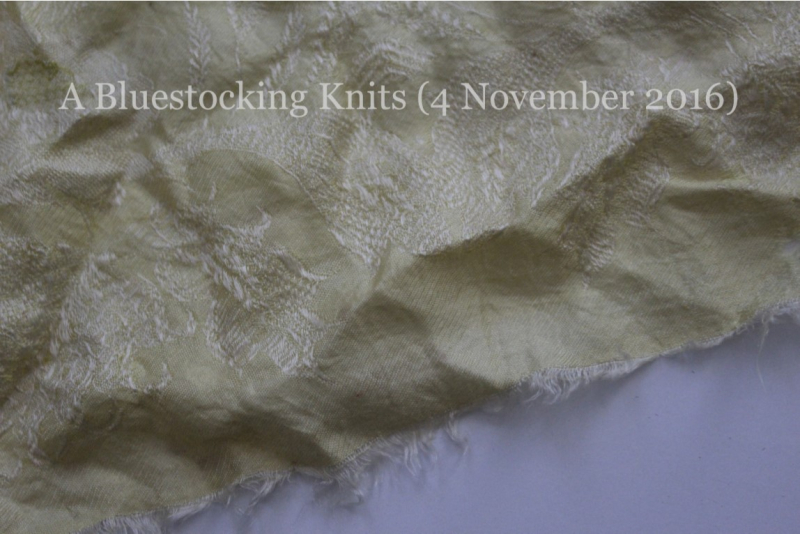
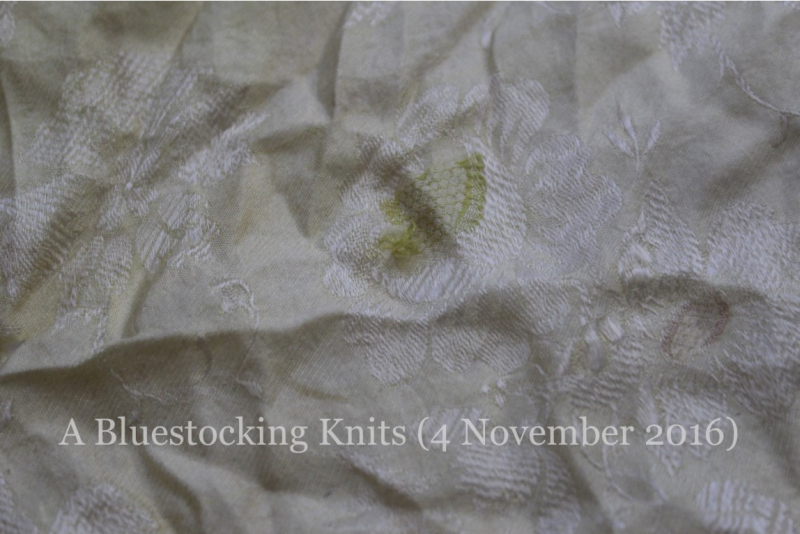
    It is worked in Appleton's crewel wool on 22-count Hardanger canvas, something of an experiment as I haven't been able to easily get hold of 24-count canvas, which is what the McNaughtons use throughout their book, and I had only 22-count and 28.  The coverage of the Appleton's is erratic at this gauge, even inadequate in some places, I'm afraid.  I noticed that the lighter colors have better coverage than the darker ones, so perhaps this is due to the peculiar effect of different dyes on the same kind of wool — I've noticed this in knitting wool, certainly.  I wanted a good-sized carpet, so I chose the larger gauge, going on various needlepoint websites that assured me that Appleton's is for 18-count. I did get the wool to bloom a little in the blocking, though — soaked it in warm water for a few minutes, roughed it up a bit, whacked it on the side of the sink — which did actually work a little, but you will have to take my word for it as I'm afraid I forgot to take a "before" photo.  There are still some noticeably thin spots, but, well, I will just call it "wear and tear" on an "antique" carpet, I guess!  I purposely didn't block it very hard, either, to leave it looking even more aged.

    4753

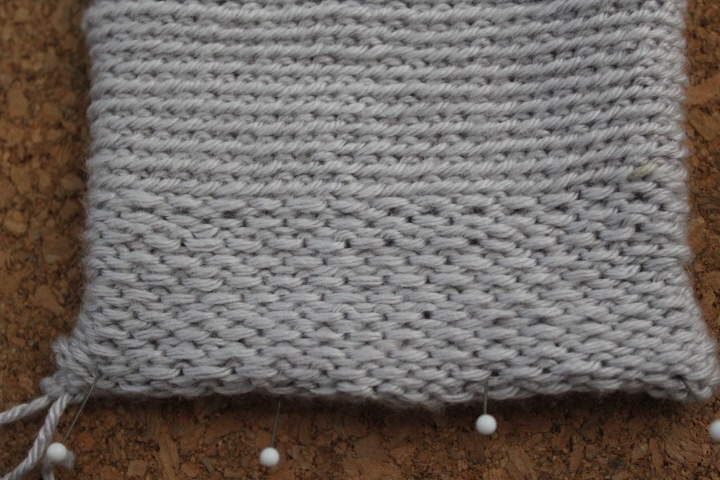
    I had just enough of the green wool left to make a small sample to compare "before and after".  I suspect now that much of the inadequate coverage has to do with the particular stitch used, as you can see on my afterthought-sample that the canvas shows through on regular diagonal lines every other stitch, and I have also noticed in other projects that the stitches lie differently when the continental is worked to the right than when it goes to the left — so, like knitting, it apparently can make a noticeable difference what direction the wool goes in at the back of the canvas as it comes in or out of the stitch on the right-side.  It is possible that continental stitch would have provided better coverage, but of course with more attendant warping in the finished piece.

    (On closer inspection, I see that even some of the other carpets in the McNaughtons' book show a little canvas in the darker background sections, so perhaps even 24-count canvas is a bit skimpy in some projects.  Oh, well.)

    4750

    This is the second carpet I've worked from this book, and while the first chart was flawless, this one had a small but fairly glaring mistake in the outermost border (repeated, because apparently the chart was mirrored for printing) but it was so obviously wrong that it was not at all difficult to spot it before I worked that area.  I did notice — eventually! — that the three red rhombus-ish motifs in the center are actually slightly different from each other, but whether this is a mistake or intentional, I don't know.  ("Only Allah is perfect.")  Mine are worked slightly differently, because I assumed that they were all the same and wasn't working strictly to chart!  But otherwise I'm delighted with this design, and the planning that went in to making the odd-sized motifs fit into a regular field — notice that the white "stars" touch the border at the bottom end, while there is a single line of green background on the opposite end, and that the whole arrangement of central motifs at the bottom is not quite in the same places relative to each other as in the top part — by only one row — but since it is only one row, you hardly notice it, only that everything fits neatly.  This ever-so-slight imbalance is in order to accommodate a perfectly regular arrangement of the border motifs, and I can only admire the meticulousness of designers whose corners have full, continuous motifs, not lopped-off overlaps.  And I would also highly recommend this particular chart for a beginner to petit point, as the border is very logical and therefore easy to work, yet the central panel is rather fantastical and interesting.

    I suspect that the McNaughtons' designs are not based on specific antique carpets, as Frank Cooper's are for instance, but they label this one as "mid-19th century" so perhaps it is more in the style of a mid-19th century Karagashli than a miniature version of a particular one.  They write, "Karagashli is a village near Kuba in the eastern Caucasus.  Many carpets woven there display a series of banner-like red rhomboids on a turquoise background, surrounded by white cruciform stars and strange, bird-like motifs.  The pattern in the main border is known as 'leaf and chalice' pattern.  It is not peculiar to Karagashli, but is widely used in Caucasian weaving."

    Here are two full-sized Karagashlis, in fact, from the very helpful and interesting identification guide at Azerbaijan Rugs in San Francisco —

    Kuba_karagashli10

    Kuba_karagashli14

    which clearly show the inspiration for the miniature version.  It would be fun to work the McNaughtons's chart again with the dark-turquoise background, though I do like the green.  There are also ones in the guide where the abrash is quite noticeable, and a handsome one where the two background colors are reversed, with a mid-blue on the leaf-and-chalice border and a golden-ivory in the center panel.  (Interestingly, the guide calls the border "leaf and calyx" — like the McNaughtons, I guess, I certainly immediately saw chalices!)

    4682

    4755

    New skill for me on this project: basketweave stitch.  Most needlepoint guides, online and in print, tell you to do larger swathes of single-color stitching (backgrounds, for example) in basketweave, which unlike continental stitch has a tendency to keep the canvas true.  I'm guessing that this comes from the strong angle of the back of the continental stitch, which you can see here in pretty much everything except the green background and the red in-fill of the large medallion.  Presumably the vertical/horizontal alignments of the back of basketweave stitch counteract the slant of its front.  But I got my nerves all a-jangle by various sources warning that you must alternate the vertical and horizontal rows or you get a little ridge visible from the front — fair enough, but the instructions on how to do this seem to involve a whole lot of trying to keep straight which is the warp and which is the woof of the canvas and whether you have used vertical on the warp or on the woof, say by going "under" on the "overs" (or is it "over" on the "unders"??) and this all just made my brain go aaaauuggghhhhhh.  But since this particular piece had already turned out to be a "teaching moment" I thought, "right, just try it" and dove in.  After carefully working a good-sized plain section in one corner, I realized that this is the back of a "down" row —

    4676

    and this is an "up" row —

    4681

    It seems quite a simple matter to me to tell which is which, so I worry that I'm missing something and it actually is really tricky.  As long as you have a long-enough row for the stitches to be clear, it shouldn't be a problem — but since this revelation I have been making it a point to stop on a long row like these where it is quite obvious how the stitches are lying, or even better to start a row and pause it in mid-stitch so that I can see right away in which direction I've been traveling.

    4752

    4747

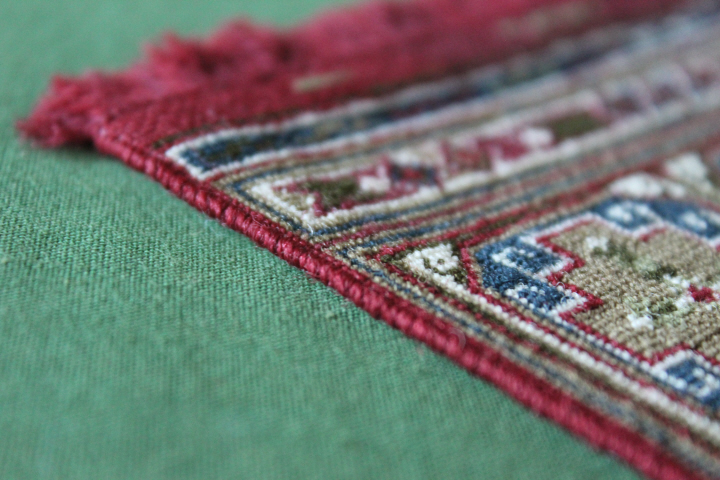
    This is the overcast edging, as Janet Granger uses — I wasn't sure if there was enough blue to work one of the "braided" edgings.

    Now that I've had a chance to look at it finished, I'm less unpleased with it than I was before, so perhaps if I put it in a darker corner of some roombox, the wonkiness will look quite natural!

    4741

  • ,

    “Apron for B”

    4653

    Some time ago my mom gave me an apron pattern that my grandma had made from newspaper, which upon closer inspection I realized was the pattern for the apron Mom has had for just about as long as I can remember, so when I recently found a remnant I'd picked up somewhere that had a groovy late-60s vibe, I decided to make one for myself.

    This red-and-black one is the original apron.  The newspaper doesn't have the date on it, but it has ads for "On a Clear Day You Can See Forever" and "Airport" and "Song of Norway", which premieres-in-the-present-tense November 10, 1970.

    I don't have very many things left that Grandma sewed — and she was a master seamstress, especially I remember at coordinating Easter dresses for us four cousins! but it seemed there was always something going on the sewing machine in her bedroom, and stray pins in the carpet — so this apron is fun for me to see her stitching.  She took a shortcut with the bias edging, and just sewed it on all at once with a zigzag stitch, but I don't hold that against her at all.  There is also a little, erm, digression on the button facing, but she was getting on for seventy by then!

    4649

    4650

    4651

    4652

    4654

    Mom doesn't actually wear an apron that much any more, but this one obviously saw quite a bit of use back in the day.

    4667

    4671

    4672

    Here is my version —

    4656

    I made a few changes — I did make it longer than the paper pattern, as Grandma suggested, but first cut a 1 1/2" strip across the grain of the fabric at one end to use as the ties, then extended the length of the apron the full length of the remaining fabric.  (I prefer narrow ties on my aprons, but I found after wearing Mom's a few times that the narrow-bias-tape ties are too narrow for my liking.)  I made two pockets — why not, there were two pieces left from the armholes! — and cut the two little facing triangles from the selvedge edge so that I wouldn't have to hem them.  I also did a turned hem on the top of the pockets, instead of using the bias tape edging, and I did felled seams at the shoulder because I loves 'em.

    The apron from my scant yard of remnant is just finger-length.  I should have made the straps a smidge wider, as they were just too narrow to sew them inside-out and turn them, which I prefer, but there it is.  I used two packages of narrow bias edging, with quite a bit left from the second package.

    My stitching certainly isn't going to win any prizes — I can't seem to "stitch in the ditch" for anything, as the wobbly bits in these photos prove, but it's an apron, and I'm happy!

    4661

    I did not plan, by the way, for the fabric pattern at the button closure to match so nearly perfectly! a happy accident, to be sure.

    4658

    4659

    4662

    4663

    4664

    4665

    4666


  • 4627

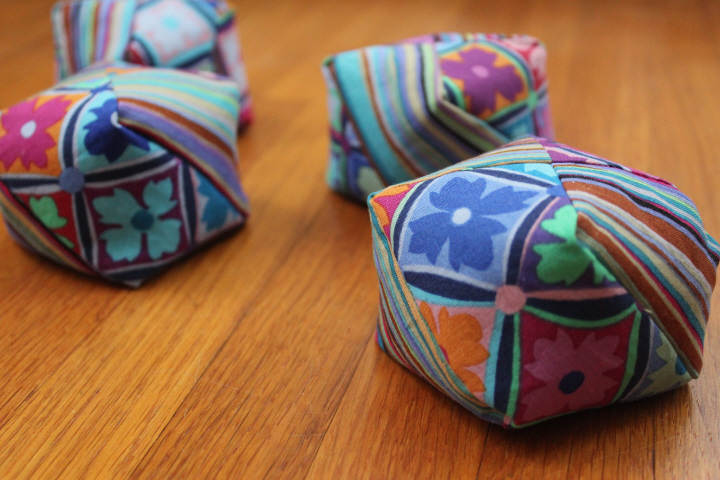
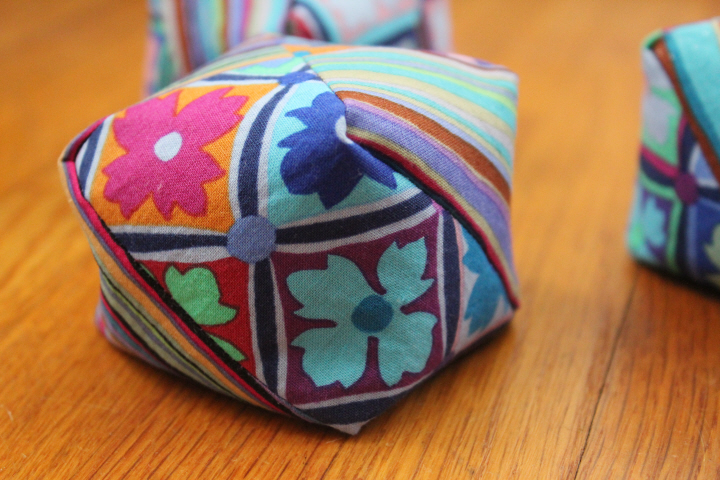
    Somewhere in a late-night rambling on the internet, I came across mention of felted-wool dryer balls.  You toss a few in the tumble-dryer and they help to move the drying clothes around, decreasing drying time — they also help to remove static and to soften clothes without chemical fabric softeners.  I'd heard of using tennis balls for this, but when I was having a bit of a late spring clean the other day and came across some decades-old knitting wool that I really have no knitting use for but couldn't bear to throw away, I thought, "well, felted dryer balls, of course!"

    4612

    This is New Zealand Wool "Wellington", 100% Perendale wool in a handsome heathered green.  I had eight skeins — it's a doughty wool, to be sure, but not really something I'd want to wear near the skin, which is why I haven't done anything with it in the last, oh, twenty-five years.  I remember how unusual it was to come across real wool at Super Yarn Mart, which is why I was so susceptible to it when I did — doubtless the reason that I bought this, plus that it was from exotic New Zealand.

    4614

    4617

    I used the dryer-ball tutorials from Good Mama and DIY Natural, which could hardly have been easier.  I wound up golf-ball sized balls, one from each skein (about 4 grams' worth of wool), tied them into a "caterpillar" in the leg of an old stocking, with a tie between each ball, then ran them through a couple of cycles with our regular laundry yesterday, and this morning wound the rest of each skein onto the resulting felted centers. 

    To continue the sports analogies, the fully-wound balls — 2 oz. of wool, though generously five or six more grams than the 56.5 indicated on the label — were about the size of softballs, which felted down to about the size of baseballs.

    4621

    The only warning I'd give is not to attempt to felt two "caterpillars" in one load of laundry!  It took a good twenty minutes to get them untangled and I had this song stuck in my head for hours afterwards.  Some of the balls also came out a bit wonky from being smashed up against each other in the stocking, and some of the fibers got enmeshed in the nylon, though only giving it a sort of aura that didn't last through the dryer cycle.

    But the wool felted beautifully, with almost no visible lines at all from the strands of yarn, and I expect that after a few loads of laundry, they will be fully felted and quite round.

    4624


  • 4603

    Here, at last, is the Shirvan I miniature carpet from Frank Cooper's book Oriental Carpets in Miniature.  This is the first piece I've worked from the book, so I really only had the photos for clues as to its worth.  I don't know why it spoke to me so very much, but although there are others in the book that are more "my style" (whatever that is), I found myself coming back to this one again and again.  It has, I think, a really charming raucousness to it!

    This particular chart (one of three Shirvans in the book) is based on a 19th-century original, wh. unfortunately I haven't seen yet.  Now part of the Azerbaijan Republic, Shirvan is an historical region in the Caucasus, on the western side of the Caspian Sea.  There is a Wikipedia article about the Kuba "family" of carpet styles from this region, and a longer one here about Shirvans, from an antique-rugs dealer.

    4592

    As for the chart, one of the bigger flaws in Cooper's book, I must say, is that there are similar symbols for similar colors, so here, for example, you have a large X for dark green and a medium-sized x for medium-green, resulting for me at least in constant checking of the key and trying to decide if that's a small x or a big one (because the chart is tiny even when enlarged 200%).  At one point, I ended up photographing the chart with my camera at the highest resolution, and printing out sections of the center panel enlarged as big as the piece of paper would hold them.

    Quite a number of the figures in the center panel are not the same in the chart as in the photograph of the finished carpet, mostly in the color choices, but occasionally in the shapes as well — this is a fairly serious flaw too, in my opinion, and only adds to the difficulty of reading a very small and rather indifferently reproduced chart with similar symbols for similar colors.  But, really, I love this carpet.  I did simply turn the chart face-down and work from the photograph at times!  Throughout the book, Cooper does sometimes point out that after writing a chart, he changed his mind and worked a particular figure in a different color, but while that isn't really an issue (because you know about it ahead of time), the sheer number of "inconsistencies" in this particular carpet lead me to feel that these are mistakes, not design choices.  So, on the whole, stitcher beware, and if you want your piece to look like the photo in the book, you'd best keep a close eye on it as you progress, but if you are willing to either modify as you go or pick out sections that you just worked by-the-chart, then you'll have fun.

    This carpet is worked in Paternayan wools on 22-count canvas, a bit smaller than the original 18-count.  I think that this is pretty much as small as one should go with Paternayan, as the irregularities in some of the strands made it quite crowded (or thin) in some areas, though thankfully most of this doesn't show in the blocked piece.  The Paternayan didn't worm on me nearly as much as Appleton's has, so there is that to be considered!  I made a rather stupid mistake when buying the wool and assumed that when Cooper said "15 strands of blue" or whatever, he meant strands in the way that you buy Paternayan, which comes in a triple strand — whereas he meant single strands, so I ended up with pretty much three times as much wool as I needed.  I can't think why I didn't look at my basket — since I was there in the shop with the stuff in my hands — and think "this is far too much wool for a miniature carpet!" (blush).  I may end up adapting another chart to use up some of this stash, now!

    4530

    I also somehow broke two Bohin tapestry needles, one snapped clean in half and the other a broken eye, both used on this project alone, as they were in a new packet.  The third seemed to compress about the eye as I worked, as it was easy to thread at first but then got more and more difficult but is still in one piece.  I am prepared to admit that my use of Paternayan on 22-count canvas was on the snug side, but was the breakage due to this or to the needles themselves?

    4597

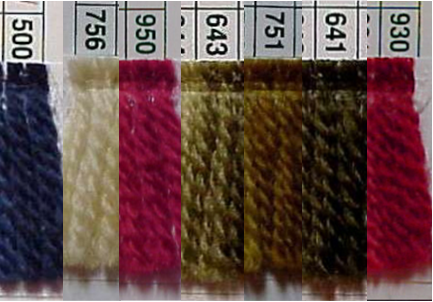
    As for my own modifications, I changed the gauge of the canvas, as I say, since 9 x 14 in. was considerably larger than what I wanted — as it is, mine is 7 1/2 x 12 in. (19 x 30 cm), quite a large carpet in 1/12 scale.  Aside from the most obvious but unavoidable use of a dark blue a shade lighter than in the book — because that was what the shop had in stock (thus 501 for 500) — I sometimes used a lighter shade for a darker one, especially in the center section where they sometimes seemed to sink into the dark blue.

    I decided not to attempt to learn something new for this carpet, despite some of the Petitpointers listers assuring me that basketweave stitch would work perfectly on the backgrounds here, since I had already started working some sections in continental and the advice also had it that I shouldn't change in mid-stream.  I never did get the finished carpet quite straight, even after three hard blockings, so I will definitely try the basketweave in similar situations in future!  On the bright side, I really wanted the carpet to look if not well-used then at least not-brand-new, so in that sense the wonkiness is actually a plus.

    4595

    I also used the long-legged cross-stitch edging, which at this scale I think was a little too much, since it is naturally rather thick, with all of the overlapping stitches, and mine ended up a bit lumpy in places, possibly due to the thick/thin variations in the Paternayan, or to my tendency to switch from working it horizontally to vertically — I think, certainly with this particular edging, consistency is key.

    4599 2

    Amusingly, I still can't decide which is "right side up".  The little dog-like figures in dark red in the center section certainly want to be this way up, but since the chart was the other way around in the book — and so that is the way I worked it — what Cooper calls the "eagle-head" figures in the large border look completely upside-down this way to me!

    I get the feeling — assuming that the miniature version copies faithfully the full-sized carpet — that the weaver improvised a lot of it.  The color choices are not particularly well-balanced — the eagle-head figures in the border have a kind of splotchiness to them if you just look at light vs. dark, and if I had planned the design out on paper before weaving, I would definitely have switched the two pairs of circley figures in the corners of the center panel, so that the light/dark balance would be better.  The center medallion is also really lopsided — why? that would have been an easy fix — when you look at it from the side.  But, on the other hand — I really love the improvised look of the finished piece, so that every complaint I have about the design makes me shrug and say, "I just love it anyway!"

    4598

    4600

    One of the things that appeals to me most is the use of colors in the big border, the way they flow back and forth between light and dark, and the subtle differences between the three greens, and between the three reds.

    (I learned a new term from Cooper, by the way — abrash, which is the variations in shade in a particular color, due to dye lots or fading over time.  You can see a built-in example of abrash in this carpet, where Cooper has used a darker green at the ends of the carpet, which goes all of the way across as it would if woven, and seems to "change" dye lot to a lighter shade in the middle.  I "faded" one of the outer puzzle-piece borders accidentally, when I picked up an even-lighter shade of green, but happily this looks quite natural!)

    4602

  • 4610

    Without having the original Ytre Norskøya hat in hand, or at least a first-generation photo, it's difficult to do much more than improvise the shaping, and so this isn't really a pattern so much as a guideline.  You will need to adjust the shaping both to accommodate your yarn gauge and to fit the wearer, anyway.

    A little less than 40 sts are visible in the photograph of the original hat, so there would be about twice that in the knitting. A circumference of 50cm at "1.6-1.8 stitches per cm" works out to 80-90 sts total, but remember that this measurement is after fulling.

    4584

    As for shaping, Vons-Comis says that the stitches are "decreased regularly at two points in the cap which lie directly opposite one another", which is certainly how it looks in the photograph, where there are no decreases visible at all, even when by the shape of the crown they must surely be there!  It might be wishful thinking on my part, but it looks to me as though in the last few cm there really are some decreases spread (evenly?) across a decrease round, so for my reconstruction, I've used a slight modification of the round-toe shaping I used on my blue Smeerenburg hat.  There certainly might also be some shaping in the now-damaged parts.

    4588

    I am a bit puzzled, I admit, by this description of only two shaping points lying directly opposite each other, since in my mind's eye this makes something more like a garrison cap, though perhaps the fulling and subsequent wearing of the Norskøya one makes it more rounded.  I decided to shape my version more according to the general shape in the photograph, than to the description —

    Vons comis 1987 - 2

    In full, Vons-Comis’s paragraphs about the cap are as follows (all question marks in the original):

    The deceased [in grave 579] wore a woollen cap on his head (fig. 20.3). This is a single thickness (red?) brown cap with a turned-up brim, with light brown (originally white?) and dark blue stripes. The cap is 26 cm long including the 5cm turned-up brim. The circumference of the cap at the junction from crown to brim is 50cm, with the greatest circumference, 60cm, reached at the lower end of the brim.

    Knitting probably began at the lower edge, by casting on stitches with (red?) brown wool and knitting one row in plain stitch. After this, two rows in purl stitch were knitted alternately light brown (white?) and dark blue. There are 1.5 sts per cm, and 4 rows per cm (table 1) [which is a chart of the various twists, plies, thread counts, and colors of the Grave 579 textiles]. As the brim is felted it is not entirely certain whether the yarns are (Z-?) plied or not. The number of stitches is decreased regularly at two points in the cap which lie directly opposite one another.

    After 5cm, one round was knitted in purl with (red?) brown, thinner wool. Then the cap was continued in the same colour using plain stitch, so that when the brim was turned up only plain stitch would be visible on the outside. Yarn composed of two 8-twisted threads which were not plied, or hardly plied, was used for the crown. The count also differs: 1.6-1.8 stitches per cm and 3 rows per cm. The cap is slightly felted inside. Some damage seems to have occurred in the coffin as a result of either the effects of the decay of the corpse or soil conditions. No patches or darns were discovered.

    I have used Paton's Classic Wool because it was to hand and is 100% wool, so fulls easily.  After over 250 years in the ground, the colors of the original cap have apparently browned considerably, and Vons-Comis suspects though is not quite sure that its original main color is red, with dark blue and probably white (now light brown) rounds on the brim — Classic Wool's "Cognac Heather" is a brownish red, which may at least roughly substitute.  I chose "New Denim" as a mid-range blue, and "Natural Mix" as a compromise between the original "white?" and the aged light brown.  At 20 sts per 10 cm, the gauge is finer, though, than the 15-18 sts of the original wools.  I have not tried to use two different weights of wool, as in the original cap.

    You will probably want to work a swatch in your chosen yarn and full it, to get an idea of how much the knitting will shrink, though I did not.

    4586

    By the way, I seem to be using "hat" and "cap" interchangeably.  Technically there is a difference, but it still isn't a simple matter to place the Smeerenburg/Ytre Norskøya ones on one side of the divide or the other.  "A hat has a brim, a cap doesn't, or only a bill" = this is a hat (though some of the other Rijksmuseum ones are therefore caps).  "A cap is usually made of [some] soft material, whereas a hat is grander" = this is a cap.  "A cap fits closely to the head" = this is a hat.  I don't know!

    Ytre Norskøya Cap 1

    The finished dimensions of the original cap — after fulling, mind — are 5cm for the height of the brim, then 21cm from there to the top of the crown, 26cm total, and 60 cm circumference at the cast-on edge, narrowing to 50 cm at the join between the brim and the beginning of the crown, though it is not clear if this is through shaping of the knitting or stretching of the fulled cap.

    Use slightly larger needles than usual for the yarn, to allow for shrinkage later.

    Cast on 80-90 sts plus 10, or desired number (also plus 10, to allow for slight shaping on the brim) using either the long-tail or Old Norwegian cast-on, in red wool.  Join for working in the round.

    Work 1 round in red.

    Work 2 rounds in natural in reverse st st, then work 2 rounds in blue in reverse st st.  Rep these 4 rnds 3 times more, or until brim measures about 5 cm; at the same time, dec 5 sts evenly on 5th rnd and 10th rnd.  Cut natural and blue yarns, and work on in red.

    In red, work either 2 rnds reverse st st or 4 rnds garter st.  This completes the brim.

    Work in st st.  The decreases in the original are apparently made at beg of rnd and at midpoint of rnd.  Work for about 16 or 17 cm, decreasing occasionally as desired at first, then more rapidly, to make a pleasing shape, until the piece will be about 24 cm after fulling.

    In order to have the shaping start rather gradually, before starting the crown shaping proper, I worked [dec 4 evenly around circumference, work 4 rnds st st] twice, with the second dec round offset, so that the second set of decreases came roughly centered between the first set.

    I used the following crown decrease:

    Rnd 1: K5, K2tog, rep to end [substituting K1 for K2tog 4 times because I had 74 sts total].
    K 5 rnds.
    Next rnd: K4, K2tog, rep to end.
    K 4 rnds.
    Next rnd: K3, K2tog, rep to end.
    K 3 rnds.

    and on in this manner until there were 11 sts rem, the previous rnd being all K2tog — then K2 tog twice, K3tog (why? I don't know!), K2tog twice, then cut the yarn and draw through the rem 5 sts.

    This made a fairly similar crown shaping, though as I said, without having the original in hand or photographs from different angles, I'm a bit puzzled as to its shaping.

    4585

    I fulled mine in the sink, since the stitches in the original cap are quite visible, and it is easier to stop when the fulling is "done" if you can see it.  I did decide to safety-pin the brim to the body of the cap to keep it from rolling during this process, though, not having enough experience with it to know if it would lie flat — this worked pretty well, and it stayed flat without markedly-obvious "waves" at the pin placement points (though these are a little more visible on the purl side of the brim, as in the photo just above!).  My version did shrink a bit more — to the point of obscuring the stitches, I mean — on the crown than on the brim.  Interestingly, the brim shrank only a fraction of an inch — I noticed this as I was fulling it and worked at it a bit more than the crown, though as to whether this slow shrinkage is because of the different dyes in the wool, or because I'd pinned it up, or some other reason, I've no idea.

    4576

    4580

    Dimensions before fulling: brim 3", total height 17", width 12".  Dimensions after fulling: brim 2.75", total height 10" (with brim folded), width (just above brim) 9.75". 

    Let me add my praises, by the way, to the numerous ones already being sung in favor of Classic Wool's feltability!  It has a lovely, rather velvety texture after this mild fulling, and would have a bit more body (which this particular hat does need) after a bit more time in the hot bath, perhaps, but the ease of the process and the resulting hand of the fabric make up for that.

    4590

    On the whole, I think this a fairly reasonable reproduction, though obviously not a strict one, of the original Grave 579 cap, with the caveats I've mentioned above.  Taking into account the differences in wool and in the unpredictable results from fulling — mine is definitely more splayed towards the bottom than the original! — I'm quite pleased. 

      Histknit2016 button 1

    The Project: an Ytre Norskøya hat, based on the knitted hat from Grave 579 on that island in the Svalbard archipelago
    Year or Period: ca.1700
    Materials:
    1 skein Paton's Classic Wool worsted (100g/3.5 oz.; approx. 192m/210 yds.) in "Cognac Heather" (MC), with less than 15g each in "Natural Mix" (CC1) and "New Denim" (CC2); US8 needles
    Hours to complete: about a month of not-particularly-dedicated knitting, plus a few days for fulling/drying time (18 May-27 June 2016)
    How historically accurate is it? fairly accurate considering the modern materials, but the lack of better photos of the original garment is a handicap
    Sources/Documentation: "Kleren maken de man: zeventiende- en achttiende-eeuwse kleding van Spitsbergen" by S.Y. Vons-Comis (pp.97-118 in the book Walvisvaart in de gouden eeuw: opgravingen in Spitsbergen, ed. by Louwrens Hacquebord and Wim Vroom, De Bataafsche Leeuw, 1988); "Seventeenth century garments from grave 579, Zeeuwse Uitkijk, Spitsbergen" by Sandra Vons-Comis (pp.175-186 in “Textiles in Northern Archaeology”, NESAT III : Textile Symposium in York, 6-9 May, 1987); "Workman’s clothing or burial garments? Seventeenth and eighteenth century clothing remains from Spitsbergen" by Sondra Vons-Comis in "Smeerenburg Seminar" (Rapportserie, Norsk Polarinstitut, no.38, Oslo 1987), also containing the paper "Textiles from Danskøya" by Ingrid Lütken, plus others noted in the previous post

  • While I was doing some online research about the Smeerenburg caps I wrote about a few weeks ago, I came across a pattern for one called a "Smeernberg" cap, which the author said was Swedish.  Well, of course I was intrigued, not only for the historical knitting and the connection to Smeerenburg, but to the fact that it was said to be Swedish.

    The page was pretty old — one version of it was in fact defunct — but with the help of a member of the HistoricKnit list I'm on, I sent an e-mail off to the author, Maeve Kane, who responded, as we used to say, "by return of post" and generously provided me with no less than four PDFs of her sources.

    Spitsbergen

    Spitsbergen is the largest island in the Svalbard archipelago, some distance off the northwestern coast of mainland Norway.  It was first used as a whaling base in the 17th and 18th centuries by the Dutch and the Danes, then for coal mining by the Russians and as a fishing base for various northern countries.  For centuries, the whole archipelago was known as Spitsbergen (from the Dutch spits + bergen, "pointed mountains"), but after control was ceded to Norway in the 1920s, it was re-named Svalbard (sval + barð, an old Icelandic name for the place probably meaning "cold edge/coast") , and after 1969 the name Spitsbergen referred only to the largest island in the group.

    Traankokerijen_bij_het_dorp_Smerenburg_Rijksmuseum_SK-A-2355

    Smeerenburg, the first and largest of the whaling settlements in the area, was on a point of Amsterdam Island, in the NNW corner of the archipelago.  It was founded by Danish and Dutch whalers in 1619 and in its heyday had sixteen or seventeen buildings, including a fort, with cobbled alleys so that the men could keep their feet dry — an important consideration in a place where the summer temperatures average 4 to 6° Celsius (39-43° F) and polar winds with it.  This 1639 painting by Cornelis de Man, "The Whale-Oil Refinery near the Village of Smeerenburg", was not painted from life, but is supposed to give a representative if somewhat clean picture of the settlement in its prime.  Late-Victorian idealism gave the settlement a population in the tens of thousands, though the reality is more likely to have been at best about two hundred.

    Here is another, closer map —

    Map_of_Albert_I_Land_north

    (Bree is Norwegian for glacier [breen = the glacier], and øya is "island".)

    Another whaling settlement was about fifty km to the northwest on Ytre Norskøya, which settlement was founded around the same time as Smeerenburg by a rival whaling company.  By the time it was abandoned fifty years later, there were at least 165 whalers buried in its cemetery.

    (Click on the speaker symbol in the Google Translate box here to hear how to pronounce "Ytre Norskøya"!)

    In this photo, seen from the south —

    1280px-Fair_Haven_Ytre_Norsköya_IMG_5062

    the settlement and burial sites are at the foot of the steep rise.  As much of the area is now national parkland, visitors can still go to Ytre Norskøya and here is another photo, from the Norwegian Polar Institute —

    Utsikt_mot_Norskxysundet_utsnitt_markert_1

    facing the south (towards Indre or "inner" Norskøya) with the gravesite area outlined in yellow.  Tourists are asked, I hope needless to say, to not land or walk in that particular spot because of the fragility of the graves, nor to remove anything.
    From 1979 to 1981, archaeological excavations were carried out at Smeerenburg and Ytre Norskøya, where about a hundred and 150 graves respectively were found, those on Ytre Norskøya at least in danger of being eroded by the sea.  Due to the polar conditions, much of the clothing in the graves was very well-preserved, and in one of the Ytre Norskøya graves, numbered 579, was found a man wearing these clothes —

    Vons comis 1988 - 1

    Many of the whalers' garments were remarkable for the sheer number of patches and repairs made to them, and this particular jacket is singled out by more than one researcher for that very reason.  It's a poignant reminder of not only the ingenuity and tidiness of the whalers, but also of their distance from home.

    Vons comis 1988 - 2

    Vons comis 1988 - 1 detail

    In full, Vons-Comis’s paragraphs about the cap are as follows (all question marks in the original):

    The deceased wore a woollen cap on his head (fig. 20.3). This is a single thickness (red?) brown cap with a turned-up brim, with light brown (originally white?) and dark blue stripes. The cap is 26 cm long including the 5cm turned-up brim. The circumference of the cap at the junction from crown to brim is 50cm, with the greatest circumference, 60cm, reached at the lower end of the brim.

    Knitting probably began at the lower edge, by casting on stitches with (red?) brown wool and knitting one row in plain stitch. After this, two rows in purl stitch were knitted alternately light brown (white?) and dark blue. There are 1.5 sts per cm, and 4 rows per cm (table 1) [which is a chart of the various twists, plies, thread counts, and colors of the Grave 579 textiles]. As the brim is felted it is not entirely certain whether the yarns are (Z-?) plied or not. The number of stitches is decreased regularly at two points in the cap which lie directly opposite one another.

    After 5cm, one round was knitted in purl with (red?) brown, thinner wool. Then the cap was continued in the same colour using plain stitch, so that when the brim was turned up only plain stitch would be visible on the outside. Yarn composed of two 8-twisted threads which were not plied, or hardly plied, was used for the crown. The count also differs: 1.6-1.8 stitches per cm and 3 rows per cm. The cap is slightly felted inside. Some damage seems to have occurred in the coffin as a result of either the effects of the decay of the corpse or soil conditions. No patches or darns were discovered.

    Vons comis 1987 - 1

    Presumably the brim is turned down in this photo, as the reverse side of the knitting is clearly visible, whereas when worn it would have been turned up as Vons Comis describes.  (Note, by the way, that the drawing of the cap and the photograph of it show rather different proportions.)

    Lars Vig Jensen dates the jacket found in grave 579 as ca.1700, so presumably the wearer’s cap would be the same. Jensen also notes that “No specific nationality can be assigned to any of the three cemeteries discussed [Likneset, on the Vasahalvøya peninsula of Albert I Land, Ytre Norskøya, and Jensenvatnet on Danskøya]; however, the graves must represent a majority of whalers from the Dutch and German provinces together with a minority of personnel from England and Scandinavia…. The textile finds should be generally characterised as being Northwest European” (p.52, emphasis in original).

    Maeve also mentioned that Vons-Comis describes the 579 cap as single-knit, but at the time of her research she’d also found a similar cap with a double-knit brim in the Skokloster Castle collection, though the image doesn’t seem to be online now (http://emuseumplus.lsh.se/eMuseumPlus). I suspect that Maeve’s 2006 pattern was a mash-up of a number of descriptions of whalers’ caps, and that perhaps the “Swedish” description was simply a mistake. (Presumably there may have been a Swede or two among the whalers at some time or another, but there is apparently no surviving identification on any of the hundreds of burials except I think two, so really no way of knowing the nationality of any of the burials anyway.) Maeve’s version of the cap has the purled brim on the outside, where Vons-Comis clearly says of the 579 cap that the turned-up brim had the “plain” stitches on the outside – in other words, the stockinette stitch was reversed at the turn-up point. It also looks, from the drawing of the cap in Vons-Comis 1987, that Maeve’s version has a different proportion of brim-to-crown, as hers is about one-to-one and the drawing has the upper crown about 2-3 times the height of the brim. I did find a report from a “Smeerenburg Seminar” (Rapportserie, Norsk Polarinstitut, no.38, Oslo 1987) — containing, among other things, another paper by Vons-Comis, titled “Workman’s clothing or burial garments? Seventeenth and eighteenth century clothing remains from Spitsbergen”, and “Textiles from Danskøya” by Ingrid Lütken in a similar vein. But unfortunately, as I said, it doesn’t seem that the Ytre Norskøya clothing has been discussed since 1990 or so.

    So, reluctantly, I must venture that the "Smeernberg" cap is unlikely to be Swedish at all, and that while the construction of the reconstruction (!) is interesting and thoroughly attractive, and certainly produces a cap that could have been worn in the period, it does not actually look like the cap from grave 579 or even any of the other Smeerenburg/Ytre Norskøya finds — this may very well be why the webpage with the more extensive version of the pattern does no longer exist.

    It may be possible at a later date to learn more about this particular cap.  It isn't at all clear from the research papers where the cap from grave 579 is now, but the Norwegian Polar Institute writes, "Any preserved whalers' outfits and other textiles from the [Smeerenburg and Ytre Norskøya] graves were taken to the Netherlands and are today a part of the Smeerenburg Collection, large parts of which were returned to Svalbard in 2005. Today parts of the collection are on display at the Svalbard Museum," so presumably it is either at the Rijksmuseum or back at Svalbard.

    The reason, by the way, that these clothes are so interesting to researchers is that very few actual garments of ordinary people survive from this period.  Paintings are all very well and good for seeing how clothing looked, but they are no substitute for seeing how the seams are constructed, or what kind of fabric was used, or how something was mended!


    Sources

    Map of Albert I Land.

    "The history of place names in the Arctic" by Oddveig Øien Ørvoll, at the Norwegian Polar Institute.

    "Kleren maken de man: zeventiende- en achttiende-eeuwse kleding van Spitsbergen" by S.Y. Vons-Comis (pp.97-118 in the book Walvisvaart in de gouden eeuw: opgravingen in Spitsbergen, ed. by Louwrens Hacquebord and Wim Vroom, De Bataafsche Leeuw, 1988).

    "Seventeenth century garments from grave 579, Zeeuwse Uitkijk, Spitsbergen" by Sandra Vons-Comis (pp.175-186 in “Textiles in Northern Archaeology”, NESAT III : Textile Symposium in York, 6-9 May, 1987).

    "Spitsbergen" at Wikipedia.

    Map of Spitsbergen from Trichinella.org.

    "The train oil cookery of the Amsterdam chamber of the Northern Company at Smeerenburg" painting (1639) by Cornelis de Man (1639), based on a painting of a "Dansk hvalfangststation" (Danish whaling station) by ABR Speeck (1634), via Wikipedia.

    "Whalers's [sic] clothing from a 17th-18th century cemetery at Likneset, Northwest Svalbard" by Lars Vig Jensen (pp.36-55 in “Acta Borealia” 7:2, 1990).

    "Workman’s clothing or burial garments? Seventeenth and eighteenth century clothing remains from Spitsbergen" by Sondra Vons-Comis in "Smeerenburg Seminar" (Rapportserie, Norsk Polarinstitut, no.38, Oslo 1987), also containing the paper "Textiles from Danskøya" by Ingrid Lütken.

    "Ytre Norskøya" (English) and "Ytre Norskøya" (Norwegian), at Wikipedia.

    "Ytre Norskøya" and "Smeerenburg" by Øystein Overrein (ed.), Jørn Henriksen, Bjørn Fossli Johansen, and Kristin Prestvold, at the Cruise Handbook for Svalbard from the Norwegian Polar Institute.

    Photo of "Ytre Norskøya seen from the south" by Erlend Bjørtvedt, at Wikipedia.no.  (The caption says that the settlement and burial sites are scattered across the coastal plain nearest the viewer, with the lookout point to the right.  It is not clear to me why the so-called look-out point would be on a much lower place than most of the rest of the island, as well as facing the other islands instead of the sea, but there it is.)

  • 4566

    As a consolation for David being gone so long this past spring, I had treated myself to two petit-point cushion kits from Frances Peterson, whose miniature carpets I have long admired, even before I joined the Petitpointers list and discovered that she is a member.  I was a bit daunted by the thought of working at 40 stitches per inch — since the finest I have done before this is 28-count! — but they are so beautiful that I thought I'd try a cushion, to get my feet wet, as it were.  And since I blocked my Shirvan carpet Wednesday, I felt entirely justified yesterday in starting one of these!

    4543

    This design is "Repeating Diamonds" and as it happens it was a good choice for a novice, as the pattern is quite logical and I could just concentrate on the itti-bittiness of it.  I had to take out my contacts and use my Super-Microscopic Up-Close VisionTM, but aside from feeling like the needle was the size of a telephone pole, it went very smoothly.  (I will say, though, to anyone who is tempted to work at this gauge in cross-stitch, well, as Jeeves would say gently, I couldn't advise it.  It's partly the gauge itself, and partly the way the twists in the silk lie nicely in one direction, and not-so-nicely in another I suspect — it just didn't work, and then it took me twice as long to pick out the two strands I did in cross-stitch as it did to work them in the first place.  And as it turned out, at this scale the funny dashed 45-deg. lines read much better than they logically should.)

    I worked the needlepoint all in one day, despite having to stop for boring things like getting dressed and going to the market — which is not so much a compliment to my stitching as it is to Frances's design, which is a happy blend of detail and simplicity.

    Here's the back, if you're interested —

    4541

    but my focus was more on security than on neatness, since it would be a cushion after all, and no chance of flipping it over to look at the back, after it was sewn up.  I actually don't really know if this is considered messy or not, but I have seen some photos on the list that you can hardly tell back from front, they are so meticulous!

    The only modifications I made were to add two extra lines of plain border all around, since I wanted a rather bigger cushion than one inch — though to be honest, at 40 stitches per inch, four stitches don't increase it that much — and to sew on the "piping" (which is perle cotton) instead of gluing it, as I trusted my sewing skills more than my gluing ones.  As you can see in the first in-progress photo, I decided to be clever and sew on the perle cotton before I even removed the worked canvas from the frame, which to my pleasant surprise turned out to be a good idea.  The ultrasuede backing was a bit of a challenge, and I might use linen next time just for ease of handling, especially around the corners — my cushion ended up a bit wobbly, though that might just have been me.  I didn't fill mine very full (I used size 16 beads), since these are for my Elizabethan house-to-be, and I have the notion from somewhere that Elizabethans used cushions more for sitting on than for leaning against, so I think they'd be a bit flatter than what we like today.

    I highly recommend Frances's kits, which have literally everything you need to make a cushion except stuffing! 

    4563

    Ebay is kind of like the lottery — you can't win if you don't play! — but frankly, Ebay gives me the heebie-jeebies.  The second auction I ever tried my hand at, I lost at the last minute (by about two dollars), and was crushed to find in my inbox, only seconds later, an e-mail from Ebay taunting me with having LET IT GET AWAY.  Ever since then, my heart starts palpitating even as I'm logging in.  I've done a number of auctions since then, but really I just don't have the nerves of steel required for Ebay, so usually I just don't even look, willing to pay more on Etsy for not having to deal with the stress.  But last week for some reason, I found myself poking around to see what was there, and there were not one but two auctions I was interested in, both for pieces of miniature furniture, and bargains with it, certainly to my eye.

    4545

    I won both, the only bidder each time.

    The first is this charming bureau, a little wonky at the upper-right corner but with charming lines and a wonderful patina.

    4552

    4553

    I was won over by those long spade-foot legs on the front, I must say.

    The second arrived today — with each leg carefully swathed in bubble wrap! —

    4557

    a half-moon table with exceptionally pleasing lines and the most wonderfully delicate Hepplewhitey/Shakery legs.

    4560

    I would have really liked this piece anyway, but this was a real bonus —

    4573

    The maker? or the owner?  I don't know.  It just pleases me very much that it's there.

    As for the "yarn" part of this post's title —

    4572

    a skein of Blue Moon's Gaea yarn in "Say Nevermore" for the Baker Street Scarf from Knitty ..

  • Shirvan

    I'm enjoying working this carpet, but it does seem to be taking a very long time! But it's apparent even to me now that it's nearly done.  The border figures are surprisingly easy to get wrong, so that I find I still have to count, and so every so often I work a strand of that last bit of navy-blue background in the center for some mindless filling-in.

    I have been knitting too — finished David's Elizabethan stockings but as it happened we didn't get to go to the Renaissance Faire this year, so it didn't really matter that I hadn't finished his Venetian hose.  Must photograph these and write them up.  I also find myself making another Svalbard hat, with a set of long posts accompanying, but the hat is as yet still on the needles.

    I have been reading quite a lot, though.  And three of them are on my TBR list! — so I am a quarter of the way up "Pike's Peak," as it were.  I read — and very much enjoyed — the two new Alexander McCall Smiths, The Revolving Door of Life from the "44 Scotland Street" series and The Novel Habits of Happiness from the Isabel Dalhousie series, and D.E. Stevenson's Found in the Attic.  If you haven't read and enjoyed the major novels, this last would not be as interesting as it might otherwise, but as a curiosity, being a collection of short stories, poems, one-act plays, and talks given by Stevenson, it is a pleasant sidelight on her non-novel writings.

    GreenockM11a

    So for my virtual "D.E. Stevenson Knitalong," here is a girl's three-piece suit — collared jumper, cardigan, and pleated skirt — from the 1930s of, what else, "Scotch Wool" (pattern image from The Vintage Knitting Lady, who adds "I had one of these for school in grey and yellow in the early 1950s!").  I was looking for a "sensible cardigan" like the one Stevenson herself is wearing in the photo on the cover of Found in the Attic, of her writing on a sofa, but "sensible cardies" are in rather short supply, I find — I guess most people already had a pattern for those in the 1930s, and wanted something with a bit more S.A.

    So as it happened most of the books I've read recently were not on my TBR list, so technically I don't think those count towards knocking off my list.  I read Helen Simonson's long-awaited second novel, The Summer Before the War, which I am reluctant to say left me feeling rather flat — not sure why.  I wasn't sure what to expect, after Major Pettigrew's Last Stand which went (as it seemed to me) from quiet romance to farce, and this seemed to go from farce to brutal, shocking carnage, though, really, one shouldn't expect anything else from a novel set during the Great War, which of course the reader knows very well is coming.  I hope Simonson writes more, as this just felt like a "sophomore" book, and I'm looking forward to her really hitting her stride.
    I have long had a soft spot for Celia Johnson, whose quiet humor and, well, Englishness I find appealing.  She never wrote an autobiography, she said, "because I never had an affair with Frank Sinatra, and if I had had, I wouldn't tell anyone," wh. I think really captures much of her personality.  Her daughter Kate Fleming did write a biography after Celia's death, and I found a second-hand copy recently and, although it did — because Celia was reserved and in that way of 1930s Englishwomen didn't fuss much — tend to fall into the "Celia played bridge with X, Y, and Z on Tuesday, Celia went to the theatre with L, M, and O on Friday", it was nevertheless a gentle and fond portrait.
    There was a very complimentary review of Philip Norman's new biography of Paul McCartney somewhere a while back, and somehow I found myself the very first on the list for it at the public library.  I was won over by Norman's admission at the very beginning that he'd always rather disliked Paul, and after many years — and many years of resisting it — had come to the realization that Paul had got a lot of bad press.  Well, this goodwill towards Norman carried me through the book, which on the whole I thought was good though perhaps not great, but I can understand that it's difficult to really get hold of a person's character when that person is, despite being familiar to millions around the world and having the minutiae of his life examined by many of those millions, a master at keeping things close.  I was disappointed, though, at some of the typos and infelicities, including a reference to Isaac Azimov — and why does Norman feel the need to explain to us that "Apple Corps." is a pun ("pronounced 'core'")?

    (I was charmed to see a photo of Paul around the time of "Magical Mystery Tour" wearing a granny-square vest — very 1967! —

    Paul vest

    This is a different photo than in the book, but it's about the vest here, so it's a "better" one in that respect!  It was not a surprise, though, it being Paul McCartney, that more than one person has already re-created it, so here is a free pattern for a similar one.)

    At the same time as I borrowed the McCartney book, I also took home from the new-books shelf at the library David Mitchell's latest, Slade House, wh. did not "creep the pants off me" as some reviewer assured me that it would, as I found it far more camp than creepy, and Judith Flanders's second murder mystery, A Bed of Scorpions, which zipped along like nobody's business, though I must admit I found the brassiness of the heroine a bit tiring.  I was very sorry to find, though this isn't really Flanders's fault, that bar the odd reference to, say, Tottenham Court Road tube station or Highgate, most English novelists now sound pretty much like Americans — a pity.

    So that's what I've been doing lately and not blogging about, and we are just about to start day 2 of Girl Scout day camp, so I suspect I will not be doing much of anything else for the rest of the week either — one of my high-school aides said yesterday "it's like trying to get eighteen cats into a box!" wh. sums it up pretty well — so keep your fingers crossed that the weather stays cool for us!

  • 3613

    Ever since I saw the Smeerenburg hats, I've rather wanted to make one.  I have a stash of deep-purple alpaca which I already I know that I can't wear because it makes my nose itch, so I wondered if I could felt it (or more properly, full it), but after working a few samples I realized that even the fulled swatch is probably too soft for this kind of hat.  Poking around in the remotest of my yarn cubbies, I found a bag of DMC Laine Colbert wool "pour tapisserie" which I'd inherited and completely forgotten about — no less than eighteen skeins (360g!) — which I couldn't really see myself doing needlepoint with, but it's about DK weight, and certainly knittable.

    3579

    The wool is moth-proofed, and I wasn't sure how it would behave with either fulling or dyeing, so after I knitted up a swatch I dyed it with a packet of Blue Raspberry Lemonade Kool-Aid, which produced this striking but not very 17th-century turquoise —

    3584

    so per the helpful and inspiring folks at Dye Your Yarn, I bought a small pot of Wilton food dye in Royal Blue — I was aiming for a quintessentially-period woad blue, but luckily for me woad-dyed fabric comes in a wide variety of shades.  Dyeing with Kool-Aid couldn't be simpler, as the citric acid in it means that you needn't mess around with mordants etc., but the Wilton on its own does require that, so I decided that I would use the two together, and just darken the Blue Raspberry as much as I could.

    David liked the shape of this hat —

    NG-2006-110-2

    with the smart little brim, so for a pattern, I bashed together the brim from the "Gagiana" barret (flat cap) by Mistress Mairghead de Chesholme and the crown partly from the "acorn" hat by Cecilia Rosa de Sancta Maria (Dani Lawson), (whose PDF with the actual pattern has since disappeared), and partly just with the same shaping as a "round" sock toe, cribbed from Nancy Bush, and all adjusted to accommodate the size and shape I needed.

    (I did appreciate Dani Lawson's comment that "based upon [the fact that there are no extant knitting patterns pre-17th century and] the generalisations used in period cooking recipes, it is suggested that period knitters either passed their patterns to one another verbally, following the oral/practice tradition of other craftspeople, or crafted items without a pattern, merely adding and subtracting stitches as needed to shape garments," and that this is why she decided to improvise her own pattern instead of simply knitting one of the patterns given by other historical re-enactors, since surely this is what knitters all through history have done, adapting a pattern to fit their own needs and materials.  There is much to be said for historical accuracy, but when you are making something that a real person will be wearing, you want it to fit them!)

    I was a bit puzzled by the dimensions of the hats given by the Rijksmuseum, which average about 60cm "width" (presumably circumference, as the average man's head size is said by Google to be 57 cm around) and range from 22cm to 30cm, so I decided to aim for around 25cm, not wanting it to be more Seussian than anything else. 

    3591

    My gauge on US7 needles was about 18 sts and 24 rows to 4 in./10cm, and the swatch shrank by an astonishing 45% in height, and about 20% in width.  So the instructions are basically to calculate how many stitches you'd need to fit your wearer, multiply that by at least 45, and add 67 for good measure — and I am almost serious.  That thing was huge.  I could have hidden a baby in it, easily — could probably have carried my laundry in it. 

    The brim is started on waste yarn, shaped, then folded and knitted together before continuing up the crown.  I suspect this is not strictly period, but the original Smeerenburg hat has no obvious join or seam at that point on the outside, so it's difficult to tell from the photos.

    I was charmed, by the way, to find that the Laine Colbert had on every skein a très utile metal clamp holding the two ends together — no tangles here!  I've never seen this in knitting yarn.

    3587

    I did offset the shaping on the brim on alternate increase/decrease rounds, since I wanted a nice, smooth curve to the brim, not the "octagon" effect of stacked shaping — you can see this staggered shaping most obviously in the "before" photos.  I suspect that the smoother edge is more historically accurate also.  Most of the reconstructions I've seen just stack the shaping without comment.

    3596

    3592

    The top of the crown is basically a round toe, with the decreases starting at every 10 sts (K8, K2tog, with a couple of K3tog to get the stitch count even), and with the decreases staggered as on the brim.  The last sts are drawn together with the end of the wool — I did pull them down a bit as I wove in the end, since I didn't want that little nipple that sometimes shows up, but more of a sugarloaf effect.

    Blue raspberry lemonade plus wilton royal

    This is three packets of Blue Raspberry Lemonade Kool-Aid on the left, and on the right that mixed with about a teaspoon of Wilton Icing Color in Royal Blue (which I added in 1/8-teaspoon increments until I thought it was about dark enough).  The streaks are just reflections on the surface of the water.  The color wasn't as dark as I would have liked, but I wasn't sure how much I could add in without changing the chemical properties of the stuff, and I had a hard time getting the gel to dissolve as well, so I decided to stop at "acceptable"!  It took off most of the artificiality, at least.

    3603

    3604

    The Wilton Royal did "break" a little — which is when the component colors separate — and this was apparent early on in the dye bath, with faintly purple splotches on the fabric where the red had come out.  Luckily the results were fairly gentle, and I think the fulling tended to integrate it a little more, though you can see in the finished hat that the color is not completely uniform.  It is, on the whole, much more woad-like than the Blue Raspberry Lemonade on its own, though, as I said, so I am pleased.

    3606

    The texture is on the bouclé side, to be sure, but I wanted to full it pretty thoroughly, not knowing how much body the finished hat would need — it has to be fairly sturdy to hold itself up, I suspect, the taller it is — and I'm not experienced enough with fulling to know how much is "enough".  This is after one cycle on a front-loader washing-machine, regular setting, before it got to the spin stage.  It is obviously fulled considerably more than the original hats, most of which still have the stitch shapes clearly visible — but there it is.  In future I might try knitting at an even looser gauge, and maybe it won't spaz quite so much.  I stretched the lower part of the crown a bit before drying, as it seemed a little small on my head, which is why the crown does not rise straight up from the brim.

    3607

    3608

    3609

    3610

    The finished size is about 8 in. (20cm) high and 9 in. (23cm) in diameter.  I'm actually glad it shrank so much, as it's already teetering on the edge of silly-hat territory! and this way it's merely amusing.  I might try blocking the brim again to get that snappy tilt to it, though I'm pretty sure that a hidden pin would also do the trick.

    To my pleasant surprise, David is so delighted with the hat that he spontaneously showed it off to visitors the other day!

    Histknit2016 button 1

    Details (with a nod in the direction of The Dreamstress' "Historical Sew Monthly") —

    The Project: a "Smeerenburg New Hat"
    Year or Period: ca.1650-1700
    Materials: about 220g DMC Laine Colbert tapestry wool (approx. DK weight), not counting swatches
    Hours to complete: about 3 days of knitting and fulling, plus another for dyeing with blocking/drying time before and after (5-10 May 2016)
    How historically accurate is it? points off for using stash moth-proofed tapestry wool (!) instead of something more appropriate, and possibly a point off for the brim being knitted-together instead of sewn, and points off for using Kool-Aid instead of woad (!!), but on the whole I think it's a fairly accurate reconstruction
    Sources/Documentation: extant whalers' hats from Smeerenburg (which I posted about here), plus tips from reconstructions of the "Gagiana" barret and the "acorn" hat as mentioned above

  • Blitz_Canteen-_Women_of_the_Women's_Voluntary_Service_Run_a_Mobile_Canteen_in_London,_England,_1941_D2173

    Members of the Royal Engineers help with the washing-up after tea, served at a mobile canteen by a WVS volunteer, London, 1941.  The mobile canteen vehicles had the names of their donors painted on the sides.

    Having a longtime interest in stories of the Blitz, and in women's history, I was especially intrigued to learn of a Kickstarter project collecting funds to digitize, and make available free on the internet, the first of the series of wartime accounts kept on behalf of the Women's Voluntary Service, as the members worked running clothing, scrap, and paper drives, driving ambulances and mobile canteens, providing services during and after air-raids, organizing evacuations of children to foster families in the countryside, and surely a thousand other things at least.  Each local WVS center submitted a monthly report outlining its activities and services, giving us, in some 28,000 now-fragile documents, a fascinating and invaluable look at life on the home front in 1940s Britain.

    Pig_Food-_Women's_Voluntary_Service_Collects_Salvaged_Kitchen_Waste,_East_Barnet,_Hertfordshire,_England,_1943_D14252

    Kitchen scraps are collected by this WVS volunteer, East Barnet, Hertfordshire, 1943.  Another volunteer helped load them up, and drove them to a local pig farmer for use as food for his animals.

    "May 1941 … 3 Cases of clothes for bombed out people have been forwarded by the Mayor to W.V.S.  They had been sent by Red Cross workers in Bolivia …."

    Collection_of_scrap_aluminium_in_Welshpool_by_the_Womens_Voluntary_Service_(8559465818)

    WVS ladies in Welshpool with donations of scrap metal, July 1940.

    "May 1941 … W.V.S. is undertaking to make a particular type of bed jacket to be worn by spinal cases under plaster-of-paris.  They are also making special pyjama coats for cases of burns …."

    Ministry_of_Food_Mobile_Canteen_From_the_Seychelles,_Britain,_1941_D3117

    Ambulance drivers and members of a stretcher party have a tea break from a WVS mobile canteen, 1941.

    "July 1944 … During May W.V.S. Old Town Dining Centre served 5,402 main meals, 688 tea meals and 5,035 cups of tea …."

    Women_of_the_WVS_Garnish_Camouflage_Nets-_War_work_in_London,_England,_UK,_1943_D17199

    A WVS volunteer cuts strips of cloth to use in making camouflage netting, London, 1943.

    "November 1943 … The amount of knitting done for the Merchant Navy has increased.  We have sent off two parcels; containing a total of 54 garments (Sweaters, scarves & socks) …."

    British_War_Relief_Society_of_America_Sends_Clothing_To_Britain,_1941_D2087

    Two WVS volunteers sorting clothing sent by American donors, London, 1941.

    "December 1940 … One of our elderly canteen volunteers, who had the previous week been in the office to see if she could do night work for us — was in the Town Hall W.V.S. Office the morning after the Sunday night raid, fitting herself out with necessary clothes.  We asked her if we could do anything for her, and she replied that if we could send two wires to her soldier sons she would be grateful.  Our Secretary took the addresses and the message down — and the wires both said 'Bombed out — but still smiling — Mother.'  She had no home, no clothes, no money — and tears came to her eyes, but her desire to avoid worrying her sons as shown in her telegram was, we considered, almost heroic…."

    You can see two videos about the project, including one about the archival digitization process, and a representative sample of the reports, on its Kickstarter web-page.

    All of the photos are from Wikipedia.