• 5380
    I bought this ensemble from a seller on Ebay who said that it had belonged to her great-grandmother, ca.1870, who was from Silvberg parish in Dalarna, Sweden. It consists of a bindmössa (close-fitting cap), livkjol (bodice and skirt attached together), and two halsdukar (silk shoulder-scarves).  There was also a sheepskin jacket which the seller said was part of the ensemble, but very unfortunately I could not afford to purchase it so it went elsewhere.  The outfit would have been worn with a linen or cotton chemise or blouse (särk) underneath, and an apron (förkläde), but these were long gone.

    I would very much appreciate comments on the authenticity of these garments, the likelihood of their really being ca.1870 and even more importantly from Silvberg, answers to the little mysteries, or corrections to my assumptions about them!  If this turns out to be an historically-interesting garment — which of course I hope it does — my intention is to eventually donate it to a museum.  I have been able to find not a single reference at all to a Silvberg dräkt, original or reconstructed.

    This page is part two, with the cap and scarves — part one is here, and has the livkjol.

    5306

    The two scarves are fine silk with a floral pattern, with the centers of the flowers being a darker color, apparently added after the fabric was woven; these spots are (or have become) a brownish version of the ground color.  One scarf is lemon-yellow, and the other lime-green.  The yellow scarf has two selvage edges and two untied-fringe edges; the green scarf has fringe all around.

    The bindmössa (close-fitting cap) is of the same rose-pink satin as the bodice, and is hand-embroidered with colored threads in flower and stem patterns.  At the back is a bow of jacquard ribbon.  The tie is a single long piece of printed ribbon, with the ends sewn to the inside of the cap.  Inside the cap is a piece of very fine wide lace, gathered and attached at each end but loose in the middle; this was meant to protect the inside of the cap from hair oils, and also to frame the wearer’s face.

    Note that the condition of the garments is exactly as I received them.

    Specific measurements are at the bottom of this page.

    5356

    A corner of the yellow scarf.

    5358

    5359

    5361

    5366

    The spots are the centers of the flowers, which appear to have been dabbed on with a brush as they are not regular.

    5362

    A corner of the green scarf.  While the yellow scarf has the same pattern all of the way across, the green one has wide borders of a slightly darker green.

    5363

    The “painted-on” (?) flower centers are more successful on this scarf than on the yellow one, being much more uniform; perhaps the darker color helps a little, too.

    5364

    5365

    5367

    A bindmössa (close-fitting cap) is made of a heavy-paper base covered with fabric, usually embroidered, which is seamed down the center for part of the shaping and pleated at the back for the rest.  A large bow decorates the back, and it is usually worn with a lace tuck framing the wearer’s face.

    5368

    5369

    5370

    5371

    5372

    The rose-pink satin is neatly pleated at the back, to fit smoothly.

    5373

    5374

    5375

    5377

    5380

    5382

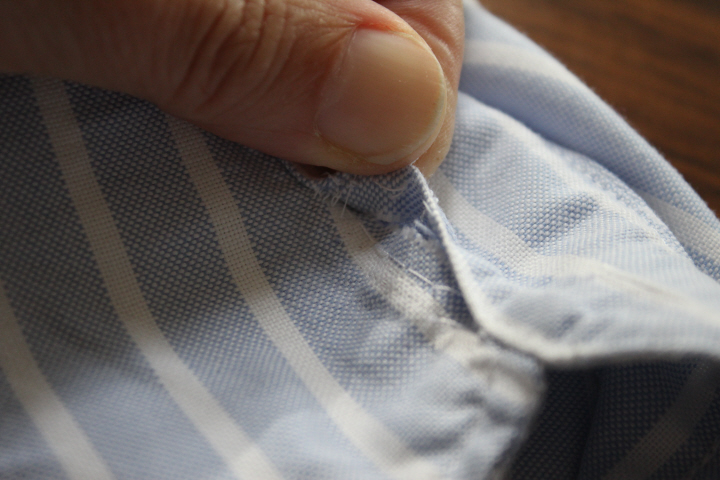
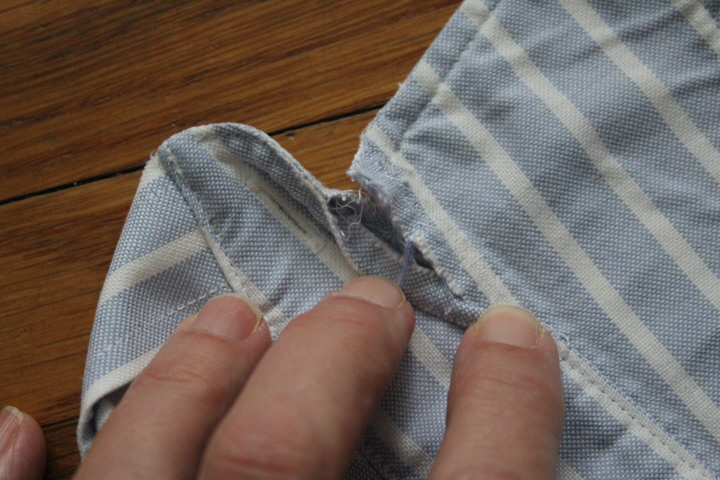
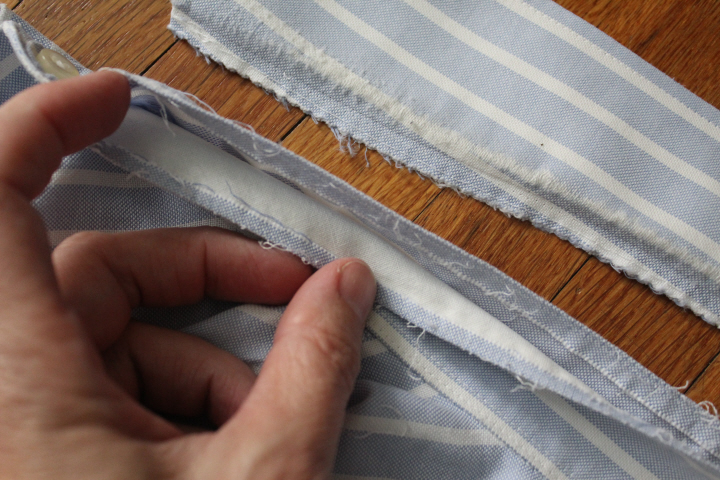
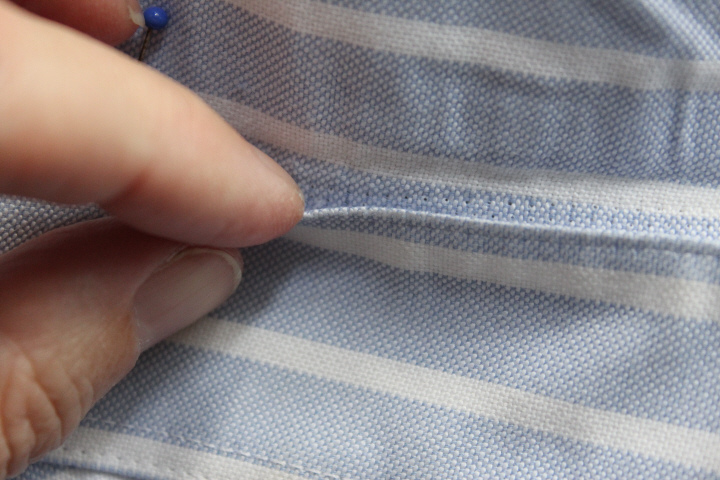
    The narrow binding appears to have been machine-stitched to the outer fabric, then tacked down neatly by hand on the inside.

    5383

    The heavy-paper base of the cap was unfortunately crushed, certainly in shipping to me if not earlier.

    5384

    5385

    5386

    5387

    The lace is surprisingly wide for something that is attached only at two points inside the cap; it seems to me that this would make it a bit of a bother to arrange neatly!  This photo shows the lace pulled out in the opposite direction of the way it would fit inside the cap when worn.
    5388

    5389

    The front edge at the top is the only part of the cap, other than the ribbon tie, that shows much wear.

    5390

    Measurements (all approximate):

    Yellow scarf: 96.5cm x 94cm (selvage to selvage), 40g.

    Green scarf: 91.5cm square, 48g.

    Cap:

    center seam (forehead to nape) 24cm

    bound edge of front opening very approx. 32cm “cheek to cheek”

    the “indentation” at each side of the forehead is approx. 4cm at the deepest point

    tie 91cm

    lace 34cm long (unstretched) not counting seam allowance; 20.5cm at middle/widest point (unstretched), possibly considerably less at the ends but this is difficult to tell as it is gathered into 2cm!
    jacquard ribbon 4.25cm wide, ends of bow 10cm on longer side, bow 12cm across

  • More Famous Knitters

    Ingrid-Bergman-knitting-Notorious

    Ingrid Bergman, again — she must have been a champion knitter!

    Knitting amanda seyfried

    Amanda Seyfried.

    Knitting bette davis

    Bette Davis.

    Knitting doris day

    Doris Day.

    Knitting judith anderson in and then there were none

    Dame Judith Anderson in "And Then There Were None."

    Knitting lucy and desi 1942

    Lucille Ball, with Desi Arnaz, in a cozy home-life scene that I might have thought the knitting was staged, if it wasn't for ….

    Knitting lucy and ethel

    Lucille Ball and Vivian Vance, or maybe Lucy and Ethel.

    Knitting marilyn monroe

    Marilyn Monroe.

    Knitting merle oberon

    Merle Oberon, with Laurence Olivier looking over her shoulder, and I think Vivien Leigh?

    Knitting myrna loy

    Myrna Loy, either in or on the set of one of the Thin Man movies presumably, since that's Asta beside her.

    Knitting rita hayworth

    Rita Hayworth.

    Knitting uma thurman

    Uma Thurman.

    Knitting madonna

    This lady needs no introduction, I think!  The "Knitting Madonna" from the Buxtehude Altarpiece by Master Bertram, ca.1400.

  • 5216

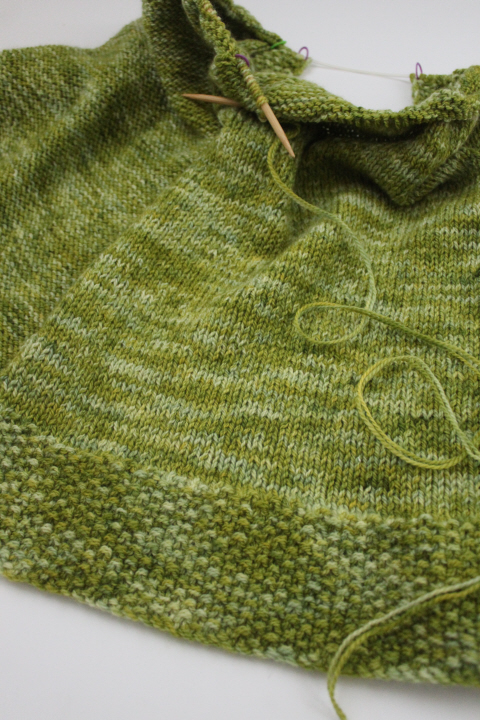
    I had this old sleeveless pullover in a drawer that I'd knitted up from some of that lovely red Araucania Nature Wool, but it pilled so much from the moment I first put it on, that I dreaded wearing it — except for the color, of course.  So the other day I remembered that I only have five of the felted placemats I made from the rest of the Nature Wool, and I want to have at least six — and so I spent a day ripping out the pullover, another day winding it all into skeins (wh. wasn't easy as I'd knitted it double), another few days waiting for it to dry after I washed it, another day winding it all into balls — and now I am knitting with it.  I don't know yet how far it will go — we'll see.  I didn't notice how much of a color variation there is in the latest stretch of knitting — luckily it is a little less obvious in real life than in the camera, for some reason!

    5220

    Yes, another petit point miniature carpet!  Couldn't resist.  This is another one from Frank Cooper's book, one he identifies as a Bergama.  The chart is much more reliable than the Shirvan I worked this past spring and summer — but this time, because I converted it from Paternayan wools to Appleton's (with a reduction in canvas gauge as well), I really had no idea of how much wool to buy, and I have just run out of the golden-brown.  You can see that I'm nowhere near being finished with golden-brown, either.  I'm going to hobble along for a while without it, and see if anything else looks like running short …

    Fairisle2

    If you have read much D.E. Stevenson, you will know somehow that her 1953 book Five Windows is for some reason extremely difficult to find.  There are rarely many copies available, and those few are priced well into the hundreds of dollars.  Why?  I have no idea — she was already a well-established and popular author by the early 1950s, so I'd be surprised if her publishers didn't issue a large run.  But for those of us who, not for lack of trying, have never seen a copy, Greyladies recently reissued Five Windows in paperback.  The story has one of her fairly rare first-person narratives, and one of her even-more-rare male main characters, but for all that it is a charming story in which nothing terribly dramatic happens, but you like the characters and you want them to be happy.  I suppose David Kirke's mother might have knitted him a jumper or a scarf before he went off to London from his little home in the Scottish Borders, though there was no mention of it, but I thought I would look for something that reminded me of young Janet Lorimer, and I was rather surprised, in Googling "1950s misses knitting pattern" to find that most of the things that came up were either matronly or with models more suited to Parisian scenes with their bent wrists and their lipstick — not fresh-faced Scottish lasses at all!  So I was delighted when this one came up to see not only a girl one wouldn't mind sitting next to on a train but one with a Fair Isle jersey as well!  This booklet is from the 1940s, and the pattern itself is available for free at The Vintage Pattern Files.  Enjoy!

  • Araucania nature wool unraveled

    I very rarely write here about unpleasant things, either in my life or in the world in general, because I want to keep this blog a place where the most stressful thing for me is having to unravel a piece of knitting or not having enough wool to finish a certain patch of needlepoint.  I am also, though, a bluestocking both by nature and by designation, and as such I can't help waxing philosophical at times — so instead of going into specifics, I'm going to ponder this morning the general nature of city politics.

    Here is what I came up with last night: "Question: At what point does a concerned citizen become a gadfly?  Answer: When he or she stands up to speak against a development proposal at a planning commission meeting."  Is this truly the way it works?  (And is this a theory or a theorem? — it's certainly a sidetrack.)

    I couldn't help noticing, at this first city meeting I have ever attended, that the proposal procedure went like this: the representative of a certain development corporation spoke for as long as he wanted, with slides of idyllic architectural renderings, about a proposed high-density multi-story structure, then citizens in attendance at the meeting were allowed to speak for a maximum of three minutes each, yay or nay but without any visual aids, then the public forum was closed and the developer's representative was allowed to respond, again with visual aids, to these compliments or concerns for as long as he wanted, and then the commissioners offered their closing remarks and voted.  Well, yes, this is certainly democratic, up to a point at least, but is it quite fair

    Nor could I help remembering, when one of the commissioners observed that few opponents of the development had bothered to come to the meeting, that when the commissioners were making their closing remarks, many of them thanked and complimented the citizens who had spoken in favor of the development ("when Mrs. Jones spoke — is she still here? oh, too bad, isn't she wonderful! what a great citizen of our fair city! –") but in response to those who had spoken against the development they merely brushed aside the citizens' concerns ("well, Mr. Smith, it's actually irrelevant that you currently live in a similar high-density development and your common spaces that were intended to be open to the community at large have since been fenced off and locked from said community because of misuse and homeless congregations, because this one is going to be different").  Mrs. Jones is therefore a stalwart citizen, and Mr. Smith is an annoyance — QED.  Is this really the nature of things? was Orwell right, that some citizens are more equal than others?

    I don't know — I hope not.  But I do suspect that the only way I am going to understand city politics is to become deeply cynical, and my whole being resists this like anything.

  • 5065

    Yes, well, when I saw the Gaea "Say Nevermore" version of this scarf at Knitty a few months ago, I somehow found myself on the Blue Moon website clicking "purchase" as though in a trance.  Maybe it was the daze, maybe it was the summer heat, maybe it was just the idea of paying over thirty-five dollars for one skein of yarn — however indescribably gorgeous — but when I sat down to knit the scarf, I discovered that the pattern actually calls for two skeins.

    4567

    I thought, and for some time, I admit, about ordering a second skein, but luckily the weather was cooler, and sense won out.  So this is the "Economical Baker Street Scarf," modified slightly from the original by Joan of Dark.

    5066

    My version is over 32 sts, but this is different from the pattern only because the label was vague enough that with the original stitch count I might have ended up with something anywhere from 6" to 8 1/2" wide (!), so since I was already being economical, I shaved 2 sts off of the original count.  This still got me 6 3/4 in. on US8 needles!

    I also, as I say, used pretty much all of just one skein instead of two — when I got close to the end, I unwound the rest of the ball and from the non-working end cut fringe for the cast-on edge and attached it, then cut more-or-less the same amount (in one length, to keep it from becoming a mess), then worked as far as I possibly could with the remaining yarn — the only bits left are the wobbly piece from the beginning of the skein, a length that I cut too short to add to the fringe, and a shaving or two from the finished fringe.  The resulting scarf is about 6 3/4 in wide x 50 1/2 in. long, not counting the fringe (17 x 128 cm.) — so considerably shorter than the 6 ft. of the original (!) but also a lot more frugal. 

    5074

    5068

    A word of warning — it does curl.  The stitch is very easy to memorize, and looks handsome, though different, on either side, but it does curl, so if that's important, knitter beware.

    But the yarn is delicious — you can tell that I think so by the number of close-up photos I've taken! — with a subtle blend of navy/black with a lighter blue here and there, and a little revelation of tawny gold and perhaps even a hint of teal at times, and it has that wonderful quality of revealing more or less of the colors in different lights.  I am delighted to say, too, that I wrapped it around my shoulders this morning after I took the photos, and the weather is cool enough that I am still wearing it an hour later …

    5067

    5072

  • Marple 6

    It seems appropriate to end this little series of knitting in the movies and television with Miss Marple, Agatha Christie's famous amateur sleuth, one of whose main characteristics is that she is often to be found knitting, and it seems that in the half-dozen-plus films and series featuring Miss Marple over the years, the knitting part has come more and more into play.

    Marple 4

    Margaretrutherford

    I admit that I haven't seen any of Margaret Rutherford's 1960s Miss Marple outings in full, and so I don't really know whether she actually knits much in the films, but I could find only the one image to use in this post.  She isn't actually knitting in the second one, obviously, but she is wearing a wonderfully dumpy cardigan as well as a knitted hat, with characteristically Rutherford pompom of course.  (Apparently, she insisted in wearing her own clothes to portray Miss Marple!)

    Marple5

    Angela Lansbury played Miss Marple in a single outing in 1980, so perhaps there was not much time for knitting.  I don't see a single image of Helen Hayes as Miss Marple actually knitting, which is a shame — I don't remember her two films, though I must have seen them, so I will certainly make the effort to do so again.

    Marple 2

    Joan Hickson played Miss Marple in the late 1980s and early 90s for the first television series, one that remains firmly in the consciousness of many viewers as the definitive Marple.

    Marple001

    The production values and attention to detail for Geraldine McEwan's tenure as Miss Marple in "Agatha Christie's Marple" were high enough that she was often shown knitting, although I will not be the first to say, nor the last I'm sure, that for a series called "Agatha Christie's Marple" it strayed rather far from the original at times.  I am still hoping that McEwan was simply doing what the director asked for.

    Marple 1

    Marple 8

    Marple02

    Julia McKenzie took over from McEwan after the latter's retirement, and I must say that she fits my mental image of Miss Marple rather more (I won't say "better" because I admire McEwan tremendously) — and of course I love the fact that pictures of her knitting in the series abound!

    Marple 3

    Marple 5

    Marple 7

    Bonus — slightly out of order, but how could I not end with this? —

    Marple 9

    Miss Marple herself wearing a classic keyhole scarf.  Free patterns are available for Skiff's Miss Marple Scarf here, and another one here by SusanneS-vV, and an actual 1948 one here from The Sunny Stitcher.  Just for fun, here's a faux-fox version.  I knitted mine up — in two days! — in some of the late and much-lamented Jaeger Extrafine Merino left over from my Pearl Buck Swing Jacket, in the beautiful elderberry shade 944 (about 80g).

    5038

  • Bletchley 1

    Another series with excellent costumes and knitwear!  For some reason, I avoided "The Bletchley Circle" when it first aired in 2012 or '13, then started watching it on Netflix about a year ago, and though I don't remember much at all now about the mysteries, I was intrigued by the characters themselves, the relationships between the four women and the way the four actresses pulled everything together.  I was also — all right, I'm a knitter! — charmed by the sight of Susan (Anna Maxwell Martin) knitting in her sitting-room.

    Bletchley 2

    Bletchley 4

    Bletchley 9

    Bletchley 10

    ("Dear Sir" spotting: "The Bluebell Railway is excellent to stage late 1940's or early 1950's scenes on trains, but when selecting stock for trains supposed to be working out of St. Pancras Station it was careless to use a locomotive of the Southern Railway. St. Pancras was on the London Midland & Scottish Railway until nationalisation in 1948, when it became British Railways…. What is more, the bus that appears is an RML type which was not built until 1961 and in a livery that dates to the mid 1970's, the stations shown on the route board for the Barking line are incorrect (East Ham!!!), and a character mentions the Gospel Oak to Barking line but at this date the route ran via Kentish Town, not Gospel Oak."…!)

  • Fili bilbo ori nori

    Well, I seem to be in a bit of a house-keeping mood this week (blog-keeping?), tidying up old draft posts and putting them up.  When I wrote this in 2014 (!!) I said "I'm a bit behind with this, I know — 'The Desolation of Smaug' came out nearly a year ago!" which sounds positively ancient by now.  These photos, though, especially the studio ones, are still pretty good, and worth posting for the knitwear and my theme, even though my opinion of the movies has tumbled considerably.

    So — these are from the first "Hobbit" movie, of course, "An Unexpected Party".  I think all of the dwarves have hand coverings of some sort, but not all are knitted.  Ori, on the far right here, has heavy garter-stitched fingerless gloves.

    Fili ori nori

    He also is the only one who has a knitted waistcoat, which gives him a sweet air of childlikeness in addition to Adam Brown's own, as though Ori's mother sent him off with extra warm clothing.

    Ori

    Sometimes he wears the waistcoat properly, and sometimes twisted and cast somehow about his neck like a cowl.  I must admit I can't quite figure out how this works, as the thing isn't circular!  Maybe he's just pulled out his arms and tucked up the hem around his shoulders.

    Oin 2

    Óin (John Callen) here has some pretty splendid knitted gloves, whose swirling cables echo that splendid beard.

    Oin

    Bofur 2

    Bofur (James Nesbitt) wears a multi-colored garter-stitch scarf.

    Bofur scarf

    Bofur

    Bombur

    Bombur (Stephen Hunter) has, perhaps not coincidentally, the thickest mitts, even with an extra moss-stitch patch sewn to the back of the hands.

    Gandalf

    Gandalf (Ian McKellen) has knitted mitts as well — these are apparently folded back for extra warmth on the hands.  Unlike the dwarves' mitts, these don't appear to have a knitted thumb.  (The scarf is not knitted but woven, though I'm sure someone has come up with a knitted version by now!  Here's one, in fact.)

  • Home-fires-frances_3289083b

    This is a bit old, but I was weeding out the images file on my computer this morning and realized I'd not posted these yet.  They are from the late "Home Fires" — yes, it's been cancelled — which I watched sort of half-fascinated, because Blitz-era England is one of my fascinations, and half-guiltily, since it was not a little soapy at times.  I do love Francesca Annis, though, in just about anything.

    Part of these photos, I admit, are for the aprons and pinnies as much as for the knitting, though!  Above we have the ladies of the village out blackberrying — Pat on the right (Claire Rushbrook) has a fairly typical cardy in a basketweave stitch.  Each of the women has a different yet very typically-1940s apron, Erica (Frances Grey) a wrap-around, Frances (Samantha Bond) a scoop-neck, and Pat a full one, probably H-back but we can't see this.

    Home fires aprons 1

    Home fires 2

     An apparently favorite slipover worn by the butcher's son with the overprotective mother (Will Attenborough and Claire Price respectively), who has presumably knitted it herself.  Don't get me wrong, I completely understand not wanting to send your son off to shoot and be shot at, but she's a bit mad about it at the same time.  She herself has an interesting raglan-sleeved cardigan in a rather lovely sea-foam green.

    Home fires

    Curiously, Frances's apron seems to have no ties, which I think would be fairly annoying, with it dragging in things.

    HOME_FIRES_2__EPIS_3331867b

    An absolutely bang-on perfect 1940s pullover in chevron stripes on the blind Isobel (Gillian Dean).  If looks could kill, the entire Luftwaffe would have simply dropped stone-dead from the skies at this glare from Mrs. Cameron (Francesca Annis).

    HOME_FIRES_EP3_01

    A very pretty green lacy cardigan worn by Kate (Rachel Hurd-Wood).  I think her sister Laura (Leila Mimmack) is also wearing a knitted cardigan of some sort, but in this picture it isn't quite clear.

    Home fires 75604

    The man we love to hate, the thoroughly-nasty Bob Simms (Mark Bazeley) in another perfectly-period slipover, this one a classic faded Fair Isle.

    Home_fires_ep1_33

    104529

    Sarah (Ruth Gemmell) has this very pretty cardigan in the famous King Charles brocade stitch, accented presumably with embroidered flowers inside lines of the diamonds at the front.

    Meet_the_cast_of_ITV_s_Home_Fires

    The wardrobe for this series is really excellent — full marks, especially for including lots of period-looking knits!

    And if you like the soundtrack, it was composed by Samuel Sim, with the haunting title track sung by Synergy Vocals, and for the time being at least, you can listen to the whole album on YouTube —

  • 4868

    These stockings have been finished for some time, awaiting the photographs, for which it has been a sort of ready/not-ready comedy — David is out of the country, David's home but I'm sick, it's just too hot to even think about wool, the bathroom tap exploded, etc. etc. etc. — so at last here they are!

    4858

    After some internal debate about wools back in January, I chose Regia 4-ply, since I've used it before (on my Spey Valley socks) and those have pilled a little at the heels but are still in very good shape after over six years!  This color is Grey Heather (no.1991), which seemed to be a good "natural wool" shade, and goes well with the rest of David's Faire clothes.  I like the grey-sheepy homespun look of it, and the color is lovely.

    3620

    These stockings took ages to knit as not only are David's legs quite impressive, but I miscalculated any number of times and had to rip the first stocking back (and occasionally out) in annoyance, and he was away on multiple business trips for so long that I didn't want to risk "hoping it would fit".  But of course once the first one was done and I knew it was all right, all I had to do was make the second one exactly like it!  (As it turned out, one was still a bit longer than the other when he put them on, but this must be due to the wool — humor me, here — since there really are exactly the same number of rows in each stocking.)

    4864

    4874

    I liked the welt on the Carnamoyle re-creation by Lady Angharad Rhos ferch Rhain (Allison Sarnoff) so I started with that, although as it turned out the finished welt contracts so much that you can hardly tell that it isn't just reverse stockinette.  Because my math skills are mortifyingly bad, I depended heavily for the leg shaping on basic advice about stockings from Elizabeth Zimmerman's The Knitter's Almanac with specific math from the calculator at Let's Get Knitting.

    3615

    4863


    Stocking foot - mid 16th century - Museum of London A13833

    I was very taken with this stocking foot now in the Museum of London (no.A13833), which I mentioned when I was planning these stockings at the beginning of the year.  I had already decided on the so-called "Barnim" foot, with its inverted gusset on the sole and then thought that it wouldn't be much of a step from the Barnim foot to this one, so I decided to follow the Cheapside lead, as it were.  The Museum writes that this foot is "the only example of its kind in England" and I can believe that, for I've not seen anything like it on historical-costume blogs, so I'm tentatively dating it, as the Museum does, "mid-16th century" with the stricture that it is "unusual" and therefore probably expensive (i.e. upper-class if not higher), though my version is considerably rougher than the original.

    So in keeping with the idea that knitters in the past would probably have borrowed ideas from the finished garments of other knitters and not from patterns as such, and therefore could also have stood in front of a Cheapside stocking-maker's window and said to themselves, "Fifteen shillings!  Marry, I can make something much the same for a pittance, and from good English wool!" — here is the Cheapside foot.

    4860

    I am putting my first version of this foot pattern on a separate page, for other historical knitters to make suggestions on and, if I'm lucky, possibly knit and make suggestions for improvements.  I will admit up front, though, that the at-the-same-time shapings for sole gusset and instep gusset really defeated me, what with balancing different rates of converging increases and decreases, which occasionally came together with a whacking great clump.  As it turned out, I had to write down the instructions in a Word table with separate columns for the two gussets, so that I could keep them straight, and check rounds off one by one — I did manage to get this into a fairly logical pattern-style format, but it was a lot to keep track of, so knitter beware.  The bright side was that I am positive that both stockings are knit exactly the same!

    The decreases at the side of the heel flap, which are fairly clear in the Museum's photograph, are very elegant, so this variation has been incorporated here along with the garter edging, into the shaped common heel.  Unfortunately, the original heel of the Museum of London stocking seems to have disintegrated at the back, so it's impossible to tell, from the photograph at least, if it was straight or shaped, but certainly the shaped one is more comfortable and handsome.

    4875

    I did err on the side of caution with the length of the sole gusset, and it is obviously considerably shorter than the original, but I'm not sure if I could have done it reasonably at this much-larger gauge anyway — mine is 28 sts to 10cm, vs. an amazing 72 on the original (!!).  I started the "first draft" with the decreases further apart, but it just didn't look good.  The original sole gusset clearly continues pretty much all of the way to the point of the toe, whereas mine peters out about two-thirds of the way there — this could certainly be "corrected" for a shorter foot, by simply using the same rates of shaping on the sole gusset, which would go farther on a shorter foot.

    3617

    3618

    4865

    The garters are simply 7-stitch strips of garter stitch, about 34 in. long unstretched.  They stretch quite a lot, even when wrapped not especially tightly.

    4876

    Histknit2016 button 1

    The details —

    The Project: a pair of man's stockings, with garters
    Year or Period: 17th century, possibly mid-16th
    Materials: most of 5 balls of Regia 4-fädig Uni in color 1991 (Grey Heather)
    Hours to complete: about two months
    How historically accurate is it? the modern sock yarn is obviously not period, and I suspect that the shaping is more towards the end of the century than the beginning, but for that it is fairly accurate
    Sources/Documentation: the extant silk stocking foot at the Museum of London thought to be from Cheapside (museum no.A13833), with modifications of the shaped common heel per Nancy Bush in Folk Socks, and of the "Barnim foot" as outlined by Anne DesMoines in her “Barnim-Style Stockings” in Knitting Traditions magazine, Spring 2014 issue

    Knitting instructions for the Cheapside foot are here.