• 6777

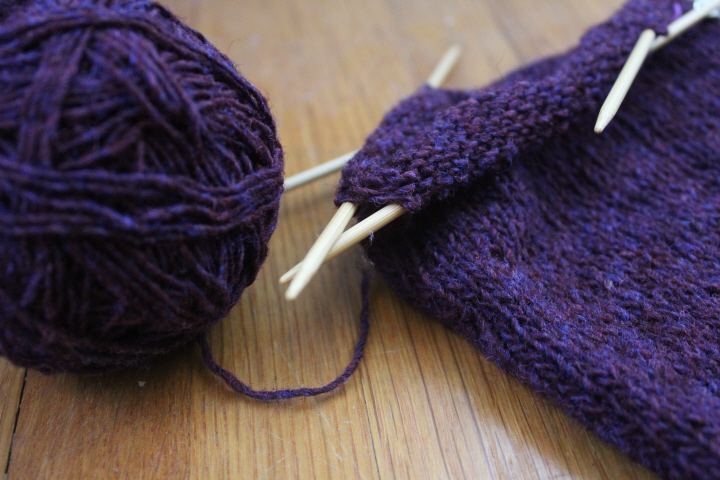
    I am halfway up the second sleeve of the Parley cardigan, with the first sleeve and body waiting to be joined together.  To be honest, I would have probably finished it by now were it not for this —
    6757

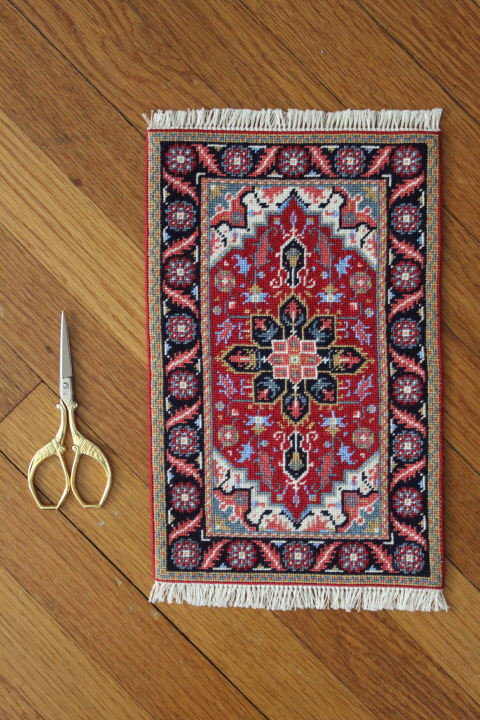
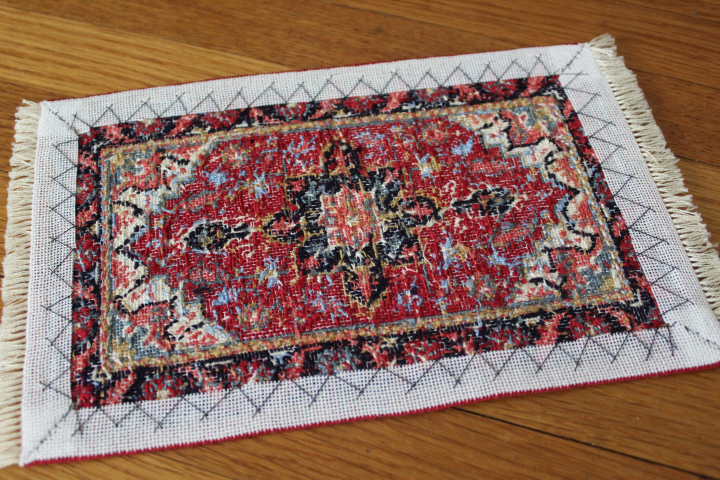
    which I was completely smitten with from the moment I saw it last summer, the Heriz carpet by Sue Bakker, in an old post at Open House Miniatures.  Fortunately I was able to get hold of this chart as well as a few others of Bakker's, wh. pleases me greatly.  I did find a number of errors here, both in the chart and the list of floss colors — astonishingly, things like leaving off a digit — but, yes, I am so pleased with the finished piece that I am willing to overlook them. 

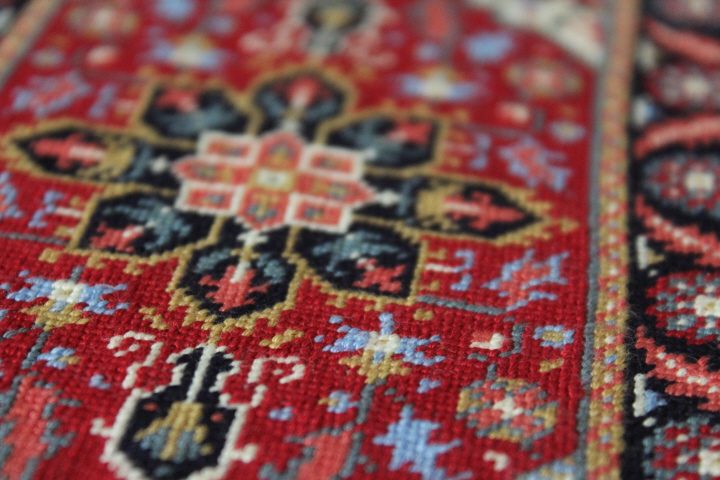
    I fairly careened through this piece in my joy — just a little over two weeks from start to finish — so I did make quite a lot of mistakes, most of which I noticed before long, some of which have now become permanent, but I admit that this bothers me not a whit.  I also made some deliberate variations in the serrations of the "leaves" in the border, just because I felt like it. I had noticed in the original photo that sometimes the edges around the lighter-red figures appeared to have a sort of golden shimmer to them, and so I theorized — since I was already aware that the photo and the chart didn't always match, eh-hem — that Bakker may have added a touch of gold to the edges, and so I tried that with the first pair of the little "flame" figures at the narrow end of the center panel, but this was more than a bit of bother, so I decided to skip it on the pair at the other end; as it happened, once the carpet was finished, I could see that in some lights the light-red figures seemed to have a golden edge to them even when I knew very well that they didn't, so apparently it is due to the surrounding colors, presumably reflections on the stitches causing an illusion of color bleed.  Interesting!  I did, though, shade the four blue "leaves" in the corners of the red medallion with the charted medium-blue blend around the edges, and an unblended (slightly lighter) blue in the middle, also an experiment in color shading — very subtle, to be sure, and I'm not sure if it is really noticeable at all, though I suppose if I were making a museum piece (!) it would be worth it!
    6759

    6764

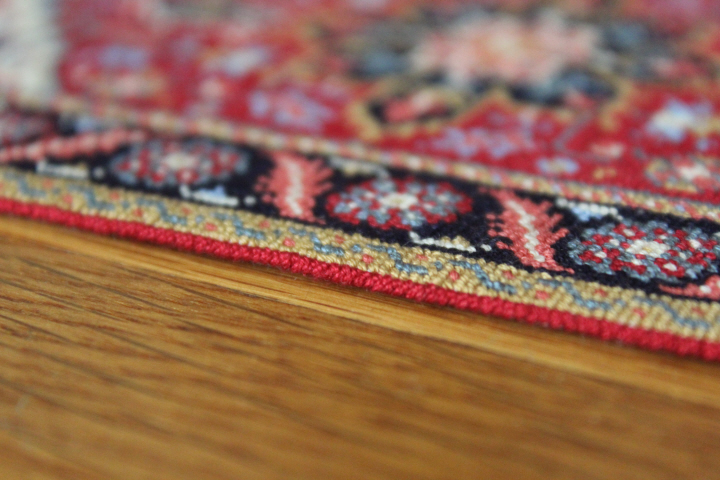
    The colors are just gorgeous, really rich.
    6765

    This actually looks a bit less messy in the photo than it does to me in real life, which I suppose is a good thing.  Some petit-pointers can make the backs of their work look nearly as good as the front, but this is something I think I can only admire from a distance.  I find it much easier to make the backs neater in wool, because of its "stickiness", though it is possible that I am too doubting and therefore leave the floss ends a bit long unnecessarily.  I don't want to think that I can't be bothered to make it neater, either — what good is it to improve one's skills on a craft if one's dedication goes only halfway? — but on the other hand, it is the back of the piece, after all, and in a room setting will make not a jot of difference as long as the miniature carpet lies flat like a real one.

    This carpet, by the way, is worked in half-cross stitch, which Bakker insists is better for miniature carpets than continental stitch, which as I already know is what other designers insist is best — I suspect that this may have something to do with both the fiber being worked (wool or floss or silk), as Bakker seems to work entirely in floss, or on the individual stitcher, for surely just like with knitting each of us has a slightly different tension and way of working the individual stitches.  I also didn't bother with basketweave stitch on the backgrounds here — for one, yes there is a lot of background but it doesn't come in large patches, only in little fiddly bits, which doesn't seem to me to utilize the speed and  non-warping property of basketweave much, and for another, I just didn't, no reason why, really.
    6766

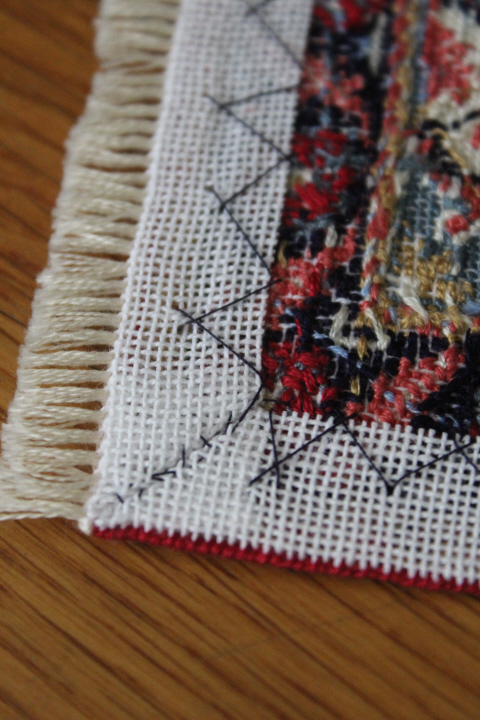
    This particular canvas is obviously heavily starched, as when I washed the piece most of the starch came out and it is now quite limp — which is great for displaying as it lies very flat, but makes it tricky to fringe and hem, especially since it also means that the threads of the canvas don't adhere to each other at the crossing points any more, as they did while I was stitching — you can see how they distort a bit at the points of the herringbone hem — but on the bright side, it mitered just about perfectly!  The long-legged cross-stitch edging has that nice habit of making the canvas fold along that line, so happily I didn't have to pull the hemming stitches very tight at all to get the turning to lie smoothly.
    6795

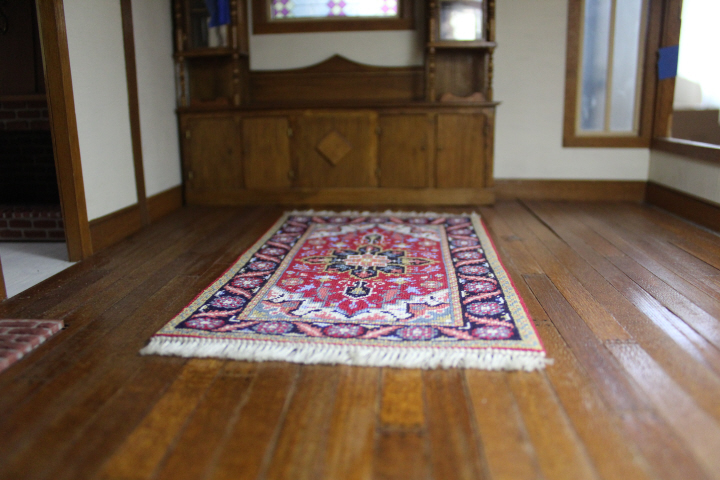
    I also decided to let this carpet be a little more realistic than I have done with previous ones, and not block it with pins and a straight-edge.  As you might expect from reading this blog the past year or so, I've been looking at images of real antique carpets quite a lot, as well as the miniature re-creations, and it is increasingly obvious to me that real ones can be pretty wonky.

    Misc antique carpets 2

    Of course, I completely understand that some stitchers may far prefer the straight edges, and that is absolutely fine and admirable, of course.  I would just like this house to look lived-in, and to be honest, in my own house that would certainly include things like wobbly carpet edges.
    6785

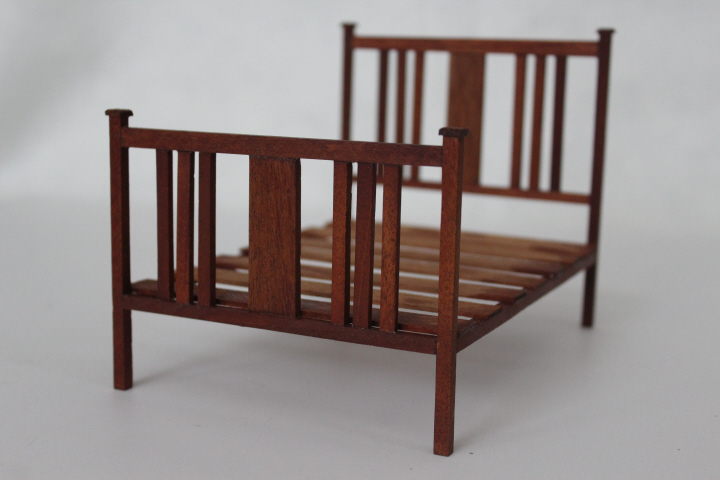
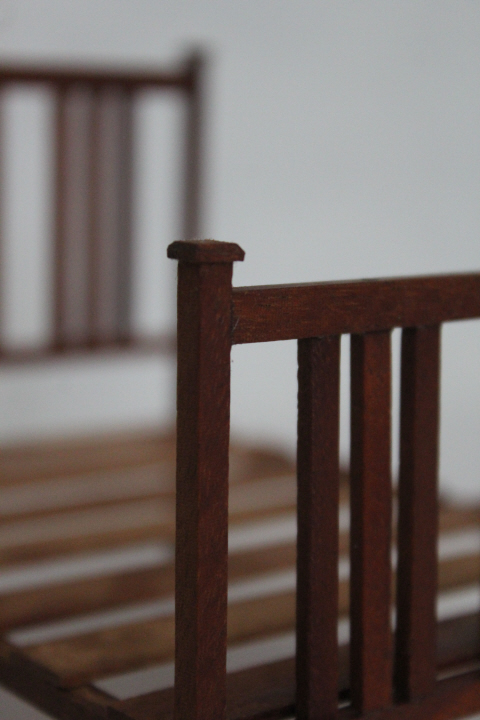
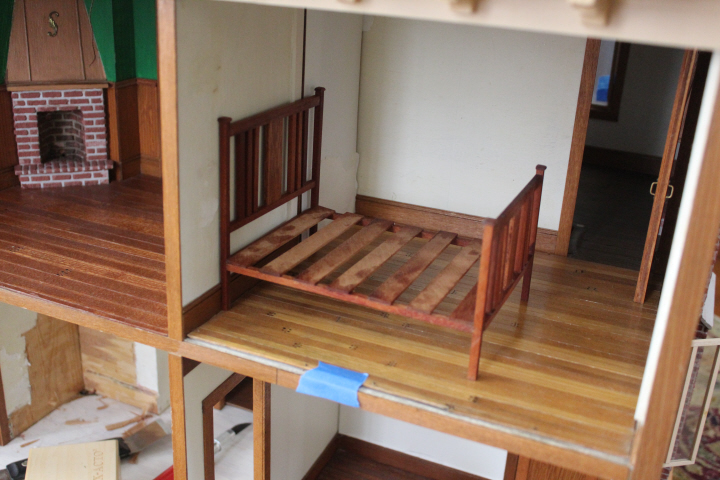
    Here also is my first piece of homemade furniture for Hardy House — the Arts & Crafts bed from Jane Harrop's Edwardian Era Miniatures in 1:12 Scale.  David cut the wood for me, after I cut a few pieces and realized that I was kind of making a mess of it.  I like to think I would have stuck with it if the wood were bass or something ordinary, but this is mahogany, said with that rather awestruck tone one reserves for things like diamonds or Lauren Bacall.  You just don't want to mess up mahogany!  But I did glue the whole thing myself, and its handsomeness is pretty much entirely due to the simplicity of the original piece and the well-designed miniature.  Luckily the glue splodges are mostly on the back of the headboard; I still have a tendency to use too much glue, but as it happens, even though this is just Aleene's Tacky Glue it worked marvelously, so I will trust it a little more next time.  The only "change" I made was to lightly sand all four upper edges of the post caps, which I think gives it a subtle realism.

    The book recommended for this particular project to finish it with a simple beeswax, but while we were at Rockler for the wood, I found Tried & True's Original Finish, which is a blend of linseed oil and beeswax, and came highly recommended by the salesclerk.  I used three coats here, letting it cure gently for a few days between each coat and buffing it well with a piece of old cloth.  The third time I used 4/0 steel wool, which was also suggested by the finish instructions, but the steel wool shed so much that although I was willing to add a few more coats, I didn't know if I'd be leaving steel wool fibers behind to get stuck in the next coat, so I stopped.  I think it looks pretty good even with "just" three coats, and it's wonderfully silky.

    I didn't finish the mattress slats, not at all sure how long it will take for the finish to stop being just a little oily — wh. I can't imagine would be good for the mattress or the bedclothes! — but I couldn't help getting some finish on the slats anyway.
    6783

    It occurred to me as I was putting this together that for a double bed it's a bit on the narrow side, but then again, the room is pretty small!
    6756

  • 6683

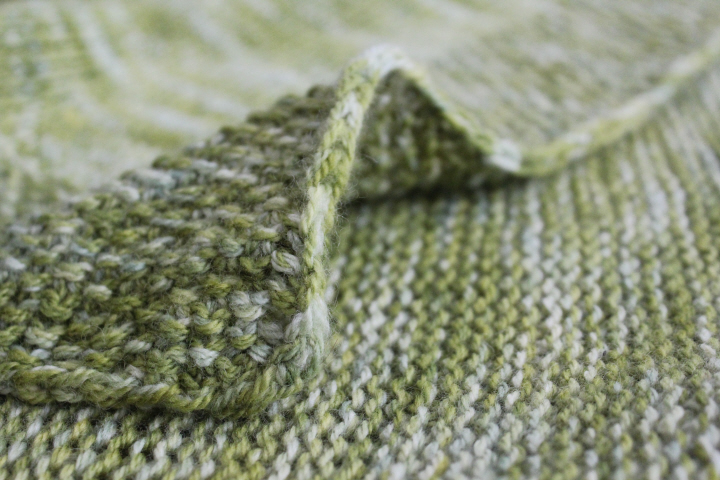
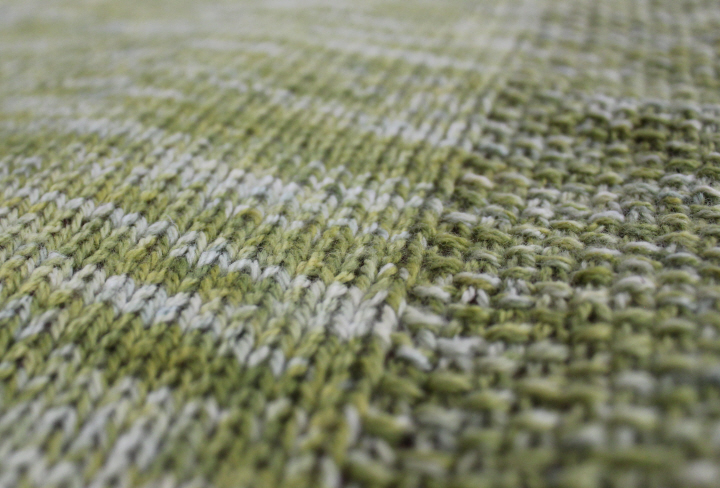
    I finished the Big Bad Baby Blanket the other day — finally!  This is two skeins in the Jade colorway of Blue Moon's Gaea fingering weight, which according to my numerous calculations and recalculations — the increasingly-desperate later ones on the fly — would make a blanket about 45" square.  When I cast off, it measured 42" across and 39" high, but blocked, without my really intending it to, to just about 45" x 45" (114 cm).  I added 36 sts to the original number cast on, and also used a crochet cast-on, slip-stitch edge, and K1, P1 cast-off so that the edge is uniform all of the way around.

    The pattern is of course by Lisa Shobhana Mason, and is in the first Stitch 'n Bitch book (2004).

    6690

    6686

    The Gaea is very pleasant to knit with, though only in a few salient characteristics such as gauge is it much like the pattern's original Koigu KPPPM. The Koigu is dense and solid, where the Gaea is almost fluffy, quite cloud-like in comparison.  This I think will make a much lighter throw than would eight skeins of Koigu, so that is an added benefit in addition to the noticeable savings in price.  I'm a little disappointed in the color I chose, expecting from the name something like jade, where what I got is realistically more of a celery, but there it is.  I hope the recipients will enjoy it, and congratulations on their new home!

    6689

    Five grams left!

    6692

  • 6371

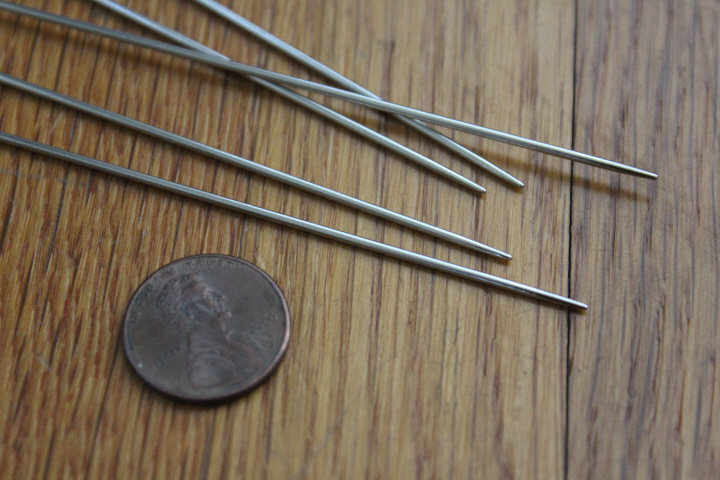
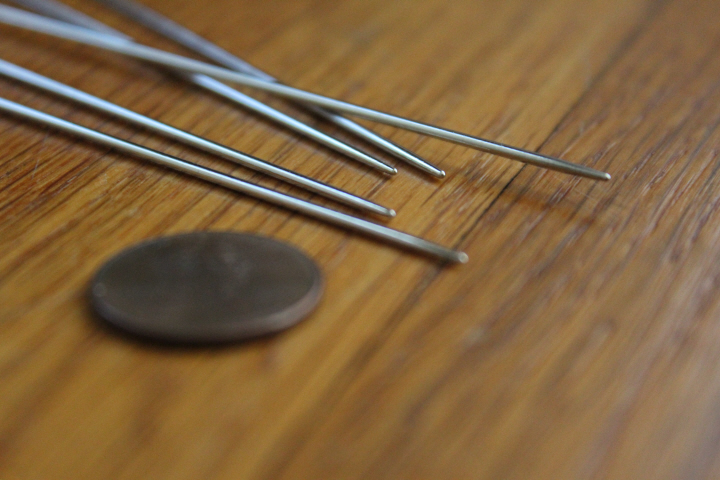
    4/0 dpns from Lacis, via Jo-ann's (online only).

    6374

  • 6680

    Big Bad beginning of the end!

  • Grange house ryton on dunsmore 3

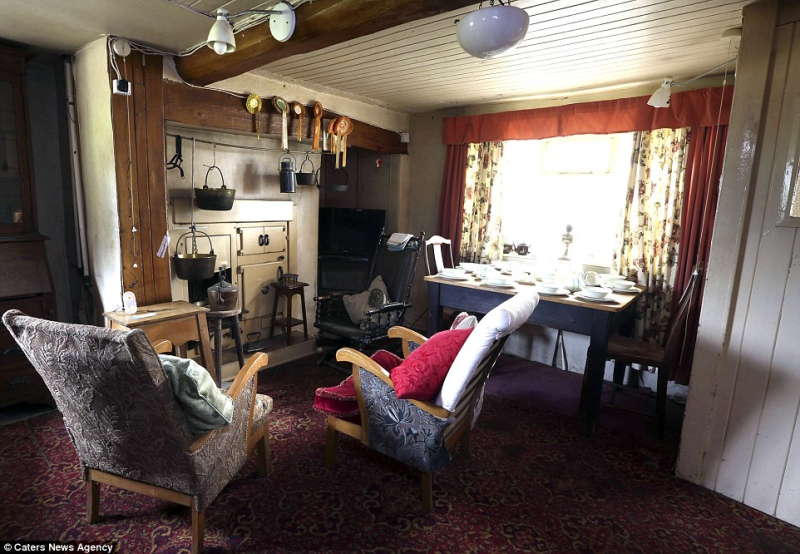
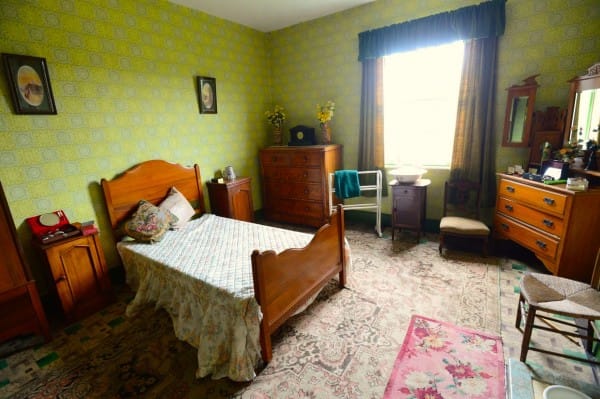
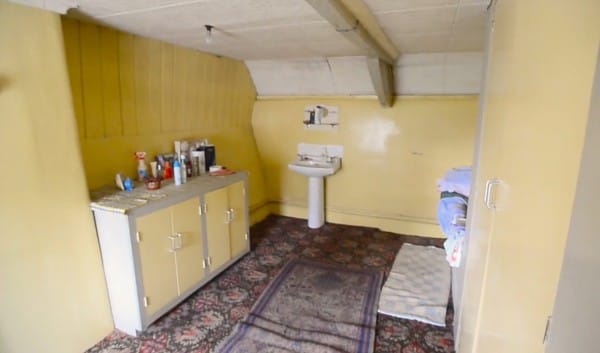
    A recent post on the D.E. Stevenson list about this farmhouse reminded me that I've had these pictures sitting in a draft post for ages.  Some time ago, I came across a newspaper story online about a farmhouse in England where the brother and sister who had lived there since the 1940s had kept things pretty much exactly the way they were since then.  The brother and sister were quiet and reserved, and neither ever married, and when they recently died, the house and contents were sold off.

    I was more than a bit dismayed by a comment on the article from someone who had viewed the house and thought that it was "creepy and sinister", because I find it anything but — a little sad, perhaps, thinking of the people who had lived there, quietly and uneventfully, and are now gone, but also fascinated by this insight into the 1940s and 50s which we usually only get to see in bits and pieces.  Perhaps the person who found it creepy was thinking of those reclusive hoarders who barricade themselves from the world behind piles of newspapers and dirty dishes and filth, but it is said of Grange Farm that it was "spick and span" and the auctioneers had hardly any cleaning to do before the auction, just re-arranging things for the inventory.  (Nor were the brother and sister recluses by any means, to judge not only by the stories from neighbors of regular musical evenings and the delight they took in amateur theatricals, but also by the number of spare rooms ready for guests!)

    Grange house ryton on dunsmore 2

    Grange house ryton on dunsmore 4

    Grange house ryton on dunsmore 7

    Grange house ryton on dunsmore 8

    Grange house ryton on dunsmore 9

    I am not an utter Luddite by any means — I have a blog, for one! — but I am a little hobbitish, perhaps, or like Treebeard the Ent, who says, "I do not like worrying about the future" because like his trees he is so deeply rooted in the past, in the earth and rock and forest itself.  I mistrust change for the sake of change, and I must admit that I find this farmhouse utterly fascinating, not just the wooden tennis rackets, the packets of soap flakes, the patterned linoleum, the rather saggy armchairs, the things we don't have any more, but also how all of these things are interesting and beautiful in their own way, the way things get somehow when they have been cherished and used for decades.  It gives one a sense that although time is passing, it is also standing still.  I have always been intrigued by time-travel stories — Tom's Midnight Garden, "The Love Letter" by Jack Finney, the Narnia stories, Diana Gabaldon's "Outlander" series to some extent (although she seems to have lost interest in the time-travel aspect as such, more interested in the characters themselves and the historical events that surround them).  These houses are rather like that, opening a gate or door and finding yourself in another world.

    There are two other places like this that I know well (I mean from having been fascinated for years with them, and read about them) — Bonnettstown Hall, in County Kilkenny, Ireland, and 18 Stafford Terrace in Kensington (the Linley Sambourne House).  I don't meant re-creations, interesting and valuable as those might be — I mean places where the people who lived there simply saw no reason to change things.

    Bonnettstown 1

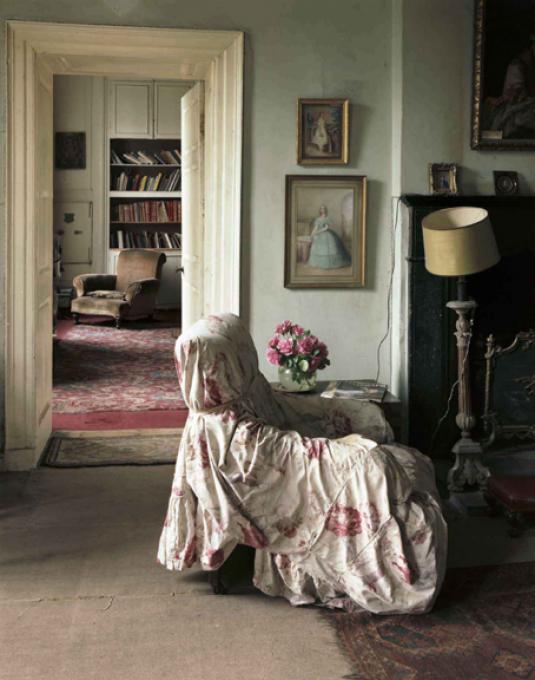
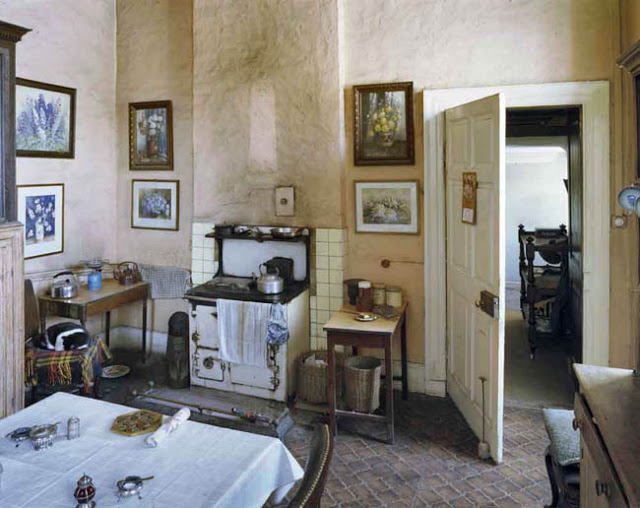
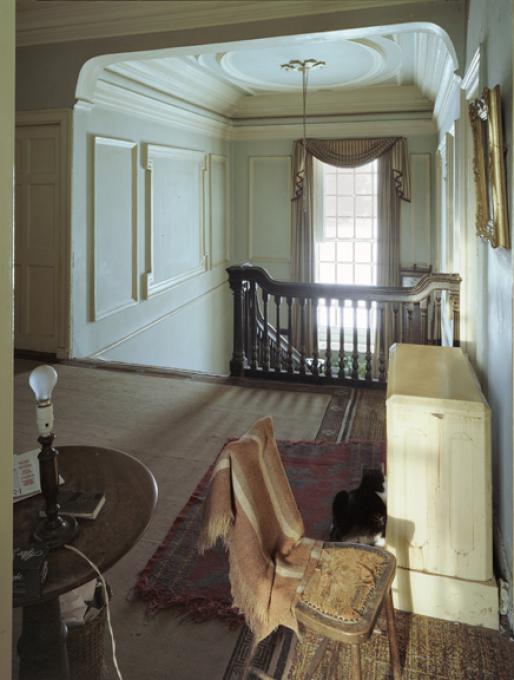
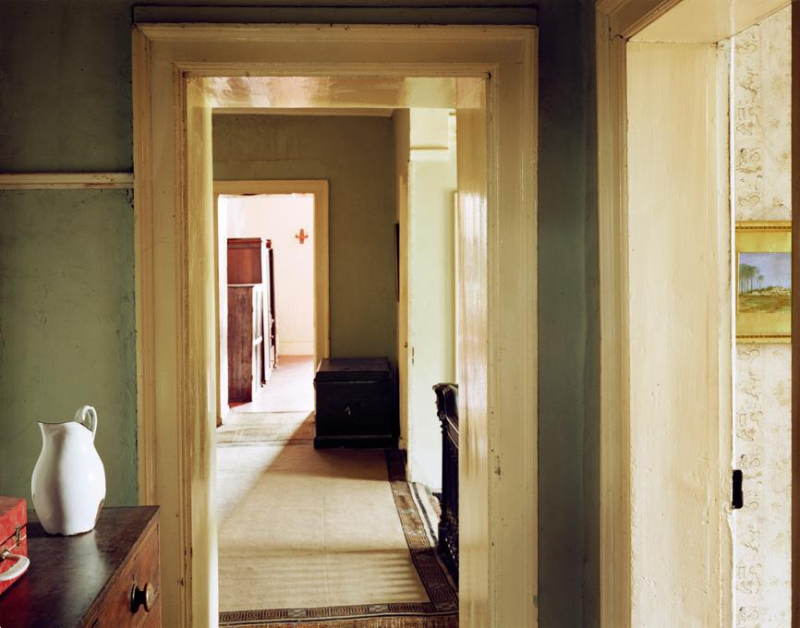
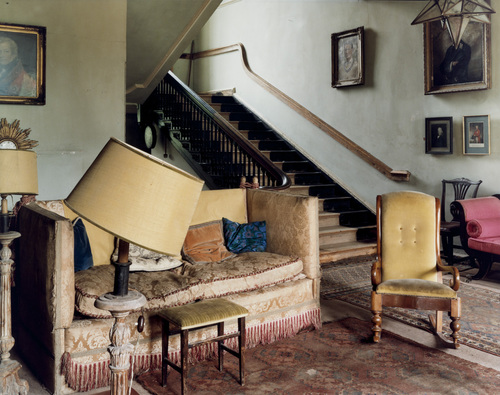
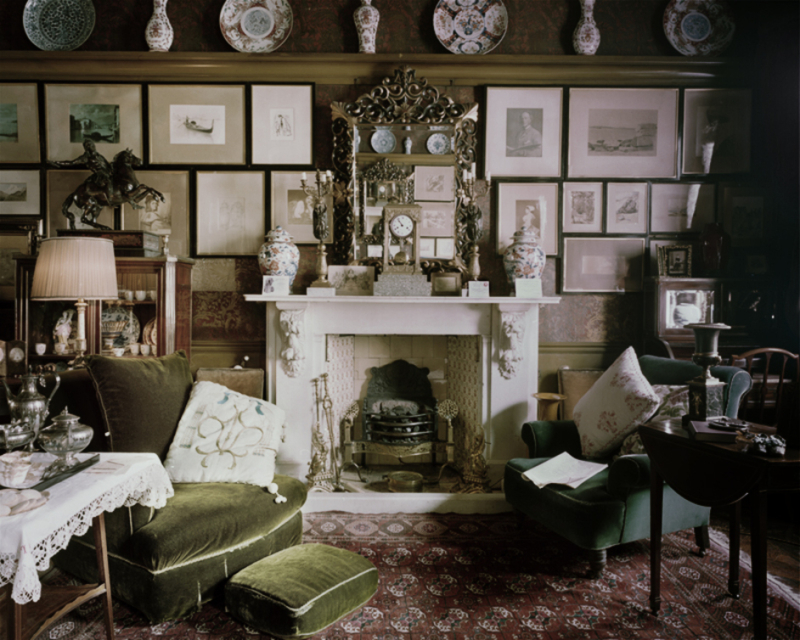
    In the early 1980s, American photographer Andrew Bush was hitchhiking around Ireland, when he met and was befriended by an elderly aristocrat living in a rather frayed early-18th-century house called Bonnettstown Hall with three companions, also in their eighties.  Bush, rather desperate, as he wrote later, "to soak up as much as I could before it was gone" began to photograph the house.  His book of these photographs was published in 1989, and the ones below are all from there.

    It is almost impossible, even without knowing that the house would soon afterwards be cleared out and sold, to see these photographs and not feel that they are an elegy, but even so the photos are deeply nostalgic yet unsentimental.

    Bonnettstown 2

    Bonnettstown 3

    Bonnettstown 4

    Bonnettstown 5

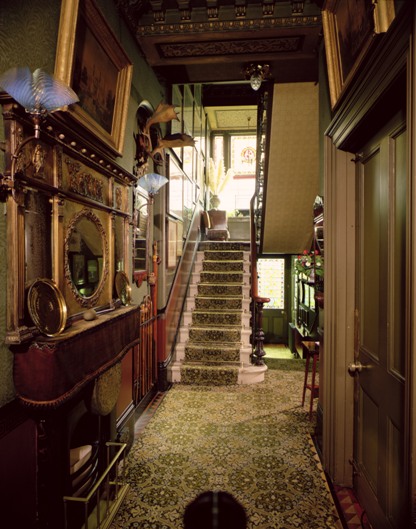
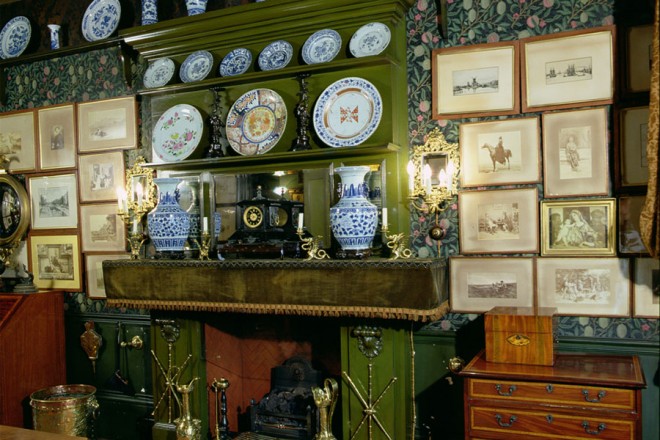
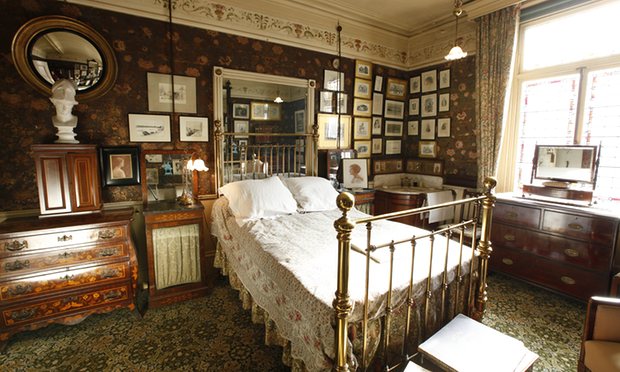
    Number 18, Stafford Terrace was the Kensington home of artist Linley Sambourne, a frequent contributor to the humor magazine "Punch", who moved into the house with his wife and two children in 1875, and redecorated it in the new Aesthetic style, which drew on the aesthetic value of things (objects, literature, music) and not their political or social values, with the ideal that one's response to all of this this beauty, this "art for art's sake", was a spiritual improvement in itself.

    The Sambournes were not a static family by any means, and they did change their house now and then — the drawing-room, for one, is papered in a William Morris design from some decades after they arrived — but when Sambourne died in 1910, and his wife Marion a few years later in 1914, their son, the bachelor Roy, made few changes of his own, and the house remained virtually the same as it had at the turn of the century, until his death in 1946, when it passed to his married sister.  Already having a house of her own by then, she kept it but like her brother had, unchanged, and eventually the house passed to her daughter, who by then had become the Countess of Rosse, and had the foresight and determination — as well as a great love for the house and its contents — to found the Victorian Society in 1957, partly in order to ensure the survival and upkeep of the house and to be able to open it to the public — which, to the fascination of those like myself who find it a way to make time-travel really happen, it still is.

    (Sharp-eyed viewers may recognize the Stafford Terrace drawing-room as the home of Cecil Vyse and his mother in the 1985 film of "A Room With a View", and the dining-room as that of Aunt Agatha in the Granada "Jeeves and Wooster" series.)

    Linley sambourne house 1

    Linley sambourne house 2

    Linley sambourne house 3

    Stafford terrace dining room

    Linley sambourne house 4

  • 6546

    I've been cleaning the new-to-me doll's house the past few weeks, starting with wiping it down inside and out with a damp cloth.  It was pretty dusty.

    6548

    This is all the stuff that was in the main room, except for the "full-size" suits of armor.  Inside the box with cotton wadding are some rather nice little pewter tankards.  The little star-shaped object is a lid for something long-gone.

    6554

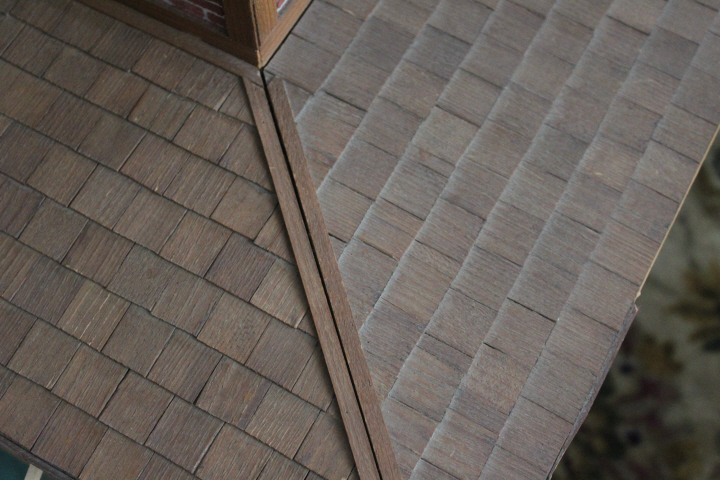
    Maybe it isn't quite as obvious in the photo as in real life, but the left side of the roof has been wiped with a damp cloth and dried, and the right side is as-is.  The improvement is remarkable.

    6556

    Teeny-tiny light bulb on the ceiling beam.

    6558

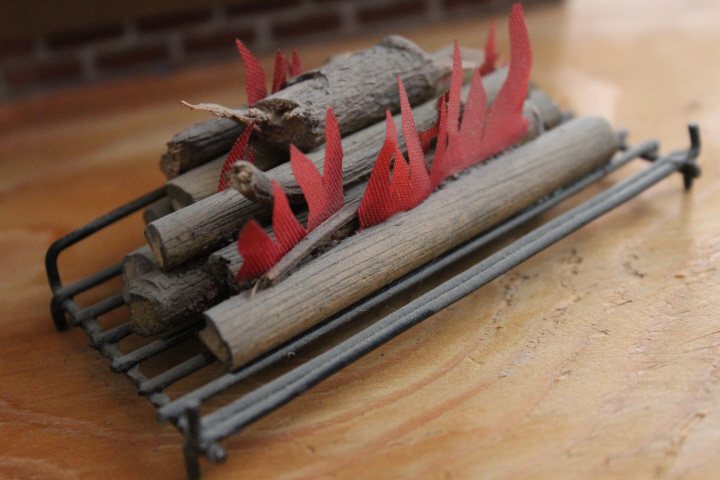
    You don't often get to see a dusty fire, but this is what one looks like.

    6560

    There are a few more things broken or bumped off than I realized, but so far nothing that can't be fixed, and I think I rather like the idea of a house that looks as though it has been lived in for a hundred years or so.

    6600

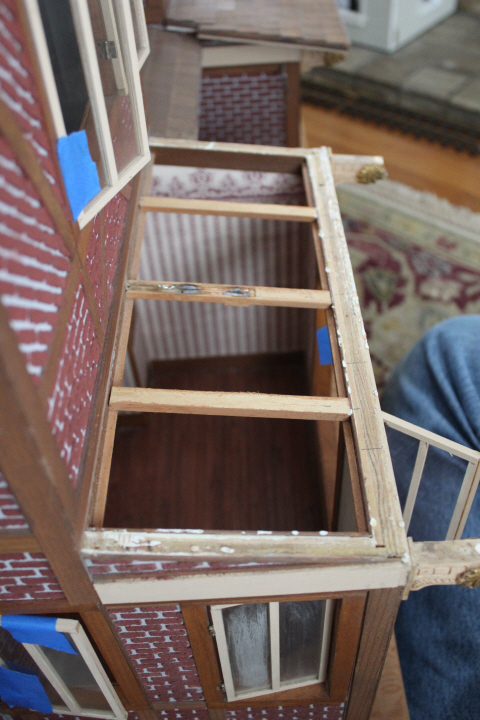
    Someone on the Greenleaf miniatures board suggested that I see if the roof on the left side could be made to hinge or lift off, so David had a go at it.  The blue masking tape is things that need to be repaired.

    6616

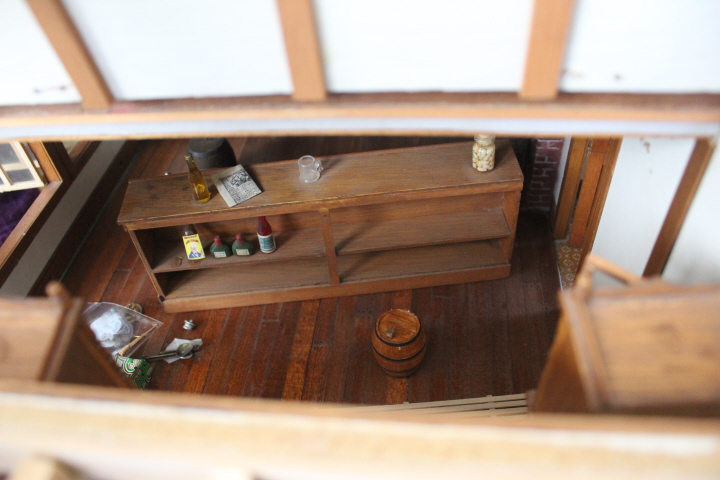
    The back bar, cleared off, dusted, and replaced — luckily the things weren't glued, only museum-puttied.  The house will be an old inn that has been converted into a family home, so this part will remain as a reminder of its "old coaching days".

    6617

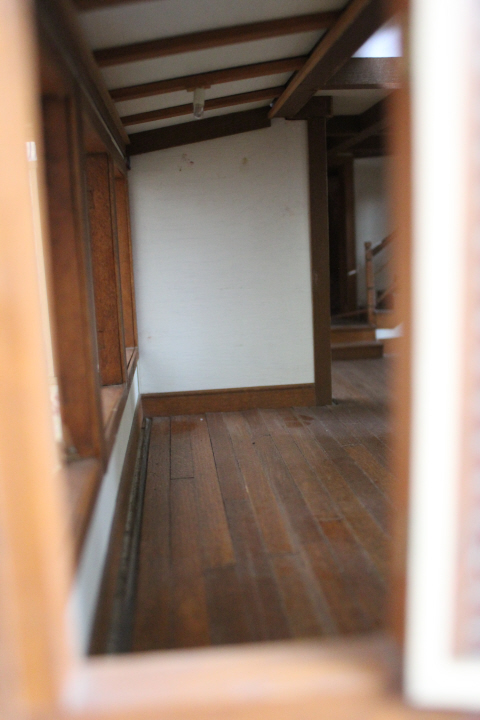
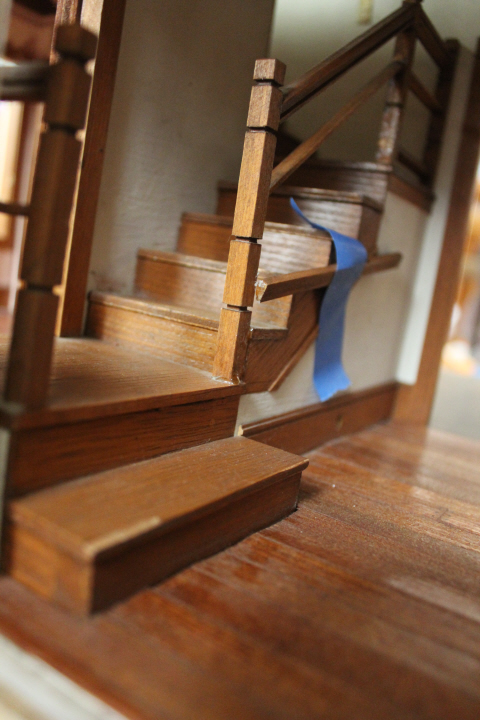
    I managed to squeeze the camera inside the front door space, with a flashlight behind aimed at the ceiling, to get this photo — interesting, since I hadn't been able to get a good look at the staircase before!

    6565

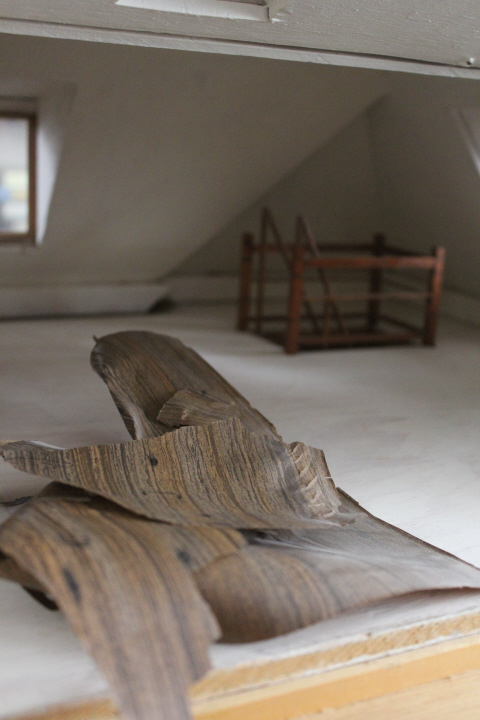
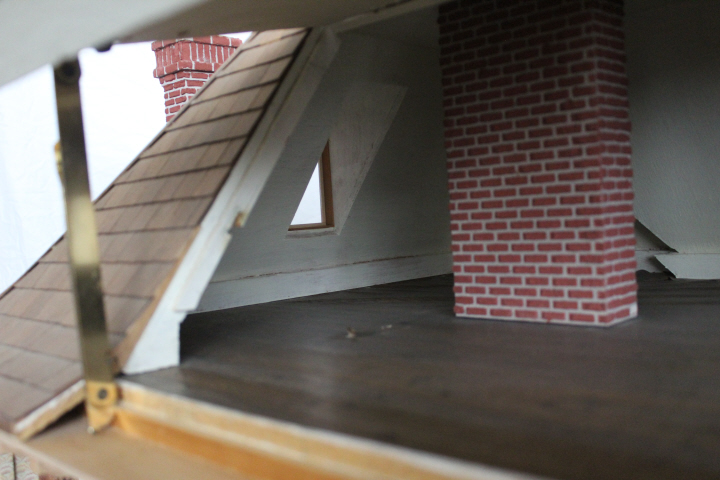
    The contact paper was buckling and rather poorly laid up in the attic, so I've pulled it out — it came up very easily, with just a few fiddly bits left in the corners that I had to remove with tweezers.

    6567

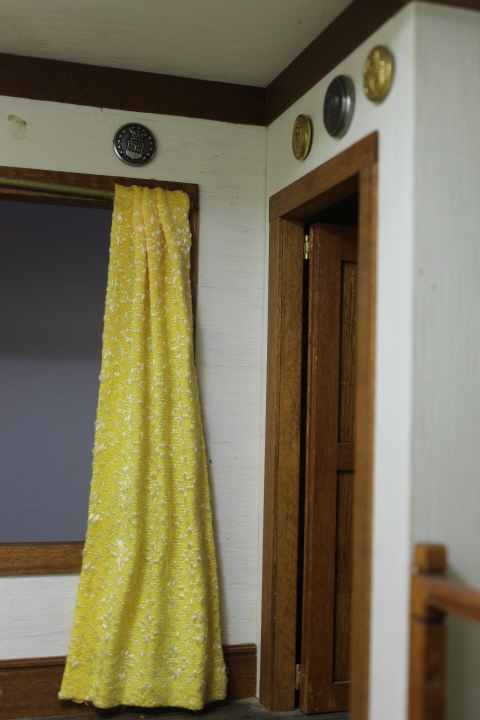
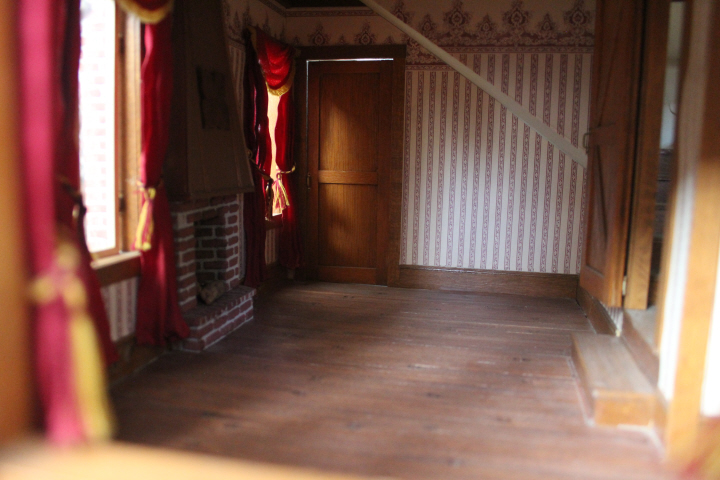
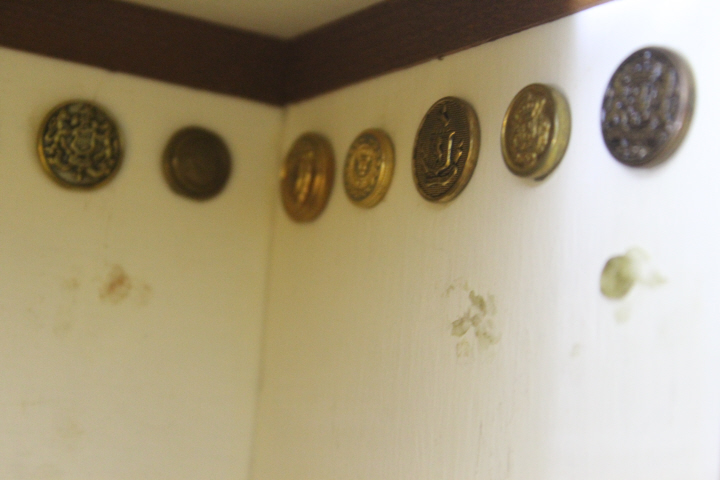
    This is just past the door that had the faux tapestry on it, looking towards the front window.  The medallions are in fact a selection of old metal buttons with the shanks removed — clever.

    6582

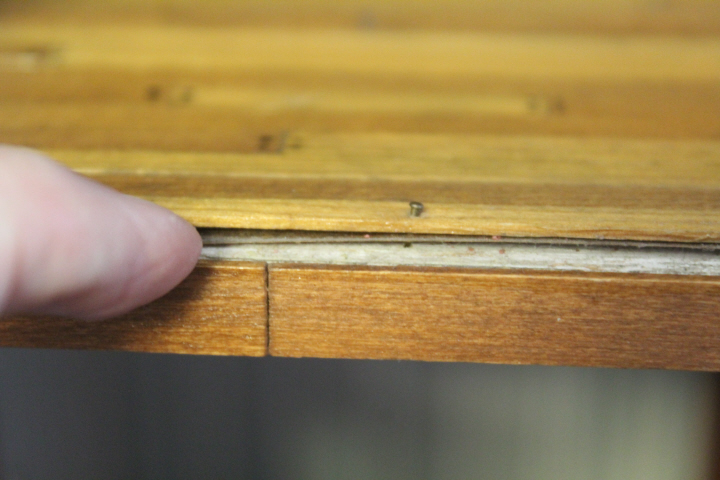
    I discovered to my dismay that the original builder laid contact paper throughout the whole house.  Someone in the interim laid down the various wood floorings, on top of the contact paper.  This one is lifting up just a little bit, though on the bright side, so far it's the only one.

    6591

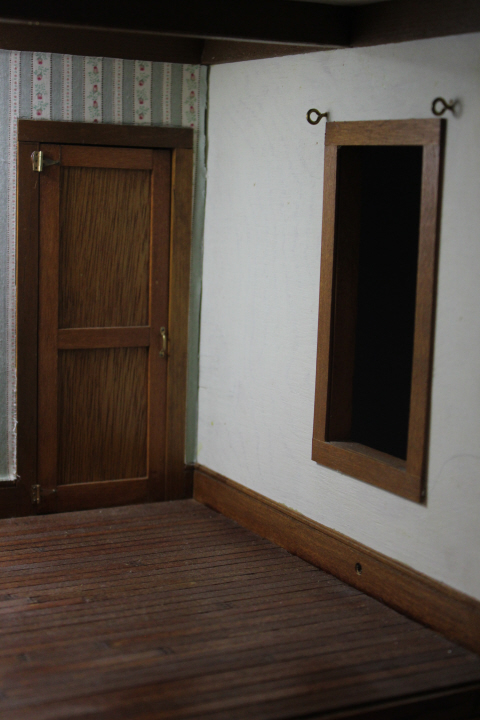
    I rather liked this "wallpaper" (actually fabric glued to paper), but as I waved the duster around, the loose edges started raveling and peeling up, so I resolved to take it off.

    6592

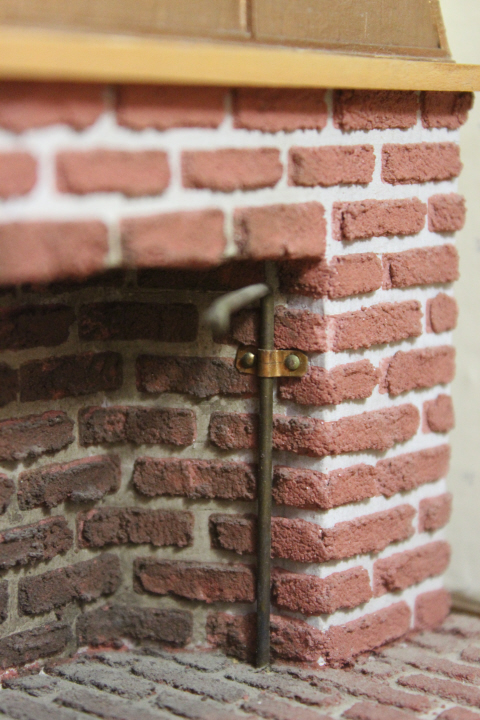
    Teeny-tiny crane in the fireplace in the old kitchen.

    6594

    This is the room upstairs-left, from the back of the house.  The piece of wallpaper on that jutting corner just popped right off, and the other is quite loose — I'm not sure yet if I will re-paste it or remove it.

    6618

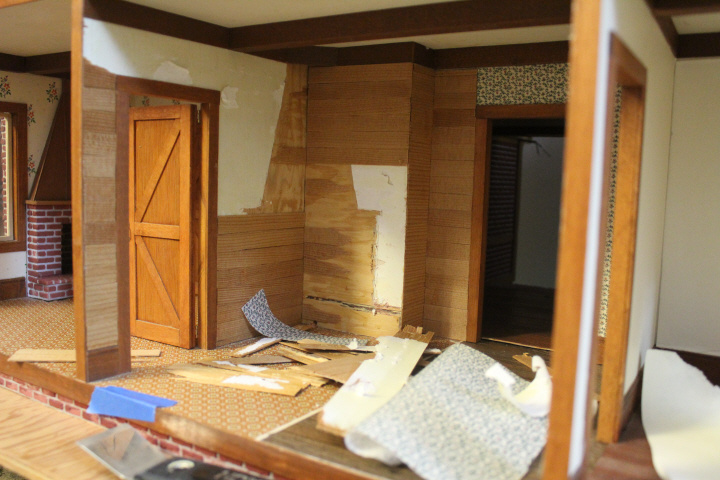
    The biggest surprise has been the solution to the Mystery of the Superfluous Chimney Pot.  This was unfortunately not solved by my powers of deduction but by bashing away at the raw paneling with a paint scraper.  On the bright side, I don't feel guilty any more about "remodeling" since the house is clearly not in its original condition anyway!

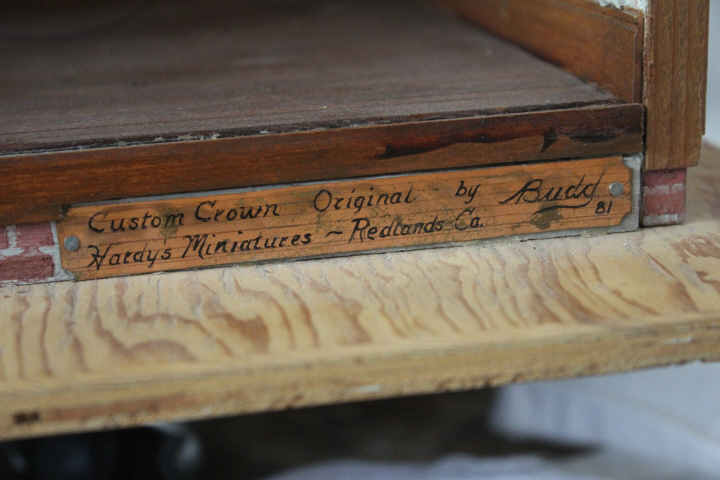
    I've pretty much decided to rename it Hardy House — imagine the confusion of living in a house called The Inn!  "Hello, is that the inn?"  "Yes.  Well, no!" etc. etc. etc.  Hardy House has I think a pleasing euphoniousness without being saccharine, and is of course a nod to Hardy's of Redlands.  I foresee a few little inn-jokes by the current occupants in reference to its history (see what I did there?!).

    6671

  • 6660

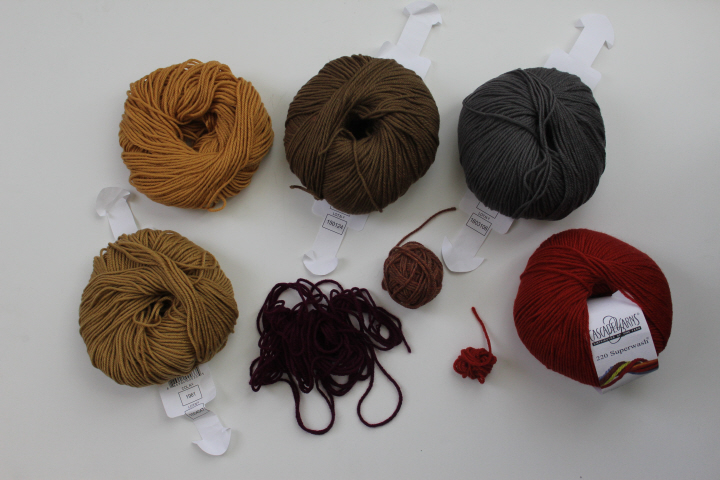
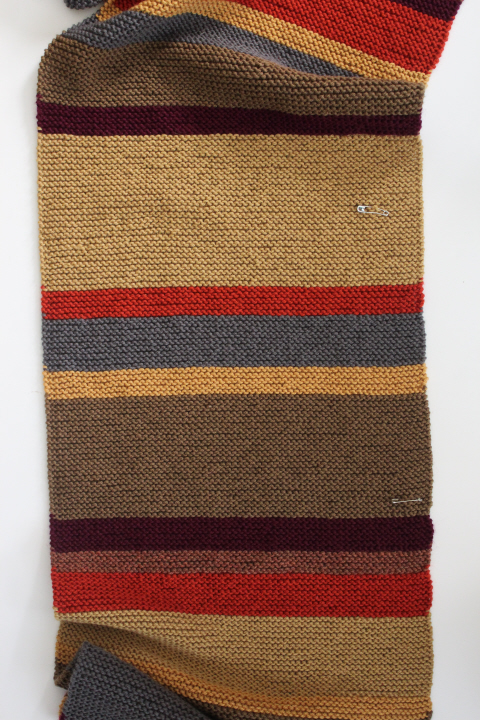
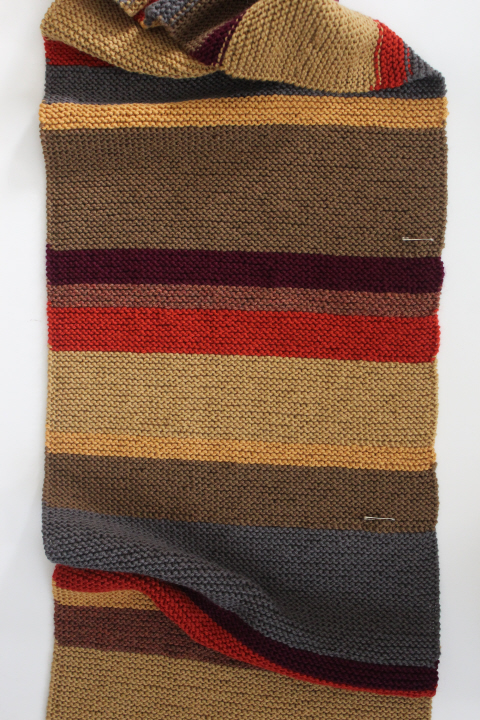
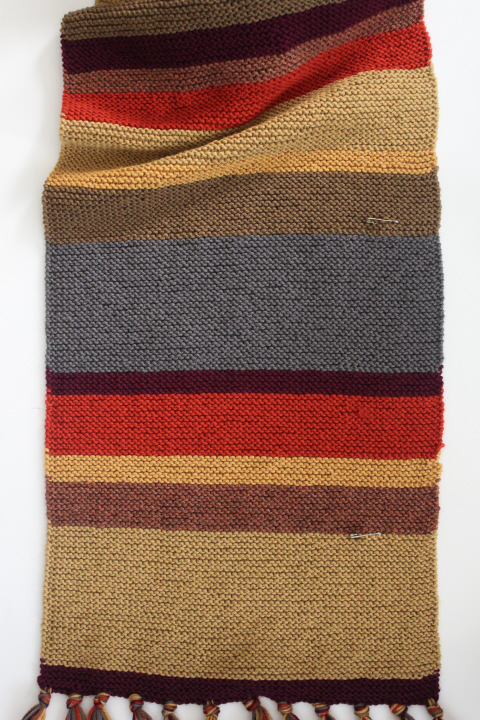
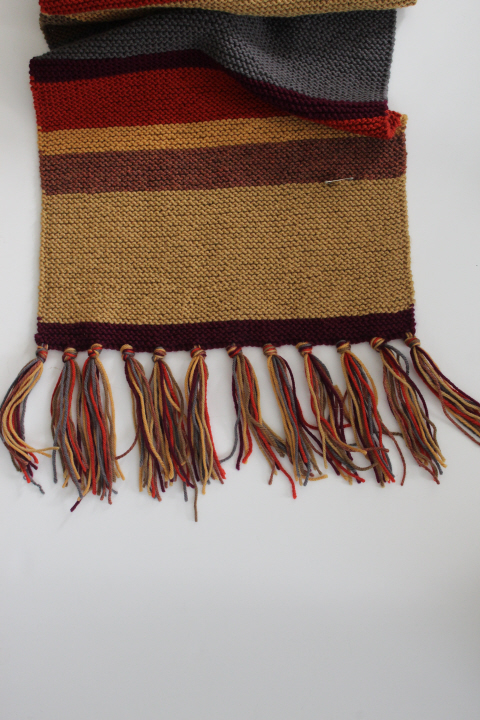
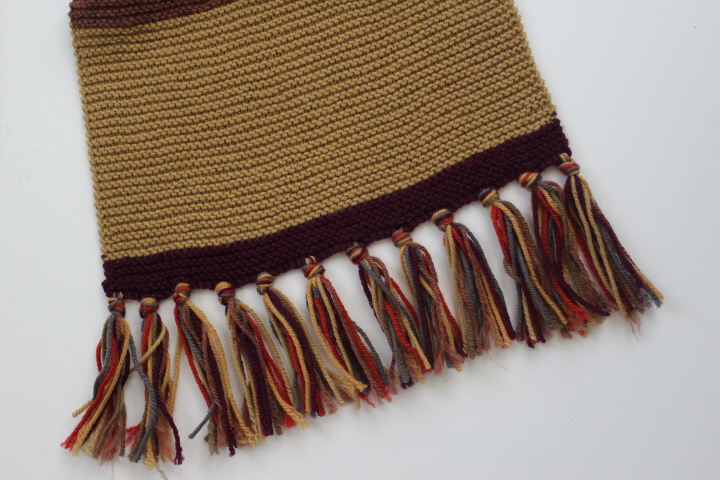
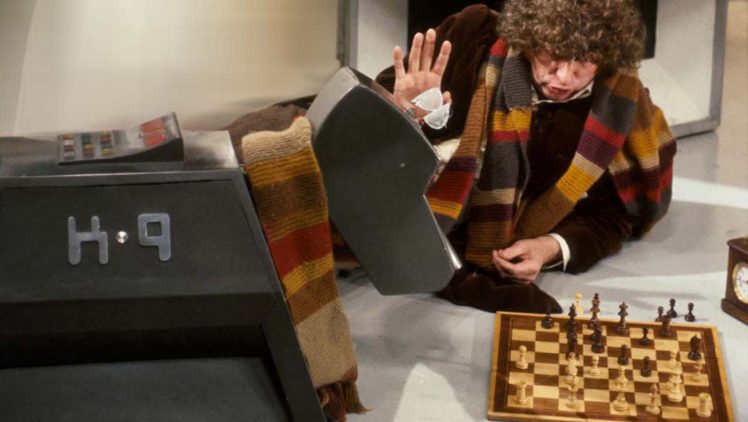
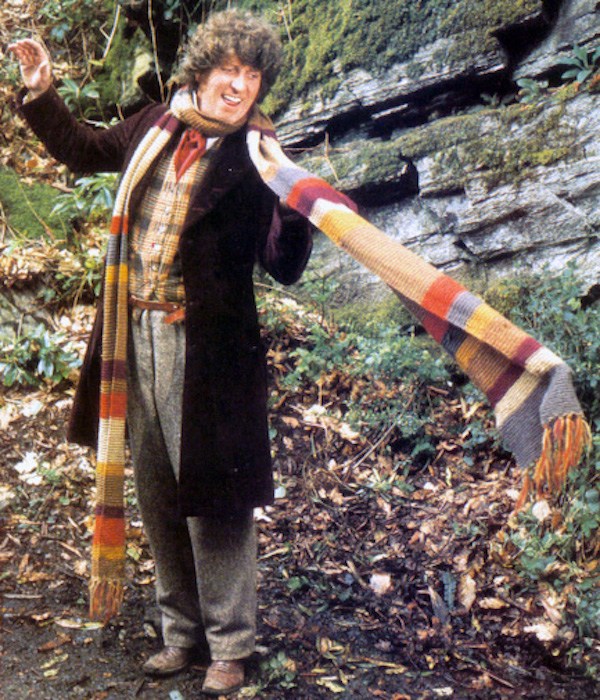
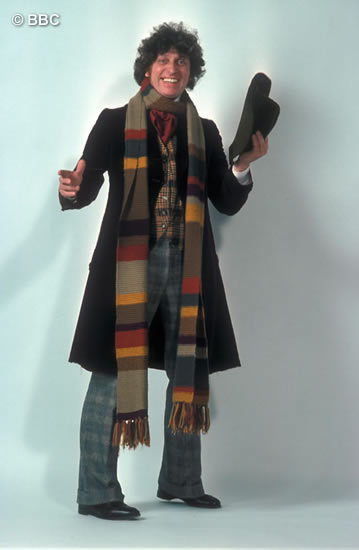
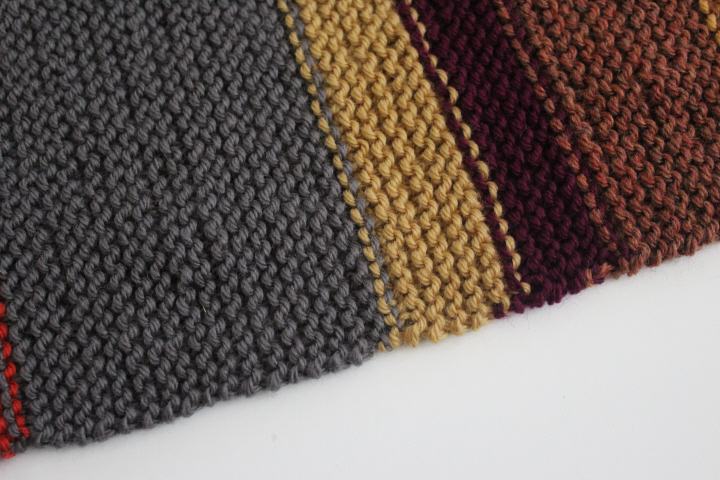
    Here it is, in all its twelve+ feet glory!  The Fourth Doctor scarf (original aka “Acheson Hero” version), in Cascade 220 Superwash, pattern from DoctorWhoScarf.com.

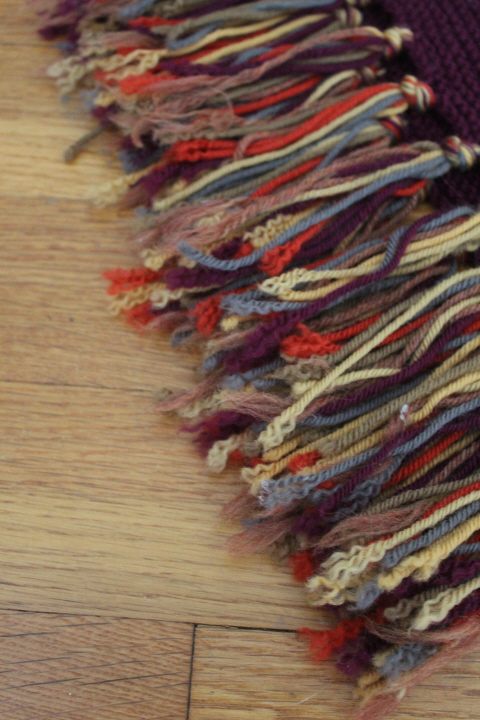
    The Cascade 220 Superwash is okay, a bit splitty, and I’ve never tried it before but I guess fringe does not work particularly well with machine-washed superwash (even on my front-loader’s benevolent hand-wash cycle) —

    6656

    but luckily I’d made the fringe with 12-inch strands so I had the capability to trim the ends even more, and I will certainly tell the recipient to wash the scarf by hand.  The scarf was definitely more like ten feet before washing, but I hung it up to dry, and it has now gained quite a bit of length, as well as getting much softer. 

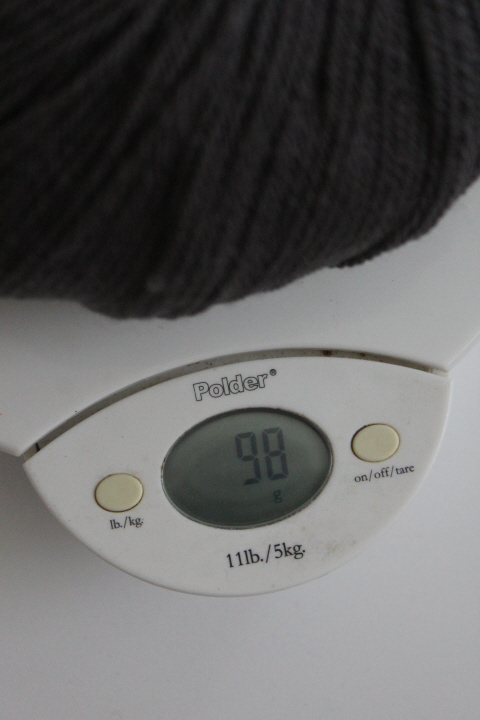
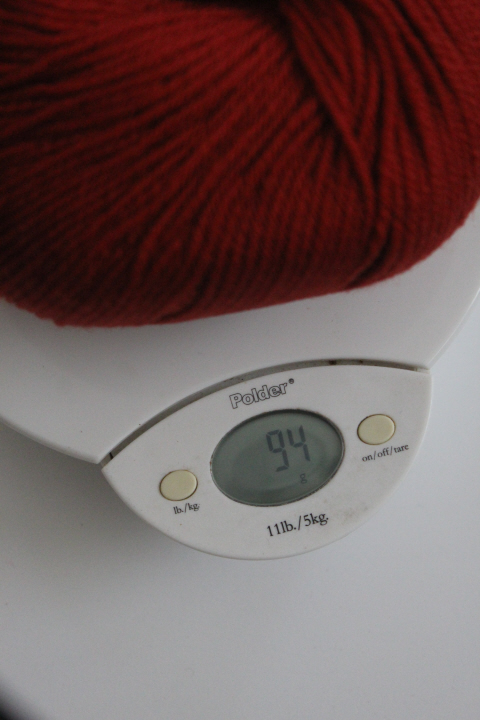
    What really irked me, though, was that even according to the pattern’s meticulous calculations, I ran short of wool.  Maybe this is why —

    6640

    Supposed to be a 100g ball.

    6639

    Grrr.

    So this was how much wool I had left —

    6665

    The labels are either used-up balls or the one I didn’t need after all.  I used two measly feet (for two strands of fringe) of the second ball of gray, but only because I had it — of course I would have just silently made two tassels without gray if I’d had to.

    So, to be frank, I think I would recommend anyone knitting this scarf to go with the non-superwash — because the ends of the fringe will look better, and because the woven-in ends of all those color changes will conceal themselves a bit better, and in the long run you will enjoy the everyday wearing of a good-looking scarf enough that washing its 12+ foot length in the bathtub the few times you really need to do it will not be so onerous.

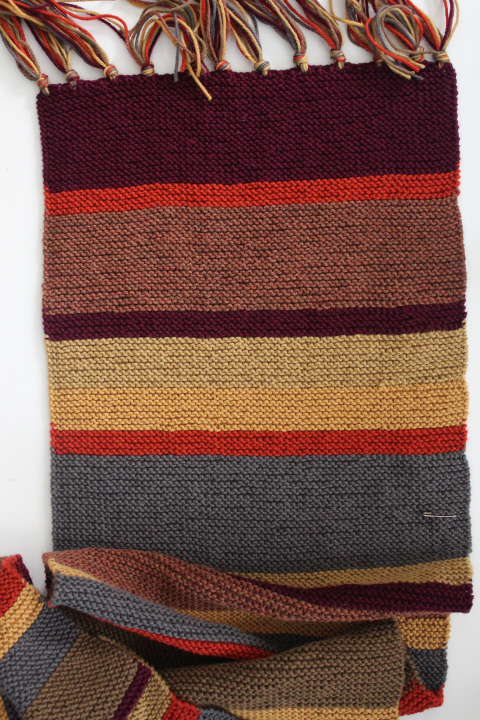
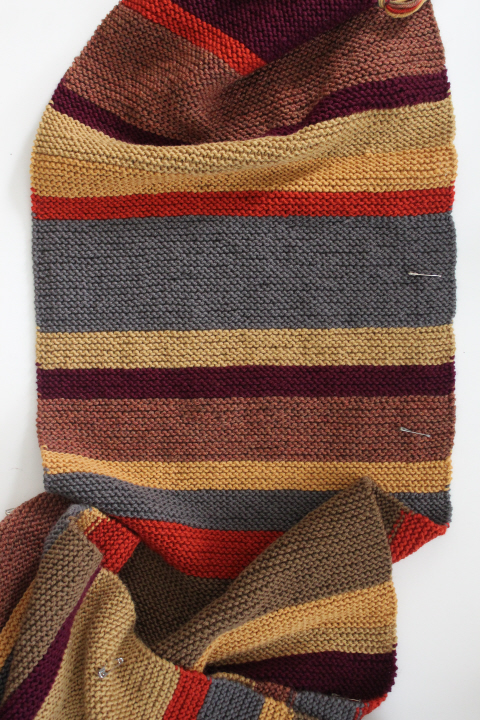
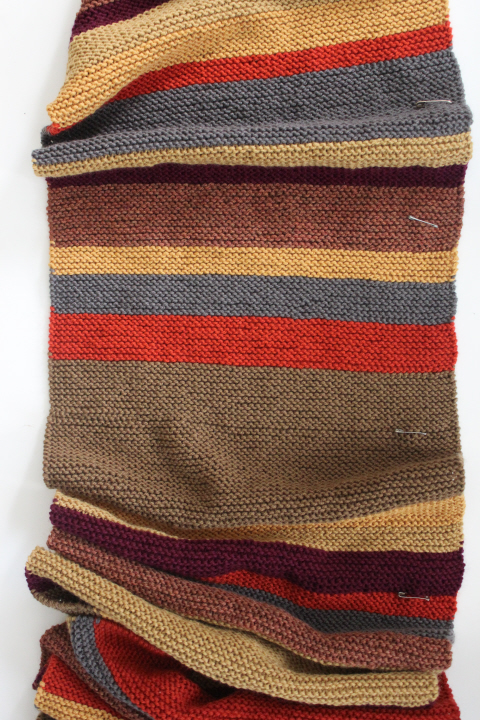
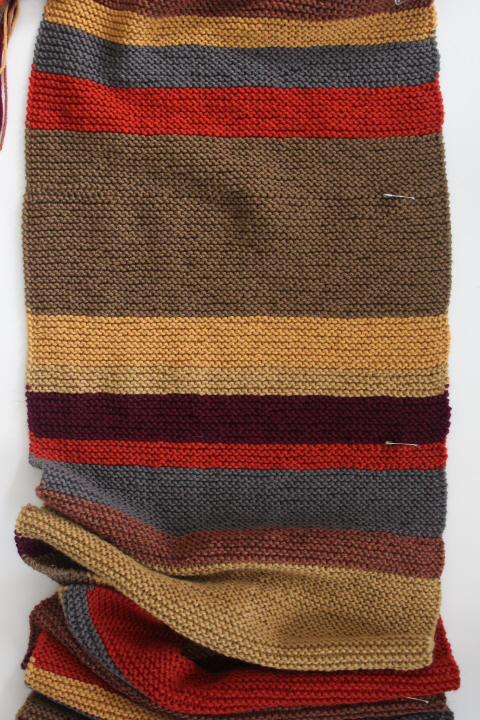
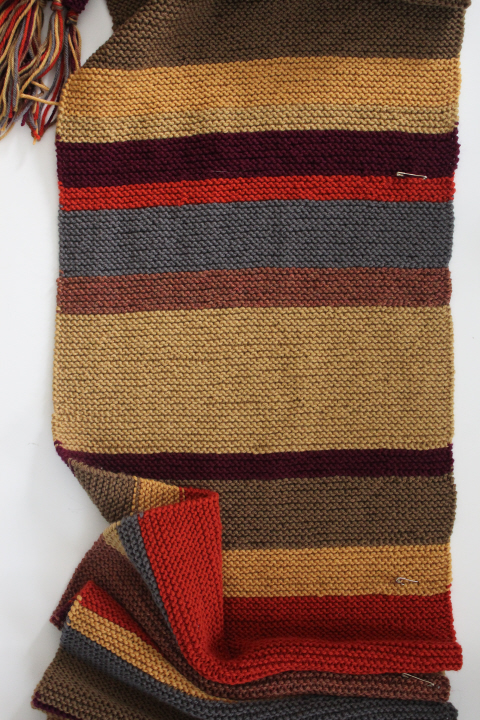
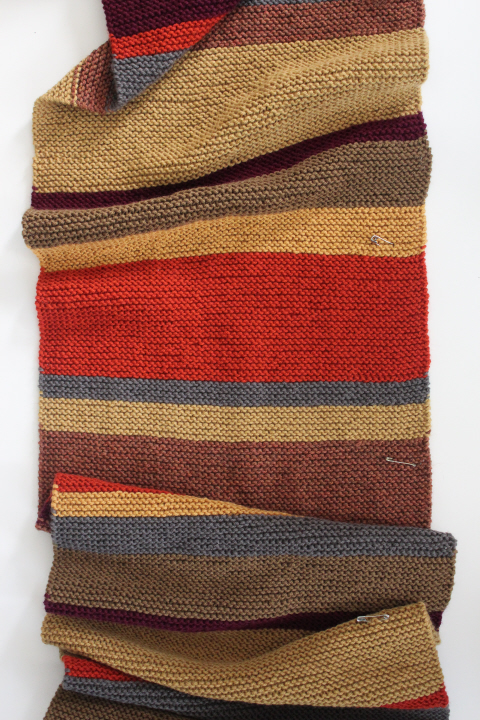
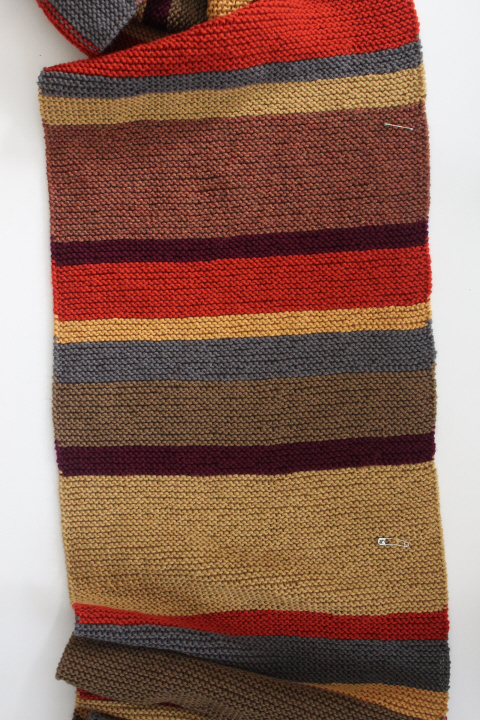
    But — it’s a fun knit, I must say.  I’d put pins in at the beginning of each new day of knitting, and as it turns out, this took me eleven days’ worth of knitting, though some were not particularly industrious and one or two were positively heroic. Just to give you an idea of the scale of the thing, here is a photo sequence of each day’s knitting! —

    6654 6653 6652 6651 6650 6649 6648 6647 6646 6645 6644

    The machine-washed texture, by the way, is a bit looser than the above (pre-laundering) photos though surprisingly not much — presumably its stretching a fraction of an inch for every foot is where all of that extra length came from!

    6663

    And a few more photos of the “real thing” in action, plus a bonus! —

    Scarf 2

    Scarf 4

    Scarf 6

    Seventh doctor

  • 01

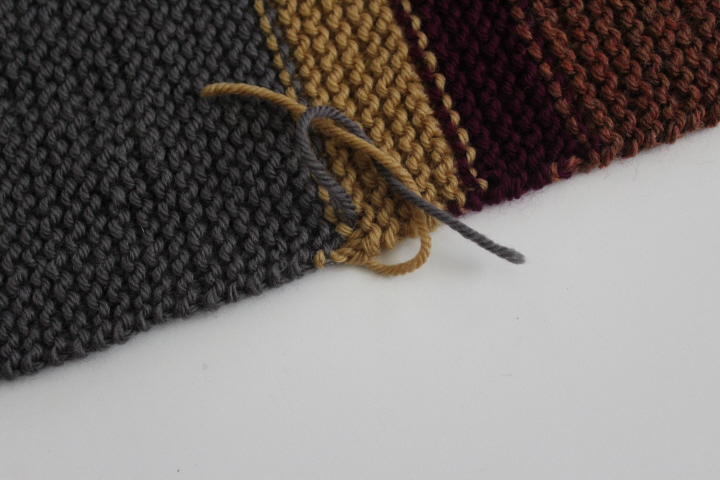
    I've learned a new-to-me technique for weaving in ends, with this Fourth Doctor scarf.  There are a lot of ends here — over a hundred, with all of those stripes! — so after every six or eight color changes, I stop and weave in the ends so as not to be overwhelmed with them all at once.  The pattern from DoctorWhoScarf.com has you weave them in this way, so I thought I'd try it, and it works very well, so I will add it to my bag of tricks.

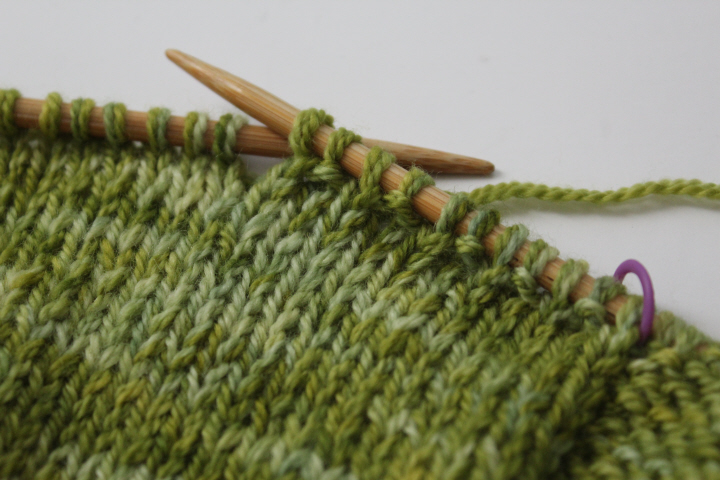
    Work the garter stitch scarf slipping every last stitch knit-wise, and the first stitch of a new-color row with the old color.  Leave the ends around 4 to 6 inches long, or a little less if you feel daring.  You will have something like the photo at top, with the previous color to the right and the new one to the left.

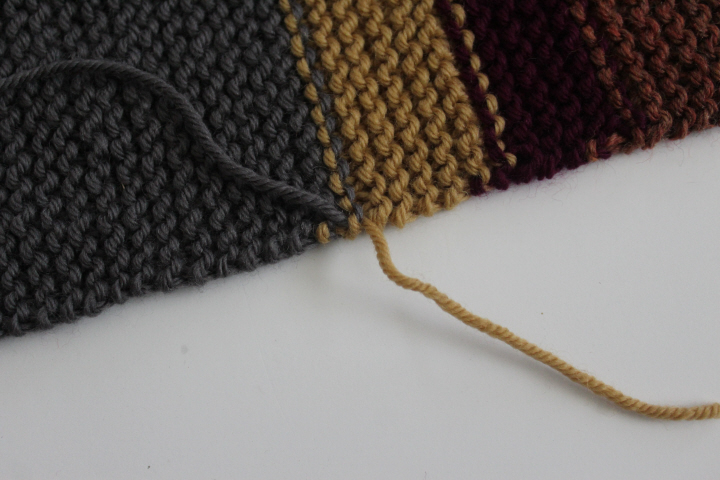
    02

    To weave in the two ends, take the "new" color and tie a half-knot with the new color going over the old one (or in other words, the one in your left hand over the one in your right).

    03

    Because you worked the first stitch of the new stripe with the old color, as you snug up the half-knot the ends will begin to wrap around each other in a remarkable imitation of a knit stitch, with the two "bumps" interlocking.

    04

    05

    Pull the ends close, but not tightly.

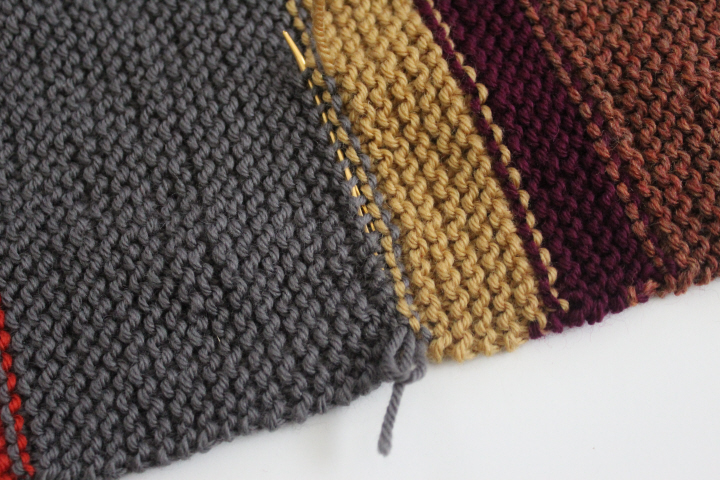
    06

    Thread one end of yarn into a darning needle, and weave the needle over and under the legs of the stitches in the old-color row, for the length of about 20 stitches.

    07

    Repeat the weaving for the second end, again weaving it into its matching color stripe.

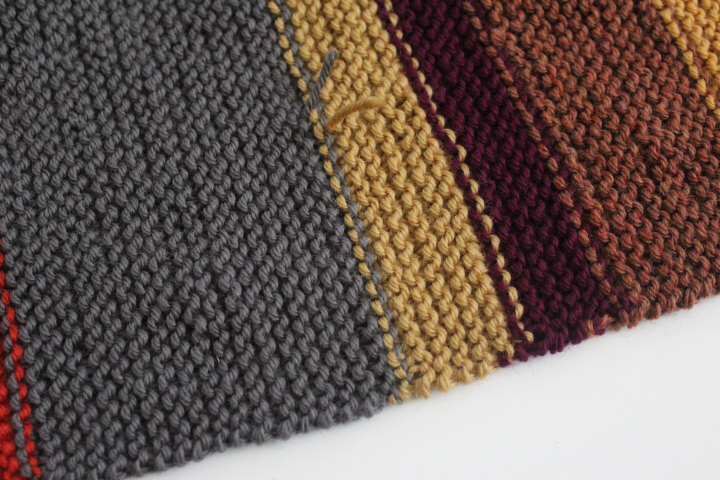
    08

    Pull the ends towards the middle of the knitting, snugly but not tightly.  If you pull it too tightly, just tug on the edge a little to make it straight again.

    Pull the end of wool out from the knitting just a little bit, and snip it off closely — as the stitches return to their original shape, the end will slide back into the knitting and disappear.  If you had a particularly short end, you may not even need to trim it.

    Nice and tidy!

    09

  • 6588

    So I'm knitting merrily along on the Fourth Doctor scarf, having made only one row-counting error and thinking I was going to offer a prize to anyone who could spot it, ha-ha! when all of a sudden —

    6590

    wait a minute, I'm only on row 36 of this fifty-six-row section of green (okay, "green") and I've reached the end of the ball!  No-o-oh!  And I've even been skimpy with the ends at the color changes!
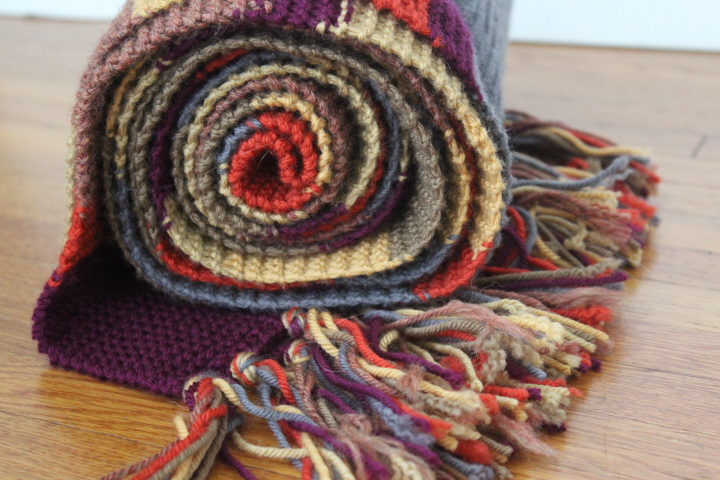
    I stared at it for a while in dismay, then went to bed, and this morning counted up how many rows there are of each color.

    • gold = 92 rows
    • purple = 122 rows
    • brown = 128 rows
    • red = 150 rows
    • grey = 158 rows
    • green = 166 rows
    • tan = 228 rows

    So if 220 yards of wool is only enough for 146 rows (not even counting the fringe, wh. is considerable), then I will also be short on the red and the grey as well (since the pattern did call for 2 balls of the tan, yardage-wise).

    This means I used approximately 1.45 yds. of wool per row, which seems astonishing but math doesn't lie, right? (she said cynically, remembering the checking and double-checking on the Big Bad Baby Blanket from a second person as well, who is much better at math than I am, and look what happened there).

    So if I used 1.45 yards of wool per row, then the yardage should be

    • gold = 133.4 yds + 8 yds fringe = 141.4 yds = 1 ball of Cascade 220 Superwash
    • purple = 176.9 + 8 = 184.9 yds = 1 ball of Cascade 220 Superwash
    • brown = 185.6 + 8 = 193.6 yds = 1 ball of Cascade 220 Superwash
    • red = 217.5 + 8 = 225.5 yds = 2 balls of Cascade 220 Superwash
    • grey = 229.1 + 8 = 237.1 yds = 2 balls of Cascade 220 Superwash
    • green = 240.7 + 8 = 248.7 yds = 2 balls of Cascade 220 Superwash
    • tan = 330.6 + 8 = 338.6 yds = 2 balls of Cascade 220 Superwash

    QED.

    PS: I have ordered this morning three more balls — red, grey, and green — and got a message within an hour and a quarter that the delightful folks at Loopy Ewe had not only shipped my order, but managed to get the same dye-lots as well.

  • IMG_6540

    I just passed the midway point on the Fourth Doctor scarf this morning, knitting at a cracking pace in order to have it finished in time for the recipient's party.  But I must say, this is a considerable distraction, and so most of the time I sit across from it daydreaming, but sometimes when my hands need a break from all that garter stitch, I take some more photos or dust some more.

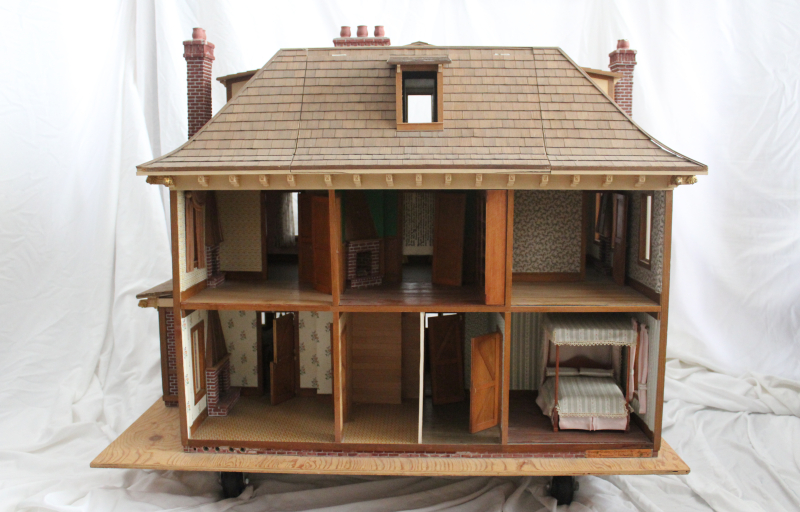
    Now, I don't tend to consider myself a particularly lucky person — not that I'm unlucky or anything, just that I don't often win contests, I don't find gold rings on the beach, that sort of thing — so I was really in the right place at the right time last week when, not long after I joined the local chapter of the National Association of Miniatures Enthusiasts, an e-mail went out to the group asking if anybody wanted this house, because the lady who owned it "wanted to give it away to a good home".  I looked at the blurry photos in the e-mail, thought, "gee, that's a big house", and that the first thing David would say would be, "where would we put it?!"  Being what the English with their straightforwardness call "Mock Tudor" (Americans tend to call it, more generously, "Tudor Revival") it wasn't what I am really interested in, doll's-house-wise — which is real Tudor (aside from perhaps a roombox or two, a Georgian one for sure, maybe a Blitz-era one …) — but something about the house was rather clunkily charming, and I found myself thinking about it all that afternoon.  By the time evening rolled around, I thought I'd quite like to have it. 

    So I sent off an e-mail to the club secretary, who forwarded that to the lady in question, who phoned me, &c. &c. &c — and Saturday we went and collected it.

    6542

    6514

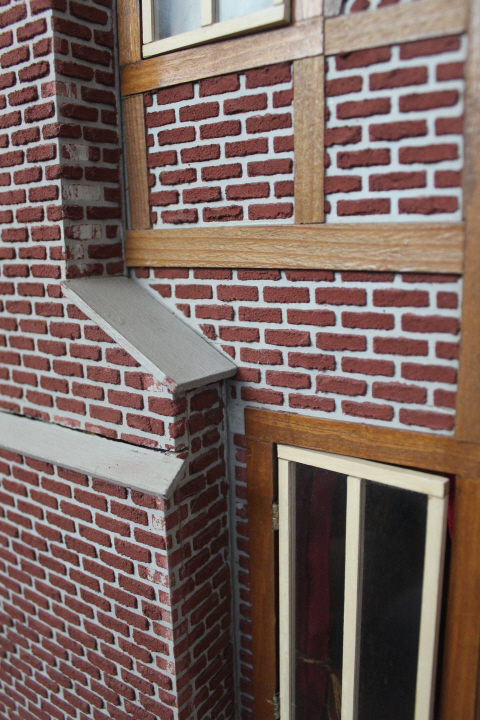
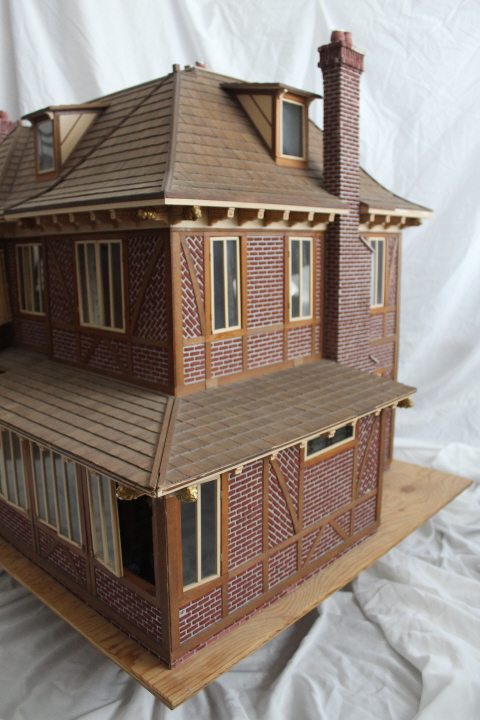
    It's pretty dusty, from having sat in this lady's service porch for I don't know how long, and obviously it has been knocked around a bit in the years since it got abandoned after Hardy's Miniatures closed — many of the chimney pots (there are seven!! though only six fireplaces) are chipped, bricks are missing, and some of the windows are hanging by a single nail.  But it seems structurally sound.

    6409

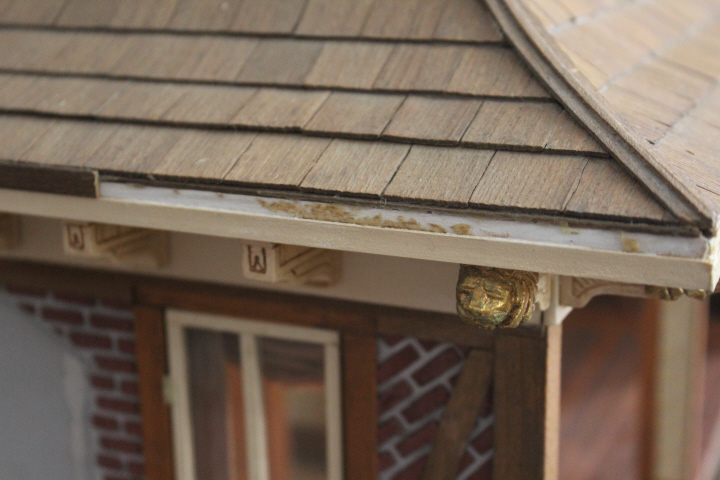
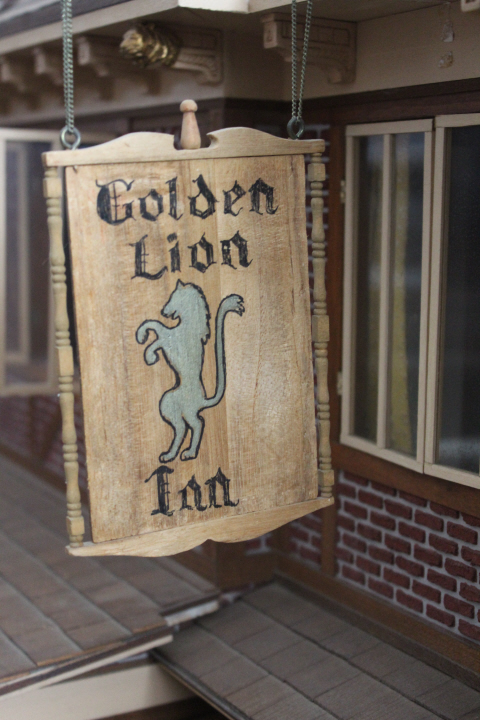
    The old inn sign.  It's hanging crookedly because the wood of the eave just there has split.  Here is also the only corbel — of a great many — that is missing.

    6464

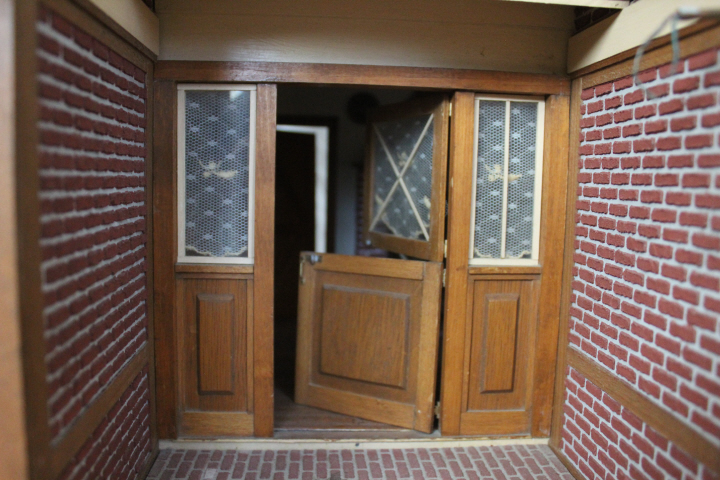
    This whole door assembly is removable, for access to the stairs and part of the main room.  I guess that little wire there means there used to be a lantern at the side of the porch — long gone.

    6469

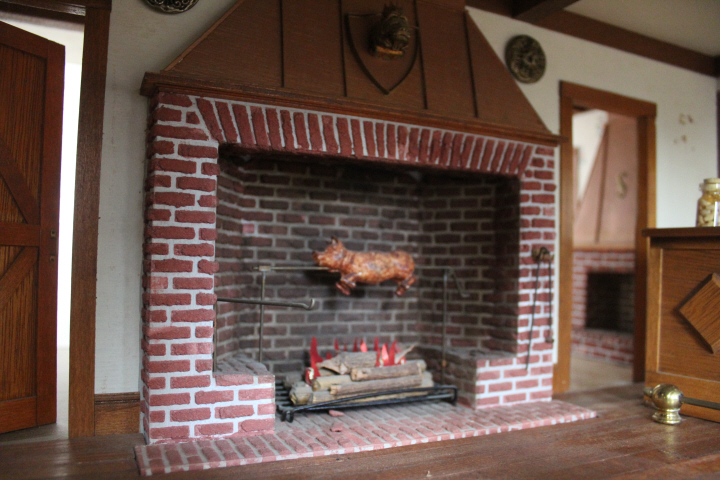
    To the left inside the front door is the staircase, and to the right is this large fireplace, complete with perpetually-roasting pig and eternal flame.  The fire is actually pretty effective in real life, since the light in the room isn't normally as bright as this, and the "flames" are sort of glimmery — some kind of foil, perhaps.

    6473

    These pieces are obviously not fixed in, but are still here despite the lack of furniture in all of the other rooms except one.  We couldn't figure out what the long rod was for — "curtains?? no, it isn't long enough to span all the windows" — so I think it is a foot rail for the bar.  ("Why?" said Julia scornfully, unwilling to grasp the concept.)

    6476

    Julia was poking around and suddenly said, half horrified and half delighted, "Are those eyeballs in a jar??"  I suppose that since it isn't meant to be that kind of a house, they're pickled eggs, but she reads lots of Terry Pratchett and therefore would in fact prefer that they are pickled eyeballs.

    6477

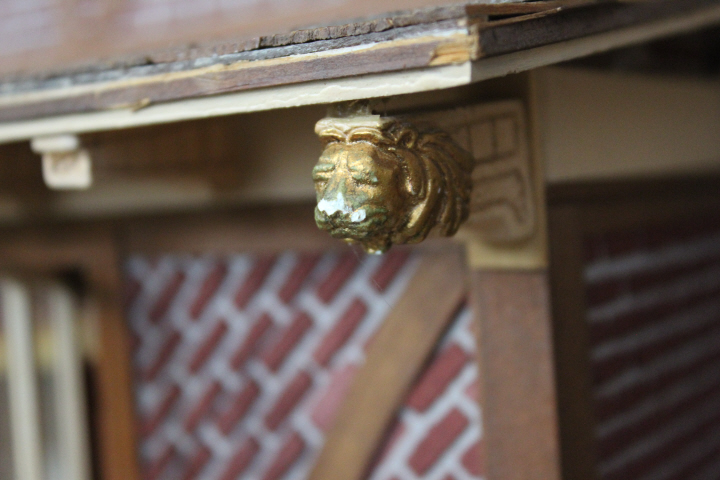
    This lion is obviously special — he gets a crown!

    6480

    It's kind of funny and surreal that the rest of the house is bare, yet the bar still has towels and bottles and glasses and a folded newspaper on it — yeah, they're glued on.

    6442

    Just past the bar is a Dutch door into this room at the back.

    6440

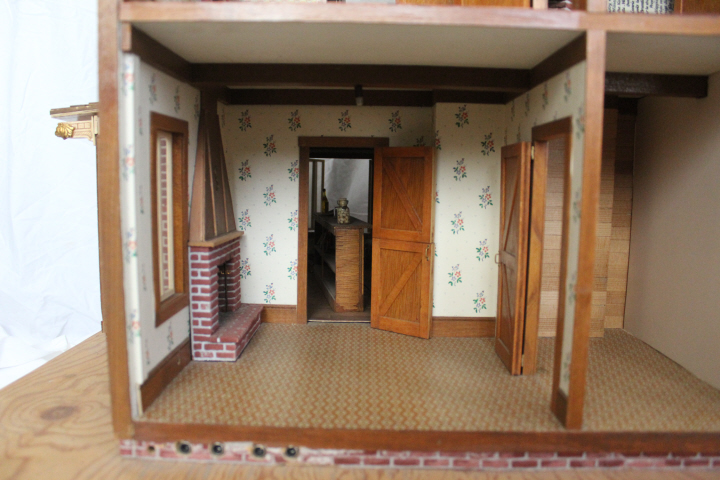
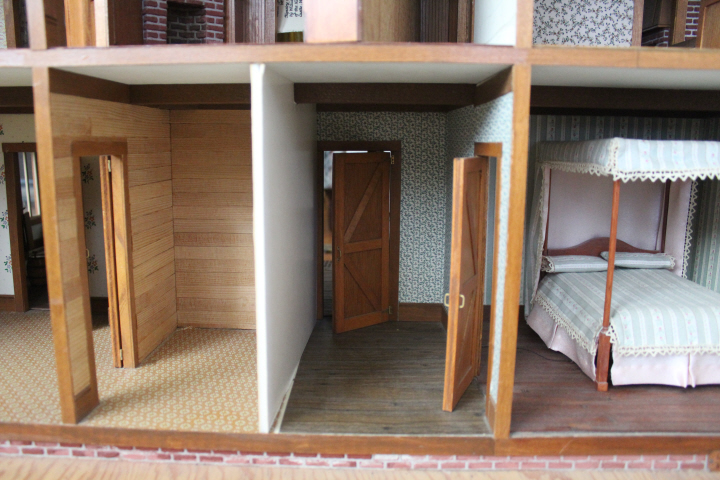
    The lady who gave this to me had begun to subdivide the center room downstairs, but the new wall is just a piece of foamboard, so I can take it out quite easily.  I'm not sure what the plans were for the little room on the left — it looks like a sauna now, doesn't it, with that horizontal paneling!  Maybe a pantry, as it would make sense to have the inn's kitchen there.  She also made the bed in the next room, though to be honest it takes up most of the space — there is in fact another door behind it!

    6450

    This has a rather sad abandoned-house look, doesn't it.  I love the color of the floor in this room.

    6459

    Through that door is this room at the front.  It is only accessible through the windows, so I didn't really realize what it looks like!  Just to the right outside the photo is a tall narrow internal window that looks onto the half-landing.

    6451

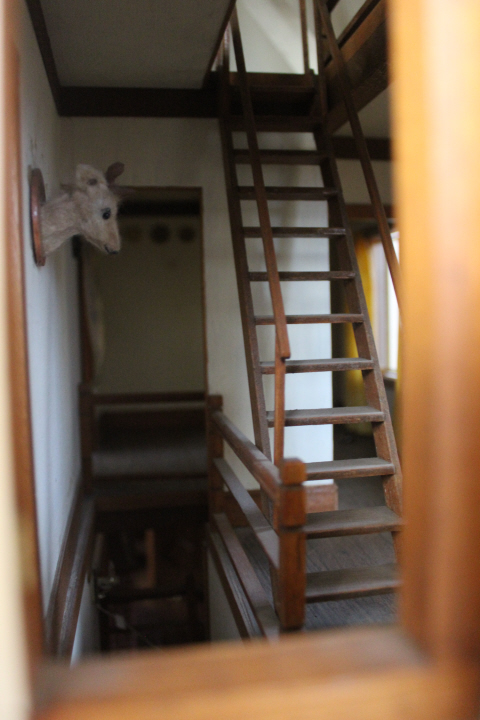
    Yes, a trophy head!  There is another one that has fallen to the floor.  I thought it was a pony at first, with a fuzzy mane and what looked like a bridle drawn on it with marker, but I think it's meant to be a zebra.  Whew.

    6434

    6428

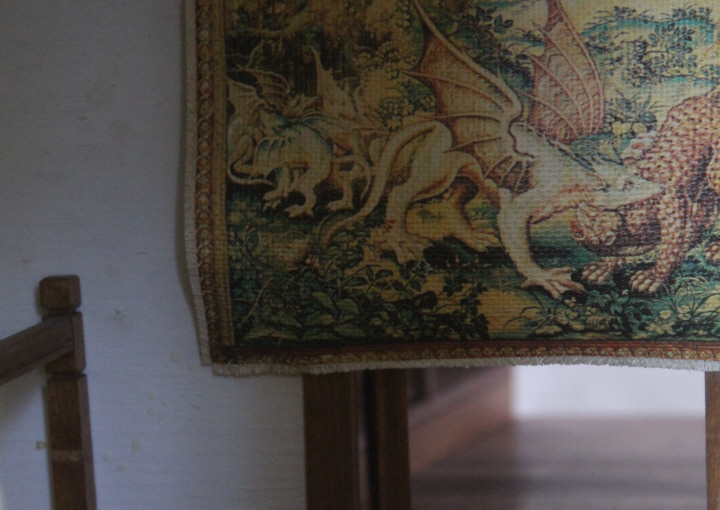
    The doorway between the little room on the right at back was papered over by the lady who gave me the house — she made the big bookcase.  Definitely keeping that — doesn't this look like a cozy library, with the wall of bookcases and the wainscoting and the fireplace?!  It just needs a sofa and a good reading lamp (and of course a petitpoint carpet! luckily, I've got some).  I'm not sure why the faux tapestry is hung in front of the door, but there certainly are an abundance of doors.  More doors than a Restoration comedy.

    6421

    6553

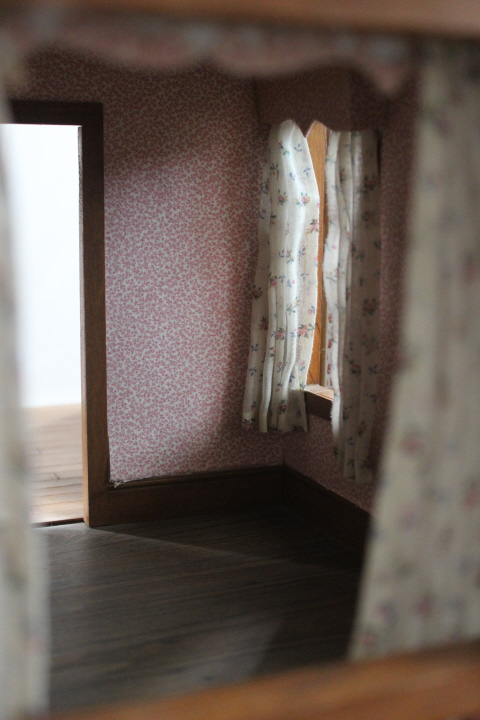
    Very difficult to get a photo of this pretty room, at the front of the house, as I can't fit my camera through the windows!

    6416

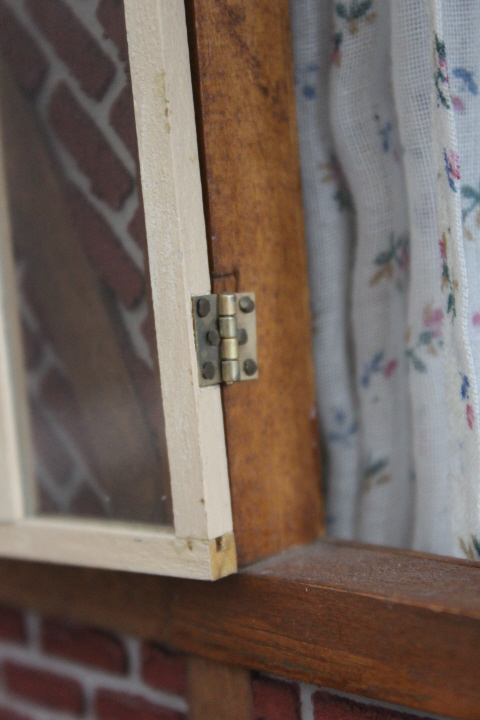
    Teeny-tiny hinges with teeny-tiny nails.

    6481

    The upstairs landing is full of nooks and crannies.  It has this faux tapestry, as well as a sort of frieze of metal medallions around the top — sort of mock-baronial, I guess!

    6484

    6424

    At the top of the main staircase is also a rather spare ladder up to the unfinished attic.

    6426

    The flooring here, I'm sorry to say, is contact paper.  It's coming out right after I give the place a good dusting.

    6417

    There are a great many corbels, and each is "carved" with this nice detail — maybe punched with a metal stamp?

    6455

    This whole chimney unit comes off, possibly for moving purposes, possibly to access the electrical in the two fireboxes.  The bricks seem to be some sort of clay adhering to the "mortar" backing — unfortunately it's apparently a bit fragile now in places.

    6463

    In honor of the inn's name, there is a golden lion head on every corner corbel.  I think this one looks like Martin Scorsese, though maybe that's just because of the eyebrows.

    6468

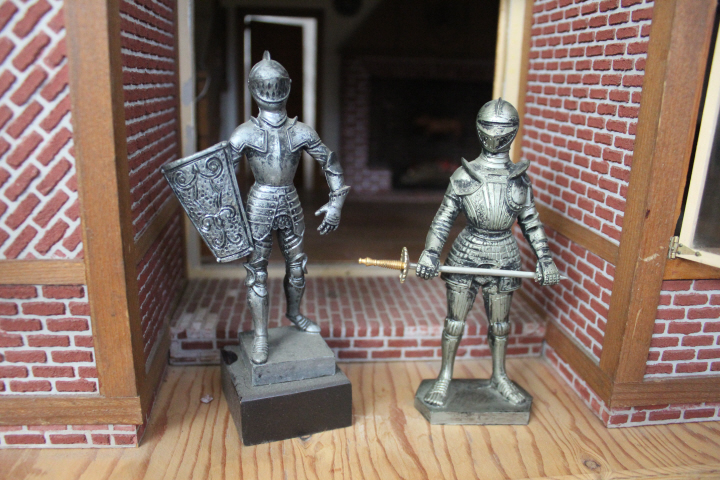
    I started calling these guys Aethelbert and Aethelred — historical accuracy be damned, just this once! — but Click and Clack is also good.

    6510

    The roof directly above the bar hinges open for helpful access to the main room. You can see the two hinges along the beam just above, when it's closed.

    6537

    6533

    So I'm really happy, and well aware of my good luck in being in the right place at the right time.  I think this will be a fun project, though it will probably take years and never be "finished"!