• 6660

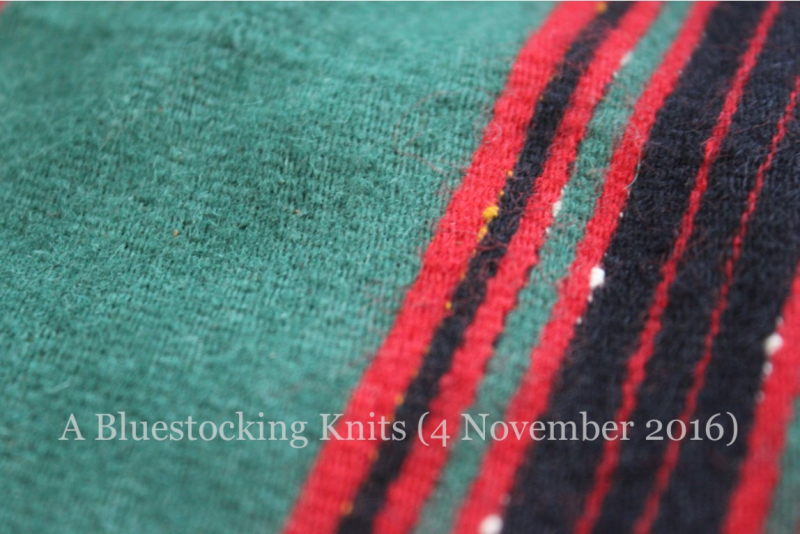
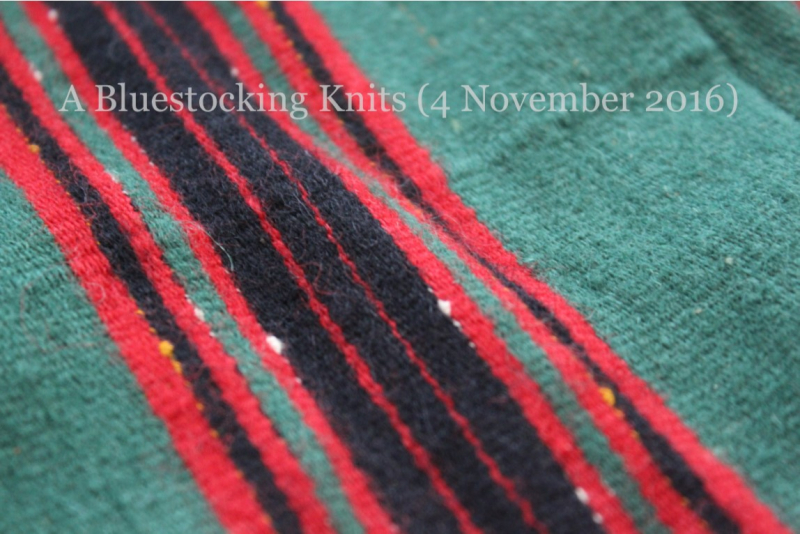
    Here it is, in all its twelve+ feet glory!  The Fourth Doctor scarf (original aka “Acheson Hero” version), in Cascade 220 Superwash, pattern from DoctorWhoScarf.com.

    The Cascade 220 Superwash is okay, a bit splitty, and I’ve never tried it before but I guess fringe does not work particularly well with machine-washed superwash (even on my front-loader’s benevolent hand-wash cycle) —

    6656

    but luckily I’d made the fringe with 12-inch strands so I had the capability to trim the ends even more, and I will certainly tell the recipient to wash the scarf by hand.  The scarf was definitely more like ten feet before washing, but I hung it up to dry, and it has now gained quite a bit of length, as well as getting much softer. 

    What really irked me, though, was that even according to the pattern’s meticulous calculations, I ran short of wool.  Maybe this is why —

    6640

    Supposed to be a 100g ball.

    6639

    Grrr.

    So this was how much wool I had left —

    6665

    The labels are either used-up balls or the one I didn’t need after all.  I used two measly feet (for two strands of fringe) of the second ball of gray, but only because I had it — of course I would have just silently made two tassels without gray if I’d had to.

    So, to be frank, I think I would recommend anyone knitting this scarf to go with the non-superwash — because the ends of the fringe will look better, and because the woven-in ends of all those color changes will conceal themselves a bit better, and in the long run you will enjoy the everyday wearing of a good-looking scarf enough that washing its 12+ foot length in the bathtub the few times you really need to do it will not be so onerous.

    But — it’s a fun knit, I must say.  I’d put pins in at the beginning of each new day of knitting, and as it turns out, this took me eleven days’ worth of knitting, though some were not particularly industrious and one or two were positively heroic. Just to give you an idea of the scale of the thing, here is a photo sequence of each day’s knitting! —

    6654 6653 6652 6651 6650 6649 6648 6647 6646 6645 6644

    The machine-washed texture, by the way, is a bit looser than the above (pre-laundering) photos though surprisingly not much — presumably its stretching a fraction of an inch for every foot is where all of that extra length came from!

    6663

    And a few more photos of the “real thing” in action, plus a bonus! —

    Scarf 2

    Scarf 4

    Scarf 6

    Seventh doctor

  • 01

    I've learned a new-to-me technique for weaving in ends, with this Fourth Doctor scarf.  There are a lot of ends here — over a hundred, with all of those stripes! — so after every six or eight color changes, I stop and weave in the ends so as not to be overwhelmed with them all at once.  The pattern from DoctorWhoScarf.com has you weave them in this way, so I thought I'd try it, and it works very well, so I will add it to my bag of tricks.

    Work the garter stitch scarf slipping every last stitch knit-wise, and the first stitch of a new-color row with the old color.  Leave the ends around 4 to 6 inches long, or a little less if you feel daring.  You will have something like the photo at top, with the previous color to the right and the new one to the left.

    02

    To weave in the two ends, take the "new" color and tie a half-knot with the new color going over the old one (or in other words, the one in your left hand over the one in your right).

    03

    Because you worked the first stitch of the new stripe with the old color, as you snug up the half-knot the ends will begin to wrap around each other in a remarkable imitation of a knit stitch, with the two "bumps" interlocking.

    04

    05

    Pull the ends close, but not tightly.

    06

    Thread one end of yarn into a darning needle, and weave the needle over and under the legs of the stitches in the old-color row, for the length of about 20 stitches.

    07

    Repeat the weaving for the second end, again weaving it into its matching color stripe.

    08

    Pull the ends towards the middle of the knitting, snugly but not tightly.  If you pull it too tightly, just tug on the edge a little to make it straight again.

    Pull the end of wool out from the knitting just a little bit, and snip it off closely — as the stitches return to their original shape, the end will slide back into the knitting and disappear.  If you had a particularly short end, you may not even need to trim it.

    Nice and tidy!

    09

  • 6588

    So I'm knitting merrily along on the Fourth Doctor scarf, having made only one row-counting error and thinking I was going to offer a prize to anyone who could spot it, ha-ha! when all of a sudden —

    6590

    wait a minute, I'm only on row 36 of this fifty-six-row section of green (okay, "green") and I've reached the end of the ball!  No-o-oh!  And I've even been skimpy with the ends at the color changes!

    I stared at it for a while in dismay, then went to bed, and this morning counted up how many rows there are of each color.

    • gold = 92 rows
    • purple = 122 rows
    • brown = 128 rows
    • red = 150 rows
    • grey = 158 rows
    • green = 166 rows
    • tan = 228 rows

    So if 220 yards of wool is only enough for 146 rows (not even counting the fringe, wh. is considerable), then I will also be short on the red and the grey as well (since the pattern did call for 2 balls of the tan, yardage-wise).

    This means I used approximately 1.45 yds. of wool per row, which seems astonishing but math doesn't lie, right? (she said cynically, remembering the checking and double-checking on the Big Bad Baby Blanket from a second person as well, who is much better at math than I am, and look what happened there).

    So if I used 1.45 yards of wool per row, then the yardage should be

    • gold = 133.4 yds + 8 yds fringe = 141.4 yds = 1 ball of Cascade 220 Superwash
    • purple = 176.9 + 8 = 184.9 yds = 1 ball of Cascade 220 Superwash
    • brown = 185.6 + 8 = 193.6 yds = 1 ball of Cascade 220 Superwash
    • red = 217.5 + 8 = 225.5 yds = 2 balls of Cascade 220 Superwash
    • grey = 229.1 + 8 = 237.1 yds = 2 balls of Cascade 220 Superwash
    • green = 240.7 + 8 = 248.7 yds = 2 balls of Cascade 220 Superwash
    • tan = 330.6 + 8 = 338.6 yds = 2 balls of Cascade 220 Superwash

    QED.

    PS: I have ordered this morning three more balls — red, grey, and green — and got a message within an hour and a quarter that the delightful folks at Loopy Ewe had not only shipped my order, but managed to get the same dye-lots as well.

  • IMG_6540

    I just passed the midway point on the Fourth Doctor scarf this morning, knitting at a cracking pace in order to have it finished in time for the recipient's party.  But I must say, this is a considerable distraction, and so most of the time I sit across from it daydreaming, but sometimes when my hands need a break from all that garter stitch, I take some more photos or dust some more.

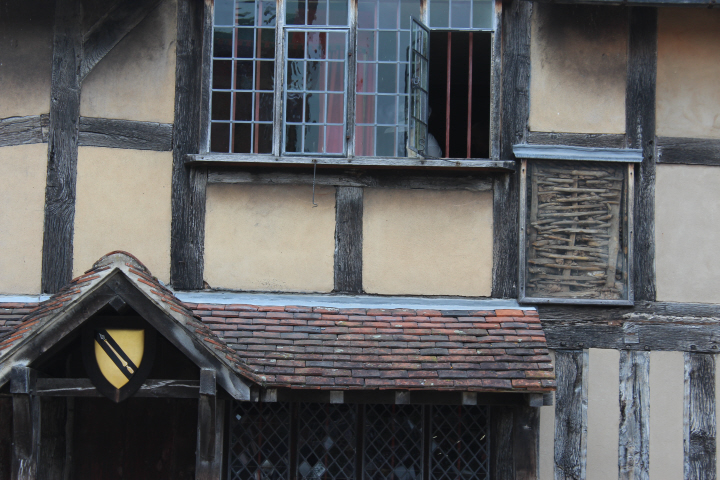
    Now, I don't tend to consider myself a particularly lucky person — not that I'm unlucky or anything, just that I don't often win contests, I don't find gold rings on the beach, that sort of thing — so I was really in the right place at the right time last week when, not long after I joined the local chapter of the National Association of Miniatures Enthusiasts, an e-mail went out to the group asking if anybody wanted this house, because the lady who owned it "wanted to give it away to a good home".  I looked at the blurry photos in the e-mail, thought, "gee, that's a big house", and that the first thing David would say would be, "where would we put it?!"  Being what the English with their straightforwardness call "Mock Tudor" (Americans tend to call it, more generously, "Tudor Revival") it wasn't what I am really interested in, doll's-house-wise — which is real Tudor (aside from perhaps a roombox or two, a Georgian one for sure, maybe a Blitz-era one …) — but something about the house was rather clunkily charming, and I found myself thinking about it all that afternoon.  By the time evening rolled around, I thought I'd quite like to have it. 

    So I sent off an e-mail to the club secretary, who forwarded that to the lady in question, who phoned me, &c. &c. &c — and Saturday we went and collected it.

    6542

    6514

    It's pretty dusty, from having sat in this lady's service porch for I don't know how long, and obviously it has been knocked around a bit in the years since it got abandoned after Hardy's Miniatures closed — many of the chimney pots (there are seven!! though only six fireplaces) are chipped, bricks are missing, and some of the windows are hanging by a single nail.  But it seems structurally sound.

    6409

    The old inn sign.  It's hanging crookedly because the wood of the eave just there has split.  Here is also the only corbel — of a great many — that is missing.

    6464

    This whole door assembly is removable, for access to the stairs and part of the main room.  I guess that little wire there means there used to be a lantern at the side of the porch — long gone.

    6469

    To the left inside the front door is the staircase, and to the right is this large fireplace, complete with perpetually-roasting pig and eternal flame.  The fire is actually pretty effective in real life, since the light in the room isn't normally as bright as this, and the "flames" are sort of glimmery — some kind of foil, perhaps.

    6473

    These pieces are obviously not fixed in, but are still here despite the lack of furniture in all of the other rooms except one.  We couldn't figure out what the long rod was for — "curtains?? no, it isn't long enough to span all the windows" — so I think it is a foot rail for the bar.  ("Why?" said Julia scornfully, unwilling to grasp the concept.)

    6476

    Julia was poking around and suddenly said, half horrified and half delighted, "Are those eyeballs in a jar??"  I suppose that since it isn't meant to be that kind of a house, they're pickled eggs, but she reads lots of Terry Pratchett and therefore would in fact prefer that they are pickled eyeballs.

    6477

    This lion is obviously special — he gets a crown!

    6480

    It's kind of funny and surreal that the rest of the house is bare, yet the bar still has towels and bottles and glasses and a folded newspaper on it — yeah, they're glued on.

    6442

    Just past the bar is a Dutch door into this room at the back.

    6440

    The lady who gave this to me had begun to subdivide the center room downstairs, but the new wall is just a piece of foamboard, so I can take it out quite easily.  I'm not sure what the plans were for the little room on the left — it looks like a sauna now, doesn't it, with that horizontal paneling!  Maybe a pantry, as it would make sense to have the inn's kitchen there.  She also made the bed in the next room, though to be honest it takes up most of the space — there is in fact another door behind it!

    6450

    This has a rather sad abandoned-house look, doesn't it.  I love the color of the floor in this room.

    6459

    Through that door is this room at the front.  It is only accessible through the windows, so I didn't really realize what it looks like!  Just to the right outside the photo is a tall narrow internal window that looks onto the half-landing.

    6451

    Yes, a trophy head!  There is another one that has fallen to the floor.  I thought it was a pony at first, with a fuzzy mane and what looked like a bridle drawn on it with marker, but I think it's meant to be a zebra.  Whew.

    6434

    6428

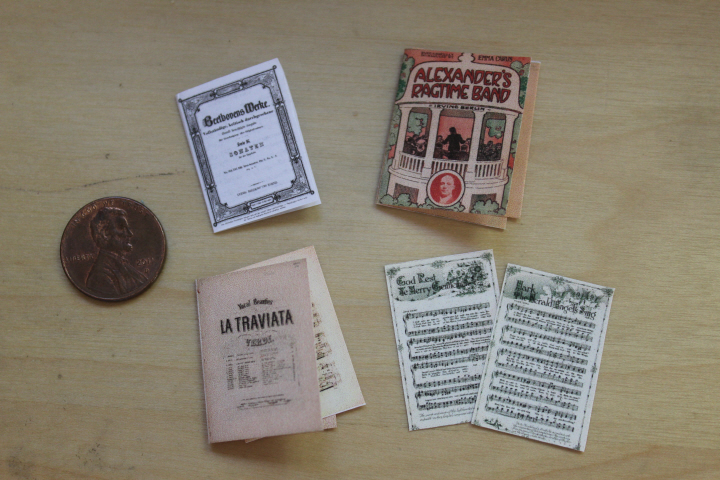
    The doorway between the little room on the right at back was papered over by the lady who gave me the house — she made the big bookcase.  Definitely keeping that — doesn't this look like a cozy library, with the wall of bookcases and the wainscoting and the fireplace?!  It just needs a sofa and a good reading lamp (and of course a petitpoint carpet! luckily, I've got some).  I'm not sure why the faux tapestry is hung in front of the door, but there certainly are an abundance of doors.  More doors than a Restoration comedy.

    6421

    6553

    Very difficult to get a photo of this pretty room, at the front of the house, as I can't fit my camera through the windows!

    6416

    Teeny-tiny hinges with teeny-tiny nails.

    6481

    The upstairs landing is full of nooks and crannies.  It has this faux tapestry, as well as a sort of frieze of metal medallions around the top — sort of mock-baronial, I guess!

    6484

    6424

    At the top of the main staircase is also a rather spare ladder up to the unfinished attic.

    6426

    The flooring here, I'm sorry to say, is contact paper.  It's coming out right after I give the place a good dusting.

    6417

    There are a great many corbels, and each is "carved" with this nice detail — maybe punched with a metal stamp?

    6455

    This whole chimney unit comes off, possibly for moving purposes, possibly to access the electrical in the two fireboxes.  The bricks seem to be some sort of clay adhering to the "mortar" backing — unfortunately it's apparently a bit fragile now in places.

    6463

    In honor of the inn's name, there is a golden lion head on every corner corbel.  I think this one looks like Martin Scorsese, though maybe that's just because of the eyebrows.

    6468

    I started calling these guys Aethelbert and Aethelred — historical accuracy be damned, just this once! — but Click and Clack is also good.

    6510

    The roof directly above the bar hinges open for helpful access to the main room. You can see the two hinges along the beam just above, when it's closed.

    6537

    6533

    So I'm really happy, and well aware of my good luck in being in the right place at the right time.  I think this will be a fun project, though it will probably take years and never be "finished"!

  • 6393

    When David mentioned the other day that a co-worker is retiring and they have been wracking their brains trying to think of something to give him, and that his name is quite like a certain Doctor's, to the point that they even call him that at work, it seemed to me that the obvious gift would be the famous Scarf.

    Yes, it's a Fourth Doctor Scarf!  Yes, it's twelve feet long, give or take!  Yes, it's so iconic, so desirable, that it actually has a website dedicated to re-creating it, in a variety of wools to suit, and you can even choose which season's version, since with use and damage and whatnot, the original scarf lost and regained some sections here and there, or you could — seriously geeking out here — make the stunt double!

    Yes, I must be mad — but really, who could resist?  So I am temporarily halting progress on …
    6403

    The Big Bad Blanket (ripped back to what I hope will be the new midpoint, and merely a handspan or so into the second half, though it still goes quite quickly once I actually start knitting).

    6402

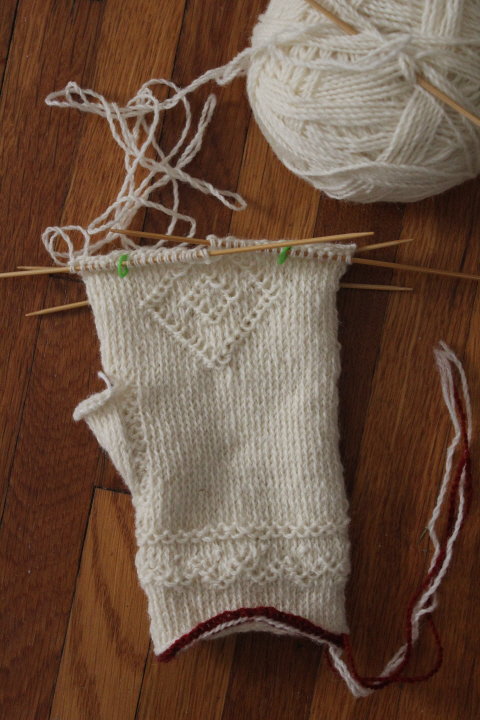
    The Mora two-end mittens (back in the ball altogether).

    6405

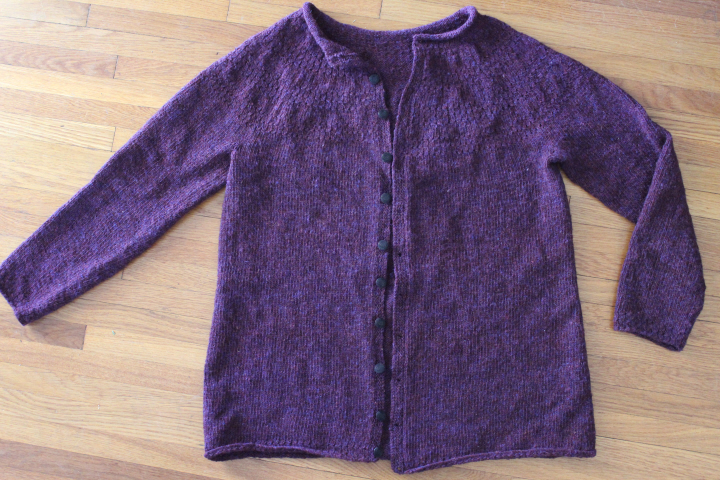
    The Parley cardigan (halfway up the first sleeve, wh. I started with, doubling as my gauge swatch — you can't quite tell anymore now that it's been stuffed into and taken out of my bag numerous times, but the lower part has been blocked and checked for gauge).

    6404

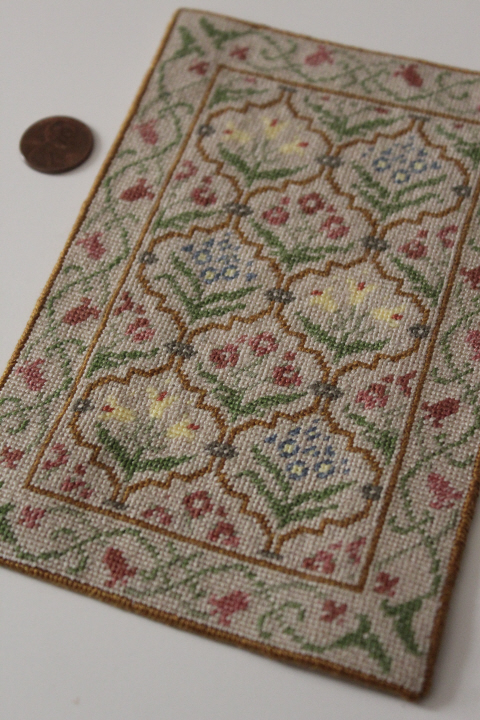
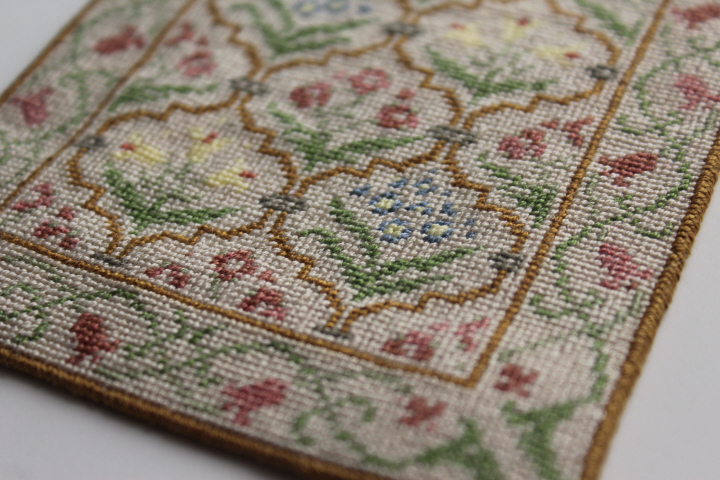
    The "Greek-Style Georgian" miniature carpet (only a little bit further along than the last time I set it aside — am going to work the rest of the gold shades to see if I run out of anything else before I order more blue).

    In a casually-unscientific calculation, I noted that I worked 12 garter "ridges" of the scarf in a little under a half-hour, so … hmm.  Wish there were sonic knitting needles.

    6406

    But I'm fairly optimistic, and anyway I'm getting a kick out of knitting The Scarf anyway.  I've seen a number of Doctors over the years, but I must admit that my favorite is still Tom Baker.  You never forget your first Doctor, do you!

    Scarf 1

  • 6399

    Some years ago, I made a set of dishcloths for my mother-in-law, on the occasion of her newly-remodeled kitchen.  I found out, a long time afterward, that she hasn't been using them as dishcloths, because she doesn't want to get them dirty, but as potholders instead.  Now, I've never been convinced of cotton's efficacy in keeping one's hands from getting burned, but I like my mother-in-law very much, and if she wants to use them as potholders, let her! say I.  But I decided I would just make her some that are thicker.  When I happened to see on the shelf at Jo-Ann's a cone of Lily Sugar 'n Cream in the reds/oranges/yellows she prefers over pretty much anything else, well, the time was right — and so these are what I have been working on in odd moments over the last few months. 

    Plain old Quaker stitch (though obviously not very "plain" in multicolored ombre!) —

    6387

    Thickish, since the ribs pull the cloth in (especially as it shrinks in the laundry), but it still has some thin spots, of course.

    Double knit with a garter stitch border, short-rowed every few rows per Elizabeth Zimmermann —

    6383

    Better!

    An experiment in double knitting with one side knit-side-out and the other purl-side-out, to see if the purl bumps will give it a little more "grip" when used as a potholder —

    6385

    Very strange, working this stitch with one side inside-out!

    Ribbed crochet following the admirably clear tutorial from Anneliese of Aesthetic Nest, with the idea of stitching two pieces together from Kathleen here

    6384

     This one was an adventure, as I am not a good crocheter, so I made a few attempts at other stitches which didn't turn out good enough to give away (!), but the photos in this tutorial are very helpful, and the ribbed crochet gave good results even for me.  I made it a little longer than in the instructions, since I find that the cloths always shrink heighth-wise.  Stitching the two pieces together wasn't quite as tidy as I'd hoped but — oh, well.  It is nevertheless quite the thickest of the lot so far.

  • 6375

    Here is my first historical knit of the year, and very timely it is, too, as the weather here can be quite cold at the moment (for southern California, mind), and in fact has gone all gloomy this morning, so a pair of warm cuffs is just the thing.  I wanted to make something with that lovely Blue-faced Leicester wool, though at DK weight it is considerably thicker than the original "four-thread Berlin wool" (The helpful article "Everyone His Own Knitting Needles" by Colleen Formby tells us that four-thread Berlin is equivalent to modern fingering weight) — but the British Blue is a pleasure to knit with, from start to finish, and I don't mind compromising a bit now and then, especially since I am also being economical by using what is on hand!

    6377

    The Godey's page shows how very basic old knitting patterns were — I mean, yes, it's pretty obvious that you would have to bind off at some point (!), but it doesn't tell you how long to make the cuffs, to put the top border on, or to sew it up.  It's pretty generous of them, in fact, judging by a number of historical knitting patterns I've seen, just to tell the knitter what size needles to use.

    Winter cuffs godeys 1861

    The cuffs are fairly obviously knitted flat, by the double knitting instructions.  But I really don't much care for seams on my hands, so I worked my cuffs in the round, since of course this was well-known in 1861.  I can understand why this particular pattern isn't though, since double-knitting in the round nearly makes me tear out my hair.  Knitting the first attempts — and I made numerous ones, trying to get the sizing right in this gauge — I said, "Gaahhh!" more times working these things than in all my life up to this point, I guess.

    Over an even number of sts:

    • Round 1: *K1, sl 1 p-wise wyif, rep from * to end.
    • Round 2: *Sl 1 k-wise wyib, P1, rep from * to end.

    For a long time, my brain just did not want to slip a knit stitch and work a purl one.  This was not "mindless knitting," to be sure! I ended up having to stop murmuring to myself, "slip one, purl one, slip one purl one" since even though I was actually saying it, after a few minutes my fingers would just knit the stitch I was supposed to be slipping — I had to stop thinking about the slipped stitches entirely, and just say "purl, [get the next one out of the way], purl, [get the next one out of the way]".  It's also surprisingly difficult to tell which round you are on, since once you have moved the working yarn around to wherever it's supposed to be for the next stitch, the just-worked stitches compress and you can't really tell unless you really interrogate it whether you just worked it or slipped it.

    I couldn't help remembering Elizabeth Zimmermann saying in The Knitter's Almanac that double knitting always seemed to her "though fascinating, a great waste of time," because each stitch has to be handled twice, either knitting it or slipping it, then vice versa on the next row.  "The result is a rather charming tube of stocking-stitch, which occasionally sticks together where you made a mistake".  She does admit, though, that double knitting is light and fluffy, which she of course would have understood is because of the slipping process, since it stretches the stitch a little bit lengthwise — this makes one's gauge a bit larger than regular stockinette would be even on the same needles, but does give the fabric that soft fluffiness.

    To compensate for this difference in gauge, Elizabeth always casts on far fewer stitches for the edging and increases to size for the double-knitted section.  I suspect that the reason the Godey's pattern calls for such a large number of cast-on sts relative to the double-knitted section is because if you use a smaller number for the garter edges, you will have to work a more-than-usually stretchy cast-on and an exceptionally stretchy bind-off, otherwise you won't be able to get the cuffs over your hands!  But I like a snug cuff, and so having learned the lesson early from Elizabeth, I went with her suggestion to cast on half the number of sts required, so that the cuff fitted smoothly but not tightly.

    I ended up casting on 30 sts in crochet cast-on with the white wool, working 6 rnds of garter st (not 4, it just looked better with another ridge), with purple Kfb on every st, then 50 rnds of double knitting, then with white dec'd every other st (with an SSK because it looked better, disguising the decrease rnd), then 5 more rnds garter, and finally a suspended bind-off to match the crochet cast-on.  (It's curious that although the British Blue must be considerably heavier than a fingering-weight "four-thread Berlin", my double-knitted section is only 6 sts fewer than the original larger size!)  And as it happened, I set this down for a few weeks, and then when I picked it up again my fingers seemed to suddenly get the hang of double-knitting in the round, and I managed to whip out each cuff in merely hours.

    6376

    I was tempted, though in the end I did not, to make a vertical buttonhole a few rounds from the top of the double knitting section, so that the cuffs could be worn as muffatees if so desired — I think this would also be an appropriate period variation, and I might make another pair later and incorporate the idea.
    (Double knitting in the round with one strand of yarn, by the way, produces a tube except at the beg/end of the round.  Because the wool must be moved from one side to the other, it will necessarily have to go across the inside of the "tube" at this point.  There is also a slight ladder here, so I would advise taking these into consideration also, when deciding whether or not to work it in the round.)

    The new badge is a painting called "Old Woman Knitting" (ca.1882) by Thomas Eakins.  I don't find anything more about it online — I wonder if it was an oil sketch for a proposed, more finished, painting, hence the grid.  I like it very much the way it is.
    Histknit2017 button 2

    The Project: "Winter Cuffs in Double Knitting"
    Year or Period: 1861
    Materials: 2 skeins British Blue Wool (pure Blue-faced Leicester) in Milk (white) and French (greyish purple), 2.5mm needles
    Hours to complete: 29 January and 31 January 2017 (a day for each cuff!)
    How historically accurate is it? I think my modifications are quite within the bounds of what a period knitter might do with the wool she had in hand, except for the gauge of the British Blue and possibly the suspended bind-off
    Sources/Documentation: Godey's Lady's Book and Magazine, no.62-63 (1861), p.164 (the pattern is reproduced in full in the image in this post)

  • 6363

    Well, the Mora mitten is back in the ball — wh. by the way was not a simple matter, since of course it's a center-pull ball, and I think my first attempt at coping with this will probably not be successful, which was winding another center-pull ball with the ripped-out portion and shoving it back into the original center.  It doesn't pull out easily at all, even though I figured theoretically this should work.  We'll see.  It wasn't as onerous as I feared, taking the two-end knitting apart, but perhaps that was because I hadn't actually worked far enough to make two separated piles of kinky wool an issue.  It's good to notice your mistakes early! (she said dryly).
    (Am relieved to see, by the way, that the amount of dyed wool needed for this particular mitten is barely one arm's length.  I'm hoping to use the rest of this Black Cherry-dyed length, wh. is roughly the size of a golf ball, for a bit of color-work on a fingerless pair with the second skein of the Mora wool…)

    6367

    I did start the Parley cardigan last night, while the Mora wool is resting.  I didn't even look at other colors of the Briggs & Little when I ordered it (though I see now there are quite a lot), just thought to myself "yes, that one!" —

    2644_galezuckerBook_medium2

    — which is Mulberry, here in one of the photos from the book.  I was having hard time capturing the color the other day and thought I would have to do lots of fiddling, whether by adjusting the camera settings or "fixing it in post", but it seems to have come out all right this morning, so perhaps the gloom is not such a bad thing!

  • 913mwXK1pTL._SL1500_-677x1024

    Obviously, I have been out of touch with much mainstream news for a few years — mostly by choice, mind — but I am very glad to have come across the true story of Saroo Brierley at last.  Some truly terrifying things happen to this little boy, inadvertently separated from his big brother at a train station deep in India and transported to the other side of the country, where — at the age of five — he manages somehow to survive long enough on the streets of one of the most unforgiving cities in the world, to be taken in by an orphanage and not long after adopted out to a loving couple in Australia.  But Saroo remains, then and now, such a hopeful, grateful soul that although I was in tears for much of the book, it serves as a reminder, in these disturbing times, of how good people can be.
    There is nothing about this story that is not amazing.  Saroo's own determination, the Brierleys' love, his Indian family's warmth and especially his mother's generosity towards the Brierleys, Mrs. Sood's kindness and dedication to the orphans of Calcutta, even the unknown homeless man who pulled little Saroo out of the river not once but twice, and the unknown teen who cared enough to take Saroo to the police station (from where he eventually was taken to Mrs. Sood at the orphanage) — all of these are evidence that there is good in this world even when you are lost.  The outcome of the story is never in doubt, as we know from the start that the adult Saroo will find his home and family in India at last, but the simple, uncomplicated way that he tells it makes it all the more absorbing.

    Here is the original Australian "60 Minutes" segment about Saroo's journey —