• Solar Eclipse 2017

    9724

    So we didn't get as great a view as some parts of the country, but I got caught up in eclipse fever this morning — why not? how often does this happen?!

    I found this video from NASA —

    about how to make a simple pinhole projector, and put my own together in about two minutes —

    IMG_9728

    Worked like a charm, too!

    The top photo is just before ten o'clock, and this one,

    9725

    is at 10:20,

    9727

    and this one at about 10:40.

    Well, I'm sure that NASA and National Geographic et al. will have much more interesting photos, but for DIY I'm fairly pleased!

    9730

  • 10th Progress

    9700

    The Petitpointers list I'm on does a "progress report" on the 10th of the month, just to show what everyone is working on — I like this because not only do you get to see what others are doing, but it keeps the list active as well.  Since I do have a petitpoint project this month, I thought I'd cross-post, as it were, and do my knitting as well!  I might make this a regular thing, as I know I have a couple of half-knitted projects stuck in a drawer somewhere, and this would keep things a bit more towards the forefront of what I still like to call my memory.

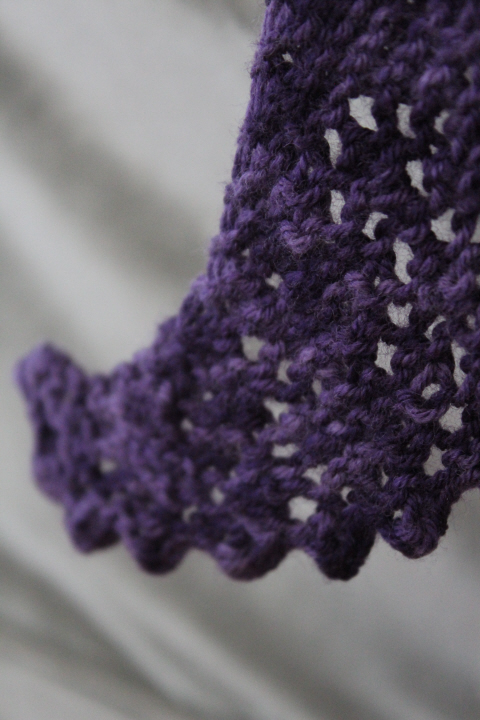
    I am almost finished with the Teatime socks! hallelujah!  I'm pleased with them, but gosh, it seems like they are taking just ages.  I have I think one more pattern repeat left, and then the toe.

    9706

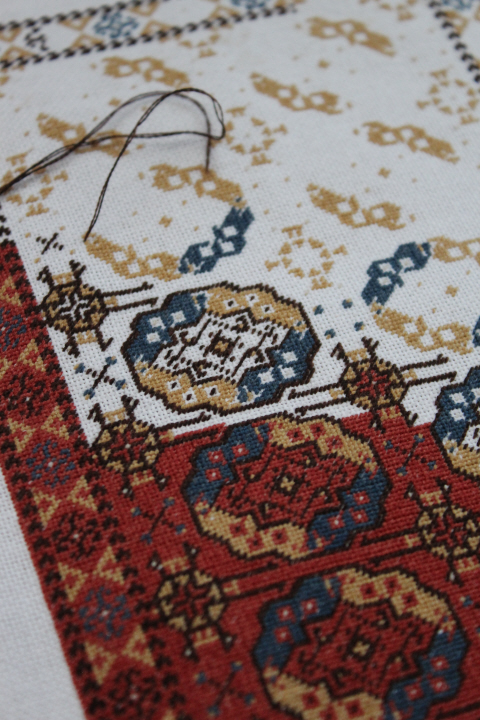
    This is Sue Bakker's Turkoman miniature carpet from the Dodge Dolls' House Needlecrafts book.  It may come as no surprise that there was a big problem with the chart, but upon pondering it for a long time, I now suspect that the reason that so little of it made sense — the estimated finished size compared with the chart, the photograph ditto — is that the chart is meant to be "flipped", i.e., you get one-quarter of it and you just repeat it, mirrored or flipped as necessary, for the other three quadrants, but presumably Dodge or the publisher said, "No, sorry, it's far too big!" and adapted the design without modifying the chart to have only three guls in the main field instead of the original ten (!!).  Since I wanted my carpet at a smaller gauge anyway, I am working it to what I think were Bakker's original intentions. 

    That said, this has just been a tough chart!  Maybe this is because I decided to work most or all of the gold before adding in the dark colors, and it is certainly more difficult to keep things in the right place when there isn't anything close by to "spot" off of.  Please tell me now if you see anything that looks out of place, as good grief I've picked out yards already, including one I think you can still see the ghost of, when I miscounted those hourglass figures along the long edge and started going across a whole inch or so early.

    9701

    The two-end-knitted mitten is still languishing without its mate.  The wool is quite hairy and raw, as it were, which I like, mind, but makes it difficult to knit with in hot weather, which has been both hot and humid here for quite some time — the pink Shepherd Sock above is cottony enough that only on the muggiest days is it unappealing, luckily, but the mitten will alas have to wait until October or November, I suspect.

  • 9691

    There isn't a new Booking Through Thursday question this week, so I'll just make something up — here are the books I bought in England.  (Looking at the stack like this, I guess I can see why David grew alarmed as the trip went on, but this doesn't even approach that heady fortnight of my youth when I came home with no less than six volumes of Virginia Woolf's diaries and letters! — in hardcover!)

    From Waterstone's in Kensington High Street, the Lucy Worsley book I've already mentioned, Jane Austen at Home.  I got distracted by some library books which of course had to be back before the due date, so I've not finished this yet, but it's no fault of Worsley's.

    After having not one but two concierges at the Marriott in Regents Park stare at me in utter mystification when I asked if A to Zeds can still be had, David surprised me with a visit to Stanford's in Covent Garden.  This is a truly wonderful bookshop, possibly the place to go in London for maps and travel books.  I asked the sales clerk, and he said, "Yes, of course!" and showed me a whole shelf of that famous street atlas, which restored my faith in Britain at once.  We could all have spent hours at Stanford's — I think it's three floors, and we only visited one — I bought How to Read Castles by Malcolm Hislop, The Walker's Guide to Outdoor Clues and Signs by Tristan Gooley, and the spiral-bound A to Zed.

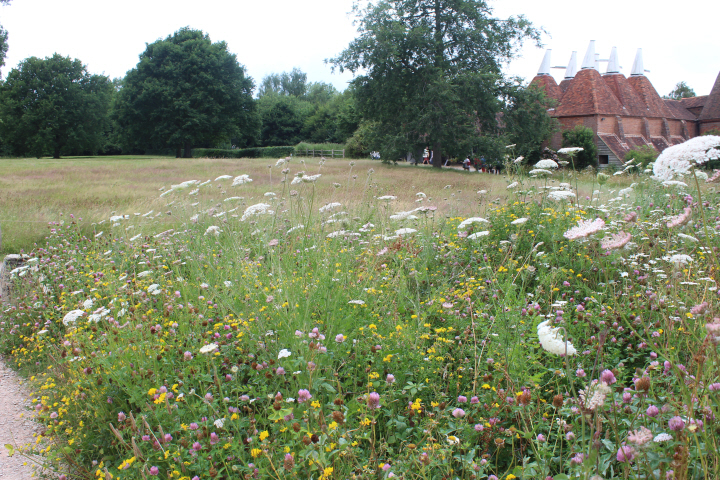
    The only souvenir guidebooks we bought were for Windsor Castle, Ightham Mote, and Bodiam Castle.  Believe it or not, I was actually trying not to buy a lot of books! but I think that Ightham and Bodiam were my two favorites of the Stately-Homes/Castles we visited.

    At the New Place bookshop in Stratford-upon-Avon, The Shakespeare Circle and Finding Shakespeare's New Place, the latter of which I am especially interested to read, of course being fascinated with Elizabethan houses, not even counting the Shakespeare angle.

    It has nothing at all to do with Chartwell, and I'm not really sure why there were so very many cookbooks in the shop there — maybe Churchill really liked his suppers! — but that was where I happened upon Sophie Thompson's My Family Kitchen — and at about a third of the cover price.  I adore Sophie Thompson, and I like to cook, so all three of these together were Fate.

    At a narrowboat/information-center/souvenir-shop at Stratford-upon-Avon, I confess I bought a number of little how-to narrowboat books including — obviously a weakness of mine! — a cookbook.  Pork fillet and dried-apricot casserole on the first page — doesn't that sound good?!

    The book shop at Sir John Soane's Museum was also a place where I could have spent hours, but the only book I came away with was At Home with the Soanes by Susan Palmer, wh. I haven't had a chance to do more than flip through to see the illustrations, but David has read it and says it's very good.

    So some of these books were actually relevant to what we were doing or seeing those three weeks — the canal how-to books, obviously, and the castles book, and the Shakespeare, certainly — and some were just serendipitous finds, which I think is a happy outcome altogether!

  • 9674

    Being a bit of a technophobe, I can't manage to subscribe to Booking Through Thursday, and so I don't know without actually going to the homepage whether a new question has been posted — so here I am thinking that there hasn't been a question since December or thereabouts, and there have been five.  So I inadvertently answered one yesterday, and here is the most recent one.

    All other things (like weight, cost, and so on) being equal, what’s your favorite format for a book? Hardcover? Paperback? Old? New? First edition? Digital? Audio?

    I see the appeal of each of these, to be sure.  For reasons of space, I am amassing a stash of classics on my Kindle (Austen, Dickens, Trollope, etc., as well as more modern things like the Cadfael and Miss Read series as they appear), and I really love some of my audio books (the Wendy Hiller version of All Passion Spent I mentioned yesterday, for one, the Irene Sutcliffe Pride and Prejudice for another).

    First editions? not really, the exception being that I am slowly collecting D.E. Stevensons, many of which are first UK editions because for the most part those are more complete and more authentic — for some reason, her US publishers regularly lopped off whole chapters, and of course (why??) Americanized spelling and certain words us Yanks would doubtless be completely mystified by, such as "neighbour" and "lorry".  (Grrr.)  But for the most part, what is inside the book matters to me more than the imprint.

    There is much beauty to be found in an old book, either the sort of universally-acknowledged beauty of morocco and gilt or simply that velvety softness that the edges of the pages get in books of a certain age.  And new books certainly have their beauties, either in some really well-done design or simply in the thought that a new world awaits just inside.

    But I find that this question is really difficult to answer!  All kinds of books have their unique appeal, and for both practical and aesthetic reasons — but I suppose if I had my druthers, I would choose hardcover more often than not, though I suppose that the appeal is as much emotional as it is intellectual!  I like the heft of them, the substantiality, the sense of permanence.

  • 1jaah

    I have a few more vacation posts in the works, but in the meantime here is something about reading, in lieu of a Booking Through Thursday question.

    I bought Jane Austen at Home at a Waterstone's we happened to be passing when out sightseeing in London and I needed to sit down for a few minutes.  I did not know about the tempest at the time, but am enjoying the book nevertheless — Worsley writes easily and well, although she does tend to get a bit informal at times, wh. I find a bit more off-putting in print than I mind in person, certainly for books, but this is a small cavil.  I do appreciate that she is not afraid to call out the recent spate of biographical ("biographical") movies for indeed being as much invention as biography!

    (If like me you did not know about it, there have been grumblings about certain parallels between Worsley's book and Paula Byrne's The Real Jane Austen.  The problem is, of course, that because there is so little known about Austen, there really aren't that many Facts with which to write a biography — and a great many of them come from the comparatively small number of surviving letters, and from now-famous quips from people like Virginia Woolf about Jane at fifteen "laughing, in her corner, at the world" — so that, obviously, it is difficult to write about Austen's life without "quoting" previous biographers.  So why write "yet another" book about Jane Austen?  Ah, the fascination is always there! and, like with Austen's novels, one must look for and appreciate the subtleties, which are certainly there.)

    2ct

    Margaret Frazer's Dame Frevisse series of murder mysteries was recommended to me by a friend — my public library had two, this Clerk's Tale and the earlier The Reeve's Tale, which I finished the other day before starting this one.  I found Reeve a bit slow getting started, rather dangerously slow in fact and I was tempted to give it up, but once the murders began (!) it certainly gained momentum.  I must admit that I hold Ellis Peters' Cadfael books as my gold-standard for mediaeval mysteries, and so far none I have found can match that, but that is something to strive for.

    3poam

    After visiting Sissinghurst — which is one of the things I've yet to post about, sorry — I was interested to read Portrait of a Marriage at last, though I had to go pretty far afield to find a library copy.  I must admit that my first impression of Vita, which as first impressions often do has stuck with me, is that she was a rather alarming person.  As it happens, though, little of this comes through in her writing, which is elegant and full of beauty.  Last summer I read two of her gardening books on my Kindle, and I have loved All Passion Spent for years — ever since finding an audio version read by Wendy Hiller, who also starred in the excellent television series.  I am still not far into this book — the mess is just beginning in Harold's and Vita's marriage, and I suspect I'm putting this off a bit in dismay, even though I know what happens.

    There was a recording of Vita playing in one of the Tower turret-rooms at Sissinghurst, and I was surprised to hear that her voice sounded nothing at all like the picture I had of her in my head —

  • 5306

    I bought this ensemble from a seller on Ebay who said that it had belonged to her great-grandmother, ca.1870, who was from Silvberg parish in Dalarna, Sweden. It consists of a bindmössa (close-fitting cap), livkjol (bodice and skirt attached together), and two halsdukar (silk shoulder-scarves).  There was also a sheepskin jacket which the seller said was part of the ensemble, but very unfortunately I could not afford to purchase it so it went elsewhere.  The outfit would have been worn with a linen or cotton chemise or blouse (särk) underneath, and an apron (förkläde), but these were long gone.

    I would very much appreciate comments on the authenticity of these garments, the likelihood of their really being ca.1870 and even more importantly from Silvberg, answers to the little mysteries, or corrections to my assumptions about them!  If this turns out to be an historically-interesting garment — which of course I hope it does — my intention is to eventually donate it to a museum.  I have been able to find not a single reference at all to a Silvberg dräkt, original or reconstructed.

    This page is part one, with the livkjolpart two is here, and has the cap and scarves.

    5369

    Because I am interested in the construction of historical clothing, as well as in Swedish folkdress, I’ve taken rather a lot of photos of both the inside and outside of the dress and cap, so this “page” will really be “pages” — but I hope it will be more useful this way.

    It is entirely likely that I will update these pages as I find out more information, or with more specific photos, etc.!

    Note that the condition of the garments is exactly as I received them.

    Specific measurements are at the bottom of this page.

    5307

    The livkjol (bodice and skirt attached together) is of a deep rose-pink satin on the bodice, and for the skirt a heavy woollen homespun with black and red stripes shot through with nubs of yellow and white, on a dark green ground.  The bodice closes with a bib front, giving a double-breasted look; the bib has small non-working buttons, probably brass, and hooks and thread-loops on the inside.  The skirt is one width of cloth, with the seam at center front; there is a facing of black twill tape at the hem.  It is knife-pleated for the entire circumference of the waist except for a handspan or so at either side of the front opening; the top edge of the skirt fabric (on the inside) is bound with red tape, which is also used to face the skirt front opening. The bodice is interlined and lined with undyed evenweave, probably linen but possibly a linen/cotton blend. The lining is assembled in one piece and then sewn in, not flat-lined.

    5310

    5311

    5312

    The five hooks have corresponding thread loops.  The front opening under the bib is slightly off-center.

    5313

    The pink satin is folded over to the inside, over the interlining, and top-stitched by machine, and the lining is folded to the wrong side, and stitched down by hand.

    5314

    Although the bodies of most of the hooks are tucked under the lining fabric, they were apparently sewn on after the lining fabric, as a continuous thread was used, which is still visible at many points along the edge of the lining.  In some places, the entire hook is visible.

    5315

    5318

    5319

    The bodice and skirt were finished completely separately, then whip-stitched together by hand, with both pink and black thread in some places.

    5320

    5321

    5322

    5323

    5324

    The top edge of the skirt is bound with a silky tape in a dark red, after the pleats were formed.  This edge is tucked under the bottom hem of the bodice, and sits facing upwards — I have turned it down on the left here, so that both sides can be seen.

    5325

    5326

    5327

    5328

    A center-front placket is formed by overlapping the seam allowances on the fabric

    5329

    5330

    5331

    5332

    Aside from the general air of age which is only to be expected in a garment over a century old, there are only a few signs of actual wear, some rubbing of the satin at the front waist, and the small tears at matching points on the fronts of the armholes, this one on the right front, and the one below on the left, both of which have been only hastily mended.

    5333

    5334

    5335

    The front opening placket from the inside.  The facings are sewn down by hand, and the seam is whipped by hand.

    5336

    5338

    5339

    This is the bound top edge of the skirt folded down to show the lining of the bodice.

    5340

    5341

    The stitches attaching the lining have come apart in two places, this one on the right back, near the center back seam.  The interlining fabric is visible through the opening.  The satin has been tacked to the interlining, and top-stitched, before the lining was attached.

    5343

    5297

    5299

    The skirt is knife-pleated all of the way around, except for a short distance at center front.  The center back pleat is inverted.

    5300

    5302

    5303

    5305

    This is the smaller of the two places in which the lining has separated — this one is on the left armscye, near the shoulder seam.

    5344

    5345

    5347

    The center back seam of the lining.

    5348

    A side seam of the lining.

    5349

    The pleats have been set at the edges of the red and black stripes, but some of them were not done with quite as much care as others!

    5350

    I thought this was a raveled spot on the inside of the skirt waist, but it is in fact a length of braided wool stitched on to make a loop on the right hip.  What is it for, I wonder?  There is a corresponding one on the other side, though now more worn than this one.

    5351

    There are in fact no raw edges of fabric anywhere — the bodice is completely lined, and all edges on the skirt are either bound (at the top), whipped (along the one seam), or faced (at the hem).

    5352

    The hem of the skirt is turned under and faced with two different kinds of twill tape, a wide one on the front and a different, narrower one at the back — presumably the difference is simply coincidental, and due to what the maker had on hand.

    5353

    5294

    5295

    5296

    5354

    5355

    Measurements (all approximate, and not including allowances unless stated):

    full length 112cm

    circumference at hem 210cm, with 2cm seam allowance at each edge (seam at center front)

    skirt length (waist to hem) 76.5cm, with a 2cm hem and 3cm allowance at waist

    green stripes 5.25 to 6.75cm

    colored stripes 4.25 to 5.5cm

    waist 77cm

    bib 13.5cm H x 16cm W (top) x 7cm W (bottom)

    button 0.75cm

    side seam (under arm) 9.5cm

    center back seam 24.5cm

    shoulder seam 5.25cm

    left front at waist (side seam to front opening) 29.5cm

    right front at waist (side seam to front opening) 26.75cm, overlap 6cm

    waist binding tape (red) 5cm + unknown allowances

    hem binding tapes (black) 2.25 and 1.25cm + unknown allowances

  • Holy tr stratford 2

    Being me, I could hardly help noticing the needlepoint kneelers and cushions in most of the churches we visited last month in England.  Most were extraordinarily handsome, and each church's selection had a character of its own, to add to the character of the building itself.

    I couldn't find out much about the history of needlepoint kneelers as such, except that it seemed to really take off in the UK in the 1930s.  Of course there is a centuries-old tradition of embroidered vestments and altar linens, but kneelers seems to be a (relatively?) new form.  If anyone closer than I knows more, please pipe up!  Perhaps I'll send off a question to the National Needlework Archives

    (Goodness, here's a needlework tour of London!)

    Holy tr stratford 1

    Holy tr stratford 4

    Holy tr stratford 3

    This one might be crewelwork, now that I look at it.  All four of the above are in Holy Trinity at Stratford-upon-Avon.

    St p ww 1

    St p ww 2

    I thought these especially pretty.  Each pew has a different selection of botanical designs.  They are at St. Peter's in Wootton Wawen, Warwickshire.

    St m le c

    St. Mary de Castro, Dover Castle.  This is the only church I noticed as having cross-stitched cushions, with perhaps three strands of wool.

    St c d 1

    This and the two below are all from St. Clement Danes in the Strand, London.  They show exceptional care and skill in the complexity of the designs as well as in the unusual shape, fitted to match the corners of the seats.  Most, perhaps unsurprisingly, have a military theme, presumably all RAF.

    St c d 2

    It was difficult not to stay there taking photos of each cushion, but this one is of course, charmingly, "oranges and lemons"! —

    St c d 3

  • Travel Knitting

    9164

    This is, as it happens, one of the rare times when I have actually found time to knit while traveling.
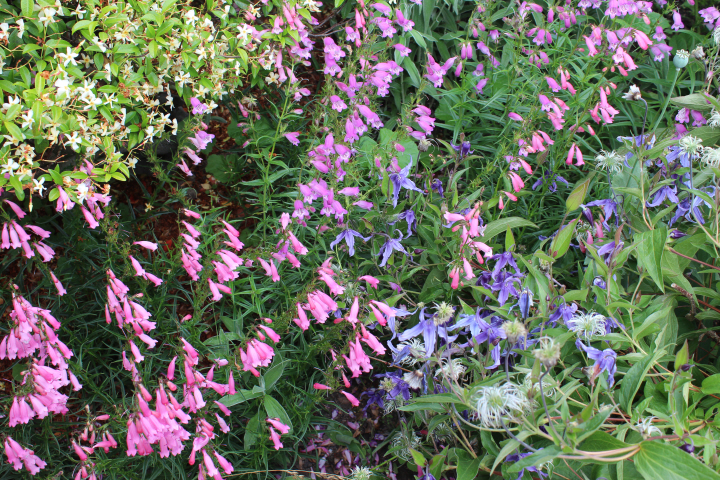
    Above, somewhere along the Stratford canal, motoring between Wilmcote and Stratford — I must say, it was very pleasant to sit in the bow and knit as the scenery slipped leisurely by, and a passing narrowboater even called out, "That looks relaxing!" — and below, a few days earlier at LAX, waiting for our flight to Heathrow via Toronto.

    2629

    Yes, Air Canada — why? points.  Fantastic!

    0185

    Some days later still, on the garden step of our B&B in Kent, the morning after an hour and a half or so when David and the girls went off in search of Sunday supper in the depths of the country.  I was feeling a bit anti-supper at the time, so lounged about on a sofa in the sitting room in utter solitude, watching the afternoon dwindle into evening — which by the way was a lovely sight, as Kent does evenings very well, I must say.

    The sock is, as it happens, called "It's Tea Time" (!) and the moment I saw it again in my copy of Around the World in Knitted Socks by Stephanie van der Linden a few weeks ago as I poked around for a suitable project, it seemed the utterly obvious choice, of course.  I had a skein of Shepherd Sock in this pretty pastel pink, and thought they would be a pleasing combination.  The photo at the airport is not all airport knitting, as I worked the ribbing and one repeat of the leg pattern beforehand to make sure that the gauge and fit would work — I didn't actually get much done at the airport, as it happened.  But as I say, this is certainly the most I've ever managed on a trip, so I'm happy with it! and I have since arriving back home turned the heel and begun the gusset ….

    9300

  • 9871

    Sunday, 2nd : Chartwell, Ightham Mote.

    We let our landlady talk us out of Knole ("it's so dark") and into Chartwell, which was Winston Churchill's country home.  I would certainly still like to see Knole — wh. I suspect I would love, actually, all things considered — but Chartwell was also interesting, and it was a lovely day.

    9892

    9894

    0176

    0149

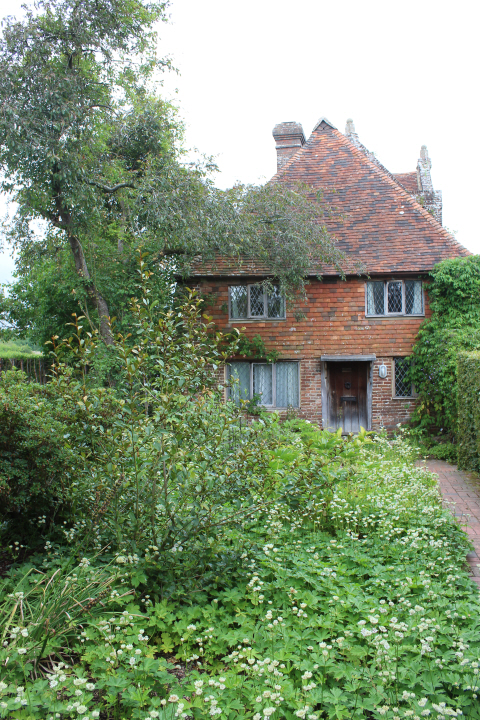
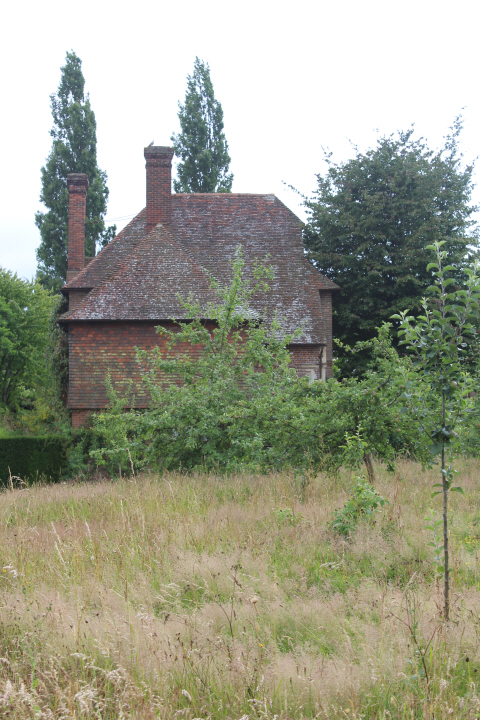
    Why do I love wobbly rooflines so very, very much?

    0163

    0167

    Monday, 3rd : Bodiam Castle, Sissinghurst.

    0207

    Graffiti on an arrow slit at Bodiam.

    0300

    "The loveliest castle in England".  Slighted, but fortunately for its beauty, much of the exterior is intact or restored.

    0312

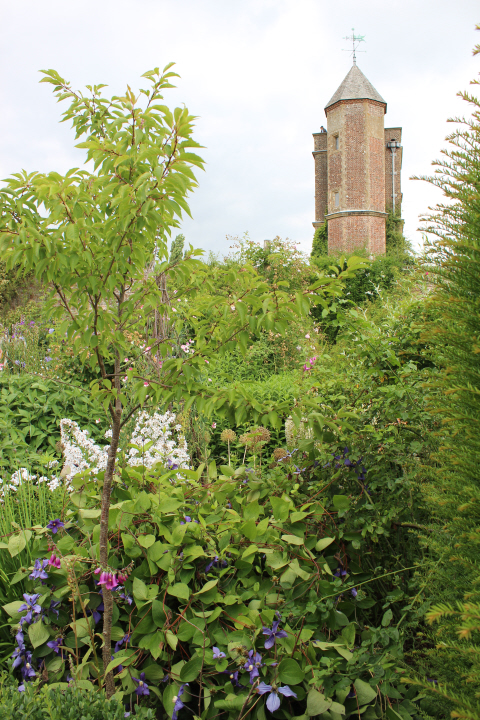
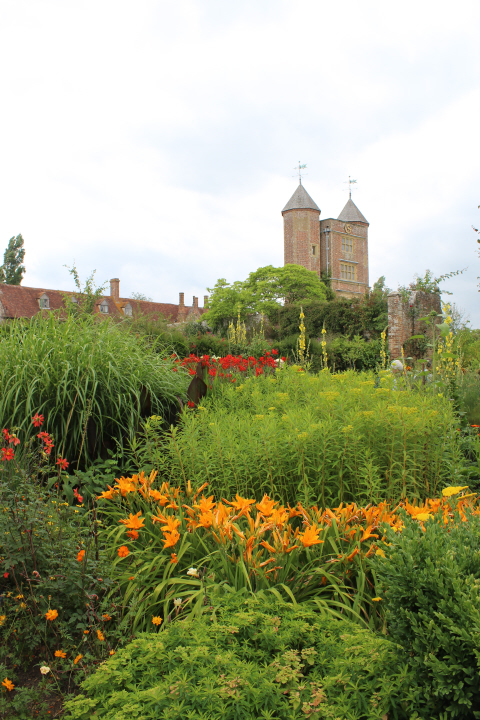
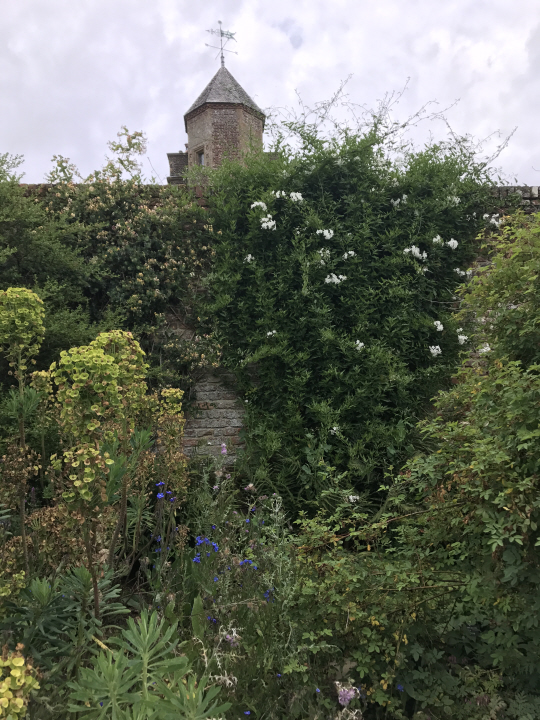
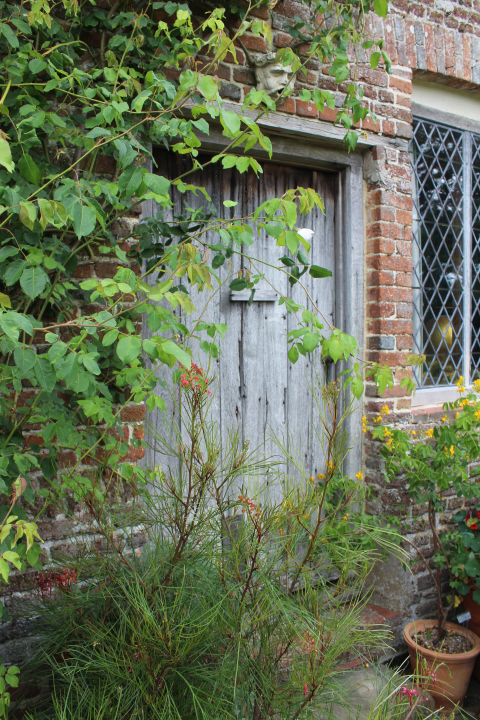
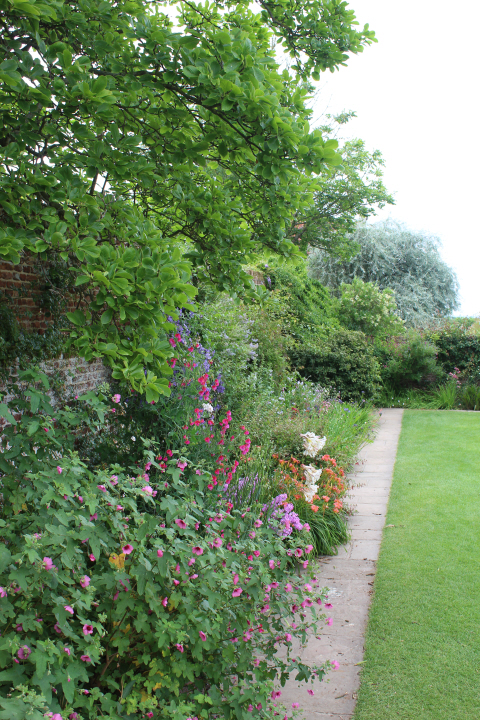
    Sissinghurst — a castle perhaps in the loosest sense of the word, but no less picturesque in its own way.  I took so many photos here that I think the following will be but the precursor to a separate post ….

    0313

    0318

    I love that this looks like a bookshelf, hanging outside the kitchen door of the South Cottage.  Perhaps Vita put little plants in pots on a shelf now and then?  Does it matter?!

    0322

    My heart is I think in Warwickshire, but Kent and Sussex — oh!

    0325

    Cherry-tomato, mozzarella, and basil tart, with berries from the garden.

    0336

    0343

    Tuesday, 4th : Dover Castle.

    0511

    A still life in the window of our room at the B&B where we stayed.

    0564

    0565

    0571

    The church of St. Mary de Castro, with the ruins of the Roman pharos or lighthouse at its west end, from the top of the Great Tower.

    0580

    Wednesday, 5th : Sir John Soane's Museum, "Twelfth Night" at Shakespeare's Globe.

    I didn't get any photos at the Soane, regretfully, as cameras were not allowed, but I don't think I could have really done it justice anyway — the place is a delight for lovers of architecture, Classical antiquities, and English eccentricity, to be sure.

    0613

    0623

    We stopped in at St. Clement Danes in the Strand, just across the road from the Twinings shop. A lovely church, quite different from the others we visited, in a style that manages somehow to be both frothy and dignified.  This somber collection of poppy wreaths was along one side.

    0673

    0687

    I'm not quite sure what to make of the production of "Twelfth Night" we saw at Shakespeare's Globe, directed by Emma Rice.  I must admit that while I can completely understand Rice's determination that the plays should speak to modern audiences, I can't help feeling that in the Globe of all places, being so much in the style of Shakespeare's own day, I would rather have seen a production more contemporary to Shakespeare than to myself.  I'm not at all sure how this could be brought about on a regular basis, though — would it be economically feasible to mount period and modern productions simultaneously?  (And of course it could be argued that Elizabethan actors doubtless modified each production according to the theatre, the audience, etc. etc. etc., a mere step or two to Rice's copious applications of disco and rumpy-pumpy.)  But this nagging question aside, although I felt some things lacking in the production itself, the cast took it on with verve and buckets of talent, and a good time was had by all.
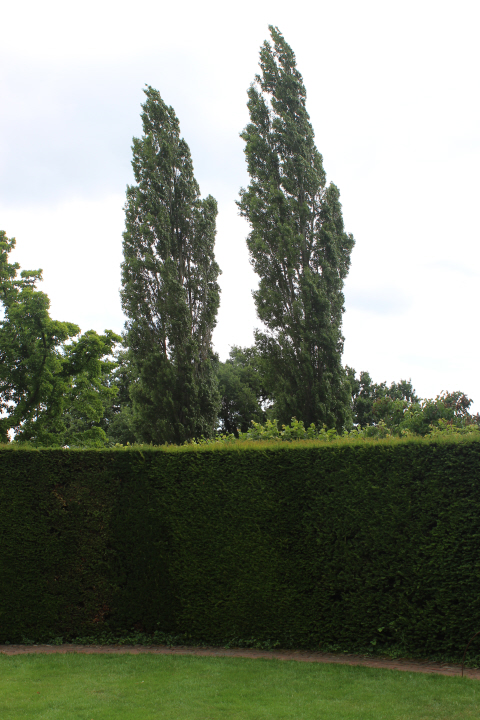
    Summer Holiday, 2017 (Part 1 of 3)

    Summer Holiday, 2017 (Part 2 of 3)

  • 8849

    Wednesday, 28th : Narrowboating, Stratford-upon-Avon.

    A "Shakespeare day", visiting the four houses in Stratford — Hall's Croft (above) where Shakespeare's daughter Susanna lived with her husband Dr. John Hall, the site of Shakespeare's home at New Place, "the Birthplace" or John Shakespeare's house, and Anne Hathaway's Cottage, a short walk away in Shottery.

    8812

    This is plain fare, to be sure, but as it happened one of the best and most memorable meals I had, of more-or-less uniformly excellent fare throughout the trip.  This is the "Tudor Spiced Sausages and Mash" from the café at Hall's Croft — the sausages were not peppery-hot but rather full of herbs and flavorful spices, crisped to perfection, and perhaps the most delicious mashed potatoes I have ever had in my life — creamy and golden — slathered with caramelized-onion gravy.  To finish off, we had a crumble with rhubarb from the garden at Anne Hathaway's Cottage, and lashings of local cream.  Brilliant!

    8837

    This drafty window is stopped up with bits of wool roving.

    8853

    8857

    8863

    In the garden at New Place, the site of Shakespeare's long-gone house in Chapel Street.

    8882

    There are water bowls for dogs pretty much everywhere — charming!

    8940

    John Shakespeare's home in Henley Street.

    8949

    The back garden at the Birthplace.

    8963

    This guide was delighted to show off for me her blackworked cap!

    9012

    9031

    Well-trodden steps at Anne Hathaway's cottage.

    Thursday, 29th : Narrowboating.

    9117

    9134

    9141

    Part of the "flight" or series of locks just east of Wilmcote.  The land falls away rather dramatically here, necessitating locks one directly after another.

    9146

    The canal is apparently rather silty lately, and we got stuck at one point, when we moored to let a succession of boats pass us coming down the flight as we went up.  David obviously had this well in hand, as he simply grabbed the pole and manhandled the boat off as though born to it.

    9154

    9169

    Utterly peaceful.

    9187

    9310

    We saw this boat a number of times, each time to different effect as a new perspective was revealed. Note the teapot tiller pin!
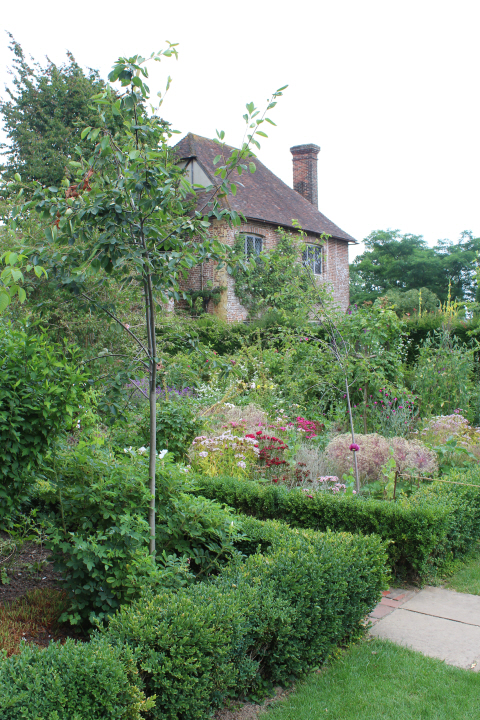
    Friday, 30th : Stonehenge.

    9490

    9505

    9525

    A rather cold, windy day — perfect for the somber, mysterious Stonehenge.  Even when the place is swarming with tourists, one somehow feels alone with its ancientness.

    More about the rooks, crows, and jackdaws of Stonehenge here.

    Saturday, 1st : "Mary Rose" at Portsmouth, Weald & Downland Living History Museum.

    9549

    Figurehead of HMS "Warrior".

    9559

    Probably most of the people exploring this the first iron-hulled warship were looking at its certainly-impressive military and sailing capabilities, but I must admit that I found the homely details more interesting!

    9564

    Rigging lines on the "Warrior".  It was too dark to take good photos of the "Mary Rose" but she is well-worth the visit, both as a technological marvel, the raising of her and the impressive museum built around her, and an historical treasure-trove.

    9612

    Interior of the Toll House at the Weald & Downland Living Museum.  I could have spent days here — I would live here if they let me!

    9650

    Bayleaf, from the path approaching.  This house is the sine qua non of the Weald & Downland for me, though of course everything is fascinating.  But I have seen Bayleaf in photographs and television programs so often that it is the main reason I wanted to visit, and I spent much of my far-too-short afternoon exploring its nooks and crannies, touching everything because I could.  Bliss.

    9660

    Yes, the solar is "en suite".  I suspect it required a leap of faith to use it, though, as you can see the ground on all sides some ten feet below, adding still more precariousness to one's already-precarious position.
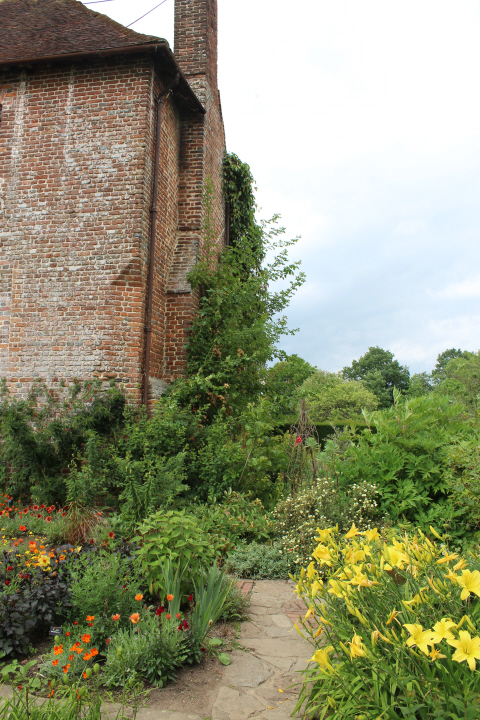
    9677

    9697

    9729

    9764

    In the furnished half of the 1860s-era laborers' cottages.

    Summer Holiday, 2017 (Part 1 of 3)

    Summer Holiday, 2017 (Part 3 of 3)