• 3553

    How nice it was to find these in my box this afternoon, at the end of a rather stressful week.  The one on the left needs no explanation of why I like it so very much, surely! and come to think of it, neither does the other one!  As it happens, the dolphin is the very first card sent by that Postcrosser, who is a young boy in Eastern Europe, "nearly four years old" — his mother writes the cards for him, but he signed his name very neatly.

    It's the little things, sometimes!

  • 3035
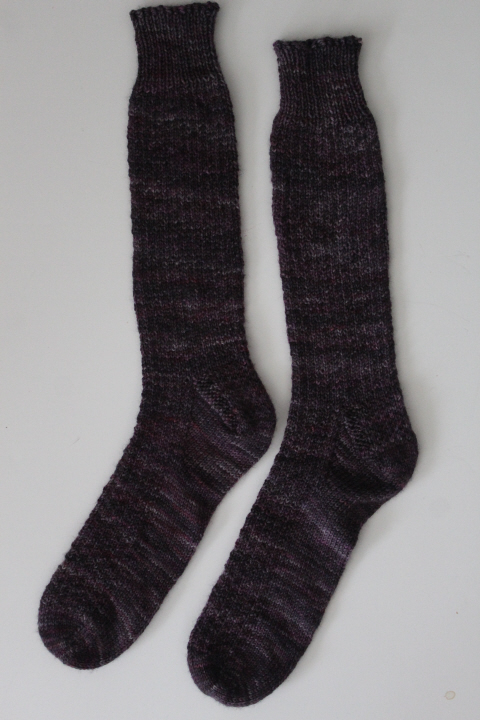
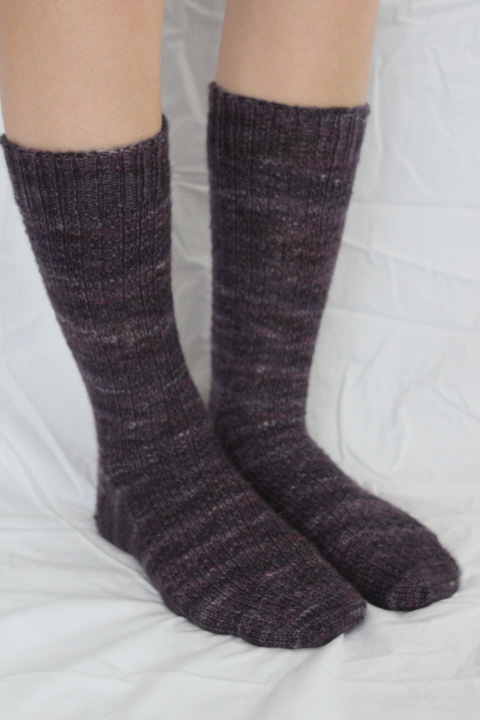
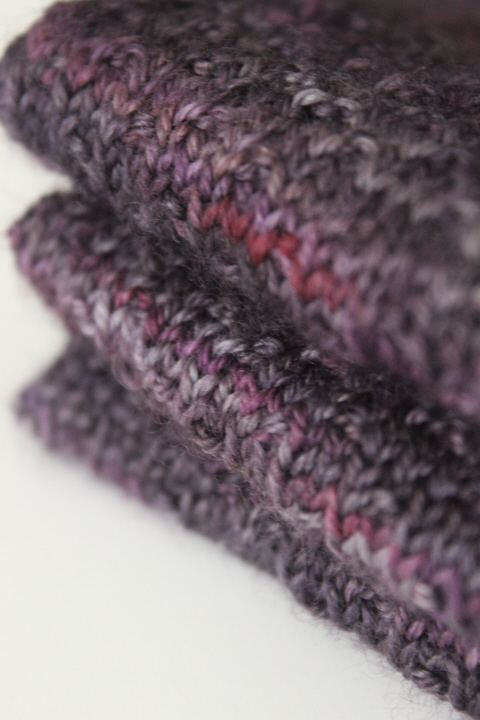
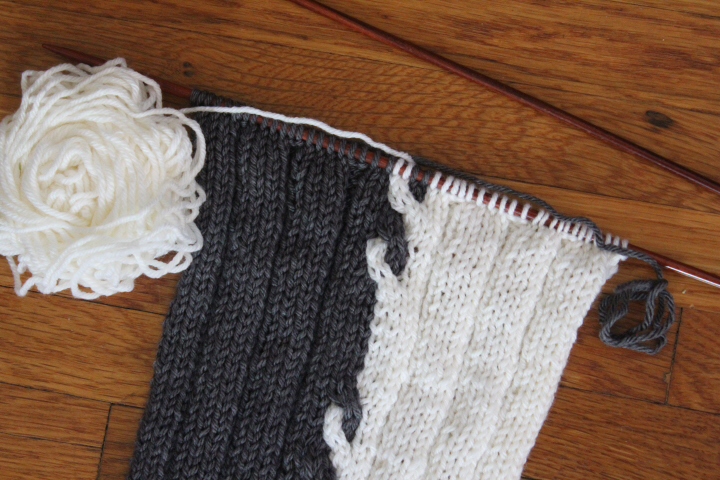
    The Bluestocking still knits!  I've had two finished projects sitting around waiting to be photographed and blogged for months, I'm sorry to say — well, not even "sitting around" because I've worn the shawl a couple of times already.

    First is the Ghislaine mitts by Sara Varty, here in a long-awaited skein of Cherry Tree Hill Supersock in "Water" (blueish greens/greenish blues).  I've had this yarn in my drawer for at least ten years — I think I had some fancy of knitting a pattern that had a watery name, but nothing ever appealed quite enough, and so when I saw the Ghislaine mitts somewhere, I decided that elegance would suit the subtle sophistication of the yarn's colors and delicate sheen perhaps even better than a name would.

    3036

    3041

    The top hems are sewn down per the new-to-me method in The Knowledgeable Knitter, which is a kind of duplicate stitch.  It's a lot more bother than simply knitting the front and the hem stitches together as you go, but much smoother and quite soft, so especially pleasing on a pair of mitts.

    3042

    This pattern probably would have been quite easy if I had paid a little more attention — it's possible that it is too easy, as I kept making little mistakes like repeating Round 2 three or four times (!) in a row, or … or — somehow — picking up an extra loop somewhere and ending up with too many stitches (!!) at the end of the gusset.  Well — I think I noticed all of these before it was too late, and the resulting mitts are quite elegant.

    There is something about certain faggoting combinations that tend, on my needles at least, to sort of scooch to one side — and I think usually on the left edge, though I will have to take note the next time it happens — thus obscuring the faggoting.  This one did as well, so I came up with a little trick that worked pretty well.  The stitch pattern has you yo, SSK on the first patt round and K2tog, yo on the second, and since it was the left edge of the column that pulled in a little too much, on the second patt round I did a YO twice, and simply dropped the extra yo on the next round, thereby giving it a little more wool so that it could spread a little better.

    3042

    For the first mitt, I did as the pattern suggested and decreased around the top edge before working the picot hem, but — possibly since I shortened the top length a bit — this made the hem too tight on my hand, so I picked it out and reworked it with the full number of original stitches.  It does flare out a bit, but this is an acceptable compromise for me, since I prefer the shorter length.

    3033

    The next time that I use this picot hem, I might work one round less on the turning (the inside), as mine usually seem a little concave where they should be either flat or convex — I'm assuming that having the turning ever-so-slightly shorter would pull the edge of the hem towards the inside just enough to solve that for me.  It might also be that the hemming method adds just a smidge of length, so that's something to keep in mind.

    3037

    I really like them — classic and elegant, with a lovely smooth line and fit.  Full marks!

    And then a skein of Seven Sisters Arts' Meridian merino/nylon blend in "Havran" —

    1819

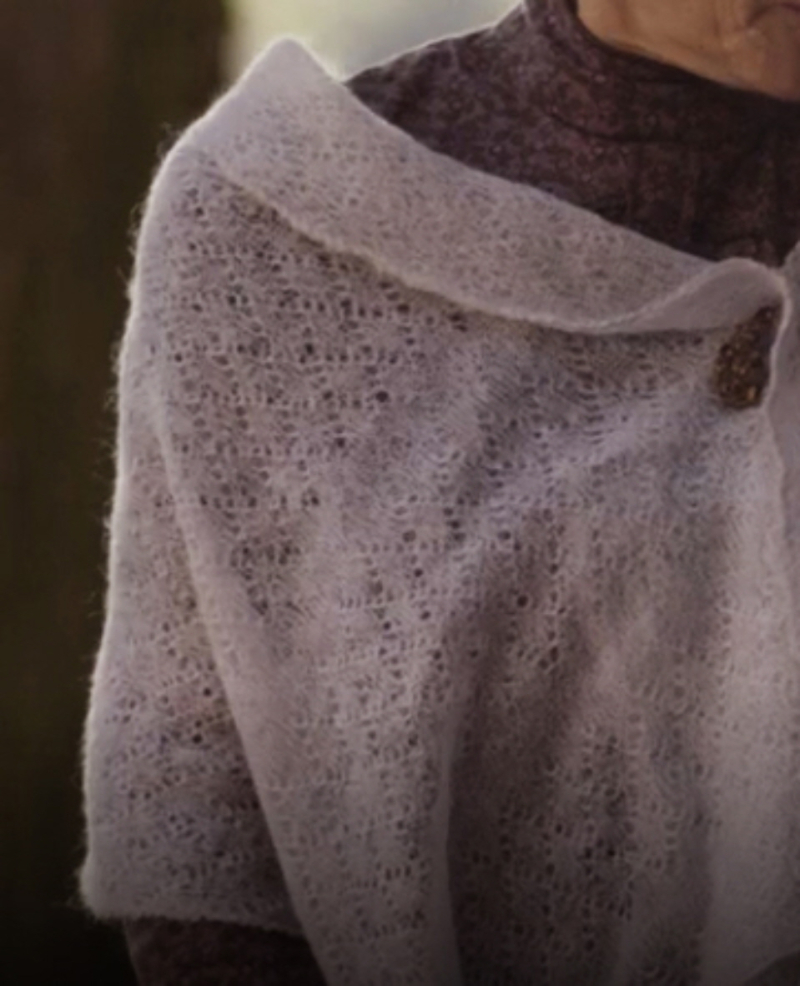
    became the "Henslowe" shoulder shawl by Beth Kling.  This is one of those charmers that is much easier than it looks, for the lace is a fairly simple one, and the interesting effect of the alternating diagonals is accomplished simply by working one repeat from the RS, then one from the WS, and so on.  And there is minimal finishing to be done, as the sections are joined as you go, with no hemming necessary.

    2825
    2825
    2825

    The wool looks rather purplish in these photos, but the one of the skein is for the most part more accurate — it is a sort of RAF blue, but changeable — very handsome.

    2825
    2825

  • 3007

    This is the Turkoman carpet, designed by Sue Bakker, from Venus Dodge's Dolls' House Needlecrafts. It is is a rather frustrating book, with hundreds of projects in all different kinds of needlecraft, from knitting and crochet to sewing to needlepoint and embroidery, but with pictures far enough away from the particular instructions that flipping back and forth from one to the other is inevitable, and in particular the needlepoint carpets are all photographed in a room setting, i.e. under furniture or dolly feet so that you don't necessarily have a particularly clear idea of what a piece is going to look like — a fairly major flaw in a needlecrafts book.  The ultimate frustration (so far) for me has been that the very charming Arts & Crafts carpet in the cover photo — which I would stitch in a heartbeat — isn't even in the book at all.

    3024

    3024

    I've already given my theory on the Problem Chart for this carpet, so I will only say here that although the instructions imply differently, the chart itself is meant to be flipped — that is, it is only one-quarter of the finished carpet — otherwise you will have to drastically alter the border as charted to fit the much-smaller main field.  I worked my version as the full ten-gul carpet, as it looks much better that way to my eye, and I like Bakker's designs. On my 28-count Monaco canvas, the finished piece turned out to be 5 3/4 x 7 3/4 in. (14.6 x 19.7 cm), less the fringe.

    3006

    I also decided to try "fading" the colors this time, to make the carpet look older.  Instead of using two strands of the given colors, I used one of the original and one of a shade lighter — this not only "fades" it a bit, but gives the colors a bit of depth, I think.  This is what I used, original shade first and the lighter one second —

    • dark brown 3371 + 938
    • blue 3750 + 930
    • cream/ecru 3033 + 3866
    • gold 3045 + 422
    • red 355 + 3830

    The fringe is 3866.  Since I was going for an older-carpet look, I decided when I was beginning to fill in the red ground, that I would also give it some "abrash", which is the word for the color variation you sometimes see in oriental carpets, as when a slightly different dye lot has been used in one section, or one dye lot has faded at a different rate than the rest, or simply due to natural variations —

    Abrash

    (I've taken these details from carpets in the Wikipedia article.)  In a woven carpet, abrash often appears as a "stripe" across the width of the carpet — to mimic this, I just used two strands of the lighter red for a few inches, then two rows of the blended, one more of the lighter red again, then back to the blended red for the rest.  I'm really pleased with the way this turned out!

    3023

    Turkoman carpets — now usually called Turkmen — were produced by the Turkmen tribes in what is now Turkmenistan, as well as Afghanistan and Iran.  The deep red background is a distinguishing characteristic, as is this "Tekke Bokhara" design of symmetrical repeated guls, here the oval motifs, separated by stars or diamonds.  (More information here, and some examples from past auctions here.)  Bakker's version looks like it might date from the early or mid-Victorian period to somewhat later, so is ideal for either a Victorian setting or, like mine, as a family heirloom!

    3006

  • 2866
    When I saw the "Retro" dining table kit on Jane Harrop's website, I couldn't resist it, so I counted up the money from my Christmas stocking and splurged.  I really liked the set anyway, but when I found out that the table is only 4"/10cm long, I knew it would probably be perfect — you can see how small the room is!

    2864

    Now that it is all a month or so behind me, I am beginning to forget how much of a bother the chairs were to put together, and instead to just appreciate their ingenuity and beauty.  The kit pieces are laser-cut, so you must sand off the scorch marks, and despite heeding Harrop's warning to be especially careful with the side pieces — because the horizontal part goes across the grain and is therefore very vulnerable — I managed to snap two of the eight before I even got to the gluing stage.  One went back together almost invisibly, at least! 

    There are also very few points where the pieces actually come into contact with each other — just at the ends of the three stretchers — so the glued joints are also vulnerable.  I was using Aleene's Tacky Glue, so maybe it would have been a different matter with something else, I don't know.  They were definitely more sturdy the more stretchers were in place, which was helpful, but I even managed to knock one apart while finishing it — I wanted to use the Tried & True I have, which was so successful on the Arts & Crafts bed, but requires that you finish it after assembly.

    The cushions are some glossy papery stuff I'm not familiar with — you glue one piece to the top and one on the underside of a piece of heavy card cut to shape (all provided in the kit) and then shape them to the required curve while the glue is still damp, to fit the stretchers in the seat.  I found that this worked perfectly to shape them! —
    1886

    I learned along the way that these particular chairs are based on Erik Buch's "49" design from the 1950s — I guess a minor Danish-modern designer, as he doesn't even have an article in the Danish Wikipedia, let alone the English one.  Here is a photo of the 49 chair from the Erik Buch company
    ErikBuch49Black_grande

    There are some interesting pictures here of a 49 chair with the seat removed, so that you can see how the seat "floats" — other photos of restored chairs are here and here.
    2861

    Harrop's 1:12 version is ingenious in miniaturizing the essence of the chair and table, just with the caveat above that the kits (certainly the chairs, the table is much easier) are probably best for someone with some kit-building experience.  I do wish that the seats were a tiny bit bigger, so that you could get more of the "floating" effect, but it's certainly good the way it is!  I did put the back rest up a little higher than in the instructions, which looked to me more like the originals.

    2859

    (I used Loctite gel glue for the cushions, by the way, as the back is held on essentially by friction, since you can't use much glue or it will show.  By this point my chairs had a linseed/beeswax finish, and regular glue probably wouldn't have held.) 

    The table was a breeze after the chairs!

    2863

    2859

    The piece underneath can actually be a table leaf if you like.  I was sorely tempted to do so, but trying it out before gluing, the larger size would have been just a little too impractical in the small room, and so that piece is now a reinforcement, its original purpose anyway.  The grain lines look a little darker in the above photo than they are in real life, where they are quite beautiful.

    It's funny because usually the things I like best are really old, but Danish Modern does get my heart pounding! and so I'm delighted to have found these kits.  I didn't plan it, but they also look really good on the Karagashli carpet I worked a few years ago — I really like the golden wood against the green, and the styles, despite being both a century and a continent apart, are unexpectedly harmonious!

    2856

  • 2833
    Poring over the March/April issue of "Piecework", I was reading the article by Lesley O'Connell Edwards about two Midlands sisters who were writers of knitting "receipts" in the 1860s and 70s, and one of the photos was of a "mitten knitted on two needles" (mentioned in passing in the text) from one of the sisters' books.  It was an interesting little thing that piqued my curiosity, and it wasn't difficult to track down the book, scanned and available on the internet thanks to the wonderful folks in charge of the Richard Rutt Collection at the University of Southampton.  There was apparently an earlier edition of this particular book around 1866, but there doesn't seem to be a copy online, and my mittens are knitted from the 1876 ed. instructions.

    Edwards notes the "radical construction" of this mitten, wondering what prompted the change from the usual welt-up versions.  It certainly crossed my mind while knitting, too — the thumb gusset is a rather ingenious use of short rows, but what's wrong with working them in the round?  Maybe Miss Harriet was one of those who find four needles a bother, or — like Elizabeth Zimmermann a few generations later — exceedingly fond of garter stitch, much easier-worked flat?

    2828

    But never mind!  The pattern is quite easy to follow, with no unfamiliar abbreviations and only a few things like "put your needle at liberty through the last stitch" which is very euphonious but just a little bit puzzling nowadays (I'm pretty sure I know what she means, but I don't know why the needle is "at liberty" — is it not at other times? &c. &c. &c.)

    I had no idea what this new-fangled "Laine de Vienne" wool is, but some leftover Regia 4-ply came up to gauge for me quite nicely.  The Kroy Sock is a bit heavier, but turned out all right as a border.

    I used the lace cast-on (like the usual cable cast-on but instead of putting the needle between the last and next-to last stitches before making a new one, you put it into the last stitch) — I figured this would make the later seam a bit softer.  I also decided to interpret the injunction to "observe the 1st stitch in each row must be slipped" more specifically as "slip 1st st purl-wise with yarn in front, and K every last st" as we often do now, so as to get the "chain" selvage (you must be sure on Row 5, though, to K the last st, not P as you have been merrily doing, or you will have a little "bump" in your handsome chain).

    2751

    The original pattern has you work a "colored border" in K2, P2 ribbing before sewing up the mitten.  For once in my life, though, I decided that something I'm going to wear myself looked a little too plain, and that just a touch of pretty at the top would be quite appealing.  I didn't feel any qualms about not sticking to the source, as I think this would be quite in keeping with a period knitter if these were being made for a lady or girl, instead of the more sober 2×2 ribbing.

    2807

    I did have to juggle the gauge and number of stitches more than a bit, but fair enough, and ended up working this picot crochet edging from the wrong side, as the picots tended to lean towards me, which would be outwards if on the RS.  I have found also that I quite like that little rope-like line that comes from working single-crochets through the front loop only, and liked the look of that here, so my edging turned out to be this:

    Rnd 1 (RS): SC to end, turn.
    Rnd 2 (WS): Ch 1, SC into front loop to end.
    Rnd 3 (WS): Pico 1 (SC1, ch3, Sl into same SC), SC1, rep to end.

    I wrote down what I did on the first mitten so that I could repeat it easily on the second one, but as you can clearly see in the above photo, I apparently did not use a US5 hook, as the second border turned out much bigger! and I had to rip it out and do it again, after I'd already washed and blocked them.

    2829

    2832

    There is no method specified for sewing up, but since these are done horizontally, I used the duplicate-stitch method, stockinette for the rib section and garter for the hand. This turned out pretty well, and much of my wobbliness — it was difficult to get the tension just right — is happily disguised by the welt pulling in at just that spot!

    I also sewed up each mitten before working the crochet border, as it seemed simpler to accomplish the latter that way.

    Note that I did not have to make the last section on my mitt a little shorter than the pattern's as I usually do — I like mitts to end just about at my knuckles — so you could certainly add some stitches to the top end (slipping them with the pattern's "first 7" onto a stitch holder before making the thumb gusset) if you want the top longer.  You could also easily make the welt at the wrist a bit longer if desired.

    2835

    (The fabric in the background is, by the way, a rather neo-William-Morris-y print I have bought for my Edwardian-apron-to-be …)

    2018

    Year or Period: 1876, though possibly earlier as the first ed. is ca.1866
    Materials: Regia 4-fädig in color 1991 (grey heather) on US0 needles, and Paton's Kroy in "Muslin" with US3 hook
    Hours to complete: Less than a week, including numerous false starts with the crochet edging
    How historically accurate is it? Aside from the non-period wool, the body of the mitten is worked entirely to pattern, and the crochet edging is I feel a typical mid-Victorian modification
    Sources/Documentation: The pattern is found in Miss H.P. Ryder's Winter Comforts and How to Knit Them (1876), available through the University of Southampton's "Victorian Knitting Manuals" page

  • Quilt
    For my first 1:12 scale quilt, I decided on an Amish-style one instead of the jewel-box, as the pieces are bigger (!) and thus I felt on more solid ground.  I'm drawn to Amish quilts anyway, the richness of colors and the simplicity — they have a kind of peacefulness to them.  There are a lot of patterns I like but I chose Diamond in a Square, for its relative simplicity yet with the subtle liveliness of the diamond's angles.  Interestingly, the Diamond in a Square pattern (sometimes called Center Diamond) originated in the 1930s, among the Lancaster County Amish.  It seems so timeless that I assumed it had been around forever.  There are some variations that can be made — the corner squares on the narrow borders can be omitted, one or both, or the narrow border around the center diamond — but of course the basic elements are the same.

    I found an image on Pinterest which I then couldn't track down —

    Amish centerdiamond

    which seemed to me quite unusual with the tan/beige, but was very appealing, so I started with that and just played around with different colors in Kona Cotton, which I really like for its quality and the richness and wide variety of its colors.  I ended up getting these —

    2752

    which are from the bottom, Parchment, Laurel, Hibiscus, Teal Blue, and Garnet.

    For the assembly I was going to just wing it (she said blithely), but when I was looking around for old quilts for color ideas, I also came across the Diamond in a Square mini-quilt tutorial at Purl Soho, which turned out to be a very helpful starting point.  Not having much quilting experience myself, it was a bit of a revelation that I didn't need to cut all of the pieces beforehand, which turned out to make it much easier and less stressful to adjust the next piece here or there if it needed it.

    2846

    I decided to press all of the seams open, figuring that that would distribute the thickness more evenly, which I suspect at this small scale might be obvious.  I didn't use any batting at all, thinking it might make the quilt too stiff to drape properly — I've heard that some miniaturists use fabric cut from an old T-shirt, though, so I'll keep that in mind.  The binding is just folded over from the back and stitched down by hand on the front, mitering the corners.

    2846

    Yes, the last corner is really wobbly!  I didn't notice until after I'd finished — so that's the end that gets tucked in!

    I was really grateful for both the quality of the Kona Cotton, which took a bit of a beating getting sewn and resewn more than a couple of times on some of the pieces but still looks great, and also for the Purl Soho tutorial and the advice I read somewhere (last summer when I was making the sling bag) that people will never know how long it took you to sew something but they will see how much care you took sewing it, which on occasion must be translated as "yes, pick out the wonky seams, you will be glad you did," which is entirely correct, for just look at the results —

    2846

    Any quilter reading this will no doubt notice that I haven't actually quilted this yet, and I think I will leave that for the time being.  Obviously it won't get much wear-and-tear in the dollhouse, so there shouldn't be a problem with things shifting around, or the seam allowances bunching up.  My hand-stitching is still a bit rough, so I think it prudent to wait until I've had a bit more experience in keeping the stitches both small and even!

    Well, after this success, of course I had to hurry up and make the rest of the bedlinens, so I stitched up a set of sheets …

    2846

    … four pillows, and cases.  The pillows themselves are sewn from plain bleached muslin stuffed with one fluffed-up cotton ball each, and the sheets and cases are from a partly-worn-out sheet, the rest of which has that lovely old-sheet softness.  The fabric proved to be awfully ravelly, but the cases do look good.

    2846
    2846

    Next time I will try and get the scale a bit better — this house isn't particularly "realistic" as dollhouses go, but I'd like to have things not too "dolly" here — but really I'm quite pleased with the quilt, and very happy with the colors and the way they play together.  Plus "quilt" starts with Q, so there's my ABChallenge!

    2846

  • Oenothera

    I have been stuck on "O" for the ABChallenge for an inordinate amount of time — I could only think of subjective things, it seemed, like "optimism" and "ornerieness" — but as David was leaving for work he said, "Look at the huge flowers!" and I smacked my forehead (mentally, of course).  These are Mexican evening primrose, Oenothera speciosa.  Many gardeners think of this as a weed, but I love the blooms' delicate pinkness and the plant's cheerful lack of temperament.  I got these from my mom about six weeks ago — she begged me to take all of them.  I suppose it is that in more-cultivated gardens it tends to insinuate itself everywhere, but here in my inhospitable driveway bed, I think it will be less rampant.

    Penstemon

    I got "two for one" this morning, as I had planted the oenothera in an empty spot next to this penstemon, which is the California native "Margarita BOP".  Yes, BOP in full caps, as it is short for "Back of the Porch" since it was discovered in that location at someone's house by the folks at Las Pilitas Nursery in central California!  My plant was pretty last summer, its first in my garden, but this year it is covered with buds and flowers, fairly exploding just this week.  The plant itself is rather small, but as you can see, well worth it for the mass of bluish-purple flowers.

    2733

    As for the "tea" part of this post, Julia turned sixteen a few weeks ago — a big milestone for all of us. I asked her if she wanted a party — she hasn't for quite some time — and she said promptly, "Afternoon tea!"  I think she had sort of written off afternoon tea as one of Mom's Anglophile quirks — until I took the family to Brown's Hotel in Mayfair one memorable day last summer, and she got to experience first-hand what a real, if exceptionally luxurious, afternoon tea can be.

    I was quite willing to cater an afternoon tea, less formal than Brown's of course, with my higgledy-piggledy blue-and-white china, but heartfelt nevertheless — cozily lavish, if you will!  There were egg-and-cress and cucumber sandwiches and chicken salad in puff-pastry shells, then my trusty Ritz Book of Afternoon Tea scones recipe with strawberry jam and Devonshire clotted cream (the sine qua non for Julia), and a selection of cakes, including rosewater shortbread (a variation of one from River Cottage) and a modified version of Nigel Slater's seed cake recipe (with a bit more caraway seeds, despite his caveat, and some cinnamon and clove, and a rather amazing crust of demerara sugar inspired by Oakden's version — I do like seed cake).

    2733

    I was inordinately pleased with the flowers, which for once in my gardening life are all home-grown.  There are three newly-opened "Gertrude Jekyll" roses (with a truly wonderful scent), some gangly stems of yellow bladderpod (Peritoma arborea), sprigs of purple de la Mina lilac verbena (Verbena lilacina "De la Mina") and "Margarita BOP" penstemon, a single big bunch of feverfew (Tanacetum parthenium), some long white fortnight lilies (Dietes iridioides), and sprigs of dark salmon-pink coral bells (Heuchera something-or-other).

    2733

    Chocolate and raspberry cupcakes, with raspberry and white chocolate cream icing — inspired by ones from Martha Stewart but adapted from a recipe at Serious Eats.  (Instead of having a jam center, I just put the — seeded — jam in the batter; I also used 1/3 cup of cocoa as it was a bit dry with 1/2 cup, and doubled the amount of white chocolate and jam in the icing for more flavor.  Quite a hit.)  You will have to take my word for it that I am not a fussy baker nor especially handy with a piping bag, because I thought these turned out amazingly pretty.

    2733

    Fresh blueberries and lemon curd in ready-made tart shells, improvised.  Also a success, and easy-peasy!

    And we are still basking in the glow of a very enjoyable afternoon!

    2733

  • ,

    Knitting Project Bag

    1879
    Here is the first of my Make Nine projects done!  This is Very Shannon's Reversible Sock Knitting Project Bag, which sews up very quickly and makes quite a nice little bag!

    1864

    When I make this again — not "if", mind! — I will shorten the interfacing by about an inch or so from the top, as it makes the gathering a bit stiff, but other than that, the pattern is pretty much ideal.  I must point out that I interpreted, "Mark 1" down from the top edge of your bag. Sew a line 1" down from this edge" as that the sewing line is two inches from the top edge, but this is not the case.  I suppose that the instructions for 2" down would have been "Sew a line 1" down from this line" — but be that as it may, you definitely want to sew the cord channel 1" from the top edge.

    1874

    The bag is actually a little bigger than I'd pictured in my head from the original photos, so that's great!  It's definitely small enough to be portable, but big enough for a sock project plus glasses, ruler, pattern (folded), etc.  It would also make a great reusable gift bag.

    1863

    I found this fabric in a drawer recently — I bought it to make Laura some rompers, so that says how long it's been in the drawer, since she hasn't wanted rompers for sixteen or seventeen years.  It is still extraordinarily pretty and cheerful, though!  It looked really good with the yard of denim that I'd bought at the same time (sigh …), but I thought now that denim would be a little too heavy for this bag, and got a short length of blue Kona Cotton instead.  I'm afraid I was very unimaginative and just flipped the two fabrics for the other side, but the yellow pleases me so much that I don't mind at all.

    1867
    And what is the project?  The beginning of Henslowe, in Seven Sisters Arts Meridian fingering-weight in "Havran" —

    1875

  • 1814
    Ghislaine
    in Cherry Tree Hill Supersock, and Twining's Darjeeling.

  • 1794

    I've had quite a lot of this RYC Cashsoft DK for a long time — this color is 505 "Mist" — and so far have attempted at least two other projects with it that turned out in the end not to be suited for each other at all.  As I was knitting away on the Foxglove Vest, it was clear that there would be a lot of yarn left over, and that it would look really lovely in the Pivot Cowl, also from Purl Soho.  When I finished knitting the Foxglove, I told myself I'd just have a quick start on the cowl before I worked in all of the ends (since there were a lot of ends, both from my having inherited a half-finished project, and my having inadvertently divided up most of what was left into partial balls!) — and the next thing I knew, the cowl was finished!

     So, yes, the Cashsoft makes a very pleasing Pivot Cowl, which works up in just a few days and breaks up the dull garter stitch with this interesting multi-directional geometrical shaping —

    1790

    I used the selvage I learned from the Doctor Who scarf, slipping the last stitch of each row knit-wise, and reversed the first section so that the long-tail cast-on is WS-forward, because I like the way it looks with garter stitch better that way — but those are the only things I did differently from the pattern.

    It's a very cozy cowl, and I really like the way it sits around the neck — being narrower at the top than at the bottom, it's a bit closer at the neck, and lies very handsomely across one's bust at the lower edge.  Hurray!

    1791

    The Foxglove, however, has proven to be a sad failure.  I wasn't really sure about which size to make, since my own measurements are more-or-less between the given sizes, so I measured, and thought about it, and measured, and thought about it, and finally got going on the larger of the two choices — I put just a little bit of shaping at the waist as it's very straight and I am not, and I thought that shaping would compensate a bit for the ease.

    1795

    The collar is very handsome and flattering, and not at all difficult to work.  I checked the size before sewing it all up, then blocked it, and it is hugeHuge.  Far too big.  I'm crushed, really — I love this color, and perhaps more importantly I'd love to wear this color.  And I have knitted and ripped out and knitted and ripped out this yarn and — bravely — it still looks pretty good, but I just don't know if I can face ripping it out yet again.

    Sigh.

    1797
    1797