• Making Art

    4322

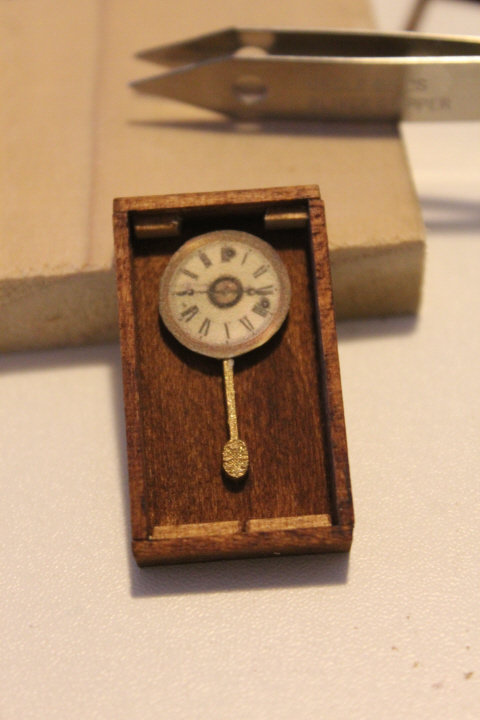
    My miniatures project this week has been making framed "paintings" — which, like my petit-point carpets, are almost always not for any particular spot in a room, but just because I like them. 

    4328

    "The Lincoln Children" (1845) by Susan Waters, "Girl in a Green Dress" by the mid-20th century Swedish portraitist David Tägtström (unfortunately there is not much on the internet about him in English), "Flatford Mill" (more on this below), "Musical Instruments" (1908) by Georges Braque, an early-20th century country landscape that I regrettably failed to identify when I saved the image, a modern landscape probably still under copyright, "Lady with her Horse" (ca.1840) by the prolific "English School", and the abstract "Arrested Movement" (1934) by the Australian Roy de Maistre.

    4329

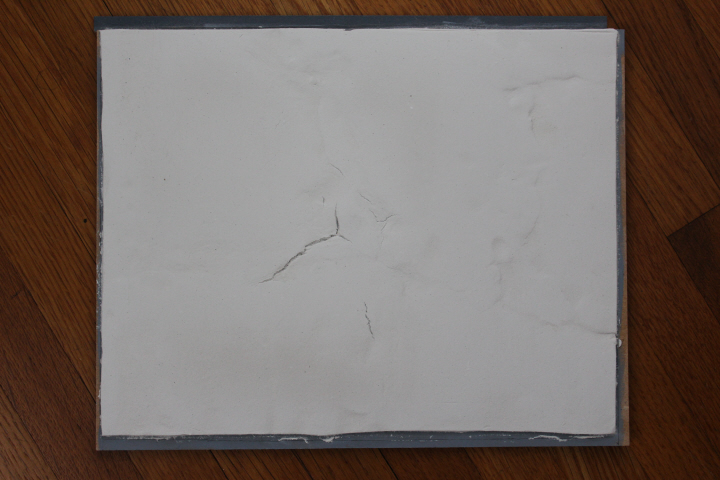
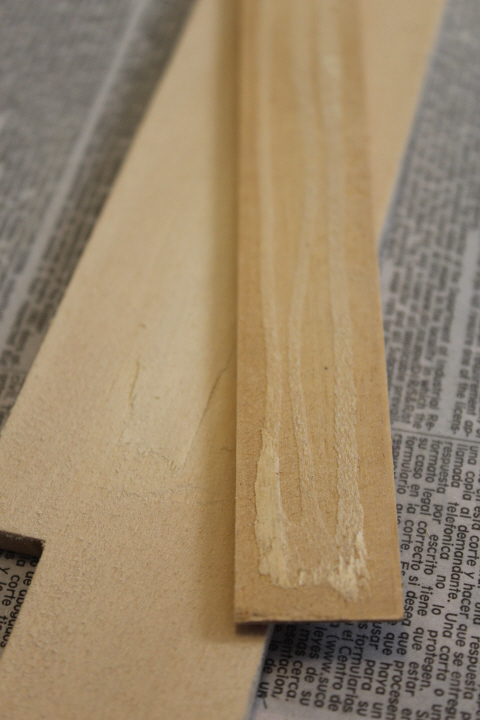
    My current method of making these is to print out images on as heavy a watercolor paper as my printer will handle, brush on a layer of artist's medium — sometimes smooth, sometimes thicker and textured to give the impression of paint — then cut them out with a border, and after making the frame, to glue the picture to the back, with luck hiding the white edge completely.

    4325

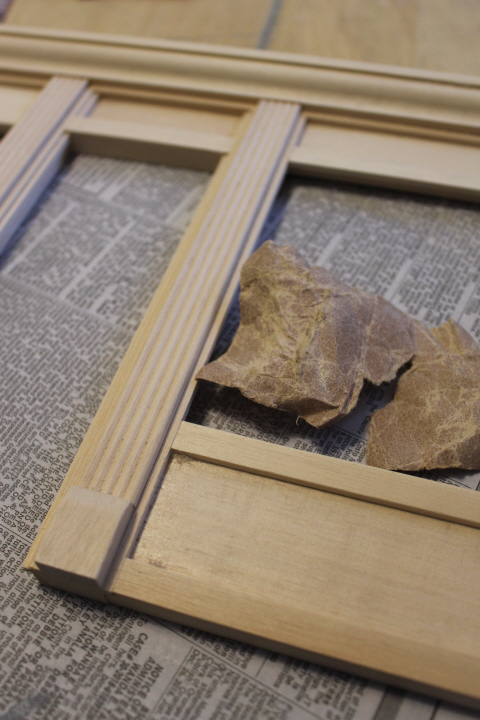
    These mouldings are all Mayberry Street ones, step casings and baseboards and whatnot, as they are fairly easily available in person.  I have used the Minwax stain pens before, and they are certainly easy, but they do tend to dry out if you don't use them regularly, and I usually end up putting on too much (trying to get the stain to drop down into the tip of the pen) and it takes ages not to be sticky — that countryside landscape is finished with Dark Walnut.  But then I discovered that the Martha Stewart satin craft paint in "Vanilla Bean" is a beautiful dark brown, and used that on the rest of these, to very good effect I think!  I finished them with a light coat of DuraClear gloss varnish just to give them a little more shine.  The gold is the Martha Stewart metallic craft paint.

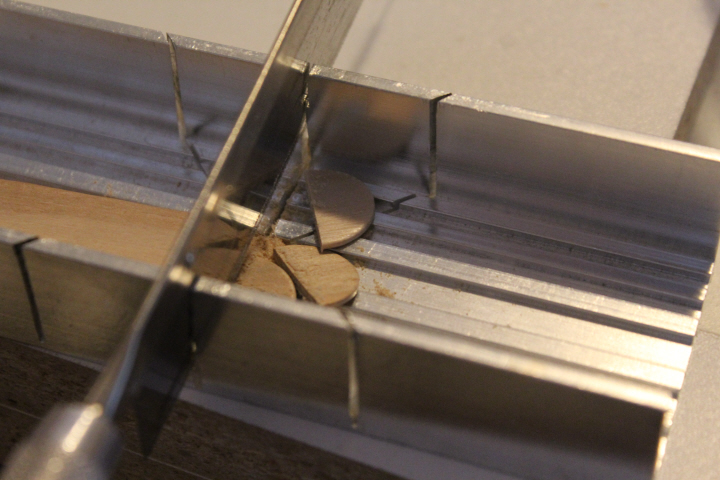
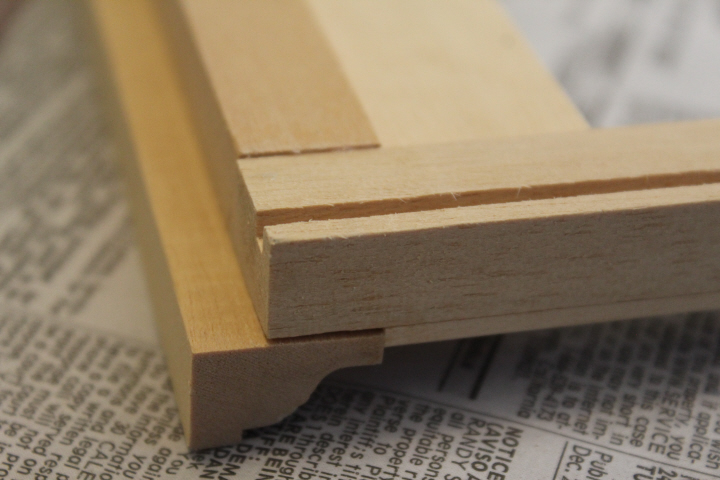
    The hardest part for me seems to be cutting the mouldings exactly the same size, because even a 32nd of an inch makes a noticeable tweak in a frame at 1:12 scale.  I have taken to taping two pieces of moulding together (back-to-back) and cutting them in the miter box at the same time but sometimes even this is not quite successful.

    I had the idea of adding in a faux mat on some of the frames, and so have been experimenting with it — some in gold, some in Martha Stewart "Wedding Cake" which I had on hand, having used it for the stencils in the Hardy House breakfast room.  It's very fiddly, and my hand is not quite steady enough yet for it to look clean, but it adds a nice touch.

    4324

    The picture of the Flatford Mill (in East Bergholt, Sussex) is actually a photograph!  It came out even better than I hoped.  The reflections in the water still look slightly photographic, but the mill itself has that flat realism that reminds me of some of Carrington's work, like "The Farm at Watendlath" and "The Mill at Tidmarsh".

    4323

    4330

  • Texture 1
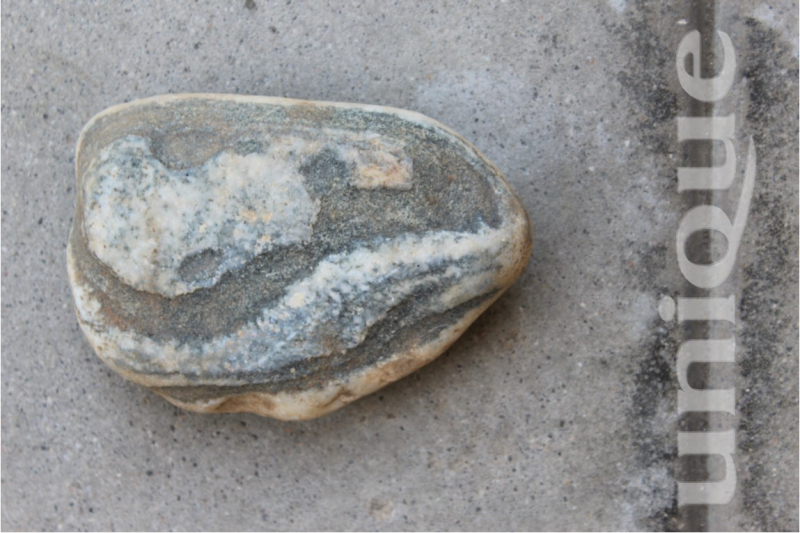
    I haven't forgotten about the ABChallenge — that is, I did forget for a while, then somehow got stumped for literally weeks on T.  (Tea, far too obvious.  But I'll have another cup, thank you.)  Then I was reading the latest post over at Mr. Micawber's Recipe for Happiness, as one does, and enjoying vicariously, and somewhat wistfully, Mrs. M's countryside autumn, and I decided then and there to walk to Michael's for that skein of embroidery floss I need — it seems a horribly long walk when you drive it, but it's only about half an hour there on foot, stop whining — and that I would take my camera and photograph our Southern California signs of autumn.  (This with a somewhat hollow laugh to myself, as it's difficult to photograph "brown-er," let alone a very slight nip in the air.)  Well, things being what they were, I realized after not very long that what I was taking photos of instead was textures.

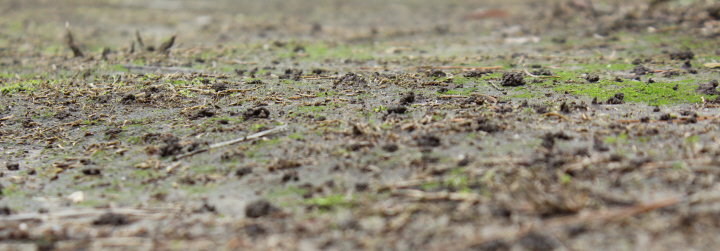
    As it happened, I wasn't much looking forward to the walk itself, but I quite enjoyed the challenge.  The above "texture" is, sadly but nobly, the remains of our front lawn, which we have not watered since the early summer of 2017 when water restrictions began to arrive.  We are now waiting for the rest of the Bermuda grass to give up, and are making plans for planting a California-natives cottage garden.  (To give some idea of the ex-lawn's lassitude, you can still see even a year later (!) the remains of our late and much-lamented camphor trees, wood chips and twiggy bits and a number of dried berries, which trees the city decided must be removed after having first trimmed the roots on the street side — to fix the street — and the sidewalk side — to replace the broken sidewalk.  Their explanation was quite logical — the trees would have less than half of their roots left — but it was with great difficulty that I restrained myself from flinging my arms around those two beauties when the chipper arrived.  The crew were quite kind, though, and let me save large pieces of trunk, which are now curing on blocks in our garage.  And a few months later, we did find two new saplings in their places.)
    Texture 2

    Blue chalk sticks (Senecio mandraliscae), in front of the public library, whose landscaping went drought-tolerant about two years ago.

    Texture 3

    Texture 4

    Ah, here's a little sign of autumn!  Golden leaves from some tree I don't know the name of, but I love the way the leaves have collected in the center of the young palm (Sabal mauritiiformis?) underneath it.

    Texture 5

    The wall of the railroad underpass.

    Texture 6

    A California live-oak trunk, wonderfully knotty and scarred.  (It is called "live-oak" because it is not deciduous like most oaks.)

    Texture 7

    The only indoor photo, at my destination.  The floss is stored in poky little cubbies, but the perle cotton is hanging on hooks and there is always a lovely variety of colors and that wonderful sheen I find irresistible.

    Texture 8

    A street tree, possibly some kind of eucalyptus, with fabulously shaggy bark twisting around its trunk.

    Texture 9

    Ah! another sign of autumn, hesitant as it is — this is a new liquidambar in someone's front yard, only about six feet high so far, but curiously with leaves evenly distributed all of the way up and down its trunk, and today with a hint of brownish-red just beginning near the bottom.

    Texture 10

    Texture 11

    Texture 12

    Texture 13

    There is a very small historic building, one of the first in town, that has been relocated to a small park in the civic center. 1887.

    Texture 14

    This is the grass du jour, it seems, but maybe that's because it has become invasive here — I think it's Mexican feather grass (Stipa tenuissima, aka Nassella tenuissima.).  A pity, as in swathes it reminds me rather deliciously of a golden retriever.

    Texture 15

    Texture 16

    I love the Georgia-O'Keeffe-ness of this agave.

    Texture 17

    Fountain in front of City Hall.

    Texture 18

     This is a Southern California autumn!

    Texture 19

    And finally, back on my own front porch, a Kalanchoe tomentosa (chocolate soldier!) in a pot.

  • 4243
    Here is the miniature carpet worked to a 1903 chart, presumably for Berlinwork or something of the sort, that I found in numerous places on the internet with no source given.  I was really taken by its air of firmly-controlled chaos, and that wildly-unusual diagonal.

    12

    Laboriously typing the Cyrillic into Google Translate — because that's how much of a geek I am — I find that the inscriptions say, at the top, "Album of Patterns" and "Appendix to the 'Homeland' [or 'Motherland', but the gist is clear!] magazine" of January 1903, with "Pattern for carpet" at center bottom, and the publisher, presumably, A. Caslary at bottom left.

    I fed the image into a chart creator, hoping to get some suggestions for colors, but in the end it was much simpler to just work from a print-out of the image itself, though I did use many of their color choices.  I ended up with nine colors, each using two close DMC shades as I really like the depth of color you get by blending threads —

    • dark green (in the border, etc.) = 934 + 935
    • mid-green (the over-painted squares) = 3347 + 3052
    • light green = 3052 + 3053
    • light gold/yellow = 3821 + 3822
    • dark gold = 783 + 3852
    • red = 400 + 3777
    • cream = 3033 + 3866
    • blue = 931 + 932
    • brown-black = 3371 + 3031
    • fringe = 3866

    As it happened, I realized after I had already committed myself to the dark gold, that a number of the figures — the red-outlined flowers and the non-green "leaves" on the white stripe, and some of the outlines in the red sections — are not gold but a sort of goldish salmon.  Mine are now all gold!  It was also quite difficult to distinguish the light-blue squares from the light green most of the time, certainly on my printout.  On the whole, I thought that my color choices, while quite happy together, are more vivid than the somber — if this carpet can ever be called somber! — ones of the original chart, so I might work it again someday in different shades, maybe in wool.

    4245

    4238

    I've been wanting to try adding the "tabby" to a petitpoint carpet — that little natural-colored woven bit on each end, between the carpet proper and the fringe.  I've seen this on Anna-Carin's site and in Sue Hawkins's book — the method is either a running stitch or a backstitch in a plain color (usually off-white).  Unfortunately, neither worked on my Russian —

    4225

    4225

    — I'm pretty sure due to my canvas choice, a Monaco evenweave.  Ordinarily I like this stuff — it is a fine count but not too fine for novices, it stands up well to both stitching and picking out as well as to blocking, and it is readily available.  (Or used to be, I should say — after I had worked a couple of carpets on it, both with wool and with floss, and decided that I liked it, it began to disappear from the various Michael's and Jo-Ann stores around town — "nobody stitches on 28-count any more," I could almost hear them say — so I stocked up when I did find it.  Now I have rather a lot, mostly white except this stash of "mushroom" that was on clearance.)

    But the running stitch (worked with a single strand), in the first photo, pretty much disappears into the weave of the Monaco, and the backstitch (worked with two strands), just sort of gurgles and bubbles ineffectively.

    Here is a partly-worked carpet in crewel wool on needlepoint canvas — you can see how proportionately larger the holes are than in the Monaco —

    4230

    I suspect that the closer weave makes the threads curve more as they travel in and out, even in the length-wise direction of running stitch and backstitch, and that that in combination with the difference in height between the warp and woof strands makes the thread not sit the way I want it to.  So, to make a long story short, I don't think the tabby will really work with floss on Monaco canvas, alas.

    So I have fringed my Russian, and with luck no-one will notice or be disappointed that it doesn't have a tabby.

    4247

    I'm absurdly pleased with the carpet, actually.  It was an interesting challenge, matching the floss colors myself and working to the hand-painted chart, and feel that a whole world of antique charts is opening up to me!

    4244

    4241

  • 4172

    I decided some time ago that I wanted to try stenciling on the breakfast room walls in Hardy House, and found one in an all-over pattern that looked as though it could have been from the 1920s or 30s, maybe even 40s, so just right for what I'm doing with the house.  I knew ahead of time that I would have to cut the stencil to get it to fit around the door and window frames, so it required some planning to do the larger swatches first, then trim off strips for above the doors and window, and so on, in increasingly-smaller segments.  It didn't work quite as easily as I might have liked, as while I "dry-fitted" the stencil around the various obstructions, I didn't double-check the width of the back wall itself, and ended up having to decide between wider-spaced columns or a partial column in the back left corner!

    But I think it's busy enough that while noticeable it doesn't really leap out at you, and once the furniture and pictures are in place, those distract the eye a bit too.

    4165

    4164

    The stencil is an ArtMinds one — that sort of leafy/feathery swag might be useful later, too.  My stenciling technique is far from polished, I know, and on top of that it was fairly awkward reaching into the room without being able to brace my hand much, or sometimes even see beyond it!  I can understand even better now why people say it's much easier to paint etc. before you even build, but of course I don't have that option here.  I was hoping that the stencil color would be a bit lighter, and therefore more subtle, but I didn't have the skill to daub more gently, nor certainly the confidence to thin the paint at all.  Still, I do like the way it turned out on the whole, so there is that.

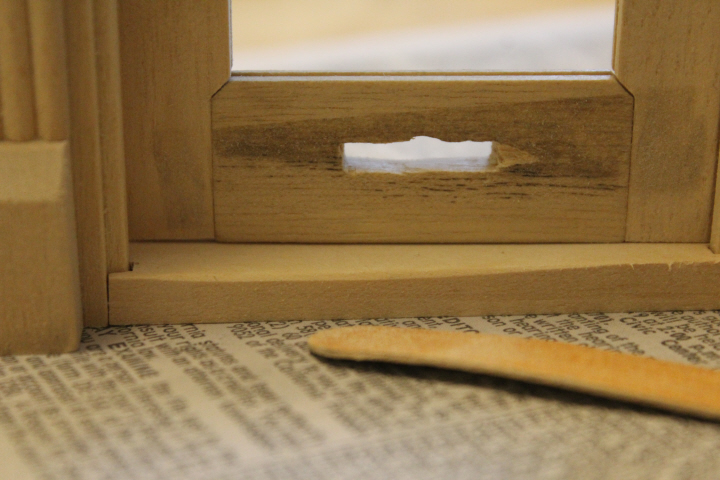
    (Haven't decided whether I should try to sand off the daubs that got onto the woodwork, or to paint over them with a similar "wood" color …)

    I haven't yet found a fabric I like for curtains, so that is still on the to-do list.  Maybe just a solid color (blue?), or faux damask, as there is a lot of pattern in the room now!  I think it also needs some more paintings on the wall, certainly one just beyond the door that leads to the kitchen-to-be, on the left here.

    4168

    Two kits from Nancy Enge — travel journals and echeverias, very pleasing to look at even in kit form —

    4126

    4159

    I was noodling around with the US9 steel hook and some no.10 cotton, and came up with this improvised rug in double-crochet.  I was marvelously impressed with the "mock invisible join" developed by Mrs. Micawber, which took me some time to wrap my head around, as it were — reading the instructions first was like blah-blah-blah-blah for me, but once I actually started to do it, it began to make sense, and indeed worked beautifully.  It didn't, however, work — or possibly more accurately, I don't know how to make it work — on the faggoting rounds, so I began looking around for yet another alternative, and ended up using a "no-chain starting double crochet" as detailed at by Hannah at Not Your Average Crochet.  It seems to me that if you didn't see the join there at the top of the outer two rounds, the places where I earlier worked the NSDC would be almost undetectable.

    4155

    4162

    My current miniature carpet, this from a Berlin-work chart that is apparently floating around Pinterest like the Flying Dutchman, with no actual source.  It is dated 1903, in Russian.  It has a charmingly improvisational air to it that somehow works really well with that imperious diagonal — the moment I saw the chart, I was besotted with it, and it jumped the queue over a number of other projects!

  • 4130
    This came together wonderfully quickly!  I stupidly forgot to note how many t-shirts I used — at least six, I suspect.  This rug weighs 2.5 lbs. — not quite 1.2 kilos!  It's single crochet (UK double) on a row of foundation single crochet, using an 11.5mm hook, the largest I could find at the time.  (I have to admit that I have tried and tried the FSC, using a number of different tutorials, and am still not sure I'm doing it right.  But this attempt looked tidy and consistent, so I went with it!)

    4142

    I was actually pretty careful to keep the edges as straight as possible, both by counting the number of stitches on a regular basis, and by sometimes working the last stitch into the side instead of the top (sshhh!), which pulled things in rather nicely — but the weight of the different shirts really made a big difference in the thickness of the various rows.  It was also certainly a factor — but this I expected — that in cutting the shirts I found the picking-out of hems so laborious that after the first two or three shirts I didn't bother, and just cut the first strip a bit narrower to allow for the bulkiness of the hem.  These lengths of the yarn didn't curl up in the same manner as the others, of course, so along with the stitching made those rows behave differently.

    This is actually Version 2, as I misjudged my gauge on Version 1 and ended up with a piece that was a bit taller than I really wanted, and so I reworked it starting from the Version 1 end, ripping it out as I went and re-crocheting it in the other direction, a few stitches smaller.  This took far less time than the first, because of course I had already connected the various pieces!  I did take the opportunity to rearrange a grey-heavy stretch at the end of Version 1 — it is still, but more balanced than it had been!

    4145

    I simply knotted the pieces of yarn at first, but this of course leaves a big lump in the fabric — it doesn't show as much as you'd think, but you can certainly feel it under your feet.  Most of the joins in mine are the larks'-head version explained in method 3 at Dollar Store Crafts' tutorial.  When I decided that for the remake I wanted to rearrange some of the colors, I couldn't just pick apart these joins, so I had to cut them apart and reattach, and I just sewed those by hand with some thread and back-stitching.  I don't quite agree with DSC that the larks'-head is the least visible join, as the knot though small does make a lump in the fabric — less than a square knot does, certainly, but still a lump — and I found the stitched joins to be not only the least visible, but the easiest to work with, as there is less bulk to have to pull through the various loops of the crochet. 

    It does make a satisfyingly solid fabric, with, amusingly, here and there just a small reminder of its former life —

    4139

    So the conclusions seem to be that the economical way of cutting the t-shirts, which will give you one considerable length of fairly-smooth yarn and a number of smaller lengths that zig-zag, with lots of pointy bits sticking out, doesn't look as sloppy as you'd think (!) once it's worked up.  I thought that I would end up having to trim off a lot of the more rustic bits, but most of them slipped pretty easily under the next row of stitches (or were pushed!).  It doesn't look as smooth as the purchased "t-shirt yarn" — and I have to put that in "scare quotes" because, really, I can hardly believe that you can buy this stuff ready-made instead of doing it yourself, where's the frugality and eco-friendliness in that?? — but although a number of the sticking-out bits will probably pop out in the first wash, it doesn't look sloppy, either.

    4132

    And this was only about a third of the stash of old t-shirts I've accumulated.  So I'm planning another rug, and since there are a lot of plain or mostly-plain white shirts and I still have a stash of powdered dye left from tie-dying at day camp some years ago — waste not, want not! —

    4119

  • 4110

    David wears a lot of t-shirts, plain white ones under dress shirts for work and colored ones for weekends, and since t-shirts are also one of the more popular giveaways in theater and tech companies, he also manages to acquire six or eight new ones a year.  He also wears them out pretty quickly, and though they spend quite a lot of time in the "yard work/painting shirt" drawer, there is quite a lot of fabric in a "worn out" t-shirt that is still strong and fairly clean — so that it seems a shame to just throw it out.

    Although I've seen around the internet a good half-dozen tutorials, at least, on how to make t-shirt yarn, it has taken me rather a long time to decide to try it myself.  But since I've started crocheting recently, the idea has come up again, and because I not only have a stack of David's old t-shirts but just now a stack of old day-camp ones that the girls have grown out of, I thought, "well, now's my chance!"

    I certainly have enough t-shirts to not need to be frugal about how to cut the shirt — many tutorials use only the body, below where the sleeve attaches — but since I just want to make a rag rug for inside the back door, I don't mind it looking like a rag rug, with some of the bits from the less-straight cuts sticking out.  But one of the big points for me is the re-using/recycling aspect, so I decided on the whole-shirt method from Sustain My Craft Habit — which also has a helpful video to accompany the written instructions.  This one discards only the collar and a few bits off of the most awkward angles, so that there is only a handful of fabric that gets thrown away.

    That said, cutting up a dozen t-shirts is really boring.  Really.  Especially since over half of them are black!  There are a lot of colored shirts in my stash, but since I've noticed that the black dye leaches out onto other colors with repeated washing, so that any back-door mat would become rather dingy after not many washes, I decided to use just black and grey for this one.  Cutting up that many t-shirts is also quite hard on the hands, and so when a rather fantastic 60%-off coupon arrived from Jo-Ann's in my mailbox, I decided to splurge on a rotary cutter and cutting mat set, which I'd been dreaming about for a while anyway.

    4118

    It's still pretty boring cutting the shirts, but at least my hand doesn't ache afterwards!

    So now all of the black and grey shirts have been cut and balled up, and it's time to get out the gigantic crochet hook —

  • Marilla shawl

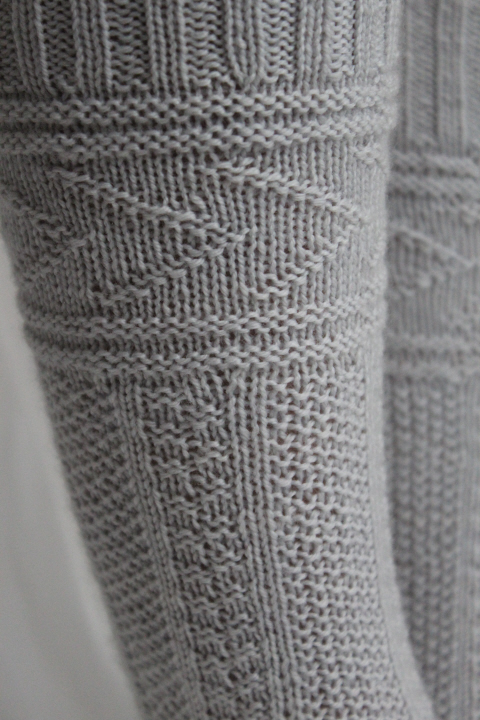
    On their way to Mrs. Lynde's house so that Anne can apologize for her temper, Marilla wears, here in the 2017 series based on Anne of Green Gables, the shawl that figures so largely in another scene from the book and the series.  The one chosen by the costume designer here is rather decidedly untraditional for a late-Victorian lace shawl — but then, it is very plain and serviceable, much like Marilla herself.  I couldn't find a better view of the shawl — there is one closer in another scene, when Anne is admiring the brooch, but that part wasn't included in the recap at the Netflix website.  Perhaps the stitch is either "Falling Leaves" or "Shetland Leaves," from Martha Waterman's shawls book? or the one that FreeKnitStitches.com calls "Shrubs"?

    Shawl closeup

    But I confess that there will probably be no more here on this particular series, as I have decided that this was my second and last attempt to watch it.  I had heard that it was coming, and was a little wary — how could anything hope to compare with the near-perfection of the 1985 "Anne of Green Gables"?! — but was delighted to find that Marilla and Matthew were to be played by Geraldine James and R.H. Thomson — oh, if anyone could come close to the standards set by Colleen Dewhurst and Richard Farnsworth, it would be James and Thomson!  And the photos only increased my interest.  I was a bit dismayed, then, upon the debut of the series here, to find such an emphasis, even in the first episode, even forewarned as I was, on cynicism and sordidness.

    I cannot fault the production values, from photography to costumes to set design to casting, in the first episode, but this leaves only writing and direction to blame for the direction the series takes.  I got as far as the beginning of the second episode — at about the 90 minute mark — where Anne alights from the train on her way back to the orphan asylum after being wrongly accused of stealing Marilla's brooch.  It was difficult enough to watch this Anne's bitter and vicious encounter earlier with the hired boy, but after the child-snatcher (yes!) at the railroad station, I turned it off.  I already knew from other reviews that this version not only emphasized the grimmer aspects of Montgomery's story but added in more than a few of its own, and so I had sort of steeled myself for things like Anne's flashbacks to the brutality of life in the asylum — but I just didn't want to watch it diverge so very much from the intentions of Montgomery's original novel.

    (I understand the rationale behind that first scene with the hired boy because, clearly and understandably, Anne is afraid of being replaced — but Montgomery's Anne is not cruel.  That's all.  If Montgomery's Anne felt that she was in danger of being replaced, she would far more likely have intuitively "imagined herself" into the boy's own situation — which he tells her right at the beginning of the scene, that he needs the work to help support his family — than she would have shrieked at him like a harpy.  What I don't understand is why screenwriters choose to adapt a story by throwing out much of what is essential to it, and adding things that the author never intended.  The fact that this series is not called "Anne of Green Gables" is a warning, indeed.  We don't need to be bashed over the head with how hard an orphan's life is — we get it!  Anne's parents died when she was a baby, she's homely and skinny and she talks far too much, and nobody wants her — nobody.  It's an awful life.  Why does the series feel it necessary to exaggerate things to the point that fellow orphans are actually physically abusive and the bullying father of Anne's only foster family dies not from a violent outburst at work but from a violent outburst while beating Anne? or worse, add in 21st-century lectures on the evils of racism, sexism, and homophobia?)

    It's a real shame that the writer didn't love Anne herself and Montgomery's book enough, that she didn't trust the original story enough to film the the real Anne, the one who brings joy and love to Green Gables and in the process finds the joy and love and family that she herself craves.

  • 4065

    I'm still laughing at myself not a little, looking down my nose at crochet for so long and now here I am rather fascinated.  There it is.  My first and deepest love is for knitting, but crochet does have a few things going for it, not least being the speed with which you can finish a project!

    4056

    Here is a knitted Hurdle Stitch dishcloth from Tricots et Créations Isabelle on the left, in Lily Sugar 'N Cream "Swimming Pool," and a crocheted cloth in Suzette stitch in "Rose" pink.  The latter took some fussing, as the first version I came across gave instructions that never did come out quite right for me, and so I found a different one that worked quite well — it's a very pretty stitch, and the same on both sides, which is handy.

    4086

    I crocheted a 1:12-ish afghan to the "Open Squares" free pattern by Butterfly Dreams Miniatures.  It's a good beginner pattern — beginner to crochet and/or miniature needlework, I mean! — as it is fairly simple and repetitive.  I know my scale is off, but I'm still practicing! this was was a US9 hook, what is recommended for the thread.  I added two rounds of single crochet for an edging all around — actually, twice all around except for the very last quarter, which was I think the top edge, as that looked too wide with the second round!  This is in no.8 perle cotton, which now I'm pretty sure isn't the best for something you will want to drape nicely — for amigurumi or other projects where you want a lot of body to the fabric it would be ideal, but it is fairly stiff at anything other than a loose gauge, and doesn't soften up much at all with blocking, so for dollhouse items perhaps it would best suit things like bedspreads meant to lie flat — or carpets!  I might try this pattern later with embroidery floss, as I think the drapability would improve.

    4089

    4062

    When we were on the narrowboat last summer, being me I couldn't help noticing the charming crocheted doilies serving as curtains-of-sorts on the portholes of many of the privately-owned boats.  This is a "traditional" craft for narrowboaters, though I qualify it a little not having found out yet if it is older than, say, the Victorians — but then, I suppose a hundred and thirty years or so is certainly still "traditional"!  Much like Romany caravans, the boatwives would decorate sometimes every inch of their living spaces, and because of the cramped quarters in a narrowboat, it is said now that crochet — taking up less space than most needlecrafts! — was the medium of choice.  I don't know if porthole covers are a newer invention, but certainly photos can be found of wartime barges with lace hung along the edges of shelves — most of these look like filet crochet to my inexperienced eye.

    I recently found some some of the history behind the craft at Crochet and Cabin Lace, as well as porthole cover patterns and some booklets with traditional cabin lace patterns available for purchase.  Mine is the Cobweb Lace one from the website, in Aunt Lydia's no.10 cotton —

    4064

    The finished piece is only a smidge bigger than it is supposed to be (7 1/2 in.) but looks a bit  more open than the original, not sure why, unless it's just because I really biffed the UK-to-US-crochet-terms translation!  Maybe the no.10 is actually finer than the Lesur Empress cotton (which I have never seen)?

    Clearly I have no need for porthole covers at this point — a narrowboat is still only a when-we-win-the-lottery fantasy! — but of course I'm fascinated by traditional handcrafts of many kinds, and it is very pleasing to combine two interests, as it were.  I might starch this one and just hang it in the window!

  • 4078

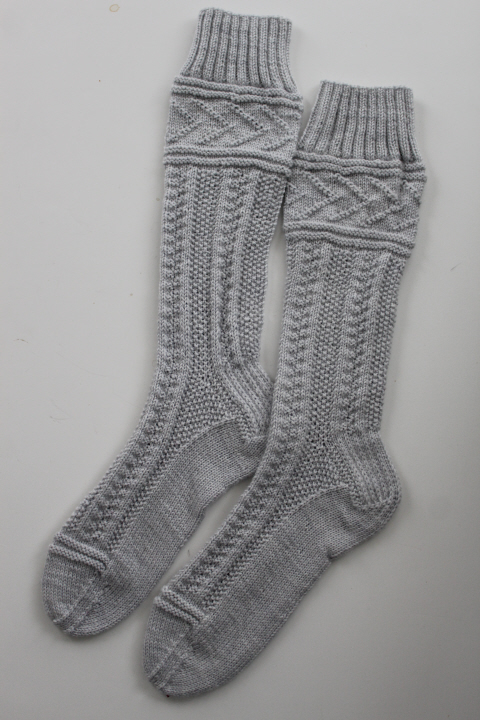
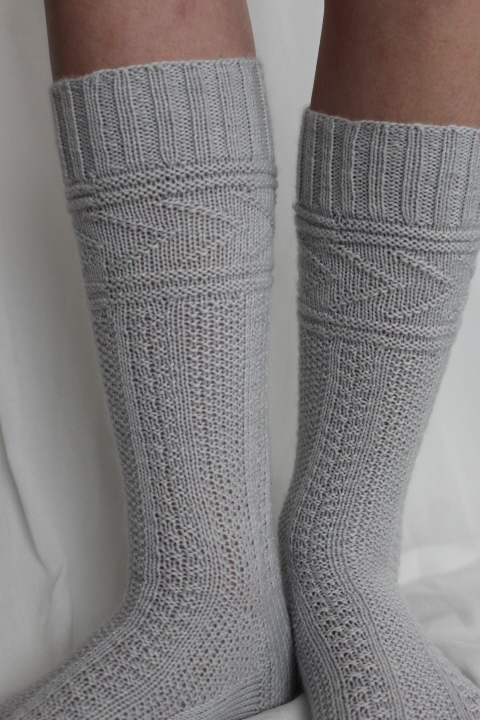
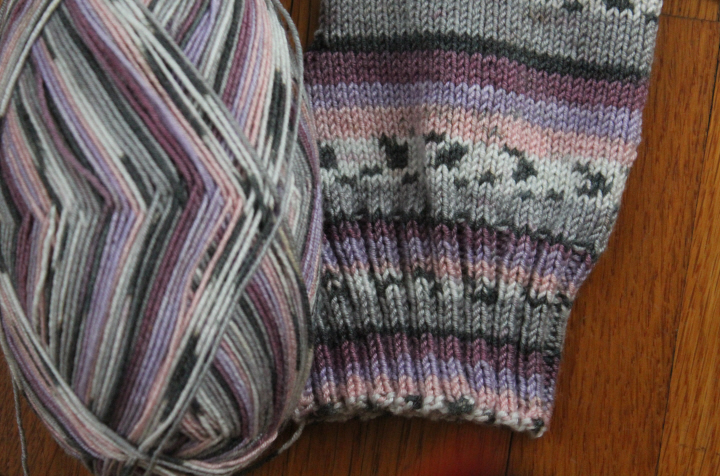
    These are the popular "Hermione's Everyday Socks" by Erica Lueder.  I worked mine toe-up, as I had no idea how far the yarn would go, though as it turned out this was not an issue at all.

    4071

    I used Judy's Magic Cast-On, which is brilliant though a bit of a pain at first, and I broke one of my lovely rosewood sock needles in attempt 2 or 3 at the really-fiddly bit at the beginning — sniff.  (I recommend metal dpns if you're going the dpn route, at least until the toe gets going.)

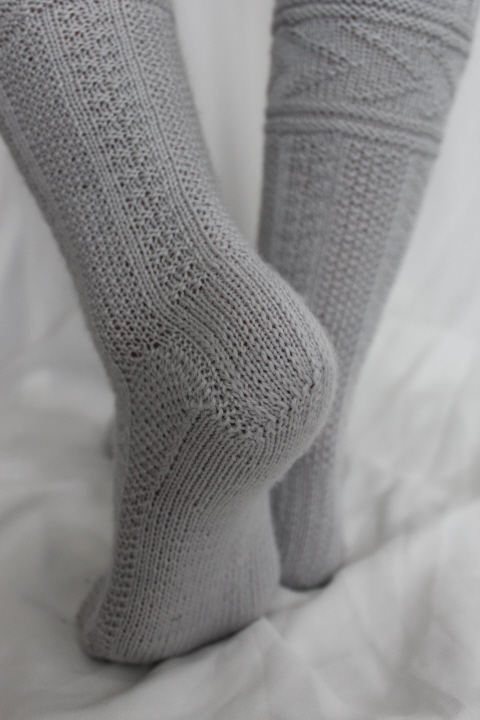
    For the heel, I used Wendy Johnson's toe-up heel instructions, modified to include the Hermione's eye-of-partridge heel with the garter stitch edge, and finally Jeny's Surprisingly Stretchy Bind-Off (the Interweave instructions).

    4067

    4080

    4020

    I enjoyed knitting these — the pattern is easily memorizable and the yarn suits it beautifully — and I even enjoyed the toe-up process, although I confess that since it has been so hot here, I finished them almost a month ago, set them down, and forgot all about them until just now when I was tidying up.  But I'm sure they will quickly become a favorite come autumn and winter!

    4066

    4029

    4068

  • ,

    Strike Up the Band!

    4036

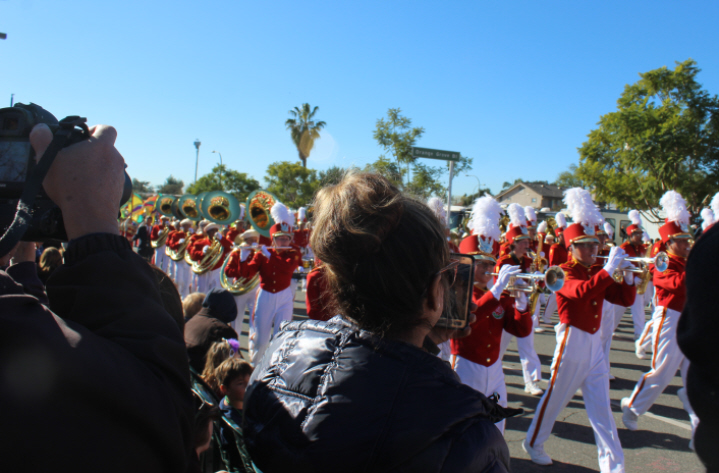
    I've been spending rather a lot of time the past few weeks in helping assign and fit uniforms for Julia's marching band at high school.  There is surprisingly little about mending band uniforms on the internet — I suppose that means that either the people who do mend uniforms aren't hanging around on the internet much, or that, which I fear might be the case, people don't bother to mend uniforms any more, either because they can't or because it isn't worth their time to do so.

    But I will happily say that our school's uniforms, while older than most of our students, are still going strong in their 100%-nylon near-indestructibility! — aside from a few hiccups, that is. And so for those who Google "mend band uniforms" or "alter band uniforms" and come up empty, here are two of our solutions.

    This particular jacket had a dark grey spot on the outside of a sleeve, which has resulted in it being passed over for a number of years, even though it would otherwise have been a perfect fit for someone.  I had thought I would just sew a patch over the spot, but this ended up being too thick, and therefore quite obvious.  (Yes, an iron-on patch would have been a simple matter, but in my experience iron-on patches come off, leaving a bigger mess than they were originally hiding.)  An old-fashioned darn might have worked, but while I understand the principle behind darns, mine don't even come close to looking neat.  I decided then to simply cover the spot with satin stitch, using the method called encroaching satin stitch or long-and-short satin stitch.  I'm not much of an embroiderer, and so I found the tutorials here and here to be helpful — essentially, working the padding as here without that one's finishing layer.  I used plain white embroidery floss, partly because the color was a better match than white sewing thread, and partly because I had the feeling — which proved to be the case — that floss would lie flatter in the end, and look smoother.  The spot is still obviously mended, but is much less visible from even a short distance, let alone from the 50-yard line, than it was!

    Many newer band uniforms have a snap system for altering the length of legs and sleeves, but ours don't, and so we have to do this by hand, in order to have the alterations as invisible as possible on the legs, and for the jackets because there really is no other way, since they have angled trim — in two colors and gold braid! — which means that you can only turn up the hem until you come to the braid, and no further.  We discovered this enormously helpful video a few years ago —

    I have found since then that you can actually do the hem in one go, instead of stopping at the creases as the lady in the video does, if you begin at one of the seams, stop hemming an inch or so before the crease and simply run the thread through the folded hem (inside the trouser leg!) to about an inch after the crease, then hem around, again skipping a short section at the other crease, back around to where you started. This method also seems to suit us well for hemming jacket sleeves too, just being careful that the stitches don't show — which usually means tacking the hem onto the lining in places, if the hem is really deep.

    You have to do this, i.e. not attach the turned-up hem the entire circumference of the leg, because the leg is not a perfectly straight tube; since it narrows as it goes downward, the circumference at the very bottom is smaller than the circumference even an inch or so higher, and the ratio only increases the more you have to shorten the leg.  If you stitch it down all of the way around, you will end up with ugly puckers in the fabric.  Leaving an unsewn "gap" lets the turned-up hem "float" on the inside of the pants leg, and the best place to leave it is at the two creases, so that they stay nice and sharp.  You just can't leave too big of a gap or the wearer will catch his or her toe on it when dressing!

    Picture1

    There is a good introduction on the Colette blog here about different methods of hand-hemming.  I usually use a variation of the blind hem, instead of the herringbone-like catch stitch in the video — I don't think it matters, whatever is easiest for the sewer and shows the least from the right side!