• ,

    Blue Coins for Baby

    7379

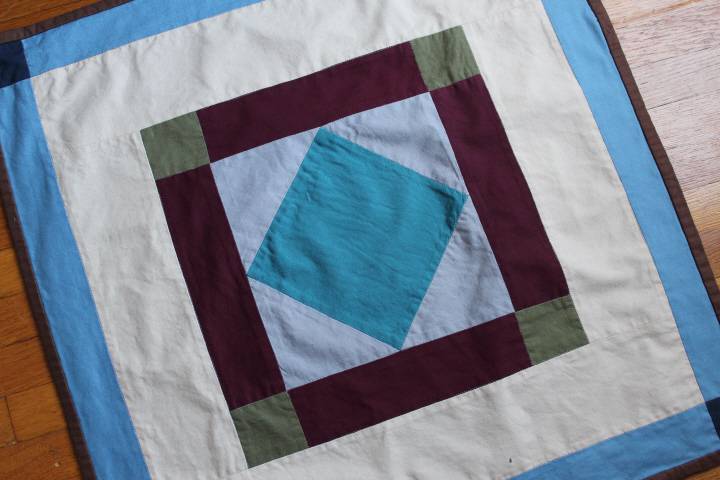
    This went together with a very satisfying quickness — not error-free, mind you, but well in time for the gift-giving next week.  The colors are very pleasing to my eye. 

    7381

    I still have my old 1980s Kenmore sewing machine, which doesn't extend to anything so grand as a walking foot, so the quilting is only widely-spaced straight lines down the "stacks", but the wideness gives the quilt a pleasing fluffiness, I think.

    I wasn't very impressed with my ability to cut a straight edge — my tendency to try to be frugal and not waste any fabric tipped over the edge into skimping, and the backing fabric actually came up short on one side, so that I had to trim off a bit more than I really wanted to, which led to a series of snips here and there that seemed to make things worse, not unlike trying to cut your three-year-old's hair, snipping a bit here which makes that bit crooked which necessitates another snip there, &c. &c. &c.  And in another instance, although I was taught by my mother and grandmother to always, always, cut off the selvages, I have begun to absorb the much-earlier practice of using as much of the fabric as possible — maybe selvages don't pucker as much as they used to in Grandma's day, I wonder to myself, I've usually been all right — I thought I had measured carefully enough that these would be just inside the seam allowances, but one slipped somehow, so that my shame is there for all to see.

    7366

    I thought, rather desperately in a dark moment at the end of a long day of making edging strips and laboriously pinning and re-pinning and hand-sewing the first long edge and a corner, that I have enough fabric left to make another quilt, I could use this one for day-camp and make another one, with straighter edges and no parsimonious white selvages, one that I wouldn't have to make excuses for — "sorry about that wobbly bit there."

    And then when I woke up the next morning, I knew that this isn't mean to be a showpiece or a prize-winner, it's meant to be used, for the baby to nap on, or the new mom to nap under, to take to the park on a sunny day and not mind if it gets dirty or spat-up on.  It's okay.

    7371

    And I really do love the colors, the different shades of indigo and brown, the little flecks of lighter shades here and there that give it both a liveliness and a kind of serenity.

    7380

    I had thought of piecing a quirky back, but this is just plain, a big piece of Linen Look, the sturdiness of which I have been very happy with in other projects, and comes already wide enough to need only a single cut.  The edging is a lovely coffee-brown Kona Cotton.

    So there wasn't really much "process" involved here, and it does look a bit more "homemade" than I quite wanted it to, but there it is — I will embrace its imperfections along with its beauties —

    7384

  • 7351
    The hardware I chose for the carpet shop doors is one of the rather-standard knob-and-plate sets and sort-of-matching two-sided letter slot available from most miniatures sources, under various brand names but clearly the same.  They weren't really ideal, looking late-Victorian where I was hoping for something more Georgian, or at least early-Victorian, but there it is, needs must — it was more efficient to order all from one place, and I was certainly happier with the rounder knobs, which are more in keeping with the period of the shop than the far more common modern-looking ones with sharp angles.  I did manage to find a shop bell that I liked! 

    They were, however, all very clean and shiny straight out of the box, so then I had to go about aging them.  It will probably be clear to experts that I don't have much idea of what I'm doing here, but after reading their blogs, I knew in theory what needed to be done!  I am lucky enough to have a real vintage bell to use as a model —

    5315

    so I painted all of my hardware black, then dabbed on a bit of green and a bit of brown, until it looked about right.

    7355

    5310

    (Like traitors' heads on spikes!)

    I've also finished the permanent signage.  I had the dickens of a time with the shop name, not trusting my skills at this scale to free-hand letters — though in my more desperate moments I did consider it.  I find it difficult to believe that there aren't 5/8 inch stencils to be had, but there aren't, unless you want to pay for custom stencils, which are far beyond my budget.  I couldn't even find stick-on letters.  I tried cutting some out of paper, which sort of worked but usually ended up with my snipping off a serif here and there, etc.  Print-your-own waterslide decals were, alas, a dismal failure, with only the number on the door being worth keeping and I'm not even delighted with that.  The "FINE CARPETS" one actually stretched as it was coming out from underneath the backing — too much water? not enough water?  I don't know.  These decals are repositionable for a few moments after you lay them, which is very helpful, believe me, but I discovered to my dismay that if you touch the image while you are doing this (despite the sealer applied after printing), some of it will most likely come off on your finger.  As the decal dries, the ink sets, but the door number decal especially was so small that I couldn't reposition it without touching the ink.  And even if they had worked, I wanted the shop name sign to be gold, and I would have had to paint over them.

    While I was dithering and experimenting with the carpet-shop sign, I had the idea to do this on the upper façade —

    7168

    — in the manner of old shops that have permanent signage painted over when a new business moves in — which was actually pretty successful.

    5294

    I was hoping to superscript the S in "Thos." the 18th-century way, but I couldn't find the same font in two different sizes, nor even, to my astonishment, upper-case and lower, so this was what I ended up with.  These are stickers from the scrapbook aisle at Michaels.  The letters are textured, which wasn't ideal — painted, they remind me of the no-slip texture on ladder steps and shower floors — but they are a good size, and they add a certain whatsit to that rather boring façade.  I just made up the name, but it sounds charmingly old-fashioned!  (You can see that I got the idea to do this after I'd aged the piece a bit, which I had to do over again after painting over the letters!  More practice, I guess.)

    The shop name has had a long journey, full of wrong turns and potholes, but like many such journeys, arrived at its destination happily.

    5312

    This is the Folkart 59796 alphabet stencil, painted with Martha Stewart Craft Paint in Metallic Gold — a handsome alphabet, to be sure, if smaller than I wanted.  (I noticed after this photo that the F was clearly below the line, so I painted it out and re-did it.)  I scanned the stencil then cropped the letters I needed and spaced them out in a rectangle the same size as the shop-front inset, so that I wouldn't have to do it on the fly — a bit of a bother, but worth it to save the stress!  I was not successful in merely dabbing paint over the stencil, so I painted through the stencil, as it were, onto the surface.  I had to do one letter at a time, then let it dry, then do the next one, since I didn't want to cut the letters completely separate.  The result wasn't what I'd pictured in my imagination — which was certainly bigger letters, as well as neater — but the sign was "up," at least.  It's possible that some of the clumsiness of execution was due to the brush I used.  It's a poor workman who blames his tools, of course, but this was my brush —

    5314

    and no amount of wetting and coaxing would get the tip any finer, so I vowed that if I ever did this again (wh. at the moment was doubtful, but I said the same thing about childbirth the first time) I would buy a better brush from an artists' supply store.

    5319

    This was just not what I had in my mind's eye, though, and so after a few days of thinking about it, I painted it over and tried something different — first, pricking around the edges of a printed letter, through the paper and slightly into the painted wood, and then filling in the outline with a very-fine-tipped gold pen, which I tried out on a piece of scrap wood I'd been using to practice weathering techniques.  This worked fairly well — the pinpricks are still visible from close-up, but not so much at a distance — but then I remembered the old elementary-school trick of homemade "carbon paper" — I printed out the letters I wanted, rubbed a no.2 pencil thoroughly over the back, then traced around the letters with a fine-tip ballpoint pen, which left a faint imprint of the graphite on the wood.

    5385

    I then carefully painted inside the lines — with a new 10/0 spotter brush, the smallest I could find — and voilà! a very pleasing shop sign.

    5389

    Even with an unstaged and badly-lit photo, this was miles better!

    As for the interior walls, my use of Paperclay to make faux plaster interior walls was, unfortunately, a pretty dismal failure.  I don't think it's the Paperclay's fault, as lots of miniaturists use it, and some very expert ones too — perhaps it was the age, flexibility, and/or utter dryness of the MDF walls, as they either absorbed the moisture from the drying clay or, as the clay shrank — which I knew it was going to do — it pulled the MDF along with it.  Regardless of the reasons, the effect was obvious —

    5390
    At the top is the Plexiglas "ceiling" which is still straight — the next one down is the thicker back wall, then the two side walls at the bottom.  Even the thicker rear wall wasn't sturdy enough to resist the warping.  No end of resting under weights had any permanent effect — after I saw how the first one bowed, I even clamped the freshly-Paperclayed ones to a very firm surface to keep them from warping in the first place, but the warping was actually very gradual, and was clearly worse after a week.  (They have also warped even more since I took this photo.)  Very dismayed, I left the whole thing alone for quite a long time — David busily coming up with ideas such as bracing the walls outside with brass rods — but eventually we both came to the inescapable conclusion that, since the rear and side walls were plain as plain could be bar the glued-on corner brackets on the back wall, the most logical thing to do was to simply cut some new walls out of plywood and start again.  It was actually ridiculously easy to pry off the brackets, and I simply re-glued them to the new rear wall.

    5494

    I really wanted the plaster effect, so I used spackling compound on the new ones, partly because I was now wary of the Paperclay and partly because David had a nearly-new tub of the stuff so I didn't have to buy anything.

    Despite all of these grandmother's-footsteps accomplishments and setbacks, what made me most nervous was the painted "aging".  The members of the Greenleaf miniatures forum were gently encouraging and helpful, though, so I did some practicing on a piece of scrap wood, then just dove in.  ("You can always paint it over and start again," said a number of people, which, though the prospect was daunting, was certainly true in my case, as I had used only a fraction of the lovely green Behr Marquee sample pot — "Chelsea Green" — I got from Home Depot!)

    The technique I ended up using was basically dry-brushing, starting with a "faded" bit of the base color (mixed with white craft paint), then some black and some brown, just sort of "dusted" on where it seemed there would be the most aged and/or dirty places on a real wall.  I did rub it off in some places and do it over.  There are also some spots that I sanded lightly with an emery board to look chipped or flaked off — there are some wonderful tutorials, especially from model railroaders, for simulating flaking paint, but the sanding worked well enough for a "slightly run-down but not dilapidated shop".

    5435

    What Not to Do: If you change the orientation of a door, don't forget to age the door jamb on the new opening side, not the old one!  Duh!

    5439

    The "Private" sign is a faux-enameled one from a selection of Victorian sign images that I found online, printed on watercolor paper and loaded with artists' medium, in the same way that I made tiles for the No.16 kitchen.  I made it slightly bigger than the real sign, as it just looked better that way on my door.

    I will try next time to get the lower parts of the walls a bit more uniformly grungy — now, how often do you get to say that, really?! — as it looks a bit spotty to me, but I'm satisfied enough with this to move on to the next step!

    5447

    The windows aren't glued in yet, as I've found that they fit in the frames very snugly just by friction and I suspect that I might want to have the access for a while longer! but I have since this photo glued in the Plexiglas.

    And, after all of this, it was time for …

    7343

    This was surprisingly nerve-wracking, and I put it off for ages, but the Time Has Come.  The base that came with the kit is here held in the right-angle of the big gluing jig by the two large clamps, the four walls of the box are wrapped around the (now also glued in place) floor at the bottom and the removable "ceiling" at the top and held snugly with extra-large rubber bands (which I had bought for a catapult experiment at day camp a few weeks ago, and worked perfectly for this as well!) and the whole box is also pushed into the right-angle of the jig, there is a piece of wax paper between the base and the underside of the shop box in case of glue overflow, and the five handy craft clamps aren't actually clamping anything (because they are too short to go around the box) but are pushed up snugly against the slightly-warped front piece in hopes that the glue will grab hold firmly enough to counteract the bowing.

  • ,

    Baby Steps in Boro

    7190
    Being a novice quilter, and being me in researching options and methods etc. etc. etc. sometimes quite a lot before actually starting a project, I've been looking around the internet (as one does) and have come across any number of Chinese Coins/Stacked Coins quilts, lighting fairly early in my explorations on Ann's blog at Fret Not Yourself, which I like very much, not least because she's going through a bit of a phase with Chinese Coins lately (she started numbering them, I think she's up to fourteen! — not in a row, mind).  Of course, there are any number of charming quilt patterns — I must make this large-scale Ohio Star pattern! — but somehow my Japanese fabrics seem to me to want the neatness and order of straight lines, and the Chinese Coins pattern gives that sense of simplicity and busy-ness at the same time that both fits the fabrics and speaks to me.  I did manage to find my original inspiration quilt, which had been pinned and re-pinned on Pinterest so many times that I thought the source would be lost to me forever, but then there it was at A Quilter's Table, the third one in the post.  I really like the gentle colors, gentle but far from dull, and the sort of regular irregularity of the stacks, chaos and order together if you will.  I am also really taken with this one, Ann's Chinese Coins V, which is more improvised than usual even for her, and I love the effect.

    These led me eventually to a post at Rossie Crafts, a bit of a digression from my own planning, but an interesting one, talking about not so much the finished product — in this case, quilts — but how the maker gets there, which of course is the part that as a novice I am least certain about.  Something one of the commenters said struck a chord of recognition in me, that "one of the most debilitating fears I had to overcome in my students was the ideas that they are not good enough and that they are not allowed to make mistakes." It's wonderful to look at a website or blog full of finished pieces — Hopewell, say — but for a novice like me, faced with a stack of fabrics and a lot of decisions, and then in the making itself any number of mistakes or uncertainties, it can be not a little daunting.  Simplicity is not always easy, ironically!

    This is not new to me, mind you.  I have a tendency to want things that I make to be tidy, to not look "homemade" in that derogatory sense we all know, ill-fitting, with crooked hems and wonky buttonholes — and so I rarely show the stages of a project, be it knitting or sewing, or the failures (and we all have those, to be sure).  Certainly for those new to a craft, knowing more about the process from start to finish, from an expert or even that of someone with a similar level of experience, can give the confidence that leads to a willingness to experiment, or even just to feel more positive about the process as well as the result.Process pledge small

    Perhaps there is a risk of being excessively meticulous about the process of making — even if not on the level of "I cast on 114 sts, using the long-tailed method. I worked Row 1. I worked Row 2," ad infinitum — but the very practical prompts that Rossie gives at the end of her post are often the kind of things I find myself thinking about in the planning stages of a project, and sometimes the kind of things I worry about ("What are you hating about this quilt at this stage? What do you love?"), but that I don't always talk about here.  And, you know, it can only help oneself, as well as the result itself, to be more meditative, more thoughtful as it were, throughout the various stages of a project. 

    And so, with no further ado —

    7185

    Not long after the previous post, I cut my fabrics, slashing each fat quarter in half up the middle, then each half into faux-random widths.  I say "faux" because I was using my relatively-new rotary cutter and quilting ruler, and so in order to have strips of even widths I did have to line up the ruler first — and so the strips are wider or narrower mostly in 1/4" increments (!). 

    I then tossed all of the strips into the air (yes, literally) to mix them up, spread out a white sheet on the living room floor, and began laying out the strips as they came to my hands, only moving them when there were two of the same fabric next to each other, and in a mild attempt at not having two horizontal joins side-by-side.  My first pass at cutting strips went through maybe two-thirds of the fat quarters, but at one point I decided that there wasn't enough of the browns and tans, and so I just blithely cut all thirty of them — this might have been somewhat foolish, but there it is, and I realized when I had finished laying out enough of these to make a good-sized baby/toddler quilt, that I had used only just a little over half of the fabrics, so there is enough for a second, maybe larger, quilt if I add some sashing.  (This is not a bad thing at all, as I was just thinking that these fabrics would also make a very good picnic/camp quilt, with their dark but far-from-somber colors.)

    I didn't actually do that much "tweaking" with this first layout — just enough to spread the browns and tans fairly evenly around among the blues, and squinting at it now and then to make sure that it wasn't too visually heavy with a lot of dark or light strips in one spot.  I'm fairly pleased with the result, and at this rate it will turn out much bigger than I had originally planned.  I've since stacked up each column in order, with pins in the top of each stack so that I know where it goes in the sequence.  And now, the sewing!

    7188

  • I Need Another Project!

    7142

    The end of the school year is rapidly approaching — less than two weeks left of classes!  I have been volunteered, nominated, and elected, from a pool of exactly none, to be in charge of uniforms for the marching band next year, requiring not a little bit of prep now, and David offered my services as librarian to the director to re-catalog the instrumental music library (which, to be honest, although is time-consuming is the kind of thing that I really enjoy!).  And Girl Scout day camp is not long after the last day of school, and since I somehow ended up (see "pool of none") as the assistant director of the day camp, I have been busy helping to sort out kerfuffles small and very large indeed ("What do you mean, somebody else has booked the park that week??").  On the bright side, I get to be a unit leader again this year, my favorite part! after having to sit it out last year and administrate.

    So, ha-ha, I need another project kind of like I need a hole in the head, really, but there it is — I want to make something for an upcoming baby gift, and I remember how useful a smallish quilt was for my girls, so I've decided to make a quilt.  I was thinking of something rather spare and architectural, a riff on a Hopewell quilt, perhaps, then saw one that was more-or-less the Chinese Coins (also known as Stacked Coins) pattern but without any sashing between the "stacks" and with the "coins" of irregular sizes.  Almost at the same moment, I saw Moda's "Boro" collection fat quarter bundle, which is no less than thirty fat quarters, most in various shades of beautiful indigo, with some browns and tans for a bit of contrast.  I think this will make an interesting quilt that is not only handsome it itself but also isn't the traditional "baby" look.

    My idea is to trim the fat quarters to a uniform width (the long way) and then cut each into thirds, which would result in pieces roughly 6-7 in. wide (depending on shrinkage) and cut those into varying heights between, say 1 1/2 and 3 in., then "stack" them into 5 strips each 5 1/2-6 1/2 in. wide.  These five stacks sewn together would make a quilt roughly "baby size," which is about 30 x 40 in.  Or, if I want to end up with a larger quilt — closer to, say, 52 x 36 in., the "standard" toddler/crib size — I could cut the fat quarters in half instead of thirds.  I am not even a mildly experienced quilter, mind, so if anyone reading this spots right off that it won't work, please speak up!

  • 7163

    I haven't done anything with my carpet shop for nearly a month, after clearing off my "work space" — which is the dining-room table — for Julia's apparently-annual birthday tea.  (Not that I'm complaining about that, mind you.  I had the tea part all organized with a prep schedule, everything made ahead except the scones, so didn't feel at all overwhelmed and in fact quite enjoyed it, and the guests did too.  The only part that wasn't organized, to my annoyance at myself, was tidying up beforehand.)  Anyway, I've pulled out much of the shop from its various storage/hiding places, and realize that I'm quite far along towards completing it.

    This is the House of Miniatures Chippendale Desk ("ca.1750-1790"), kit no.40017, which despite the "$5" written on the box was on the giveaway table at one of my miniatures group's meetings some time ago.  I knew that I wanted a desk for the carpet shop, so I was delighted to see it there.

    But this little piece proved to be puzzle upon puzzle upon puzzle, in both its background and the putting-together.

    5230

    Wait a minute, two bags of hinges?  After some pondering, and an unrelated inspection of the parts list, I realized that the second bag in fact does not belong here, as the screws on the parts list illustration are clearly round-headed, where these are flat. It is possible that a previous owner decided that the round-headed screws were too bulky-looking and hoped to substitute a spare set with flat-headed screws — quite likely, in fact, as I thought the same thing when trying to decide which to use! — or they just migrated inadvertently into another box — also quite likely, as I have seen the workrooms of dedicated miniaturists, tidy but very full.

    5231

    Wait a minute — again — in the photo on the box the slant front is attached coving-side out, and on the little "historical fact" note, the slant front is attached coving-side in.  The writing surface in both of these illustrations also clearly has no galumphing hinges on it either.  But the instructions tell you to start off by carving out (yourself) tiny notches for the hinges….

    By the time I got this far, I had seen Maria Nikolajeva's post on the desk, and then I found a post about one that Brae had done, and after reading the post a couple of times thought "wait a minute — hers has pins instead of hinges!"  The page for this kit at the (unofficial) House of Miniatures webpage says that there were two versions of the slant-front desk, one 1976-1979ish without pigeon-holes inside and a few years later one from 1979 on with them, but it seems that there were two versions of the earlier one as well, one with hinges and one with pins.  It looks like the pinned version of the earlier desk has no coving on the slant-front, either.

    Well, this research was all very curious and interesting, but much of it was, really, my putting off doing the hinges, about which I had no choice because there they were.  So I just dove in.

    There was not any end-grain sealer to be had at the local hardware store, and I didn't want to keep running around to different stores (as I had just done looking for stencils …), so on the advice of a number of woodworking sites, I made my own, out of 9 parts water to 1 part white glue, in an old jam jar.

    5326

    (Which provided me with a bonus "V" for the ABChallenge —

    Vermiculate

    "adj. 1. another term for vermicular [like a worm in form or movement; vermiform]."  Which leads me, word geek that I am, to wonder, in both admiration and mystification, why on earth we need three words in the same language for "like a worm in form or movement"?!)

    I cut the hinge slots myself, with David's direction, after practicing on a piece of scrap wood.  The person who had the kit before me had penciled in two of the four placement marks and stopped there, 20+ years ago — fair enough, it was a pain.

    5297

    To give you an idea of scale, those are David's fingers (casting a shadow) at upper left!  He is making the pilot holes here — you attach the hinges before anything else, then take them off again and put the desk together and finish it, then reattach the hinges in the established locations.

    5298

    He carefully filed off the tips of the screws, so that they would be short enough not to poke through the desk front.

    5299

    After that, it was a walk in the park, really.  I did everything myself except trim the screws and make the pilot holes — I did the holes in these drawer fronts with a pin vise! — so I'm rather pleased with myself.

    7154

    The piece is stained with one coat of General Finishes Black Cherry, and finished with two coats of Ceramcoat gloss varnish.  I added in some aging along the way, smearing a bit of glue that was on my finger onto the top of the desk as a sort of water stain, and lightly sanding off some of the stain along the top edges of the drawers where there would be more wear over time.  I also used the metal ferrule from an old pencil to stamp some glue on the desk top, just beyond the right-hand hinge, hoping that it would look like some careless person had left a coffee mug on it, but unfortunately (!) maybe it wasn't enough glue, as the stain seeped underneath, nearly disguising it entirely.  (Ironic, of course, that when you want to leave a cup ring on a piece of furniture, it doesn't work!)

    7158

    7159

    So now that the rather nerve-wracking bit of doing the hinges is long over, I'm very pleased with this, and happy to see that the chair I wanted looks just as good as I had hoped, an antique desk with a modern office-type chair!  Later, I will make some IKEA-era cubbies/organizers for the paperwork that I'm sure will have accumulated in an old carpet shop ….

    7160

  • Spring Fling

    7095

    A few months ago, Julia and I tossed around in our front yard a packet of "Payne's #1: Rainbow Mix" from the Theodore Payne Foundation, and for the past few weeks already, have been enjoying the wonders of a yard-full of California wildflowers in bloom. The mountain garland has been the last to come out, but now we have the full complement of colors, and a large patch of our once-sadly-drought-stricken former lawn is now a charming riot of colors and textures.

    7085

    Arroyo lupine (Lupinus succulentus).

    7095

    7085

    Lacy phacelia (Phacelia tanacetifolia).

    7085

    7085

    7085

    One of the biggest delights, I think, is finding different "bouquets" in the photographs, like the blues and oranges above, or the pinks and blues and yellows below.

    7095

    7127

    Globe gilia (Gilia capitata), with a painted lady butterfly, though I don't know if it is the American one (Vanessa virginiensis) or the West coast one (Vanessa annabella).

    7085

    Mountain garland (Clarkia unguiculata), also known as elegant clarkia.  These come in a wide range of pink shades, from magenta to salmon, and there are even a couple of white ones here.

    7109

    California poppy (Eschscholzia californica).

    7095

    Only one arroyo lupine emerged, but it is clearly setting seed!  Later, I will gather these to spread further next year, Miss-Rumphius-like.

    7095

    7132

    Tidytips (Layia platyglossa).  I know there were California goldfields (Lasthenia californica) in here too, but I can't seem to find any now!

    7095

    7109

    Coast poppy (Eschscholzia californica var. maritima), also called maritime poppy.  Instead of the California poppy's pure orange, the coastal one has orange in the center, lightening towards near-yellow at the edges of the petals.

    7085

    Desert Canterbury bells (Phacelia campanularia), also known as bell-flowered phacelia. The photo doesn't actually do justice to the intense cobalt blue.

    7109

    Bird's eye gilia (Gilia tricolor).

    7109

    7109

    Happy spring!

    7109

  • 7043

    I have in fact finished the No.467 wrap-front vest I've been plugging away at since January, but despite the numerous re-workings I did of the angles for the front edges, which in the end turned out pretty well, the vest as a whole is unfortunately just too big for me.  Clearly, I should have tried it on and considered it for a while before I worked the crocheted armhole edging.  It's possible that at a previous point in my life I would have worn it anyway, but now, well, I want it to look good, I want it to be close-fitting like the original would, and although it was an awful lot of rather dull garter stitch, I'm prepared to rip it out — after some careful measuring and note-taking, of course — and re-knit it, but I think I might have to change its name to the Penelope vest, for patiently ripping it out so very many times.

    6935

    Even weeks after writing about the Victory jumper as my choice for the D.E. Stevenson knitalong while reading Spring Magic, I found myself still thinking about it, wondering if the Knitpicks Palette I had somewhere in my stash would work ….  I think it will, but the larger gauge (!) and the single relatively-tiny size of the original will require a number of adjustments to accommodate the Palette, and of course a rather reserved color like this (which is "Mist") would alone make it unlike the original jumper, whose most salient characteristic is probably its distinctive and celebratory scallopy stripes.  So perhaps a "Spring Magic" jumper?!

  • Notre_Dame_en_feu

    When something beautiful is lost, we lose a part of ourselves.  May Notre Dame de Paris rise from the ashes through the generosity of all of us, no matter our race or nationality or creed, who are all her people.


  • Bairnswear1235a

    The D.E. Stevenson group is reading the "Mrs. Tim" series, interspersed with related DES titles, and we have just finished Mrs. Tim Carries On (1941) and started Spring Magic (1942).  Being wartime, of course there is knitting for one's menfolk and others in the armed forces sprinkled throughout, especially in Mrs. Tim Carries On, but since there are so very many patterns available for "soldiers' comforts" and really, how many variations can there be on plain, dark socks, I chose for my virtual "Knitting with D.E. Stevenson" project the girl's socks in this late-1930s/early-1940s Bairnswear leaflet available in reproduction from The Vintage Knitting Lady. The photo reminds me not a little of Hester's young daughter Betty who likes dolls and girlish things, to be sure, but doesn't stick at climbing trees as well.  As a knitter, I like how these particular socks have different kinds of heels, too — I know it's comfortable to knit something that one is familiar with, but it's also pleasing to have different options.

    Mrs tim carries on

    Thanks to the wonderful folks at Dean Street Press — especially Scott of Furrowed Middlebrow, whose Furrowed Middlebrow colophon debuted there a few years ago and specializes in "works by lesser-known British women novelists and memoirists" — three of the four Mrs. Tim books are now available in e-book format (the first was reprinted some years ago by the Bloomsbury Group), as well as Spring Magic and 1935's Smouldering Fire, of which more in another post.  I have been very much looking forward to the group read of Spring Magic, as it is one of my favorites.  We've only just started, and already have had interesting discussions about books a sheltered child might have read (a child such as Frances, though she is now at 25 not sheltered so much as trapped), the idiom "doing the messages" (which may or may not involve actual messages, depending on whether one is north or south of Hadrian's Wall …), horsehair mattresses (and sofas), the Pioneer Corps, and potential inspirations for the setting's Scottish fishing village — not to mention sidetracks like April Fool pranks and plagiarism.

    Spring

    But knitting, that's what I was talking about.  In one scene in the book, during a rather terrifying air raid — this isn't London, mind you, it's a fishing village on the west coast of Scotland — the ladies of the inn where Frances is staying are knitting — who could sleep? — and Annie offers to share a knitting pattern.  "It's quite an easy pattern," she says, "you slip one and knit one and pass the slipped stitch over.  I'll give you the pattern tomorrow if you would like it –"  In searching the internet hopefully for "lacy knitting pattern 1940s", I came across this one —

    Victory jumper V&A 2006AC6474-

    which is available free from the V&A (here's the Ravelry link) as part of a page about 1940s knitting patterns (huzzah!).  The lace stitch is a simple two-row one with a familiar "sl1, K1, psso" maneuver that combined with K2tog and judicious yarn-overs produces the pretty scallop effect, here in patriotic red, white, and blue — so it seems particularly appropriate for my Spring Magic choice!  I've used the Ravelry link instead of going straight to the pattern itself so that you can see some examples of how changing the colors or simply changing the number of rows of red, white, or blue can vary the effect of the jumper.

  • 6040
    I was on a bit of a roll, and so I put together both of these floors recently — the lighter one is for the tea-room-to-be and the darker one for the corner shop.  I had stained the floor I made for the carpet shop, and was delighted with the results, but for these I thought I'd just use the craft sticks in their natural state, with only the linseed and beeswax finish.  Since I'd wanted a dark floor for the carpet shop, I had chosen the bags of sticks by which had the most dark ones in it, and of course there were quite a lot left, so I decided to make one floor with the lightest sticks and the other with the darkest ones.

    5968

    6016

    Who would have thought there would be so much beauty in a humble craft stick!  The ones I chose seemed to me to have a bit of "character" to them — knots here or there, perhaps a warped edge, grains going this way or that and sometimes both at once, one in the tea shop even has something that looks just like a water stain!  I added a bit of "wear and tear" to the dark floor, repeatedly dropping David's work keys on it from my shoulder height, and a couple of scratches from some tool or other that I had on hand, but I didn't do anything to the light one at all.

    6033

    These two floors are made in the same way as the first one, with a piece of 1/8" plywood as a "subfloor" marked with lines 1 1/4" apart where the joists would be in reality.  I trimmed and dry-fitted all of the sticks at once, so that I could move any that seemed to "clash" — too much dark or light in one area, grain lines all going in the same direction, etc. — then glued them on a few courses at a time, clamping and letting them dry overnight before moving on to the next few courses.  Each floor has three coats of Tried & True finish, with a moderate amount of buffing with a dry cloth in between.  The recommendation on the label is two coats, but some of the sticks on the carpet shop floor seemed noticeably drier than others, or more absorbent, and so I did a third coat to get it looking more even, and did the same this time with the other two floors.  (There is a bit of gunk between many of the boards on all three floors, which might be dust from the preparatory sanding that didn't come off on the tack cloth, or might be bits of coagulated beeswax, or both.  It looked more unpleasant after I tried to pick it out, so I've just left it.)

    6011

    6010

    Here are photos of the finished floors with some sticks in their natural state, so that you can see the effect of the finish.  Apparently, linseed oil adds a noticeably golden tone to wood — the lighter sticks originally were a very pale gold and now are a lovely sort of wheaty-gold, and the dark sticks, which were a rather ashy brown to start, now have a beautiful rich amber-gold color.  They are both rather changeable in different lights or from different angles, and the digital camera makes this even more apparent, as I'm sure you can tell from the variety in these photos!  It's rather like watching the sky on a breezy spring day, now bright, now cloudy, always changing.

    6020

    6030

    I know these particular sticks are a bit wide for 1:12 scale — the package says 3/4" but they are actually about 1/16" less than that, which would be 8 1/4" in real life, on the wider end of the Regency period's "between 18 and 23cm [7-9 in.]" — but, really, they are so very pretty that I for one certainly will acknowledge any quibbles about scale and then admit that I just couldn't help myself!

    The edges aren't trimmed yet, nor that diagonal section for the corner shop, which I will do when the room boxes are closer to final fitting.

    6047

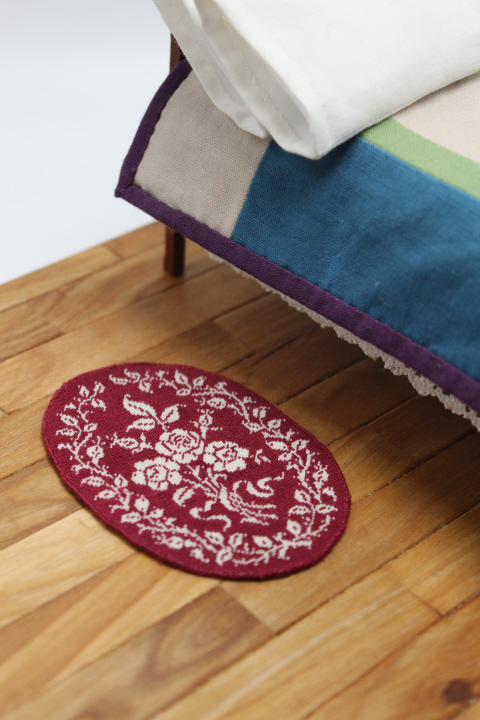
    The piece of petit point is an experiment — I wanted it to look as though it were a badly-damaged antique carpet or fragment thereof that has has the damaged bits trimmed off and a new binding put on the trimmed edges — there is even a jog on one edge where the rows are uneven.  Part of it, as you can see, was stitched with one thread of floss, while the rest is stitched with two, to simulate a worn area.  This is partly successful, I think — probably the line between worn and less-worn should have been blurred a bit, as it seems just a little too sharp to me.  I also worked it in a hoop instead of a frame, so that it would go ahead and skew if it wanted to!  I'm tempted to age it with a coffee bath, but haven't done that yet.  The original chart is the Kuba no.9 — converted from Appleton crewel wools to DMC floss, and worked on 28-count Monaco linen — from Making Miniature Oriental Rugs & Carpets by Meik and Ian McNaughton (in fact, the one at the top on the cover), which is said to be "an early design" from the Kuba region in Azerbaijan, ca.1800.

    6023