• 3812

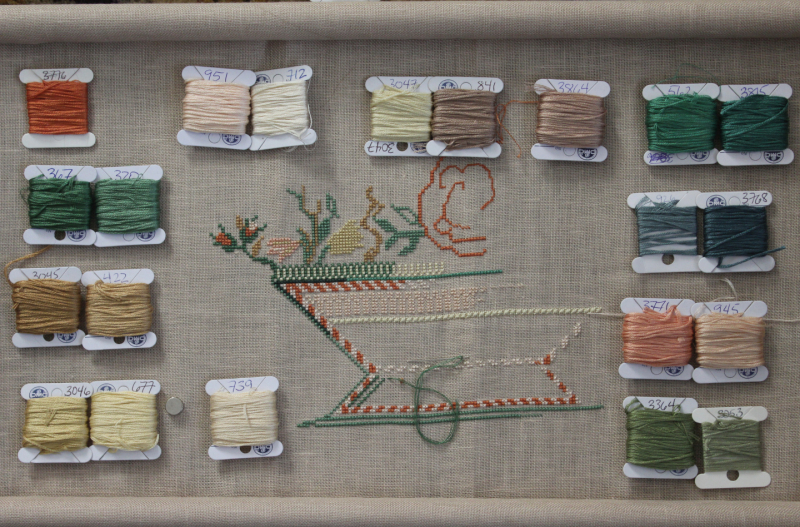
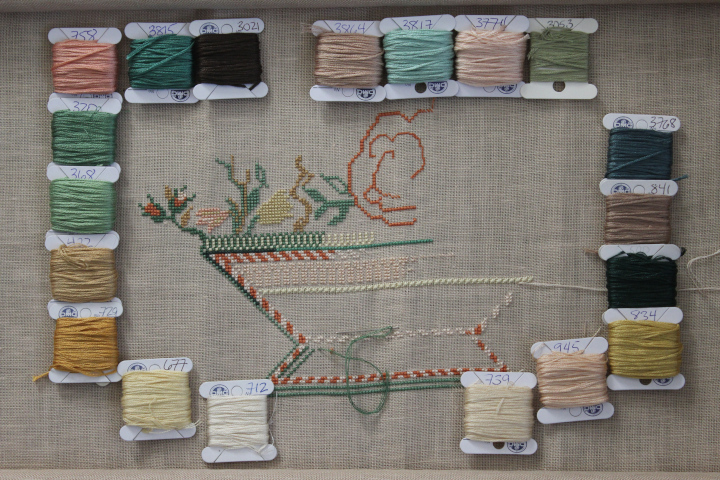
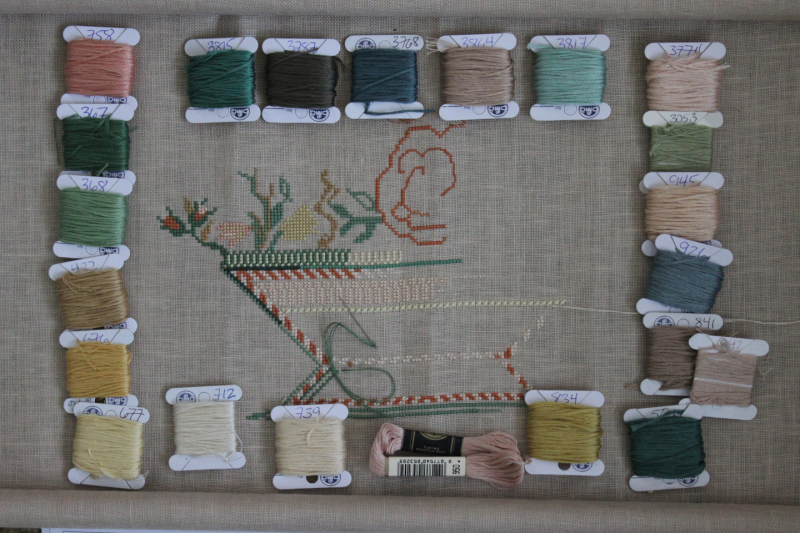
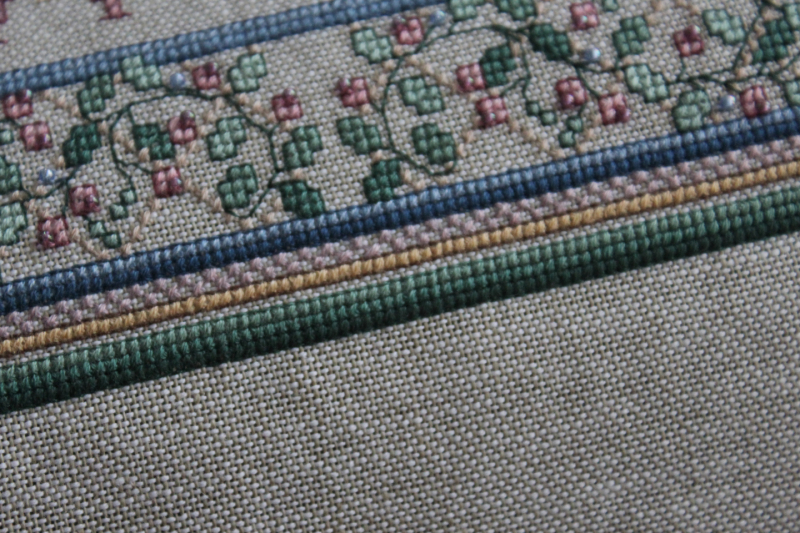
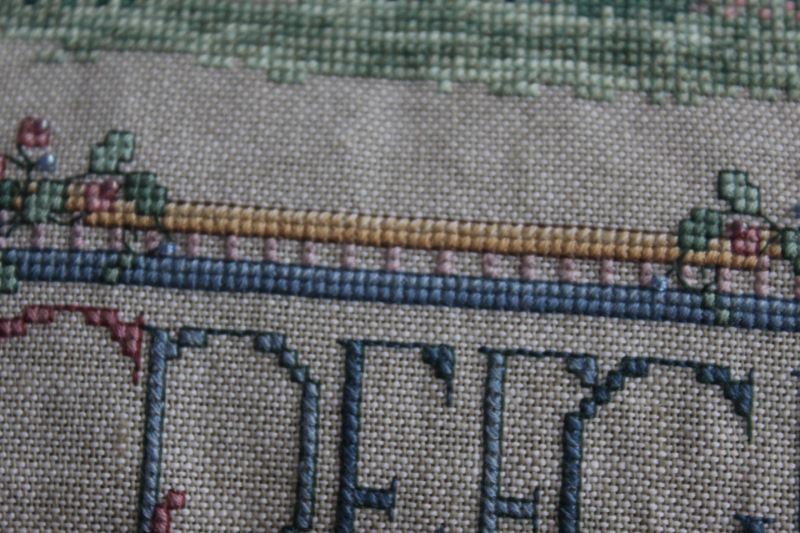
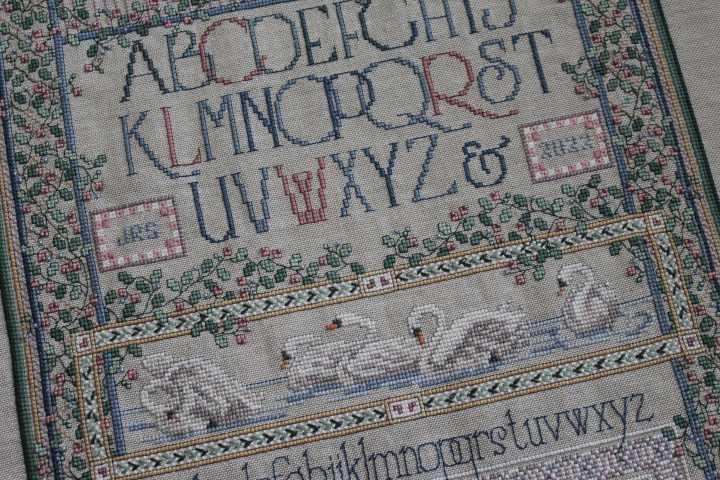
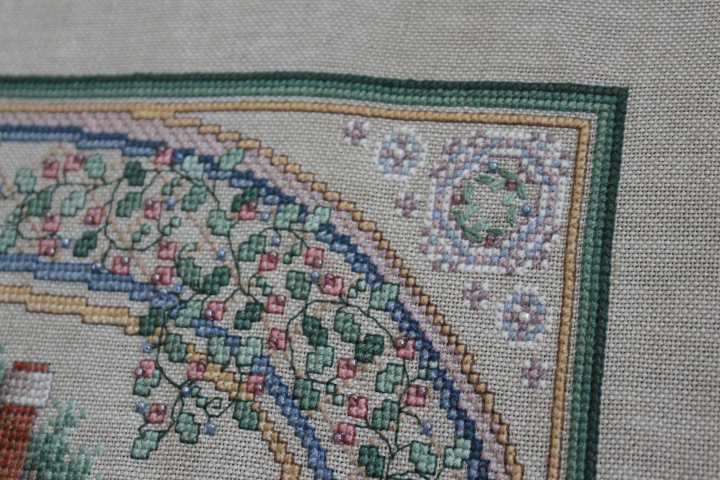
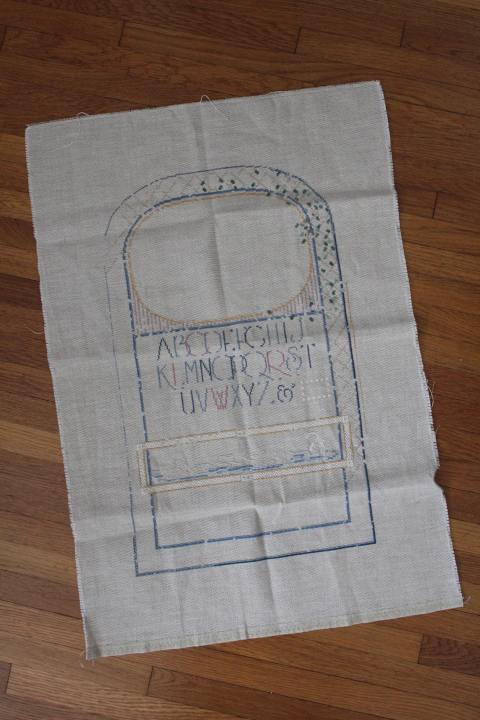
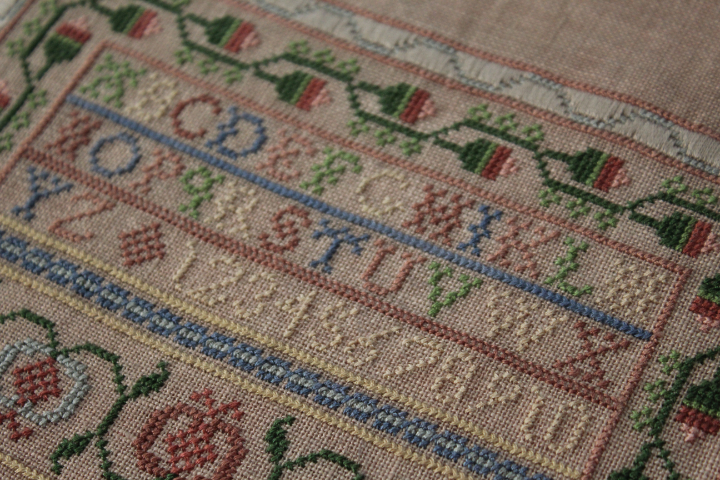
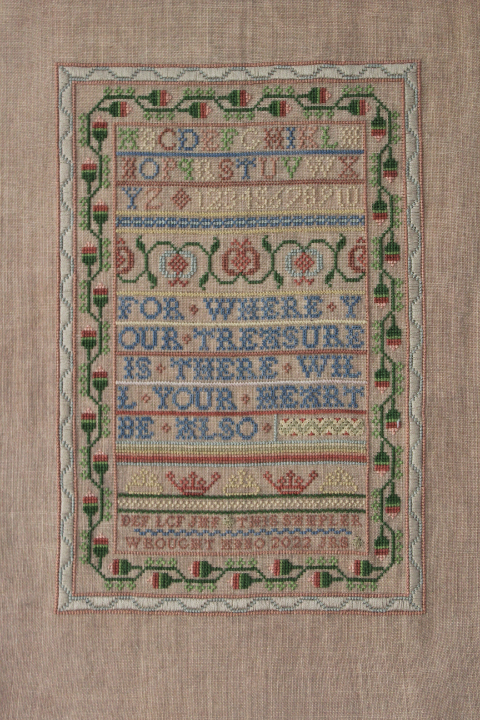
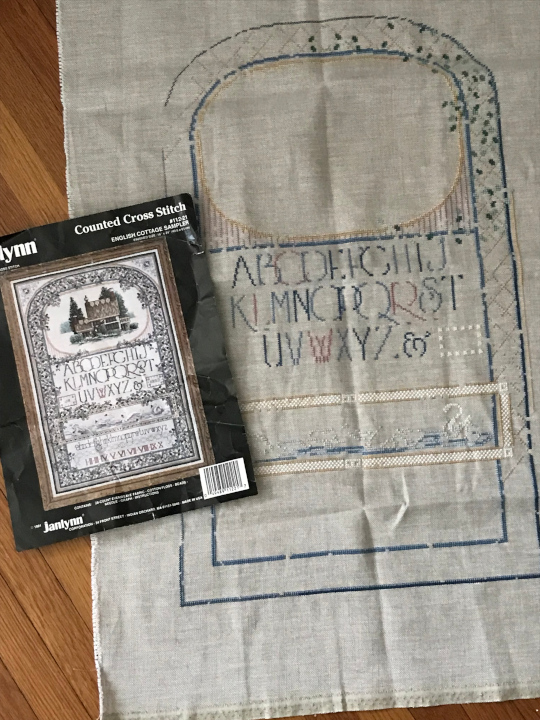
    Well, it has been over a month since I posted, and I didn’t even realize it.  I finished the “Honeysuckle Sampler” ages ago, enjoyed it very much despite the egregious number of queen-stitch flowers in that border (!) — haven’t blocked it yet, though, obviously.  I made some very slight changes, re-positioning the signature line a little, and centering the date by moving it down a single thread — feeling a bit of an outlaw as I did so, as nobody ever seems willing to suggest that sort of thing even though sometimes a motif looks quite strange with two two-thread rows below it and only one above.  (I think I made the “J” a stitch wider as well — and why not?!)  These thread colors look very well against the natural linen, I think!

    3813

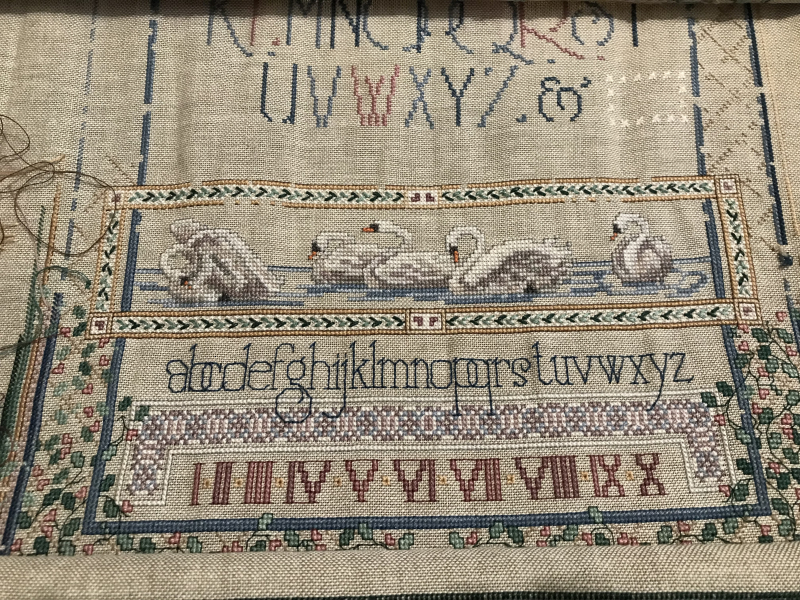
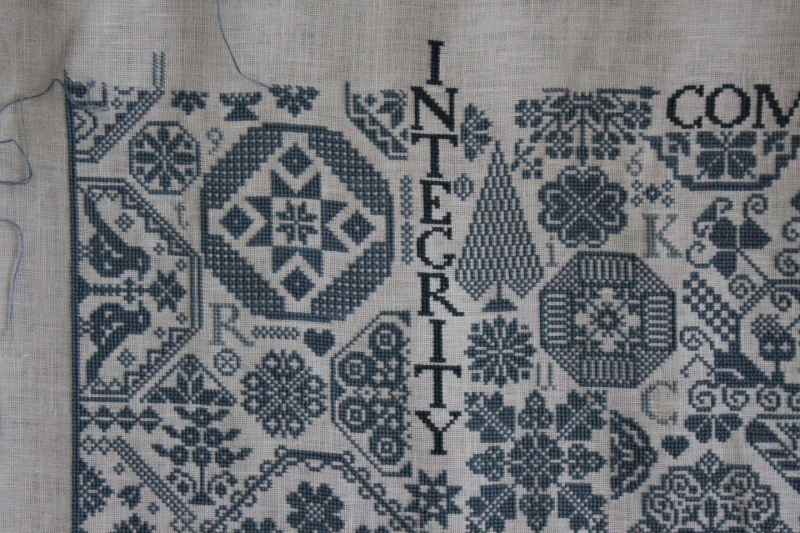
    Also unblocked, “Samplings IV” by Ellen Chester, from her “Quaker Samplings series.  This is on the 36-count Edinburgh linen that I coffee-dyed over the summer.  I enjoyed working this little sampler very much, and the thread is quite handsome — Gentle Art’s “Brethren Blue” — and so I look forward to the rest of the series, which I will do in a selection of different colors.  I’ve started the “Samplings V” — in Gentle Art’s “French Lilac” but got distracted …

    3818

    3809

    I got a new phone for free so felt entirely justified in splurging a bit on a new case, the first one I’ve ever bought, since all my others were hand-me-downs.  Some folks might recognize the place names as being in the Lake District, others might realize, from, say the campsite just there near the compass rose, and the Amazon Boathouse across the lake, that it is actually Swallows and Amazons!  It makes me happy every time I see it, and that’s the first time I’ve ever said that about a phone, to be sure, so well worth the extra few dollars.  And it has prompted me to start rereading the series — I’m now in the middle of Pigeon Post, so about halfway along.

    3804

    I had a bag of Jaeger Baby Merino in the bottom of a box, that I kept passing over because while the yarn is delicious, the color was just kind of meh.  I debated with myself for months about overdyeing it — what if it went badly? aaugh — but a few weeks ago, I said to myself, “Right, just do it.”  I wound into skeins and dyed it with one envelope each of grape-flavored Kool-Aid, and was pleased to see that everything turned out rather well.  It’s a bit more mottled than I was expecting — that was really the only surprise. 

    I had been half-planning to make a Christmas-present afghan with it for Laura — whose favorite color is purple — and I liked the “Modern Classic Baby Blanket” by Kirsten Holloway, though I’ve stalled a bit after working the first end section.  It seems to me that the mottled color of the yarn obscures the intricacy of the design — the purple is a bit darker in real life than in the photo — ironically, the yarn and the pattern would most likely have suited each other better with the yarn in its original state.  The stitches are on the complex side, and it took me a while to puzzle through some of them, but it worked out well — but the other thing that is giving me pause is that it’s very yardage-hungry, and this bit alone used up a whole ball and a good portion of another, and I’ve got only ten!  So my choices are to forge ahead and hope for the best, to try out the “plain” panel and see if the yarn goes further, as I could omit the inner fancy-work, or try something else altogether.  Ten skeins sounds like a lot; I can hardly believe that I couldn’t make a lap blanket out of ten skeins!

    3806

    In my indecision, I came across this “Japanese View” cross-stitch chart, available free at Smart Cross Stitch, and thought it also might make a good present for Laura —

    3817

    and so as I have accumulated a considerable stash of 28-count Monaco in the past few decades, I thought, “Go for it!”  But I have had the dickens of a time with it — counted wrong and somehow couldn’t figure out where, picked out all of the mountain bits I’d done, got off again and picked it all out a second time (luckily not so far along as before), ran out of the medium-purple (of course, half of it was in shreds on the floor), did it a third time using a couple of in-betweens I had in my needle case as re-positionable guide lines.  Now at last I feel like I’m getting somewhere and it looks like the beginnings of a mountain view instead of a bunch of random specks, which is encouraging.

    (Why multiple presents for Laura?  She has just gone off for her first year away at university, after spending her post-high-school years thus far at the local community college.  She is still in the same time-zone, but far enough away that I know she isn’t living at home any more.  The compulsion to make things for her is especially strong.)

    Lest you think I do not knit anymore — I have been working on this scarf (which is “Camptown Races”), albeit for what seems an eternity.  I might rename it “Grandmother’s Footsteps” as I keep finding that I’ve been daydreaming and lost track of which row I was on, so that some of the sections have far too many stitches, and I have to rip back to the point where it went wrong.  It’s very nice yarn and lovely to knit with, thank goodness, and doesn’t seem to mind my two-steps-forward, one-step-back.  If we take the train to visit Laura, this will be a perfect carry-along!

    3820

    And there is the binding on my “Persuasion” quilt, which binding is very long (somewhat over queen-sized), but of course would probably be finished already if I didn’t keep getting distracted …

    3816

  • 3763

    3763

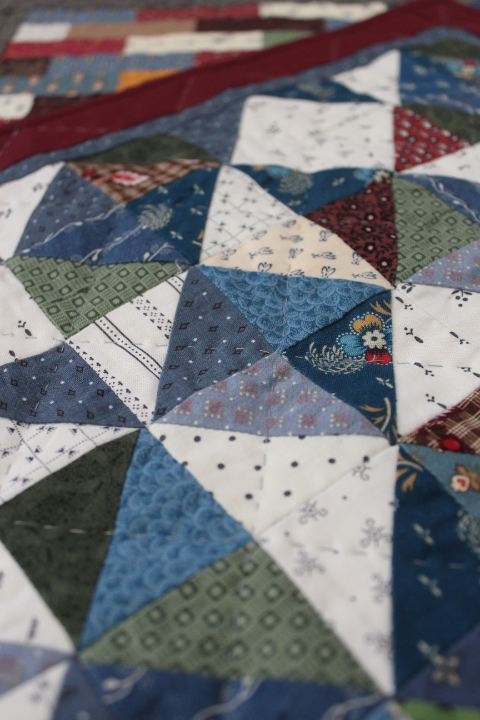
    These seven strips of blocks were in the quilting stuff I bought at the estate sale last Saturday, longish strips with six or eight blocks (small or large respectively), “on point” and edged with half-squares.  I was impressed with the piecing, and even more so later when I realized that they are all hand-sewn.

    Most of the folks I talk with on a regular basis about miniature needlepoint always laugh at themselves that the first thing they do when looking at petitpoint — theirs or someone else’s! — is turn it over and look at the back.  There is probably a slight touch of the competitive kind of curiosity about it — as in “whose backs are neater, mine or theirs?” — but most of the time that really is only slight, and instead it’s more of a curiosity about what stitches did they use (“did she use basket stitch for the background? should I try that next time?”), etc — like a car lover checking the engine, it’s just something you do!  You don’t very often get the chance to see the underside of quilts, though, of course, since most of the time once it’s out in public, as it were, it’s already bound and quilted and therefore impossible to do!  Even quilting bloggers rarely if ever show this — I don’t think I’ve ever seen it — and so I will take up a rather long post now to show some details of the backs of these lovely and carefully-stitched blocks.  (And I’ve left those photos bigger than usual so that you can see up close if you like!)

    I am assuming that this is Betty’s work, since it is clearly not antique and probably not particularly “vintage” — there were some large scraps of the two background fabrics folded up along with the strips, and the brown one still has “Marcus Brothers” on the selvage. 

    3763

    3763

    3770

    It took me a few moments to realize what it was, but one of the things that struck me the most about these is how very little fraying there is!  That certainly goes a long way to explaining the air of tidiness about the backs of these blocks.  The fact that there are few loose thread ends also contributes.

    3770

    You can see the traces of pen lines, on both the pieces and the border triangles, that Betty marked as sewing lines.  This here looks at first like machine-stitching, but the thread she used is cream-colored, and the pen line disguises that.  (She used running stitch, by the way, not back-stitch.)

    3770

    3770

    3770

    3764

    3767

    I was particularly interested in the stars, having just completed a dozen of a similar size, and not been terribly impressed with my results.  Here is one of mine, it all of its shabbiness —

    3785

    It’s easy to see here what I mean about the fraying! There is essentially none on Betty’s.  It’s possible, looking at the one below, that she cleaned it up, either as she went or while pressing it, as you can see where the fraying would have been, but still — gosh!

    3784

    3775

    3775

    3775

    3775

    3775

    3775

    3775

    3783

    3783

    Sometimes she marked on the back of the fabric the center of a motif that she wanted to “fussy-cut” — she didn’t on the center square of the above block, but did on at least three of the four light brown prints, presumably with a window template —

    3783

    3783

    She was careful, certainly, but not obsessive about pressing particular seams in a particular direction on the same kind of block — sometimes it’s towards the lighter of the two fabrics, sometimes it isn’t —

    3783

    3783

    3783

  • Four, Five, and Six

    3752
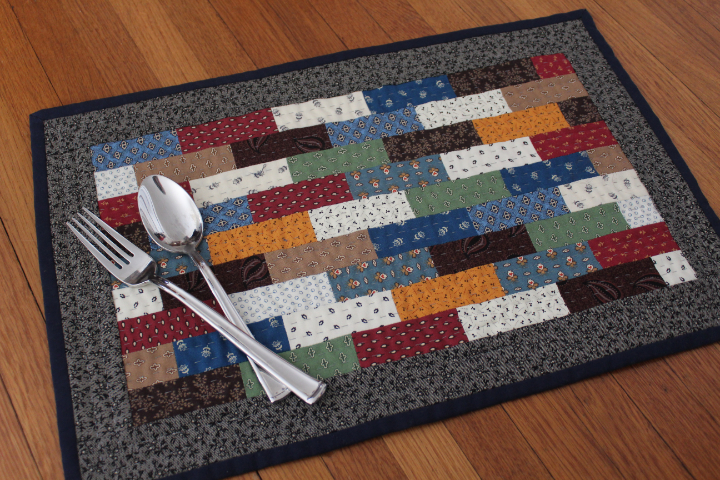
    The "Brick Road" mini quilt kit (from Temecula Quilt Company) was part of the "Monthly Minis" subscription from 2016.  There are a couple of wobbles if you look closely, but I'm pleased with my piecing on this one!  I made my first cutting mistake here, unfortunately for me on one of the few kits that had little extra fabric, and so I would have had to piece a strip, but I decided to use a little bit of the border/binding fabric instead, since I'm not going to bind these individually.

    3748

    "Bathwick," using prints from Karen Styles's "Bathwick" collection, these from 2018 so not too long ago.  I chose this kit partly because it's pretty but partly because I have a half-yard or so of that fussy-cut print in my half-square triangles quilt that I'm this close to finishing, which amused me greatly!  The kit came with that particular piece larger than the rest, so that it could be fussy-cut, a nice touch.  I made a slight cutting mistake — well, not really a mistake, but I changed my mind literally as the rotary cutter was whisking across the fabric, that instead I should just make the border strips as wide as the fabric allowed, instead of trimming them to 2" — and so one of them is a smidge narrower than the others!

    3746

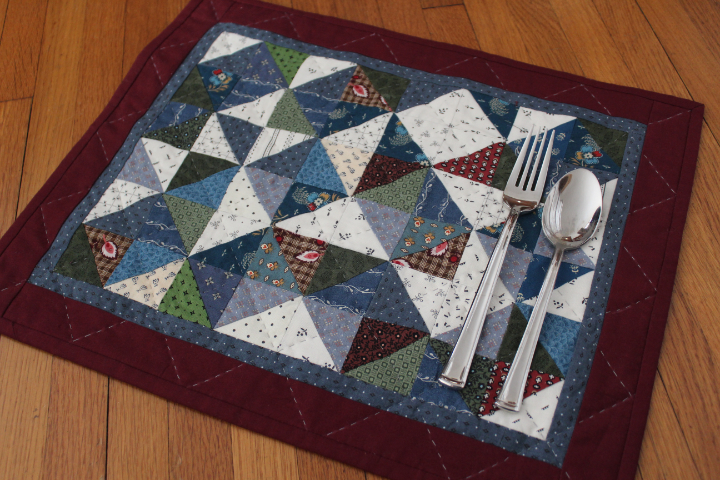
    The "Little Stars" kit was immediately my favorite, but I also knew that it would be the most fiddly, with those star points, and so I left it for last.  It is also, unfortunately, the one at which I was least successful — the stars are sometimes more "wonky" than they should be, and as you can probably see, some of the blocks were not especially amenable to lining up with the ones next to them.  As much as I've taken to heart the maxim, "People will never know how long it took you, but they will see how well you did it!" I wanted to pick out as few as possible of any wobbly seams because the pieces are so small — I was afraid they would stretch or fray so badly that nothing would go right — though I did pick out the howlers on this one.  Well, it's a learning experience, and yesterday evening I spent a rewarding hour gathering tips for more-accurate piecing which I will use in future!

    I was pleased, though, with my figuring out how to get the strongly-directional fabric of that pale-pink star to have the lines all radiating outwards, instead of some outwards and some across (like the less-obviously-directional fabric of the star in the upper left corner), which is what happens when you cut the triangles from squares in which the lines all run in the same direction.

    3741

    3744

    This is, by the way, apparently the "traditional" way of assembling a sawtooth star block, cutting out each piece individually.  There are two other methods that I know of now, which are a bit less risky where that unsupported bias edge is concerned, for one — but I thought I should try it this way, to see for myself.  Personally, I don't think I will cut individual pieces this way again, unless I'm doing English piecing! certainly not on pieces this small!

    Here is something like my idea for putting these six pieces together, here laid out on my "Medallion Variations" quilt which is about the size I'd like this one to be — blue though, navy blue perhaps, instead of purple!  I have enough scraps to piece together a good-sized frame or border for the sides at least, with luck for the whole thing —

    3754

  • 3728
    (This Wednesday, anyway!)

    I sewed up the second of the six miniature-quilt kits this morning, and being the top-only, of course, it went together so quickly that I thought, "Well, goodness, I might as well do another!"  Above is the "Sweetheart" one.

    3732

    This one doesn't have a name, so it's just "February 2017" — I sewed it up yesterday afternoon.  I need to work on keeping seams parallel — I guess I have a beginner's tendency to look at the edge of the fabrics while I'm sewing quilt pieces, when I should be looking at the previous seam in relation to the new one!

    I decided to place the four-patch blocks randomly instead of following the picture — the down-side of randomness is that you can end up with two matching blocks directly opposite each other.  I couldn't face picking it out, by the time I noticed — oh, well.

    3726

    This one I suspected the moment I saw it that while I like the pattern itself I wasn't wild about all of that orange — my least-favorite color, I think — and so since I had a bit of a coordinating Kona blue on hand, I decided to switch out the long "cheddar" strips.  Because of that, I rather slavishly followed the placement of the 1-inch blocks according to the photo!  This one is called "Autumn 1863."

    The kits, by the way — from Temecula Quilt Co. — are excellent, with brief-but-clear instructions and more than enough fabric, even if I had cut the bindings.  There will be a decent amount of scraps for a border to go around all six, I think.

    I also finished up an electric-heating-pad cover for Laura, who is about to dip her toes into the world of living on her own, heading off to university next month and a student apartment to be shared with a friend she knew in high school.  The cover is to a tutorial by Julie Stocker of Pink Doxies, and went together quite easily, although because I decided to make French seams on the inside (not having a serger or an effective serger-like stitch on my machine), it is certainly snug.  I'm very pleased with the fabrics, though — I was looking for something "Japanese" but decided on this instead, a bundle of fat quarters from the "Elements" collection by Dashwood Studio.  I didn't use any batting in this, by the way, rationalizing that that is only for looks, really.

    (It was good to be pleased with this, as I've just spent the last few weeks sewing up hourglass blocks and ended up deeply ambivalent about the results, which I have rolled up and shoved under the piano while I go through a sort of stages-of-grief period.  This is also quite possibly why I am now binging on the mini quilt kits!)

    3723

    3602

    It was almost a shame to cut this one into pieces — it reminds me of starlings —

    3604

    3723

    Now I am going to sit for a while and work on this! —

    3736

  • Ave, Betty, Atque Vale

    3670

    David ambled into the bedroom this morning after breakfast, where I was sitting with my cup of tea and reading, and he asked if I was interested in going to an estate sale.  "She was a hoarder, apparently, and there's some quilting stuff."  So we went, not expecting much — "quilting stuff" often means just "cheap fabric" when you're at an estate sale — and indeed, the "hoarder" appellation was easy to understand when I saw literally a half-dozen rows of plastic and cardboard boxes laid out in the driveway alone, stretching on up into the garage, spilling over onto the plants along each edge, the boxes crammed with plastic bags full of fabrics, magazines, books, in addition to the usual Christmas ornaments, commemorative plates, tchotchkes, board games, DVDs.  Stunned, I made my way up between two of the rows of boxes, and about halfway along began idly poking through one of the boxes of fabric.  One of the first things I came upon was this crazy-rails quilt top, hand-stitched, clearly vintage if not antique.  Holy mackerel.

    (I didn't unfold it until I got home.  It is full-size.  The beautiful red "rails" going upwards on the diagonal have faded considerably in the middle, but it is clearly the same fabric.  I had already noticed that some of the individual rails are pieced, but it wasn't until I got a closer look that I realized how very many of them are, some pieced in just a tiny corner — you can see in the photo below the large-ish piecing of the middle rail, but the dark one on the right has about a quarter-inch strip pieced into the upper-right corner as well.  Amazing.  The unknown maker didn't attempt to match the pieces, but she was very careful about cutting stripes and plaids straight, with the occasional surprise of a piece of seersucker or a bias-cut strip.)

    3673
    3673
    3673
    3679

    And blocks — bags of blocks, some with just a few, like the two very handsome stars above, or with dozens — nine-patches, four-patches, four-patches-within-nine-patches …

    3679
    3701
    3679
    3700
    3699
    3699
    Some of the blocks have been cut apart from each other or from a top, as there are traces of the neighboring fabric still attached to the edges.

    3696

    Her taste was not much for the 1930s' bright colors, it seems, but for the "Civil War" browns and greys like these, practical pioneer colors that don't show the dirt but still long now and then for something pretty and floral.

    3687

    And here and there for something exotic.  Scraps — but large ones — of Japanese fabric.  Very boro.

    3687

    I saw this striped fabric folded up in a plastic bag and thought it was another scrap, but one that would make a perfect apron for a Scandinavian doll costume.  When I unfolded it at home, I discovered that it is in fact a full Japanese furoshiki, or wrapping cloth.  I suspect from the direction of the wrinkles that, in fact, it has been used for that very thing.  I hesitate cutting it up now, especially as I use furoshiki often for wrapping gifts, but it does have a number of tiny holes in it …

    3687 2
    3687

    A substantial stack of indigo-blue cotton pieces, complete with paper templates.  I haven't figured out what block or blocks these were meant to become, as I haven't worked myself up to removing the pin yet, that is holding the paper shapes together.  Diamonds, obviously, some large triangles, and at least one rectangle.  Blue-and-white heaven.  Is is really 1870-something??

    David said in my ear, "You should go into the house, there's more stuff in there," adding, bless him, "here's another bag."  He must have seen the look on my face.  It was becoming clear to me that the lady was not a hoarder in the psychological-disorder definition, hanging on to things because they're there, essentially, but that she amassed things because they were beautiful or fascinating, or because it's just so very easy to acquire kits faster than one can stitch them.  She must have sewed a lot of things herself, but she also collected antique quilts and blocks, as a number of the zip bags had prices on them.  There was a box entirely full of miniature-quilt kits from Temecula Quilt Co. (addressed to Betty, so now I knew her name, already thinking of her as something of a kindred spirit), a subscription that she had taken five or six years ago and then presumably not had time, or perhaps the energy, to make up.  I chose six of them, the ones I thought most likely that I would want to make — I don't know that I would have much use for miniature quilts, but who knows? maybe they could make a big "sampler" quilt.  Each kit comes with a photo of what the finished piece will look like — I love the stars one —

    3695
    3668

    There were piles of books everywhere, higgledy-piggledy, falling over, stuffed into boxes of fabric, that made my librarian's heart wrench.  New books, most of them!  Betty obviously had a deep interest in antique quilts, including a sideline specifically of the Oregon Trail and its pioneers' quilts — I put one of those in my bag — but she was also curious about lace and other needlework.  The Korean one was a long-shot, in case Laura's interest in Korean culture extended to art and design, but the others are obviously some of my interests.  It got to the point where I was gently sliding them into my bag with a kind of gobsmacked astonishment — "Elizabethan treasures" from Hardwick Hall! Tasha Tudor's DollhouseOld Swedish Quilts!

    Diamonds, ready to piece into English-style patchwork.  Not long ago, browsing through my copy of The Quilts of Lucy Boston (as one does), I suddenly fell in love with her quilt now called "Kate's Stars," six diamonds placed together to form a star —

    3685

    I've often had the feeling, at an estate sale, of poignancy at the thought of someone's things being sold off after her death, and yet at the same time a sense of wonder and luck at finding them myself, and this was just like that.  I think I would have liked Betty, and admired her taste and the wideness of her interests in the field of textiles and the history thereof (and understood her compulsion to collect!).  I certainly am grateful that I've come to know her, another of the makers before me, if only just a little and through some of the things that fascinated her.

  • , ,

    Page 7

    3667

    Page seven of the nine-page chart for the "Quaker Virtues" sampler.  I had been feeling for a while that the border would look more finished with two lines of stitches instead of one, so I went back to the other side and have begun adding in another line.  I'm quite content with my rather agonized choice of three shades of Antique Blue — blue and white china being always pleasing to my eye — which makes the eternity that this thing is taking into a journey, not an arrival-to-be (!).  Laura — who to my astonishment and delight has decided after working a set of small cross-stitch pictures that she actually likes this hobby — frequently asks me, "How far along are you now?" and I sigh and say, "Not halfway yet," but I think I've passed that mark without even noticing, since page 4, the one above what I've just finished, is in fact the only remaining full-page of the chart, and the rest are all partial pages.

  • 3362

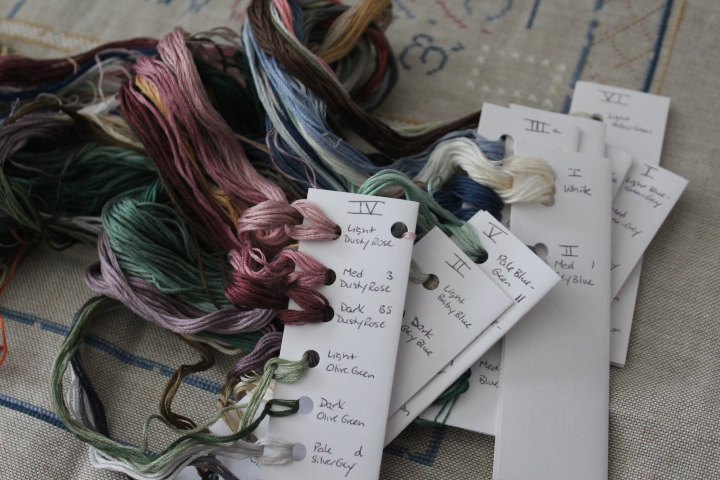
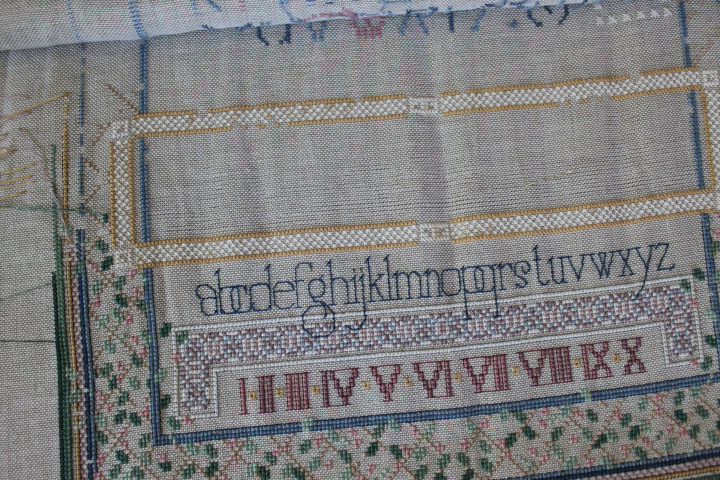
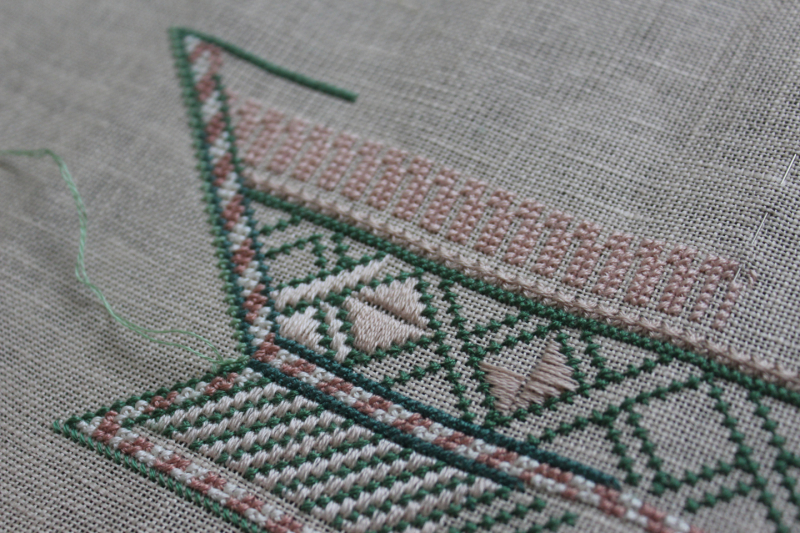
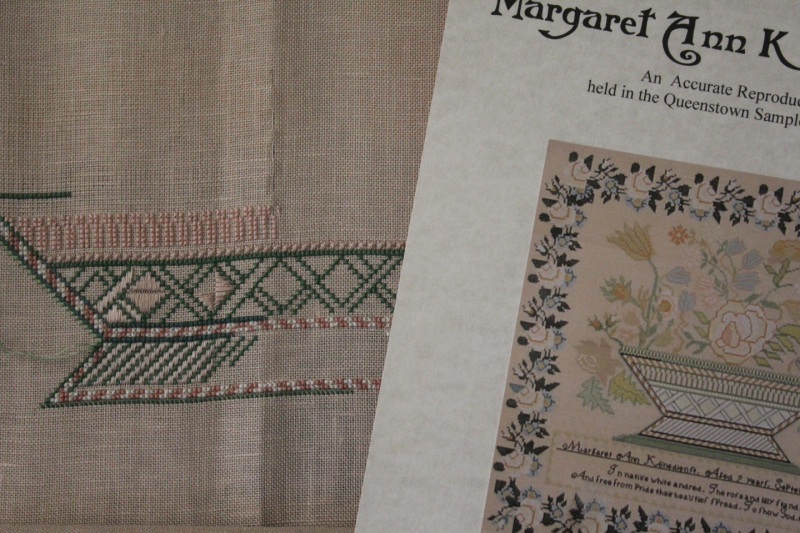
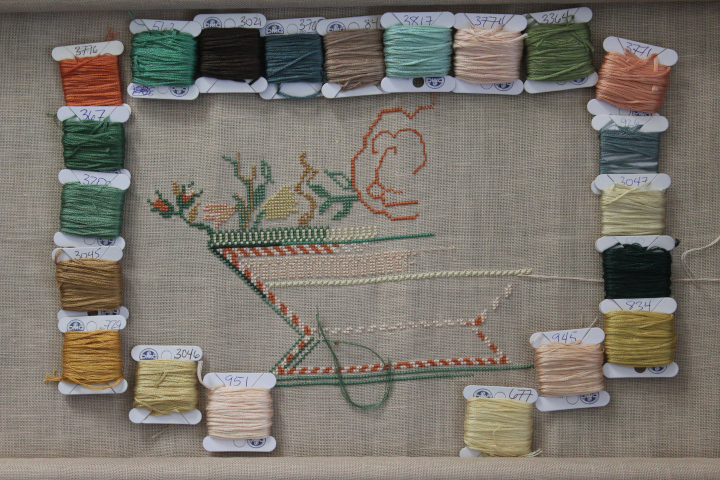
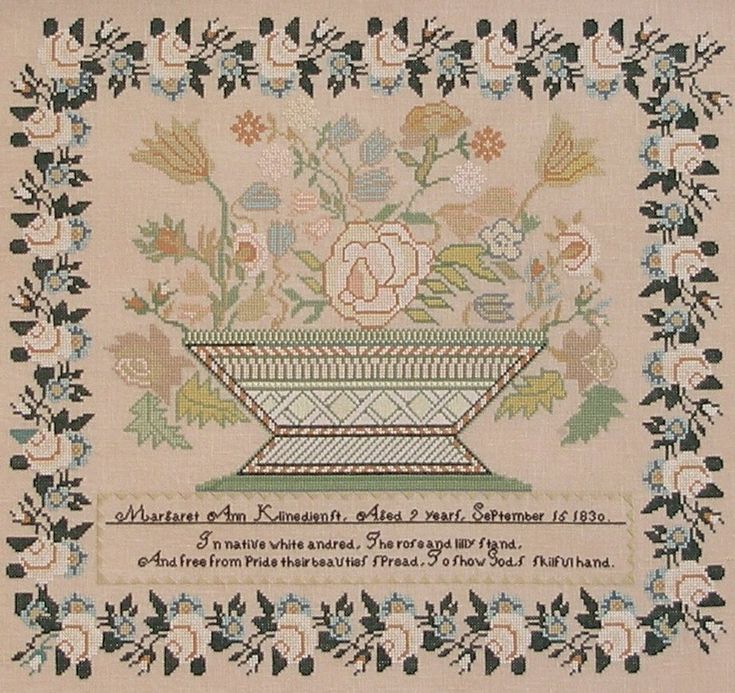
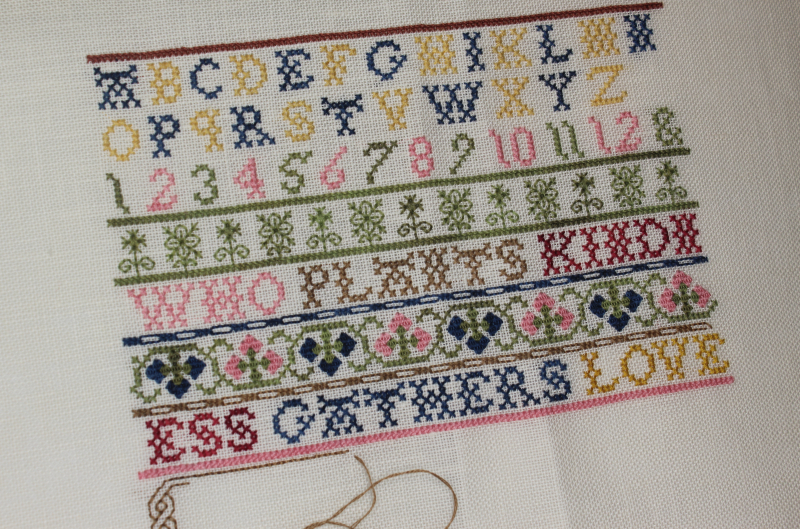
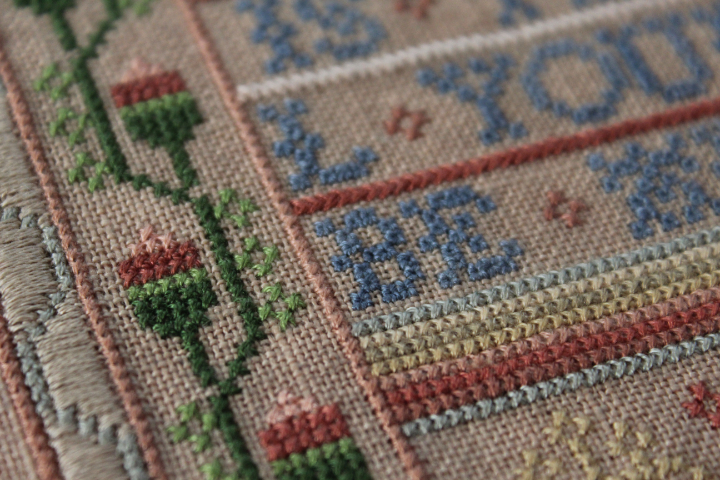
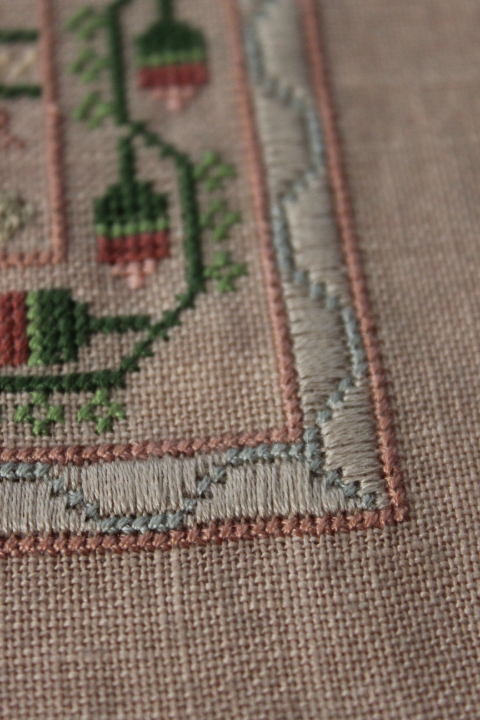
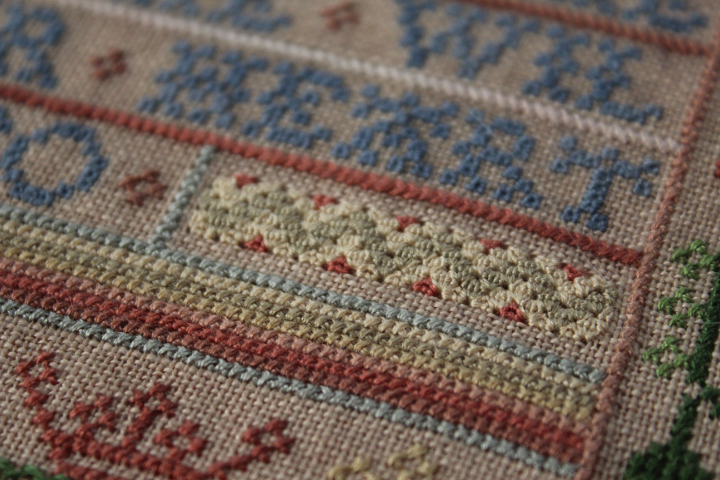
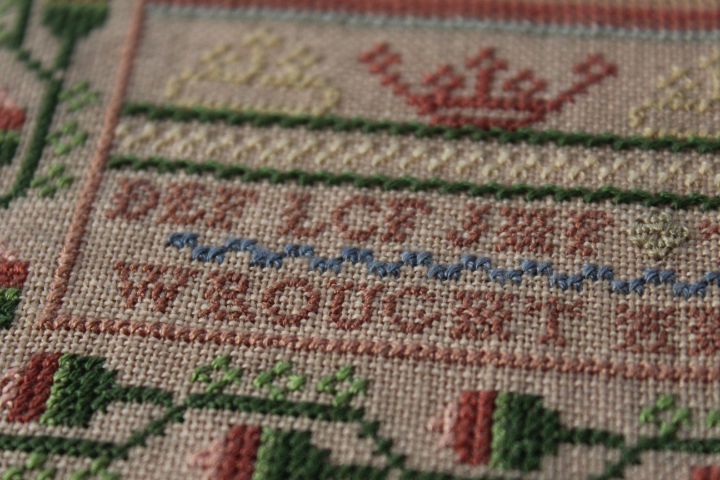
    Darlene O'Steen's little "Honeysuckle Sampler," which I couldn't resist starting.  I suspect, judging from the thoroughness of her book as well as knowing that she taught numerous seminars in North America and the UK, that she would be delighted that I am learning new things with this first sampler, including that this is properly called "counted stitch" since not all of them are "crossed," that is Xs.  There are a number of stitches that I have not worked before — Irish stitch, queen, rice, and double herringbone certainly. 

    3364

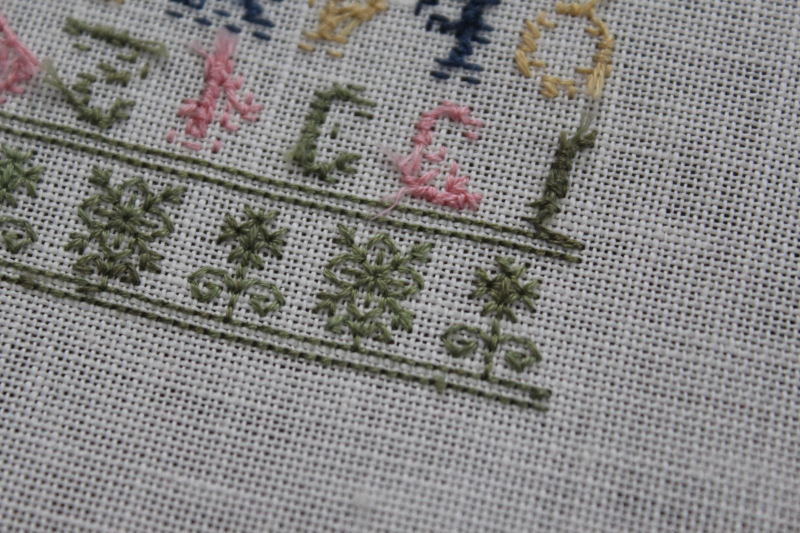
    The Irish stitch is fun, and makes a lovely touchably-satin-like surface, as well as these rather dramatic "flames".  Queen stitch is my least-favorite, as it is not a simple thing to get the diamond to be consistently flat, or the little couching stitches across its middle to line up neatly, and more vexingly, it's an utter pain to pick out when it goes wrong.  Unfortunately, there is quite a lot of queen stitch in this sampler — all of the blue flowers in the border, and as a filler for the box across from the Irish stitch one!  And I discovered that I must pick out that errant gold diamond in the upper corner …

    3363

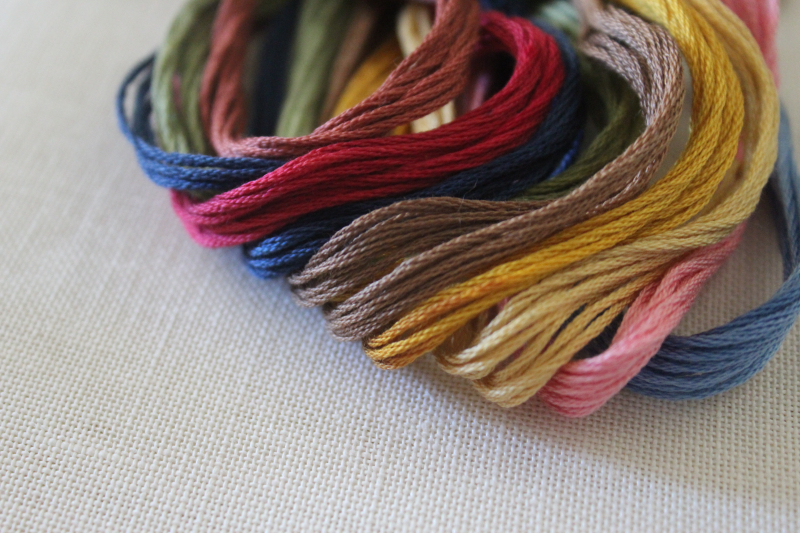
    Oh well — I'm still very happy with it, and with the color palette, which manages to be both rather brilliant and gently-faded at the same time.

    3360

    The calm blues and whites of the "Quaker Virtues" sampler.  I have turned the second corner of the border, and am filling in and up to meet the already-worked area.  I'm pretty sure there are indeed variations in dye lots between the dozen or so skeins of DMC 931 that I've used so far, but as I'm alternating between three or four skeins at a time as I go, I find that, when you notice it at all, it has a pleasing overdyed mottling to it rather than a jarring "edge".

    3367

    Some beautifully-cut pieces of poplar picture-frame molding, for "Froth and Bubble," "Peace to My Friend," and "Anna Ohman" — the last is already stained and coated with beeswax and linseed oil.

    3374

    And five pieces of home-dyed linen, waiting to become Ellen Chester's little "Quaker Samplings" series …!

    3353

  • ,

    Night Light

    3295 2

    "Night Light" quilt, designed by Joy Hoffman (the pattern seems to be more-easily found under its original title of "Shimmer").  I used fabrics from Pam Buda's "Forevermore" and Jeanne Horton's "Country Soiree" collections, augmented by a blue and cream print I had in my stash, and Kona Cotton solids in Delft and Cadet blues, and Bone for the solid stars.  It was both a challenge and fun to make, sometimes both together, and after I settled into a rhythm, I quite enjoyed my first experience of hand-quilting (which is a simple outline of the stars and along-the-seams). 

    I think if I were to make this again — and I wouldn't write off that possibility — I would be daring enough to try working out how to make that set of star points that uses a pair of half-rectangle triangles with one piece of the patterned fabric, so that there isn't a seam through the middle of it.  I almost wish that the smaller stars were "wonky" too …

    3298

    3288
    3288

  • 3280

    I had the niggling feeling that there was some "experimenting" that I was leaving out of yesterday's post, and this morning I remembered two things.

    Some time ago I bought a copy of Diana Boston's The Patchworks of Lucy Boston, and admired the quilts — of course — but put aside the thought of paper piecing as just too labor-intensive.  Imagine my amused contrition when not long ago I browsed through the book again and thought, "You know, self, I think I'd like to try that after all …."  It was partly the capability of using "oddly-shaped" pieces that aren't particularly easy to do when machine-piecing (though "odd shapes" aren't usually something that appeals to me), but more just the intrinsically-pleasing effect of Mrs. Boston's quilts that spoke to me, as well as the pleasure that I am taking more and more in "slow" needlework.  You can't really do this kind of quilting by machine.  And so I ordered a small stash of paper shapes, deciding to start with a simple table runner using some William Morris fabric reprints I bought years ago. 

    This kind of paper-piecing really is as labor-intensive as it sounds — you have to baste the fabric to the paper shape, stitch two basted shapes together, then add more shapes one at a time, all by hand — though it is more the tedious kind of intensiveness, not the exhausting kind.  I must admit, though, that I'm very impressed with the tidiness of the results — the intersections where my four tumbler blocks meet are pretty much perfect, even from a novice such as myself!  So we will see how it goes …

    3281

    There are varying opinions about whether it's okay to dye fabric with coffee and/or tea — the thought is that the acids in coffee and tea will eventually degrade the fibers in the fabric, and popular knowledge says specifically that tea-dyed cotton will begin to degrade in 30 to 40 years, and coffee-dyed in 75 to 100 years.  On the other hand, some dyers such as R&R Reproductions say that it isn't a problem, that "the acid content in coffee and espresso specifically] has been tested and approved by museums all over the U.S."  Of course, "degrading" is not only subjective in itself — is that a bit of fuzz here and there, or does the whole thing just dissolve into a mass of loose fibers?! — but much I'm sure depends on the conditions in which the fabric is kept — framed (under glass or not), acid-free storage or not, etc. etc. etc.  Anyway, I thought I'd try it on some fabrics intended for samplers and see what the results look like.

    This is Cashel cotton on the left and linen at the bottom, both from Zweigart (with its distinctive red selvedge).  Both were dyed in the same batch of cold brew made with Seattle's Best house blend, though with slightly different methods and times, so it was interesting to see that although the linen was in the coffee bath for about a half-hour it is darker than the cotton, which soaked for at least ninety minutes!  Both are a fairly unexceptional ecru in real life, so I suspect that in future I will leave the dyeing to the professionals or at least the more-dedicated-to-it than I!

  • 3237

    Well, we might be heading at what feels these days like breakneck speed towards normality, what with now-readily-available vaccinations here in California, but I am still stress-crafting, clearly.  I rarely have less than a half-dozen things going at once, some of them new to me or mostly-new.  Some are things that I've been thinking about for a while, others are admittedly impulsive but no less fascinating.

    These two skeins of yarn have been sitting on my dresser since Christmas, caressed now and then while I pondered what to make with them.  I was amused to see the differences in the look of this yarn from skein to ball to knitted fabric — it is "Gluttony Sock" superwash merino/nylond blend from Forbidden Fiber Co. in the "When Presents Explode" colorway.  I have no idea what these colors have to do with exploding presents, but there it is.

    3247

    3251

    3278

    It is now becoming a modified "Camptown Races" cowl — "modified" because I don't need to change colors, of course!

    3265

    This is the first time I have encountered "print on demand" fabrics — it's a bit disconcerting, to be honest, but one must move with the times I suppose, at least occasionally.  This particular selection, from Spoonflower, came out a bit more turquoise than I was expecting, but I was certainly looking for midcentury-modern prints, that is true.  I like them all, but the two on the far left at least are too big for the quilt I have in mind, so that the design would get lost.  I'm definitely interested in the three on the right, but will have to see how they work with screen-printed fabrics, as the feel is noticeably different.

    3268

    David built two more "Victory Garden" beds this spring, in the patch of sunlight made by cutting down an old tree (both decrepit and vile) in our backyard, and I planted them with vegetables, and at the recent tomato sale at our local arboretum, managed to score five young tomato plants, now residing in our sunny front garden.  This one is "Uluru Ochre".  I haven't had much luck with tomatoes in previous years, thanks to an inordinate amount of suburban wild- and semi-wildlife, but we're trying some (non-chemical, of course) methods of protection, so we'll see how it goes!

    3272

    The Furrowed Middlebrow imprint of Dean Street Press has just reissued a spate of previously-long-out-of-print Molly Clavering books from the 1930s.  I splurged on three of them, since I had enjoyed Mrs. Lorimer's Quiet Summer and perhaps even more, Near Neighbours (which was a few years ago reprinted by Greyladies, alas now gone from their catalog, though I believe some copies are still available from Anglophile Books).  These new editions themselves are handsomely put-together with covers featuring details from artwork contemporary-ish to the novels — my only quibble is that, since the text has been re-set, presumably to conserve space, the gutters are very narrow, meaning that to actually read the book puts the reader at risk of breaking the spine, certainly of distorting the covers.  But it's what's inside that counts the most, of course — so I'm off to read for a bit —