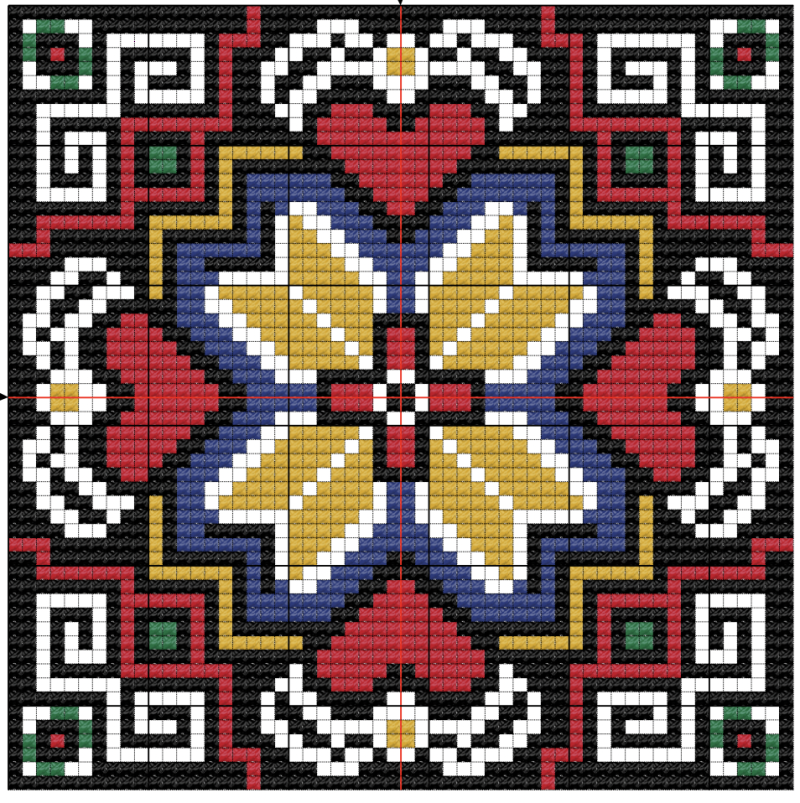
 As a peaceful protest and as a sign of solidarity with the Ukrainian people, Antony of At the Point Studio has generously made this chart free to share as a stitch-along project. For details on the symbolism of the motifs and colors, inspired by traditional Ukrainian embroidery designs, and a PDF of the chart, please visit his post here.
-
-

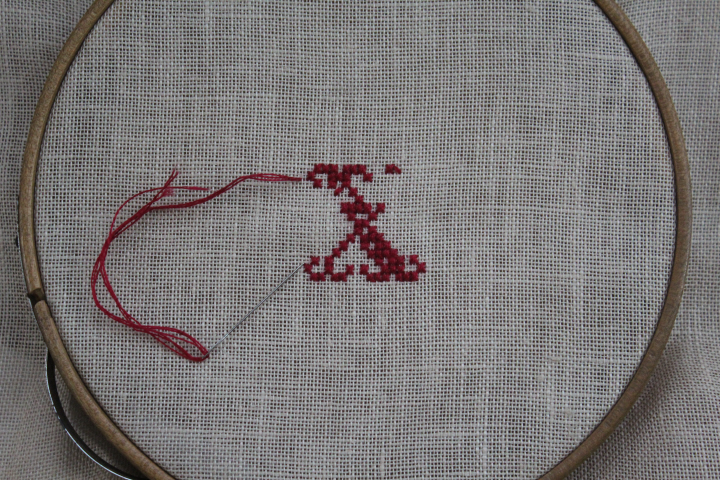
This is the "Patience" sampler by Homespun Samplar, which I saw one day not long ago on a Pinterest list called something like "100 Best Samplers of All Time" — a rather sweeping claim, to be sure! — and I fell for it instantly. The blackwork, certainly, and something about the over-the-top-ness of the letters just spoke to me! The original shade of linen is still available (a Zweigart standard, happily for me), so I managed to get a piece, marked the center, put it in my frame, and dove in. It wasn't until I was well along the next line of the alphabet that I realized what I had done …
-
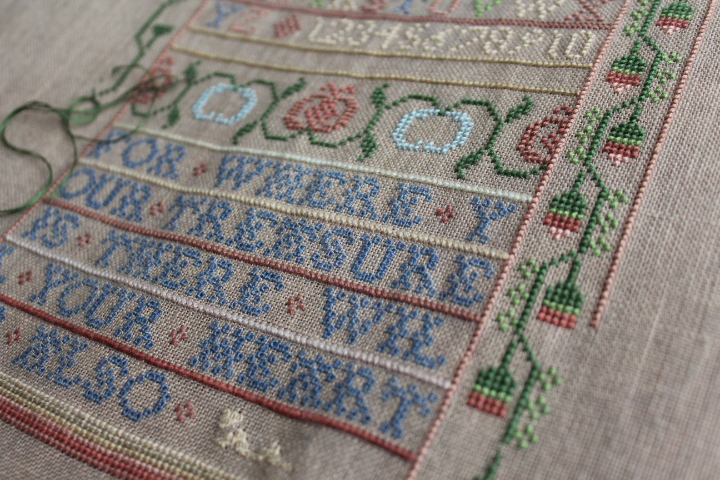
Oh dear, it has been a very long time indeed since I posted anything. In my defense, my computer — which was at least ten years old — has been fading fast this past year, and around Christmas-time the top row of the keyboard just stopped working. I debated with myself whether to try writing posts without using those letters, and in my younger days I might have enjoyed the challenge, but, well … no, I just couldn't face it! (No "e"! That alone is 12% of the words in English!) I then got a lovely new laptop that seemed every day to have some different bug — I still can't print anything double-sided — and didn't have any photo-editing program. On the bright side, I was extraordinarily happy in the meantime stitching the "Pomegranate" sampler, despite some at-the-time-horrendous mistakes on my part, and so I was quite content to stitch and make sympathetic noises while David fussed over the new computer.
It wasn't until the third row of the blue alphabet, for instance, that I realized it was supposed to be eyelet stitch, not cross-stitch, so I had to pick it out and do it again. More poignantly, I had been so very pleased with the overdyed threads, and as it turned out, almost one by one, I thought, "no, that color just isn't working" or "well, there's a bit too much variation in the overdye there," and ended up using only two of the eleven that I had chosen. I took the above photo just after I decided that the color of the "green" pomegranates was too bright — and too blue — and so I picked out one of them and tried a different color —
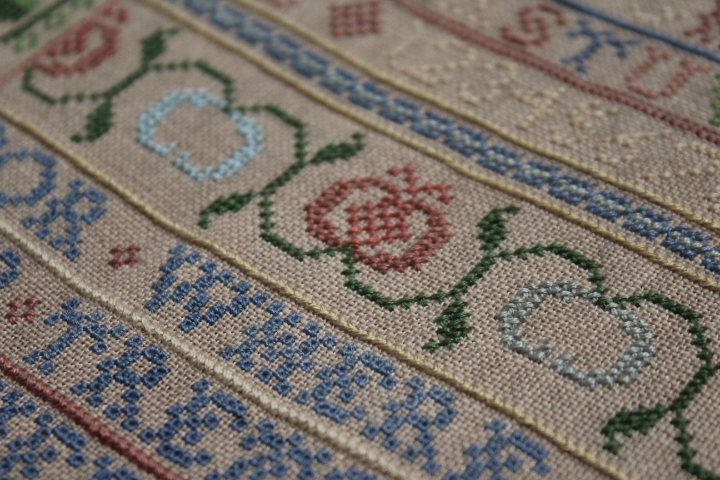
— which I liked much better.
One of the intriguing things about this particular sampler was the satin-stitch border — quite unusual. I had a slightly different color of linen than the original, and it seemed to me that the original color was getting a bit lost, and so at the same time that I auditioned some similar shades I also tried O'Steen's tip — from her book, not unfortunately from the chart for this sampler — to work it with a single thread run through twice, instead of a double thread, because the two-at-a-time threads have a tendency to twist and overlap each other as you work. You can see this in the section at the bottom (which is worked in the original color) —
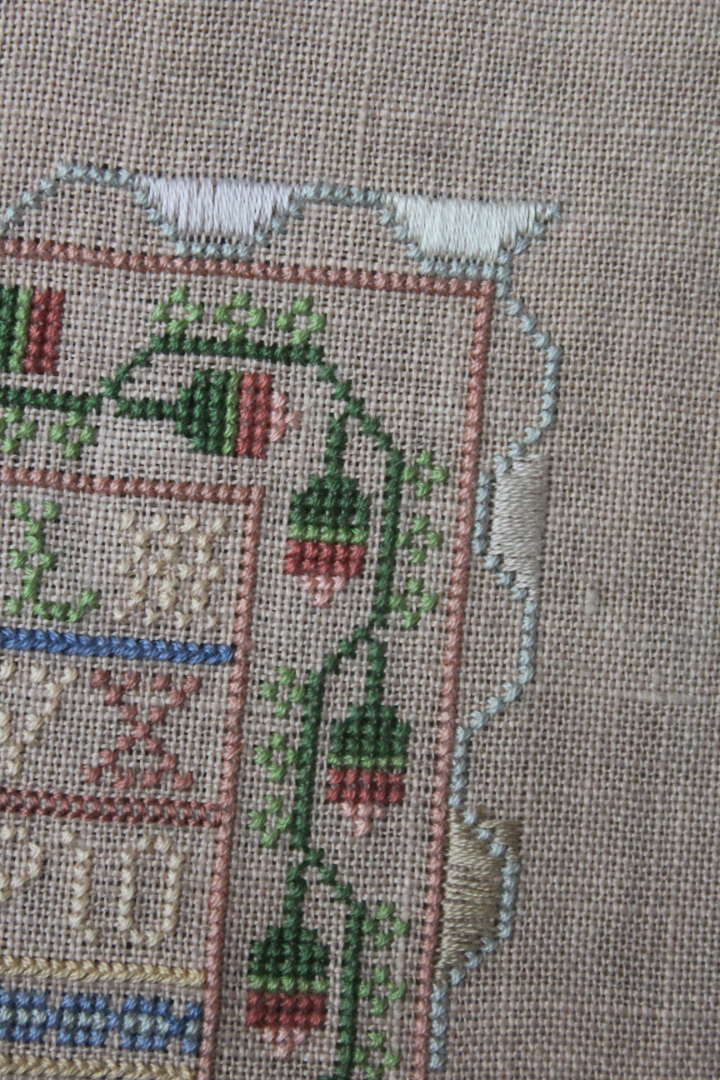
Each of these four satin-stitch areas has two threads per hole, but the bottom one is worked with both of the threads in the needle at the same time, while the other three are worked with a single thread, working essentially two stitches in each hole. This takes twice as long to do, obviously, but the result was clearly so much tidier that there was no question about which to do!
It surprises me that I haven't taken pictures of the finished sampler yet, but I will do that soon and make a separate post. In the meantime …
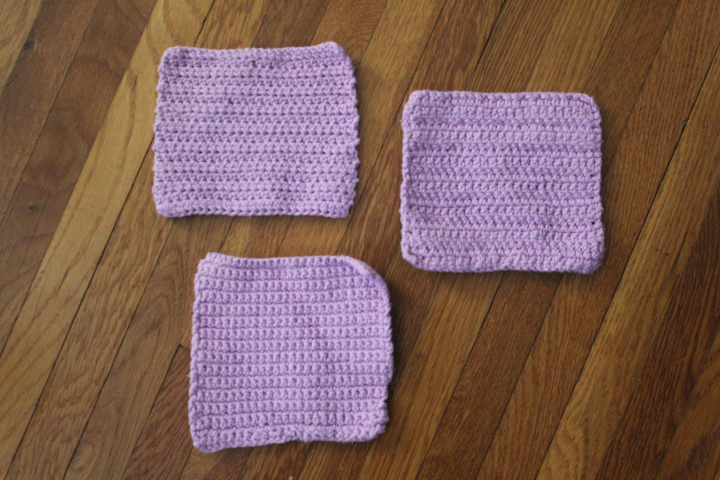
I said to Julia one afternoon not long ago, "Let me teach you some basic crochet, so that you will always be able to make yourself a supply of dishcloths," and to my pleasant surprise, she agreed. ("Someday I might want to do some Irish crochet," she said thoughtfully.) I couldn't find the hook I usually use for dishcloths, so she had to use a size smaller — I went smaller rather than larger just because the cloths tend to stretch out a bit when they get wet, and we tend to like them a bit snug. The first one, at the bottom, is single crochet, and the others are double and half-double. It's kind of funny, because I remember the girls' bits of knitting — fifteen years ago! — that were all wobbly and full of holes, and Julia I think didn't even get an inch knitted before she decided that she wasn't interested at all, and now she worked a row or two with me showing her what to do, then she went off by herself and focused intently on it, after a few wobbles at the start keeping the stitches perfectly uniform. That is what a year or two of making bobbin lace can do for one's concentration and standards!
(That, by the way, is pretty much exactly how I learned to knit, getting the basics from my mom, then going off by myself to work at it until I figured out how to get it all going smoothly!)
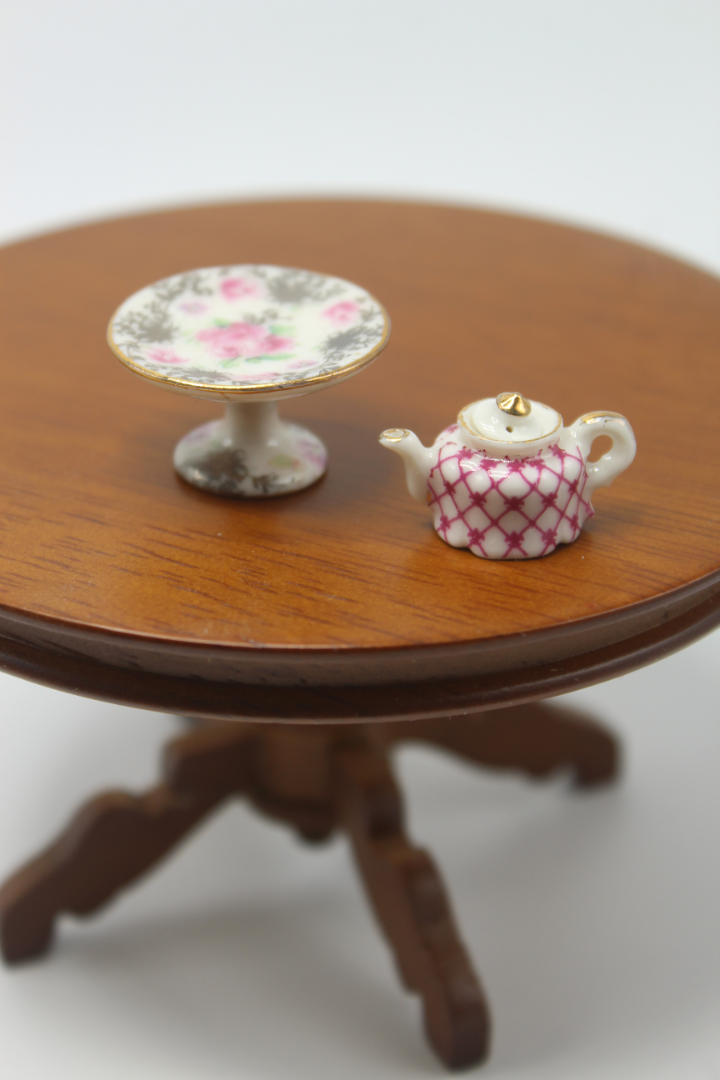
My New Year's resolution this year — yes, the only one — is to finish my three 1:12 shops. I don't know why I was so uninterested in them the past few years — well, not uninterested, it was just that other things were more interesting, I guess — but there it is. But to that end, I bought a few new-to-me things to inspire myself, including these little charmers for the tea shop, which are from Old Bell Pottery — I love that the teapot even has that little steam hole in the lid! —
-
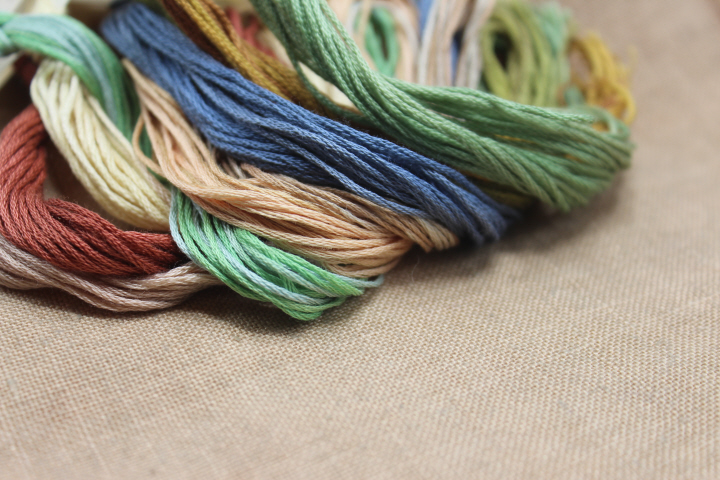
Linen and threads to start the "Pomegranate Sampler" by Darlene O'Steen — I'm looking forward to this very much! The linen is Weeks Dye Works' in "Cocoa" with a collection of threads from Weeks, Classic Colorworks, and Simply Shaker, converted from the DMC list on the chart. I'm also relieved to see that although I had to choose both the fabric and the threads without seeing them in person, the results are fairly successful!
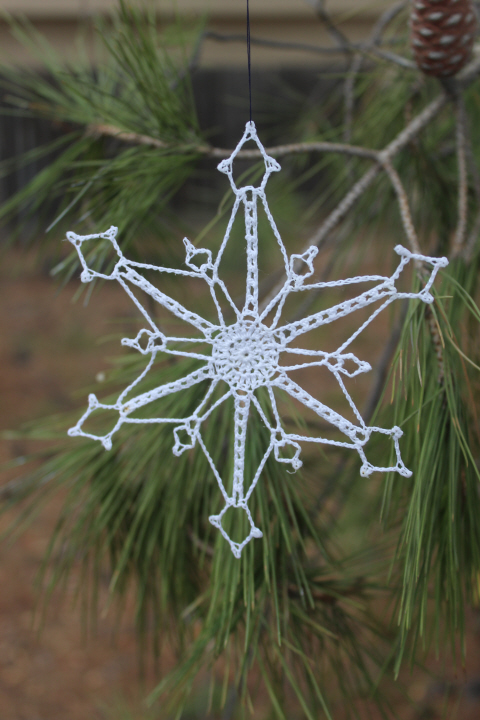
A crocheted snowflake for an exchange-by-mail with our lace group. This one is called "Matterhorn" one of the amazing variety from SnowflakePatterns. I had planned to use starch to block this, but it is so ethereal that I was concerned it wouldn't hold its shape for long, so I re-blocked it with full-strength white glue. This one is in Coats size 30 crochet cotton using a US9 steel hook, and, impressively, is not as difficult as it looks!
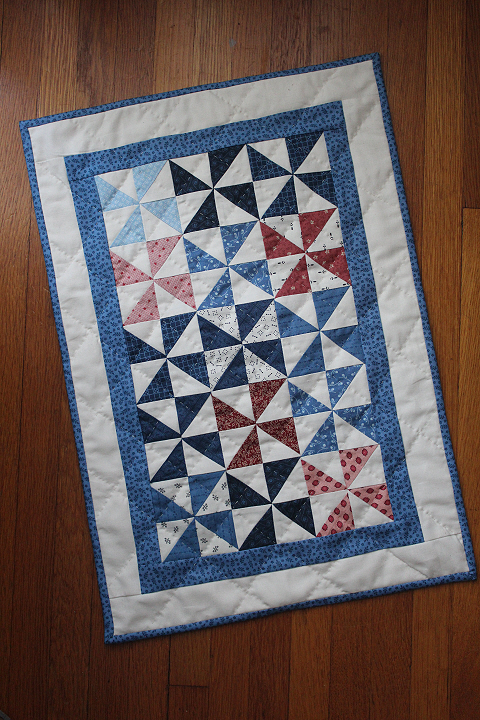
The second of my two Temecula Quilt Company kits, an unnamed pinwheel. I'm quietly pleased to find that I'm getting better both at piecing and at hand-quilting.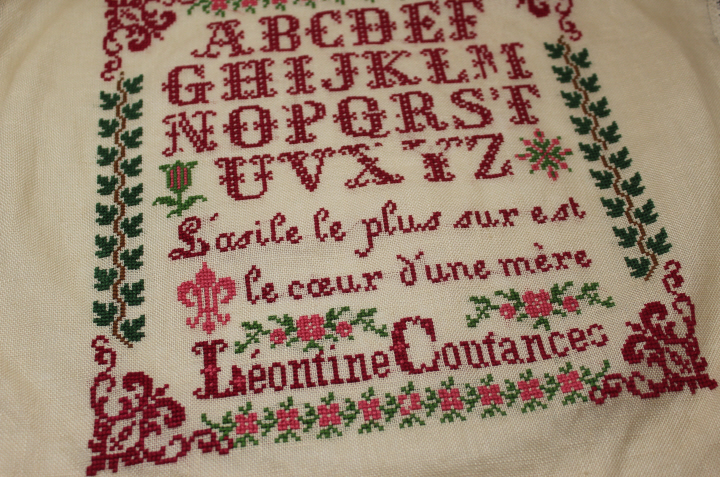
The "Léontine Coutances" sampler by Mamilou, a free reproduction chart of a ca.1900-1910 French sampler. I decided to work this to look a bit more like the original than like the chart, so I left out most of the now-missing stitches and kept some of Léontine's mistakes, though I confess I added a few of my own! I like the effect of using three strands of floss instead of the more-usual-these-days two — it does have that plump "vintage" look, as I'd hoped — and was not too much for this rather loosely-woven Charles Craft linen.
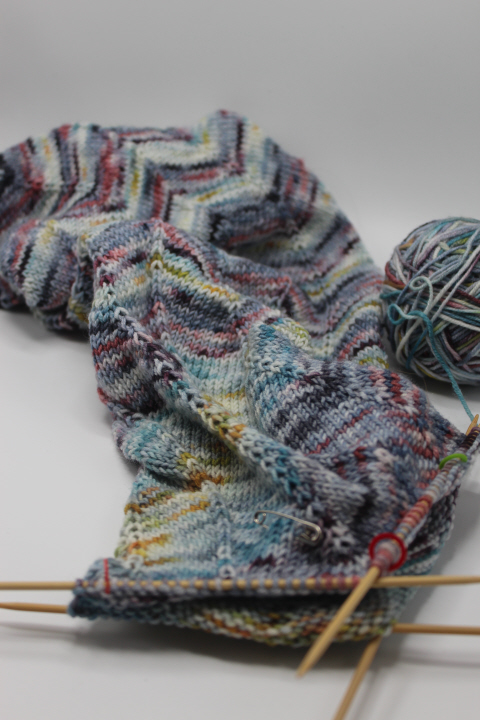
And my "Camptown Races," thanks to no less than three concerts of Julia's for which I sat knitting while waiting for the curtain to go up, is actually starting to look like it's going to be a scarf! Huzzah!
-
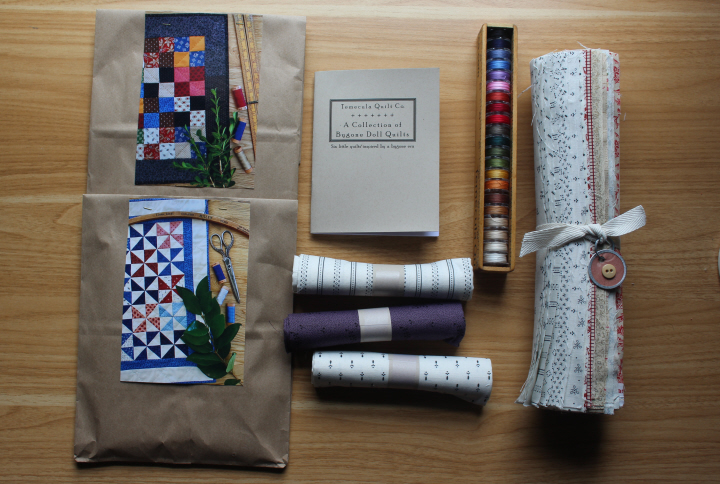
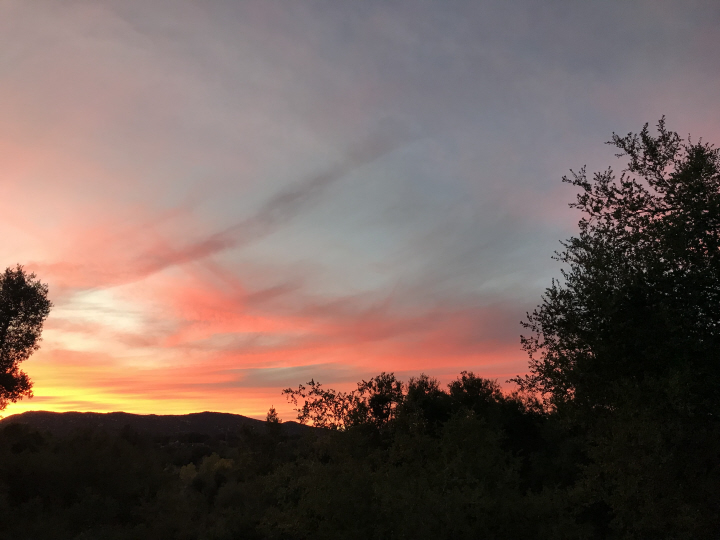
Not long ago, David needed to go down to San Diego to collect some tool or other that he was buying from a friend, and said, "Let's have a little road trip," and so he and I went to Temecula and visited the Temecula Quilt Company shop which has been mentioned rather frequently here of late, and which is going to online-only in the next few months. I had thought, "Gee, what can I do with all of these mini quilts once I sew them up" as I'm not really the quilt-on-the-wall type, and eventually I thought, "Duh! Placemats!" And so I came away from the shop with one each of their last two mini quilt kits, a booklet of doll quilt patterns (which are often about the same size as placemats …), and some pre-cuts of TQC fabrics. After lunch in San Diego, we stopped off to visit some friends who recently moved to the wilds of the Santa Ana Mountains — had a good visit and a delicious dinner, with the bonus of a gorgeous sunset — so all in all, an excellent day.
I sewed up the first mini quilt kit in an afternoon, deciding to arrange the squares randomly instead of in four-patch. The kit is of the same high quality as the others, with a generous selection of fabrics and clear, concise instructions. I backed this with some navy Kona Cotton and hand-quilted it, pleased to see that I'm getting a bit better at the latter, though that may also have something to do with the batting being thinner that what I used previously, and thus easier to manipulate the needle through!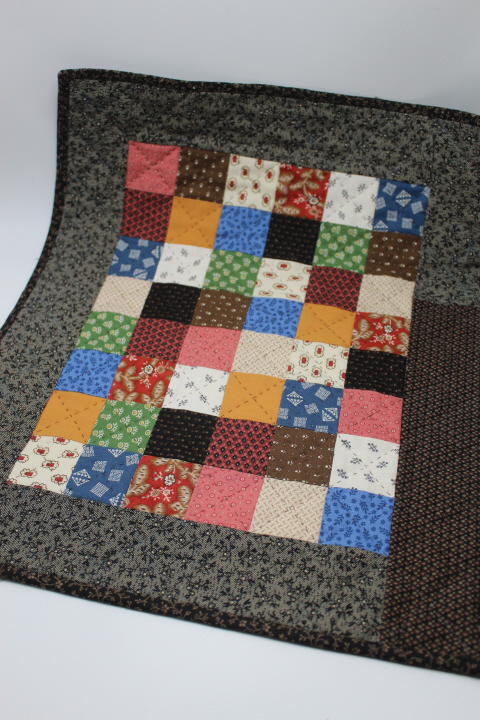
I'm glad I started with this one, as it was thus clear to me early on that for placemats, I think I will want most of them slightly longer than the 16" here. I've sewn up the pinwheel kit, and will start quilting it soon.
I do have — of course — another distraction —

which is Mamilou's charting of an antique sampler which I found almost accidentally while I was researching French samplers. I decided, since I had some linen that has quite a loose weave, to experiment with three strands of floss instead of two, to get that rather "thick" look that so many antique samplers have, usually (I guess) from the original stitcher using wool and not modern cotton floss. It's actually quite a success, I think! and because of the loose weave isn't at all too much. I was originally thinking that I would veer towards a "re-creation" and follow Léontine's mistakes as well as the now-missing stitches, but the chart has a few "corrections" and I've made a few mistakes of my own (!), so it is Léontine as well as a soupçon of both Mamilou and me!
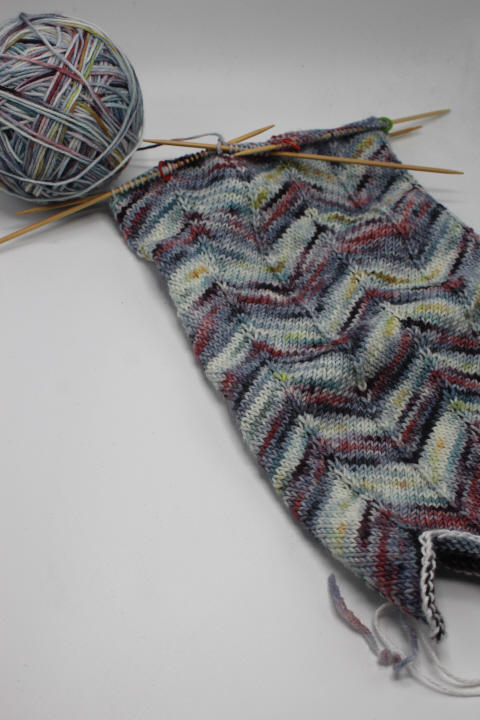
And I do, I assure you, still knit, although it may not seem like it! I like this wool and think this will make a fabulous scarf, but I cannot knit it during Zoom meetings, as I lose track of which row I'm on and find after an hour that I worked a plain row when I should have worked a pattern row, or vice versa, and have to rip out all I've done since then. This is the longest it's been yet! —
-
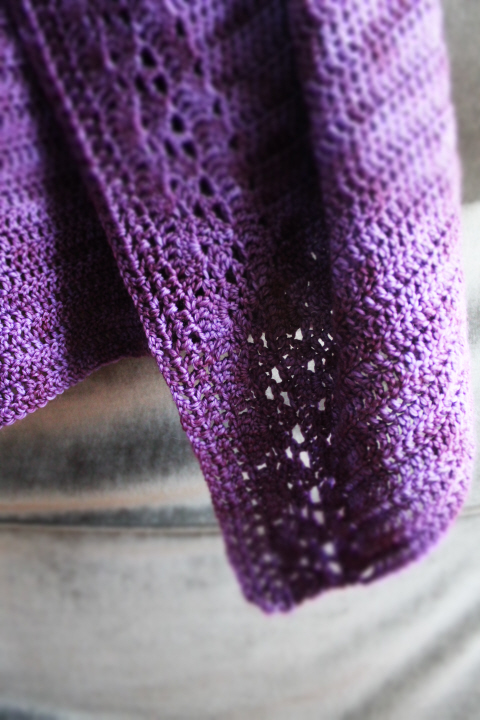
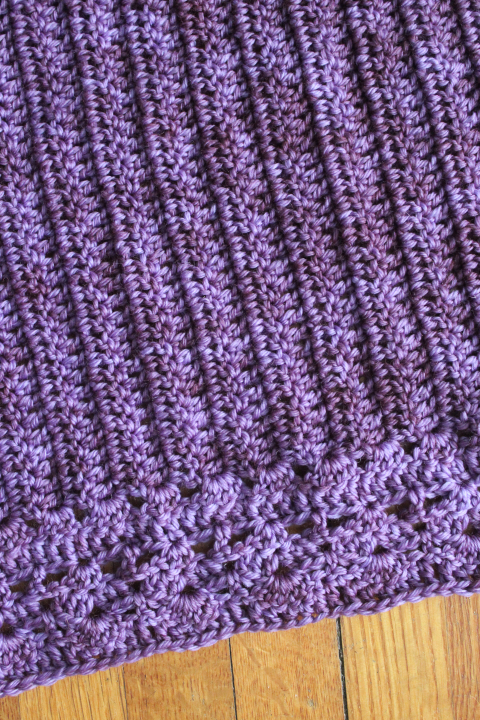
This, at last, is the "Basic Blanket" from Simple Crochet for Cherished Babies by Jane Davis, which I have to say, was an utter pain most of the time I spent on it, but is very pretty now that it's finished and draped artfully over the arm of a sofa. I had searched for blanket or afghan patterns that called for 10 balls of Jaeger Baby Merino and would be fairly quick to make, and this seemed to fit the bill perfectly, but ten balls were not enough by at least one, and I spent quite a lot of time having to figure out not only the instructions themselves but how to arrange it so that I could get as much of the pattern worked with almost every inch of the ten balls I had.
Strangely, although my gauge came out noticeably larger than given in the book, with the same weight yarn and my usual 1-size-smaller hook, the finished measurement of the panel was smaller than given. How can that be?
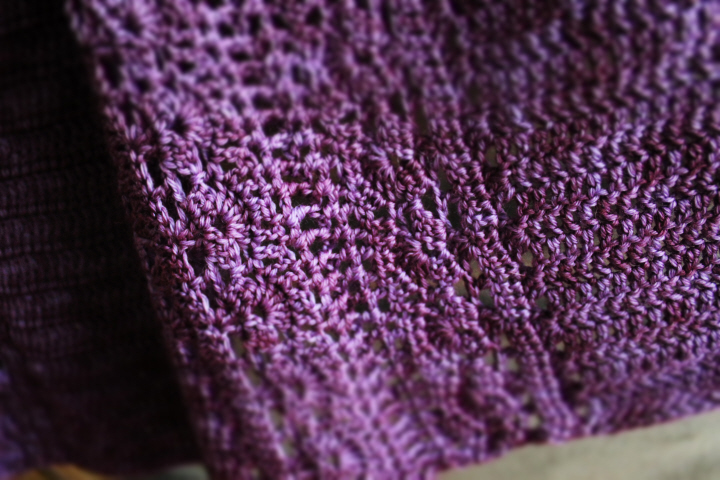
There really should be a more-clear photo of what this blanket is supposed to look like when laid flat. I suppose that this —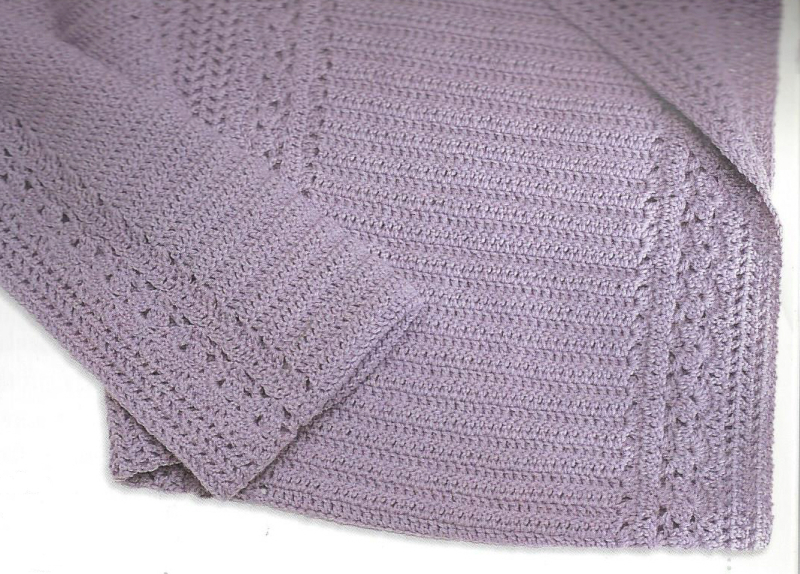
— which is the photo from the book, is clear enough once you've already made the thing, but before I got to that point, I heartily wished to see it more fully. (What does the seam look like? for example …)
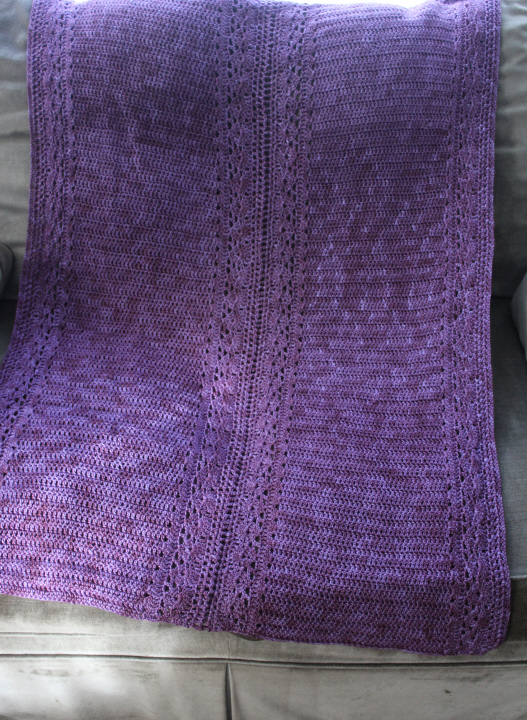
I found out early on from reviews on Amazon that a lot of people have had difficulties with a number of patterns in this book, so perhaps I'm a bit more salty than I would have been if I thought it was just me. I suppose I can figure out that if the instructions say "weave in end after row 11" that I'm supposed to break off the yarn at that point, or that if it says "sew the panels together" that I'm supposed to make a second panel, but it doesn't say so at all. But I was mystified by the instruction "Work row 8 along the top and bottom edges of the blanket" — it's multi-directional, so which edges are the top and bottom?!
This edging, by the way, is simply begging for a chart, but I am not at that stage yet, myself. (Laura herself came in not long after I'd hidden the blanket-in-progress but not my attempt at a chart. "What's this?" she asked, "some weird code??")
After trying to puzzle out the directions, then trying to figure out from the photo what was meant in the directions, I came up with these alternate instructions for certain rows, with my choices and some clarifications in boldface. Note that in the main body of the panel, the initial ch3 does not count as a stitch — you are making loops in which to anchor the edging. (This, if I remember correctly, is not what the general instructions say at the beginning of the book.) The initial ch3 in the border, however, does count as a stitch. I also did 1 less ch than specified at the beginning of each row, as mine tend to be a bit looser than average, I guess, so that one less ch made my edges a bit straighter than they would have been —
- Row 3: Ch3, 1 DC, [ch1, sk 2, DC, ch1, sk 2, 3 DC in next st] 32 times (on the last rep, 2 DC at very end) [129 sts].
- Row 4: Ch3, DC, [(DC, ch1, DC) all in next st, 2 DC in next st, sk 3, 2 DC in next st] 32 times, (DC, ch1, DC) in top of ch3. Note that the "sk 3" will be above a DC in the row below.
- Row 5: Ch3, 2 DC in 1st st, [DC in sp of sk3 section, 6 DC in ch1 sp] 32 times, 3 DC in top of ch3. Note that the 6-DC cluster will be above the 3-DC cluster in the row below.
- Row 6: Ch3, sk1, 1 HDC, 1 DC, sk1, [2 DC, 2 HDC, 2 DC, sk1] 32 times, 2 DC, 1 HDC in top of ch3. Note that each bracketed section will be centered over the 6-DC cluster of the row below.
- Row 7: STDC, DC in 1st st, DC, sk1, (2 DC, sk1) 64 times, 3 DC (the last in top of ch3).
As I said, I did not have nearly enough wool to do the four rows of DC mesh at the top of each edging section (which is worked four times!), so in frustration, I just worked the mesh on each side until the wool ran out, estimated how many rows total I could get, which ended up being about a quarter of what was called for, and then ripped out the ones that had gone past that. In the end, I decided that, really, an open section of mesh down the middle makes a rather drafty afghan, and so I would work the edging only through Row 7 on one side of each of the two panels, stitch those two together, and then work as much of the mesh as I had yarn on the two "outside" borders.
It also seemed to me — and perhaps I'm mistaken, not having that much experience with crochet — that having a mattress-stitched seam running through a quite-pretty lacy panel might look just a bit clunky, and so, remembering some particularly clever methods I'd come across for joining crochet squares and used myself with tolerable success, I decided to do one of those instead of a mattress-stitched seam. (I used the fourth one from the top, the one with the sort of "telegraph pole" look to it). I thought this suited the pattern quite well, actually, and would recommend it to anyone making this blanket, certainly if not using the full complement of mesh rows down the middle. (I ended up, by the way, after joining the two panels after their respective 7th rows, getting a grand total of two rows of mesh on the two outside edges, four altogether, far less than the sixteen the pattern called for with ten balls of Baby Merino, even subtracting maybe two of those which got used up in my join. Oof.)
But — as I said — it turned out very pretty, and I'm also quite happy with the color, which was Jaeger Baby Merino 233 Lilac overdyed with 1 package of grape Kool-Aid per ball. Interesting that it came out mottled even though I did not try to get it so. It looks very different in different lights, as you can see!
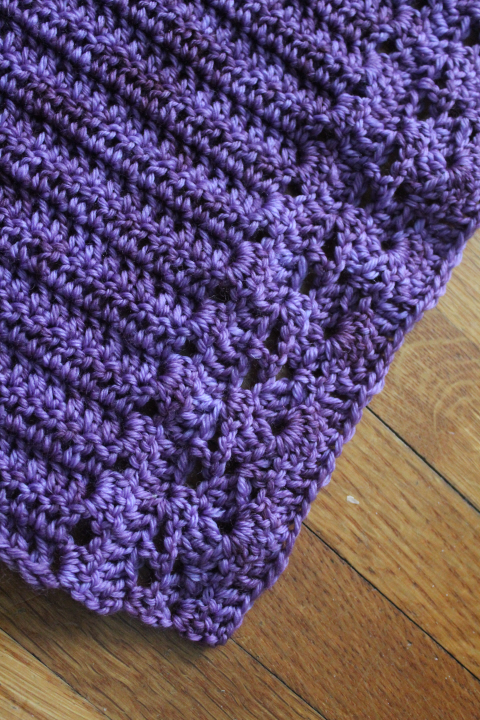
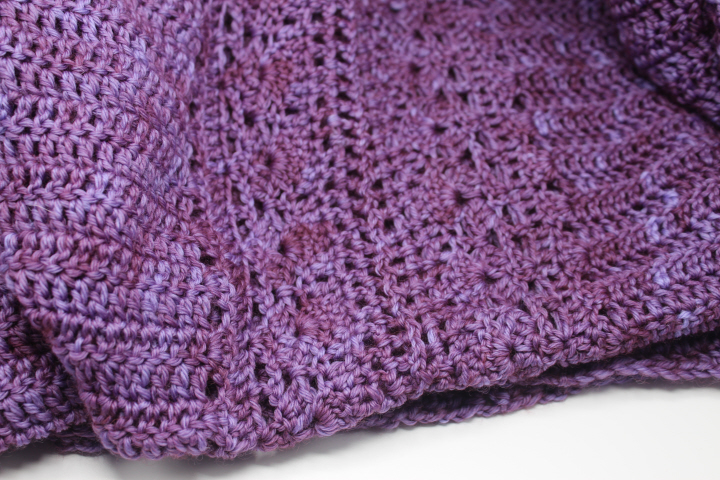
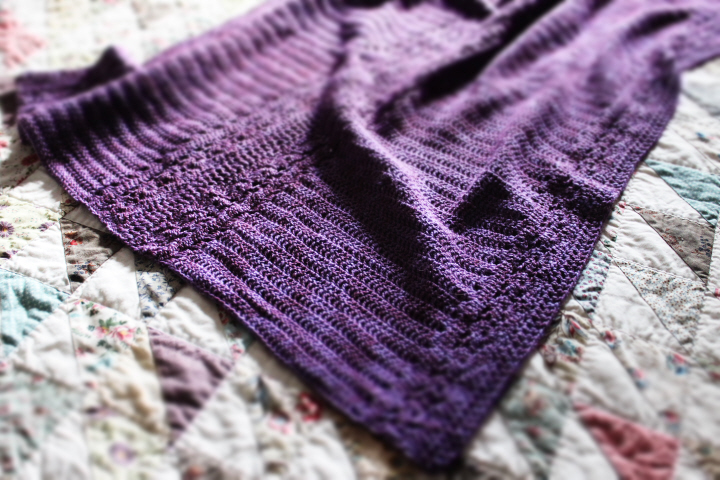
(Yes, that is my HST quilt, finished and on the bed!)
-
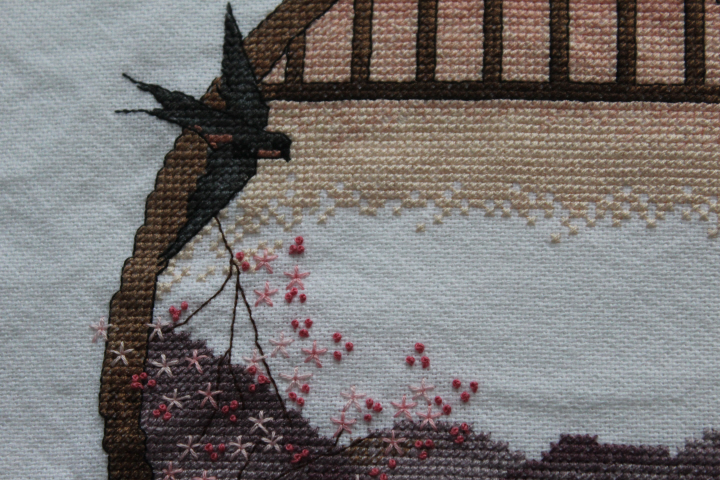
The "Japanese View" cross-stitch is completed, partly-blocked, and ready for framing!
The chart is by Irina Neskorodeeva and is available free at Smart Cross Stitch. It is actually quite polished for a free chart — I don't mean to sound snobbish, mind, but it is complex and clearly has had a good deal of thought and effort put into it, so was a generous contribution to the free-charts library by the designer.
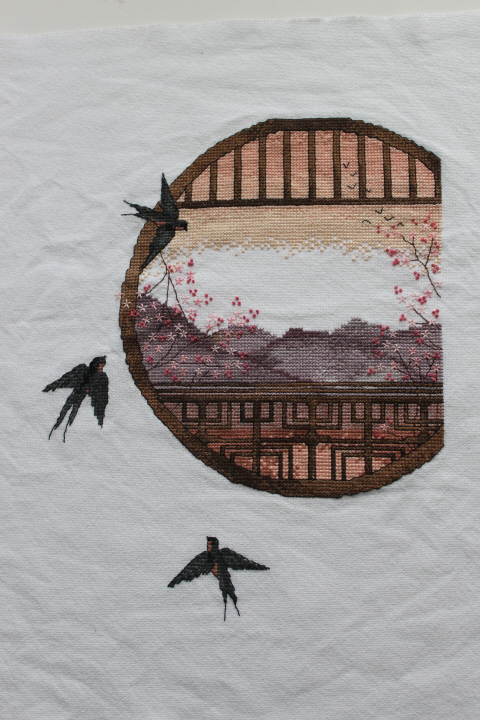
I did make a few tweaks — as I said before, I like the more-solid look of full cross stitch, so the mountains and "sky" here are not in half-cross as in the original. I have used partial stitches in the past, and so I wondered why they aren't used here, to smooth out the stair-step edges on the many curves. I did blend the colors at the upper edge of the peak on the far left, just by going over the color-change with a single thread of the darker color, which made it flow a little better, to my eye. There was a slightly-harsh straight line across the "sky" where the palest-pink is, which was probably more apparent in my full-cross than it would have been in half-cross, and so I just skipped a few stitches in a sort of programmed-random manner, fewer and fewer through the four or five rows as I went upwards.
I confess I had a terrible time keeping on track in all parts of the sky, partly mistaking which small "panel" I was on, and partly just miscounting, and so the blending isn't quite what was intended, but luckily the shading is particularly effective either way. I wasn't quite happy with my French knots, either, which seemed to have a mind of their own and never wanted to lean in the direction I thought they would go, so that the effect isn't quite what it is in the original, but there it is.
And because I clearly crave more than one needlework project going at the same time! —
-
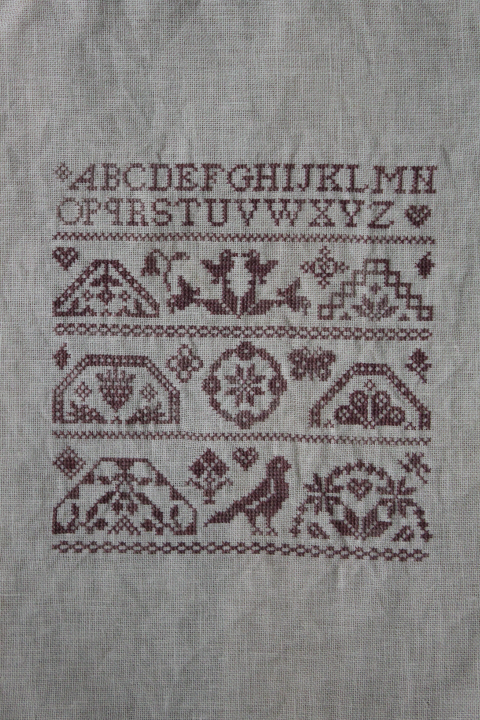
"Samplings V" by Ellen Chester, one of her five-chart "Quaker Samplings" series, here in Gentle Art's "French Lilac" thread on coffee-dyed Edinburgh linen. I gave it a bit of a steam-press after finishing, but clearly it needs a bit more! A very enjoyable chart to work.
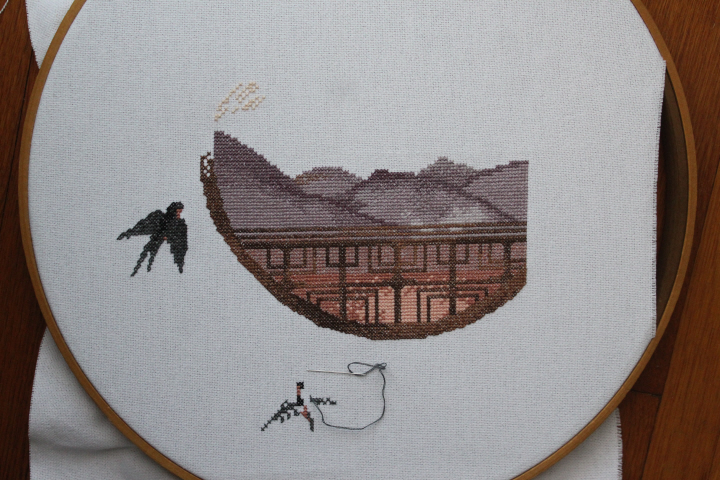
I've pretty much finished, bar the backstitches, the lower part of the "window" in the "Japanese View" cross-stitch, and am doing the second of the three swallows as a bit of light relief. I'd forgotten, in my fascination with samplers, how easy it is to lose one's way in the painterly kind of chart. But it's really starting to come together now, I'm happy to find. The original has the landscape part in half-cross, but I like the more solid look of full crosses, so am doing it that way. I think I will go back with a mid-purple shade and soften the line at the top of that hill on the far right, so that it's more like the other hills ….
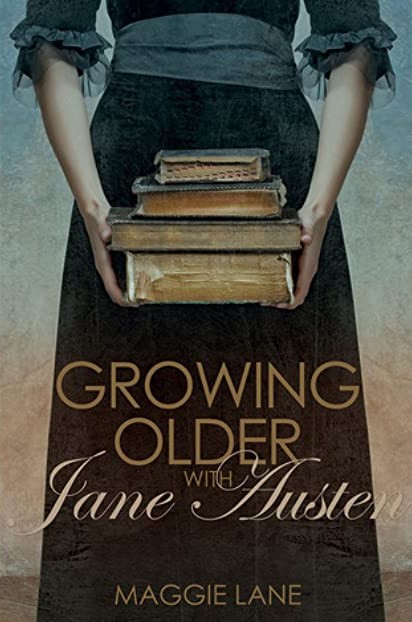
I'd had Maggie Lane's Growing Older with Jane Austen on my wish list for quite a few years now, but for some reason all of the used-book sellers have been charging nearly three figures for it, and so when not long ago I saw a copy for only slightly more than its original price I did not wait for some kind gift-giver but bought it immediately myself. It is certainly worth the wait, though, as it is well-written and insightful, on a subject that does not usually feature much in literary criticism, but clearly was important to Austen, both simply as a means of delineating a particular character and, perhaps as she grew older herself, a way of pointing out the effects of one's relative age on a person's — more often than not a woman's — place in her family and social circle and in the society of the time.
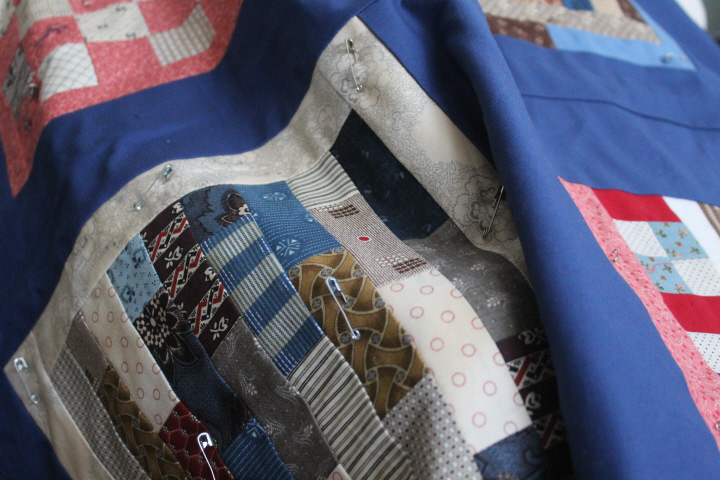
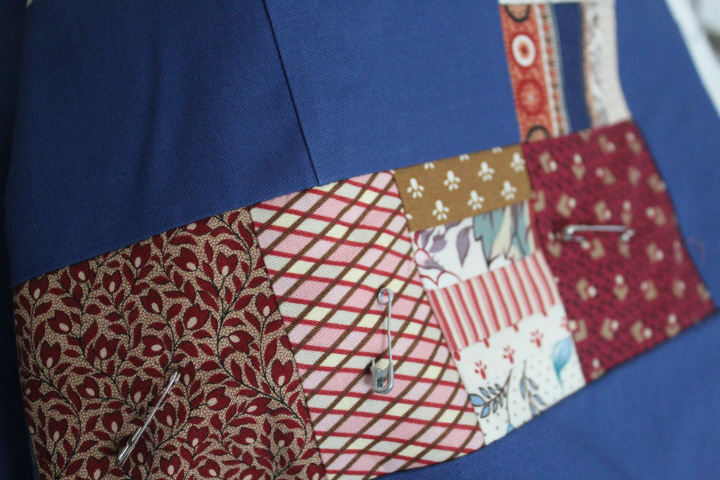
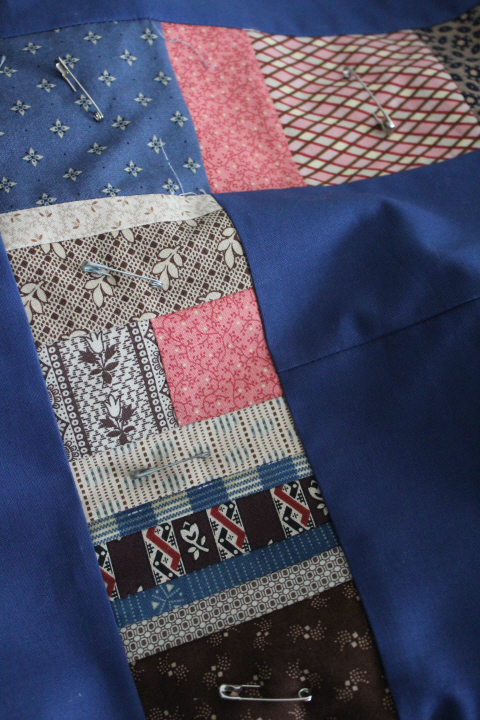
After the thorough treat of being able to compare in person every single color of Kona Cotton and Bella Solids at a new-to-me fabric store, I came home with a not-quite navy blue solid to surround my six mini quilts, so have pieced together both a backing and batting — have been thinking of calling this "No Scrap Left Behind"! — and am pondering how best to quilt it.
-
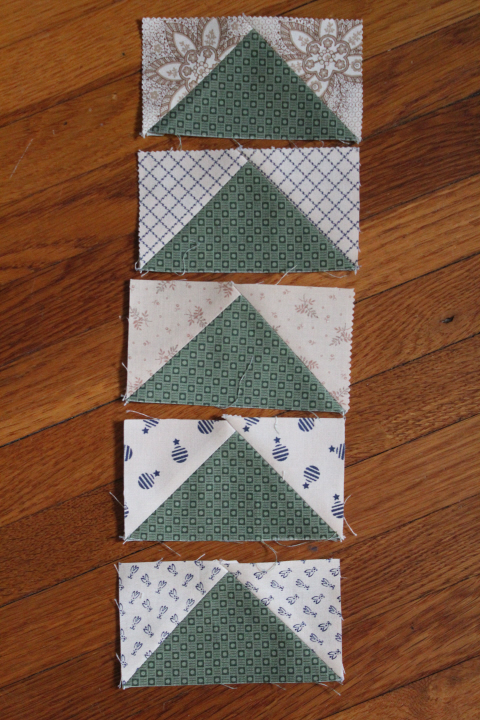
This batch has a bit of a "theme" since I came across a large-ish piece of the green print in my stash on Sunday, and thought it looks very handsome with this selection of the light-value prints. I hope it's not a fluke that I got all of these rather neatly lined-up!
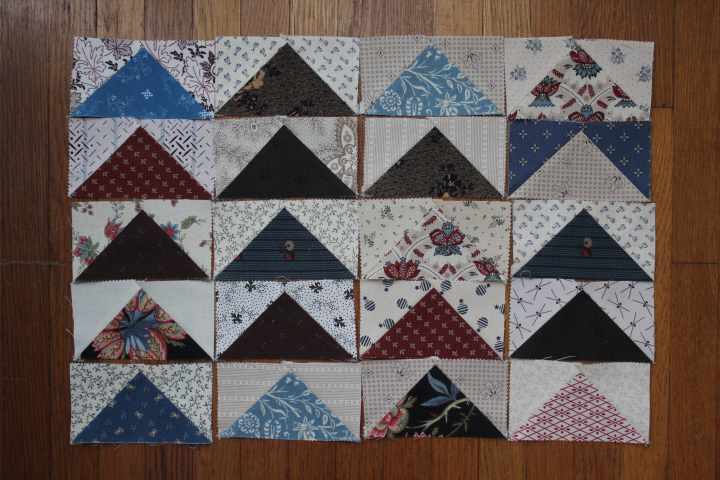
I went a little crazy Tuesday morning and sewed up all twenty of the blocks I'd laid out on my board. On the bright side — well, brighter, because I'm now twenty blocks further along! — this gives an idea of how the finished quilt will look —
-
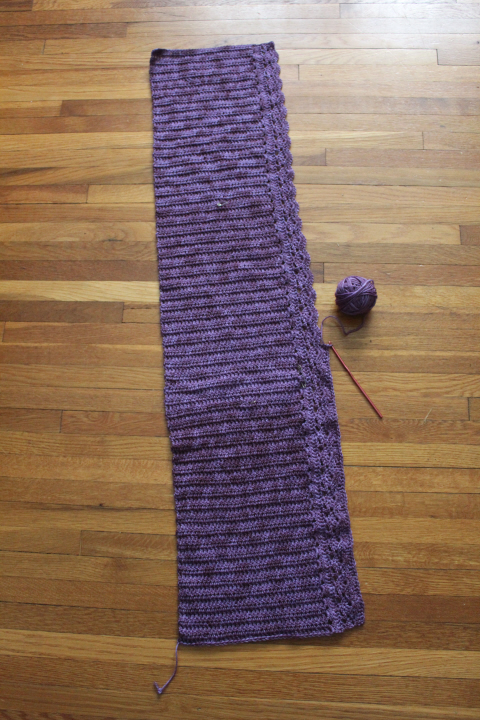
I decided that both because I was quite unsure if the amount of wool that I have would make it all of the way through the "Modern Classic Baby Blanket" and that the mottled over-dye distracted from the lovely stitch pattern anyway, and that, to be honest, being still a novice crocheter there were times when I couldn't understand what I was supposed to do — I would set that pattern aside and go for a more sure thing. I searched online for patterns specifically using Jaeger Baby Merino DK, and came up with the "Basic Blanket" from Simple Crochet for Cherished Babies by Jane Davis, which, wonder of wonders, is held by my public library and was on the shelf at that very moment.The construction is a bit strange, and not quite clear since there is only one photo of the finished blanket in the book and it's scrunched and folded over on itself, and the instructions never say "make a second panel" but I think this is how it goes: you work the DC panel, turn that on its side and work the edging, then break the yarn and work the edging on the other side, and then make a second panel in the same way and sew them together up the middle.
You can't quite see them in my photo, but there are three safety pins where I joined in new balls of yarn — the first about a third of the way up the main panel, the second almost two-thirds up, and the third a row or two into the edging (near where the crochet hook is at the moment). That is, yes, four balls of yarn so far, with six more rows of the first border section and all eleven rows on the second still to go — and I have ten balls altogether. Rather naïvely, I suppose, I did not make a gauge swatch, since I'm using the same yarn and a one-size-smaller hook, but it turns out that my gauge is much bigger than the one in the pattern, so I suppose that's at least part of the issue. Regardless, though, I don't think ten balls of yarn is enough as it stands now, and so I need to figure out how much smaller I must make the blanket in order to use as much of the yarn as possible.
I do rather like the overdye with this pattern, though — it's not quite as "busy" as the Modern Classic blanket (which, again, I think would be wonderful in a solid yarn, and I will keep it in mind as a potential future project). It might be also that this one has a bit more "space" in the twiddly part, more lacy-ness, as it were —