• 7299

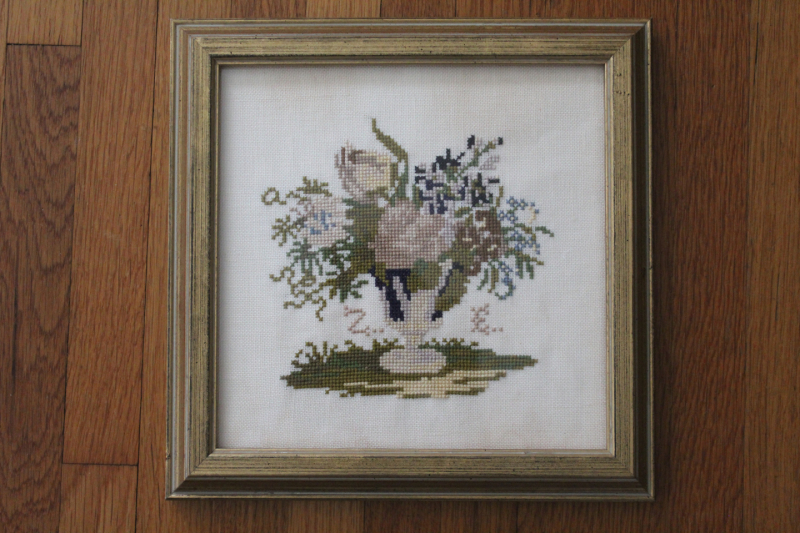
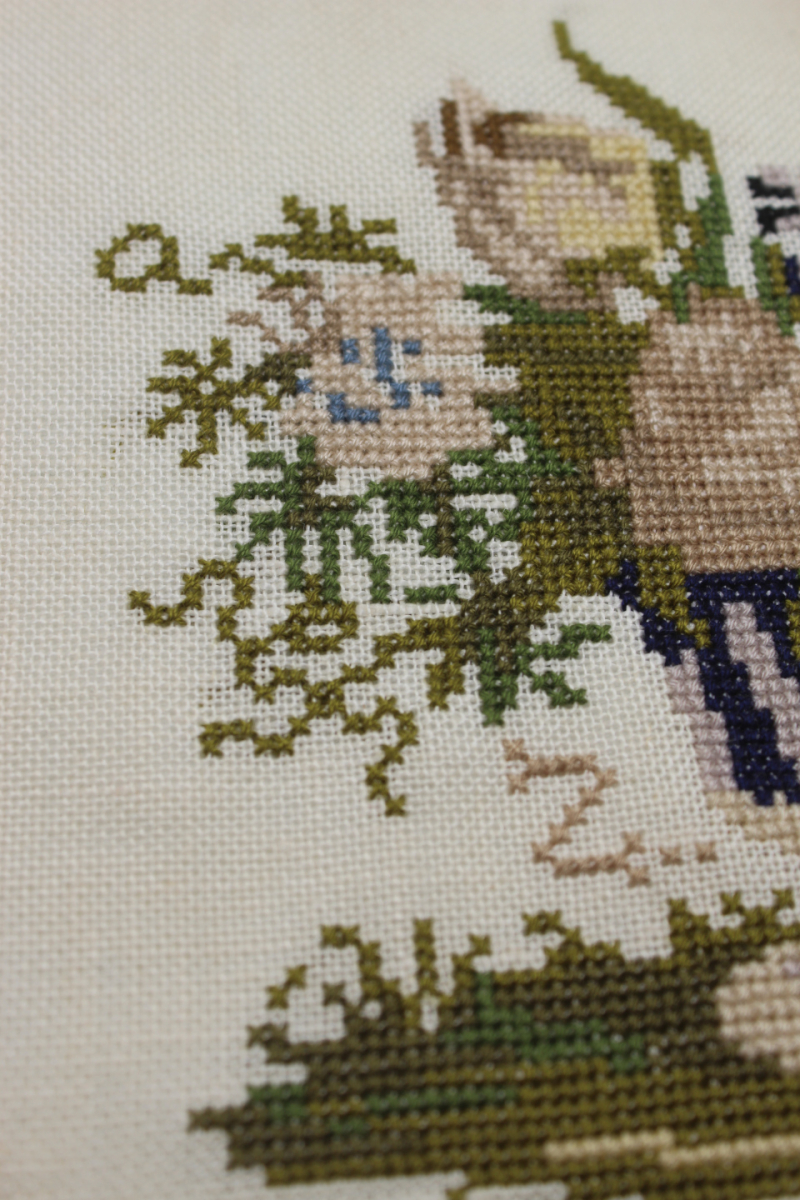
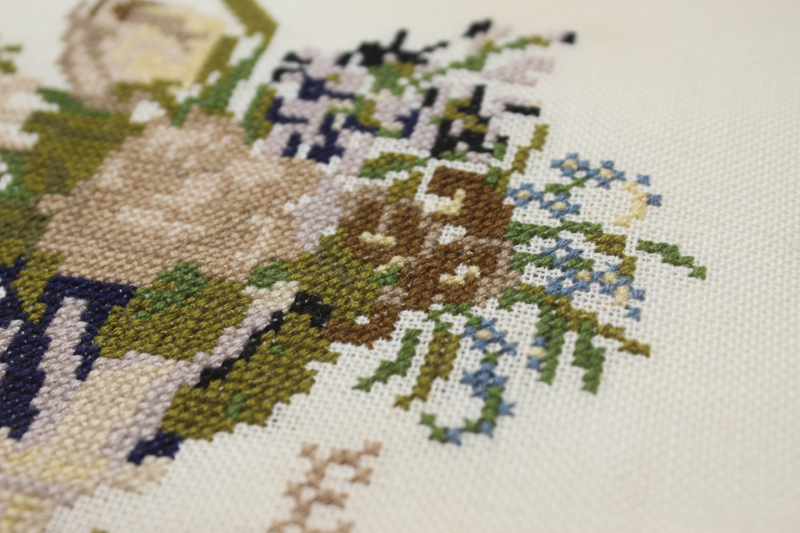
    This is the start of “Margaret Ann Klinedienst” by Queenstown Sampler Designs, which I was charmed by I think almost immediately.  The naïve flowers, the more-than-slightly wonky basket (she was nine, Margaret Ann, when she stitched this!), the softly-faded colors — oh yes!  I’ve had the chart sitting on my shelf for a while, but of course had resolved to finish the “English Cottage” first — indeed, had to, since I have only two frames for large pieces, and they were both occupied.  But not long after the “Cottage” was done and out of the frame, this went in.

    21a6d3a65fc79947690f3fb8f51564b7
    But as I stitched, I had a strange feeling of history repeating itself, after my “Floral” escapade — the colors were not what I had in my mind from the photo I’d seen.  Now, of course it may be that the original 1830 sampler is darker than the photo, or that the conversion from NPI Silk threads to DMC lost something in the translation — or both, to be sure — but either way, the lovely soft faded colors were a large part of the original appeal for me, and that soi-disant mahogany is in fact glaringly orange.

    So I began to research, and the first thing I found was a conversion chart from NPI to DMC that is considerably different from Queenstown’s version (perhaps due to new colors coming out in the dozen years since the chart was first released?).  And I dug through my stash of DMC threads, and bought a few more, and sat down in the living-room yesterday in the afternoon sunlight and compared the different colorways.

    The one in the photo at the top is Queenstown’s conversion from the NPI used (on the model in the photograph, presumably).  The 3776 Light Mahogany really jumps out — and though I know very well that sometimes a color in the skein looks very different when stitched, often because of the colors surrounding it, well, there is quite a lot of it even in the small bit I’ve done so far.  It’s orange, I think there’s no getting around that!

    7301

    This selection is beginning to lighten all of the colors by at least one step, two in some cases, putting some alternatives in pairs to see which I like better.

    7300

    This is a few more tweaks.  Better!   And below is the selection I’ve made — I’m much happier with the 758 (“Terra Cotta Very Light”) instead of the 3776, and the whole thing just has more of that air of the softness of age that so called to me.

    7302

  • Page 4

    7282

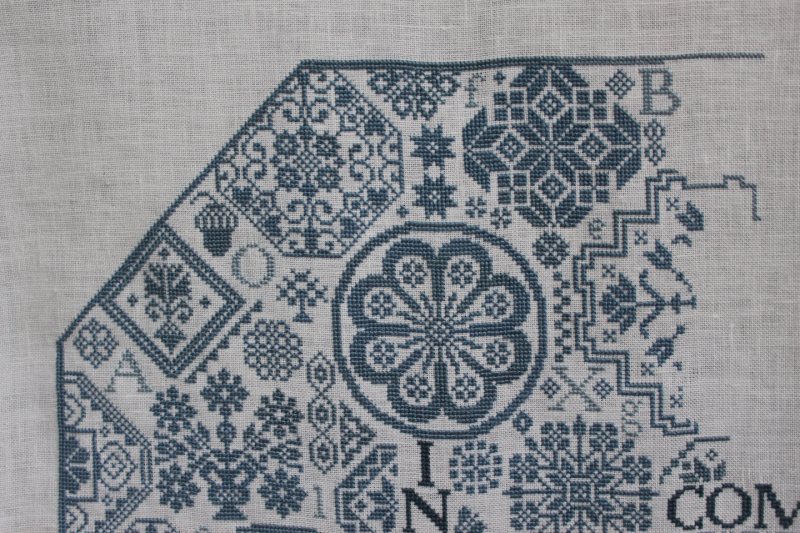
    Page four of the "Quaker Virtues" sampler.  There are nine pages in the chart, and with this I've done six of them.  The middle runs through the lower part of the R in INTEGRITY, so I'm actually well over halfway through — that seems hard to believe, although I must add that it is still a delight to me!

  • B7280
    I'm still trying to figure out my new-to-me photo-editing program, which is very different from my previous one, a demo version that was no longer available by the time I got my new laptop in January — gee, yes, it's September already, and I'm still trying to figure things out.  But maybe because I've been stitching instead of trying to figure out my computer — I will admit that for various reasons, not all of them to my credit, I've spent many hours a week working on this!

    It is of course the "English Cottage Sampler" designed by Teresa Wentzler. As I said earlier, in April I proposed to my friend J that, since we both had an unfinished Wentzler in our respective cupboards, we have a finish-along, so we've been sharing photos and encouraging texts all summer.  I had much the easier project, since J's has not only a peacock with that complex tail but also a lot of foliage — even Wentzler herself says that the "Cottage" is one of her easier designs! —

    B7267 2

    It's pretty apparent upon inspection that the floral vine border is mirrored on the two sides — this made what seemed to me a rather awkward transition in the middle in some places.  I disguised these joins — in the pink alternating border at the bottom and top, in the pink vertical "trellis" at the bottom of the oval surrounding the cottage, and in the trellis-work at the top — in a few different ways.  For the trellis in the floral border, I simply eliminated much of it, where it came together in a sort of W manner, and to be honest, that empty space doesn't really read as "something is missing" to me, but just restfully empty where the two vines are coming together.  For the pink alternating border at the bottom, I expanded the two stitches to fill the space — there were 8 threads that needed to be covered, and so I worked a "lower" stitch over 3 threads across instead of 2, then a regular cross as the "upper" one, and another expanded one.  Unless you're looking for it, it's quite hard to spot!  The pink "trellis" was trickier, as it's more exposed — there instead of wider stitches, I left wider spaces. shifting the two pink lines in the middle just one thread to accommodate the necessary space — but it's still a little more pleasing to my eye than the four-space gap in the original.

    B7284

    B7285

    B7269

    I have a tendency to pay more attention to Js and Ss than other letters in a cross-stitch alphabet, I suppose for obvious reasons, and so it seemed to me that the original S looked more upside-down than right-side-up.  I flipped the capital S when I worked the large alphabet in 1991, but had completely forgotten about it when I started it back up again this past April, and since the majority of the piece was rolled up on my frame when I did the small alphabet — because I started at the bottom — it didn't occur to me to flip the S in the small alphabet as well.  So there it stays.  It doesn't leap out at me as much as the capital one did, there is that.

    But, other than shortening the last lazy-daisy stitch at the top and bottom of the two vertical swan-box borders (instead of doing a half-pair of "leaves", as it were), those were the only changes I made on purpose — yes, I know there were numerous mistakes, but even Wentzler says, "Don't sweat the small ones!"  The cottage roof I think was the trickiest, and is in fact the first time I've found it necessary to actually cross off stitches as I worked them — the swans were a bit crazy-making, but the roof was by far even more so!

    B7277 2

    J and I had a discussion one evening about long floats on the back — I was pretty lucky with this one, as the backstitching covered up those long floats between leaves quite nicely, thank you!  (I did usually secure the floats where possible, but it wasn't always, especially between the pink flowers, and I did not want to keep tying off and reattaching threads.)

    B7275 2

    I was quite unsure about the beads from the very beginning, not being a particularly sparkly person myself, and was half-tempted to do French knots instead, but in the end I did the beads, and for beads they're actually quite subtle on this piece! so I'm glad I did.

    And so, all things considered, I'm very happy to have worked this, and even more happy to have finished it!

    B7276

  • Hard Lessons

    7278

    I wanted to love this, the "Floral Sampler" by Darlene O'Steen.  I still do, the arrangement and the variety of stitches and the general air of it.  But I really don't like these colors.  I kept telling myself, "She knew what she was doing, Darlene O'Steen, who am I to say otherwise?" but either something has changed drastically with Gentle Art's threads in the ensuing twenty-six years since this was first published, or she kind of stumbled a bit here.

    Floral plus lady brittany

    It's entirely possible, of course, that the difference between what I saw in the magazine and online and what I have in my hand is just a matter of reproduction processes, and the original colors were really this vivid, even odd in places — or that there is an errata notice in the next issue of the magazine, which I don't have, and that twisted vine, say, really is supposed to be green, not brown.  The pink in my sampler and the pink in the "Floral" (on the left) are both certainly pink.  And O'Steen clearly modified the sampler, enough in her eyes to justify re-naming it "Lady Brittany's Sampler" (on the right) — the three large flowers are the most noticeable difference, but there she also changed the uppermost dividing band and the numbers line, and it certainly looks as though the small queen-stitch flowers are now Midnight and Dried Thyme, instead of Midnight and Victorian Pink.

    Regardless, I wanted to love this and I do not, and my dismay is not lessening but increasing, enough that I think the wisest thing to do is put it away for a while until I decide whether it's best to pick out the bits I don't like or to start it all over again from the beginning.

  • 4250

    What with computer problems, camera software issues, phone camera difficulties*, &c. &c. &c. and the general ennui of summer in Southern California on top of post-2020 malaise, well, I have not been blogging.  This is not to say that I haven't been stitching, wh. is possibly the one thing that has kept me sane these past months, and I've clung tenaciously to it.  But I did take lots of photos, there is that! so here is a catch-up post, maybe the first of a short series ….

    *I still can't get the top photo a little sharper.

    An old family friend said to me, as they were packing up to move to Arizona about two years ago, "Hey, I've got this cross-stitch that I haven't been able to work on for a long time — when I find it, would you finish it for me?!"  I laughed and said yes.  She added, "It's a peacock by Teresa Wentzler."  At the time, this didn't mean anything to me, but then after I dug out my own unfinished sampler, and did some research online about it, I discovered that it, too, is by Teresa Wentzler, and I remembered J's peacock cross-stitch, as the name had stuck in my head.  I sent her the above photo and proposed a Wentzler finish-along (ha-ha!), and about half an hour later she texted back, saying, "I managed to find mine, let's do it!"  And so all of this summer, we have been texting back and forth, sending progress photos and encouraging each other.  I have much the easier project, as the cottage sampler, while some 20 sts bigger in both directions, has a lot more "white space" and no partial stitches, while J's — which is called "Peacock Tapestry" — is very dense in a lot of places, and lots of foliage (which is difficult because it is irregular and the colors are usually very closely shaded, and so can be easily confused).

    I did, though, have a bit of a handicap, as I remembered that one of the reasons I kept putting this back in the drawer was that somehow in the intervening years between 1991 and 2013, I guess (my first "miniature" carpet), I switched from making crosses with the first stroke like this / and the second like this \, to the other way round, first this \ and then this /.  It doesn't sound that important, but if you mix the two in the same piece, it looks messy, even chaotic at times, and so it just Isn't Done.  Some time ago, I had picked out the offending bit of water horizon and fixed it, then put the piece away again, so that at least was no longer an issue, but everything I had done up to then was "right-handed crosses," and after two years of some rather intense cross-stitching "left-handed"*, I just could not make myself do it the other way.

    *Which is silly, really, calling it that, as I am thoroughly right-handed, and I now make my cross-stitches the same way I write Xs, first \ and then /.  How is that "left-handed"?!  (I just polled the girls, both of whom are left-handed, and one writes her Xs "left-handed" and the other "right-handed"!  And Laura makes her cross-stitches "right"-handed.)

    And so I ended up picking out almost everything that I had done so far, bar a short stretch of the outermost dark-blue border that I had only worked half-way, which I finished by (laboriously) running the thread under the first stroke in order to have them be lefties.  As you might expect, it was actually easier in the long run to pick it out and do it all over again.  Luckily for me, I hadn't actually got very far in 1991, relatively speaking, and so once I resolved to re-do it, it wasn't as much of an ordeal as I had feared.  ("There's a life lesson for you," I remarked to Laura.  "Don't be afraid to accept that something is a mistake, and to fix it.")

    4996

    There are a lot of threads, and thread blends, to keep track of here!  I thought I was being fairly clever in my system of hole-punched index cards, and I was in that I only mixed up one batch of blends for the whole piece, but after a while all of the long ends of threads got handled a lot, and tangled, so I think that the next time I do a large project, I will think of something else — bobbins, probably.  (Some people use three-ring binders, with the flosses hanging from a similar kind of card, just the length that the binder is tall, but for some reason that just doesn't click with me.)

    5090

    30th April: The old swans are picked out, but the frame around them is still the "righties".  I have no idea now why some of the white gingham-like bars have gold stitches here and there.  (I tweaked the lower-case z a bit from the original, which looked a bit skimpy to my eye.  The lower-case s will crop up again later.)

    4314

    18th May. I decided, when I got to the upper-case alphabet, that I would leave those particular righties as they were.  The letters are far enough away from the other areas that it won't be obvious unless you look closely — so I rationalized to J — and it would be pleasing to have a little bit of the "original" 1991 stitching still intact.  It's now a Design Element.

    It has been very comforting and encouraging, having a compatriot.  I felt a bit guilty, that my progress has been by leaps and bounds compared to hers, but she said that she appreciates having somebody who is having similar struggles and who understands that "progress" can be a hard-won square inch at times!  I have had the somewhat dubious "advantage" this summer, too, of unusually chronic insomnia, so that sometimes I will stitch a few hours in the evening, and then carry on for much of the night, so it's quite likely that I have at least twice the stitching time, maybe more, than she does.

    4313

    Swans in progress.  I used the lazy-daisy embellishment as a bit of light relief now and then from all of the whites and greys.  (I also did a lot of "parking" of my threads, not cutting them but temporarily securing them to one side until the time came to shift the fabric up in the frame — this is a bit of a bother but saved cutting threads.  There are a lot of ends back there!)

    4326

    Swans done!  I think this was one of the things that appealed to me most in 1991.  Swans on a sampler — fabulous!

    4404

    7th July.  I started running out of threads at this point, to my surprise just a few colors as the kit was very generous with threads but of course picking out almost everything I'd done was going to drastically affect my thread supplies in certain areas.  A number of DMC colors were affected by the changes that the company had to make in order to comply with then-new EU environmental regulations — a number of grey shades were affected in 1994, and a number of red shades in 2017.  The 613 is not actually on the list of colors affected by the changes, but either it actually is, or the lengths of 613 were the only ones in my kit affected by thirty years in a manila envelope — regardless, for whatever reason, my old 613 was noticeably darker than my new 613, as you can see here in the mosaic stitches at the edges of the "thatch".  J made the brilliant suggestion that, instead of either a), picking out all of the old 613 and re-doing it in new 613, or b) picking out the new 613 and re-doing it in 612, which is curiously a closer match to the old 613 than the new 613 is (!), that I pick out only the old 613 on the lower edge of the main roof and re-do it in the new 613 to match the bit at the top edge.  This would make the two side roofs look as though they are more in shadow than the main roof.  "It would give it some depth," she added, convincingly.

    And so I did that —

    4411

    I had heard, by the way, of magnetic "needle keeps" and since there was a small stack of earth magnets in my metal gluing jig, I decided to give that a try with a pair.  Very handy!  I have also used them to keep a coil of the current floss nearby.

    Now I need to go and try to convince my phone to hand over the August photos …

  • ,

    Floral

    7256

    I have some catching up to do, clearly.  But in the meantime —

    There has been a bit of knitting going on, but it's just too hot at the moment, and frankly, I am so thoroughly fascinated with antique samplers and samplers-in-the-antique-style that that is what has been absorbing my imagination and attention for most of the summer.  I have finished the "English Cottage" at last — after thirty years! pictures to come — and so may now go back to my earlier "to do" list with a clear conscience.

    This is Darlene O'Steen's "Floral Sampler," published in the February 1996 issue of "Just Cross Stitch" magazine — it is the second of my three O'Steen must-haves.  (There are other O'Steen charmers, to be sure!)  These colors are quite vivid in real life, it seems to me, more than in any photo of the finished sampler I've seen — a bit startlingly so, but I am trusting O'Steen's judgement.  (Though I will admit to already having tweaked the numbers line and switched out the long signature for a motto …)  The fabric is Zweigart's Belfast linen in "Winter Moon" — nearly white, with just a hint of cream.

    7257

    I usually start a piece in the center, but I'm pretty sure that the pre-cut piece of linen that I bought is too big length-wise, and just maybe there might be enough left at the bottom that I can trim it off and use it for something else — and so for once I've started at the top of the chart.  I was amused all over again, on the Holbein-stitch band, at the near-magical transformation that occurs after the first pass, when you have just a jumble of apparently-random stitches, that with the second pass turn into a motif!  O'Steen's thoroughness is much in evidence here, as she not only incorporates the dividing band below the flowers into the Holbein motifs, but gives the specific sequence to follow throughout, so that this section is in fact entirely reversible! —

    7259

    (Or would have been, if I had taken the trouble to hide that little blip from my thread changes!)

    The dividing band below the first line of text is also reversible, thanks to O'Steen's numbering — it's not necessary on a sampler, of course, but I must say it is a bit of a kick to get to the end of the line and turn it over and see that it looks just the same on the back as on the front!

    7260

  • 2 4994
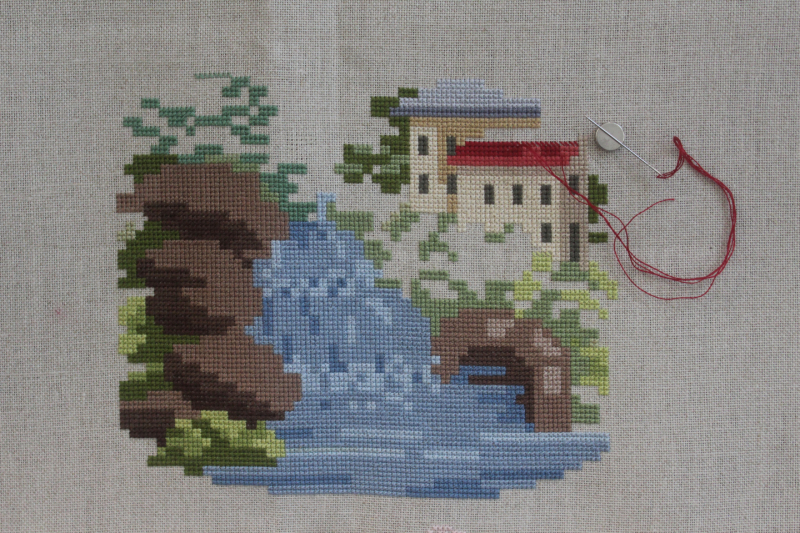
    I come across this in a drawer every so often, the outer envelope getting more and more ragged as the years pass.  After my first cross-stitch piece, I was on a mailing list, and got catalogs regularly — in one was this, a kit called simply "English Cottage Sampler".  Being by then an Anglophile of some years' standing, I was charmed by it.

    The kit still shows up on Ebay etc., so I guess a lot of other stitchers didn't even get as far as I did, which wasn't very.  I remember finding that I'd worked one section of the water horizon too high, and for some reason — or maybe life got in the way, those became busy years, I remember — I couldn't face picking it out.  (It's funny to think that it wouldn't faze me much at all, now.  I've picked out eyelet and queen stitches! picking out crosses is child's play.)

    Since this got packed away some time in the early 1990s, and I think I did not do any cross-stitch again until … good heavens, two decades later, the name Teresa Wentzler didn't mean anything to me until recently.  The earliest chart that I can see on her website is from 1989, so perhaps she was still relatively new when I bought the "Cottage" — she is now known for intricate designs with lots of colorwork, especially with blended threads, and her designs, unlike say Darlene O'Steen's which are quite formal and squared, are full of swirls and curves.  But like O'Steen, Wentzler does not stick to cross-stitch alone, and includes sometimes a number of other "specialty" stitches — the "Cottage" for example includes Smyrna cross, Algerian eyelet, diagonal satin stitch, and lazy-daisy stitch.

    It was nice to find this on Wentzler's website just now:

    Background Information: This sampler was inspired by pastoral scenes from the English countryside … (my admittedly romanticized view!) It is also my first attempt at designing a piece using whole cross stitches (except for the specialty stitches, which were also a new departure for me at the time). Samplers offer unique challenges; designing them is a welcome change-of-pace for me. Letters (alphabets) are especially interesting to manipulate compositionally … they must not overpower, but rather, must compliment the rest of the design in order to achieve a pleasing balance.

    Stitching Comments: Because it has no quarter stitches, this piece is significantly less difficult to stitch than most of my other designs. However, it is very large, and the hand-drawn chart is a challenge to read in places. Several people have told me that this piece is the very first of my designs they attempted, because of its relative simplicity … they seemed quite pleased (and justifiably proud!) of the results.

    2 4993
    I wasn't entirely sure when I started writing this post that I wouldn't just put everything back in the envelope, but I think now that it will go onto my frame to be worked.  I have two O'Steen charts on my must-do list — the "Floral" a.k.a. "Lady Brittany," and "Virtue Outshines the Stars" — and I meant to start the "Floral" soon, but haven't managed to get hold of all of the overdyed threads yet, which seem even harder to get hold of the past year and a half.  That's not the only reason, of course — I should finish it for itself.

    (You can still get the "Cottage" chart, as it happens ….)

  • 4865

    I am on the home stretch with the "Patience" sampler, with just a few more repeats of the green border, about half of the red flowers, and filling in the rest of the tiny landscape.  I'm still getting a big kick out of it, the over-the-top-ness of those letters!

    (You can see where I changed my mind, not having believed the designer when she said to use two threads for the double running stitch around the letters — I did Q, R, and S with one thread, then realized that she was probably right, and carried on with two threads, going back over R and S later to plump them out, as it were.  Haven't done Q yet, as I can't decide if it looks anemic or if I should leave it!)

    4855

    Continuing my series of mini-quilts-turned-placemats, here is one to the "Brick Road" pattern from Temecula Quilt Company, the original of which ended up in my sampler quilt.  (I am not exactly learning to love orange, but perhaps at least to accept it … in very small doses …)

    4854

    And the Broken Dishes from Prairie Children and Their Quilts by Kathleen Tracy.  This one is a kind of friendship piece, the whites being almost all TQC's but the others being some of my own stash (including scraps left from Laura's quilt and my big half-square triangles), some of Betty's from the estate sale, and some from a garage sale at the end of my street a few weeks ago — we shared a wry laugh about fabric acquisition.

    4856

    4857

    I'm enjoying the smallness of these projects, easily manageable in a few days, even the hand-quilting.  Very satisfying.

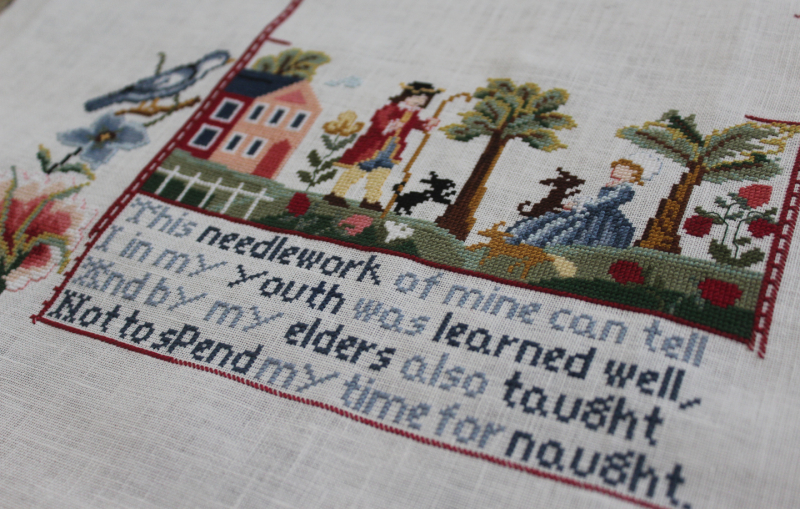
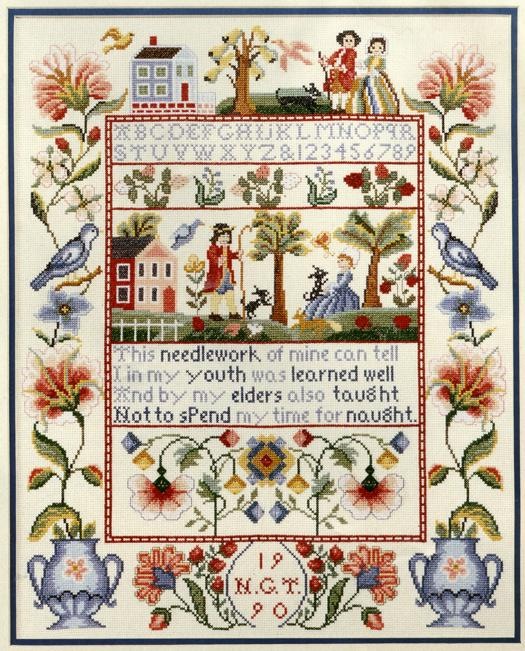
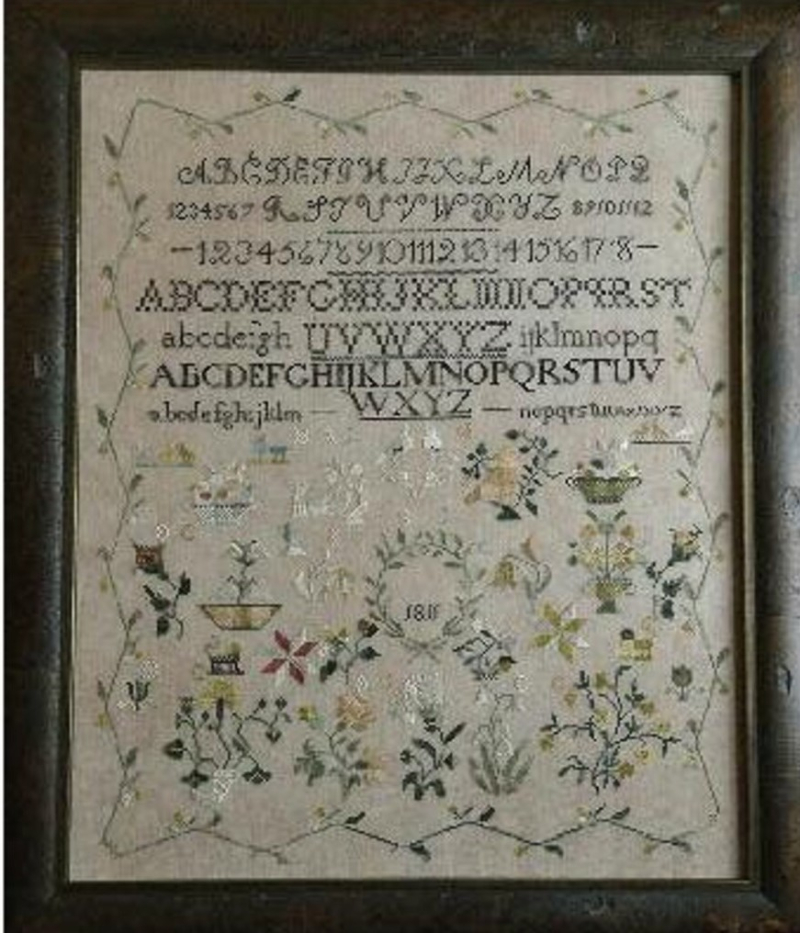
    And — I couldn't believe my luck — at a swap meet a few weeks ago I found this sampler dated 1830, and bought it for a song, a pittance.  I was not surprised when I sent a photo to Amy Finkel and she replied, briefly but kindly, that it is not worth conserving, but very happy when she agreed that it is indeed from 1830.  I plan to rechart it …

    4864

  • 4862

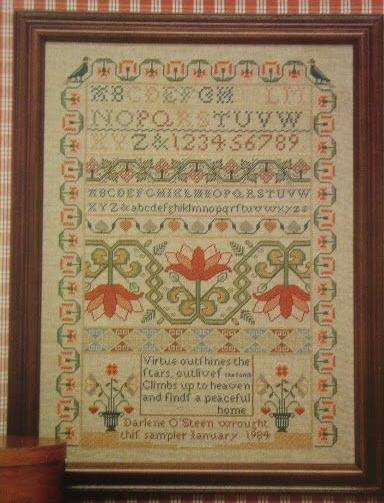
    The "Pomegranate Sampler" by Darlene O'Steen, from the May/June 1986 issue of "Just Cross Stitch" magazine.  I think this is one of her earliest designs, which is all the more impressive, that she started off at this level of excellence.  I enjoyed every moment of working this sampler — even the frustrations of having to pick out mistakes (of which I made a number) were only fleetingly annoying, because it was a pleasure to have it in my hands.

    4858

    I did make a few changes in the blue alphabet — frankly, it surprised me not a little that she made some slightly tortuous modifications to two of the As when simply re-spacing the words would allow the full letter to fit, but there it is — my quirk is that I deeply appreciate a beautifully-spaced alphabet and therefore will go to some trouble to get it! 

    I had bought a lovely selection of overdyed threads, but as I said before, I ended up using only two of them, Old Blue Jeans for the eyelet-stitch alphabet and Used Brick, which is the darker pink of the "strawberries" and other bits throughout — these are both by Crescent Colors.  (Partly this is due to the fact that there just aren't enough overdye shades to make reasonable equivalents to the range of DMC or Anchor threads … I will certainly remember in future that most of the conversion charts online are in some cases wildly "approximate"!)  The other colors I used here are for the most part the DMC ones that O'Steen suggested as an alternative for the original Au Ver à Soie silks.

    The fabric is Weeks Dye Works' 32-count linen in "Cocoa".

    4859

    I still don't really like working eyelet stitch, but they look lovely in that blue, don't they!

    4861

    I couldn't really tell from the just-not-quite-clear-enough photograph on the cover of the magazine, but it seemed to me that the satin stitch was running all in the same direction, i.e. that the top and bottom were meant to be short vertical stitches and the sides to be long vertical stitches.  This seemed a bit reckless to me, having long floats of thread lying on top of the fabric, and it seemed far more thrilling to me to miter the corners of the border, so that is what I did.  (And as I said, O'Steen's tip in The Proper Stitch of working it with one thread in the needle going round twice, instead of the potentially-twisting two making a single pass, worked more perfectly than I could have hoped!)

    4863

    Queen stitch is clearly a favorite of O'Steen's, as she uses it a lot — I find it hard to get the threads to lie nice and flat, but it was worth picking out a half-dozen or so and doing them over!

    I really like the way that some stitchers worked their family's initials in their samplers, and so the other biggish change I made was to re-do the signature panel in order to include them — these letters are worked over one thread, which was tiny! —

    4860

  • Screen-shot-2022-02-24-at-4-27-49-pm_origAs a peaceful protest and as a sign of solidarity with the Ukrainian people, Antony of At the Point Studio has generously made this chart free to share as a stitch-along project.  For details on the symbolism of the motifs and colors, inspired by traditional Ukrainian embroidery designs, and a PDF of the chart, please visit his post here.