• Thoughts on Roza’s Socks

    Roza2

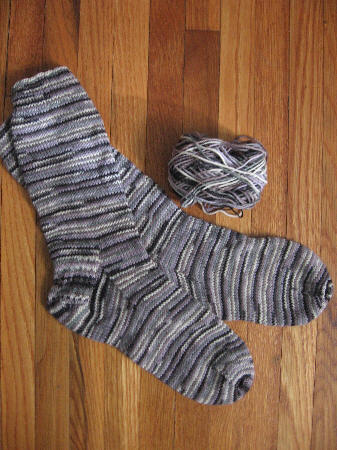
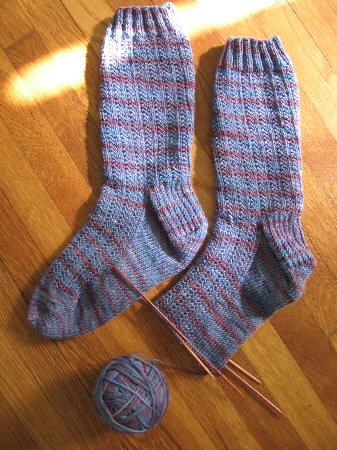
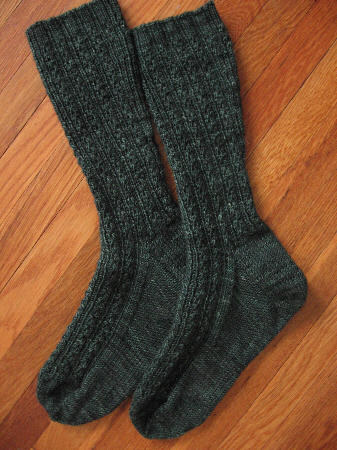
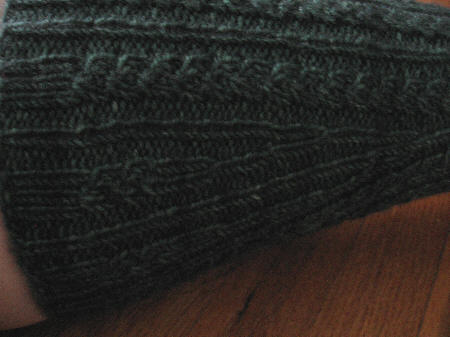
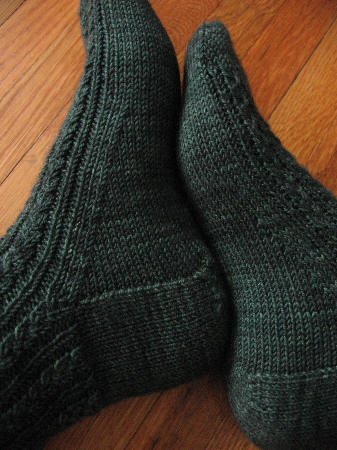
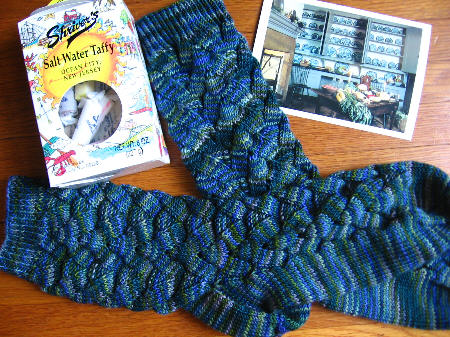
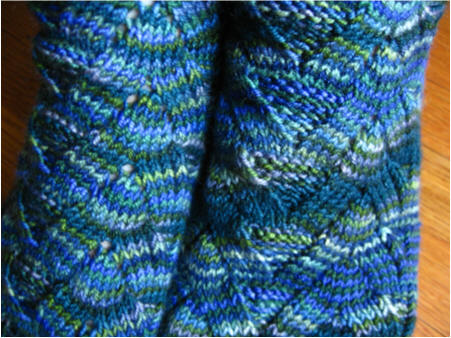
    Done! she cries in triumph.  These took a month exactly to knit, but for some reason it felt like forever.  Perhaps it was that I set them aside in despair for a week, after I misplaced my notes — found as I was beginning the second toe, behind the couch, which was not where I’d left them, I assure you.

    Roza3

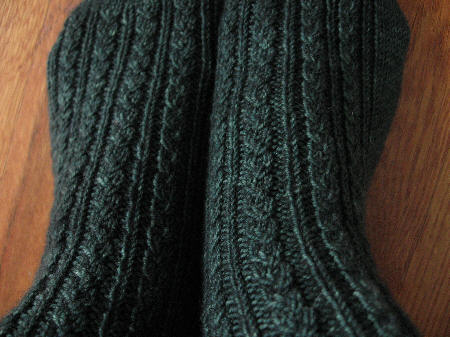
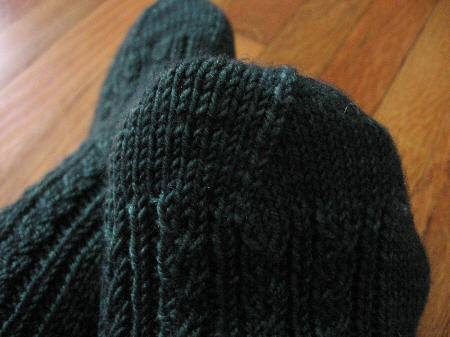
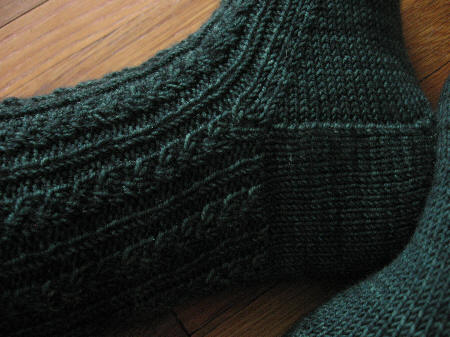
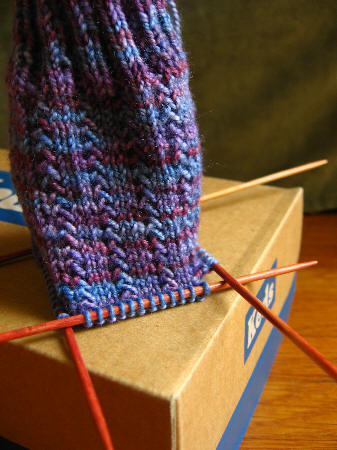
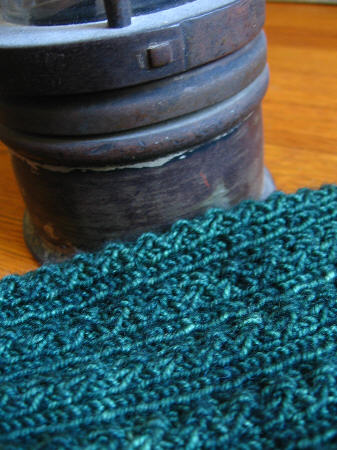
    I modified the pattern somewhat, to accommodate a larger foot than in the original — I added an extra brioche rib repeat, so there were 6 more sts to contend with when it got down to the heel.  This wasn’t terribly difficult, but I did also have to realign the placement of the brioche rib on the instep as well, since 3 of those extra 6 sts had to go on the bottom of the foot and it didn’t line up the same way as the original.  I also worked the leg to 7 inches, instead of the 8 specified, as the rib at the top was very tight even just one inch higher (the brioche is much stretchier than the plain rib), and I lengthened the heel flap to fit better on a high instep.  The toe seems rather narrow as written — I would (will?) change this for my own pair.

    Roza4

    All in all, I like the pattern very much and will add it to the list of things to make for myself!  Hope my sockpal is pleased, too —

    Roza6

    Sazor2

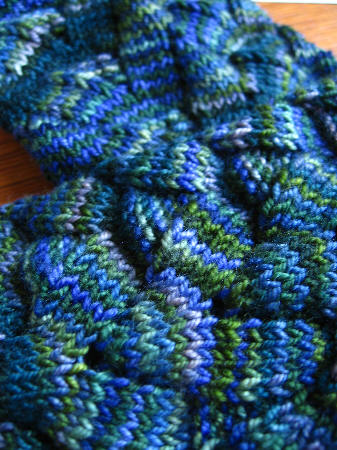
    Sazor socks — Rozas inside-out!

    Sockapalooza4_button

  • Field of Flowers

    Flowers11

    We have a very large pine tree in our backyard, planted smack in the middle some seventy years ago, now about eighty feet tall and home to various squirrels, birds, and perhaps a possum or two, as well as a deliriously long-reaching swing.  The drawbacks of it are, obviously, pine tar spots on the deck and unsuspecting bare feet, a constant carpet of needles, and that the canopy reaches literally from one side of our property to the other.  But when I saw this seed packet at the market a few months ago, I thought, "Shade? we’ve got that!"

    Flowers12

    The girls and I had a grand time, then, poking holes in the earth and dropping a pinch of seed into each — by the time we’d gotten about halfway through the large packet, I thought, "oh, well!" and simply flung them into the air to fall where they would.  I haven’t done a thing to them since, except for watering now and then in a dry spell, and we’ve been rewarded with a veritable flower meadow.

    We haven’t seen the forget-me-not and baby-blue-eyes varieties yet, nor I think much of the self-heal and blue pimpernel — curiously enough, all blue — nor the foxgloves, but the yellow button daisies (Chrysanthemum multicaule) are just starting to open — you can see the yellow dots in the top photo — and about two-thirds of the others are well in evidence.

    Flowers1

    These charming things, which I’d never heard of before, are mountain garland (Clarkia unguiculata), in a variety of purple and pink shades.  Lots of the sweet alyssum (Lobularia maritima) in the background, freely reseeding itself for the past few years — patches of dichondra (D. micrantha), too, amusingly, from some long-forgotten lawn I suppose.

    Flowers2

    Flowers5

    The packet says only Shirley poppies (Papaver rhoeas), although the red one hasn’t got the black underpinnings of the Shirleys, and there are many more colors than simply red.

    Flowers6

    The bees are happy to see them, too.

    Flowers7

    Toadflax or "baby snapdragon" (Linaria maroccana) —

    Flowers8

    and tiny columbines (Aquilegia hybrida).

    Flowers9

    I probably should thin things a bit, as they are living in each other’s pockets, as it were, but the charm is the accidental posies, here with some of the pale blue Virginia stock (Malcomia maritima) just underneath.

  • Booking Through Thursday asks this week,

    Almost everyone can name at least one author that you would love just ONE more book from. Either because they’re dead, not being published any more, not writing more, not producing new work for whatever reason . . . or they’ve aged and aren’t writing to their old standards any more . . . For whatever reason, there just hasn’t been anything new (or worth reading) of theirs and isn’t likely to be.

    If you could have just ONE more book from an author you love . . . a book that would be as good any of their best (while we’re dreaming) . . . something that would round out a series, or finish their last work, or just be something NEW . . . Who would the author be, and why? Jane Austen? Shakespeare? Laurie Colwin? Kurt Vonnegut?

    Nutmeg_amazon

    David asked me last night, "Where are your mystery books?" and I pointed to a shelf in the living room.  He was gone for some moments, then came back with not a mystery but Master and Commander, the first in the novels by Patrick O’Brian chronicling the adventures of Jack Aubrey and his friend Stephen Maturin in the early 19th-century English navy, and basis for the brilliantly atmospheric if somewhat hodge-podge movie of the same name.  We sat together for a while, David reading and I knitting, but I kept glancing over at his book, and before long put my knitting away and picked up The Nutmeg of Consolation, fourteenth in the series.  Why I’ve left it so long, I can’t say — it’s been two years at least since I read the previous book.  What was I thinking?

    I was rewarded nearly at once by this, as the marooned sailors take a respite, from their hard work of building a schooner from the wreckage of their frigate, in a game of cricket:

    "What Stephen did not fully appreciate was the degree of pleasure that Jack took in this particular ceremony.  As a captain Aubrey was exceedingly worried by the shortage of food and marine stores, particularly cordage, by the near absence of powder, and by the coming total absence of arrack and tobacco; but as a cricketer he knew that close concentration was necessary on any pitch, above all on one like this, which more closely resembled a stretch of white concrete than any Christian meadow, and when he came in second wicket down, the yeoman of the sheets having been bowled by the sergeant of the Marines for a creditable sixteen, he took centre and looked about him with an eager, piercing, predatory eye, tapping the block-hole with his bat, wholly taken up with the matter at hand." (p.11)

    A masterful paragraph.  It conveys something of Jack’s charisma as a leader, his dedication to his men, his attention to detail (when it concerns his ship, at least) and his sportsmanship and raw energy, with a nice touch of humor, and also something of Stephen’s obtuseness when it comes to cricket (shadowed by his even greater denseness when confronted with naval terminology, which despite knowing umpteen languages and impossibly arcane minutiae of medical and zoological terminology, not to mention having spent by this time some dozen years at sea with Jack, remains a blank to him).  And it is of course, bar the opening line, all one sentence.

    ("Nutmeg of Consolation" is an honorific carried by the Sultan of Pulo Prabang (in the South China Sea), who features in the previous book, whose title is borrowed by Jack to christen his newest vessel, "a tight, sweet, newly-coppered, broad-buttocked little ship, a solace to any man’s heart" (p.80).)

    Patrick O’Brian died, alas, in 2000, and I am reading the fourteenth book in a series of twenty (twenty-one, if you count the one unfinished at his death), but even though I can console myself with the thought that I can certainly read the whole canon over again from the beginning once I’ve finished, there is a certain wistfulness that there are no more to be had.  One of the things I appreciate most about these novels is that despite the nearly-interminable amount of naval jargon, it isn’t really necessary to know much of it.  One can infer from context that a topgallants are a kind of sail, and so on — and more information can be found at The Gunroom and the aptly-named Guide for the Perplexed, or in any number of O’Brian lexicons — and quite a lot is explained to Stephen as things go along! — but even lubbers such as myself can simply enjoy such passages as this, "Royal masts were sent up and their sails were set upon them, very fine and delicate canvas too; and since the wind, a good steady topgallant breeze, was now abaft the beam, studdingsails too made their charming appearance, four on the weather side of the foremast and two on the main, with a crowd of staysails; spritsail and spritsail topsail, of course, with all the jibs that would stand, a noble array.  Presently skysails flashed out above the royals, and all hands watched the water rise high at the bows, sink to the copper abaft the forechains and then race hissing along her side, leaving a broad wake behind, stretching straight and true to the west by south" (p.110), which creates a fine picture in the mind’s eye but does not hinder the storyline if rigging is a mystery.

    Well, I could go on, but this post is quite long enough already, I suspect!  Suffice it to say that I recommend these books highly as brilliant and entertaining historical novels, with great depth of characterization and elegant prose.  Cracking good reads, too.  Give you joy, as Stephen Maturin might say, if you’ve yet to discover them!

  • Progress —

    The first rule about adapting a sock pattern to a different size is to keep extensive notes about the changes you make, so that you can repeat them exactly for the other sock.

    Img_8941small_2

    The second rule is not to lose your notes.

  • ,

    Dona Nobis Pacem

    Pvtalexm_3

    It seemed appropriate that on Memorial Day, we were singing this evening Haydn’s Paukenmesse, "Mass in Time of War," and Vaughn Williams’ "Dona Nobis Pacem."  These are very different pieces, one melodic and classically structured, the other unsettling, brutal at times and disillusioned, but with a stark beauty — and yet the two works share not only their use of a fabulous percussion score, wonderfully stirring and martial, but a culmination on the Latin text dona nobis pacem, "grant us peace."

    Garrison Keillor, in "The Writer’s Almanac", which I heard on the radio on the way to choir practice, said that Memorial Day was originally not a day for speeches and debates, but simply a day for both sides — as it was not long after the Civil War — to come together and remember, not to judge, but just to remember.  We do so much judging these days, and so little remembering.

    The Vaughn Williams piece is set to Biblical texts — "Nation shall not lift up their sword against nation, neither shall they learn war any more" — and three poems by Walt Whitman.  Whitman is a lot like Vaughn Williams, I think, weird and wonderful.  Sometimes I think he’s a bit, well, over-the-top, but other times, even with the same poem, I can’t read it without tears in my eyes.  This is from "Dirge for Two Veterans" —

    I see a sad procession,
    And I hear the sound of coming full-keyed bugles,
    All the channels of the city streets they’re flooding
    As with voices and with tears.

    I hear the great drums pounding,
    And the small drums steady whirring,
    And every blow of the great convulsive drums
    Strikes me through and through.

    For the son is brought with the father,
    In the foremost ranks of the fierce assault they fell,
    Two veterans, son and father, dropped together,
    And the double grave awaits them.

    Now nearer blow the bugles,
    And the drums strike more convulsive,
    And the daylight o’er the pavement quite has faded,
    And the strong dead-march enwraps me.

    In the eastern sky up-buoying,
    The sorrowful vast phantom moves illumined,
    ‘Tis some mother’s large transparent face,
    In heaven brighter growing.

    The moon gives you light,
    And the bugles and the drums give you music,
    And my heart, O my soldiers, my veterans,
    My heart gives you love.

    (The soldier in the photograph is a cousin of mine, some half-dozen generations back, from Ohio.)

  • Booking Through Thursday has a new home and a new button —

    Btt2

    This week, BTT asks about inspiration.

    It happens even to the best readers from time to time… you close the cover on the book you’re reading and discover, to your horror, that there’s nothing else to read. Either there’s nothing in the house, or nothing you’re in the mood for. Just, nothing that “clicks.” What do you do?? How do you get the reading wheels turning again?

    After I finished reading Linda Lear’s excellent biography Beatrix Potter: A Life in Nature a few weeks ago, I already had Judith Levine’s Not Buying It in hand, thanks to Elizabeth of "A Mingled Yarn", who wrote a few weeks ago about the book, intriguing me enough to search out a copy — that was easy enough!  Sometimes, all it takes to inspire me is a trip to the library, especially when I see a favorite author on the New Book shelf — I came home with Claire Tomalin’s book on Thomas Hardy the other day, and am looking forward to starting it this weekend.

    Like with knitting, or with most things, really, I don’t like to read when I’m not in the mood — makes it seem like work, that way.  There are usually enough other things to either distract me for a while or keep me busy until the inspiration does come!

  • Logcabinsocks1

    These were finished in a bit of a rush, before the hot weather hits and I don’t even want to think about thick wool — the Log Cabin Socks, my first project from Handknit Holidays by Melanie Falick, despite my having owned the book for over a year now.  I must confess that I did not particularly enjoy making these socks.  It’s my first experience with Cork, so I will reserve judgement on it until I knit it at a more reasonable gauge, but here I felt like I was trying to beat it into submission — not the experience one wants with one’s knitting.  It didn’t help, to be sure, that my Surina bamboo needles have splits in the tips (again!), so kept catching and splitting the wool.

    I was also, like quite a lot of the knitters who have already made these socks, a bit perturbed at the difference between the instructions and the photograph.  Directions for the heel flap don’t mention leaving out the last few cables, but I just worked the sts as established after Row 18 of the chart, instead of switching to the second cable portion.  I’ve heard that the book has rather a lot of errors (there is an errata page from the publisher), but luckily the only other one that I noticed was more one of clarity than actual error: the last part of the heel turn should be something like "Rep Rows 1 and 2 three (four) times, omitting final K1 in last rep of Row 1, and final P1 in last rep of Row 2."  The heel was a bit wonky, but I suppose that’s due more to the gargantuosity of Cork than anything else.

    Logcabinsocks2

    I had the morning to myself for finishing, and so I thought this movie would be appropriate —

    Logcabinsocks3

    Log cabins and all, don’t you know.  "Seven Brides for Seven Brothers" has really grown on me.  I was a bit bored by it when I first saw it, but I’ve come to appreciate its rustic charms.  My feminist hackles raise a bit, of course, but there is enough in the characters to counter most of that!  Howard Keel is wonderful enough to make me think that I would have married him on the spot, too!  And I like that Milly knows her own mind well enough to take the risk, but is spunky enough (in the best possible way) to stand up to Adam when she needs to.  I don’t need to say anything — well, not very much, anyway! — about how terrific the dancing is, as the barn-raising number alone is enough to guarantee the movie its place in musical-comedy history, but the music is fabulous too, beautiful Gene de Paul/Johnny Mercer tunes that leave me humming them for days.

    The accompanying documentary on the single-disc DVD has some interesting tidbits and interviews, as well.  Sometimes I find the behind-the-scenes information so distracting that I don’t enjoy the movie as much as I would like to — which I found to be the case in some of the "Lord of the Rings" movies, for instance — but here it’s just fun.  One of the brothers, for instance, was played by a non-dancer, such an intimidating thing in the company of Jacques d’Amboise and Russ Tamblyn, et al., that you can see him around the musical numbers but not actually in them, so we have a good time Benjamin-spotting during the dances — "look, he’s on the other side now! oh, sitting down!".  (Reminds me of the little girl in the "Seventy-Six Trombones" number in "The Music Man" who obviously had trouble remembering the steps, as she’s watching the feet of the other little girl.  Poor thing! I sympathize whole-heartedly.)

    "Bless your beautiful hide,
    Wherever you may be!
    We ain’t met yet
    But I’m willin’ to bet
    You’re the girl for me!"

  • Merrymdn_dress_b1

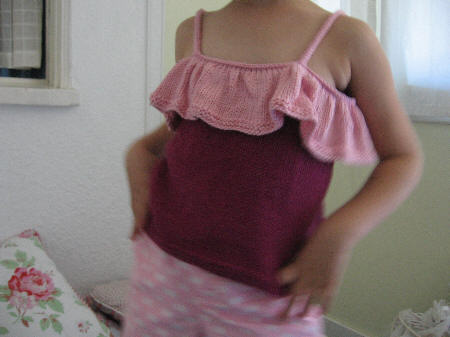
    This is seriously cute — the Merry Maiden’s dress by Gryphon Perkins, from the Spring ’07 IK.  It certainly strikes a chord with my own mediaeval-princess fantasies!

    I’m not sure than I’d want to spend a hundred dollars on a girl’s handknit, though, even if it is for my own lovely princesses.  In wool, in southern California.  Here’s one in Plymouth Encore.  I’m still in the planning stages, of course, but not sure whether I’d go for economy, or wool blend and washability — Shepherd Worsted?  All-Seasons Cotton?

  • Roza_blackberry

    I think I’ve settled on a pattern for my exchange pal — Roza’s Socks, by the inimitable Grumperina, to be found in the IK Spring ’07 issue.  I had some trouble with the brioche stitch for a while, but it seems to have evened itself out, although mine looks more than a bit lacier than the originals.  I tend to knit very loosely (which I can never understand, as frankly I’m a very tense person), and the pattern calls for US0/2mm needles for the Shepherd Sock, but I really didn’t fancy having to search out smaller needles.  Luckily, we like lace!

    Sockapalooza4_button

    On another note, I may also have solved the problem of the Elusive Purples.  My camera, a Canon PowerShot A520, tends to drain out the red tones from most purples, leaving them more blue than anything else.  I learned how to use the "snow" setting this past winter, and discovered the other day that the "foliage" setting indoors (go figure) got me a fairly true Blackberry.  The foliage setting did not work in this morning’s seven a.m. overcast light, but "underwater" did!  (The underwater setting seems to pull the blues out of foliage, though, as you can see in the sword ferns in the background.  But it’s the yarn we’re interested in, here!)

    Exp1 Exp2

  • Blackberry

    Shepherdsock_blackberry

    Lorna’s Laces Shepherd Sock in purply Blackberry, in about 48 hours from Jimmy Beans.

    Now to choose a pattern….

    Sockapalooza4_button