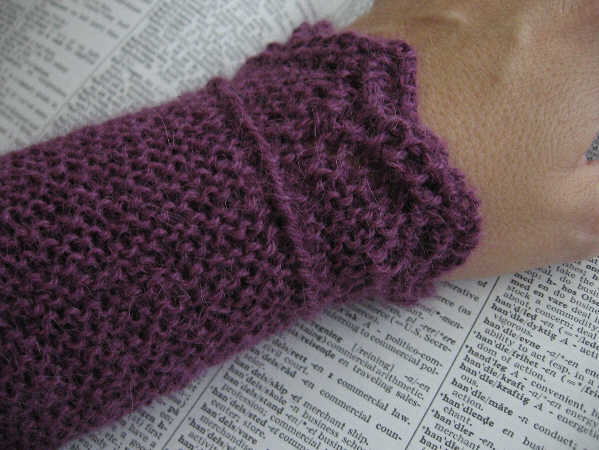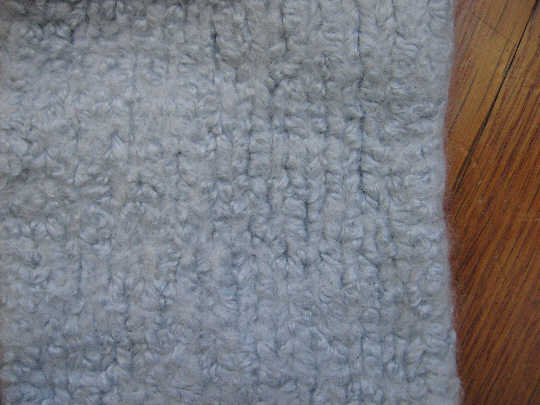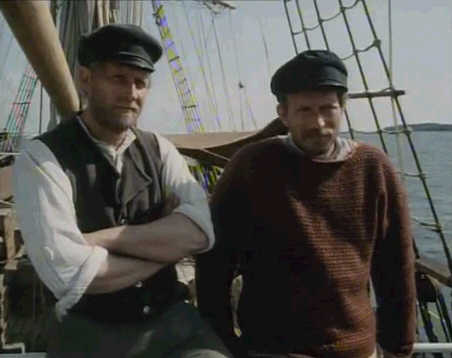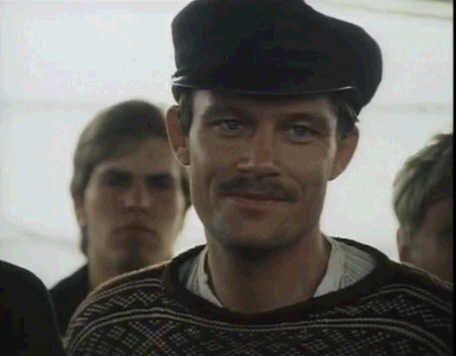
• This scarf is named for HMS Sophie, the first vessel under the command of newly-fledged Captain Jack Aubrey in Patrick O’Brian’s Master and Commander, the first in a series of novels set in the early 19th-century Royal Navy. The Sophie was a fourteen-gun brig-rigged sloop who “spread her wings a little more like an unhurried dove than an eager hawk…. [Jack’s] chief impression was of old-fashionedness: the Sophie had something archaic about her, as though she would rather have her bottom hobnailed than coppered, and would rather pay her sides than paint them…. He loved her dearly — had loved her from the moment his eye first swept along her sweetly curving deck.

     The lace patterns are adapted from the Ladies’ Home Journal Edging #2 and the Insertion to Match Knitted Lace #2 in Nancie Wiseman’s Lace From the Attic (Interweave Press, 1998).  They are simple but effective laces, and the slightly heavier-weight wool than usually used for lace gives them a sturdiness that in no way detracts from their beauty. 

    Sophie_small

    Materials

    150g (525 m) DK weight wool, working up to approximately 22 sts per 10 cm in st st on 4mm needles. Model shown in Filatura di Crosa Soft Wool (75% extrafine merino, 25% angora) in color 516.

    Size 4.5 mm (US7) needles, or size needed to obtain gauge.

    2 st markers.

    Finished size: approx. 25 x 200 cm.

    Note: The slipped st selvedge creates a tidy “chain” along all sides of the scarf, as well as a convenient edge for attaching the main section of lace to the border. Picking up both sts of this chain for the main lace patt will leave the chain showing at the back of the work, whereas picking up only one st will disguise the picked-up line, leaving the scarf almost completely reversible.

    Border

    Cast on 20 sts using crochet cast-on.

    K 6 rows.

    Row 1: Sl 1 p-wise wyif, K2, yo, P2tog, K1, yo, K2tog, K2, yo, K2tog, K3, yo, P2tog, K1, [yo] 3 times, K2. (23 sts)

    Row 2: K3, P1, K2, yo, P2tog, K10, yo, P2tog, K3.

    Row 3: Sl 1 p-wise wyif, K2, yo, P2tog, [K2, yo, K2tog] twice, K2, yo, P2tog, K6.

    Row 4: K6, yo, P2tog, K10, yo, P2tog, K3.

    Row 5: Sl 1 p-wise wyif, K2, yo, P2tog, K3, yo, K2tog, K2, yo, K2tog, K1, yo, P2tog, K6.

    Row 6: K6, yo, P2tog, K10, yo, P2tog, K3.

    Row 7: Sl 1 p-wise wyif, K2, yo, P2tog, K4, yo, K2tog, K2 yo, K2tog, yo, P2tog, K6.

    Row 8: [K2tog, sl st back onto left-hand needle] twice, K2tog, K2, yo, P2 tog, K10, yo, P2tog, K3. (20 sts)

    Rep these 8 rows 8 times more.

    K 5 rows.

    BO 19 sts in K1, P1 rib, working first 2 sts as K2tog. 1 st rem on needle.

    Main lace section

    Pick up 44 sts evenly along straight edge of border, 1 st into 1 loop of “chain” at slipped edge.

    Set-up row: Sl 1 p-wise wyif, K to end.

    Note: Place a st marker after the first and second reps of the lace patt, if desired.

    Row 1: Sl 1 p-wise wyif, K2, *K1, yo, K2tog, K1, K2tog, yo twice, K2tog, K2, yo, K2tog, K1, rep from * to last 2 sts, K2.

    Row 2: Sl 1 p-wise wyif, K1, *K2, yo, K2tog, K3, P1, K3, yo, K2tog, rep from * to last 3 sts, K3.

    Row 3: Sl 1 p-wise wyif, K2, *K1, yo, K2tog, K7, yo, K2 tog, K1, rep from * to last 2 sts, K2.

    Row 4: Sl 1 p-wise wyif, K1, *K2, yo, K2tog, K7, yo, K2tog, rep from * to last 3 sts, K3.

    Rep these 4 rows until work measures approx. 170 cm or desired length from beg of main section.

    Next row: Sl 1 p-wise wyif, K to end, removing st markers.

    Place these 44 sts on a stitch holder or dpn, if desired.

    Border

    Cast on 19 sts using crochet cast-on.

    Set up lace border as follows:

    First row: K to last st, K this st tog with next st from holder.

    Second row: K to last st, M1, K1.

    Third row: K to last st, K this st tog with next st from holder.

    Fourth row: K.

    Rep 3rd and 4th rows once more, then 3rd row once more.

    Begin lace border patt:

    Row 1: K3, yo, P2tog, K1, yo, K2tog, K2, yo, K2tog, K3, yo, P2tog, K1, [yo] 3 times, K2. (23 sts)

    Row 2: K3, P1, K2, yo, P2tog, K10, yo, P2tog, K2, K last st tog with next st from holder.

    Row 3: K3, yo, P2tog, [K2, yo, K2tog] twice, K2, yo, P2tog, K6.

    Row 4: K6, yo, P2tog, K10, yo, P2tog, K2, K last st tog with next st from holder.

    Row 5: K3, yo, P2tog, K3, yo, K2tog, K2, yo, K2tog, K1, yo, P2tog, K6.

    Row 6: K6, yo, P2tog, K10, yo, P2tog, K2, K last st tog with next st from holder.

    Row 7: K3, yo, P2tog, K4, yo, K2tog, K2, yo, K2tog, yo, P2tog, K6.

    Row 8: [K2tog, sl st back onto left-hand needle] twice, K2tog, K2, yo, P2 tog, K10, yo, P2tog, K2, K last st tog with next st from holder. (20 sts)

    Rep these 8 rows 8 times more.

    Next row (WS): K.

    Next row (RS): K to last st, K this st tog with next st from holder.

    Rep these 2 rows twice more. K 1 row.

    (RS) BO 19 sts in K1, P1 rib, working first 2 sts as K2tog. Work last st tog with rem st from holder, and BO this last st. Weave in ends, and block lightly.

    This pattern copyright 2009 by A Bluestocking Knits.

    Sophie_detail_small

    Revised 16 May 2012, and 8 April 2014.

  • No, I don't know why, either.  I just had a craving.  This is the start of Nancy Bush's Norwegian Gloves, a free pattern available from Interweave.  I chose Dale's Falk instead of Heilo for its handwashiness — plus it felt deliciously soft, unlike Heilo's rather gruff asperity in comparison.

    Multi-color gloves are, I must say, not for the faint-hearted.  The pattern itself is not particularly difficult — it's the fiddliness of dealing with both two strands of wool and five needles.  It took me a while to get into the rhythm of it, especially at the joins where two needles meet, and I don't think I am completely successful yet, but am erring on the side of caution where stranding is concerned, as all advice has it, and leaving the floats a bit loose.

    Progress_1

    I tried on the glove just after casting on the thumb stitches atop the gusset, and thought that it was a bit small, but after working ten more rounds or so, I realized that it was spot-on.  My gauge is pretty much exactly 7 sts per inch/28 per 10 cm, on 2.5 mm needles.

    Progress_2

    My problem with it now, you might see, is that the edges of the patterns do not line up with the edges of my hand.  The thumb gusset is too far towards the center of the palm.  This probably makes a prettier glove when lying flat on a table, but on my hand I was continually tugging at it.

    I was undecided as of this morning whether I would just carry on and finish it as written, or start over again, but upon looking at the photos, I feel that I really must start it again — it's painfully obvious in this photo, much more so even than on my hand:

    Progress_3

    perhaps because I could not actually twist my arm far enough to see it so clearly!

    And I think I will take the opportunity to work the red rounds with a jogless jog, too.  In for a penny, in for a pound.

  • Annas_shawl

    This is Annas Shawl, from Anna at Stickfrossa.  It's a simple, fast knit, very satisfying.  I did run back to the yarn shop and get another ball of Felted Tweed as it seemed a bit short, but it stretched quite a lot with blocking, so maybe it would have been all right.  I didn't make any modifications as such, except for not changing needle size for the edging, mostly because I forgot.

    The Felted Tweed was very pleasant to knit with, full of texture and wonderful nubbins of blue and white and gold against the dark green.  It is not particularly warm, so makes a nice shoulder covering for cool weather.  I loved the way the edging curled up before blocking, like a little sea anemone —

    Annas_2

    I watched the entire twelve hours of "Poldark" knitting this ….

  • Odessa Revisited

    Odessa1

    This is, of course, the famous Odessa, which is turning out to be quite a hit with the little girls of our social circle.  I made this one as a birthday gift at a party Julia attended the other day.

    Odessabeads

    I got tired of white beads on colored wool, so I did pink beads on white this time — the beads came in a pack of various shades and textures, but I used only the rounded ones as the bugle shapes apparently had much-smaller holes.  I rather liked the subtlety of the effect of the slightly different pinks.

    Odessa2

  • David went off on a business trip to Orlando a few weeks ago, but all was forgiven when he came home with this wonderful Dale of Norway cardigan for me, in my favorite Setesdal "lice" pattern, from the Norway Pavilion at Epcot.

    Grotli1

    Grotli2 

    It isn't actually black, but a beautiful charcoal grey with white hairs throughout, very subtle.

    Grotli3 

    And of course, the inside, because we're knitters —

    Grotli4

  • I was happily rereading Patrick O'Brian's first novel of Jack Aubrey and Stephen Maturin's adventures, as one does, when with one of those curious leaps one's mind occasionally makes, I thought, "I'd like a bit of lace around my neck."

    Sophie_small

    Hence, the "Sophie" scarf.  I've had this Filatura di Crosa wool in the drawer for an age, and thought now that it would make an interesting lace, sturdy and delicate at the same time.  It reminded me of Jack's first ship, which causes a number of raised eyebrows in the book due to her modest and homely looks — "the little small squat merchantman with two masts?" as Stephen inelegantly puts it — but which Jack loves dearly.   The lace is not a flashy one, but comfortable, like the Sophie herself, who "spread her wings more like an unhurried dove than an eager hawk" (ch.2).

    The lace patterns, from Nancie Wiseman’s Lace From the Attic (Interweave Press,
    1998) are easily memorized and worked — I liked the way they went together so easily, the echo of the edging's holes in the main pattern.

    Sophie_detail_small

    The pattern is available here.

    Geoffhunt_hmssophieleavingportmahon

    "Jack let her pay off until the flurry was over, and then, as he began to bring her back, his hands strong on the spokes, so he came into direct contact with the living essence of the sloop: the vibration beneath his palm, something between a sound and a
    flow, came straight up from her rudder, and it joined with the innumerable rhythms, the creak and humming of her hull and rigging.  The keen clear wind swept in on his left cheek, and as he bore on the helm so the Sophie answered, quicker and more nervous than he expected. Closer and closer to the wind. They were all staring up and forward: at last, in spite of the fiddle-tight bowline, the foretopgallantsail shivered, and Jack eased off. ‘East by north, a half north,’ he observed with satisfaction" (Master and Commander, ch.2).

  • Yellow Tulips

    Tulips

  • Ravenclaw1 


    I have been knitting — a little — witness the Ravenclaw scarf finished in December and worn quite a lot since then!

    I doubled the length of the fringe as specified in the pattern — it seems to match the generous length of the scarf a little better.


    Ravenclaw2 


    And this, wh. is taking up rather a lot of my knitting interest these days — the “Vest for a Fiancé” from Inger Fredholm’s Knitting With a Smile. I didn’t have the wherewithal to send to Sweden for the wool, so I’m using Smart from my local yarn shop. I have a few quibbles with the pattern, but it’s so very cheerful that I really don’t mind at all.


    Sw


    And listening to the Boswell Sisters, who really swing —


  • Sweet Heart

    Heart

  • Twelfth Night

    2007-12-7-twelfth-night_theatreworks

    VIOLA. What country, friends, is this?

    CAPTAIN. This is Illyria, lady.

    VIOLA. And what should I do in Illyria?  My brother he is in Elysium.  Perchance he is not drown'd. — What think you, sailors?

    The Captain (Michael Ching) and Viola (Carrie Kawa) arrive in Illyria in this 2007 TheatreWorks production of Shakespeare's "Twelfth Night" at the Lucie Stern Theatre in Palo Alto.