-
-
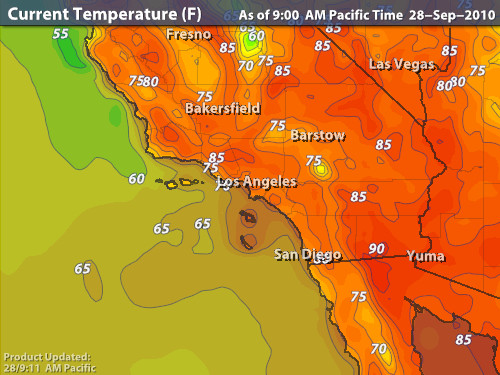
So yesterday set a record Los Angeles temperature for the hottest 27th ever — 113° F (45° C).
And just a little over a week ago, I was contemplating putting the comforter back on the bed. I had a number of autumnal meals planned for this week — baked ziti tonight. I don't think so.
Here's my knitting —

Yeah, it's all theoretical. I don't even want to touch wool just now.
I finished reading Brat Farrar the other day, and started on A Shilling for Candles.
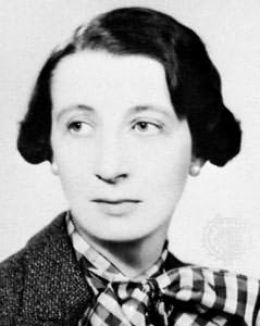
Josephine Tey (Elizabeth Mackintosh), 1896-1952
Brat Farrar is the story of an imposter — we know from the very beginning that he is not who he says he is, and so the "mystery" comes from how Brat fits in, or not, with the family of the presumed-dead Patrick, how he deals with his own feelings about his deception, and whether or not the truth will come out. I can't really say more about the plot for fear of giving something away. It is a very complex story that doesn't seem so — I mean that Tey makes it look easy — and it is interesting to read it again knowing how it will end, to see just how Tey works everything in. Her wonderful ability to create different characters is very much in evidence here, and the way that her humor comes not through some authorial voice but through the characters themselves.
I remember reading somewhere very long ago a rather magisterial list that Dorothy L. Sayers once drew up, of the transgressions that a mystery writer must not make, and one was that a crime must never be solved by intuition. As much as I like both Sayers and Tey, I had to laugh when hunches popped up more than once in Tey's books. I wonder what Sayers thought of them.
-
Just this moment finished Frontier Wolf by Rosemary Sutcliff — in fact the first of her novels that I have ever read, surprisingly, since I have long admired her memoir Blue Remembered Hills after reading it straight off the cataloging cart in 1983. Frontier Wolf is part of her series loosely following members of the Aquila family in Roman Britain, this one to do with the young and disgraced Alexios Flavius Aquila sent to command a band of half-wild frontier scouts north of Hadrian's Wall in 343 A.D.
Sutcliff's prose is extremely readable, very evocative at times in her descriptions of the countryside even in its wintry glumness — oh, Britain in January! — yet spare and unstinting when dealing with the realities of life in that brutal time and place. She is noticeably more "modern" than Ellis Peters but in the same vein; I didn't care much for her use of sentence fragments, but this is a minor cavil. I was quite caught up with the story, and read the whole novel in two days, and I am actually not a little disappointed that there does not seem to be another book with this character, who I found very interesting in the way that he dealt with his mistakes and dilemmas.
The cover of this edition, too is an excellent fit to the story — dark, brooding, enigmatic.
I've also just finished Miss Pym Disposes, the first of my re-read of those Josephine Tey books that I own, and am a few chapters into The Franchise Affair. I have long admired Tey, and was surprised to realize not long ago that
it must be twenty years since I have read any of her books. I remember the three novels in the first omnibus pretty well, I think — Miss Pym, Franchise, and Brat Farrar –and of course her most famous, The Daughter of Time, but not the others — A Shilling for Candles and The Singing Sands — so I am looking forward to the re-read.I do have to say here, though, that this time around I am finding Tey's repeated insistence on the infallibility of facial features as indications of character to be more than a little irritating and at times quite unsettling. It has more than a whiff of phrenology about it at times. And anyone who has seen "A Class Divided" can't, I think, help seeing the injustice in the assertion that people with a certain shade of blue eyes are all liars. To be sure, Tey does qualify her insistence at least once, in this exchange from The Franchise Affair, here replying to the statement that people who have one eye larger than the other are invariably murderers: "'And when you turn up a photograph of the revered vicar of Nether Dumbleton who is being given a presentation by his grateful parishioners to mark his fiftieth year of devoted service, and you note that the setting of his eyes is wildly unequal, what conclusion do you come to?' 'That his wife satisfies him, his children obey him, his stipend is sufficient for his needs, he has no politics, he gets on with the local big-wigs, and he is allowed to have the kind of services he wants. In fact, he has never had the slightest need to murder anyone.' 'It seems to me that you are having your cake and eating it very nicely.'"
I have to say that I didn't quite buy Tey's verdict that Richard III did not murder the Princes in the Tower, mostly because the portrait on which she bases her whole premise, apparently this one,

has always given me the creeps. Personally, I think it risky to base character analysis at this level on a painting, when so much depends on the talent of the portrait painter.
The fact that the above portrait from the National Gallery is a late-16th-century copy of an early-16th-century painting, viz this one,

which is in turn apparently a retouched copy of a now-lost contemporary (15th-century) portrait, makes its likeness to the original even more suspect, like a great game of visual Telephone.
But never mind, we were talking about books — Tey is a delight to read, so much that the fact that I take exception to some of her arguments feels more like friendly banter than a serious disagreement. Her characters feel true-to-life, even to their pet theories and the vigor with which they defend them, her stories move along at a cracking pace, and her intelligence and wit shine through on every page.
-

Today was the first day of school. We went to the mall last week in preparation. Both of the girls said that they didn't really need clothes — Grandma has gotten them each a skort-and-top set — but Julia's shoes were literally falling apart, and Laura has already outgrown her size sevens from last year. We got back in less than three hours (including a long thirty for lunch), which compared to last year was the blink of an eye, thank goodness.
I also made them each one of these —
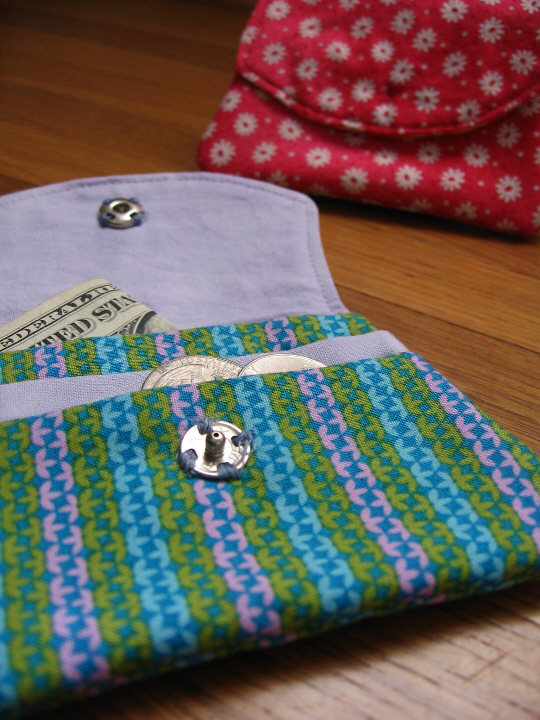
from the "Little Wallet" pattern by Valori Wells that I bought at the craft store. The girls keep losing their coin purses, so I thought this would be perfect, as the two fat quarters recommended in the materials list would easily make three wallets. I probably even had enough in the scrap stash, but these fabrics were bright and cheerful.
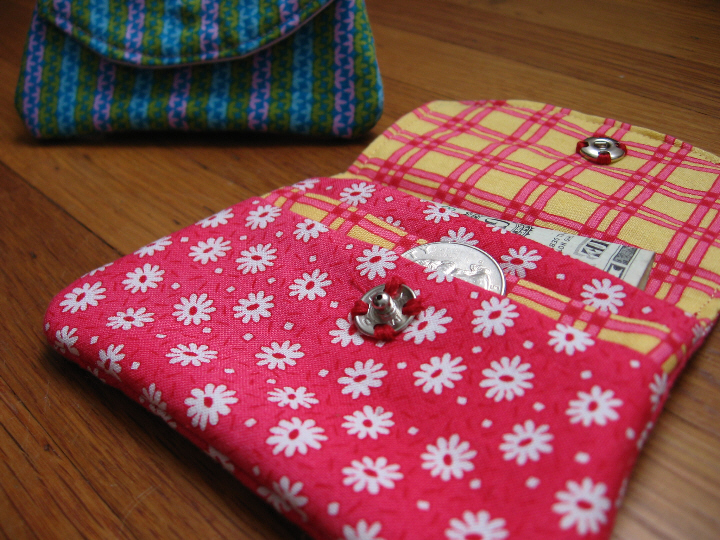
The pattern is pretty easy even for a novice like me, and the directions are clear, and printed conveniently on a single folded piece of cardstock. I didn't get the turning hole together quite to my satisfaction either time, so I might try next time shifting the hole down a little and actually sewing the corner before turning it right-side out. (Now that I look at the photo on the cover of the pattern, that one doesn't look quite symmetrical either!)
Laura said when I gave them these this morning, "You made these?" astonished, so I guess my stock has gone up!
-
Well, I was looking through my old photographs to see if I’d taken any of Honeycomb at the time I finished it — I hadn’t, but I did find this —
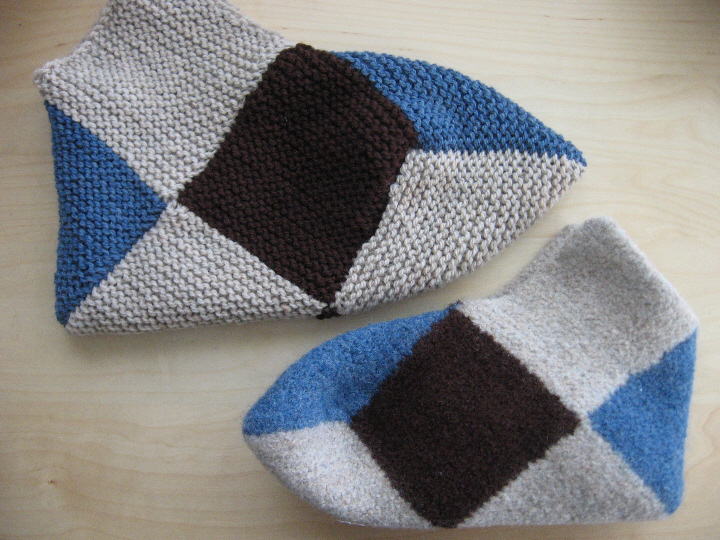
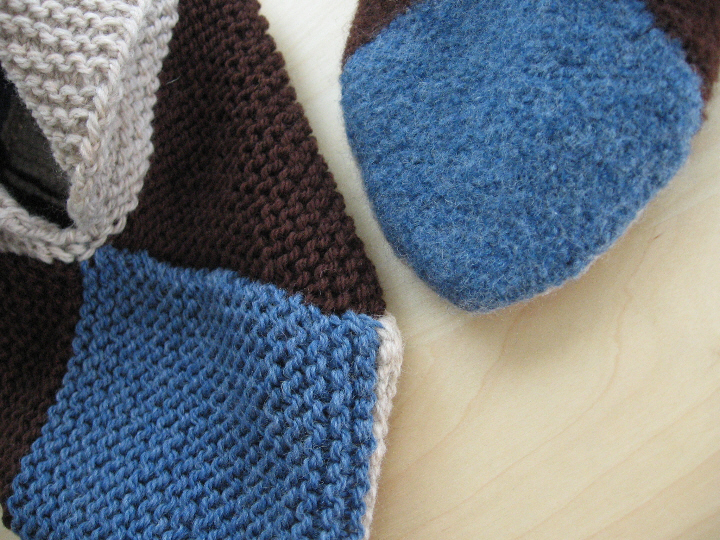
theEasy House Slippers by Liecel Tverli Scully. I couldn’t resist the origami-ness of them!
These can be whipped up in a couple of days — the “hardest” part is the folding, but once you’ve seen how it goes together, it’s fairly simple.
Liecel has done a helpful video, too, for the folding part —The wool is just some Paton’s Classic Wool stuff I picked up at Michael’s. I ended up fulling the slippers twice, once carefully in the sink, and again by just tossing them in the machine and letting them air-dry, as the first time they were still too big. Just right, now, like Goldilocks’ porridge!
-
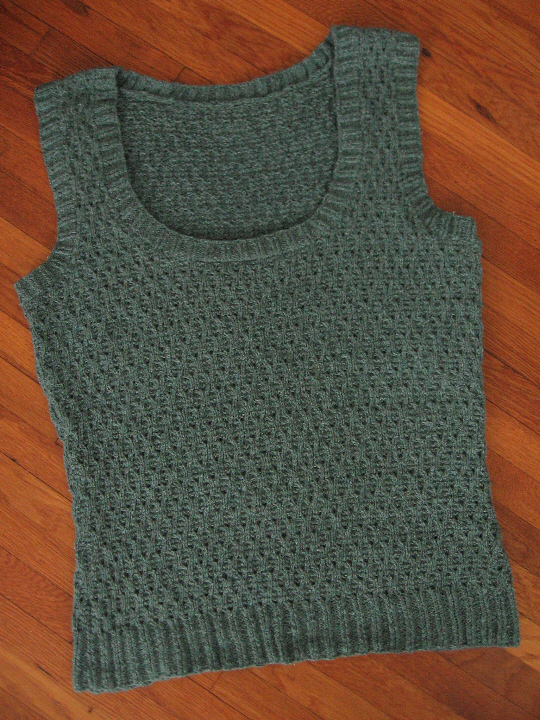
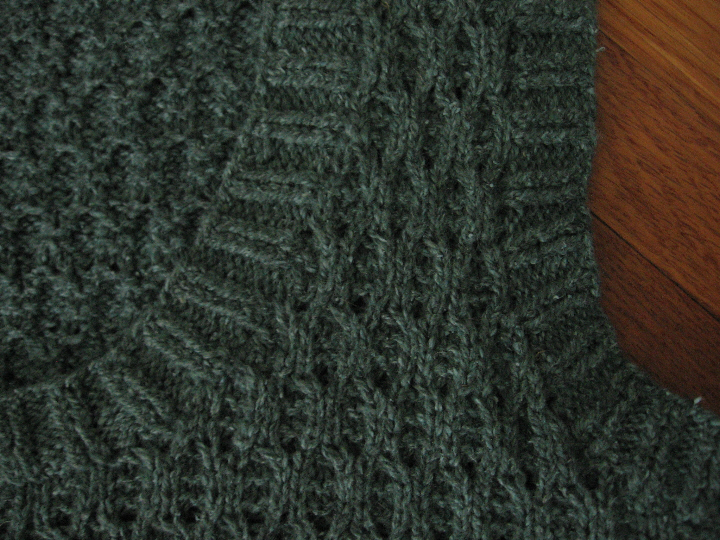
Still catching up —This is Sarah Castor’s Honeycomb slipover from the Spring 2008 Knitty — why it has taken me this long to a) finish it, and b) blog about it, I do not know, for it is in fact a very nice pattern, and it turned out well. I finished it some time in May, I think — I remember wearing it to choir practice, surprised and pleased that the weather was still cool enough at the time to wear it. I am embarrassed to admit that I don’t know any more how many skeins of the Silky Wool I used, nor what size I worked — I have four ball bands in the bag with the leftover wool, but I’m sure it was more than four, certainly five, but possibly six, as I worked it about 3 inches longer than specified, as I don’t like slipovers quite this short.
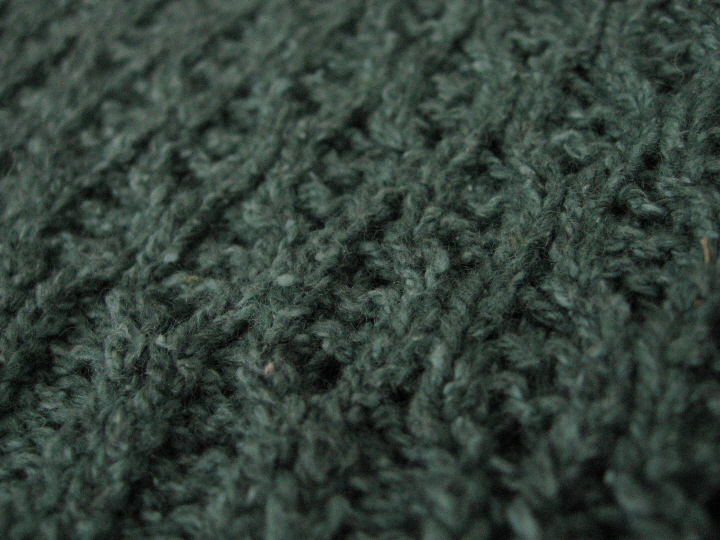
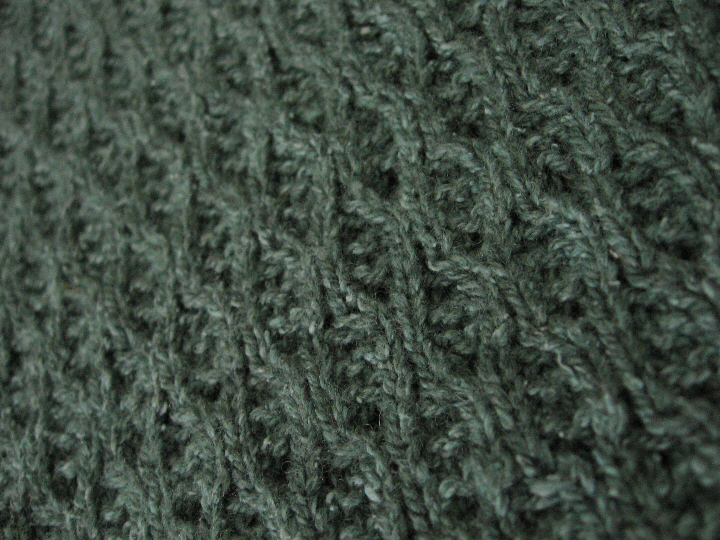
As I’ve said before, I debated with myself for quite some time after working the ribbing — I hate to say a year, but it may well have been — about the honeycomb stitch, which I did not much care for, but eventually thought “for heaven’s sake, just do it” and plowed on ahead.
And I couldn’t stick fussing with a cable needle for one stitch at a time, nor bring myself to cable without it altogether — in my defense, the wool is rather fine, and did not seem to lend itself well to this method — so I used the twists instead. Much easier.
For C2B, do a right twist (RT): K2tog but do not remove sts from needle, K first st again and slip both sts off needle together.
For C2F, do a left twist (LT): K second st tbl but do not remove it from needle, K first st and slip both sts off needle together.
Other than that, it’s a good pattern — it all went together very easily, has a nice fitted shape, flattering (flattering is good!), and matched nicely with the recommended yarn.
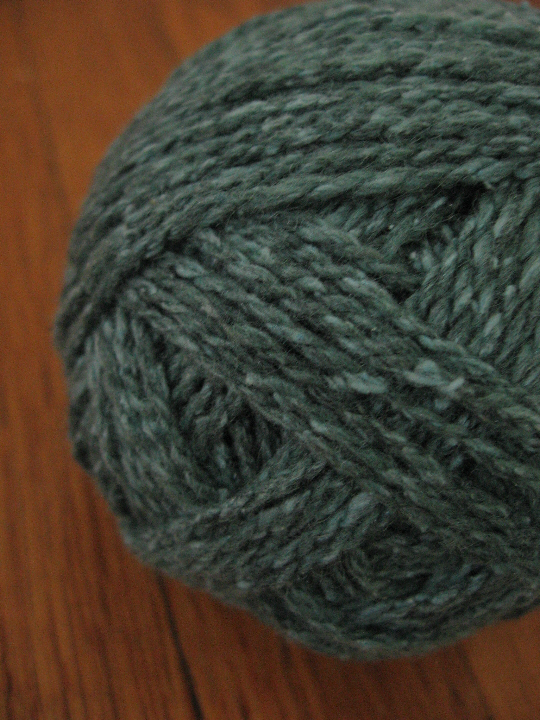
The Silky Wool is very nice, lovely to work with, a pleasant hand, and the color is just perfect.
So — yes, a very nice knit. Got a number of compliments on it the very first time I wore it, too!
-
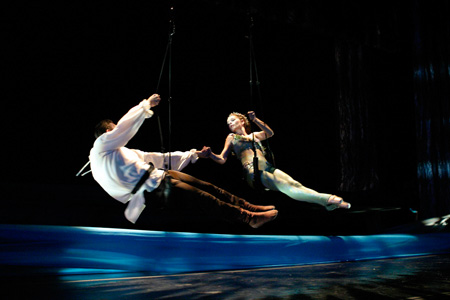
We went to see a performance of Inland Pacific Ballet's "The Little Mermaid" at the Redlands Bowl last night.
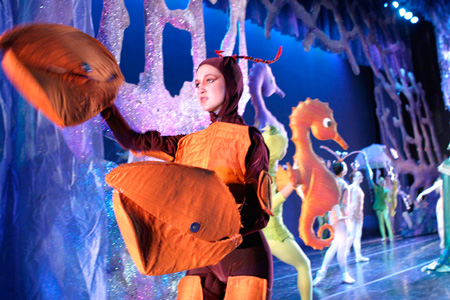
I was very impressed with the performance — lovely staging and costumes, excellent dancing. The designer's use of the set was very clever, and the music was woven seamlessly from pieces by Ravel, Debussy, Britten, Vaughan Villiams, Dvořák, and Leoš Janáček. I felt that the second act didn't quite live up to the first, as most of the drama and spectacle were in the first, including this splendid villainess —
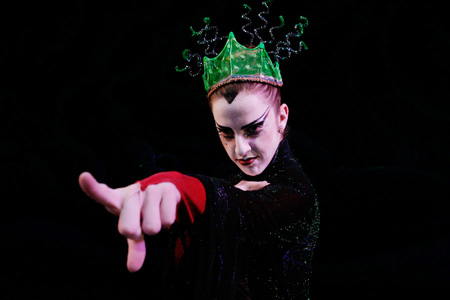
I actually loved the original ending of the story, and so although not entirely disappointed by the "surprise ending" promised by this company, thought that they actually didn't make enough of it in their version.
But the girls were enchanted, and I recommend the production as a lovely family evening.

All photos by E.Y. Yanagi from the IP website.
-
We went to the Getty the other day, the "new" one in Brentwood. I hadn't been in ages.

We went to see the exhibit of Jean-Léon Gérôme paintings on view through September.
I am not particularly familiar with Gérôme, although I do know his "Pygmalion and Galatea" and "Duel After the Masked Ball", both of which are on view here.
This is the one that is on all of the posters, "Pollice Verson (Thumbs Down)" of 1872 —
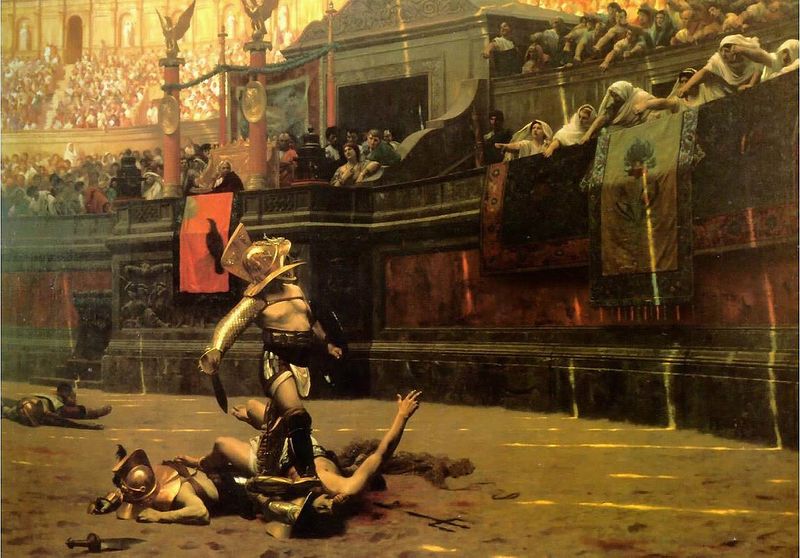
Apparently Gérôme was famous for the historical accuracy of his paintings such as this — the inspiration for hundreds of sword-and-sandal flicks from C.B. DeMille to Ridley Scott's "Gladiator".

He was one of the prime figures in the Orientalist movement in 19th-century painting and sculpture, typified in "The Carpet Merchants" (1887), a stunning piece of color and detail and exoticism.
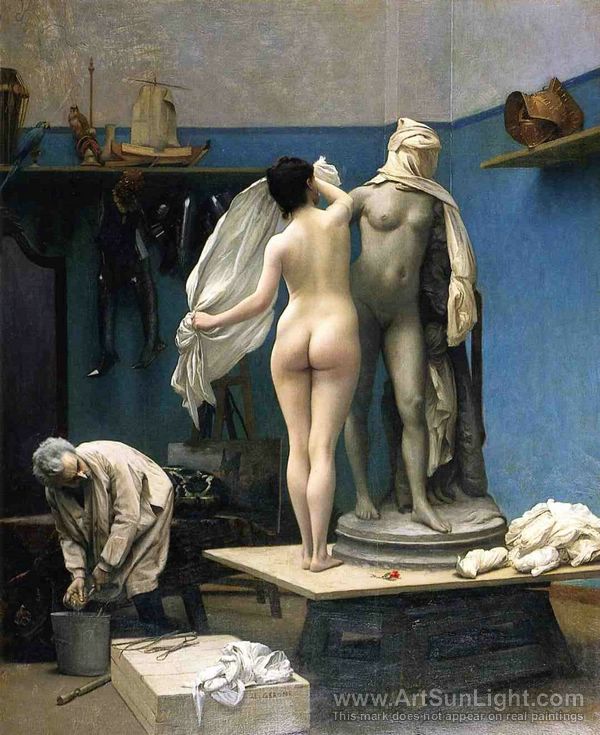
Gérôme also turned towards sculpture in his later career, and experimented with different polychrome techniques in the Classical manner. I must say I rather admire the nice little conceit of the self-portrait of the artist at work in "The End of the Sitting" from 1886.

"Veiled Circassian Lady" (1876).
None of these images really gives the full effect of the real thing — the richness of color and detail are quite amazing.
We also saw the Renaissance drawing show, "From Line to Light".
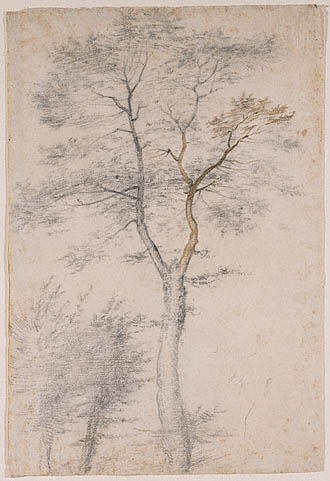
This is a ca. 1508 sketch of three trees by Fra Bartolomeo, and here a sketch of a "Standing Saint" by Filippino Lippi from about 1490 —

I always like the white detail on ink and metalpoint sketches, especially on grey paper — something about that color combination speaks to me, I suppose.
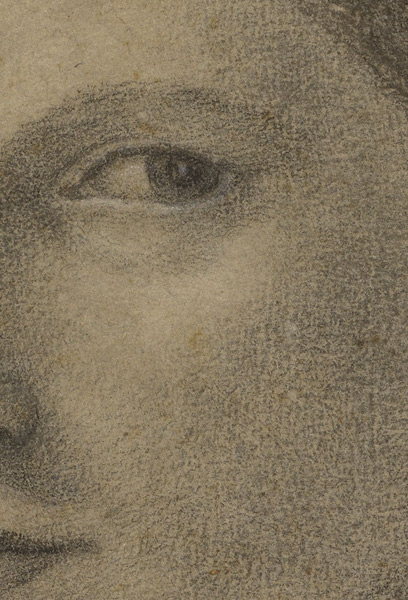
This portrait of a young woman from the 1520s, attributed to Andrea Previtali is one of the showpieces of the exhibit, and rightly so —

Certainly worth closer study. Here is a detail of the workmanship —
Lovely.
It was a beautiful day — I highly recommend it.
-
My goodness, it has been a long time. Dear me.

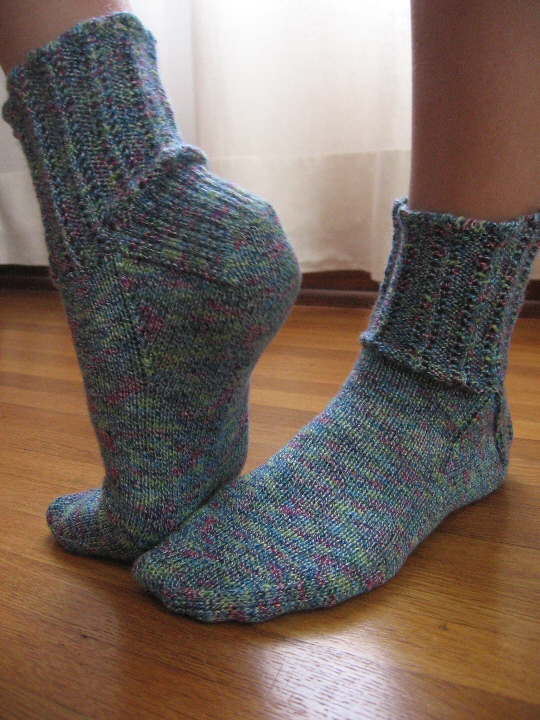
These are the Coquette Socks, from 2-at-a-time Socks by Melissa Morgan-Oakes. I confess that I made them the old-fashioned way, one at a time, because not only did I not have a small-enough circular needle, but I was in a tearing hurry to get these done before Christmas and so would have had to make a special trip for the needles and learned a new technique as well. I think I finished them on Christmas Eve, in fact — but they looked very cute in clear plastic goody bags with a curly ribbon around the top.
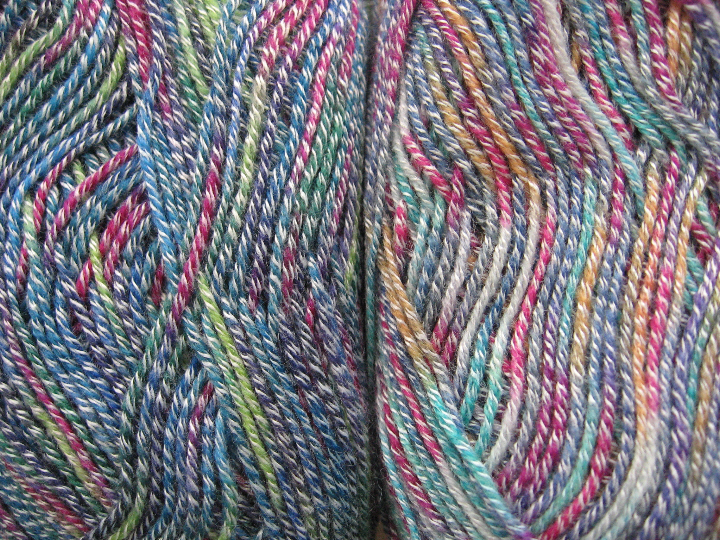
The yarn is of course Regia Bamboo Color in Jamaica — the darker blue/green colorway — and Papillon — the lighter red/pink/blue combination. I had more than a bit of trouble telling them apart in poor light, but knitted up it was more obvious.
I must say that the pattern gave me a bit of trouble, too, and that the publisher's errata were actually not much of a help, as I kept getting a slightly different stitch count, and ended up just winging it. More importantly, the pattern stitch itself did not come out looking like the photograph, until I realized that the photo looks more like a simple two-row stitch, not four. Once I worked it as repeating rounds 1 and 2 only, it looked better to my eye.
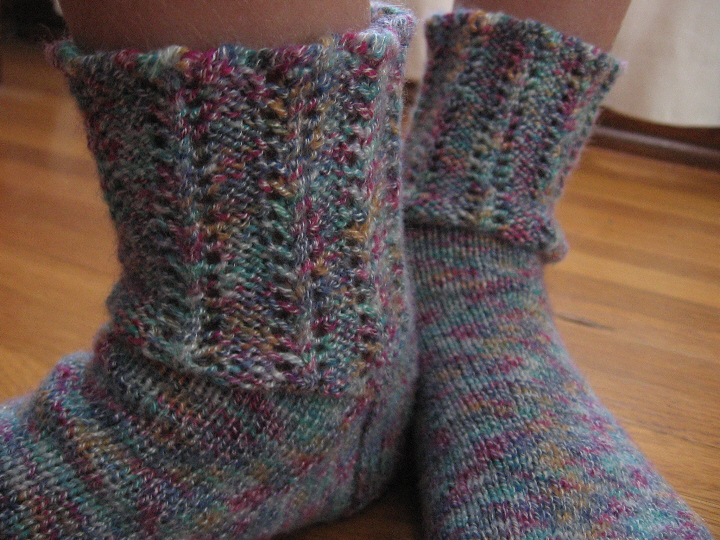
Other than that, I like the socks very much — cute and girly, but not too much so.
I have been reading a lot lately, and barely knitting at all — have finished one Christmas sock, not yet cast on for the other, as I got distracted by Nine Coaches Waiting, wh. I had in fact never read. My public library is renovating, and decided that the fiction section was the most expendable (why why why?), so that was what got boxed up and hidden away, leaving I think three half-stacks. I was looking for D.E. Stevenson, and had my hand stretched out in a pathetic begging gesture in the place where they should have been, and the Stewart was there. I think I'd read only her Merlin books before. Quite enjoyed the Nine Coaches —
-
Laura looked at the first of these mitts when I was trying it on, and said, "That's really nice, mom. Norwegian?"
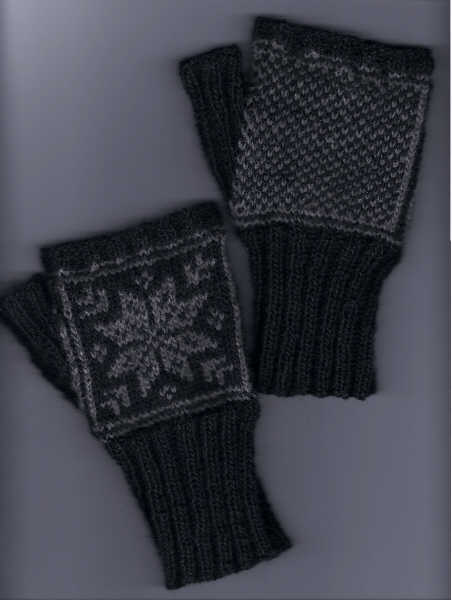
I impulsively decided to make a pair of mitts a few months ago while riffing on some Scandinavian patterns, but was about two-thirds of the way through the first one and either got distracted or wasn't completely satisfied, I can't even remember. But I sat down with them in a bit of a trance, I guess, the other day, and whoosh! they are done.
The yarns are both Regia sock yarns, less than half of a skein of Cotton in black, and 4 grams of 4-fädig in grey left over from my Spey Valley socks, because they were both in my sock-yarn drawer at the same time, and they looked good together. (I said it was impulsive!) I can't fully recommend the Cotton as a component of two-color knitting, as it's a bit splitty and I had a hard time with it in places. It is also slightly larger in gauge than the 4-fädig, so I was concerned that it would be a bit overwhelming, but actually now that I look at the finished pieces, the wobbly bits are entirely mine. But as an experiment, it all comes off, I think.
I was not entirely pleased with the thumb either time — would possibly
space the gusset increases farther apart, to make it a bit longer
(taller, as it were), as it's a bit snug. I did learn that while
carrying floats behind a 2×2 rib (here across the base of the thumb), you need to attach them between two
knit stitches, otherwise it pulls the rib out of shape rather
unattractively. I had assumed that as you do on the pattern sections,
you don't want to "stack" the floats — that is, have them twisted in
at the same spot on two consecutive rows — because it tends to pull at
that spot and show from the right side. It actually doesn't show much
at all on the second thumb — only when it's either stretched
mercilessly or folded, neither of which it is when worn, so that's all
right.The shape of the mitt is based on Ann Budd's generic mitten in The Knitter's Handy Book of Patterns, and the star is adapted from my Dale cardigan with little diamonds and arrows improvised at the compass points. I had originally thought I wanted something quite subtle on the back of the hand, and tried an all-over sort of argyle-ish pattern from Sheila McGregor's book, but it was in fact far too subtle, and I'm thoroughly delighted with the star.
Just in time for our ice-skating party next week!

-
Subscribe
Subscribed
Have a WordPress.com account? Log in now.

