• ,

    That Was Fast!

    1044
    The "Color Wheel" sampler from Dropcloth Samplers, done!  I have just a couple of quibbles: I wish that the fabric was a bit bigger — the "margins" are a bit skimpy, and especially for novices like me I would have felt safer with a bit more room for error and/or a bit more scope for mounting — and although I completely understand about artists wanting to identify a design as their own, having "DROPCLOTH SAMPLERS" smack in the middle like this keeps the stitcher from putting initials and date there, and there's really nothing you can do about it as it's printed on the fabric, much more centrally than on other designs from Dropcloth.  On the bright side, I love the piece's cheerful exuberance and vivid colors!

    1046

    1048

    I can see now that the original uses four strands of floss (in some sections at least), not three as I chose because it's the equivalent of the perle no.8 recommended for beginners.  Mine therefore looks to my eye at least a bit more spare than the original, though this isn't a problem per se.  Four strands does also give you more scope for blending colors, which I definitely wanted to do.

    1045

    I shamelessly pinched the idea of a running stitch edging around the binding that uses the "main" colors of each section!  I even learned how to tie off the quilter's-knot.

    Here again are the colors I used —

    1043

    though as it turned out, in the case of the French knots and the coral knots, I decided on the fly which of the possibles to go with.

    1051
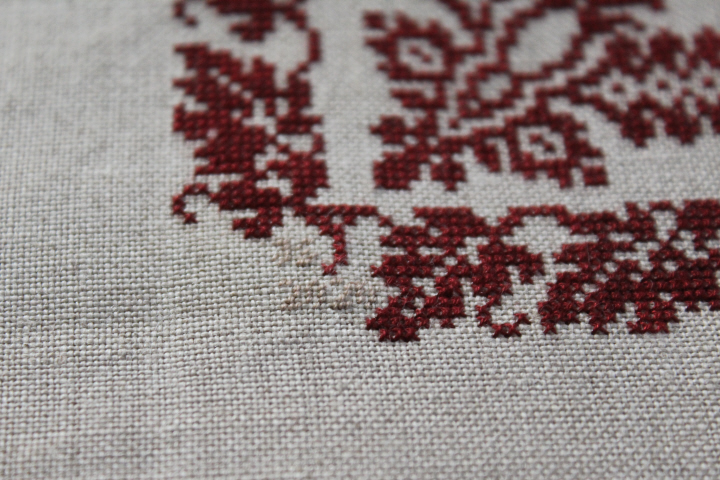
    With just the caveat that the supplied fabric shows noticeable needle holes if you have to pick anything out (yes, I learned this from experience …), these samplers would be excellent projects for Scouts or 4-H groups, this "Color Wheel" or maybe the "Stripe" for beginners, and the "Original" and others for either kids with some embroidery already under their belt, or for those with more focus, though simply because the latter samplers are bigger.  It would be great fun to see the variety in a group's choices and work!

    1050

  • Blursday

    1043
    Good heavens, it has been almost two months since I posted last!  It isn't that I haven't been doing anything, just that … well, you know.  One day blends into the next.  I can usually remember what day of the week it is, but the date — sometimes I only remember that it's late-August.  Even our clocks are uncertain lately, with this one five minutes ahead of that one, which is twenty minutes ahead of another one, as though time is literally moving at a different rate in each room of the house.

    Above is the Color Wheel Sampler from Dropcloth Samplers.  I fell for the cheerful exuberance of Rebecca Ringquist's designs and had a hard time deciding which of them I wanted to stitch, but chose this one to start with, at least.  The thread colors aren't given, which is fine when you're willing to wing it, but what spoke to me about the original was its colors as much as anything else, and so I was a bit dismayed that the only clue was the photograph on the packet.  I appreciate interesting color combinations, even unusual ones, but feel more than a bit uncertain when called on to make the combinations myself, so I spent quite a long time at Michael's yesterday poring over a list that had taken me quite another long time to write up from online DMC color charts the day before, trying to decide if this color was close to the original color, or if that color clashed just a little too unpleasantly with the one next to it.  As you can see, I was unsure about the yellow-oranges!  Some of these I bought, some I had already.  (Yes, I write the numbers on the "bottom" of the paper bobbins.  It seemed that very time I put one back in my storage box, the slits that hold the ends of the thread kept getting snagged on the bobbins already in the compartment, so one day I just started turning them around.)

    1035

    In the spring we bought a pair of pop-up raised beds, to put at one side of our front garden, which thanks to the Tree in our back yard is the best place for sun-loving things to grow.  I had envisioned herb beds, popping out for a bit of basil or sage, and chose a couple of heirloom dwarf tomato plants to try starting from seed.  I don't know if it's me, or just that starting tomatoes is not like growing nasturtiums, say, but I carefully planted at least two dozen seeds and had less than half of them get above the edge of their seed pots, and two survived.  Neither is the one I was really looking forward to, the cherry "Dwarf Velvet Night," alas — the healthiest one is the bonus one the seed company sent along with my order, "Dwarf Sleeping Lady"

    1034

    Not sure which the other one is yet, maybe "Dwarf Beauty King" or another "Sleeping Lady".  It's in behind the French beans, between sage and basil — a bit cramped, but things didn't quite grow (or not …) according to plan!

    1033

    How have I run a household for twenty+ years without knowing that you can grow cuttings of green onions on your kitchen windowsill??  When you buy a bunch at the market and use the green part, don't throw away the rest! just put the finger-length remnant in a jar of water, and in literally just a couple of days, if it has enough roots to start with, you will see a new length of green pushing upwards.  We got two or three full-sized stems or more from each one before they got pale, presumably from lack of soil nutrients and sun, and then I planted them outside.  All but one or two are now growing happily.  Recycled onions — amazing!

    Lucky day

    Wow, how often does this happen? four hypergems in one round!

    0996

    A three-tiered "dumb-waiter" table, from a hand-me-down House of Miniatures kit.  From this angle, you can hardly tell that despite my checking and re-checking, I still managed to glue it crooked.  Oh well — the color turned out nicely!

    0990

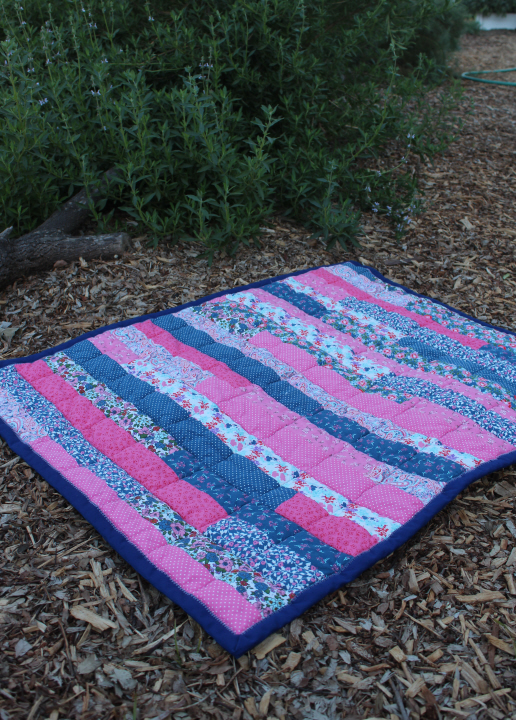
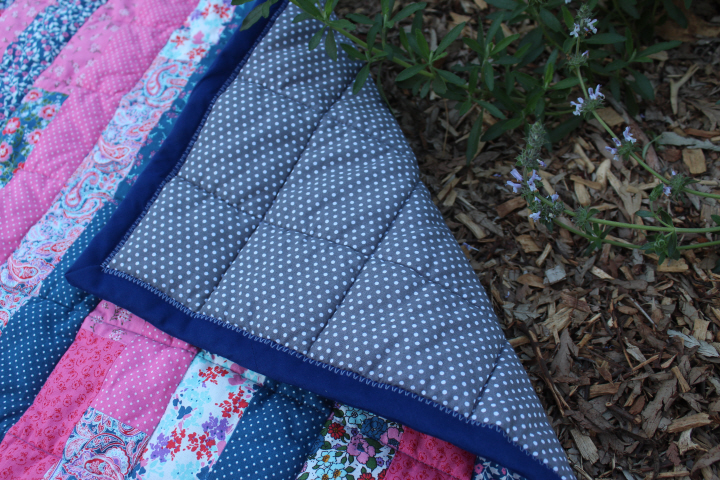
    I wanted to make a cover for Julia's bobbin lace pillow — you spread a cloth over things when you are not working on the project, to keep it from getting dusty or fiddled with by inquisitive pets (if you have them, so in our case the first is much more likely).  It seemed to me that large-ish quilt blocks would make excellent covers, but in scouting around the internet, as one does, I came across the “All in a Row” quilted placemat, and thought with a few modifications it would suit very well.  Julia has a large pillow, so the cover would have to be significantly larger than a placemat, and although I was tempted to batt it as in the original, I was concerned that that might make it a bit heavier and stiffer than one would want — it wouldn't do to dislodge anything when covering or uncovering the project, obviously.  I also found this pack of fat quarters on sale, pretty but not twee.  Perfect!

    1003

    While I was dithering, I decided to get my feet wet, as it were, by sewing up a bag to take to the farmer's market, since I can walk there and back quite easily.  It is the Summer Festival Sling bag, a free pattern from Swoon.  This fabric is the last of a unknown remnant I got ages ago — I had already made a roll for my increasing stash of crochet hooks with some of it, so there wasn't enough, no matter how I turned and pieced it, to do more than the two sides and the two inner pockets, but I like the finished bag a lot, and it is quite handy!  It has good-sized inner pockets to hold change and reusable produce bags.

    1006

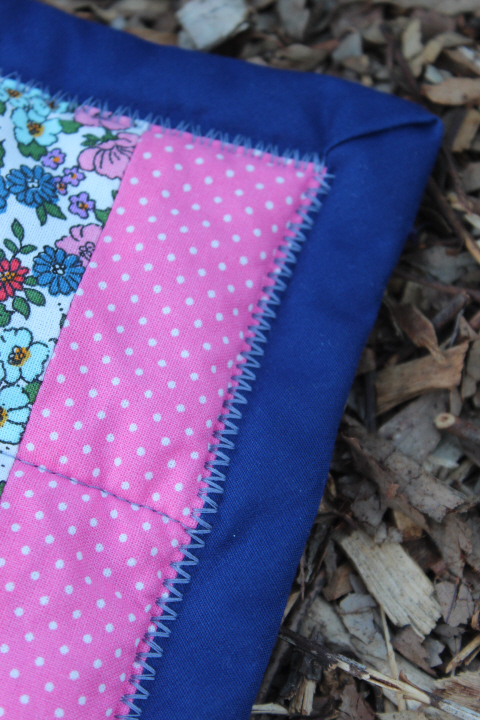
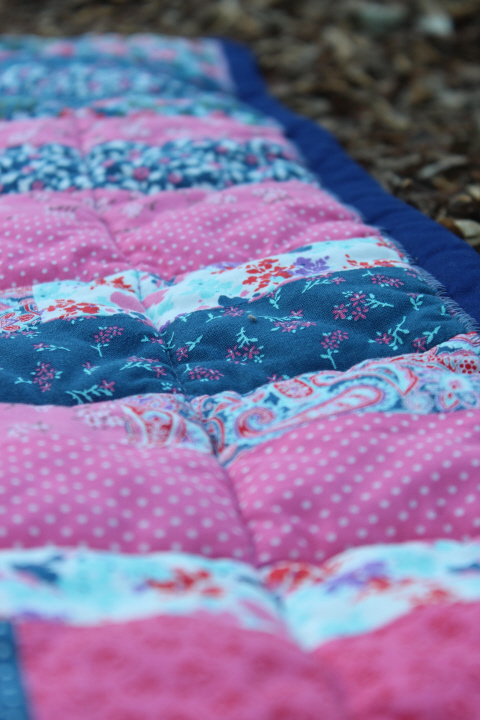
    This didn't turn out as well as I had hoped, but there it is.  I enlarged the dimensions by 147% — I don't remember now why such an odd figure! — though in hindsight perhaps I should have made the patchwork strip a bit deeper, to enjoy the patterned fabrics more.  As I said, I sorely wanted to hand-quilt it, even without batting, as it seemed an excellent small project for getting into that, but it also occurred to me that the pins on the lace pillow might get caught in larger stitches (which mine would almost certainly be) and pulled out, which is not what one wants in a lace-pillow cover cloth — quite the opposite in fact — and so in the end I did the whole thing by machine.  It did go together very easily, though, so my slight dissatisfaction is not at all with the pattern, but most likely from my not being able to realize my fantasy of hand-quilting something!

    I do like the fabrics, at any rate — that dash of algae green is a nice touch, to keep it from being too sweet!

    1007

    This is why the thought of pins snagged on quilting stitches was a concern —

    0995

    Julia is already miles ahead of me with bobbin lace, but that is in fact her only hobby at the moment, where I have a myriad of things that catch my interest — but I've been slowly turning out bookmarks, which are an easy beginner project as they can range in complexity but are small enough not to be daunting.  I still need practice, but I'm getting better …

    1040

  • FLOYD _PAULINE._WOMAN_SUFFRAGE_LCCN2016866495
    One hundred years ago today, Carrie Chapman Catt, one of the leading figures in the women's suffrage movement that had had its beginnings in the U.S. some sixty years before that, celebrated the certification of the Nineteenth Amendment with a speech including these words:

    The vote is the emblem of your equality, women of America, the guarantee of your liberty. That vote of yours has cost millions of dollars and the lives of thousands of women. … Women have suffered agony of soul which you can never comprehend, that you and your daughters might inherit political freedom. That vote has been costly. Prize it! The vote is a power, a weapon of offense and defense, a prayer. Understand what it means and what it can do for your country. Use it intelligently, conscientiously, prayerfully. … The vote is won. … but human affairs with their eternal change move on without pause. Progress is calling to you to make no pause. Act!

    "Woman Suffrage" (1915) photo from the Library of Congress.

  • ,

    Done! … ish

    Peace to My Friend framed 2

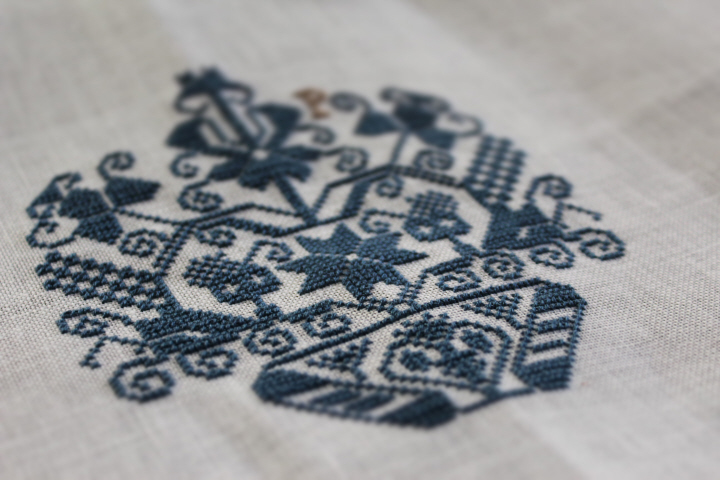
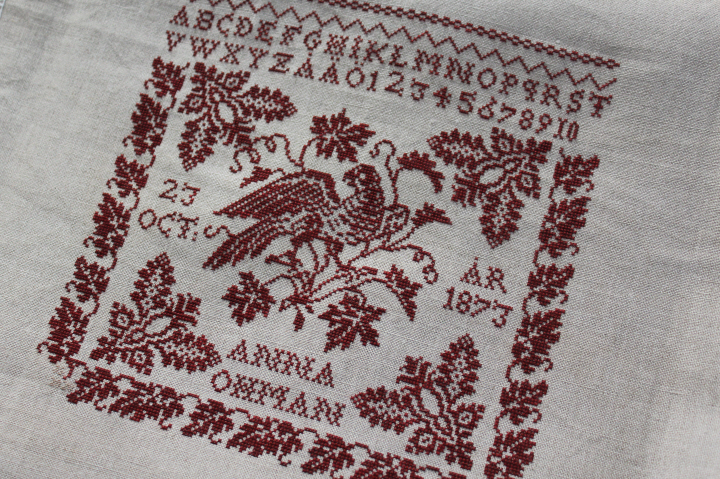
    Here is my version of the "Peace to My Friend" Quaker-style sampler by Jacob de Graaf of Modern Folk Embroidery, on 32-count linen in Natural by MCG Textiles using custom-dyed floss.  I made some modifications, perhaps most notably to me the alphabetization of the ligatures (!), and in the dedication and initials plaques, and some tweaks here and there with spacing but which I think don't detract from the charm of the original.

    It's "done-ish" because the frame is at the moment only a virtual one — though excellent, and perfect for this piece in both color and elegant simplicity — but I decided to enter it in the virtual County Fair we're having this year, the deadline for which is next Monday.  Even the mascot is getting into the spirit of things! —

    Contest guide

  • 0925

    I have been utterly delighted with this piece from start to finish, I admit.  It has always been one of my favorites in Frank Cooper's book — Oriental Carpets in Miniature — and so it was a pleasure to add it to my queue at last, and then to work it, and even better, to have something charming to make in these worrisome times.

    0916

    Here again is the late 18th-early 19th century original now in the McMullan Collection at the Metropolitan Museum of Art in New York (accession no.1970.302.8) —

    DP166864

    I think Cooper did a fine job here, reducing and (necessarily) simplyfing the design without losing any of its charm.  It is my good luck that he worked his version on 18-count canvas, and that converting that to 40-count silk gauze — which was only a matter of my using a different fiber, one strand of DMC floss instead of Paternayan crewel wool, and converting the colors — makes the rug a more-delicate scale for 1:12 miniatures, and very like the original proportions of a prayer rug.

    For colors, I used these —

    • dark blue 3750
    • medium blue 931
    • light blue 3752
    • ivory 3033
    • red 815
    • green 523
    • gold 680
    • yellow 422
    • coral 3722

    The green and light blue are very pretty but together their value is so similar that it isn't easy to distinguish them, so perhaps a darker green might have been better — though on the whole, I don't think it spoils the effect at all.

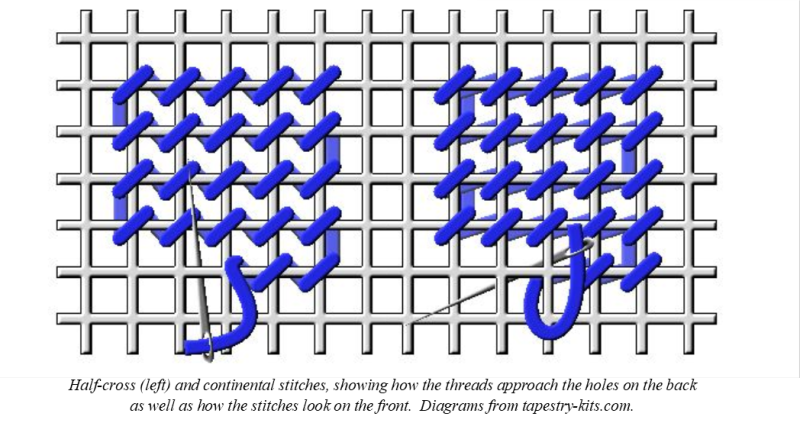
    I worked mine in continental stitch, which I find makes a neater back and an all-around more pleasant experience than working half-cross in tiny scales!

    0918

    0917

    This has always been meant to have pride of place in the carpet shop, so the next thing is to install it!

    0953

  • 0908

    This is the back of the DROPS 118-26 vest/waistcoat/sleeveless cardigan/thingy, for which I decided to use the Knitpicks Palette that my mom decided she didn't want any more.  I started this a while ago, then waffled about it, then decided the other day to carry on.  I got down to the lower edge of the armscyes, shushing the inner voice that said "it's too small, something isn't right," then laid it out like this and knew at once that it is indeed far too small.   Part of that, to be sure, is that between "a while ago" and "the other day" I forgot which hook I used to work my gauge swatch, and then picked up the wrong one — smaller, of course — but part was that the instructions do indeed tell you to work 5cm before beginning the increases for the bottom of the armscye, when clearly 5cm is nothing in the world of armscyes.  I decided that, joy of joys, I am confident enough to adjust a crochet pattern to fit me, and so in looking around for some advice about shaping armscyes and coming across Elinor Brown's article and the calculator linked therein, I worked out that I need to have 5 inches, not cm, before (because it is worked top-down) beginning the increases.

    And so the piece in the above photo was ripped out and re-worked into this — which is the right front, instead of the back, being a smaller piece to work before I judge whether the alterations will be sufficient —

    0934

    I figured that since I was ripping it out to modify the pattern anyway, I might as well shape the shoulder while I'm at it, so I worked a graduated set of SC, HDC, DC, and TC across the 17 sts of the first row (to be worked in the opposite order for the corresponding back shoulder). 

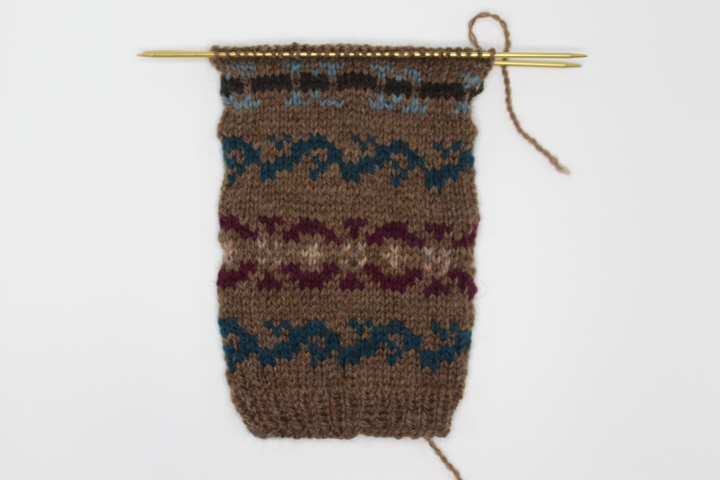
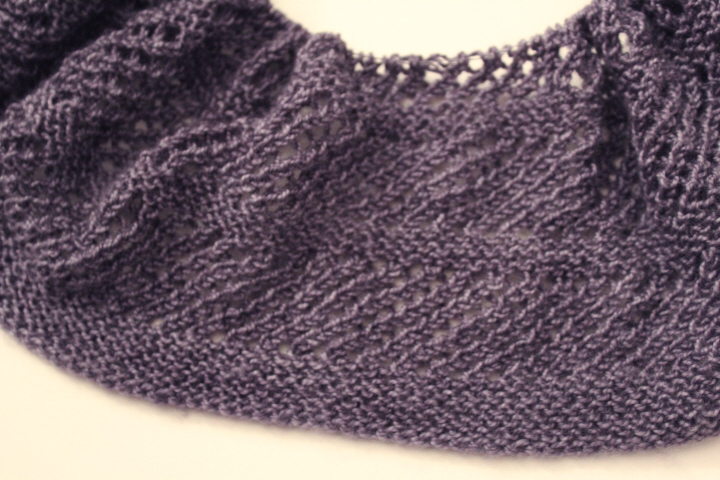
    And in knitting news — because, glory be on this knitting blog, there is some — David asked for a ski-helmet liner for his birthday, so I've got the beginning of one on the needles.  I can hardly bear to confess how many stitches I've had to ladder and pick back up in the proper direction because I'd purled instead of knitted here and there, but it was a lot.  Oh well, dark green wool in distracting times! there it is.

    0928

  • 0892

    Well, I'm much happier with this! 

    Per my experiment, the tiles are made of watercolor paper painted with FolkArt Milk Paint ("Pirate Black," rather unsuitably!), "glazed" with Mod Podge in the satin finish.  They aren't perfect, obviously, but a great improvement on the previous attempts.  The tiles are individually glued to a piece of drawing paper, pre-folded and trimmed to fit over the corners and molding, then the whole assembly glued in place.  I didn't get the edges quite as flat as I would have liked, but there it is — perhaps from a bit further away than these photos are, it won't be so apparent!

    I will probably age it a bit, though not as much as the carpet shop as that is meant to look somewhat run-down, while this is "newer"!  Still, it should probably have a bit of dirt here and there …

    0893

    0894

    I am amused to find that I am becoming much more nonchalant about re-making miniatures — I wanted to put a fireplace on one wall of the tea shop, and fell in love with the shape and reasonable price (especially with a coupon!) of this Tudor-esque one

    0870

    which has a very simple-yet-handsome arch, but wasn't quite what I had seen in my mind's eye.

    Elizabethan_Fireplace _Little_Moreton_Hall cropped

    Not that a Georgian-ish/early-Victorian shop would originally have had an Elizabethan fireplace, of course, but let's say some recent owner of the shop was loitering around an architectural salvage yard (as one does) and came across a small one, either Elizabethan or Revival, that would fit in a tiny shop — well, I would buy it!  I didn't really care for the Houseworks fireplace's sandstone color, when what I was picturing was more limestone, like Little Moreton's above, or even better Dorney Court's, and so I decided to paint it. 

    0884

    The best grey I had turned out to be the same one I had used on the interior of the carpet shop, with some aging and soot in dove grey, brown, and black.  I might actually put a bit more "smoke" on it.

    (The pink vase looks huge, but actually it is the fireplace that is really very small — you can tell by the relative size of the 1:12 chair!)

  • 0874

    I just realized that I haven't written this up yet, so I "borrowed" the lawn next door for a quick photo session this morning, and here it is!  This is of course the Granny Square Sampler Afghan, following the project led by Blair Stocker in 2012.  (There is also a Flickr group, for more inspiration.)  I really enjoyed this, and learned a lot about crochet — which was the point, after all. 

    There are two different join-as-you-go methods here — one (demonstrated here by Annette of My Rose Valley)  that is more-or-less adding another round of granny clusters to a square but instead of working a chain st or two in between, reaching up to work one of those ch sts through the ch space in the square you are joining to, and another method (demonstrated here at Carina's Craftblog) in which you work another row of granny clusters but alternate attaching it to the bottom square or the top square, essentially flipping every other cluster "upside down".  I like both of these methods, but I think that with my "crazy" layout, the "flipping" one was much more efficient, and so after joining two sets of four squares with the former, I found myself using the latter method for pretty much everything else.  I think I made it a bit harder on myself by joining the squares free-form, as there are a number of slight wobbles all over, due to fiddling the number (or size!) of clusters, but wool, bless it, blocking disguises any number of irregularities.  If I do another of these — and why not, it's a great stash-buster, and would certainly never be boring — I will probably use Adaiha's tutorial for joining squares of different sizes.

    0875

    I didn't use one of the squares Blair did, and added in some, including "Nana's Latte Square", which I will definitely use again (I love the soft neutrals in solid squares, in the photo from PDKlein on the Ravelry page). I really liked the Granny Wheel Square, so much that I made two in quick succession — it's interesting how a color change can give a quite different effect.  The "little bit of white" in single crochet on my first one (now towards the upper right corner) isn't really enough, but the speckly line is not uninteresting.  The other "new" square is Granny On Point.  Inadvertently, I didn't really follow the instructions, because I was looking at a photo of someone else's square in the Granny Sampler photo pool at Flickr at the same time, and found myself, to my later amazement — I don't crochet! really! — following the photo as though it were a chart of instructions.  It's that light-bulb moment, when after months of not understanding what you are doing or quite what you're looking at when you've done it ("is that a double-crochet or a triple? wait, how do you make a half-double, where's my cheat sheet …") things finally begin to make sense.  I used different borders on each of them, because I could.

    0877

    0882

    For the edging on my afghan, I used the brilliantly simple variation on granny clusters by Jacquie at Bunny Mummy, which she calls Double V Edging.

    0880

  • 0438

    Wondering why a previously-successful process didn't work very well at all twice in a row, I decided that I should just do an experiment.  Since I have a number of different kinds of varnishes in my stash, I got out some unvarnished paint-chip squares that were left over, and tried every one of the varnishes, partly to figure out why the artists medium didn't work and partly to audition a different varnish.

    The results were quite interesting, actually.  I stuck my samples on a piece of card stock, so that I can have a record of the various finishes — at the top in the photo above is one of the leftover tiles from my very first batch, as charming as it was the day it was made!  Below it, on the far left, are a cluster of three of the faux tiles varnished with the Liquitex gloss medium I used originally, then Mod Podge satin finish, then DuraClear ultra-matte, CeramCoat gloss varnish, and DuraClear satin.  They were all smoothly covered when the varnish was newly-applied, so the dips appeared during the drying process for some reason I don't know yet — I applied it intentionally quite thickly, by the way, so these flaws might not appear if applied thinly.  The DuraClear ultra-matte is ultra-matte, indeed! but too matte for my purpose, though beautifully smooth and even.  I wasn't willing to risk large irregularities like the CeramCoat sample, so that one was probably out, too, at least for now.  This left the Mod Podge satin finish and the DuraClear satin, both of which probably would be successful, but the Mod Podge was still a bit tacky the next day, and indeed the instructions say it might be, and recommend a varnish top-coat, so I decided to use the DuraClear even though the Mod Podge had just a bit more depth to it, which to my eye looked more like a real glazed tile.  But by the second day, the Mod Podge sample was not tacky at all, and so I changed my mind and used the Mod Podge after all.  (I figured that if the faux tiles were still tacky after a few days, I could varnish them with the DuraClear satin …!)

    My conclusion from this experiment is that the Liquitex gloss medium is just getting old.  I bought it and first used it in 2014!  It has worked fine only a month or so ago for "varnishing" faux paintings (printed on paper with the computer), so I'm guessing that enough of the water in it has evaporated over time that when laid thickly like this, it just doesn't set as well as it did when first opened.  (The first batch of mini tiles I glazed a month ago are still tacky, in fact.)  It's also possible that the water content helps it to self-level while it is drying, and therefore the bubbles and irregularities "stick" instead of smoothing themselves out.

    And so I made a third set of tiles — but this time, I had been scrolling, rather disheartened, through photos of "tiled shop fronts" on Google (as one does), and seen one with a sort of self-border of half-tiles, and thought it looked very handsome.  And … if I did rows of half-tiles along the top and bottom, I could make them bigger and still have an odd number of rows!  The only remaining problem was that of getting each square the same height and depth as its neighbors.  I cut a piece of watercolor paper a good bit bigger than the area to be tiled, painted it with FolkArt milk paint in "Pirate Black" (!), and tacked to the back of it a piece of 1/2" grid paper.  Instead of cutting the painted area into strips and then cutting each of the strips into squares — which is what I did before, resulting in ever-so-slightly different "squares" — I numbered the squares on the unpainted side before cutting, enough squares to fit the space to be tiled, then used my big paper-cutter to cut along the horizontal lines but only almost to the edge, leaving them still attached to each other at one end.  Then I turned the whole thing clock-wise 90 degrees and cut along the other set of lines, this time all of the way (because I could put them back in order using the numbers).  This was more than a bit awkward, obviously — I had to make sure that all of the partly-cut strips were flat and butted up closely to each other, so that the second cuts would be in the right place, and the grid paper didn't stick very well so that I had to carefully peel it off of each cut square and write the correct number onto the back of the square! — but it wasn't as onerous as it sounds, and it achieved the result I was hoping for, a nice straight set of squares that line up evenly, and in both directions.

    0440

    0441

    The Mod Podge, just like the artists medium in my very first set of faux tiles, took on some of the texture of the watercolor paper, which is fine with me.  I'm very pleased with the satin finish, too — it has enough shininess to say "glazed tiles" but not so much that it's distracting or reflects irregularities.  Now that I have a better idea of the predicted-success-rate, in future I might try a smooth paper — the paint chips are worth using again, for instance — or something more Arts & Crafts/"hand-painted" like a watercolor wash.

    So I'm happier with the finish, and I'm happier with the new size!

    (The façade developed a crack running from the upper left corner of the door frame through the cornice molding, so I've pulled it apart and reglued it, which is why it's clamped now.  The tiles are not attached to the bay window yet …)

    0448

  • ,

    Trivet Pursuit

    0454

    Well, not much has been happening around here, to be honest.  One of my miniatures club members had an 80th birthday recently, with a Zoom "party" — I made this 1:12 bunting and delivered it earlier in the day in lieu of a card.  I thought it turned out pretty well for a spur-of-the-moment birthday greeting. 

    0452

    David is reorganizing his workshop in the garage, and was tossing this piece of ipe wood into the scrap box.  Some years ago we replaced a tiny concrete patio with a small deck (so that we could have a French drain underneath to direct water away from the lowest point on the property, which is right in front of the door to the garage), and said deck is made of (responsibly-harvested) ipe.  Even as a piece of scrap wood, ipe is extraordinary stuff.  It is surprisingly heavy, being very dense, and when newly-cut has a lovely auburn color with a fine but distinct grain.  We let the deck age naturally, so it's now a sort of ashy brown, but I decided to oil this scrap and use it as a trivet.  David rounded off the edges of the ends for me, to match the sides, and I sanded it and put two coats of linseed and beeswax on it.  You can't quite get the full effect from the before and after photos, unfortunately, but now it's smooth with just a hint of the grain under one's fingertips, and with the auburn color deepened beautifully.

    0457

    This inspired me to finish another project that had been sitting around for far too long, two sets of tiles from the bargain bin at Home Depot, four squares of something stony that I can no longer identify, and four squares of Carrara marble.  Laura had managed to get some cork for me — a bit more and a bit thinner than I wanted, but needs must — and I cut squares just smaller than the tiles and rounded the corners, then glued it to the back of each tile.  The reason I had left it so long was because I was agonizing over what kind of glue to use — Aleene's Tacky (of which I have an inexhaustible supply since I get to take home the leftovers from day camp each summer and never manage to use up the four or five bottles before the next year's four or five bottles land in my box)? it's a workhorse around here, but is it right for trivets?  E6000? it's supposed to be really strong, but gosh it's smelly — so now I just threw caution to the winds and used Crafter's Pick Ultimate.

    0458

    And so suddenly I've gone from having no trivets to having nine!

    0464