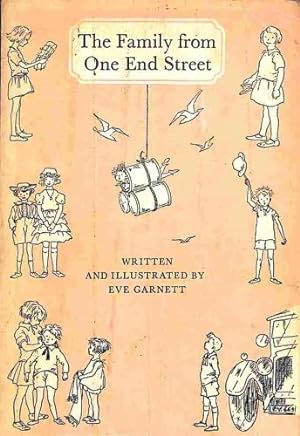
For the 1937 Club hosted by Simon of "Stuck in a Book" and Karen of "Kaggsy's Bookish Ramblings", I made quite a decent-sized list of intriguing titles, then set out to see if I could find a copy of those, and of the ones I could on that rapidly-shrinking list, a considerable number were in fact children's books. I wasn't entirely sure about Eve Garnett's The Family from One End Street, but I'm glad that I didn't skip over it, as it turned out to be delightful.
It is essentially a series of adventures centering on the Ruggles family, in a (fictional) small town in south-east England.
Mrs. Ruggles was a Washerwoman [the story begins,] and her husband was a Dustman. “Very suitable too,” she would say, though whether this referred to Mr. Ruggles himself, or the fact that they both, so to speak, cleaned up after other people, it was hard to decide.
With seven children, one would imagine — correctly — that a great many adventures ensue. The general tone reminded me not a little of a more-realistic P.L. Travers, sort of quietly amused at the hijinks, though of course Mr. Banks is something or other in the City, while the Ruggles family are unapologetically working-class, often having difficulty making ends meet even in what we would now call a two-income family — apparently this was in fact one of the first children's novels centered on a working-class family. Like Travers, too, there are often details that perhaps only an adult would appreciate — Mr. and Mrs. Ruggles at the Tate wanting to see pictures "more cheerful" (than "Carnation, Lily, Lily, Rose"!) so they go into the next room "and enjoy battle scenes and shipwrecks"! — or tea-cakes that have "a look of great breeding". As I write this now, the story reminds me as well of "Life With Father", even of Wodehouse in ways, in that the adventures and mishaps arise from character, from the various family members' attempts to get out of the scrapes they have inadvertently found themselves in — a neighbor's green-silk petticoat ruined when oldest child Lily Rose is trying to be helpful, a school-uniform cap floating off on the waves during a visit to the seaside (a lost cap being disastrous for a working-class family whose children most likely don't all get to go to secondary school, not to mention that eleven-year-old Kate is extraordinarily proud of her "new velours hat with the beautiful striped school band"!), the irresistible appeal of Mickey Mouse at the cinema to a boy to whom the fourpence admission is a fortune. Despite what some readers have seen as a patronising "buck up" attitude of superiority towards the working class — which might be interpreted as Garnett's aren't-the-working-class-amusing perspective — I found this a highly enjoyable story about a family who, despite a propensity for scrapes, and the occasional cross word, clearly are very fond of each other.
Perhaps needless to say — since I rate the Mary Poppins series, "Life With Father," and Wodehouse all among my personal classics! — I enjoyed this very much, and look forward to reading it again, along with the Ruggles family's further adventures!
(I read a copy online, by the way, that is dated 1917, which is clearly untrue — for one thing, the author was born in 1900, and while it is not impossible for her to have written this in her teens, she did not. For another, the verso of the title page states that it was awarded the Carnegie Medal for 1917, and even if like me you don’t know what year the Carnegie Medal was established, it is a simple matter of looking it up — 1936. I suspect some copyright shenanigans going on, but suppose it is a moot point now.)
Links to other readers' reviews of books published in 1937 can be found here.

 A Bluestocking Knits
Leave a reply to Constance Cancel reply