• Rereading

    I have been spending the last few rainy evenings with "Rereadings" edited by Anne Fadiman, author of another favorite of mine, "Ex Libris", and formerly the editor of "The American Scholar", a feature of which was apparently essays on rereading.  (I mentally smack my forehead, as I’ve long thought it would be a great idea to review older books and classics, and now it seems that I’ve missed some eight years’ worth of the very thing!).  "Rereadings" is a collection of seventeen of these essays, from authors as diverse as Vivian Gornick, Pico Iyer, Philip Lopate, and Sven Birkerts, and others — but all readers, and all able to vividly convey the delights and, it must be said, now and then the disappointments of rereading old favorites.  Almost all of the titles are familiar to me from my years of shelving and cataloging untold numbers of them, but I have read less than half, and it is interesting to see that even though I’ve never read, say, the Helen Dore Boylston "Sue Barton" series, Katherine Ashenburg’s sense of amazement at both the liveliness of the writing and the stereotypes are still familiar to me.
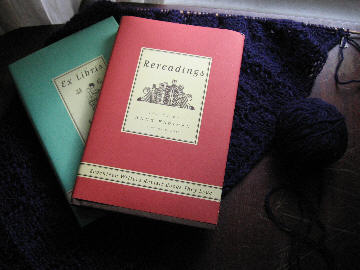
    Rereadings

    And this is, by the way, a handsome little volume.  The dust jacket is simple and elegant, a sibling to "Ex Libris," and the edge is trimmed to a tidy curve that fits the tip of my finger perfectly.  It is true that you can’t judge a book by its cover, but certainly it is very pleasant to read a book that satisfies the eye as well as the mind.  (I have now spent far too much time this morning trying to eliminate the distortion from the digital camera of the solid lines around the cream-colored boxes on the dust jacket.  Please be assured that the lines on "Rereadings" are not dashed, but straight and clean, as on "Ex Libris."  As much as I would like to spend any number of hours figuring out why the one comes out right and the other doesn’t in the same photo, time, tide, and the kindergarten bell wait for no mother.)

  • Christmas? already?  Yes, Country Living‘s Holiday issue is on the newsstands.  Let’s not call it over-anticipation, but practicality and advance preparation, for one of the articles is called "’Tis the season to be … knitting!", featuring these funky stockings (sic),

    Funky_stockings

    and other projects from Melanie Falick’s new book, "Handknit Holidays".  (This is the first I’ve heard of this book, but I must confess that I’m intrigued, as for some time I’ve harbored secret hankerings for a knitted treeskirt.)

  • From the Garden

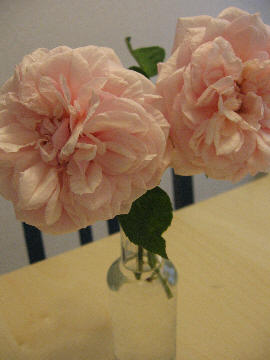
    "Souvenir de la Malmaison" —

    Souvenir_de_la_malmaison

  • Booking Through Thursday‘s questions for today are about books we don’t like!

    Here’s another set of questions from Nicki.

    1. What’s the worst book you’ve ever read?  It’s actually rather difficult to think of one.  I used to slog through a book even if I wasn’t enjoying it, but these days time is too valuable to waste on junk.  I tend to forget about them except for a vague sense of disappoinment.
    2. What’s the book you hated the most?  "Hate" is too strong a word.  "Disappointed," "disgusted," and "bored" are much more likely for me.  The last disappointing book that I actually finished was a Penelope Lively novel that I had to really work to get through — I’ve really enjoyed her earlier novels, so I kept hoping for a spark of inspiration, but it never came.  I didn’t make it through "Middlemarch," even though I had to write a paper on it.
    3. Is the answer the same to both questions? If not, why not? I guess that the answers to the first question would be more related to the quality of the grammar, typesetting and printing, etc. and the answers to the second question would be more often about the content, the ideas presented and the way that the characters (if fiction) interest me.
    4. Why was this book (or these books) so bad? Considering how many books I’ve read in my lifetime, the "bad" list is pretty short.  I think I’ve skewed the poll a little bit, though, in that I tend not to even bother with books I think I won’t like!
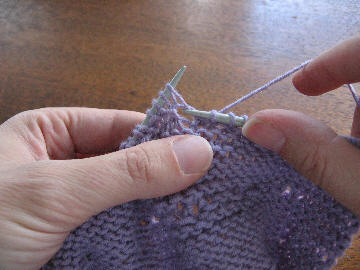
  • Have been humming along with Amy Detjen’s Beginner’s Triangle shawl, featuring the Centered Eyelet.  This is an interesting technique, and prompted me to take a closer look at it.  Frankly, I am amazed at the kind of mind that would come up with something that includes "k second st but do not remove from LH needle".  I say this with the utmost admiration, as it would certainly never occur to me to do anything of the sort, being a fairly unadventurous knitter technique-wise!

    Here is the problem —

    Some_eyelets

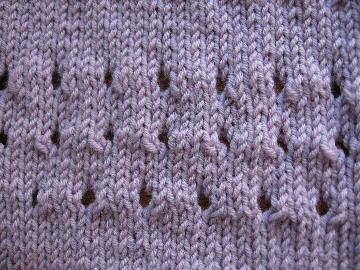
    that eyelets, worked either as k2tog, yo (bottom row) or as yo, ssk (middle row), are asymmetrical, leaning either to one side or the other.  This could be partly avoided with working the eyelets as ssk, yo (top row), but even though this disguises the slant somewhat, it is still obvious that there is a decrease on one side and none on the other.

    Of course, this slant or running stitch can be used decoratively, as in this little digression, in which the slant appears to travel upwards in a nice little s-curve —

    Running_eyelets

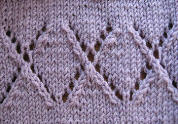
    But Detjen wanted to have rows of eyelets that crossed one another in a diamond-shaped pattern, and here the lack of symmetry bothered her.

    Leaning_x

    Notice the rather lackadaisical point where the X crosses (I used yo, ssk).  That single eyelet is certainly in the middle, but it is not centered, as the decrease makes the running sts, especially the ones traveling from lower right on each X to upper left, look bulky.  It would probably have been better to work a different decrease, as at least that side of the X would have a perfect line of running sts from bottom to top, but it would still not have been symmetrical.

    Here is Detjen’s solution, the centered eyelet:

    Centered_eyelet_2_2   

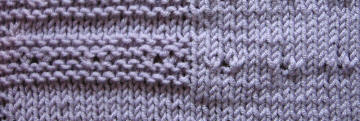
    (Worked over 3 sts; 3 sts remain.)  Sl first st knitwise, k second st but do not remove from LH needle, psso, yo, k2tog (3rd and 2nd sts).  On the next row (WS), k into st below each yo of the centered eyelet.  The garter st version on the left is as in the Beginner’s Triangle; the st st version, on the right, is for clarity.  (Note that in the stockinette version, I had to tweak the sts afterwards with the point of a needle, as they didn’t sit quite right.  The one on the left is untweaked, to show how it looks at first.)

    Here are the steps for the centered eyelet (garter st version), partially broken down:

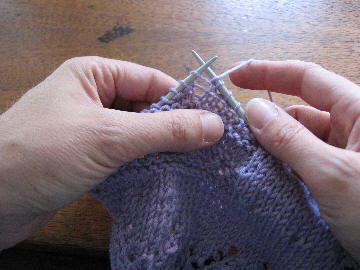
    "Sl first st knitwise, k second st but do not remove from LH needle…"

    Do_not_remove

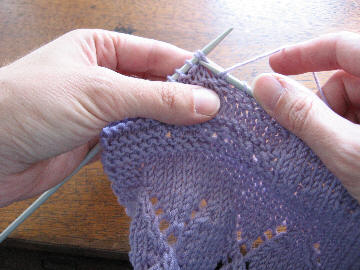
    "psso…"

    Sl_st_over

    "yo…"

    Yarn_over

    "k2tog (3rd and 2nd sts)…."

    K2tog

    Centered_eyelet

    On the WS row, at the yo of the centered eyelet, "K into st 1 row below…."

    Ws_k_into_st_below

    Detjen says that she based the centered eyelet on Robert Powell’s 3-into-2 decrease, which is identical to the centered eyelet but without the yo in the middle (and so without the "k into st below" in the second row as well).

    Here is the beta version, if you will, of the centered eyelet:

    Centered_eyelet_beta

    Notice the horizontal bar across the eyelet.  (Interestingly, the bar is in the middle of the eyelet in the garter st version, and across the top of it in st st.)  On the next (WS) row, knitting into the st below the yo (and of course including the yo, which gave me pause for a moment) solves this problem, by simply pulling the bar up out of the way. On the st st version, you would purl into the stitch below.

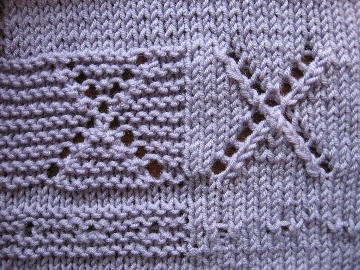
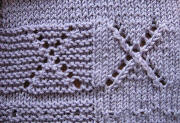
    Two Xs worked with the centered eyelet, one in garter and one in st st, nice and tidy:

    Centered_eyelet_x

    Leaning_x_small Centered_eyelet_x_small

    It might be interesting to try this in an all-over eyelet pattern….

    And as a bonus, we can now do the 3-into-2 decrease!

    3_into_2

  • Booking Through Thursday‘s questions for today are similar to last week’s, but with a bit of a spin:

    Go get a book that is in the most inconvenient place in your home.

    1. What corner of your house did you dig this book out of?   Actually, I went out to the garage and moved a bundle of newspapers to get to a stack of boxes filled with the books we’d stored so that we could ship a bookcase with us to Hong Kong last February.  The book I chose today was not really the hardest one to get to, but after heaving four rather heavy boxes around, I decided to not even open the fifth.  (I skipped the most "inconvenient" book that was actually in the house, "Patterns of Fashion 2 : Englishwomen’s dresses and their construction c. 1860-1940" by Janet Arnold, because it has only 88 pages!)
    2. What are the book’s title and author? "Fathom Five" by Robert Westall.
    3. Turn to page 127. Locate the third paragraph, first sentence. Type that sentence here: "The woman’s pinny had flowers on it."
    4. Does the sentence make sense out of context? I think it’s a bit too simple to make much sense out of context.
    5. Seeing it sitting here by itself, out of the book, is it funny? Sad? Strange? Does it make you want to explore its source? I didn’t recall many of the details in this story, just a memory of being utterly absorbed by it.  To me, the sentence has a rather chilling poignance, but then I remember the rest of Westall’s stories, too (which are mostly for teens, with one adult non-fiction that I know of).  I first read this book after watching the fascinating  "Danger UXB" on PBS, when anything on Britain during WWII caught my eye.  When I finished "Fathom Five," I searched out "The Machine Gunners", the first book featuring Chas McGill of "Fathom Five," and in fact as many of Westall’s books as I could find.  I still have all that I did — he’s a fabulous writer, with a deceptively easy style.  Sometimes his books are realistic, sometimes with a supernatural twist, always engrossing.  I remember reading one of his books, "The Watch House," I think, sitting in the living room of the family home — I can picture the moment still — feeling the hairs on the back of my neck standing up (something I’d only heard about before, never felt).  I was almost afraid to put my feet on the floor, the story was so creepy.  Wonderful stuff!
    6. Are you currently reading this book? Why? I was going to say, "No, see number 1," but I just found myself reading the rest of page 127, about the woman in the flowered apron, sitting in her cold, cold house, waiting to hear the footsteps of her Bill coming home from work, even though he’d been killed on the Russian convoys eight months earlier….
  • So all of a sudden, this blog is getting a dozen visitor stats from what is apparently an online English/Czech dictionary.  It looks kind of like Wikipedia, in that anybody can submit a Czech definition of an English word.  (Hey, Ann, "modrá stužka" is "blue ribbon"!) 

    But nothing for "blueberry pie" yet — anybody?

    Wha-at?!

  • Knit.  "Mommy, can I have a snack?" —

    Knit, knit.  "Honey, the truck registration is due.  Can you go over to the Auto Club and get the tags for me?" —

    Knit, knit.  "Mommy, will you push me on the swing?" —

    Knit.  "Grandma’s dog just threw up on the rug!" —

    Knit.  Sigh.  The Cotton Glace just isn’t working for me.  Love the color, but it feels stiff and rough in garter stitch, even at a fairly loose gauge.  And I am coming to the realization that the current ball will end somewhere in the middle of the sleeve again, with nowhere to hide the join —

    Knit.  "Honey, I’ve got to be at work at six tomorrow morning.  What can I take for lunch?" —

    Knit, knit.  "Mommy, Laura called me ‘stupid’!" —

    Yawn.  I wake up early.  Knit, knit, knit. Julia wanders in and adds a few Duplo blocks to the tower she’s been building.  "Ma, can I have some break-tiss now?" —

    "My tummy hurts, Mommy" —

    Knit, knit.  An email from my friend in Australia.  "K is getting bigger and bigger.  No baby yet, but sometime in the next couple of weeks, we think."  So soon?!  Aaugh —

    Knit.  "Mommy, Julia threw her milk at me!" —

    Knit.  Sigh.  I dig out some Anny Blatt merino that I got at Cheer Wool.  It’s heavier than the cotton, so I can use a different set of needles to try it out.  I swatch and start at the same time — only ten or so more stitches than my usual swatch size, so what the heck.  There’s a new episode of "Foyle’s War" on, with the always-watchable Michael Kitchen —

    Knit.  "Mommy, how do you spell ‘love’?" —

    Knit, knit.  The merino works up nice and fast.  I check the pattern again.  "Cast on 45 sts for sleeve."  45? that sounds familiar.  Oh, nuts.  I was in such a hurry to make up for lost time the other night that I cast on for the sleeve instead of for the back.  Rip, rip, rip —

    Knit.  "Mommy, is it time for Brownies yet?"  Laura’s first Scout meeting! —

    Knit, knit.  "Mom, where’s Sparkle-Fairy’s wings?" —

  • Here are the Booking Through Thursday questions for today:

    Pick up the book that is closest to where you’re sitting right now.

    1. What are the book’s title and author? "Ancestry’s Red Book" ed. by Alice Eichholz.  (Mine is the 1992 edition.)
    2. Turn to page 127. Locate the third paragraph, first sentence. Type that sentence here: "A number of Florida land records, including the ‘Florida Donation Entry Files’ and ‘Private Land Claims’ are held by the National Archives, and a number of them can be found indexed in Florida Land: Records of the Tallahassee and Newnansville General Land Offices[s] [sic], 1825-1892 (Bowie. Md.: Heritage Books, 1989)."
    3. Does the sentence make sense out of context? Er, well, it’s a bit dry, to be sure, but I suppose it makes sense….
    4. Seeing it sitting here by itself, out of the book, is it funny? Sad? Strange? Does it make you want to explore its source? It’s a little bit mystifying, even to me!  (It actually does make me want to read further, but not perhaps in the way the questioner intended.  I have not done much genealogy for the past seven or eight months, and although my ancestors apparently never set foot in Florida, they were in a lot of places mentioned elsewhere in this book, and the idea of the book sitting here unconsulted makes me a bit wistful to do some more sleuthing.)
    5. Are you currently reading this book? No.  I keep my genealogy reference shelf close to the computer, for easy access (librarians, huzzah!).  I was rather hoping that the "first book" I came across would be something fascinating and conversation-provoking, but I didn’t want to cheat!
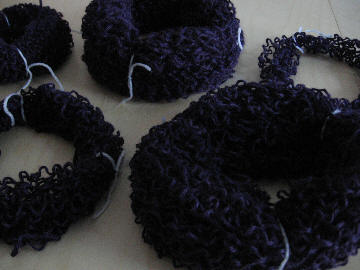
  • I got tired of seeing this unfinished project in the drawer, so I ripped it out this morning, and tied the wool back into skeins.

    Unwound

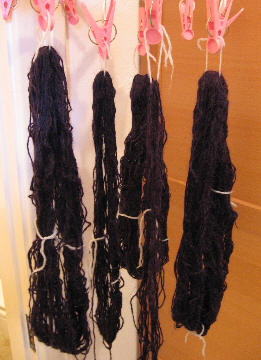
    I must say, I get a bit of a kick seeing how kinky wool gets when it is knitted.  After washing, it was a sorry sight, though —

    Drying

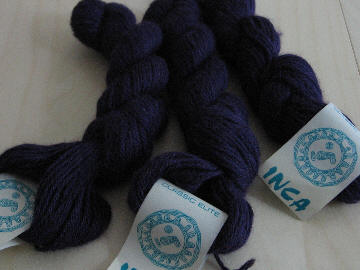
    especially since it once was this —

    Inca

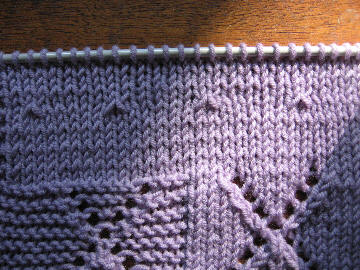
    Classic Elite Inca alpaca.  The color is apparently long-since discontinued, since I’ve had it around for I don’t know how long.  (Cough–twenty years–cough.)  Very nice stuff, so soft, in a rich purple that the digital camera cannot seem to capture.  Here is the first repeat of the Beginner’s Triangle from "A Gathering of Lace".

    Beginners_beginning

    One of the things I like about blogging is that my resolve to finish things is much stronger.  Who wants to show off a bunch of half-started projects?!