• I’m not entirely sure why the delightful Blackbird wishes us to show-and-tell our butterdish, but here it is —

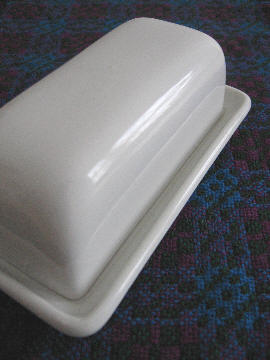
    Butterdish

    Bought so many years ago that I’ve long forgotten its origins — plain, serviceable, of a size to hold the longer sticks of butter that seemed so elegant to me, having grown up with the short, fat ones.

  • Peterman1930sdress_1

    From J. Peterman.  Sigh!

  • Sense

    These seem to appear whenever I see a Jane Austen film! This particular quiz is actually more effective than most, as the questions aren’t so leading ("Q: Would you rather dance or ride a scooter?" "A: You are La-La!").

    Amusing to see Emma Thompson pop up, anyway!

    "Which Jane Austen Character are You?"

    You scored as Elinor Dashwood. As Marianne’s older sister, Elinor lives at the other end of the emotional spectrum. She rarely reveals her intense feelings and is more concerned with being honest and loyal than having what she deserves. Even though her intentions are pure, she sets herself up for loss by constantly placing other people before her own needs. Overall, Elinor is gentle and rational but is just as capable of radical emotions (despite her withholding them) as her sister.

    Elinor Dashwood

    75%

    Marianne Dashwood

    63%

    Elizabeth Bennet

    59%

    Jane Bennet

    56%

    Charlotte Lucas

    47%

    Emma Woodhouse

    44%

    Lady Catherine

    3%

    Which Jane Austen Character are You? (For Females) Long Quiz!!!
    created with QuizFarm.com

  • Booking Through Thursday‘s questions for today come from Cate.

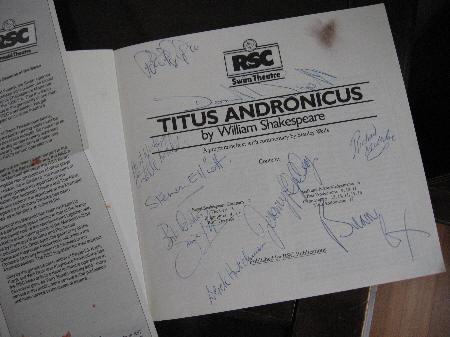
    1. Do you have any books that are signed by the author? I have a paperback of Outlander by Diana Gabaldon, who did a reading some years ago at Vroman’s (she is small and dark and very funny).  I had a Dick Francis book from a signing there, too (goodness, didn’t know he has a website!), but this was regretfully given away during one of my periodic running-out-of-shelf-space weeds, on the assumption that if I wanted to read any of his books again, I would surely be able to find it at the library.  I also have a copy of Shakespeare’s "Titus Andronicus" signed — not by the author! — by most of the cast of Deborah Warner’s 1987 RSC production.
    2. Do you have a story behind the autograph?  I loved the Outlander series from the beginning, with its wonderful blend of romance, adventure, history, and time travel (although I must say, I have lost steam regarding the later books in the series).  "Titus" was part of the schedule one blissful summer when I took a Shakespeare course/tour in college, and I went to see it because it was on the schedule.  It is not one of his better-known plays, to say the least, but I was completely amazed by the production’s power and with the cast’s brilliance, and so, not a little stage-struck, I haunted the back of the RSC to collect their signatures on a copy of the play (there are more on the next page, as well).  They were all very generous with their time, and I have very happy memories of that week in Stratford.

    Titusandronicus

  • Eyes

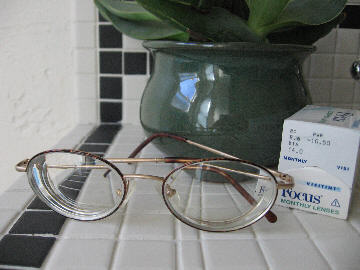
    Blackbird wishes to see our eyes for Show and Tell this week.

    Img_3493_small

    But optics sharp it needs, I ween,
      To see what is not to be seen.
          — John Trumbull (American, 1750-1831), McFingal, canto I, l. 67

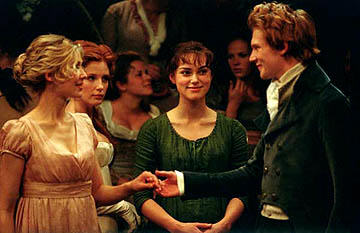
  • I’ve at last gotten around to seeing the new "Pride and Prejudice" — due to the surprisingly early DVD release date!  I got much of the right front of the Swing Jacket knitted up while watching it.

    Img_3500_small

    I was astonished to see that except for her very first scene, Elizabeth did not wear a petticoat.  I cannot claim to be an expert in this matter, but I believe that this is akin to a woman going braless in the 1950s — just not done.  I was also rather surprised that she almost never wore a hat — now, Elizabeth is something of a free spirit, but although it might be supposed that she would "forget" her hat when walking to Meryton, I cannot believe that she would appear at Lady Catherine de Bourgh’s bareheaded.  I am also astonished that Mr. Bingley would simply open the door of Jane’s bedroom without first knocking — and that Lady Catherine would appear at the Bennets’ in the middle of the night — while this lady, too, is strong-willed enough to expect the world to cater to her, a midnight call is rather mind-boggling.  (I think that we are supposed to believe that Darcy’s midnight call on Elizabeth, at the Collinses’, is a kind of dream, and that his letter’s appearance in her hand comes as something of a surprise to her, but this makes the two calls together rather puzzling.)

    (Regarding hats, it seems to me that Elizabeth would be much like Laura Ingalls, who would usually wear her bonnet but push it back off of her head.  It seems like she was always grudgingly pulling it back up.)

    It’s also disconcerting to hear, in the opening scene, a stunningly beautiful piano piece and wonder if we are expected to believe that Mary is playing it, the same Mary whose clumsy music "delights us long enough" later at the Netherfield ball.

    And of course, the fact that the film is only two hours makes it much more difficult to explore the nuances of character and family relationships so delightful in the longer versions.  I understand, in this light, that many of my favorite lines have ended up on the cutting room floor, or not even in the shooting script, alas — although I was surprised that Mr. Bennet’s little tease of his wife regarding their new neighbor Mr. Bingley, "It is very unlucky, but as I have actually paid the visit, we cannot escape the acquaintance now" (which I was looking forward to hearing from Donald Sutherland), was altered to no obvious improvement.  Mr. Wickham was a bit of a loss, too — and I did think it better that his spilling-out of the story of Darcy’s perfidy (as Wickham presented it, anyway) was much better coming impulsively (on purpose) from himself, as in the book, than from Elizabeth asking him — which made him seem less of a cad.
    Pp2005_2_2

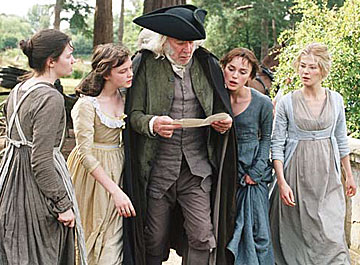
    But cavils aside, this is a lovely film to look at.  The locations are utterly gorgeous.  It’s funny, how fashions change in the way we film period pieces, isn’t it.  Twenty-five years ago, everything was clean and the colors were bright and everyone wore gloves when they touched each other — ten years ago, we discovered sex, and this year, dirt.  I can believe that the Bennets’ home might be shabby, but not, I think, Shabby Chic.  The amount of paint flaking off of the walls was incredible! and would, I think, have opened them up to a censure that Mrs. Bennet at least would have found mortifying.

    I did like that there were so many night scenes.  I suppose that in the first series the demands of video required that either filming was done mostly during the day or that night scenes be brilliantly lit — it does make more sense that night scenes, either at home or at a ball, be by candlelight, after all, and here it seems much more realistic.
    Pp2005_1

    It was unusual and yet not unpleasant that the family dynamic has changed here from other versions — this Mr. Bennet especially is much less disparaging of his younger daughters and his wife, whose silliness is not as readily apparent.  Mrs. Bennet especially gets more justification for her behavior, and actually gets to point out to Lizzie that five daughters need to be married off.
    Pp2005_3_1

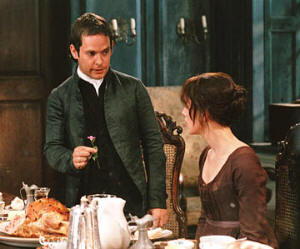
    Tom Hollander was unexpectedly marvelous as the odious Mr. Collins, who is usually a figure of fun, but here was kind of awful and yet pathetic. 

    This indeed an enjoyable adaptation of the novel — not, obviously, as faithful as the 1995 version nor the 1980 one, which is still my all-around favorite.  But this new one does have its own strengths and beauties.

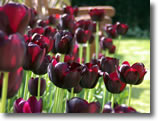
    (And here is a little unexpected Project Spectrum red: "Queen of Night" tulips from the Formal Gardens at Groombridge,
    Groombridge_tulips

    which was used for Longbourn in this film.)
  • Well, it’s been a quiet week in Swing-Jacket-town.  Theresa has been distracted — understandably, go and have a look! — by her Dragonscale socks.  But Kat modestly says, "I’ve made a bit more progress since my last blog post," by which she means that she is almost done. "The sleeves are now finished and are blocking. In the meantime, I’m seaming the body pieces and knitting the collar. I’ve decided to add in a zipper as well so hopefully I’ll be able to find one in a matching color."

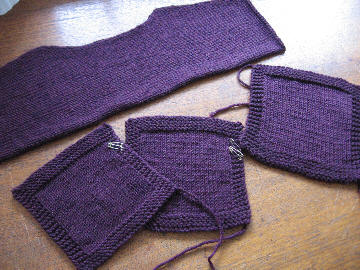
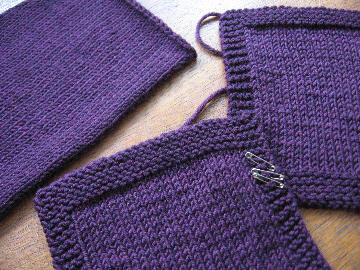
    I had a surprising amount of trouble getting the gauge with the Extrafine Merino.  I usually knit loose, so I started off with one size smaller than recommended on the ball band — too big — down one — still too big — down another … finally ended up with a swatch on US3s that was just a smidge too big, and another on US2s that was a bit stiff.  I am one of those, however, that purls too loosely, and while I am fully aware of this and vow daily to purl with less abandon, it rarely seems to show in the finished stockinette — hence the solution here of using a US3 needle for the knit stitches and a US2 for the purls, solving two problems at once.

    So_far

    (This, for those of you who don’t have the problem, eliminates that curious wobbly effect on stockinette, when the tension of the knit and purl stitches is inconsistent.

    Swatches

    You can see the difference here, between the two swatches and the first piece.  They have all been blocked.)

    I started the Swing Jacket with the yoke, also remembering my tendency to work a project with quite a different tension than my gauge swatch, once I get into it.  The yoke — the smallest piece of the jacket — is essentially another swatch.

    This could also qualify as a Project Spectrum piece for this month, if I could figure out how get a consistent color from my camera!  The wool is actually a purplish red, but the light this morning — very overcast and grey — brings out the blues in it.

  • I really did mean to do every project in this book.  It seems a bit of a swiz to say that I’m going to work my way through the Knitter’s Almanac, and then skip a project early on — although Elizabeth herself would probably tell me, gently but firmly, not to be an idiot and knit something that I have no use for!  But it’s March, and the project for this month is a sweater, and instead of Bleak Midwinter or anything even remotely along those lines, here where I live it is sunny and 70° F/21° C — or at the least 60°/15° — as it has been since before Christmas.

    Sigh.

    I Googled the "Chainmail Sweater," to see if I could find any inspiration, and at Knitty.com was "Knitting for Maniacs" by Julie Theaker, an heir to Elizabeth’s philosophies if I ever saw one.  She includes in her article a photo of her Chainmail Sweater, Elizabeth’s other name for this month’s Almanac project, and it’s incredible.  I’m very impressed — the photos in the Almanac are rather sedate, really, and Julie’s is an eye-popping mix of blue lines against a shifting background of pinks, reds, and oranges.  She also steeked it into a cardigan.  While I don’t think I would ever be bold enough to choose this color scheme, it’s certainly a fabulous piece of work.

    But, no, this one still doesn’t do much for me.  I was tempted to do another EZ pattern as a compromise, perhaps one of the lovely 3&1 sweaters in Knitting Around (there is one at the lower left on the cover), but that didn’t seem quite right, somehow.  I thought I should just make a swatch, at any rate.  Elizabeth sounded very pleased with herself for coming up with the trellis pattern of this month’s sweater — and rightfully so, as she managed to overcome that rather herky-jerky shift of colors that comes with colored diagonals in knitting, in that a stitch has to (well, usually) go up and over a stitch to make a diagonal.  She decided to use K2togs and SSKs with our old friend from January, the Left Twist, to make a vertical line that actually flows — very clever.  "Shall we make a colored Travelling-Stitch on a differently-colored background?  We shall"!  So I dug around in the stash and came up with four balls of wool that were fairly pleasing together, and of a similar weight, to give it a try, but all of this improvisation was making me nervous, so I drew up a homemade chart and tried out a few schemes with colored pencils before casting on.

    March_almanac1

    The photo in the book, I’ll admit, is not very inspiring, due I suspect mostly to its being black-and-white.  Funny, how spoiled we’ve gotten with color photos in knitting books!  The pattern is more interesting in color, even as it comes off of one’s needles.

    It is also good practice for that Bohus pullover I keep dreaming of, using the Bohus technique of purling on the first row of a new color.  It makes a kind of optical illusion with the colors, pulling a little dash of color from the previous row into the different color of the new one.

    (Elizabeth also mentions keeping a record of one’s knitting projects, something I’ve been pondering for a while, but am a bit indecisive about the format.  Does anyone keep a knitting journal that they would be willing to show-and-tell?  Leave a comment here –)

    But what will this swatch turn out to be?  Ah —

    March_almanac

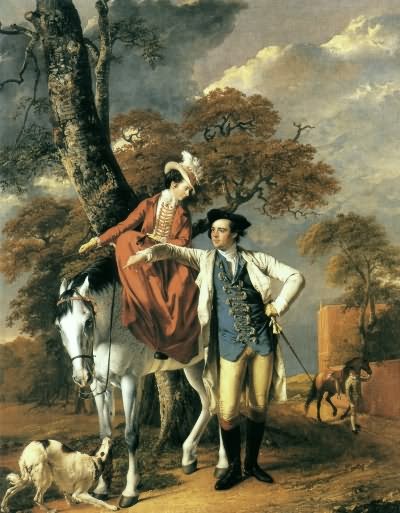
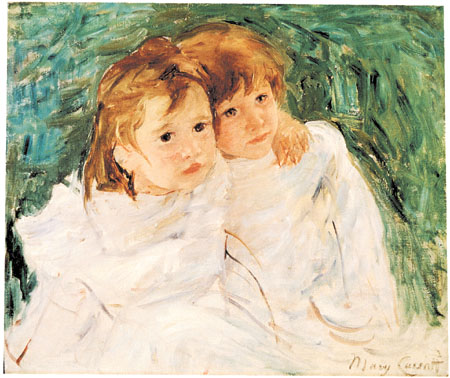
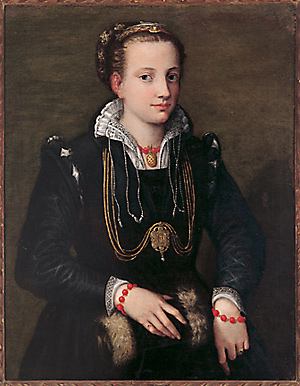
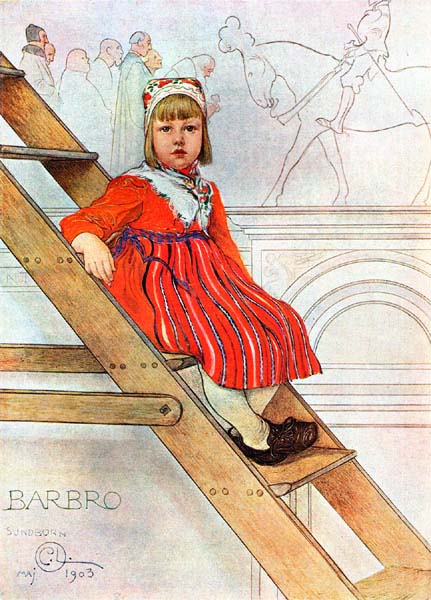
  • One of my favorite pastimes is "collecting" art for my fantasy museum.  If money, time, current ownership, etc. etc. were no object!  Here then, arranged to suit Project Spectrum‘s theme for this month, is the Red and Pink Gallery — or, as I suspect, part of the Red and Pink Gallery ….

    Wright_mrandmrscoltman_natlgallery

    Joseph Wright of Derby, "Mr. and Mrs. Coltman," 1771 (National Gallery, London).  One of my favorite pictures ever.  So often, portraits of couples have some kind of psychological distance between them, but Mr. and Mrs. Coltman have a comfortable familiarity with each other.  I love the way that his elbow rests on her knee.  Her red dress is a bonus.

    Cassatt_younggirls_c1885_frick_1

    Mary Cassatt, "Young Girls," ca. 1885 (Frick, Pittsburgh).

    Degas09red_1

    Degas, "The Dance Lesson," 1879 (National Gallery of Art, Washington).

    Anguissola_artistssisterminerva_1

    Sophonisba Anguissola, "Portrait of the Artist’s Sister Minerva", c1564 (Milwaukee Art Museum).

    Carllarsson_barbro

    Carl Larsson, "Barbro," 1903.  Finding reds in Carl Larsson’s paintings and watercolors is absurdly easy — he loved to put splashes of red, whether flowers, textiles, painted furniture, in almost everything.  This little girl, though, I find extremely charming, as she reminds me very much of my younger daughter.  (I cannot seem to find the location of the original watercolor.  It was reprinted in Larsson’s book Andras Barn (Other People’s Children), but the reproduction that I have of the watercolor is rather vague as to the credit.)

    Fantinlatour_whiteandpinkmallowsinavase_

    Henri Fantin-Latour, "White and Pink Mallows in a Vase," 1895 (Norton Simon, Pasadena).  An old favorite from early on, thanks to many school trips to this wonderful museum.