• Far-Distant_Oxus_cover
    I came across The Far-Distant Oxus, as apparently many other readers have, by way of its appearance not only on Wikipedia's list of novels published in 1937 but on a number of if-you-like-"Swallows and Amazons"-you'll-like-this lists, and this plus the novelty that it was written by two schoolgirls, about the same age as the children they were writing about, was appealing enough for me to hunt down an early edition. 

    It feels more than a bit churlish to say that I didn't like it much — I appreciate it for what it is, a full-length novel written by a pair of fifteen-year-old school friends, who were not only determined enough to plan it all out and write it (editing each other's chapters apparently without qualm or rancor!) but were also brave enough to send it to Arthur Ransome, who even in 1937 was quite famous.  Full marks there!  But it does read like the writing of schoolgirls — intelligent ones, well-read ones, to be sure, just very young.  (Did children in 1937 really say "Umm" so very often? and not in a pondering sort of way, but meaning simply "yes"?)

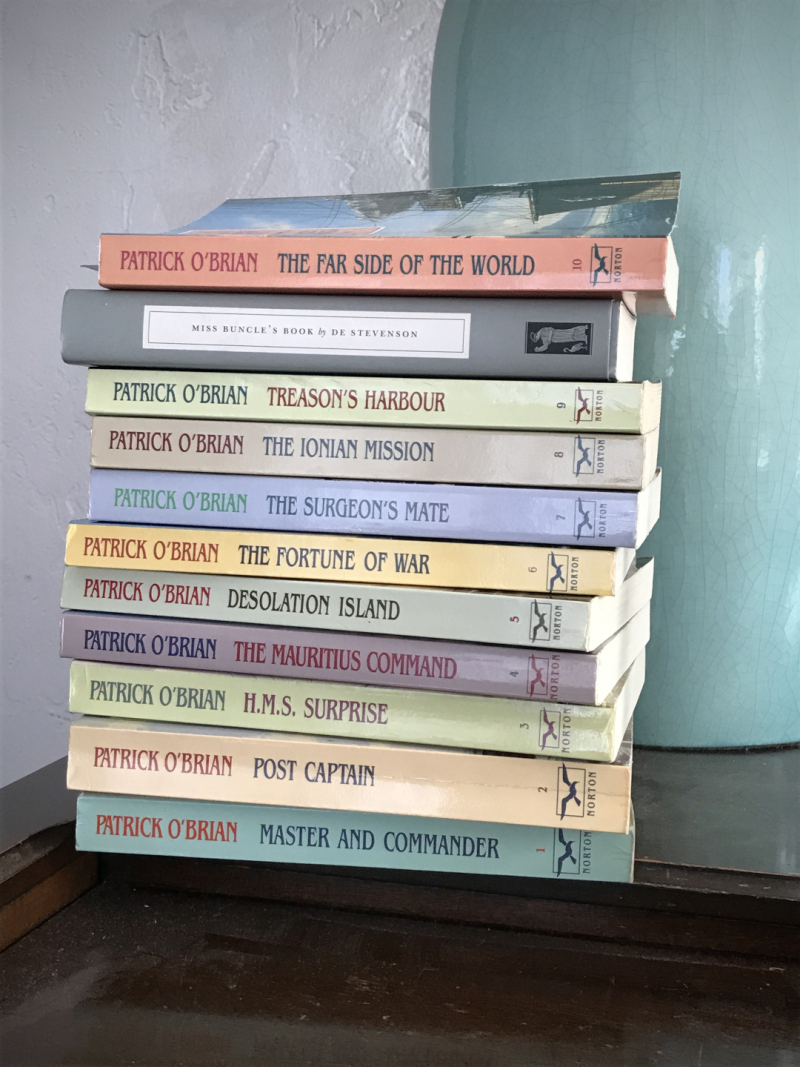
    The plot is often pithily described as "Swallows-and-Amazons with horses instead of boats," which was not at all off-putting, since I was a horse-mad girl myself, though alas mostly from a distance, and obviously I love the "Swallows and Amazons" series deeply.  But I actually found myself wishing that this book had more horses in it –there are horses around quite a lot, and the main adventure is a week-long ride across the Devon moors to a particular lake (parentless, as are the Swallows' and Amazons' adventures).  But while sailing is an integral part of many of the latter's adventures, the horses seem much less integral in the former, almost as though they are simply the means of getting to the lake, not characters in their own right, as often "Swallow" and "Amazon" almost seem to be.  Whether by accident or design, one of the advantages of having youngest-brother Roger or new friends Dorothea and Dick Callum is that much technical detail can be supplied without it being dull authorial exposition — this is very similar to one of Stephen Maturin's functions in Patrick O'Brian's Aubrey/Maturin series, or Hastings' to Poirot and Watson's to Sherlock Holmes — and I think this story could have benefited from one of those.  (And more horses.)  The Oxus children are all somewhat interchangeable, except for the almost absurdly-perfect schoolgirl-fantasy boy Maurice — darkly good-looking, superbly capable and resourceful, and mysterious! — and don’t really hold up well in comparison to Ransome's deft characterizations of the four Walker children and the two Blackett girls, and re-reading Elizabeth Enright’s Melendy family series recently reminded me of the same thing, that Ransome and Enright both have characters which are not just physically different from each other but in character as well, which comes out in both their actions and their conversation.

    All things considered, I appreciated reading this — horses (though not enough!), some beautiful descriptive passages — but I daresay that if I'd read The Far-Distant Oxus when I was ten, I would have loved it —

    (For those of us who have not read much Matthew Arnold, the title refers to the river in Central Asia — the Amu Darya, classically the Oxus — featured in Arnold's narrative poem "Sohrab and Rustum," which so enchanted these young authors that their characters re-christen numerous landmarks along their journey with names from the poem.)

    1937 Club small

    Links to other readers' reviews of books published in 1937 can be found here.

  • Baby island
    The 1937 Club is the latest iteration of an online book club hosted by Simon of "Stuck in a Book" — the only requirement is that the book one reads is published in the year in the current club's title!

    Not being able to produce off the top of my head a list of novels published in 1937, I went to Wikipedia's list thereof as a starting place.  I decided, with some regret, not to read books I have already read — and so out went The Hobbit, On the Banks of Plum Creek, Summer Moonshine, and The Broken Ear, although it would be interesting to re-read them in the light of having been published in 1937, and their respective reflections (or not …) of that year.  But when I saw Baby Island by Carol Ryrie Brink, you could have knocked me over with a feather — 1937?! impossible!  Why, I bought a copy from the Scholastic classroom book orders service when I was in, what, fifth or sixth grade, and read it literally umpteen times, and it wasn't that old then!

    But it was, of course.

    It's not a little surprising — and luckily, amusing — to me now that I can still almost recite whole passages of Baby Island from memory, and yet some of it — I suppose the dated bits — simply went over my head at age ten.  I had completely forgotten that the ship on which the Wallace sisters sailed was bound for Australia to meet their missionary parents.  I do remember that in times of trouble the girls sing, loudly if possible, "Scots Wha Hae" — to stir themselves up, as it were, to give themselves courage.  (The song, like "The Star-Spangled Banner," has a now-rather-unpleasant martial aggressiveness to it, possibly as lost on the young Wallace girls as it was on me at the same age.)

    But I deeply admired the sisters' resourcefulness, their situation — who hasn't dreamed of being shipwrecked on a desert island, especially when you've read both Robinson Crusoe and The Swiss Family Robinson?! — and the novelty of being shipwrecked with no less than four babies under toddling age.  The characters of both the two Wallace girls and the babies are distinctly drawn and while their predicament is pretty serious the overall tone of the book is humorous, and although the appearance of their own Man Friday and the outcome of the plot might be more than a bit predictable, it is a story for young readers, after all, and, impressively, perhaps apart from elder sister Mary's old-fashioned sense of decorum, it doesn't seem impossible that it could all be happening now.

    3a
    (The cover art of the paperback edition has gone through at least three iterations since then, a similar assortment of girls and babies, though looking more au courant, as it were, each time.  It's interesting that the Aladdin paperback of 1983 is the only one that highlights the peril of the shipwreck.)

    1937 Club small

    Links to other readers' reviews can be found here.

  • 5455
    I should put exclamation marks in the title.  Camptown Races (Sort-of) Cowl!! Finally!!

    I don't remember when I started this, summer of 2021 is the closest I can get, as I well remember knitting during Zoom meetings and usually having to rip out large portions afterwards since I'd get distracted and lose my place.  It's only partly the Camptown Races pattern because of course I didn't need to work any stripes, the yarn doing it all for me, sometimes handsomely, sometimes crazily.  The yarn is "Gluttony Sock" superwash merino/nylon blend from Forbidden Fiber Co. in the "When Presents Explode" colorway.  It pooled and flashed in some strange and not particularly pleasant ways — why do these yarns always start off so well, then go off the rails?! — but luckily for me, with this style, I can wrap it up and tuck the weird bits under.  I have had a number of compliments when I've worn it, actually, so that's all right.

    5456

    5453

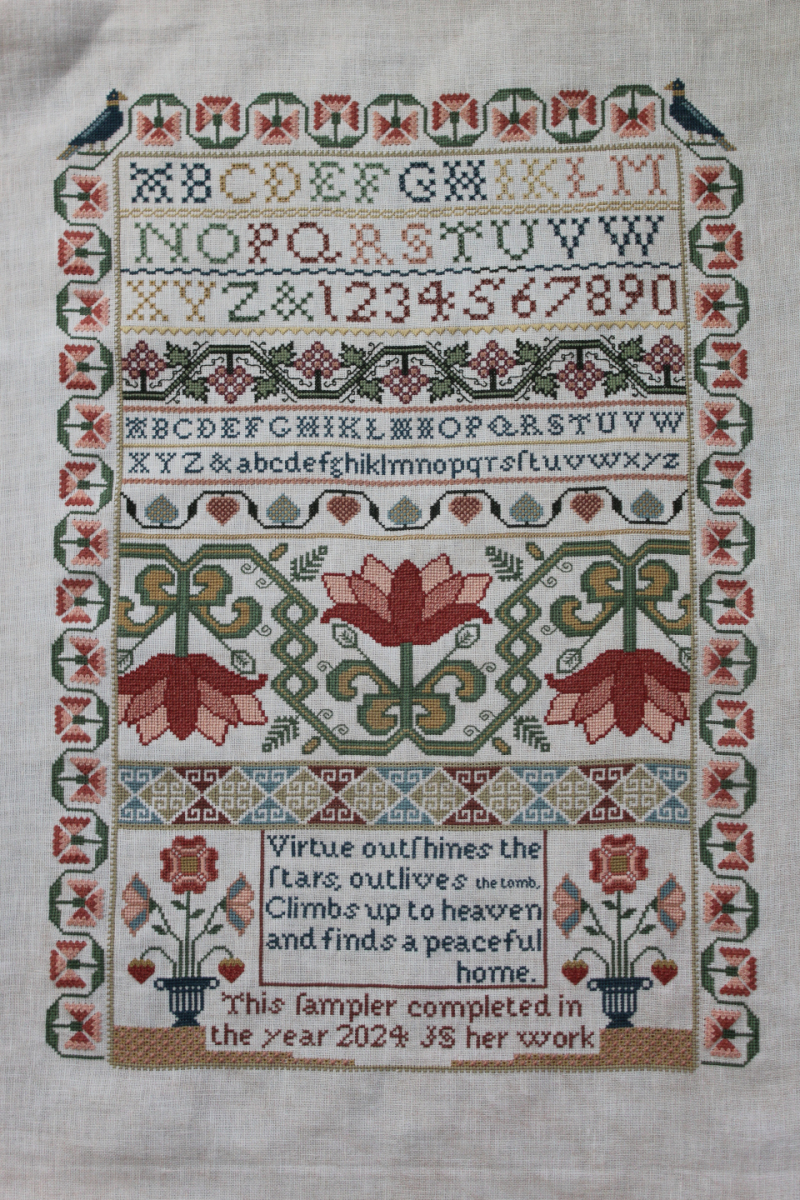
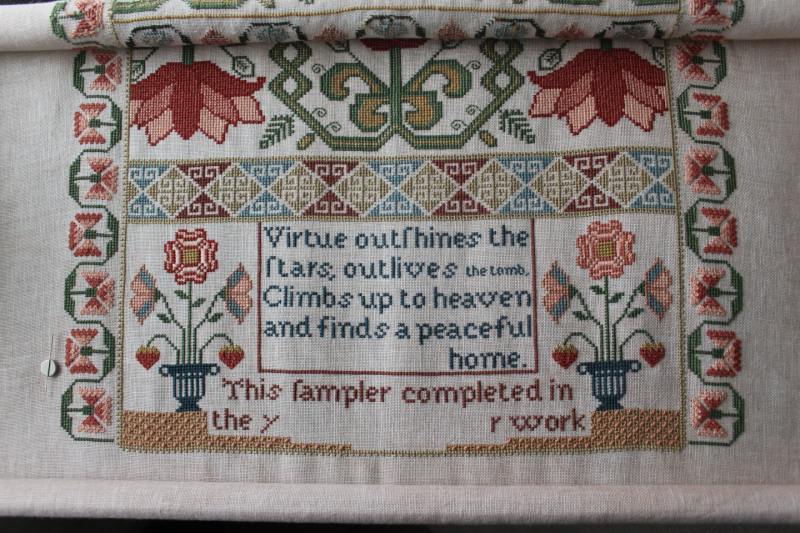
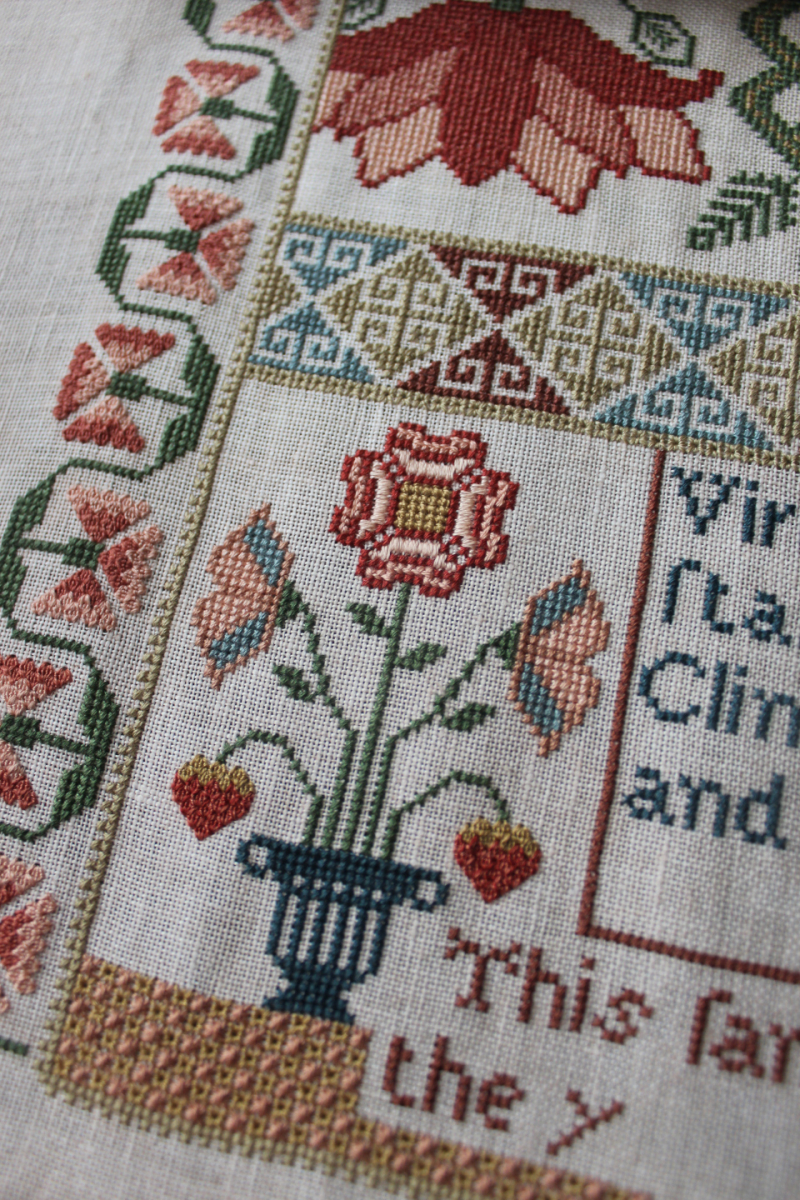
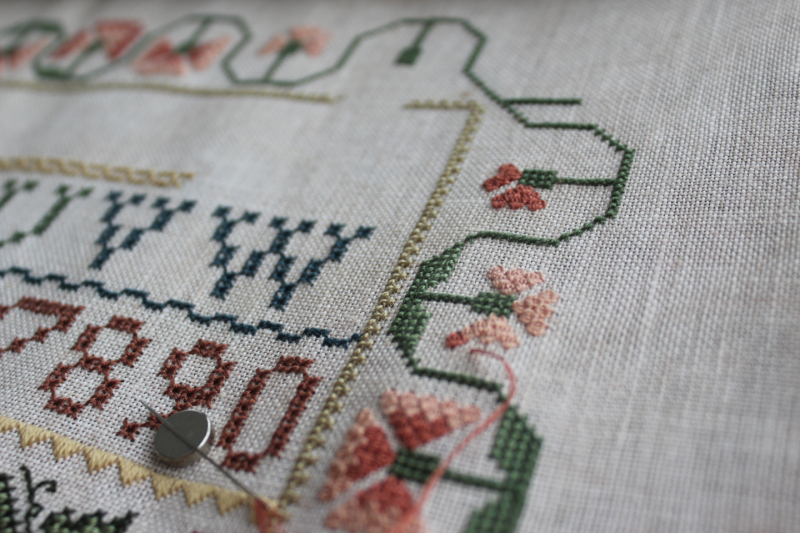
    I was going merrily along with "Virtue Outshines the Stars" when I realized with a thud that I had mistaken the large dot for the small dot on the old hand-drawn chart, and that the "picot" line down the left-hand side should be gold and the outlines of the large flowers should be red.  Since I had done only one thread's worth of the picot, that was a simple matter to pick out, but I was this far with the flower outlines, and not only was that some hours' stitching, but having filled in the first flower, picking it out might cause a number of problems nearby.  It doesn't look wrong — unless you know it's supposed to be red, of course! — in fact it doesn't look bad at all.

    4540

    And I had made up my mind to leave it, when I found myself the other day picking it out.  As it turned out, it was a bit of a bother, but not trouble, really, as I had feared. 

    The next hurdle is that I wasn't sure at this fabric count — 32 threads per inch, on the fence now and then as to using one strand of floss or two — if the queen stitches in the border would look better with one thread or two.  I decided on one, and indeed they look quite tidy, although upon reflection they look very delicate next to the 2-strands cross stitches, like using your Denby stoneware teapot with your Spode china cups — both lovely in their own ways, but rather imbalanced together!  Looking ahead at something else on the chart, I realized that another set of queen-stitch flowers (for this is a Darlene O'Steen chart, the Queen of Queen Stitch!) uses a blended color, definitely two strands, and so one can assume that she meant there to be two strands in the border as well.  Queen stitch is not fun to pick out, but … oh well.
    4541

  • 4264

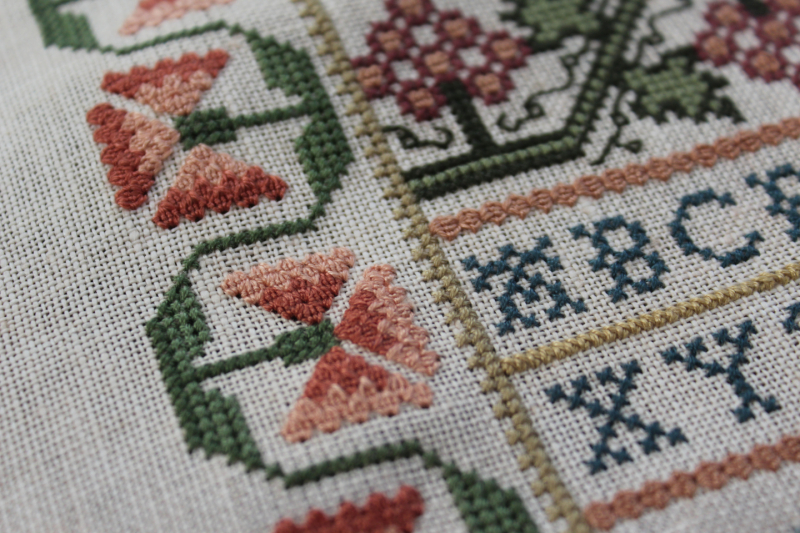
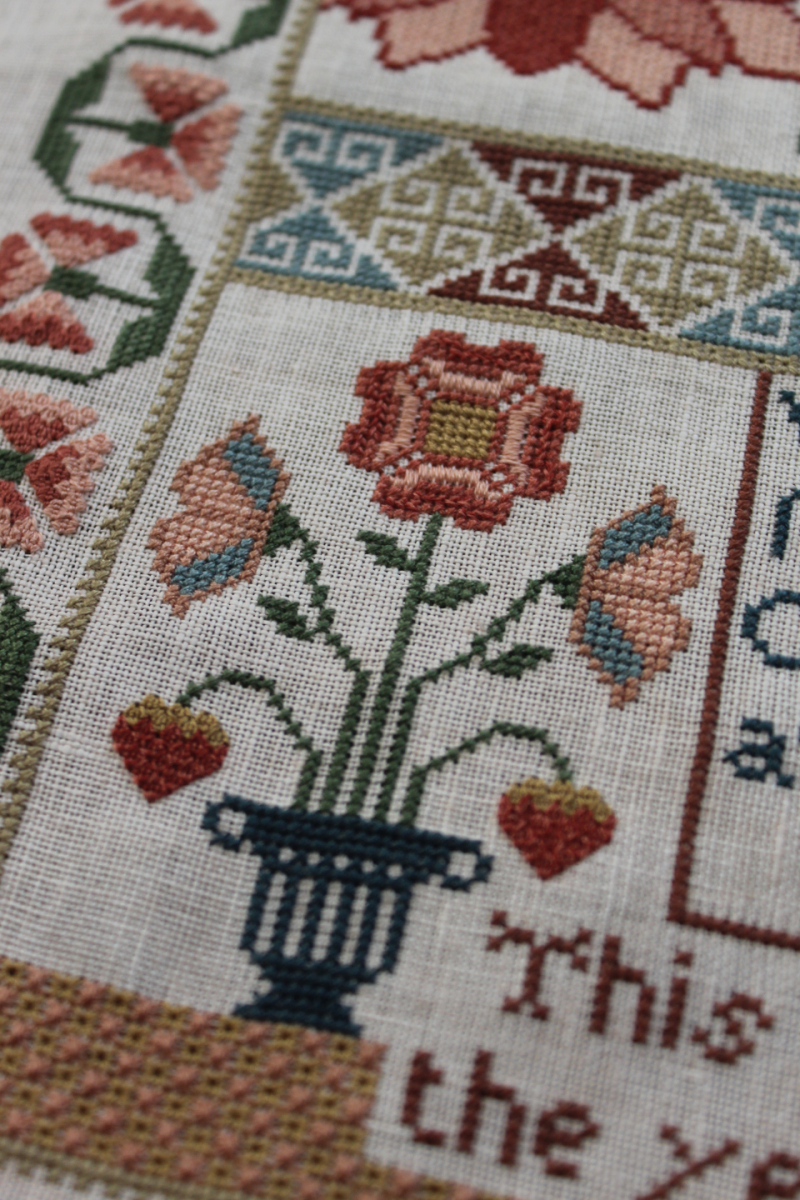
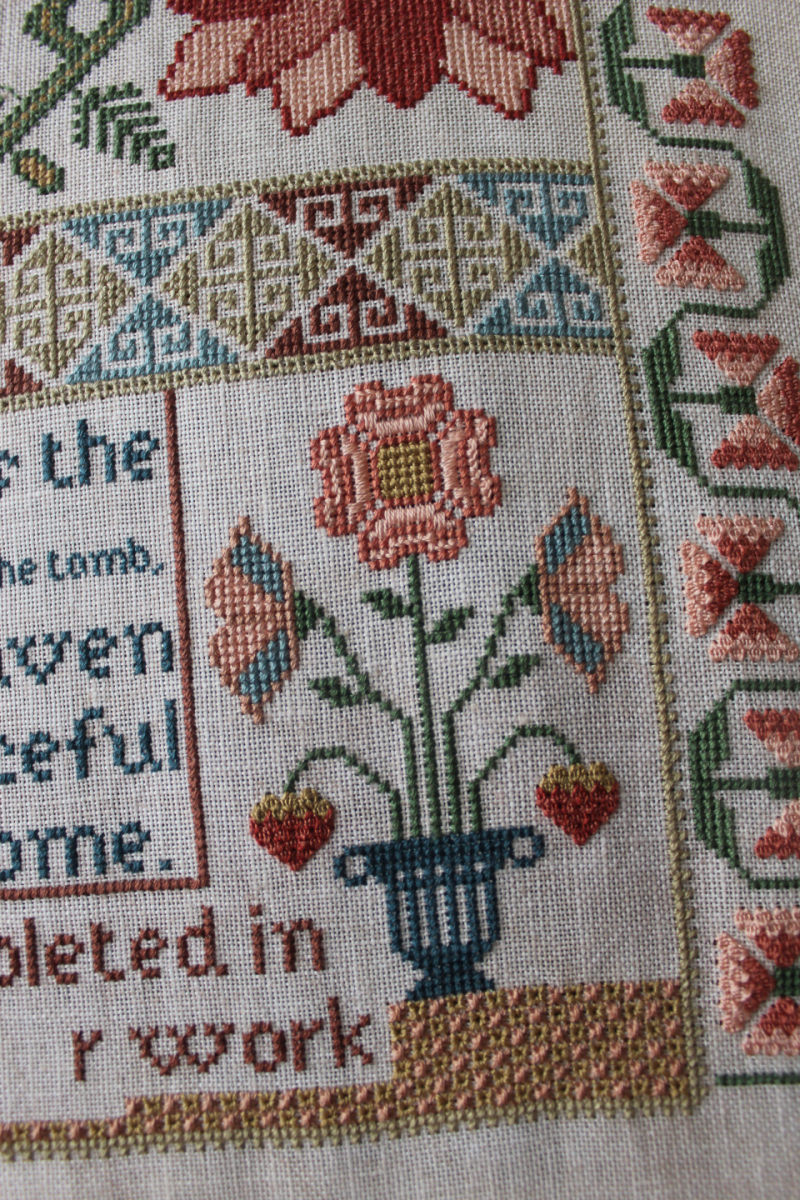
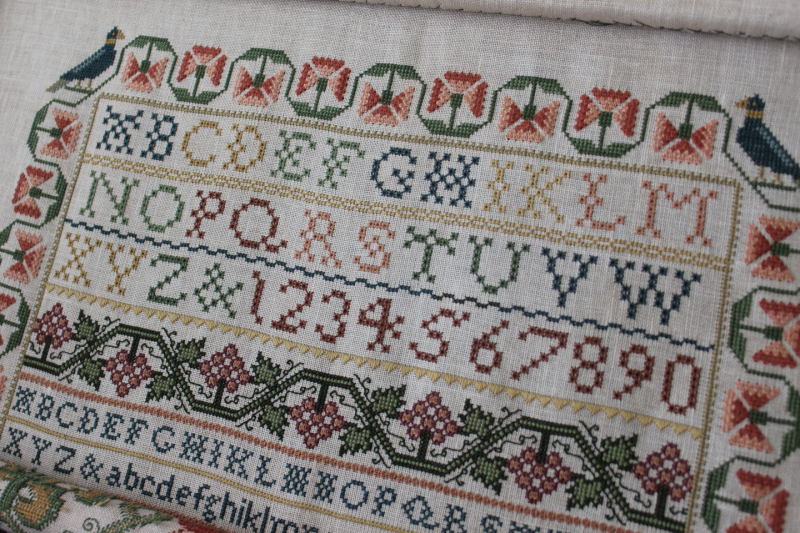
    I almost wish that this had taken me longer to stitch, because I enjoyed it so much!  It is "Mrs. Campbell, 1805" from Hands Across the Sea Samplers.  I love the colors, the rampant and exotic central field — the garlands of which are ostensibly symmetrical but actually aren't — contained in an neat and tidy border that would be severe if it weren't for the bright colors.

    This is in the DMC colorway, on Zweigart Newcastle linen (40-count) in "Antique White."  I'm still a bit undecided about tea-dyeing this to be more like the original, but I suspect I'm going to leave it as it is now.  (If you're curious, you can see the original sampler in an old Barneby's auction listing here.)

    4256

    This is the first sampler from Hands Across the Sea that I've worked, and to be honest, I don't really like the beautifully-printed and spiral-bound booklet that the chart comes in — while the small pages allow for a large image of each section of the chart, there are too many sections — twenty, in this case, not even counting the key — which necessitates a lot of flipping back and forth as one stitches, and the spiral binding, while it lies admirably flat, prevents the heavy-paper pages from flipping easily.  I managed it well enough on the border and alphabet, which are logical and relatively intuitive, but when I came to the central field I soon scanned the pages and cobbled together a full chart that let me carry on in any direction to finish a particular leaf or flower bud.  Were I to buy another chart from them — and there are certainly a lot of charmers to be had! — I would probably simply buy the PDF version.

    Alas, nothing is known of Mrs. Campbell, except that we can assume, partly from the fact that she was not a schoolgirl and partly from the admonitory motto, that she was a teacher in Oban.

    4258

    The little parrots are delightful!

    4259

    4257

    I made a slight wobble here, putting the "c" in "clean" one space too close to the "l" — since I happened to be working it from right to left, this put the next letters one space off as well, but once I noticed it, about halfway along, I started the "K" in the correct spot.  The lower-case letters being worked over-one, they are a pain to pick out, but I would have done so if they hadn't been in red — I had had to pick out a few stitches somewhere in "Mrs Campbell Oban" and the red thread left a rather obvious "stain" of red fibers — and so I decided — pace Mrs. C — to leave the "c" where it was.  I think it's almost unnoticeable …!

    4260

    4262

    4263

    A pleasure from start to finish!

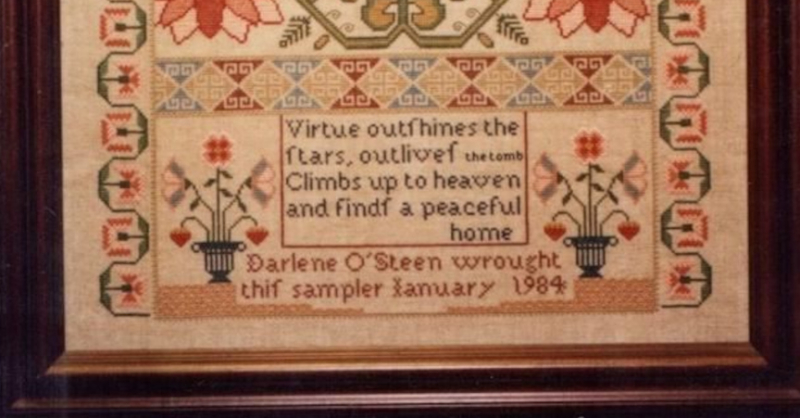
    And then — I admit, the moment "Mrs. Campbell" came out of the frame — because I've been saving this, my sine qua non of counted-stitch samplers, Darlene O'Steen's "Virtue Outshines the Stars" …

    4255

  • 5274

    Ta-da!

    I made a bit of a push to finish this, since it was so close.  I started it on the 27th of September, 2020, and finished it on the 24th of December, 2023 — just over three years.  It is of course the "Quaker Virtues" by Bygone Stitches (and it is apparently back in print since I bought the chart in I think 2019).  After much internal debate, I decided on DMC threads — since it requires 30 skeins of the main color! — specifically 931 Antique Blue Medium, with 930 Dark for the virtues and 932 Light for the scattered letters and numbers.  I admit to making a lot of subtle fixes and changes — there were a rather shocking number of mistakes in the chart, in motifs that are supposed to be symmetrical — and I moved more than a few motifs a thread or two to get what I felt was a better balance.  I also added a second line around the outside, which I felt gives it a bit more finish — but considering the size of the thing, it's a wonderful chart, and I enjoyed it and highly recommend it.
    5266

    5268

    5269

    5270

    5271

    I had been sharing my progress via text messages with a dear friend who moved to another state a few years ago, and when I sent the photo of the finished piece, she said she thought this was her favorite of all of the stitching I've done.  I had been pondering pretty much the whole three years what I would eventually do with it — it's I think 29" x 23" (74 x 59 cm)! — and so I said quite impulsively, "Would you like to have it!"  She said yes, and as it was her birthday that very day, I took these photos, wrapped it up, and sent it off.  No time therefore, alas, to wait for better light, or to re-take that blurry one! but I was very pleased that she was so delighted, and am glad to know that it is going to a good home.

    (I added in a "date" of sorts, changing two of the small characters near bottom center to 2 and 3 for the year.  I was going to change the E and U to my initials but there was no time with Christmas coming — we had twelve here sitting down to Christmas dinner! and hosted another gathering of eight the next day — and our friends unexpectedly in town that weekend, and so I put a quick inscription in backstitch along the selvage instead ….)

    5276

    5277

    5278

    5279

    5282

    5283

    5284

    5285

  • 4244

    "Mrs. Campbell, 1805" by Hands Across the Sea.  I started this just before New Year's and am enjoying it tremendously — amused at the same time that I looked at it a bit askance for a while after first seeing it, for Mrs. Campbell's rather severe motto "Keep your work clean and pay Attention to it".  Clearly a teacher! and a stern Scottish one, too.  But, to be honest, I love the fact that she has fit everything in so neatly — solving the eternal Corner Problem with a clever and pleasing arrangement — and that while the border "flowers" are strict and orderly, even with the colors repeating in the same order on all four sides, the center field is a nearly-riotous pair of leaves-and-flowers garlands with brightly-colored little birds — a calm and reserved outside with a playful inside.  I get that.

    4245

    It seemed obvious to me, after working a couple of Darlene O'Steen's designs, that the border lines should be in alternating backstitch, although the chart makes no distinction and so presumably indicates simple crosses and backstitch.  (The back of Mrs. Campbell's original seems pretty clearly to show that something is different between the three-stitch sections, but it certainly does not look like backstitch, to be sure.)  I enjoy the rhythm of alternating backstitch, though, and so it did not feel that I was doing Mrs. Campbell a disservice at all (!) to work it that way.

    4246
    Completely coincidentally, I had just bought a piece of the recommended linen, "Woodsmoke" by Tabby Cat Linens, but it is quite brown, where the Hands Across the Sea image looks much more to be of a rather yellowed linen.  Try as I might, I could not picture this on a café-au-lait brown, and so I bought a piece of Zweigart "Antique Linen," a lovely off-white, thinking that my coffee-dye experiments with "Zoé Elie" were quite successful, and I might put the finished "Mrs. Campbell" through something similar.  I'm liking the DMC colors quite a lot, though, so I might just leave it as-is.

    Mrs Campbell - Hands Across the Sea

    4249

    And the "Wisdom Sampler" is now back on a frame as my long-term WIP.  (I have in fact finished the "Quaker Virtues" that was in this frame, but can't get the photos from my phone yet ….) —

    4250

    I managed to get two more things actually framed for hanging — I can work the samplers much more quickly than I can get them framed, certainly.  Jane Jameson's charming-if-scruffy 1830 original is now in an "oops" frame that Laura brought home for me from work.  I had already archival-mounted the sampler on a cotton fabric-covered board, thinking to someday have it framed fairly close to the edges of the stitching, as so many historical samplers were, but a free frame was too good to turn down, especially when it was the right proportion and not a bad fit aesthetically either.  I really wanted to get this under glass and away from the elements as soon as possible, and so Laura and I went to Michael's one day and the framing clerk suggested this dusty-green mat and Laura suggested the float-style mounting — good choices, both.  The other sampler is of course my "Lady Floral Brittany," now in one of the three antique frames I bought a few years ago with my birthday money — wish I could have bought more of them, they were all as beautiful as this one.

    4252-2

    4251-2

  • 2587
    Page two is the next-to-last page in my journey through the "Quaker Virtues" chart!  I made an effort the past few weeks to focus on this and get to the join between pages two and three — and page three is less than half of a page of chart, because of the diagonal corner.  Whee!

    2591

    My Camptown Sort-of Races scarf — "sort of" because of course I'm not doing stripes, just letting the yarn go where it will, pools and all.  I don't even remember when I started this, but it was at least during lock-down in 2020, as I knitted on it during Zoom meetings (!).  It's an easy pattern, but also therefore easy to go wrong, because *you start daydreaming and all of a sudden think, "Oh no!  I should have worked the pattern row way back there," rip it back, re-knit, repeat from *.

    2595

    The 1909 Ladies' Mitts which I started back in July — well, at least it was this year, ha-ha.  I finished the first mitt a month or so ago — it took so long partly because for some reason my brain just did not want to keep track of the stitch pattern, and I kept getting off and having to rip it back and figure out where I'd gone wrong, or to get that second stitch of Kfb, which I don't know if I'll ever understand how to pick up when I've inadvertently dropped it.  With the second mitt, I bowed to Fate and used stitch markers after every repeat.  I still have to tink back now and then to get a dropped Kfb, but at least it's obvious when I've gone wrong!  I'm not crazy about either of these stitch patterns, to be honest, but the yarn is lovely to work with, so that's a plus.  (For some reason, I decided to cast off the first mitt in purl, then changed my mind, but I haven't gone back to re-do it in K1, P1 rib yet, which is why I haven't woven in that last yarn end!)

    2596

  • Death on the nile 2022
    I got on a bit of a mysteries kick after watching Kenneth Branagh's new version of "Death on the Nile".  I confess that I did not like it much — it not only didn't compare well to the 1978 version with Peter Ustinov as Poirot, but even if I hadn't been familiar with the earlier one, I would have been dismayed at many of Branagh's changes.  The moustache backstory was illogical and unnecessary, the attempts at "modernizing" the characters historically jarring — and also unnecessary — and the background details historically absurd (the maid in evening dress at a celebratory dance party? no! female crew members on the boat? no! and in shorts? no!! — and why on earth would they wrap the bodies of the murder victims like mummies?! good heavens). 

    Undoubtedly, my dismay at the movie is what compelled me to dash to the public library and raid the Christie section.  While I was there, since I knew that the three I chose are fairly quick reads, I looked at the Georgette Heyer shelf as well, and borrowed two of those as well.  I had read all of the Christies many years ago — I went through her entire oeuvre, possibly after seeing the charming "Tommy and Tuppence" series with Francesca Annis and James Warwick, if not earlier! — but these Heyers were new to me, at least.

    Death on the nile 1978

    First, of course, was Death on the Nile.  The 1978 movie is perhaps my second-favorite of the Christies — for the lovely and authentic (cough) scenery, for the wonderful clothing, the superb cast.  Although David Suchet will forever in my mind, as in many others', be Hercule Poirot, Peter Ustinov makes a charming and appealing Poirot.  It was interesting to read the book knowing very well how the murder was accomplished, and see all of the clues that Christie planted along the way, both in people's characters and their actions.

    After that, I read Heyer's 1939 No Wind of Blame, which I enjoyed very much.  The dialogue sparkles, the characterizations are deft, and the Scotland Yard inspector — who, rather surprisingly, doesn't make an entrance until halfway through the book — is appealingly snappy at times, with a teasing sense of humor that to me is quite unusual in a literary detective.  I fell for a red herring, too, trying to work out how one of the charming characters could have done it, when it turned out to be one of the less-charming ones (and I hope that isn't much of a spoiler!).

    Agatha-Christie-Murder-on-the-Orient-Express-1974

    "Murder on the Orient Express" is my favorite of all of the Christie movies, a stand-out in every respect.  Obviously, I was well aware of the plot as I read the book, but it also struck me how well the screenwriter, as that of "Death on the Nile" (John Dehn and Anthony Shaffer, respectively) concentrated the plot and the number of characters without sacrificing any plot points, and indeed, in many respects actually improving the tightness of the story.  It's also telling, cinematically, that while Kenneth Branagh felt that his 2017 version (even less successful in my eyes than his "Death on the Nile," but perhaps this is inversely proportional to the perfection of the 1974 version …) needed exterior chase scenes (!), the earlier one makes even the splendidly luxurious Orient Express feel claustrophobic, both in the flashback to the murder scene and in Poirot's summation of the events.

    Envious Casca I found somewhat less appealing than the other Heyer, most likely because the Herriard family is constantly sniping at each other, or outright arguing, but of course it is equally well-written and tightly-plotted as is the first one, with an admirably clever clue (if somewhat less obvious to those of us reading a century or so later) to the locked-room problem given quite early on.

    The 1982 film of "Evil Under the Sun" is one of those that I enjoy watching but don't seek out, for some reason — it just doesn't speak to me as much as the other two.  The book had somewhat the same effect on me — it's clever, but … not really a favorite of mine.  I can see why readers find Christie rather slight compared to, say, Dorothy L. Sayers, but then, one doesn't read Sayers if one is in the mood for Christie, either!

    I don't quite see, by the way, why so many reviewers find Branagh-Poirot's moustache so absurd — it's supposed to be absurd, except of course to Poirot himself, who is quite proud of it.  Christie describes it in Orient Express as "enormous moustaches" (note the plural!), and in other novels as "gigantic," "immense," and "amazing" (there is even a page devoted to it at AgathaChristie.com!) — and Branagh-Poirot's is far more amazing than Ustinov-Poirot's surprisingly average moustache or Suchet-Poirot's foppishly dainty one.  If you look at a selection of Victorian moustaches, most likely Poirot's generation, what is remarkable about Branagh-Poirot's is not so much its enormity as the mouche under his lower lip, which in my admittedly-small survey is never seen.  Mutton-chops, yes, goatees, yes, the rather "newer" Van Dyke as on George V, etc. etc. etc., but not the little patch.  Branagh-Poirot's moustache might actually be one of the few historically-accurate things about his movie!

    Some victorian moustaches

  • Mrs. Christie_s Sampler of Canvas Stitches (_When Daisies Pied_)

    It is Sampler September 2023, which seems to be not a stitch-along or even anything really official, but just is, as a time to celebrate cross- and counted-stitch samplers. In honor of this, and in thanks to those before me who have posted free charts of samplers, here is one that I have charted from a book that I came across somewhat randomly, Samplers and Stitches by Grace Christie.  It is essentially an early stitch dictionary, with descriptions and instructions and diagrams, and includes as plates (mostly black-and-white, it was 1921 after all) a number of little samplers that Mrs. Christie worked to demonstrate the stitches, and a few larger pictorial pieces, including one called "A Persian Flower Garden," a riot of colorful, though now faded, flowers and birds and insects, many of which she adapted into this smaller piece, with a springtime quotation from "Love's Labour's Lost" —

    Christie when daisies pied

    Download Mrs. Christie's "When Daisies Pied"

    The sampler was surprisingly challenging to chart in some places, as although the illustration looks pretty straightforward, the "columns" and "rows" don't always line up from one motif to another — and of course I had to adapt the colors of a hundred-year-old embroidery which I've not seen in person into modern threads.  I tried to strike a pleasing balance between the lovely faded colors of the front of the "Persian Garden" and the brighter, more original ones on the back.  Choices were made, obviously, and another stitcher should feel free to change them as desired. 

    I have not stitched this yet! though it is certainly on my list.  If anyone does, I would be delighted to see it worked!

  • 2507

    Now the boulders look like “three-dimensional” boulders, after switching out the errant DMC flosses for ones that more resemble the picture on the cover of the chart.  I meant to take a photo of this at the time, but clearly I was enjoying stitching too much to think of it.  Curiously, the water didn’t look like much of anything until the landscaping around it began to be filled in, and then suddenly it was obviously a waterfall!  I’m still not quite sure what that brown construction at the lower right is — I thought it might be a mill wheel … a bridge tunnel?  At the moment, I am leaning once again towards mill wheel …

    1819

    I bought these delicious-looking pastries for my 1:12 tea room some time ago.  Flush with the success, I decided to re-paint the outside of the third shop, which I had done in a rather vivid blue —

    1797

    that turned out to be just too much.  I had been going for a lovely dark blue, but though the paint chip looked tempting enough to buy a sample pot, it just didn’t work on the shop itself.  One night when it was far too late to run out and buy something else, I looked through my craft paints and pulled out a Martha Stewart one in “Magellan Blue” —

    1814

    and I quite like it now!  I’m afraid that the white trim next to a dark blue does show up the crookedness of the factory assembly, but there it is, can’t be helped.  I might try and touch up some of the wobbly paint work, though (!).

    2509

    I bought this at the same time as the two chairs for the tea shop, a midcentury-modern room divider from Arjen Spinhoven.  It is a superb kit, cleverly reducing a real piece of 1950s furniture into 1:12 scale.  My finishing techniques don’t live up to the beauty of this kit, I’m afraid, but luckily for me, it doesn’t look too bad from a distance.

    I worried a lot about the faux teak wood-grain that this piece absolutely required — I could paint the chairs black, but not this! — and I did a lot of research and testing on scraps before I did the real thing.  I’m mostly happy with my results — could be better, but for a first attempt, not bad.

    2505

    I’m embarrassed to admit that although I remembered and heeded the instructions to glue the two layers of a particular piece in a certain direction — so that the notches on the underside of the upper cabinet are aligned with the holes on the top of the lower cabinet, to fit that central shelf support — and that I laid them out carefully before applying the glue, I somehow managed to turn one half around as I was spreading the glue and forgot to turn it back.  This necessitated carving out some rather laughably clumsy notches on the piece that would become the underside of the upper cabinet — in a piece that actually has some rather good faux wood grain on it, too! aaugh — so builder beware, and learn from my mistake!

    2503

    (What an eye for detail Spinhoven has! Look at the double-H piece — the upper side of the cross-pieces, which will support the two small shelves, are cut with straight corners, but the undersides, which will be visible, have a slight curve in the corners.)

    2512

    This double-H was the most worrisome piece, as it is frighteningly thin and bendy, and you can see that I did not get it to stand as straight as it is meant to.  Even though there was a spare included with the kit (thoughtfully!), I had already cracked said spare earlier while dry-fitting my re-cut holes, and so I didn’t dare to take this one out and re-set it.

    This is my favorite part of the piece, the bow-like cross-pieces on the legs! —

    2510

    And yes, those “glass” doors do slide open and closed!

    2513
    2511