• Momchart

    I was watching an old episode of Louis Henry Gates's PBS series "Finding Your Roots" last night, and after having been intrigued yet again by the pie charts he provides to each of his guests, thought I'd make something similar for myself.  I haven't done the DNA testing because barring unforseen circumstances (i.e., a parent not being the actual biological parent), I already know where most of my ancestors came from.  (Not all, though — Addison A. Long, I'm talking to you!) 
    Here is a fairly simple way to figure out the percentages of your heritage:

    Multiply the number of foreign-born …

    … parents by 50.

    … grandparents by 25.

    … great-grandparents by 12.5.

    … gg-grandparents by 6.25.

    … ggg-grandparents by 3.125.

    … gggg-grandparents by 1.5625.

    … ggggg-grandparents by 0.78125.

    Theoretically, you can go further back than this, simply by halving the multiplier, but obviously the percentages are going to get microscopically small very quickly. (Note again that this is not your genetic profile, but the much-more fluid cultural heritage; DNA is actually a random mix from each of your parents, and in turn a random mix from their parents, and so on, so that there is actually a 1 in 64 chance that you inherited no DNA at all from your gg-grandparent instead of the 1/16th you would expect from simple math.  It can get complicated.  Gates's charts are DNA-based percentages.)

    Here is an example using my mom, whose pie chart is at the top of this post — her family has that amazing American characteristic of immigration ranging from pre-Revolution to fairly recent.  I use only the immigrant ancestors for these calculations; obviously, the parents of a German-born ancestor will probably (but not always, of course) be German-born.  Both of my mom's parents were American-born, so I skip that step, and that of her grandparents, who were also all American-born.  Two of her great-grandparents were German-born, and one was a Scot.  Two of her gg-grandparents were German-born.  One of her ggg-grandparents was Swiss.  Five of her gggg-grandparents were German.  Two of her ggggg-grandparents were Moravian, seven were German, and three were Swiss.  (This last is one of the places where the figures are a bit misleading, partly because I'm using only immigrant ancestors to do the calculations, and partly because the term "Moravian" can refer to people from Moravia or to the religious group, or in Mom's case both.  Her ancestors who came from Moravia — and also happened to be some of the early members of the Moravian Church — were her 5th-great-grandparents, so their percentage in the chart below is very small, but her father was culturally almost completely Moravian (since most of his German and Swiss ancestors were also part of the church) — so Mom's Moravian heritage is 1.5625% or as much as 50%, depending on how you look at it!)

    Now I do the math …

    Momtable

    Then I add the like percentages together, all of the Germans, all of the Swiss, and so on.  This gives me German = 50.78125%, Scottish = 12.5% Swiss = 5.46875%, and Moravian = 1.5625%.  The "other" is probably German or Swiss,  and English.

    Word has a pie-chart maker, so all I have to do is plug in the numbers and decide which color scheme I want.  The chart maker rounds up the numbers to the nearest whole, and apparently also adjusts them so that the total is 100%.

    My dad's ancestry is noticeably different, as his immigrant ancestors were almost all much more recent, six out of his eight great-grandparents.  Here is his pie chart — I list Germans and Bavarians separately because it amuses me, Bavarians being famously nationalistic —

    Dadchart

  • Swatch 1

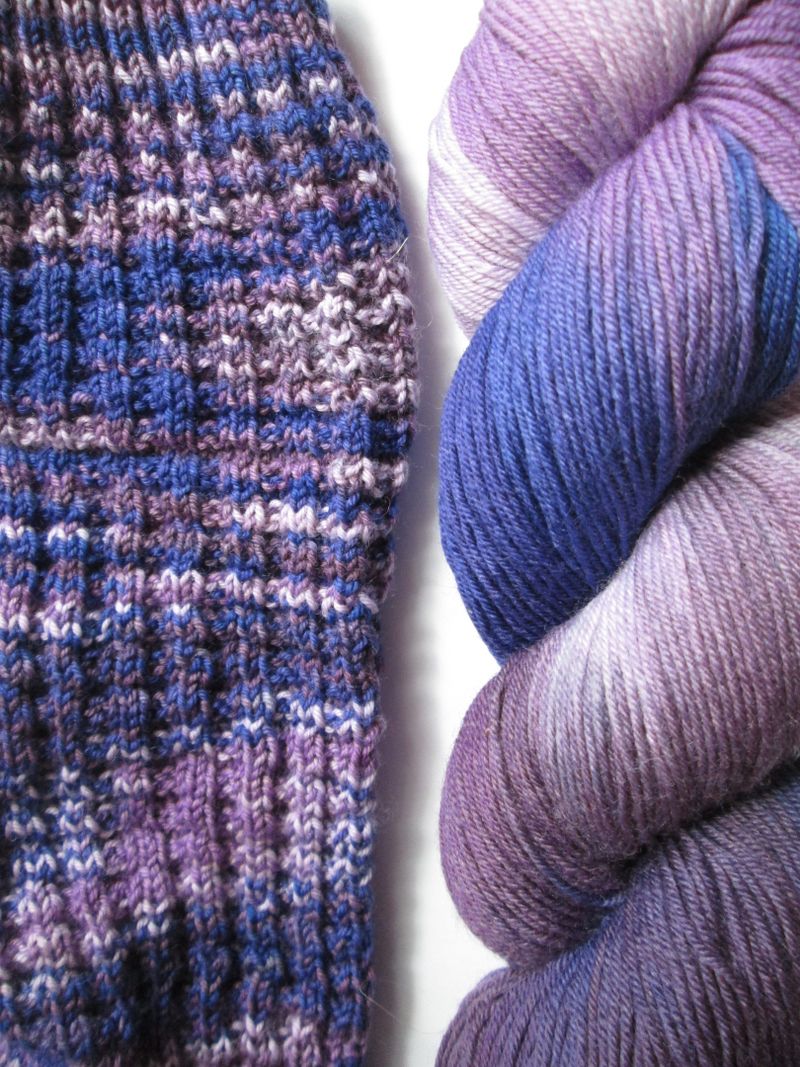
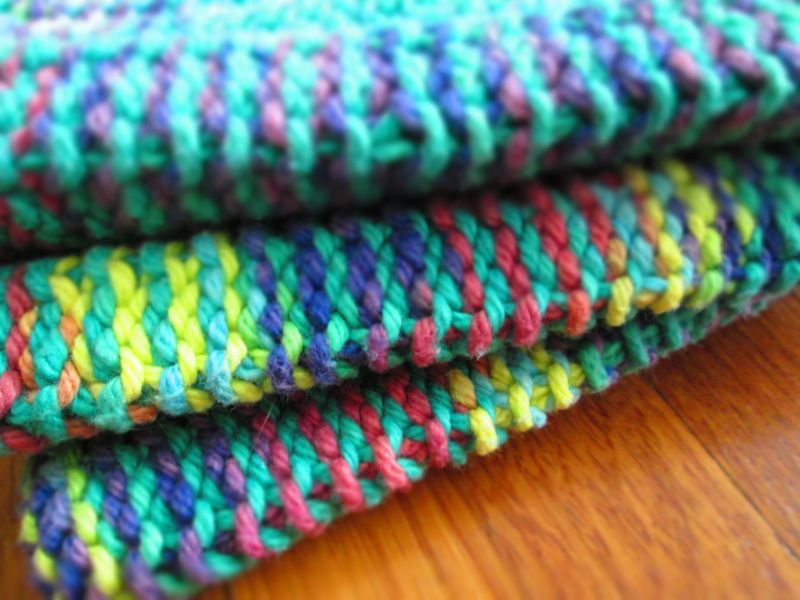
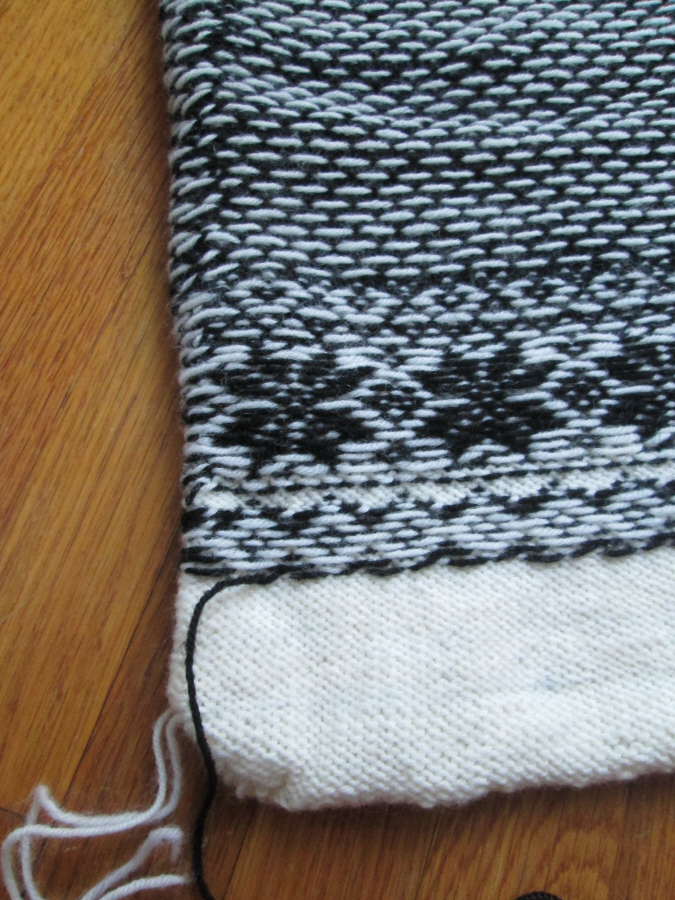
    This is that lovely Blue-faced Leicester wool that I got for a song at Tuesday Morning a month or so ago.  I decided that it wants to be some Fair Isle mitts, so I'm currently swatching.  These are all on 3mm needles, so a bit less than the 4mm/US6 the ball band recommends — gauge about 6.5 sts per inch.

    The wool is very pleasant to knit with — smooth and soft, with just a bit of sheen.  The colorwork looks great even without blocking.  The first time I put my hand in the swatch, I said "Oh!" out loud, it felt so good.

    Swatch one is a riff on a riff of the colorwork of the Muckle Mitts, a simple zig-zag with crosses — I used the blue and the mouse as background colors, and the cream and the beige for the pattern.  I like the way this turned out — and first one out of the gate, too! — though it's a little blue-heavy, using about twice as much as any of the other colors.

    Swatch 2

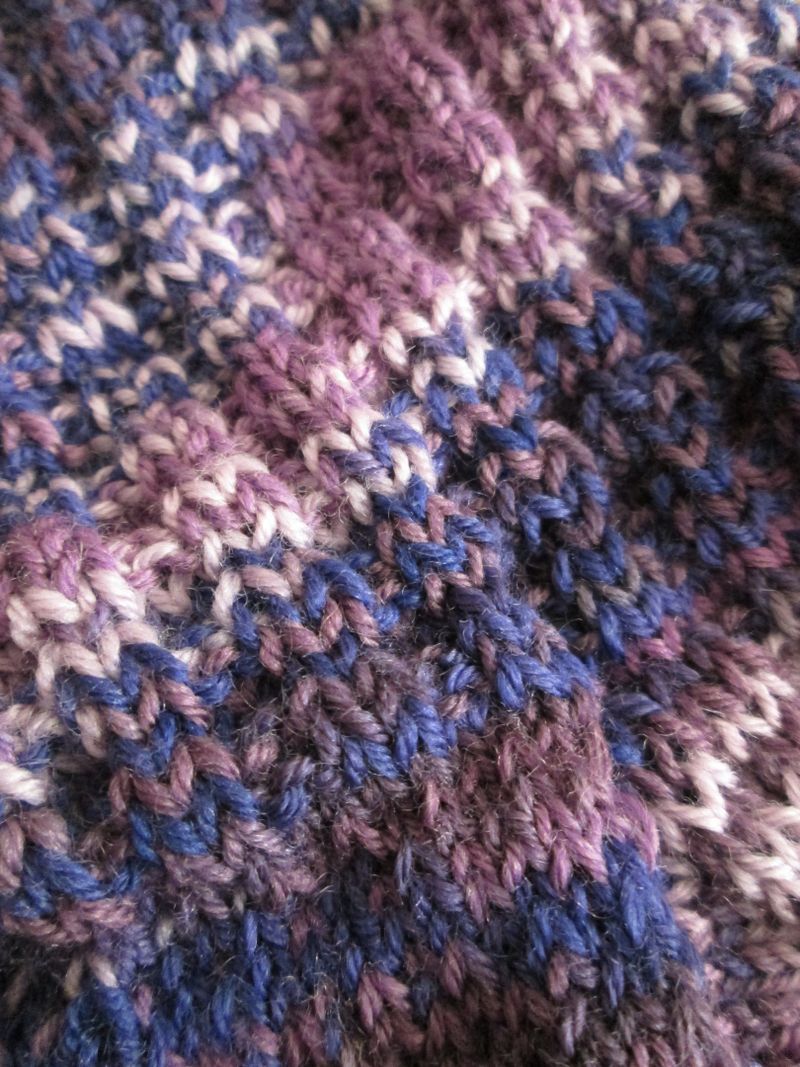
    Swatch 2 is less successful.  I wanted to do a simple OXO Fair Isle, but it doesn't really read at this scale, I guess.  Three rows of the second background color didn't work at all, so I changed the first chart, at the bottom, to just one row of the second background color, at the top — it works a bit better, but still not really.  On the whole, it does have a slighly more balanced use of the four colors.  To my eye, though, the band of the mouse-brown across the very middle probably should be the cream, too.

    Swatch 3

    Swatch 3 is not much of a winner, either.  I like the pattern itself, which is cribbed from some Lion Brand scarf that keeps popping up when I Google "free fair isle chart", but these colors don't have enough contrast to bring it out.  I'm afraid I wasn't very careful with the tension, either, which the longer floats definitely require.  I added in some single stitches in the bottom third, to get the floats shorter, but it doesn't really speak to me that way. 

    So No.1 it is!

  • Othello

    For the "Clash of Civilizations" unit in the FutureLearn "Shakespeare and His World" course, we discussed "the outsiders" in Elizabethan society.  I watched two productions of "Othello", first the Trevor Nunn film from 1990, with Ian McKellen as Iago and Willard White as Othello.  This production is set in a vaguely American Civil War-era, I'm not entirely sure why, perhaps some commentary on race, though it doesn't quite carry through since if Othello is black he would not be a general, surely! — but after a while it is not distracting.  White is a majestic and compelling Othello, and McKellen is pure poison as Iago.  Imogen Stubbs is delicate and trusting as Desdemona, and Zoë Wanamaker is excellent as Emilia, as is the rest of the cast.

    Othello fishburne branagh

    I also watched the 1995 film with Irène Jacob, Laurence Fishburne, and Kenneth Branagh.  Jacob was an unexpected choice, as she is a little old for Desdemona, and her accent was a little distracting, but she is lovely to look at and one can see why Othello was so taken with her, and she conveys a real sense of shy love for him, and distress when he is cruel to her later in the story.  Fishburne handles himself very well both with the verse and the magnetism of the soldierly Othello, and with his headlong descent into jealousy, and Branagh is brilliant as usual as Iago.  Iago's motivations on the page seem not entirely clear, but Branagh's Iago certainly makes us feel that he himself feels justified.

    I don't think I quite agreed with the director's choice to make it obvious that Cassio slips a dagger to Othello in the last scene, perhaps because it's a little too ambiguous as to why he does it.  I suppose we are to think that Cassio is allowing Othello "a noble exit", but it just doesn't ring true to me.  It doesn't "ruin" the film for me, but the fact that it comes so near the end makes it stick in the mind longer, as it were, so it looms a bit larger than it should.

    Antony and cleopatra

    Last week the theme was "The Roman Example" and, instead of choosing the more obvious "Julius Caesar", Bate went with "Antony and Cleopatra," and so I watched the 1981 BBC Shakespeare production, with Colin Blakely and Jane Lapotaire.  Colin Blakely is not someone I ever would have thought of as playing Mark Antony, but he does remarkably well, and he has the legs for it.  Perhaps his working-class-yob air helps bring out the sense of Antony's being out of his depth here.  This production goes for a rather Shakespearean look to it, with not Roman or Egyptian costumes, but "contemporary" Italian Renaissance ones.  Not one of my favorite plays, but with some really gorgeous poetry.

    Tempest

    For this last week of play-viewing, titled "O Brave New World", I watched 1980's BBC Shakespeare production of "The Tempest", here with David Dixon as a seriously creepy Ariel and Michael Hordern as Prospero.  This version starts out with an exciting storm, but beyond that it turns bland, with little sense of magic or wonder.  Christopher Guard is dull as Ferdinand, and there is no chemistry between him and Pippa Guard (his cousin in real life) who plays Miranda.  Warren Clarke is a weirdly hairy yet effective Caliban, but other than a mildly amusing turn from Nigel Hawthorne as Stephano, Hordern is the only one who is at all interesting.  A shame, really.

    (By the way, despite the much-vaunted premise of the BBC Shakespeare series being that the plays are produced with minimal cuts, the Ambrose DVD version I have is surely edited, as I've seen images of this fey Ariel sprouting enormous wings and alighting on a table at one point in the play, which is certainly not in the one I saw.  Good heavens, I would have remembered that.  Iris, Ceres, and Juno appear in the credits, yet their lines, in IV.i, are not here.  Curiously, the DVD box gives the running time as 150 minutes, while both IMDB and Wikipedia give it as 124 or 125 minutes.)

    Tempest

    Lastly, I watched the 2010 version directed by Julie Taymor, with Helen Mirren in the role of Prospero, rewritten for her as Prospera, wife of the Duke, who becomes Duchess upon her husband's death and then is banished as Prospero is in the original play.    This actually works pretty well here, so is not terribly distracting, but it does of course lend some different aspects with a mother/daughter relationship being one of the central themes, instead of a father/daughter one.  I don't always like Taymor's interpretations — I didn't much care for her "Titus Andronicus" though that may be as much Anthony Hopkins's fault as Taymor's — but I thought that this film was really wonderful, and wonderful in the sense that Shakespeare would have used the word, too.  Taymor really uses the capabilities of film to convey a sense of magic, things that could not be done on the stage — Ariel's shimmering transparency, for instance, as in this photo of Ben Whishaw and Helen Mirren.  In the BBC version, Ariel dashes off and, jumping into the air, simply disappears into a film cut, which even in 1980 I found anticlimactic, but here he leaves a vapor trail across the sky that really gives a sense of Ariel's otherworldliness.  I also found Prospera's relationship with Ariel very touching, possibly due to cuts — I don't really know the text especially well — but I'm sure very much due to Mirren herself, the way that she speaks to him, sometimes rather cruelly, but with great fondess certainly, and that she takes his gentle chiding, towards the end, and accepts it, and learns from it. All of the supporting actors here are excellent, although perhaps Chris Cooper was the least effective with the verse, though his physical presence as the jealous brother Antonio certainly works very well.  I usually find Russell Brand exhausting, to be honest, but here he was well-cast as the jesterlike Trinculo, playing off the more stolid Alfred Molina as Stephano.  Djimon Hounsou is excellent as Caliban, not-quite-human yet profoundly moving at times in his primal humanity.  It was also a pleasure to see Tom Conti again, perfectly cast as the gentle courtier Gonzalo, with his faintly tedious nattering.

    This series of "play-going" was an interesting exercise in itself, besides the online course, in watching sometimes wildly different productions hard on the heels of each other.  It's curious that, traditionalist that I tend to be, I often found the stagier productions more dull that the modern ones, even though sometimes I deplore the tendency of directors to feel that they need to fizz up Shakespeare for modern audiences (I didn't think Baz Luhrmann's "Romeo + Juliet" worked very often).

    PS, I've recently seen an excellent and hilariously funny production of "The Merry Wives of Windsor" which really brought this lesser-known play to life for me — it's the Globe production from 2008 (revived in 2010), with Christopher Benjamin as Falstaff and Sarah Woodward and Serena Evans as Mistresses Ford and Page, respectively.  We all laughed so much — even the girls, who think Shakespeare is "boring" — that our sides hurt.

  • TTOU - grace william robert

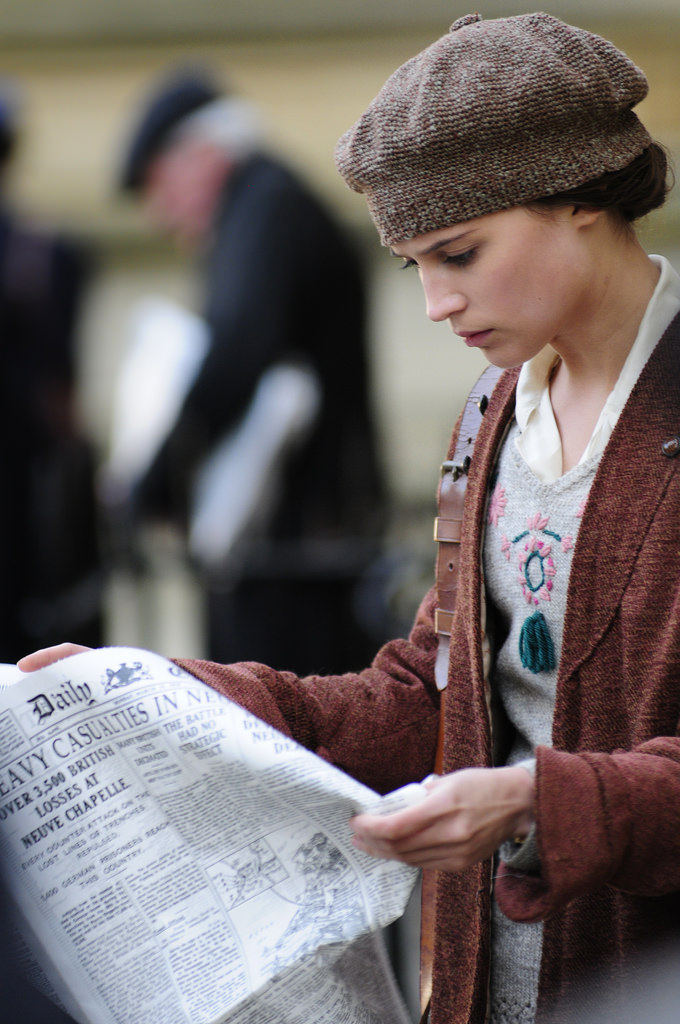
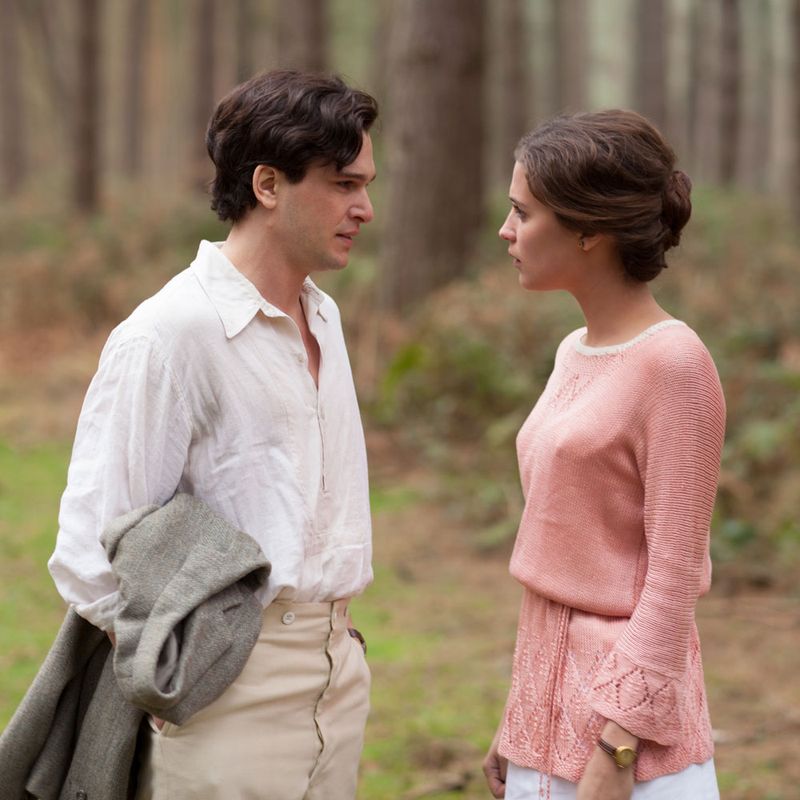
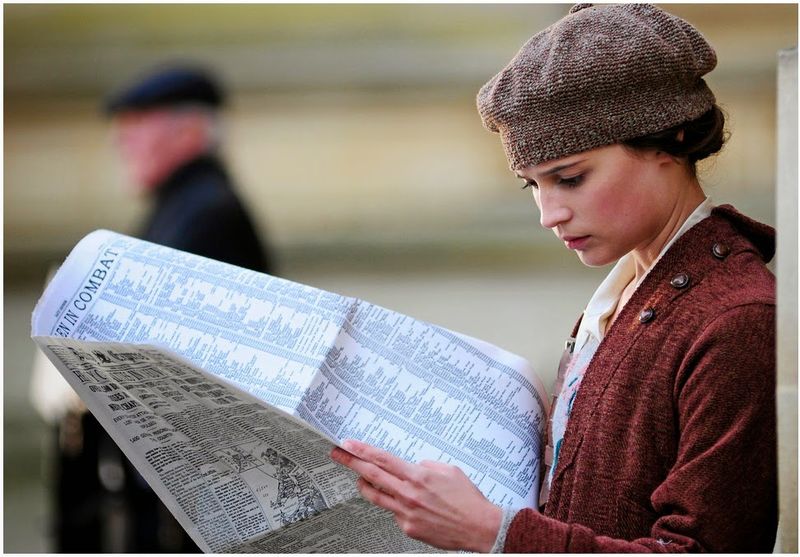
    Here is another picture-heavy post, hard on the heels of the last one, but at least this is about knitting!  I read just this morning about a small independent film in Britain, "Tell Them of Us", about a real Lincolnshire family, the Crowders of Thimbleby in Lincolnshire, during the Great War, a project inspired certainly by the centenary this year of the outbreak of that war.  The call went out for knitters to help recreate the wonderful amount of knitted garments the director wanted for the film, and Mary Lou of Yarnerinas was fortunate enough to have been part of the knitting team — she tells a bit about the experience on her blog.

    There is a book, called Centenary Stitches, available from Northern Lace Press, including "about 70" period patterns used in the film, rewritten for modern knitters.

    TTOU - robert writing

    Robert (played by Reece Ackerman) writing a letter, certainly with "comforts" received from his mother and sister at home, a warm knitted waistcoat and what is either a sock or a balaclava hanging on the X of the table leg.

    TTOU - wwi knitting

    A wonderfully jaunty ensemble, hat and matching scarf — with pompoms! — and the sailor's jumper.  Love the fluffy stripes on the collar!

    TTOU - grace cardy hat

    Notice too the hap that the woman on the left is wearing, garter stitch with a simple lace edging.

    TTOU - waiting

    Grace (played by Victoria Rigby) is wearing a wrap-around sleeveless jumper, a natural progression from the sontag of her grandmothers' generation.

    TTOU - waiting 2

    TTOU - william

    Ttou - reading a letter

    A hug-me-tight, perhaps! and Mrs. Crowder has put down her knitting to read the letter.

    TTOU - before the storm

    TTOU - grace and ann

    Knitting-book-photos-2014-09-09-490

    The dark blue cardigan is almost exactly the same shape as the light blue one Grace wears above, but in a brioche stitch here, and with the front buttoned closed. 

    TTOU - grace

    Mary Lou admits to having knitted this cardigan, which she adapted from a photograph of the real Grace Crowder, as well as the camel-colored jumper below, which is from a 1912 "sport sweater" pattern.

    TTOU - brother and sister

    TTOU - at last

    TTOU - land girls

    TTOU - armistice

    TTOU - relief

    Notice the wonderful assortment of knits here, from old-fashioned shawls to "modern" jumpers and hats.

    TTOU - happy moment

    I am sorry to say, though, that Robert Crowder was killed at Passchendaele in 1917.  The film was in fact inspired by the local memorial, and a window in the Thimbleby church which his family dedicated to his memory.

    Thimbleby great war memorial

  • Queen marys other dollshouse 1 V&A

    Of course I've known about the famous Queen Mary's Doll's House for quite a long time — but I didn't know that she had another house — properly "Queen Mary's Rooms" — which is now at the V&A.  Far more intimate, this two-room house was made, the museum says, in 1920-24 by David Allan, who was responsible for the textiles and upholstery at Buckingham Palace.  Queen Mary gave the house to the Museum of Childhood in 1924.

    The "big" house is amazing and splendid, but to my mind this little one is far more charming!  It's very beautifully made, too, — look at all of the mouldings around the tops of the walls, and the mitered corners of the sitting-room floor.  I keep finding new details in these photos — of which there are more on the museum website — like the family portraits on the folding screen, and the hot water bottle, and the lorgnette on the desk….

    Queen marys other dollshouse 14 V&A

    Queen marys other dollshouse 16 V&A

    2007BP9187_jpg_l

    2007BP9198_jpg_l

    2007BP9201_jpg_l

    2007BP9188_jpg_l

    2007BP9197_jpg_l

    2007BP9183_jpg_l

    2007BP9194_jpg_l

    2007BP9184_jpg_l

    2007BP9189_jpg_l

    2007BP9191_jpg_l

    2007BP9192_jpg_l

    2007BP9193_jpg_l

  • 4094

    I haven't been doing much knitting since the last pair of socks, since I got distracted by this, which is the "Small-patterned Holbein" carpet from Meik and Ian McNaughton's Making Miniature Oriental Rugs and Carpets.  I was a little concerned about it being too big (!) for my Tudor house-to-be, so I'm working it on 28-count evenweave instead of the 24-count of the book — it's a bit more fiddly, and I have a hard time seeing it sometimes, especially now that the pattern is really filling in, but the more I look at the design and the colors, the more I like it.

    This is the first miniature piece I've worked in wool — of course it will have a different feel to it, but I didn't realize quite how much.  I guess at this gauge the linen is even harder on the wool fibers than a 24-count would be — I have to be unusually stingy when cutting a length, as it can get worn down to just a few hairs very quickly!

    Here are two new things for No.16 that I impulsively put on my wish list, and got for my birthday — thanks, Mom!  The fishbowl looks a bit odd in close-up because of the bubble in the "water" but it's very charming in real life.  Now I need to get started on a kitchen dresser for the new dishes!

    Blue china

    Fishbowl

  • 4123

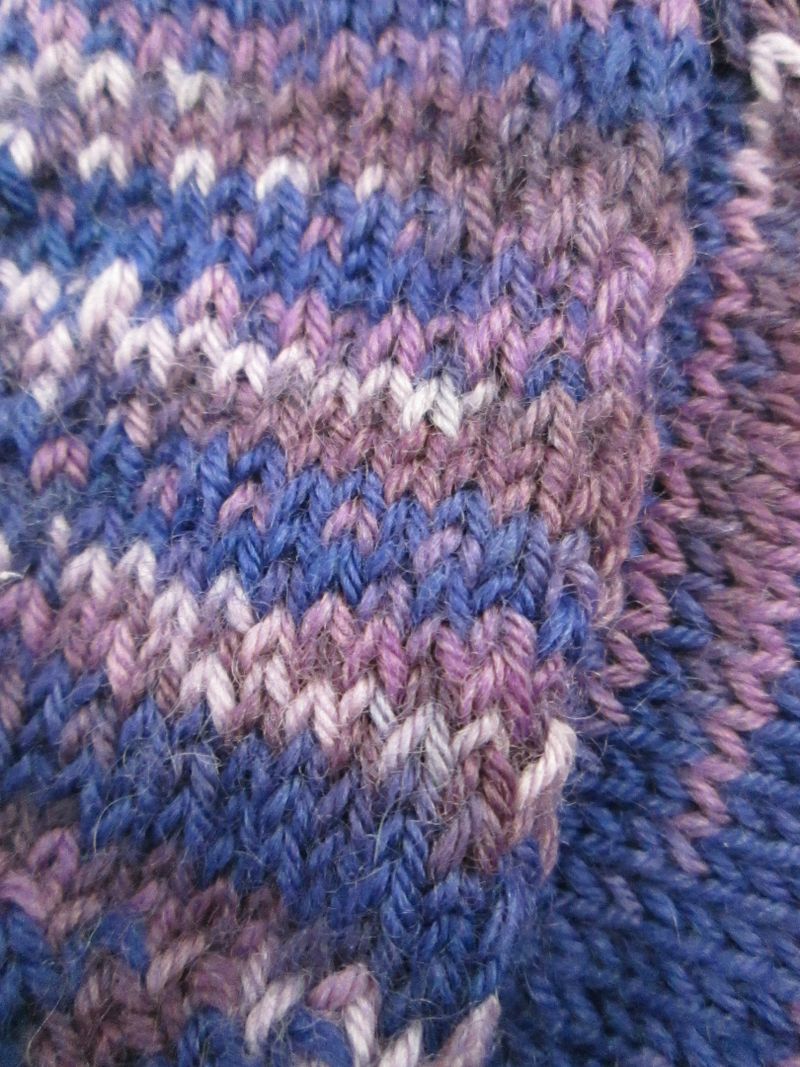
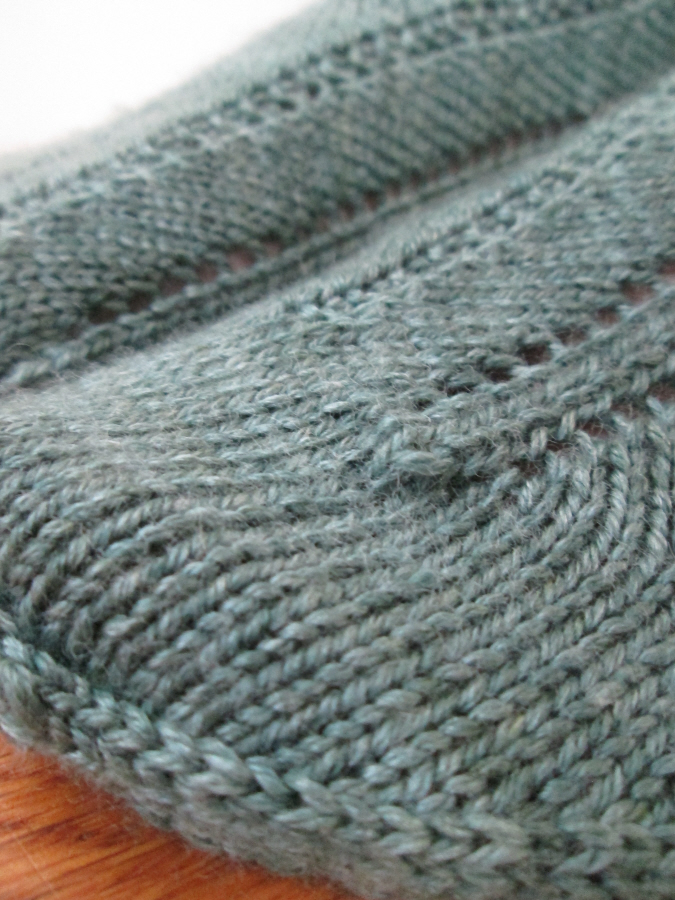
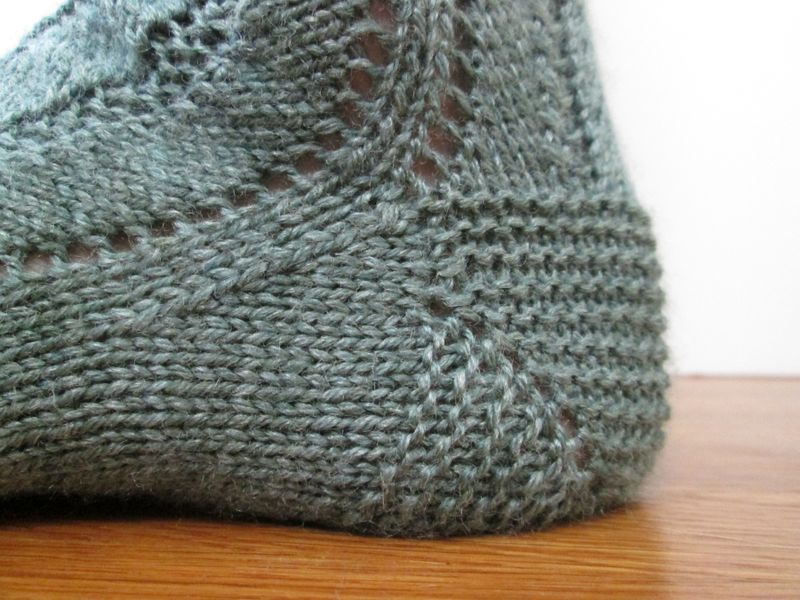
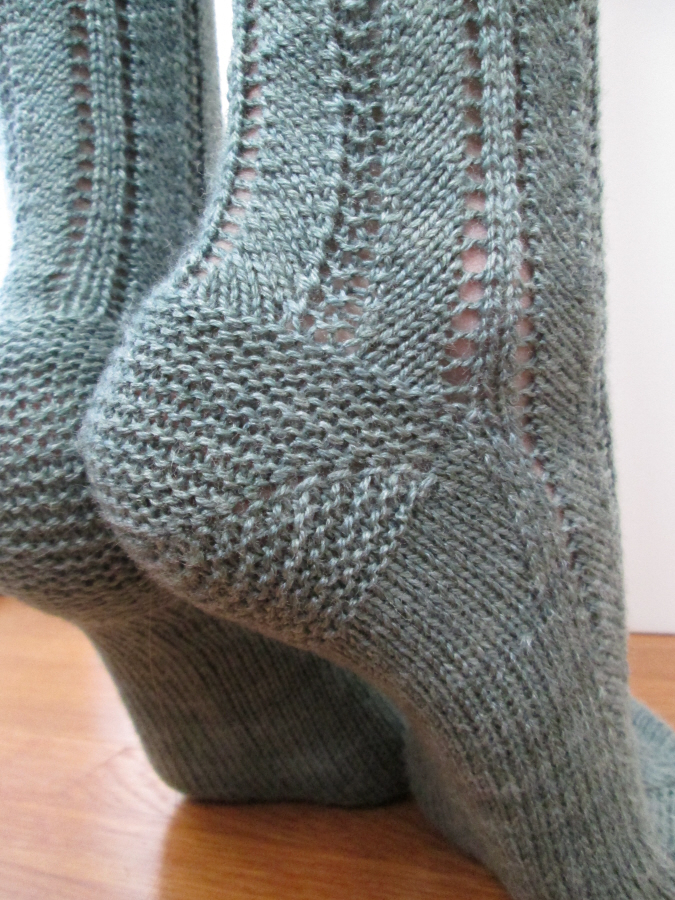
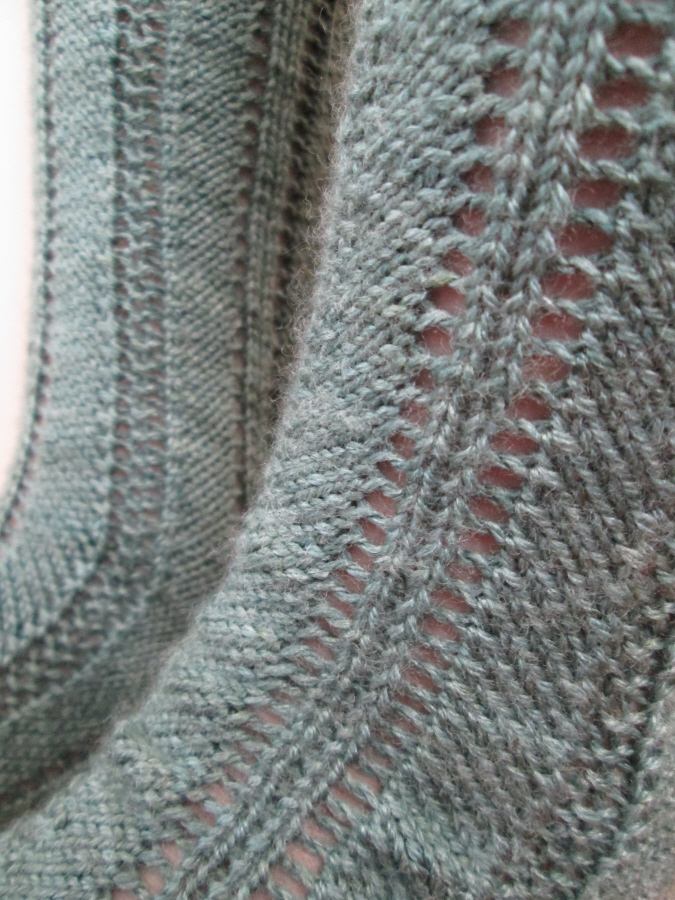
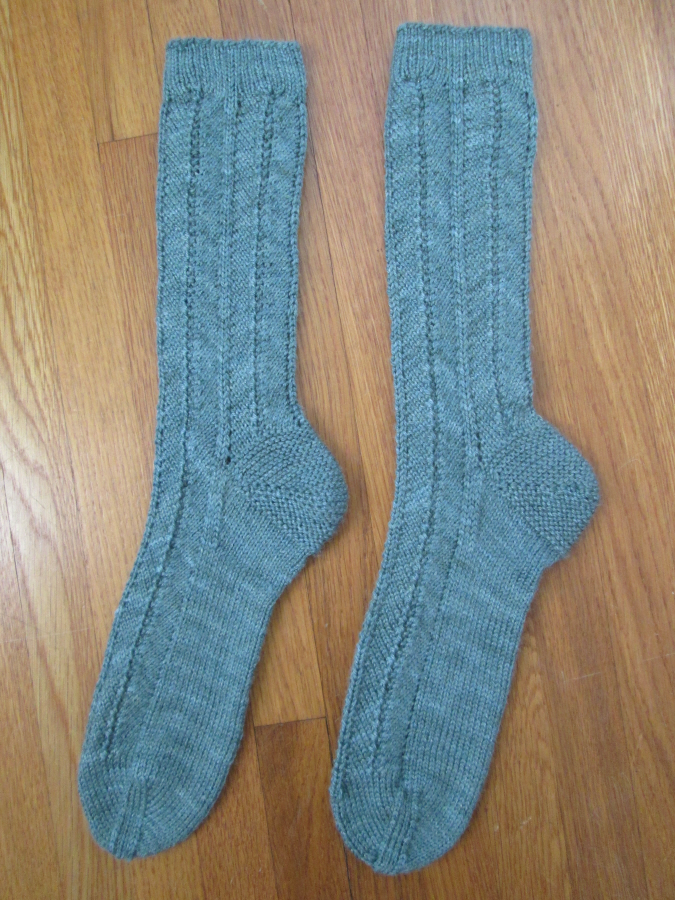
    These socks are a calf-length version of the "Barnim-Style Stocking" by Anne DesMoines in the Spring 2014 issue of "Knitting Traditions", in Sensations Truly sock yarn from Jo-Ann's.  This is a so-so yarn, good for the price, I suppose, which was about three dollars a giant ball I think, but not what I would call sensational.  I do like the tweedy charcoal-grey, though.  I actually could have made my socks a lot longer, as I didn't realize — despite the enormity of the ball, in hindsight — how much yardage there is.  Oh well — it's been discontinued for some time, apparently.

    4112

    4120

    This is an interesting pattern, and makes a very comfortable foot, which seems to hug one's arch a little more than the usual side-gussetted foot.  It did take a considerable amount of attention, though, and I had to rip back the second foot a couple of times for not paying attention and missing an alarming number of the paired decreases.  I wouldn't mind having a stocking-length pair, though, so I'm sure I'll be having another go.  The pattern didn't seem to mind much being adjusted rather considerably for a different gauge, either.

    4118

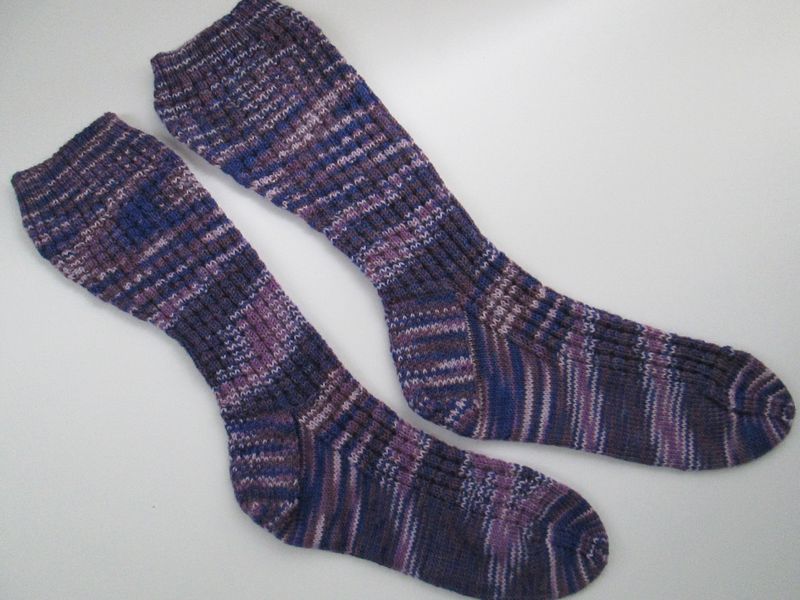
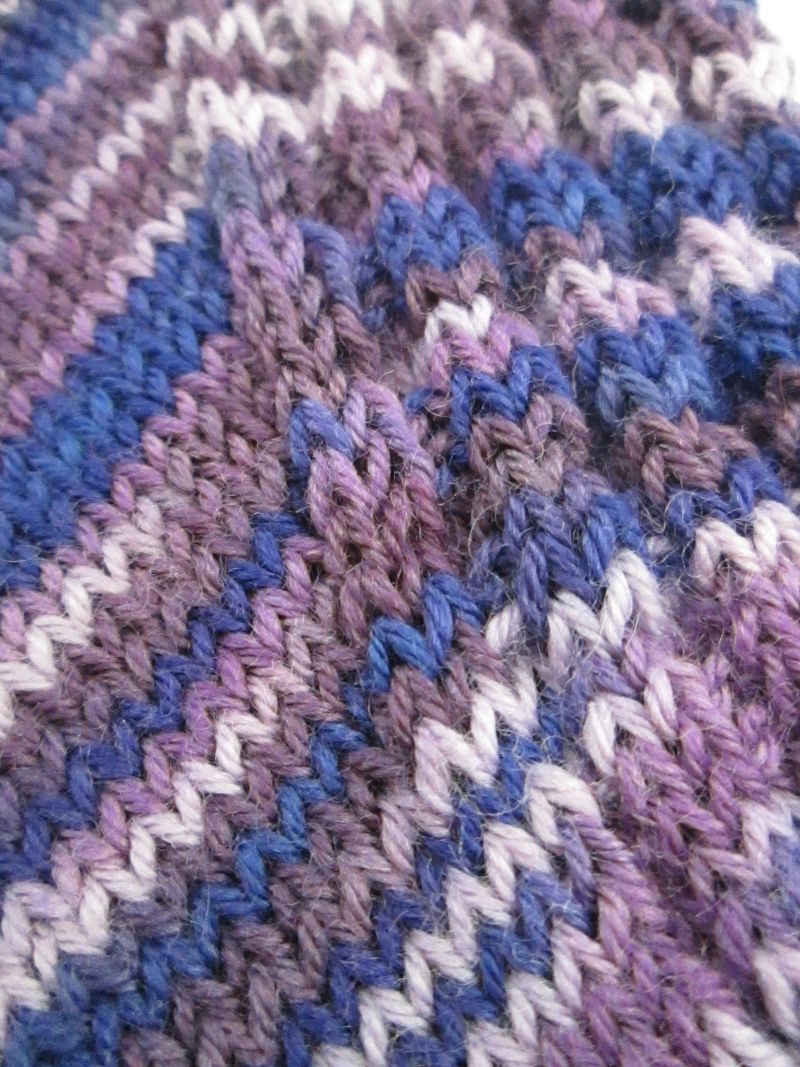
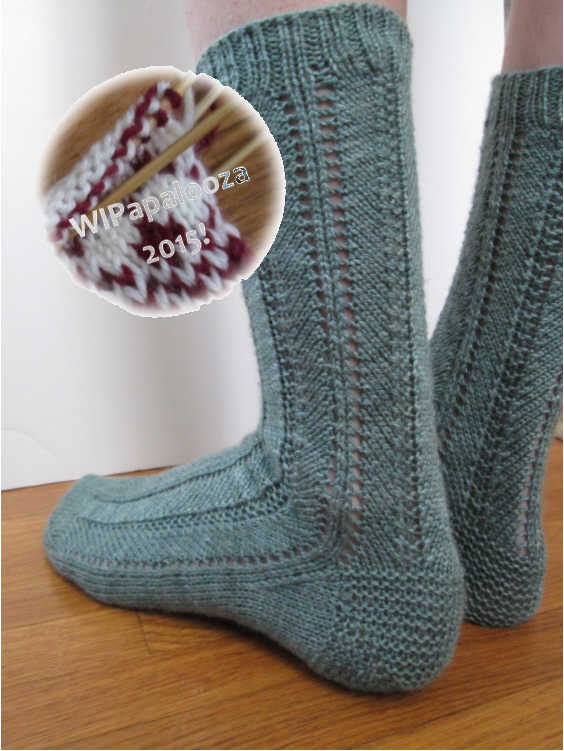
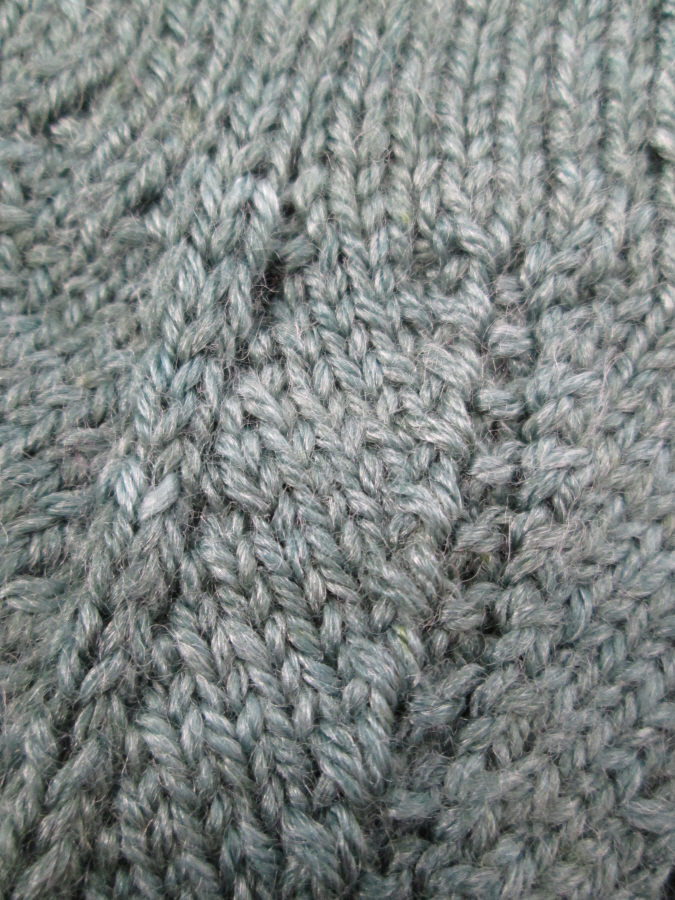
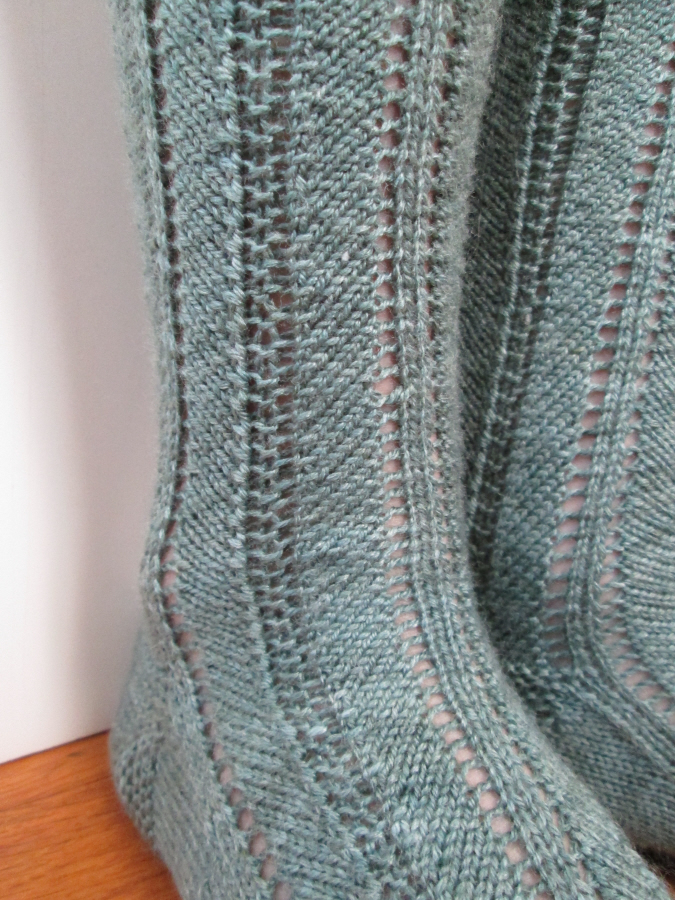
    I also finally finished this pair of the justly-celebrated Charades by Sandra Park — I really like this herringbone pattern, it's easy to work and to memorize, and it looks great in solids and variegated colors, simple yet effective.  Can't believe it took me literally years to finish them!  The yarn is Shepherd Sock in "Baltic Sea".  As I've said before, I worked this pair toe-up, just because, and since I didn't want the "Baltic Sea" to pool at all, I alternated the two balls of yarn on every round, except on the toe, the heel, and the ribbing at the top.  There is still a sort of shadow of flashing, but since the colors are similar in value it doesn't bother me.

    4103

    I don't have a photo of what the "Baltic Sea" looked like to start with — it was so long ago that I bought it, you still had to get two skeins for a pair of socks.  Sigh.

    4102

    Baltic charades

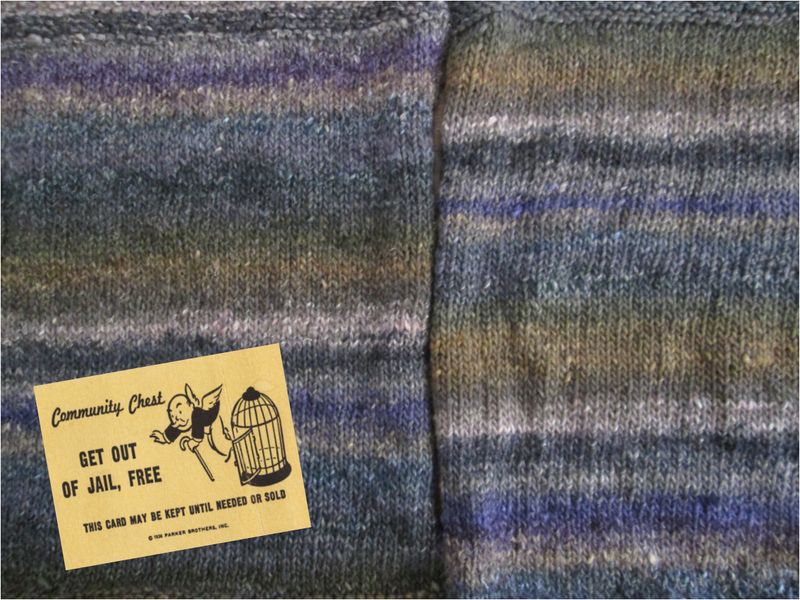
    What a difference the background color makes!  This color is less true-to-life than the photos on the blue carpet, as the gold of the floor has brought out more of the brown.  The ridge is where I twisted the strands on the inside, which has since flattened out when I washed them.  The sock on the left has my Old-Norwegian cast-on ribbing grafted to the leg, and the sock on the right uses Mary Lou's "K2TBL Stretchier Bind-off", which is —

    K2, *insert left needle into the front of the two stitches on the right needle and knit them together. Leave that one stitch on the right needle. K1, repeat from * to end, fasten off.

    4108

  • Merchant 1

    Last week in the FutureLearn "Shakespeare and His World" online course, we discussed "Money and the City", with "The Merchant of Venice" as the focus play.  The public library had three productions on the shelf, so since I have long found this play intriguing, I brought home all of them.  I decided to watch them chronologically, so began with the 1972 BBC Play of the Month production, with Maggie Smith and Frank Finlay.  I like both of these actors, and so it may have been no fault of theirs, but this was a rather dull production.  I kept getting distracted by various things, that Antonio looked laughably like Henry VIII, the absurd pumpkin breeches worn by the younger male leads, which were made out of cloth lattice-work, revealing all — though, to their credit, the gentlemen wore them well — and, really, how unlike a man Maggie Smith looks in drag.

    Merchant bbc

    Next I watched again, after many years, the 1980 BBC Shakespeare production with Warren Mitchell and John Franklyn-Robbins — Gemma Jones is Portia.  This held up pretty well.  It's a difficult play, and this cast does it capably.  I just feel that the "quality of mercy" speech shouldn't be a lecture, as so many actresses do it.  It seems to me that, yes, Portia has prepared all of her arguments — she knows that she has the ultimate one, a pound of flesh but no drop of blood — but that Shylock's stubbornness should come as a bit of a shock to her.  How can he really be demanding that a pound of flesh be cut from another man's living body?  "Then must the Jew be merciful," she says, and Shylock replies, "On what compulsion must I? tell me that."  If she looks at him in disbelief, then tries to reason with him — because, because "the quality of mercy is not strain'd" — I think it plays better, plus it would sound less like a set piece that we've all heard a thousand times before.

    Merchant 2004

    The third was the 2004 Pacino version, here also with Alan Corduner as Tubal.  The cast is first-rate, and Pacino does a terrific job (I was going to say "for an American", but I don't always get Pacino).  Visually stunning, with wonderful costumes and gorgeous photography, and the only production to actually be filmed in Venice, so there really are palaces and canals — though of course, to be fair, the other two were television studio productions.  I just wish this one hadn't cut so much.

    Macbeth bbc shakespeare

    By the time it came for this week's unit on "Witches and Doctors", the only "Macbeth" left on the library shelf was, alas, the 1982 BBC Shakespeare production with Nicol Williamson and Jane Lapotaire, which I didn't like much the first time around either.  He was wooden, and she took up the slack and went in rather the opposite direction.  This is one of my favorite plays, so I was hoping to see the 1972 one with Jon Finch and Francesca Annis again, after many years, or perhaps a new-to-me production — McKellen and Dench, say, or Patrick Stewart and Kate Fleetwood.  Will definitely have to look for those.  (Alan Cumming has done what looks like a stunningly bizarre yet effective one-man version set in a mental hospital — this takes away all of the "reality" of the play, of course, since it's obviously all in his mind, but what a tour-de-force!)

    Money pot 1550-1650 shakespeare birthplace trust

    Professor Bate accompanies each unit with a selection of objects from the Shakespeare Birthplace Trust collection, a contemporary map, a hornbook, a ceremonial pike.  I think the one I found most fascinating was this, which is a glazed money pot used for collecting the pennies from the audience at the theater.  It has no bung like a modern piggy bank, so that the only way to get the takings out is to smash it — obviously intact ones are therefore very rare, which is why he is holding it here so gingerly!  Apparenly it was not unusual for the lesser members of the company, the wardrobe or props for instance, and thus often women, to be the ones to go round with the money pots. It's a very evocative picture.

  • Pioneer girl

    For those of you who, like me, are a little out of the loop, plans have been in the works for some time now to publish Laura Ingalls Wilder's original autobiography, which she titled "Pioneer Girl", in annotated format.  Background and details can be found at "The Pioneer Girl Project" blog.  The book is to be, thankfully, a "serious, scholarly work for adult readers" — though not, if the blog posts are anything to go by, dull.  (I'm sure that the term "adult readers" doesn't mean what it does so often nowadays, but that it isn't written for children who are doing an "about the author" report!)  "Scholarly but accessible" is how editor Pamela Smith Hill describes it in her original proposal.

    Most people know that events in Wilder's life were compressed and sometimes altered a little to fit her purposes in the "Little House" books, so that Pioneer Girl will shed I think a fascinating light not only on Laura herself but on her writing.  It will include the stories Wilder later felt were not appropriate for children, or which for one reason or another were not included in the "Little House" books — I didn't know, for instance, that the Ingalls family had lodgers with them during the hard Long Winter, a young married couple and their infant son — and the annotations will give background on various places, people, and historical details, not leaving out the controversies surrounding how much of a hand Rose Wilder Lane had in the "Little House" books.

    The publication date is November 20, 2014.

    (The image of Laura's manuscript is from the video in the post "A Pioneer Girl's Treasures".)

    A July 2013 interview with Smith is here.

  • Michael-peter-ancher-a-young-girl-knitting-maren-brens-1887

    Here are two paintings by the Dane Michael Ancher — "A Young Girl Knitting (Maren Brens)" (1887) —

    Michael_Ancher_-_Skagen_girl,_Maren_Sofie,_knitting._-_Google_Art_Project

    and "Skagen Girl, Maren Sofie, Knitting" (1882).  Socks, I think — pretty certainly in the first painting.  The shawls — or is it the same shawl? — look intriguing too.  I love the quiet homeliness of both of these.  Thanks to Wendy of Spinsjal for writing about her trip to Skagen, and for reminding me of the Skagen painters, whose work I admire tremendously.