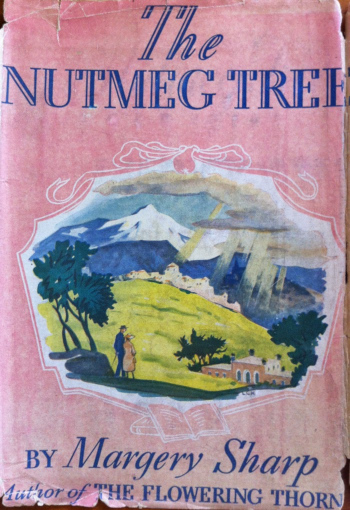
Margery Sharp is on my list of "writers I think I would probably like but haven't read yet," and so when I saw The Nutmeg Tree on the list of books published in 1937, I said to myself, "Well, the time is now!"
The story begins in medias bathtub, as it were, with Julia Packett, a former chorus-girl and would-be theatrical producer of a somewhat certain age, defending herself — by way of the bathroom door — from creditors waiting to either be paid the £5 she owes them or to take her last possessions. Julia, however, is re-reading the letter from the daughter she has not seen in sixteen years, who is now twenty and wishes to marry someone of whom her grandmother (the mother of Julia's late husband, killed long ago in the War) disapproves. Susan, out of the blue, has written to Julia to invite her to come and stay with them while on holiday in the French countryside, in hopes that Julia will be able to convince Susan's grandmother to relent. Deeply and somewhat unexpectedly flattered at this filial appeal, and not one to pass up a good opportunity when it arises, Julia decides — while still in the bath, and after she has sent a telegram (using up something like her last few pennies) in the affirmative — that the thing to do is sell everything she owns for the fare to France.
Complications obviously ensue, beginning during the trip across the Channel, and ramping up once Julia has reached the house in Haute-Seine and met Susan's fiancé, since rather to her surprise Julia agrees with her mother-in-law that the young man Susan has determined to marry, is while quite charming to be sure, Not the Right Sort — being, Julia recognizes, just like herself.
Julia does not seem the typical 1930s heroine — she is plump and curvaceous, rapidly approaching forty, and has had a string of lovers, only one of whom — Susan's father, then a somewhat grim first lieutenant on a ten-day-leave in 1916 — was willing or able to marry her, and he had done so only, though honorably, when Julia had informed him that she was pregnant, after a brief affair that had begun with dancing in a nightclub, merely sentimentally on Julia's part. Her Micawberish optimism, too, is sometimes "helped along" by what might be unkindly, if truthfully, called con games. But somehow, despite this lack of respectability, Julia is an appealing heroine because of her warm-hearted, innocent generosity.
It was not her nature to deny: if she took lovers more freely than most women it was largely because she could not bear to see men sad when it was so easy to make them happy.
She might easily be described as "vibrant and delightful," but this does not seem at all formulaic because instead of telling us that Julia is vibrant and delightful, Sharp simply lets Julia show us, by being herself. We go along with all of Julia's escapades — and there are many! — and we still like her because her heart is in the right place.
I think that of all the new-to-me writers I've come across in my choices for the 1937 Club, Margery Sharp is the clear favorite. I enjoyed The Nutmeg Tree so much that I have actually read it again, not long after the first time!
Links to other readers' reviews of books published in 1937 can be found by starting here.
 A Bluestocking Knits
Leave a comment