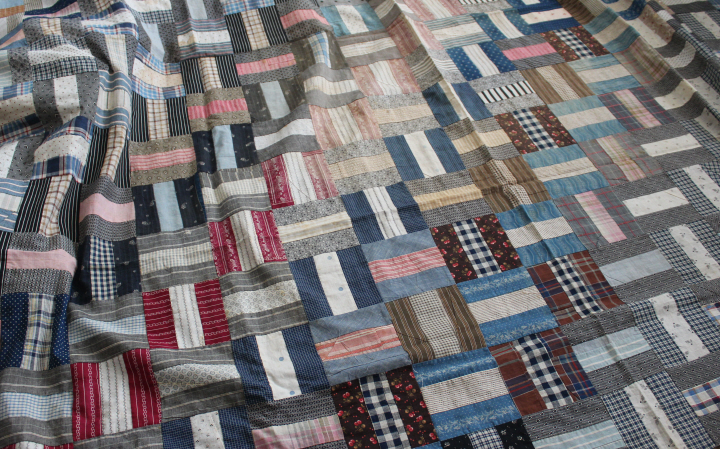
David ambled into the bedroom this morning after breakfast, where I was sitting with my cup of tea and reading, and he asked if I was interested in going to an estate sale. "She was a hoarder, apparently, and there's some quilting stuff." So we went, not expecting much — "quilting stuff" often means just "cheap fabric" when you're at an estate sale — and indeed, the "hoarder" appellation was easy to understand when I saw literally a half-dozen rows of plastic and cardboard boxes laid out in the driveway alone, stretching on up into the garage, spilling over onto the plants along each edge, the boxes crammed with plastic bags full of fabrics, magazines, books, in addition to the usual Christmas ornaments, commemorative plates, tchotchkes, board games, DVDs. Stunned, I made my way up between two of the rows of boxes, and about halfway along began idly poking through one of the boxes of fabric. One of the first things I came upon was this crazy-rails quilt top, hand-stitched, clearly vintage if not antique. Holy mackerel.
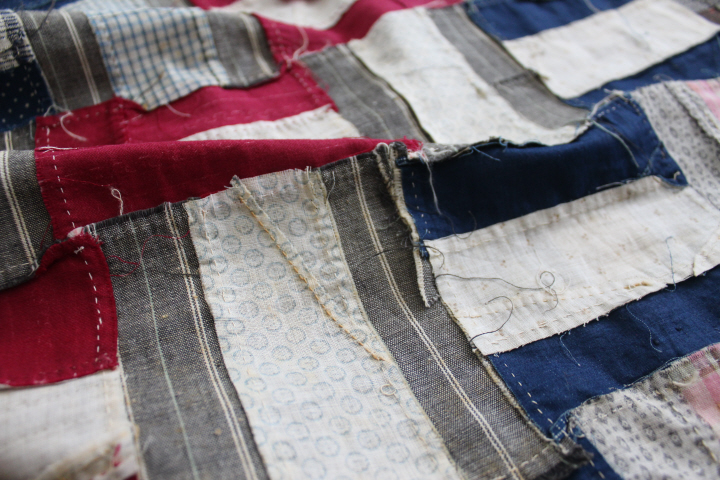
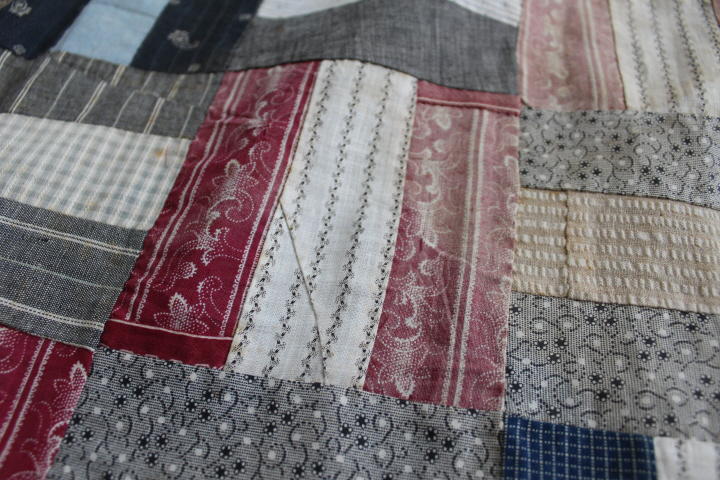
(I didn't unfold it until I got home. It is full-size. The beautiful red "rails" going upwards on the diagonal have faded considerably in the middle, but it is clearly the same fabric. I had already noticed that some of the individual rails are pieced, but it wasn't until I got a closer look that I realized how very many of them are, some pieced in just a tiny corner — you can see in the photo below the large-ish piecing of the middle rail, but the dark one on the right has about a quarter-inch strip pieced into the upper-right corner as well. Amazing. The unknown maker didn't attempt to match the pieces, but she was very careful about cutting stripes and plaids straight, with the occasional surprise of a piece of seersucker or a bias-cut strip.)
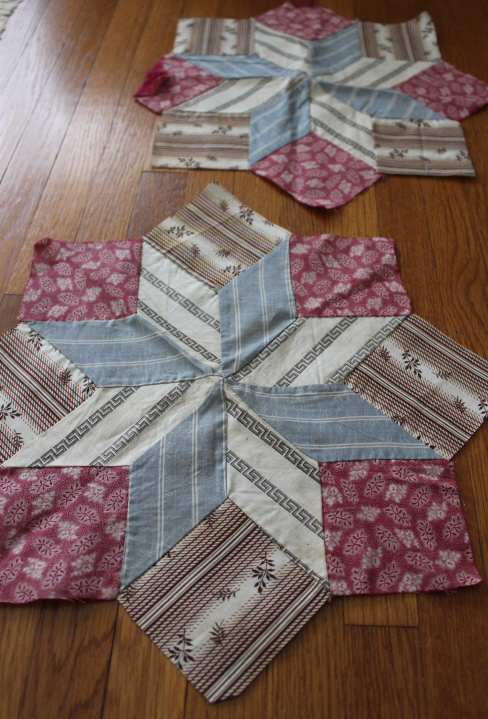
And blocks — bags of blocks, some with just a few, like the two very handsome stars above, or with dozens — nine-patches, four-patches, four-patches-within-nine-patches …
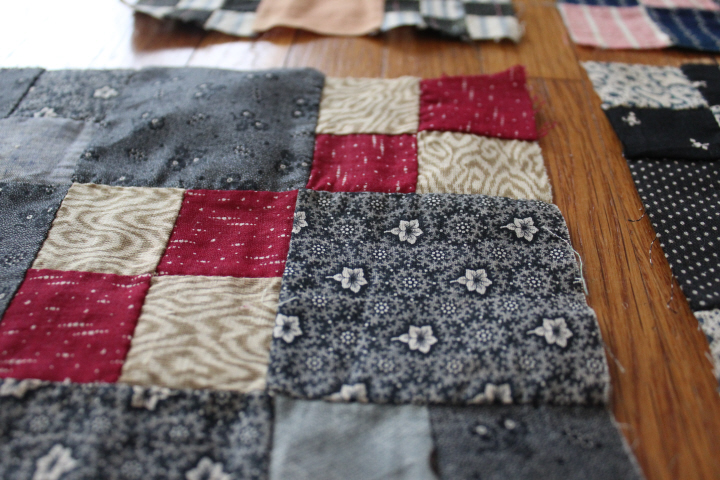
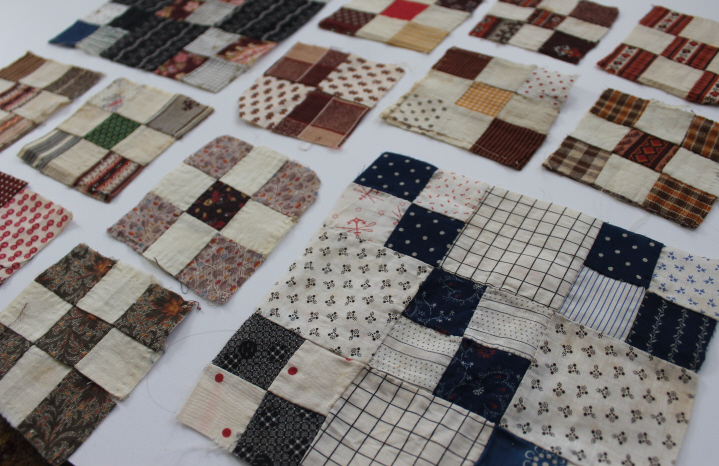
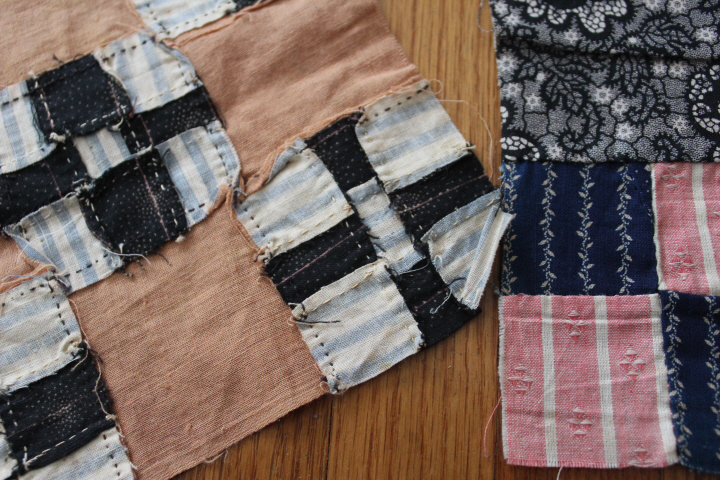
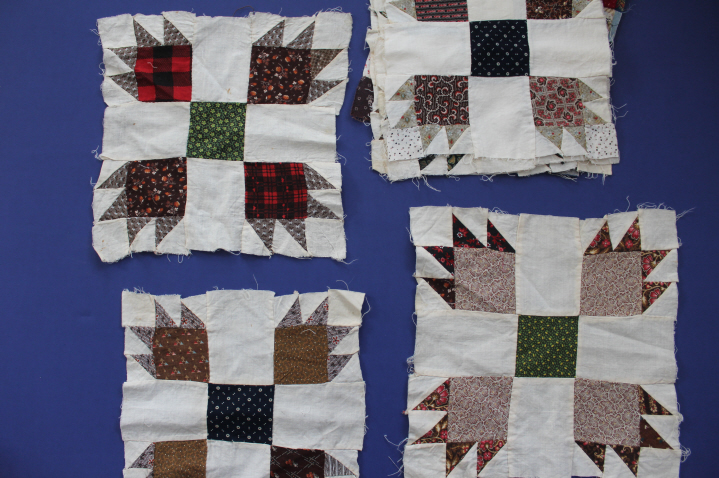
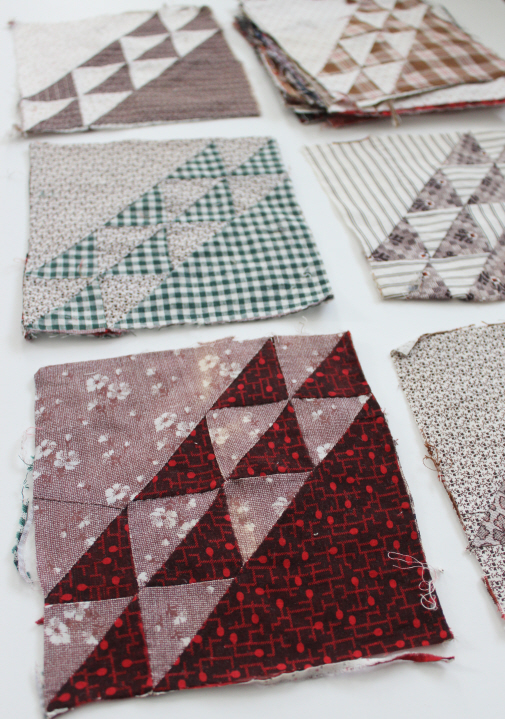
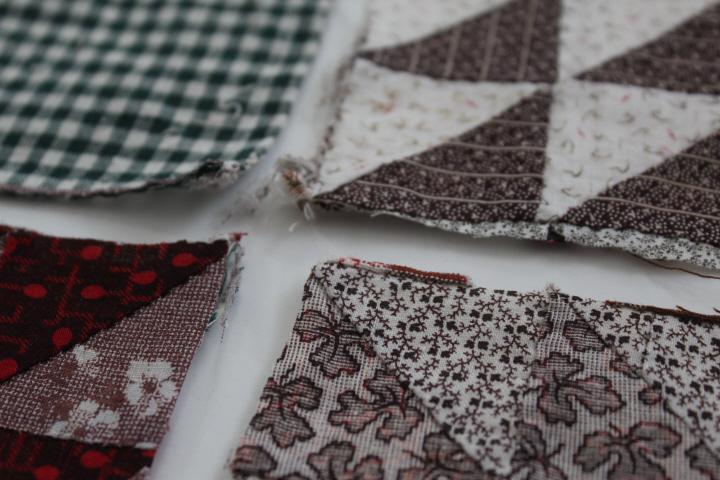
Some of the blocks have been cut apart from each other or from a top, as there are traces of the neighboring fabric still attached to the edges.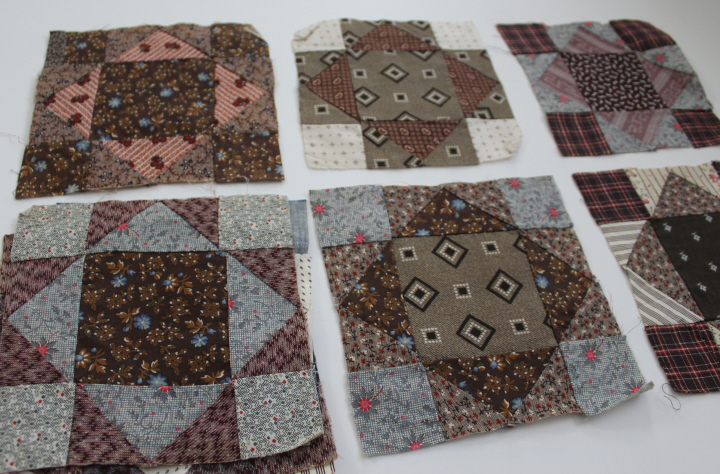
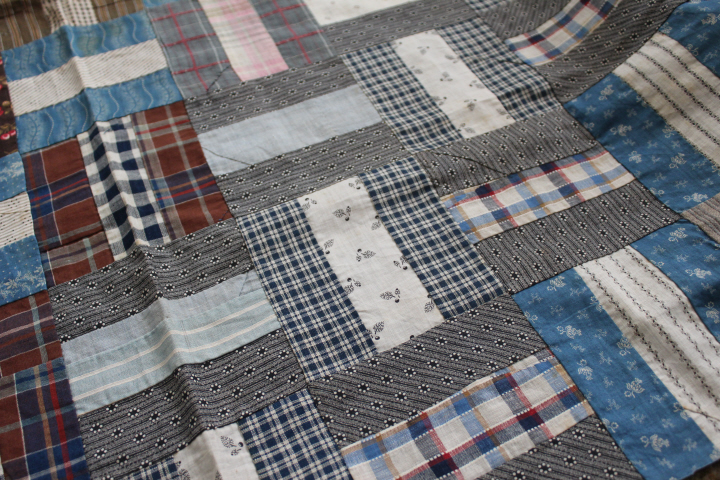
Her taste was not much for the 1930s' bright colors, it seems, but for the "Civil War" browns and greys like these, practical pioneer colors that don't show the dirt but still long now and then for something pretty and floral.
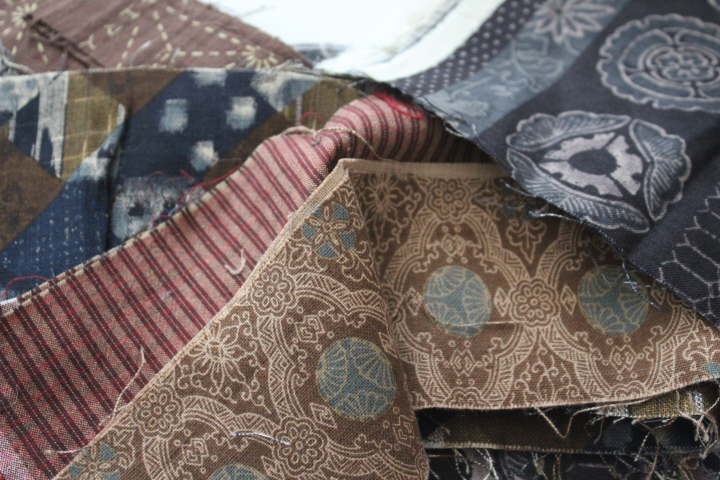
And here and there for something exotic. Scraps — but large ones — of Japanese fabric. Very boro.
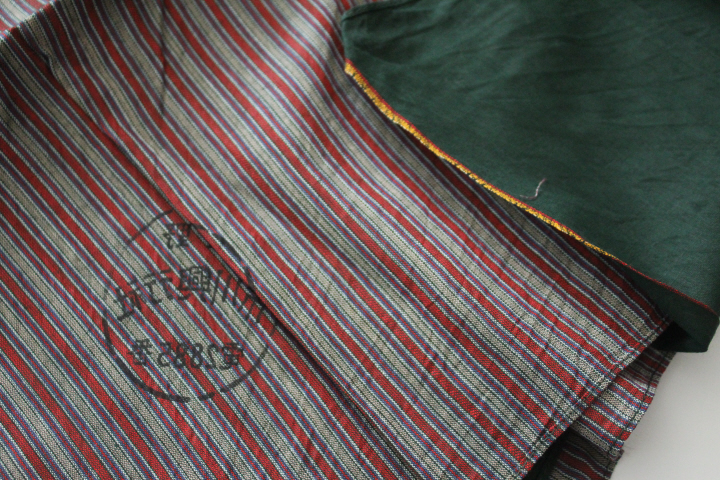
I saw this striped fabric folded up in a plastic bag and thought it was another scrap, but one that would make a perfect apron for a Scandinavian doll costume. When I unfolded it at home, I discovered that it is in fact a full Japanese furoshiki, or wrapping cloth. I suspect from the direction of the wrinkles that, in fact, it has been used for that very thing. I hesitate cutting it up now, especially as I use furoshiki often for wrapping gifts, but it does have a number of tiny holes in it …
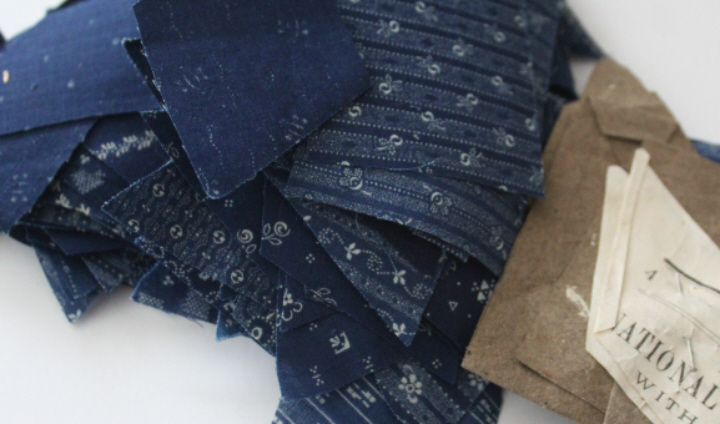
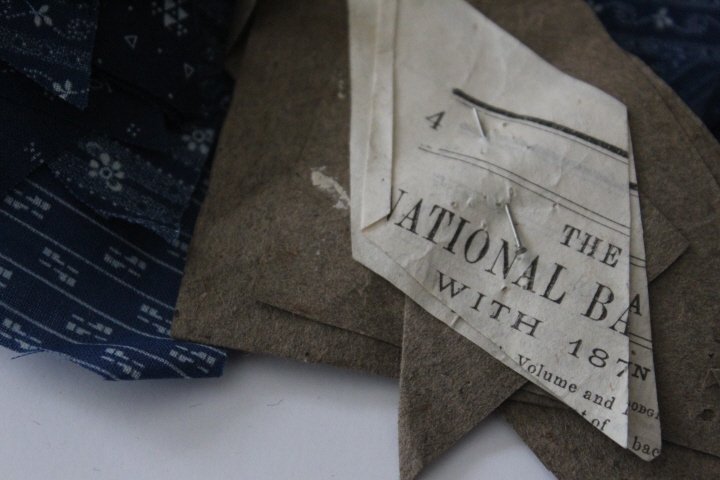
A substantial stack of indigo-blue cotton pieces, complete with paper templates. I haven't figured out what block or blocks these were meant to become, as I haven't worked myself up to removing the pin yet, that is holding the paper shapes together. Diamonds, obviously, some large triangles, and at least one rectangle. Blue-and-white heaven. Is is really 1870-something??
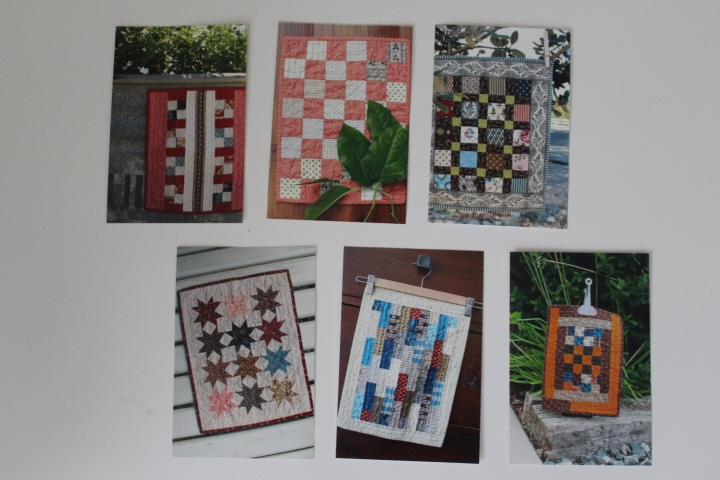
David said in my ear, "You should go into the house, there's more stuff in there," adding, bless him, "here's another bag." He must have seen the look on my face. It was becoming clear to me that the lady was not a hoarder in the psychological-disorder definition, hanging on to things because they're there, essentially, but that she amassed things because they were beautiful or fascinating, or because it's just so very easy to acquire kits faster than one can stitch them. She must have sewed a lot of things herself, but she also collected antique quilts and blocks, as a number of the zip bags had prices on them. There was a box entirely full of miniature-quilt kits from Temecula Quilt Co. (addressed to Betty, so now I knew her name, already thinking of her as something of a kindred spirit), a subscription that she had taken five or six years ago and then presumably not had time, or perhaps the energy, to make up. I chose six of them, the ones I thought most likely that I would want to make — I don't know that I would have much use for miniature quilts, but who knows? maybe they could make a big "sampler" quilt. Each kit comes with a photo of what the finished piece will look like — I love the stars one —
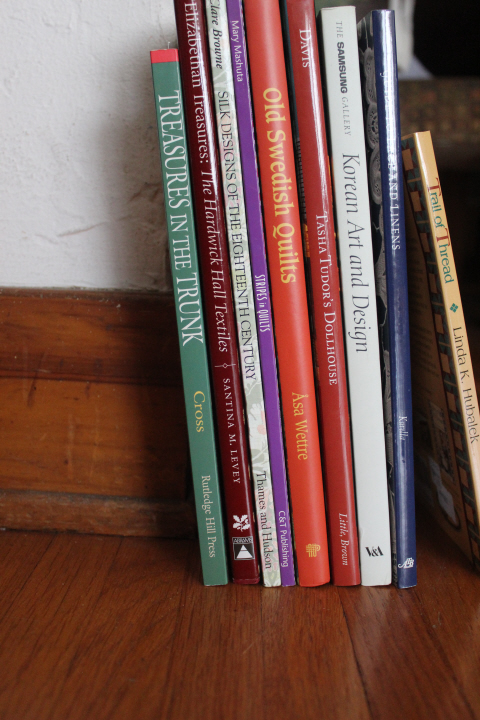
There were piles of books everywhere, higgledy-piggledy, falling over, stuffed into boxes of fabric, that made my librarian's heart wrench. New books, most of them! Betty obviously had a deep interest in antique quilts, including a sideline specifically of the Oregon Trail and its pioneers' quilts — I put one of those in my bag — but she was also curious about lace and other needlework. The Korean one was a long-shot, in case Laura's interest in Korean culture extended to art and design, but the others are obviously some of my interests. It got to the point where I was gently sliding them into my bag with a kind of gobsmacked astonishment — "Elizabethan treasures" from Hardwick Hall! Tasha Tudor's Dollhouse! Old Swedish Quilts!
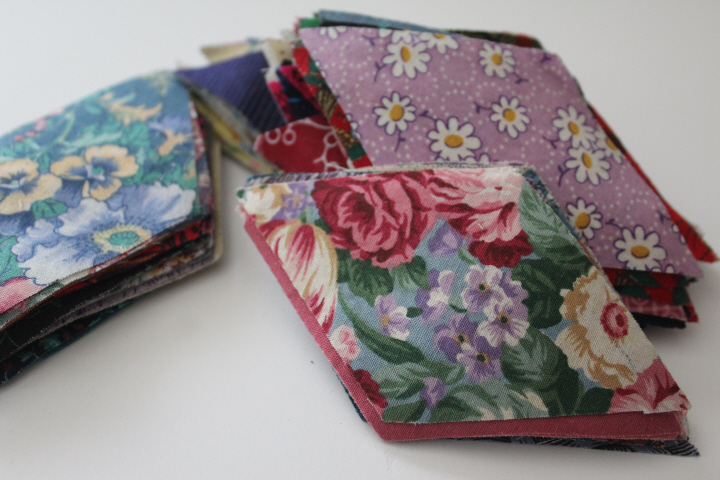
Diamonds, ready to piece into English-style patchwork. Not long ago, browsing through my copy of The Quilts of Lucy Boston (as one does), I suddenly fell in love with her quilt now called "Kate's Stars," six diamonds placed together to form a star —
I've often had the feeling, at an estate sale, of poignancy at the thought of someone's things being sold off after her death, and yet at the same time a sense of wonder and luck at finding them myself, and this was just like that. I think I would have liked Betty, and admired her taste and the wideness of her interests in the field of textiles and the history thereof (and understood her compulsion to collect!). I certainly am grateful that I've come to know her, another of the makers before me, if only just a little and through some of the things that fascinated her.


 A Bluestocking Knits
Leave a comment