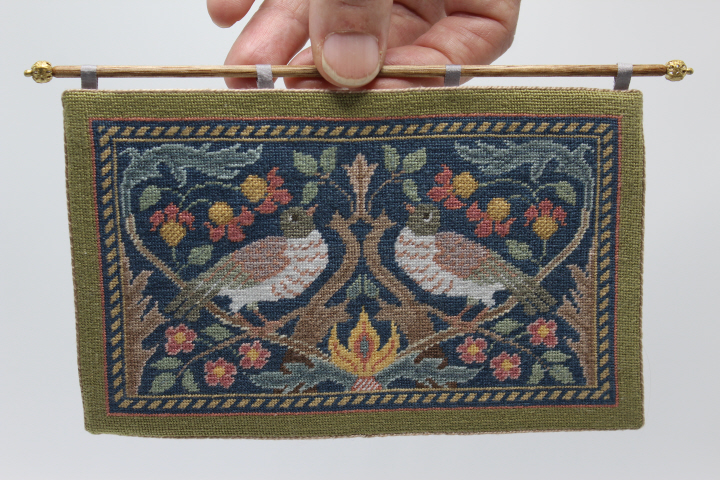
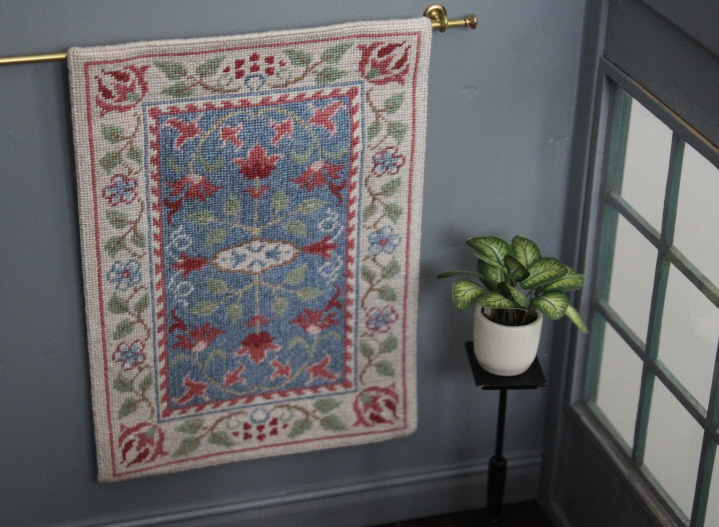
The moment I saw this Sue Bakker petitpoint chart, I wanted to stitch it. I love its Arts & Crafts naïveté, the profusion of flowers and leaves against the simple rope border, the softly-faded colors — it just speaks to me. Bakker says it can be a wall-hanging or a carpet, but it didn't seem quite right to me to put it on the floor — not so much the idea of walking on it, I think, but that you just get a different perspective when a piece is on the floor than when it is on the wall — so wall-hanging it would be.
For me, Bakker's charts have become a matter not of "are there going to be challenges?" but "what are the challenges going to be, and where the dickens are they?" The Anchor 676 on the chart does not appear on current Anchor color cards, and it was only by happenstance that I came across a website that offered the substitution "A676 = DMC 452". But Bakker calls it "green" — it appears on the birds' wings — whereas what I found in my hand was this —

which takes a very considerable leap of the imagination to call "green" — oh, well. I tweaked a few things here and there, rearranging the colors on the birds and using a lighter shade of the dark blue for the background. I like the really deep border on the original, but didn't do quite as many rows on mine, as it's already a bit larger-than-life for 1:12 scale and I didn't want to push my luck.
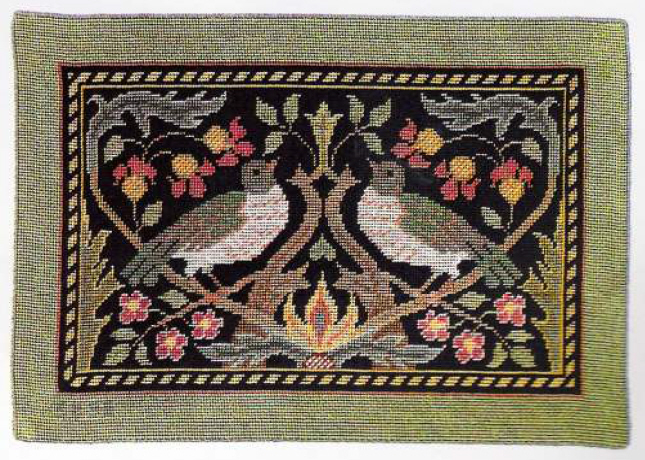 Never mind — I love the design, and those swirly leaves in the top corners give me a thrill every time I look at them. Morris used birds quite often in his designs. Here is a detail from the popular "Strawberry Thief" pattern —
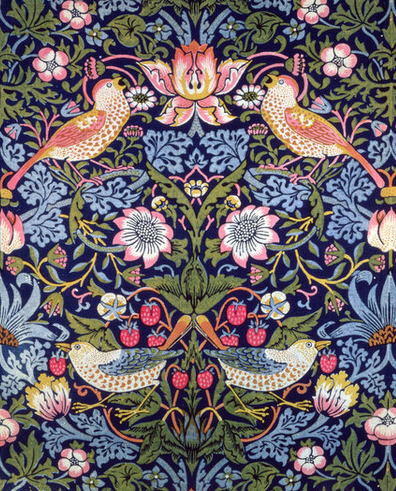
which is certainly a cousin of Bakker's design.
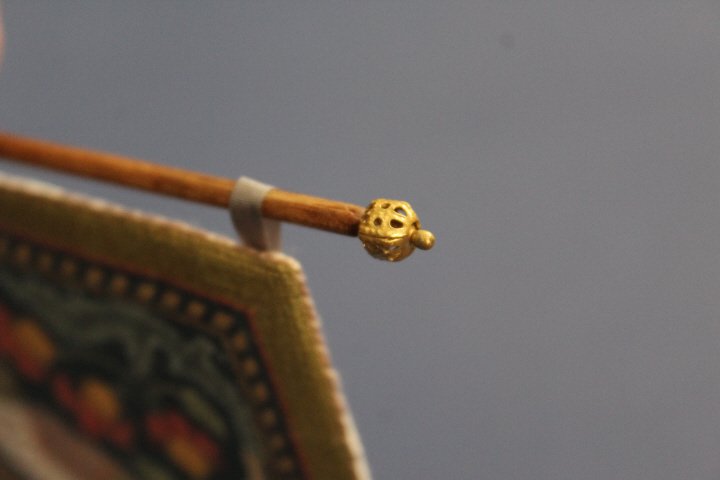
I made the hanging rod from a slender dowel that came in a package from the crafts store — it isn't bass wood, that I can tell, but something with a lovely color and grain, which came out beautifully with a bit of beeswax and linseed oil finish. The finial is a filigree bead attached with a sewing pin that has an unusually ovoid head — they come in the shirts that David likes from Penney's! — and once assembled, I painted the finials with gold paint to tone the bead down a little and make the silvery pin match. The hanging loops are silk ribbon.
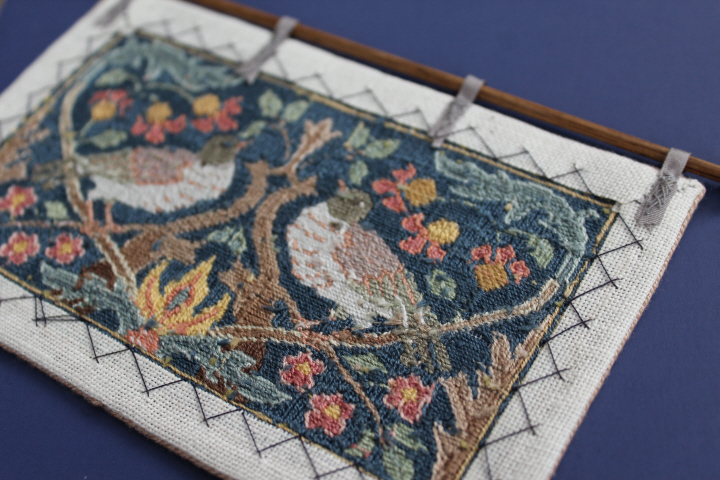
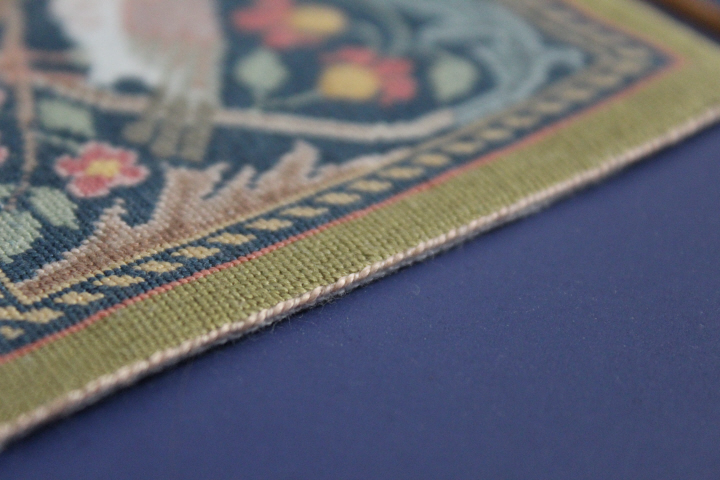
I actually finished the stitching on this quite some months ago, and dithered for a very long time about how to finish the edges, as my usual carpet edgings seemed just … carpet-y. I was tempted to just fold the edges over and tack them down at the back, and then impulsively decided to do the same thing I did with my first petit-point cushion, and couch a length of perle cotton around the edge. The color doesn't "match," but sort of "co-ordinates," and it was on hand. Despite that, I'm very pleased with the way it all turned out.
The title of this post is the first line of a song from 1530 or thereabouts — I know the poem from Benjamin Britten's "Ceremony of Carols" and it seemed quite appropriate here, with all of the little birdies!
My hope for the 1:12 carpet shop was to attach the carpets to the display rods in such a way that they would hang as realistically as possible but still be removable if I later wanted to use a particular carpet in another setting. (Because of course when you want a miniature carpet, you get one from the miniature carpet shop ….) Luckily for me, what I had thought would probably work did, and on the first try.
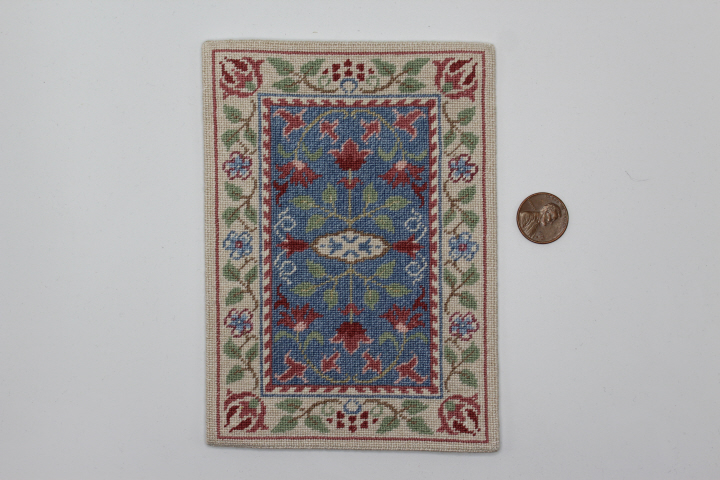
One of the members on the Petitpointers list proposed a Sue Bakker Challenge recently, to work a design by her, since there is such an abundance published in miniatures magazines and so fairly readily available — and they are charming! — so it is really more of a Celebration or Appreciation than a Challenge, but there it is! I chose this one since it was new to me. Bakker clearly has an affection for William Morris's style, as it is one of her many Morris or Morris-esque designs. This chart is from a long-ago Miniature Needlework Society newsletter, based on a carpet by John Henry Dearle who designed for Morris & Co., and is called "Carnation". I worked mine on 28-count Monaco linen with two strands of DMC floss, some blended, and I lightened one strand of each color except for the mid-pink to get a slightly "faded" look (the contrast between 523 "Shell Pink Light" and the next-lighter shade was a little too much for the effect I wanted).
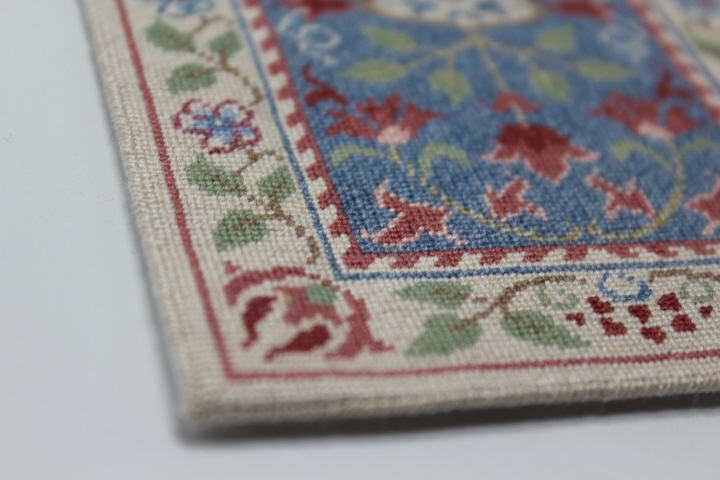
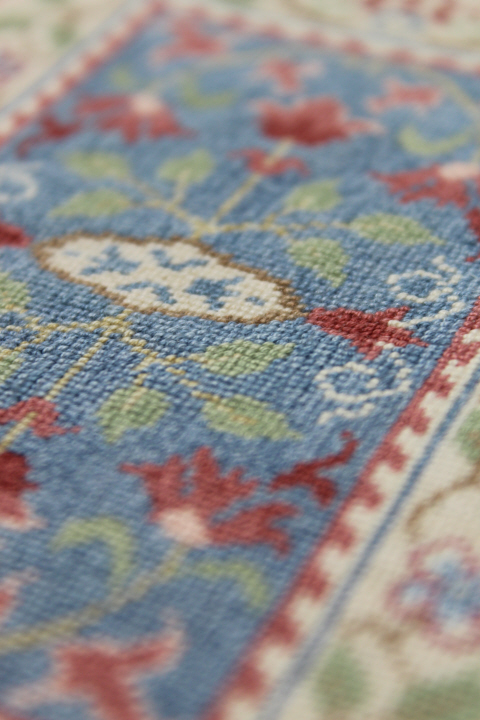
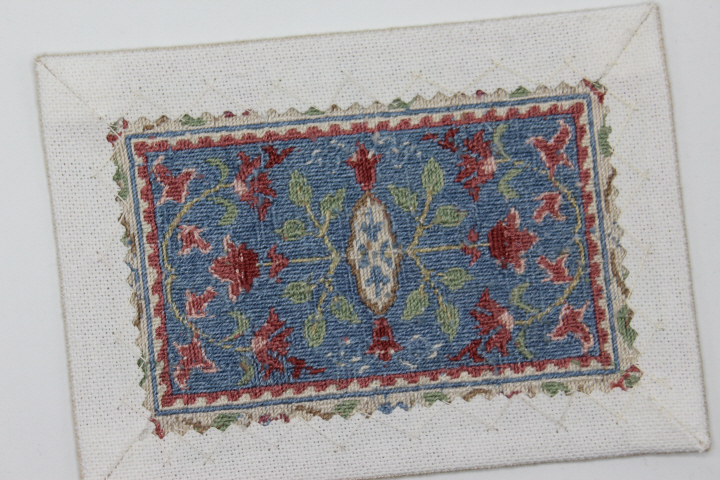
Despite Bakker's repeated admonitions to work petit point carpets in half-cross stitch to prevent distortion of the canvas from the tension of the stitches, I've come to suspect that — for me, at any rate — I have pretty much the same amount of tweak (that is, the finished-but-unblocked piece being a parallelogram instead of a rectangle) whether I use half-cross or continental stitch, and so here I used continental. It takes more thread, certainly, because of the longer, diagonal leg of each continental stitch on the back of the work as compared to the straight leg of half-cross, but on this kind of canvas at least, I find it so much easier to secure the beginnings and ends of threads under continental stitch that I feel more pleased with my work both while I'm stitching and afterwards, and that is all the persuasion I need. Different fibers and different canvases may require different stitches, though, certainly!
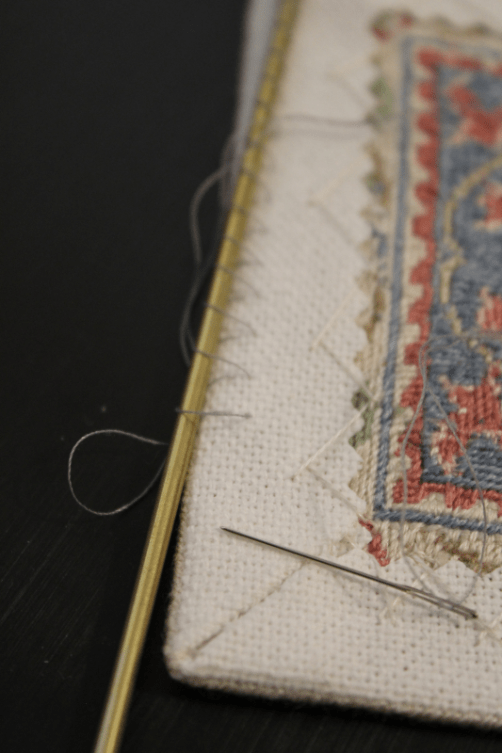
And so to hang this carpet on its display rod, I just whip-stitched around the rod and through a few rows of canvas on the back of the carpet. I had thought that I would use invisible thread, and I actually went to my thread box to get it, but I dislike hand-sewing with the stuff so much that I came away with a neutral grey thread instead. It took less securing to hold together than I expected, which is good news! I cut a much-longer length of thread than I would need, so that I could leave the loops loose enough to move the rod out of the way in order to see what I was doing, which was very helpful. I also made the stitches into the canvas fairly short, so that with luck the carpet wouldn't droop or sag — here the stitches in the canvas are two strands tall, where the rod covers about twice that. Since this particular rod is on a side wall of the room box, I started and stopped the whip stitches about 1/2" (15mm) from the edge so that they wouldn't show when viewed end-on.
The main uncertainties were that the carpet would be too heavy for the rod (which is fairly flexible), and/or that its weight would cause the whip stitches to slip towards the underside of the rod and make an unrealistic-looking inwards "dent" at the top of the carpet. But neither has proved to be the case, and the carpet is hanging fairly successfully, I think!


 A Bluestocking Knits
Leave a comment