"Second June. Spend the morning lying in a deck chair in the garden pretending to knit. How glorious to have nothing to do!"
Mrs. Tim of the Regiment always seems to me like the "first" D.E. Stevenson novel, though it was neither the first one she published nor the first one I read. But it is so indelibly and characteristically Stevenson that it is difficult not to think of it as such. As it happens, this "diary of a officer's wife" was actually based on Stevenson's own, so that I'm sure we can take much of Hester Christie's character and sense of humor as very like Stevenson's own as well. Mrs. Tim's diary — there are four books, spanning the early 1930s to the early 1950s — are rather like the Provincial Lady's, whom Jilly Cooper calls "gentle, disaster-prone, yet curiously dry-witted," though probably less of the last two than the Provincial Lady's, especially if you read the P.L.'s humor as more often than not verging on the satirical. Mrs. Tim, though an army wife and therefore subject to the whims of the Service, has many of the same things to deal with as the Provincial Lady, being of a similar age and situation — running a household, raising children, managing servants and an occasionally obtuse husband, and observing the quirks of those around her — which last Mrs. Tim for the most part enjoys, I think in a warmer manner than Delafield's heroine. That, I think, is one of Stevenson's salient characteristics, and Mrs. Tim's humor and good-nature I think keep her from seeming to us as caustic and near to the razor's edge as the Provincial Lady occasionally can. Mrs. Tim seems to enjoy life much more than her contemporary. One of the chief delights of both, however, is that wonderfully English — British, I must say, for Stevenson was a Scot — understated self-deprecation.
"I've heard a lot about Mrs. Christie from some friends of hers staying at the hotel — Mr. and Mrs. McTurk," [says Mr. Baker to Mrs. Loudon.]
I try to explain that I don't know them very well, but Mr. Baker does not listen. "Very nice friends to have, Mrs. Christie, especially the lady. She's always saying how sorry she is at you leaving Kiltwinkle. It must be a bit trying for a lady like you not to have a settled home of your own, isn't it now?"
This statement is often made to me, and it always annoys me, chiefly, I think, because it is true. But some time ago I found a quotation which seemed to meet the case, and I always make use of it on these occasions.
"'To a resolved mind his home is everywhere,'" I reply sententiously.
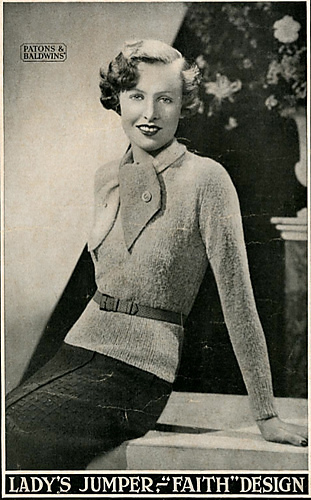
For my virtual D.E Stevenson Knitalong, I couldn't decide between two patterns from "Patons Specialty Knitting Book No.33" by Patons Australia, the "Faith" jumper, above, originally in blue bouclé with one of the ties in a contrasting grey, or
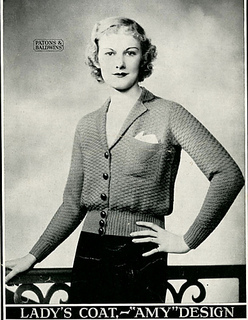
the "Amy" originally in Paton's Rose wool (a fingering weight) in "Kenya Red" — I wonder what shade that is?! Interesting that we would certainly call that a cardigan now, where in the early 1930s or so when this came out it was a "coat" — there are three other front-buttoning garments in this particular book, two of which are called coats and one which is, strangely, called a "jumper-cardigan" though it clearly has two front pieces buttoning up in the middle. They both seem very "Mrs. Tim" to me — sensible, not too frivolous or youthful but still not at all dowdy (the frivolity would come with the hat, no doubt!), practical yet appealing.
(This Paton's book is indexed at Ravelry, though the patterns are not available there; the entire booklet has been scanned and is available here courtesy Bex of Subversive Femme.)
Actually, I'm strongly tempted to knit one or both of these!


 A Bluestocking Knits
Leave a comment